David Williams's Blog, page 42
January 29, 2019
The State of the Union

The recent government shutdown did only one good thing.
It didn't move America any closer to resolving our challenges. Not even a little bit. Not even an iota. All that stress, all that fear inflicted on millions of American workers, for what? Nothing. It was colossally, impossibly foolish, yet another display of political malpractice on the part of a "dealmaker" who has no idea how to be the leader of a republic.
But there was that one good thing came of it: the State of the Union was delayed. Ideally, it would have been delayed for...well...ever. But we takes what we can gets.
And it's not just because listening to a semi-illiterate compulsively mendacious serial adulterer clumsily deliver words that have been written down for him is painful, though it surely is. Sniff. Sniff.
It's because the State of the Union is utterly unworthy of our time. It's a pointless, empty, useless ritual, one that doesn't even feel American.
It's been well over a decade since I've watched the entirety of one. I stopped early in Dubya's tenure, because as genial as he may be as a person, he isn't exactly a Shakespearian orator. I listened to about ten minutes of Obama's first attempt, and then gave up, because it was just as terrible.
We all know why. I mean, sweet Lord Jesus, we all know. The endless interruptions for applause, which resonate with all of the authenticity of the Party rising before Stalin in those old Soviet speeches. The "guests" who are carted out like props, to which there's more applause? The regurgitation of obvious and painfully familiar talking points?
It's stale and empty and false, and that stale, empty falseness just goes on and on and on like a circle of Dante's hell.
As it exists now, it serves our nation poorly. It tells us nothing we need to know. More importantly, in the hands of a president whose primary skillset is fomenting division, dissent, and disruption? It has no chance of uniting a nation in common purpose.
Unless you're a journalist and getting paid to endure it, there is no earthly reason to watch it.


January 21, 2019
Eight Conservative Thoughts

1) Individuality and personhood are more important than systems, labels and categories.
The good and just society, wherever it has tried to rise, has been based on the rights of human persons. Respecting an individual's freedom of conscience, speech, and religion (or absence thereof) is absolutely vital to the well being of culture. This has always been true.
Preserving the rights of the individual against the oppressions of national, ethnic, or religious assumptions is and has always been the struggle of liberalism.
But in the progressive world these days, the individual is not the unit of analysis. Individuals are agglomerations of intersecting categories, representative of systems and structures, and their unique personhood becomes secondary.
I'm just not there. Nor do I wish to be there.
I am, therefore, conservative.
2) Grace is a higher purpose than Justice.
Justice is a fundamental biblical virtue, and the essence of good governance since Hammurabi. No culture that sneers at or rejects justice can stand.
But I am a Christian. Jesus defines my existence, and though I struggle daily to live into his teachings, I acknowledge him as the source of all authority in my life. From that basis, I can do no wholistic assessment of my faith that comes to the conclusion that justice is the ultimate goal, purpose, or method of Jesus. That purpose, the teleological core of the faith?
It's grace.
What matters is not the quest for perfect balance, for being sure that every wrong is exactly and perfectly righted. That's not our task.
Grace is the soil from which justice springs. It is the light that give growth to justice. Radical agape-love grace is both the essence of the the faith and the nature of God.
And it does not work the other way around. In that, I'll freely admit to being convinced by Augustine, who...though he was an African man...isn't really well received in non-conservative circles.
I am, therefore, conservative.
3) The Good is a universal, not culturally subjective or personally relative.
As a person of faith, I don't understand the good as culturally mediated. Cultures and societies all struggle towards the Good. Sometimes, they get closer than others. More often than not, they yield to the siren song of power.
But the Good exists, extrinsic to all of our human striving. It is not socially constructed, but something deeper, something more fundamental, something more essential. It does not depend on us, on our meat-monkey grasping and peculiar collective solipsisms.
And sure, sure, it's a transcendent mystery, one towards which we must always journey.
And yeas, it's of such mind-warping immensity that it tends to fill our souls with the kind of mortal terror that usually only appears in H.P. Lovecraft novels.
And yeah, I know, that's also almost neoPlatonic. Seriously old way of thinking. Technically, it's because I'm mystic, drawing my sense of truth from that deep wellspring of the divine that speaks out of every single faith tradition in human history.
I am not willing to let that go.
But that's what conservatives do. We hold on to the good.
4) Deconstruction sabotages progress.
Deconstruction is the method of progressives these days, and there's an irony in that. Because progress implies growth. It implies improvement. It implies movement towards a better future.
And deconstruction, as a methodology? It can be useful, if used judiciously and wisely. You cannot make room for the new if you do not take some things apart. You cannot step away from dark paths in your life unless you take apart those aspects of yourself that hunger for them.
If your eye offends you, as my Rabbi once said.
But unfettered and unbounded, deconstruction does none of those things. It is nothing more than endless defenestration, as one assumption after another is smashed, and one edifice after another is torn down. It burns it all down, always.
Nothing can give joy. Nothing is ever right. Everything is unworthy.
I mean, that's all that the howling mobverse of #twitter does. Never was a communications medium so perfectly designed for the pharisee in all of us.
And a worldview that allows nothing to stand has no foundation upon which to build. It leaves us with nothing but the churning, aimless chaos of self-annihilation, an unformed yawp of no-thingness instead of purpose and hope.
Again, I see no purpose in that, because it has no purpose.
5) Science has limits
I love science. I do, and I always have. Our striving for the stars and our opening up of the fundamental physics of being is a wonder. I'm right there with Carl Sagan, goggling at the billions and billions of stars. Even on our fevered, changing world, there is so much beauty and intricacy. It's a marvel.
But there are boundaries that we seem willing to cross in the name of "science" that trouble my soul. Because I see human beings as having souls, which, given my profession, is unsurprising.
When I hear talk of how young people can't really make effective choices because their brains are still developing, I shudder a little bit, because that makes them less of a person and more of a "process." When I hear a parent's love for a child or lover's delight in one another reduced to neurobiology and evolved patterns of response, I similarly balk.
Do not tell me that I love a doggo floof because of any reason other than that it is a doggo floof. Seriously. Back off, science. You're adding nothing to this moment.
There may be truth in those insights, but it is an immaterial truth, a truth that misses the point of human existence in a fundamental way. It doesn't deepen us, or grow us. It just teaches us to view one another as flesh automata, and that is a terrible, terrible path for humankind.
We've walked that way before as a species, during the last century. It does dark and horrid things.
6) Friends are better than allies.
The language of progressivism talks about being an "ally." Be a good ally, they say. But that's all about power dynamics, about the actualization of self or collective interest as it "intersects" with the power interest of others.
Allyship falls away when interests diverge, or where disagreement arises. In the zero sum game of the #twoke short attention span activism that defines our poisonous online life, it's become nearly impossible to disagree without it becoming about Not Being an Ally.
Friends don't think that way. Friends don't care about power dynamics. They just love you like you're their own flesh and blood. They are as close to you as your own soul.
You can be completely yourself and unafraid with a friend. This is not true with an ally.
Among the wisest of the secular ancients, that's why friendship was considered among the highest of the virtues. Philia, that natural and volitional affinity, was a relationship of complete, freely given trust between one person and another. Being an ally is a more sterile, formalistic, and self-interested form of relation, one in which lists of rules and trigger-avoidance-protocols define a carefully negotiated exchange.
And as one who follows the Nazarene as their Teacher in all things, the term "ally" sounds with a peculiar dissonance against the radical command to both love and friendship. "A greater love has no-one than this," says Jesus, as he swore his life to his friends. Not his "allies." The Greek word for "ally" does not appear in any of the teachings of Jesus, nor does it occur in any of the Epistles.
It's also challenging, honestly, to integrate the conflict-assumption of the "ally" concept into the radical agape ethic taught by the Nazarene. Sure, one can have enemies, those ruled by brokenness and the injustices created by our hunger for power.
But the idea that your calling in existence is to go to war with those who your allies war with? It stands in tension with the most fundamental ethic of Christian faith. It is difficult to be authentically Christian and part of that form of binary relation.
And so, being conservative, I am not.
7) Marginality is not inherently normative.
My Teacher loved people who were marginalized. I do too. When power presses you down, and dehumanizes you, Jesus is there.
But just because you're on the margins doesn't mean you understand the whole picture. Marginality conveys no inherent moral benefit. It is a morally neutral state. You can be marginal for a reason. You can have internalized a pattern of thinking or lifeway that is less healthy and/or less lifegiving than others.
There are margins that lead us deeper into madness or farther into hatred. There are margins that make us more selfish, or that pull us apart as cultures.
It isn't always the "leading edge," in the peculiar consultant speak of my left-leaning denomination.
Sometimes, unless we have the wisdom to know otherwise, the margin is nothing more than a precipice.
8) Cultural identity is fluid and ever changing.
It's that melting pot thing, that old stodgy Schoolhouse Rock saying about the nature of the American republic...and, writ larger, a globalist view of humanity.
The Left sees the melting pot as an enemy of social identity, as a part of an oppressive system that strips away culture. "Erasure" is the image, which indeed it does, vanishing the clean boundaries that establish discrete racial and ethnic identity, and that makes it dangerous. If the deliniation between white and POCs ceases to be meaningful, if race and culture blend and shift and fold into one another, maintaining rigidly distinct identity groups becomes impossible. Barack Obama, for example, ceases to be cleanly "black," and is suddenly something more complex.
And something more real.
That is a place where racism dies.
But reality and ideology mix poorly.
I see the melting pot as both more vibrant, more transformative, and more representative of how human anthropology and social dynamics have always worked. Cultures shift and change in relation to one another.
Again, this is also how love works, in the most Jesusy sense of that word.
There's that.
January 1, 2019
The Spiderverse and Multiversality
 Whenever I encounter a film that's gotten nearly universally great reviews, well, I inherently don't trust it. I've been burned too many times, walking into a theater with great expectations and leaving disappointed.
So when, after much family discussion, we went to see the recent Spiderman/Spiderverse flick? I'd prepared myself to be disappointed, to find it tedious and by the numbers, talking it down in my mind until, well, I had low expectations.
This proved to be completely unnecessary. It was an utterly entertaining film, a live action graphic novel of the best sort. Wonderful art style, excellent primary character voice acting, and a decent plot? It was a delight.
I particularly enjoyed it because it toyed about with what is now a deeply familiar theme in comic book movies and postmodern narratives generally: the multiverse. The parallel universes concept isn't just a convenient conceit for storytellers: it's got cosmological legs.
Which brings me to one of the minor non-spoilery weakness in the film: character development. As the various iterations of Spiderman are introduced, there's really only character development for three of them. The other three are by necessity supporting cast members. The viewer only gets loose character sketches of them in the movie, and most of their development is as broad-swath comic relief.
If it's a weakness, it's a necessary one.
In a film where a functionally infinite number of Spider-people can exist, we can only focus on so many of them before we'd get overwhelmed. We have to choose which narratives to engage, because if we don't, we'd be lost. There'd be nothing to ground us, nothing to give a sense of continuity, just churn and chaos as we lose ourselves in a fractal vortex of variant, dissonant plotlines.
As one of the few Jesus folk who've bothered to take the actual multiverse we inhabit seriously, this is one of the core moral and ethical problems in our reality. We face a functionally infinite array of moral demands and possible ends. Every choice leads us down a variant path, each of which is just as real and valid as any other. If we make the mistake of thinking too much about it, it's dizzying to the point of madness. It cannot be integrated by human-scale intelligence, nor can the tensions between the infinitely variant paths be resolved.
Even within the timeline of our single universe, we struggle with this. To cohere as integrated beings, we must choose in ways that create a viable self-narrative. We have to orient ourselves towards something that gives us purpose, that defines us...or we fall into anxious dissonance.
December 8, 2018
The Sentinelese and Jesus
 We've moved on, now, because things are only relevant for a few moments in our low-attention-span culture.
Yet today I found myself reflecting again on the death of John Allen Chau, an evangelical missionary who attempted to bring the message of Jesus to a notoriously violent tribe on an isolated island in the Sentinel island chain.
He was killed, of course, because that's what that Sentinelese tribe does to anyone who steps on their shores.
Was he naive and foolish? Perhaps. You can't convey anything to a people if you don't speak their language. If you know that, and still go? Sigh.
Do I share the theological assumptions that drove his obsessive pursuit of this people? Not entirely. I'm sure he fretted that their souls would be lost forever if they didn't hear the Gospel and take Jesus Christ as their Lord and Savior. That terror for the souls of unbelievers has been around for quite a while, inculcated into evangelicals at an early age.
But I found myself struggling more deeply with the response of some progressive Christians to his death. There was clucking and shaming...on #twitter, of course, because that's what that medium does to our souls. There was this odd willingness to condemn Chau for...for what?
For trying to share the Gospel, because colonialism racism indigenous peoples something something. There were folks going so far as to describe him as manifesting a "white supremacist Christianity," which is odd, given that Chau wasn't actually "white," not by any current variant of that pernicious, false category.
From the current ideological framework of the decadent American Left, though, he was in the wrong. But if you're a left-leaning Christian, there's going to be an inherent dissonance in your thinking on this one. Because, well, let's look at the Sentinelese for a moment. What do we know about them? Meaning, let's set aside the odd skew of ideology, and consider them.
We know that they're "indigenous," meaning they're from there, having migrated from Africa centuries ago.
We know they're socioculturally isolated, with a language that is functionally unknown.
We know that they are few in number, with perhaps no more than 200 total individuals, and possibly as few as 40. This means...after dozens of generations of isolation...that they are a genetically compromised population. They're inbred, and likely to become more so. Think about the locals in Deliverance. I mean, really. That's them.
We know absolutely nothing about their belief system, other than this:
Like the Deliverance locals, they murder outsiders. That's their response to the stranger and the Other. They murder them. They've killed local fishermen whose boats have failed. If you washed up on their shore after a plane crash, hungry and desperate with your clothes in tatters, they would murder you.
Chau was there to tell them about Jesus. That was his thing, and in the dwindling, dying wing of progressive Christianity, proselytizing is a bad thing. But...did the Sentinelese know that?
No. No they didn't.
They had absolutely no idea why John Allen Chau was there. They couldn't understand a word he was saying. They knew he was Other, and so they killed him.
Herein lies the tension that seems oddly unaddressed by those Christians who wish to posthumously scold Chau. If you believe that colonialism racism indigenous peoples something something gives a people the right to murder strangers, then that belief lies in tension with your claim to be a disciple of Jesus of Nazareth. Such a community is not "good," not if "good" is understood in Christian moral terms.
Let's set aside the "getting saved" angle for a moment.
From what Christian ethical basis is the slaughter of the Other permissible? Where, in the Gospels or Epistles, is permission given to attack and kill the stranger?
There are such texts, certainly. You can go to the Deuteronomic histories, or to some of the more challenging scriptures in Torah. You can make the case that the Zealots made, or that Ezra made when he demanded that foreigners be cast out so that the people could be pureblooded. But is that where you wish to be?
The challenge, for the Christian Left, is this: there is nothing about the Sentinelese response to the Chau that jibes with the Gospel. Nothing. It's a fundamental Matthew 25 violation. It was "tribal" in the worst way, insular and violent and brutal.
Does such a community have no need of the teachings of Jesus? What about their cultural/ethical response to the stranger is inherently worth preserving?
It's as radically wrong and as in need of the Way of Jesus as, say, refusing to allow a shipload of Jews seeking refuge from the Nazis to land on your shores. Or teargassing asylum seekers at the border.
Such an odd, odd dissonance.
December 7, 2018
How I Learned to Love the "Vengeful Old Testament God"

For over a month now, I've been leading the Adult Education class of my wee kirk on a long, careful reading through the Psalms, those ancient spiritual songs of the Hebrew people. Though we typically read one each week in our liturgy, it's rare that we stop and savor them, and it's been a remarkably interesting journey.
Part of the reason it's been so fascinating is the wild shifts in voice and tonality that comes from this millennia-spanning collection of sacred lyrics. The Book of Psalms speaks from so many different contexts. You've got personal anguish. You've got pride in the power of the monarch. You've got pride in the inherent blessedness of a nation. You've got wisdom. You've got woe. You've got celebrations of creation, and wedding marches.
And intermixed in there, you've got a whole bunch of songs calling on God to kick in the teeth of those who oppose us. My class has particularly struggled with these, as have I.
Generally, the spiritual read we get from those texts is...nothing. They feel more than a little brutish, more than a little petty, pulling the Creator of the Universe down to the level of our endless human squabbles. It's easy, as one reads, to simply attribute such things to what is often described as the "Vengeful Old Testament God," which is to be distinguished from what theologians call the "Sparklefairy Wuv New Testament God."
I've never been comfortable with this distinction. First, it diminishes Judaism, whitewashing the fundamental interconnection between the Torah, Prophets, and Writings and the person of Jesus. This is just not kosher, so to speak. Second, it assumes the Gospels and Epistles contain within them no smiting or wrath, which just ain't true. Spend thirty seconds in the Book of Revelation, and you just can't miss that. And if we're honest about the Parables of Jesus, well, they ain't exactly My Little Pony videos.
Where the Psalms start talking about personal or sociopolitical violence, it has always felt, to be honest, more like projection on the part of various Psalmists, as personal ambition or national pride has infected their view of the I Am That I Am.
This last Sunday, we went to wrath again, as we read the 94th Psalm. It starts right in with the vengeance. "O Lord, you God of Vengeance," it begins, and we all rolled our eyes. But then we read on. It was...different.
Meaning, for the first time in a Psalm mostly about smiting, I was right there with the Psalmist. Sure, the Ninety Fourth Psalm calls out for God to be vengeful, to wipe the wicked from the earth, but there were two key distinctives.
 First, this is a Psalm that rises from a more universal framework. It's not calling for God to be the god of a particular nation. The God hat is invoked is not the judge of just one people, but of all the earth and all nations. All of the Psalms that sing most brightly seem to share this characteristic, as the earth itself rises to bear witness to the One that is greater than any person or nation.
Second, the Psalm is expansive in its understanding of justice. Sure, the Psalmist wants things to turn out well for them. But their interest goes deeper than transactional selfishness. They care about the damage done by corrupt, self-interested leaders, and the impact they have on the most vulnerable in their culture. What matters is that justice be done...not simply justice for "us" or justice for "me," but justice for all, with a particular focus on the poor and the oppressed.
It's the cry of the powerless for some measure of balance, for those who lie and manipulate and trample over others to be held to account for their deeds.
And for once, that call on God to not let that stand felt...good. It felt good.
November 28, 2018
I See It
 This year, we have all seen it.
We have watched North Carolina, battered by storm-driven rain, roads covered, highways closed. We watched Wilmington, cut off for days, as rivers rose and turned it into an inaccessible island. We looked to the Florida Lost Coast, as what was a small tropical storm blossomed into a nightmarish beast, and entire coastal towns were obliterated by winds and the sea. We saw record flooding in Texas, and states of emergency declared as the Midwest was overcome with rain. Saw the Arizona State Fair cancelled at the height of summer, because it was underwater.
We saw California burn, conflagrations that have no precedent, as terrified Americans fled firestorms that roared through entire communities. As they died in their homes. As they burned to death in their cars.
These are the things that we all saw on our screens. But there is a reality beyond what we see on our magic devil boxes.
If you live in the Washington DC are, which I do, you saw things that people elsewhere may not have seen.
Here in Washington, DC, we had a storm earlier this year. For two whole days, the wind howled, 45-50 miles an hour, with higher gusts. Trees were down everywhere. We lost power for a day, and some of my nearby family lost power for multiple days. The storm damaged roofs everywhere, tearing away siding, pulling shingles from subroofing. Our own roof was damaged, as hour after hour, the relentless howling wind slowly peeled the vent from our roof as I watched helplessly from our front yard. Many homes in our area weren't repaired yet weeks and months afterwards.
It was one of the fiercest storms I've ever seen in Washington, made peculiar by this: it involved not a single drop of rain. No thunder. No lightning. It was, during the day, partly sunny. Yet with winds that never, ever let up, leaving destruction in their wake.
We saw this, in Washington, this year.
Here in the suburbs of Washington, DC this year, I grew my a garden in my front yard. I grow greenbeans and kale and potatoes. I have blueberry bushes, which mostly feed the birds, and strawberries, which lately have been a favorite of the chipmunks. I've tried carrots, which have mostly not done anything at all.
I also seed-save my green beans, leaving pods on the healthiest plants, where they dry and provide me with next year's crop.
But this year, it rained. It rained endlessly, sometimes for a week straight. It is, in point of provable fact, going to be the single wettest year in recorded history in the Washington area. Roads have flooded, over and over again. The Potomac, overtopping its banks. Some towns in the DC area were obliterated by apocalyptic deluges. People died.
It rained so much that I lost the most of seeds I was saving, some to rot, but most of them to...seeding. There, in their pods, the seeds sprouted while still on the plant, the roots springing out from the still unfallen pods. I shared this with other gardeners, and they concurred. It was weird. Not normal. Wrong.
I saw this, in Washington DC, this year.
There were other things. We saw the trees, holding their leaves deep and late into a strangely delayed fall. Among the trees, the oaks were masting, wildly overproducing acorns, which they do when stressed. There were so many acorns in my back yard that they piled up in mounds.
These are the things you saw, if you lived in Washington DC and your eyes were open. They are signs.
There are so many signs, in fact, that you'd need to be the world's greatest fool not to see them.
November 5, 2018
How I Became a Conservative
 I've been coming to the realization slowly over the past few years, and it feels a little strange.
I mean, it does. It's weird. I'd always thought of myself as a little edgy, a little wild. I fought the Man, or at least wrote snarky blog posts about the Man. I was liberal. My friends were liberals and leftists and anarchists and progressives.
They still are.
But I am kind of conservative now. I mean, I am. It's how I feel. It's an odd thing, but I can't resist it. While I still share significant common cause with my more earnestly prog comrades, I no longer fully inhabit that realm.
It's probably because I am no longer young. I no longer inhabit that place where I'm the prime demographic. That, and I tend to creak and ache most mornings.
My wife notes it, as I gradually become more curmudgeonly. "Honey, you really don't need to yell at those kids on our lawn," she'll say. "But those are squirrels, dear," I'll reply. "No, honey, those are kids. You really should get your eyes checked," she'll reply, for the hundredth exasperated time.
That conservatism manifests itself in a range of other ways beyond my nascent presbyopia. Like, for instance, I believe that individuality and personhood are more vital than systems, labels and categories. I refuse to relinquish the idea that grace is a higher purpose than justice, and that the Good is a universal, not culturally subjective or personally relative.
I'm not convinced that deconstruction and disruption are inherently good. I would rather have one true friend than a thousand "allies."
But two aspects of my conservatism seem most important as we roll into tomorrow's election.
First: I am a liberal.
It's an odd thing, a paradox, perhaps. How can a liberal be conservative? But it's my "lived experience." I am a liberal, with liberal perspectives. And the fact of my liberality makes me conservative. I think that all things should be considered, carefully, before leaping to judgement. I believe that bias in encounter with a new thing is unacceptable, and that we need to take and consider everything carefully and respectfully.
Not that I don't have opinions. Lord, do I. I also have a moral compass, one dictated by a deeply held faith.
But liberality has always meant leavening what you know with the possibility that the Other has something to offer. It does not mean "left wing," because there has never been any functional difference between the bolshevik and the brownshirt.
Neither is liberal. Neither is open to the soul and personhood of the Other.
And liberality seems a thing of the past in this era of social media hysterics, as our positions calcify and radicalize. We are driven to be loudest, to be shrillest, to be roaring and bullying and mocking. That's what gets the RTs and the likes and the shares. That's what starts the fights, and fights draw our attention, and attention means our blog can be monetized.
Circumspect and measured? Who wants that? Dull. Liberality has always been a little boring. And so it fades into the rearview mirror.
Being that it's a thing of the past, well, that's where I'm conservative.
I hold on to a liberal worldview, because it's a good that should never have been lost, and that can't be forgotten if our republic is to stand.
Second: The current POTUS and his regime.
I do not use his name, not typically. It seems to play into his brand, and his hegemonic black-hole ego-vortex ever-presence in media. I never speak it in my sanctuary, because it would profane a sacred space.
But I can say this: Donald J. Trump has made me conservative.
Conservatism, after all, is holding on to the good. Particularly the good that is threatened by misbegotten change. Conservatism's best spirit sees where a culture has wandered from the story of its God-dreamed best self, and points the way back to that path.
I do not want the crass, false, boorish and bullying America that this presidency represents. It bears no resemblance to the best graces of a nation I deeply love.
Donald J. Trump is a mark of America's decadence, and of our moral decay as a people.
I mean, sweet Mary and Joseph, look at him. Let the scales drop from your eyes, and look at him.
See his story, crude and grasping and lascivious. He shamelessly appeals to a leprous racial blight in the American soul, a sweet dark creamy rot in our national flesh that we've never fully excised. He has no vision, no imagination, offering nothing but japing lies, transparent hucksterism, and brassy cruelty.
I want none of that.
Because I am conservative.
And tomorrow, I'll be voting that way.
November 3, 2018
The Common Ground
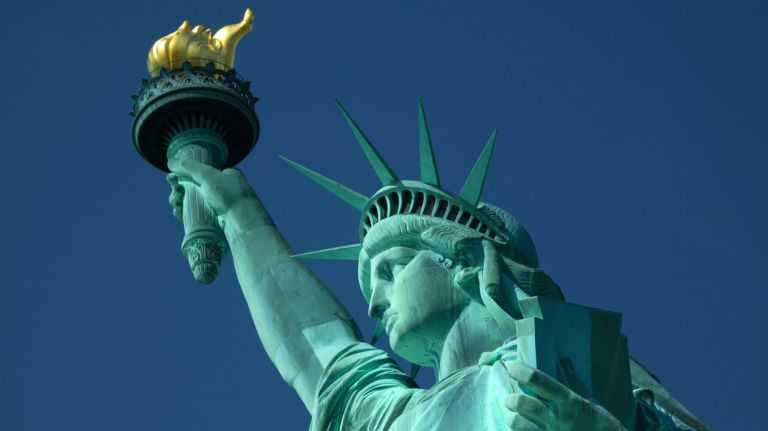 There is no point in seeking common ground, or so I hear said these days, by those who despair of our public discourse. The assumption, in those statements, is that seeking common ground is what weak and mealy-souled people do. You can't possibly find common ground with *them,* they say, from a heart of disturbed rage. It is possible that this is so, although it has not always been.
Have we, as a people, reached the point where what once made America worthy and universal is now something worthy of disputation? Where even the most essential things are now seen as something we won't accept?
I will offer you, American, a sample piece of common ground. There are many emblems and symbols that mark our greatness as a republic, and this is one of them. It's a poem. I love this poem, because it's speaks to the heart of our difference and goodness as a nation. It is a proud poem.
Not like the brazen giant of Greek fame,With conquering limbs astride from land to land;Here at our sea-washed, sunset gates shall standA mighty woman with a torch, whose flameIs the imprisoned lightning, and her nameMother of Exiles. From her beacon-handGlows world-wide welcome; her mild eyes commandThe air-bridged harbor that twin cities frame.“Keep, ancient lands, your storied pomp!” cries sheWith silent lips. “Give me your tired, your poor,Your huddled masses yearning to breathe free,The wretched refuse of your teeming shore.Send these, the homeless, tempest-tost to me,I lift my lamp beside the golden door!”There. You've read it. Of course, you should know it already. It's "The New Colossus," by Emma Lazarus. It's the poem inscribed on the base of the Statue of Liberty. It represents, as does that statue, our national spirit, the best angel of our life together. A nation of welcome. A "shining city on a hill," as a president I cast my very first vote against once so clearly put it.
But how does it sound? Does it seem politically charged to you? Am I being "divisive" by quoting it right now?
The answer is, now, of course. Yes it does feel divisive. I feel it, too. These words read politically right now in American history, as an indictment of one political party's current anti-immigrant agenda. And yes, I know, you're not anti-immigrant. You just want them to follow the rules. Rules which, at the same time, you want changed to reduce the flow of immigration, because they're taking jobs from real Americans. So you're not anti immigrant. You just oppose immigration in every way, unless it's "the best people." Meaning, not hard working souls seeking freedom and escape from oppression. Just rich people, who already have power and freedom of movement.
This poem is written against your way of thinking. Which is why it may prick a little.
In fact, it may sting so much that you might even be fiercely Googling Emma Lazarus, trying to find reasons why she and her political agenda are suspect and unAmerican.
It would satisfying to do so, no doubt, to punch back against the thing that challenges you.
But then do not ask, or expect, me to seek common ground with you as an American, because that's not the common ground.
Here. Let's try something else. It's not a familiar text, although it is one that every American citizen needs to have read all the way through at least once. At a bare minimum, we should know the beginning of it, which establishes the fundamental principles of our lives together in this Republic. So. Here it is:
All persons born or naturalized in the United States and subject to the jurisdiction thereof, are citizens of the United States and of the State wherein they reside. No State shall make or enforce any law which shall abridge the privileges or immunities of citizens of the United States; nor shall any State deprive any person of life, liberty, or property, without due process of law; nor deny to any person within its jurisdiction the equal protection of the laws.This is not a regulation, a rule, or a policy. This is, of course, section one of the Fourteenth Amendment of the Constitution of the United States. It is the fundamental governing document of our great Republic.
Perhaps you do not like it. Or perhaps, from current context and your position on immigration, you'd like to be rid of it. The political process for fixing immigration is too hard, you might say, and it's too easy for people to claim citizenship. We need to change that!
There is a long history of such thinking, from people eager to preserve America for themselves, and to keep out the undesirables, the Wops (Criminals! Gangsters! Violent and Dangerous!) and the Micks (Illiterates! Drunks! So Violent! My Ancestors!) and so many others. I know you cannot possibly be such a person. My gracious, of course not. But still, you have been made to fear, and fear does not think.
There is a process, of course. The Founders, in their wisdom, put one into the Constitution itself:
The Congress, whenever two thirds of both houses shall deem it necessary, shall propose amendments to this Constitution, or, on the application of the legislatures of two thirds of the several states, shall call a convention for proposing amendments, which, in either case, shall be valid to all intents and purposes, as part of this Constitution, when ratified by the legislatures of three fourths of the several states, or by conventions in three fourths thereof, as the one or the other mode of ratification may be proposed by the Congress; provided that no amendment which may be made prior to the year one thousand eight hundred and eight shall in any manner affect the first and fourth clauses in the ninth section of the first article; and that no state, without its consent, shall be deprived of its equal suffrage in the Senate.This is article Five of the Constitution of the United States of America, which lays out how that gets done. But that's too slow, you might say. We need someone to cut through all of that and do what needs to be done!
And there, perhaps we do have a problem.
If you view the Statue of Liberty as unAmerican, and you reject the Constitution as a means of mutual governance, then how can I, as a proud and patriotic American, be expected to find ground with you?
Is that my doing? Have I made that choice, by honoring and abiding by the Constitution and holding the great symbols of liberty dear?
Can we stand on common ground as Americans? I can answer that question for myself, with certainty. Yes. The common ground remains.
It is where I have chosen to stand. I will not move from it.
October 29, 2018
Secret Edict Seventeen

The knock came against the great oak door, once, then again. Not demanding, not a hammering, but precise and clear. A polite, clear request.
The old woman roused herself from a half slumber. A guest? But none was expected. Everything was such a mess. She was such a mess. She sighed, and spoke a word over her unbrushed and thinning hair. It sorted itself into a semblance of order as she heaved her old bones upright.
"Who is it," she said, just loudly enough that the door could hear.
"Director Hermione Granger-Weasley, of the Ministry of Magic," thrummed the door, officiously.
The woman's eyes brightened with pleasure.
"Well, let her in!"
The door complied with equal pleasure, opening in a single well oiled motion, proudly unsqueaking.
A trim and neatly dressed woman in early middle age entered, her all-business demeanor slightly subverted by a barely controlled storm of grey and chestnut hair.
"Minerva," she said, with a soft smile. She approached, and took the old woman's proffered hand as she struggled to rise. "It's been too long. And please, sit, sit."
McGonagall returned the smile, and eased herself back down into her chair. Hermione settled into onto the ottoman that had helpfully crawled up behind her. The retired professor clapped her hands gently, and whispered a word, and a tea service floated across the room, the tray heaped with jellied biscuits and magically fresh scones. A cup of perfect Earl Grey settled in on a side table.
"Would you care for some, my dear?"
"Yes, but not quite yet."
"Oh, Hermione. It has indeed been too long. How are you?" Her eyes leapt to Hermione's hair. "I mean, other than you all of a sudden going rather impressively grey."
Hermione gave a short snort at the familiar, friendly poke. "Things are well. And we shall talk, we shall, but..."
The old woman's lips pursed. "A business call, is it? Ministry business?"
"Only partially. But yes, yes it is."
McGonagall laughed. "Right to the point as always. I'd expect nothing less. We can talk pleasantries later, I suppose. And it's nice to know my old bones are still useful to the Ministry. You will stay for tea after, won't you? Gryffinsrest is lovely, but, well. One grows weary of being alone."
"Of course, Minerva. That's mostly why I'm here. For tea, and for you. But business before pleasure."
Before McGonagall could reply, Hermione continued. "I've been reviewing the Wizarding War Archives. Part of a larger research project, of course. The history I'm working on, you know, the one I mentioned the last time I was here. I came across something, well, something that you did while working with the Ministry when you were part of that effort. The files are incomplete, and it's...well...it's troubling me." An uncharacteristic hesitancy entered her voice. "I...it..."
"Well, out with it, my dear."
"What do you know about Secret Edict Seventeen? I'd always wondered, you know, why it was that everyone wouldn't speak his name during his initial rise. I mean, there was the fear, and I understood that. But it seemed too...neat. Too consistent. Too accepted as the way things needed to be. Must not be named? But why? Why did everyone just not say it, for so very long?
And then I stumbled across it in the archives, in the files of the Special Circumstance Team of the Ministry. SE17. Utterly secret, of course. Only two dozen wizards appear to even have known of its existence. The records, just fragments. Most of them destroyed."
The old woman's voice, a firm whisper. "SE17: Of Deepest Secret. A Semiotic Dweomer, Contramaleficent, Antidynamus, Silentium, Polis Pacebis."
"You helped write it?"
"Yes, my dear. Yes I did. That's why my name is on it."
"And Secret Edit Seventeen was the real reason none of us could bring ourselves to speak his name, not until Harry started doing it?"
"Indeed."
Hermione leaned in closer. "But why?"
"There came a point, my dear, when we realized that it was necessary. We had no choice."
"I'm not sure I'm following, Minerva."
"It was at the height of his rise, you know, before that moment when he failed to kill Harry. Before his curse rebounded and struck him down. He was everywhere. Every single page of the Daily Prophet, his name, his leering, confident face, his confident, lying words. And if it wasn't about some horrid thing he'd done or said, it was an earnest writer or commentator reflecting on it or lamenting it or in full fledged panic about it.
Even the Quibbler, my gracious, he was even there, mixed amongst all the delightful Lovegood silliness. His name, carried by every owl, spoken of in every tavern, souring the froth of a first year's first taste of butterbeer. His name, whispered and shouted and muttered until it was all you could think about. All you could dream about.
And with the endless repetition, there was the fear. It was palpable, that fear, among those of us who knew what he was and could become, and fear became the curse itself. Among the Death Eaters, the name was power, pure power. It affirmed them, told them they were important, sang to them a dark song, a song that tore at everything the Wizarding world was and had been, and put their hatred up in its place.
For months, my dear, months, it grew. Until, finally, some of us working with the Ministry realize that it was..."
Hermione settled back, her head nodding slowly.
"A spell. His name was a spell."
McGonagall's eyes twinkled behind the thick crystal depth of her lenses, a flicker of a prim smile on her thinning lips. "Precisely. Nice to see your years in Ministry bureaucracy haven't dulled your lovely mind, Hermione. His name itself was a subtle spell, one no-one at the Ministry was ever able to replicate or grasp. I was part of the team that found it, that worked to break it, and...well...we just couldn't."
"But a Secret Edict? Minerva, shouldn't we have been told? Why hide it?"
McGonagall sighed, a gentle deflation of her age-slightened frame.
"Of course, ideally, yes, people should have been told. Flitwick argued for more openness, because of course he did. Filius was such an idealist, even more so than most Ravenclaws. His goblin side, no doubt. But ultimately...no. In the end we realized that it could not be so. His spell was crafted against such countermeasures.
Do not think of X, we would say, because X is a secret dark curse blighting your soul, we would say. 'His name is a spell, one that builds his power each time you speak it,' the Prophet would publish. 'Beware!' And everyone would know it...and we would only have made it worse."
"Worse?" Hermione frowned. "How?"
"The minds of muggles...forgive me, dear...and wizards are not so different. Telling everyone not to think the word of his name...the word of the spell...would only magnify the collective incantation. Experiments at the Ministry confirmed it. "
"Like saying, don't think of a Nimbus 5500," said Hermione, softly. "And all you can think of, at that moment, is..."
"Is this year's most excellent broom," finished McGonagall. "Yes. That's quite it. It's a spell that preys on that same basic weakness of the human mind, our fundamental reliance on the symbols that both represent reality and allow wizards to cast the spells that shape it."
"And so the Edict was meant to quiet things? To weaken the fear? To still the power that the endless cycling of his name-spell gave him?"
McGonegal sighed again. "That was the Ministry's intent. SE17 wasn't just a regulation, of course, or even a law. It was a spell in its own right. Complex and deep, and one that required a dozen of us to cast." She paused, considering something.
"I had my part, of course, particularly as the Ministry came to the decision to cast it. But the design of it, the intricacies of the casting? That was mostly Severus. I'm not quite sure if it worked. But for a while, it seemed to make a difference. His face, gone from the Prophet. The Quibbler, back to babbling about oddities. Evil things happened, but his name wasn't bound to them. Talk grew less. For a while, it weakened him. People felt, well, almost normal again. Even with all of the terrible things going on."
"And then he made the mistake of trying to kill Lily's little baby boy. He didn't make many mistakes then, my dear. I'd like to think that our dulling his power blinded him to his inevitable failure. To the trap he was setting for himself and his blighted, fragmented soul. Perhaps, in a small way, it helped." She paused. Hermione sat still, watching her.
"Perhaps," said Hermione, breaking the silence.
The old professor cupped her tea in the papery flesh of her hands, feeling the warmth of the Earl Grey within. She sipped it, and gave a short exhalation of pleasure.
"Oh, that's nice."
Hermione's lips pursed, puzzling over something, her mind busy beneath her partially contained mop of graying frizz.
"Minerva?"
"Yes, my dear?"
"We haven't used his name, not once, this entire conversation."
The old woman raised her chin. Lowering her glasses, she narrowed her eyes and gave Hermione a piercing look, one which sparked and danced with a lingering fire.
"No, my dear. No. We have not."
October 15, 2018
Of Silence in an Evil Time

It was a sermon remnant, an odd outlier that required attention.
I was reflecting on the book of Amos, one of the fiercest prophets of justice in the Hebrew scriptures. Most of the message worked with what I was preparing, reflecting on how socioeconomic power disparities create additional suffering in times of ecological crisis. And, of course, how pleased Jesus is at all the unnecessary suffering our greed creates.
A nice, light, sermon, in other words.
But one verse from Amos just stuck in my soul's craw. It didn't mesh. It needed more attention.
"Therefore the prudent will keep silent in such a time, for it is an evil time."
From one of the fiercest and loudest prophetic critics of greed and injustice in scripture, that was...strange. "Enigmatic," as my study bible so helpfully offered.
I mucked about in commentaries for a bit, and found the sort of disagreement that tends to arise when scholars are really just kind of spitballing at something.
A minority suggested that this meant that the "prudent" folk are privileged cowards, who from their cowardice refuse to take up the mantle of condemning injustice.
Many, though, took it a different way, because prudence is a fundamental biblical virtue and all.
The wise soul offers what can be heard, and speaks when there is hope that a soul might listen and be moved. Wisdom does not speak to hear the sound of its own voice, or from a place of ego, or from desire to control. It speaks to teach, and to improve, wherever such an opportunity arises.
In times when evil walks loud and proud on the earth, it is the wise course of action to lay low and say little. Why? Because evil does not listen. Evil is sure of itself, even more deeply so when it holds the power for which it hungers. Evil will not be moved, or changed, or turned. The words of the wise...or of a prophet...mean nothing to the fool, the bully, or the tyrant.
In such a place and time, wise words are both pointless and very potentially dangerous.
Reading back deeply into historical commentaries, this seems to be the consensus.
Not a particularly reassuring consensus, I'll admit.
But one worth hearing, particularly in our current cultural context. If we're in a moment in our life together where patience, grace, and justice are parsed as cowardice, weakness, and treason? How can we meaningfully speak truth to those who wish to hear only their own power?