Christopher Lawson's Blog, page 9
August 12, 2017
The Whispering Room by Dean Koontz
The Whispering Room: A Jane Hawk Novel
By Dean Koontz
In THE WHISPERING ROOM, Dean Koontz continues the saga of Jane Hawk, rogue F.B.I agent. When we last saw Jane, she had just killed a key member of a diabolical conspiracy to purity the human race. The conspiracy had developed organic technology to spread in the brain, making the host obey commands. Oftentimes, the command is to commit suicide. That's the method being used to purity the race.
Jane had taken out a few members of the group, but the #1 guy--and the financier, was still out there. In the recent fire fight, Jane also had to kill a colleague, who had been taken over by the network.
Jane Hawk is tough, and she knows what she has to do. First, however, she needs help. She breaks into the home of a respected journalist to ask for help. But will he give it?
She was now a rogue agent, and she’d had enough of killing.
I found THE WHISPERING ROOM to be a little more captivating than the first book in the series. Of course, book #2 does not need to spend any time setting up the plot. We can get down to those evil "bots" spreading through the brains of the victims.
When reading any Dean Koontz book, get ready to learn some new words. I found that reading the Kindle version had one big plus: When I come to a new word, I just highlight it, and Kindle brings up the definition.
The Whispering Room (Jane Hawk #2) by Dean Koontz


August 10, 2017
A Big Little Life by Dean Koontz

Profound Book by Profound Author
Mr. Koontz is not an author. He is, instead, a bright beacon of light shining light on a cold and dark world. My words cannot do justice to this moving and profound work. This is not only a nice way to remember a good pet. It is also not just a "feel good" or "Aw shucks" type of book.
Despite the many playful stories, and even the title, this is a serious work with serious, profound ideas.
Of course, there are the wonderful stories about Trixie Koontz, the "Golden." Indeed, the tales are fun and enjoyable. Who could not love hearing Trixie vocalize, "Bah" when she wanted to hunt down stray tennis balls at the local tennis court. And what about Trixie shouting down the loud barking dog? Great, fun stories. I enjoyed them all.
Caution! Don't be fooled--the theme is not just what a great dog Trixie proved to be. Neither is the book just a heart-warming tribute to a loyal pet. The essence of this book is more like, "Watch out--Look at the wonderful mysteries of life! Don't miss it!"
This is what Trixie brought to the Koontz family. This book is not a story documenting some fun frolicking with a Golden; Rather, this book takes direct aim at the very essence of life--what it means to be ALIVE on planet Earth.
Among other things, Trixie taught the Koontz family a message that the author perhaps didn't understand before. He learned this:
"True Wisdom is Humility. What a wonderful, mysterious universe we live in."
I am in awe of the author. After finishing the second to last chapter last night, I could only say, "Lord, Bless the Koontz Family."
A Big Little Life
$10.68
By Dean Koontz
A Big Little Life by Dean Koontz
August 9, 2017
Blue Ocean Shift: Beyond Competing by W. Chan Kim and Renée Mauborgne

In BLUE OCEAN SHIFT, Professors W. Chan Kim and Renee Mauborgne continue their analysis, following up on the well-received BLUE OCEAN STRATEGY. In this sequel, the professors dive into more detail, and provide a detailed “Blue Ocean” plan. Do not expect to just breeze right through this book; it will take time to grasp the details.
The theme of this book:
“Study those who had applied our theory and methodology to their organizations to create and capture blue oceans.”
The authors remind the reader that a Blue Ocean shift “occurs only when unprecedented buyer value is created by opening up a value-cost frontier that didn’t exist before.” A firm must target one of these areas:
Offer a breakthrough solution for an industry’s existing problem, ORIdentify and solve a brand-new problem or seize a brand-new opportunity, ORRedefine an industry’s existing problem and solve it.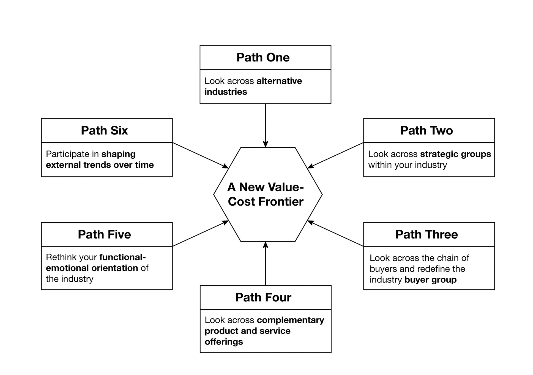
Three Things Leading to a Shift
To do a Blue Ocean Shift, one needs to figure out exactly what factors could allow your firm to transition into the Blue Ocean. Similarly, one must identify the hurdles that might prevent it from happening. The authors boil it down to 3 things:
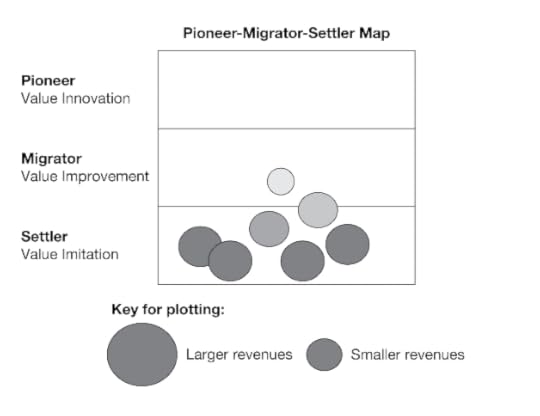
Adopting a blue ocean perspective;Having practical tools for market creation;Use a “humanness” approach to inspires and build confidenceOne of the earliest steps is to evaluate your firm's current products or services, and figure out which ones are innovators, and which ones are not. The authors recommend making a chart showing each product as a "Pioneer," "Settler," or somewhere in between. A Pioneer is an innovator, whereas a Settler is a product living off its former glory days.
Not Necessarily First in Technology
Success in a Blue Ocean market doesn't necessarily mean your firm was the first in technology. Oftentimes, the authors suggest, those firms get the bragging rights of being the first in technology, but still do poorly in the marketplace. (Think TIVO, for example.) The point is, being the technical creator is not good enough.
I found the most helpful part of the book right at the end—in Chapter 12, “Selecting Your Blue Ocean Move.” The authors take you through the details of setting up your own "Blue Ocean Fair." The idea is to build up “ambassadors” who can explain why a shift is necessary, and drive the process forward. Here’s how the fair works:
Start with an overview of your industry’s red ocean reality and the need to make a blue ocean shiftHave the team present their blue ocean strategic optionsAsk the attendees to visit all the stations and then cast their votesProbe for maximum feedback and learningDecide which blue ocean option to pursueA Blue Ocean Fair for Toilet PaperThe book details how Kimberly-Clark Brazil (KCB) ran their own fair. They wanted to do a Blue Ocean Shift for TOILET PAPER! The authors admit,
“What can you possibly do with a product as simple and basic as toilet paper? KCB was about to find out.”
So all in all, I found BLUE OCEAN SHIFT to be a useful book--but also a complicated book. It would have been helpful to have “bullet point” summaries for each chapter. Without a concise summary, it took me longer to understand the details. I think it would be helpful to actually read about the Fair first, so that you can see where the plan is going.
Advance Review Copy courtesy of the publisher.
Blue Ocean Shift: Beyond Competing - Proven Steps to Inspire Confidence and Seize New Growth
$19.04
By W. Chan Kim, Renée Mauborgne

Blue Ocean Shift: Beyond Competing - Proven Steps to Inspire Confidence and Seize New Growth byW. Chan Kim and Renée Mauborgne
Blue Ocean Shift: Beyond Competing - Proven Steps to Inspire Confidence and Seize New Growth by W. Chan Kim and Renée Mauborgne
In BLUE OCEAN SHIFT, Professors W. Chan Kim and Renee Mauborgne continue their analysis, following up on BLUE OCEAN STRATEGY. In this sequel, the professors dive into more detail, and provide a detailed “Blue Ocean” plan. Their idea was to “study those who had applied our theory and methodology to their organizations to create and capture blue oceans.”
The authors remind the reader that a Blue Ocean shift “occurs only when unprecedented buyer value is created by opening up a value-cost frontier that didn’t exist before.” A firm must target one of these areas:
Offer a breakthrough solution for an industry’s existing problem, ORIdentify and solve a brand-new problem or seize a brand-new opportunity, ORRedefine an industry’s existing problem and solve it.To do the “shift,” we need to figure out exactly what factors allow your firm to transition into the Blue Ocean, and what are the hurdles that might prevent it from happening. They boil it down to 3 things:
(1) Adopting a blue ocean perspective;
(2) Having practical tools for market creation;
(3) Use a “humanness” approach to inspires and build confidence
I found the most helpful part of the book right at the end—in Chapter 12, “Selecting Your Blue Ocean Move.” The authors take you through the details of setting up your own fair, to figure out your own strategy. The idea is to build up “ambassadors” who can explain why a shift is necessary, and drive the process forward. Here’s how the fair works:
Start with an overview of your industry’s red ocean reality and the need to make a blue ocean shiftHave the team present their blue ocean strategic optionsAsk the attendees to visit all the stations and then cast their votesProbe for maximum feedback and learningDecide which blue ocean option to pursueThe book details how Kimberly-Clark Brazil (KCB) ran their own fair. They wanted to do a Blue Ocean Shift for TOILET PAPER! The authors admit, “What can you possibly do with a product as simple and basic as toilet paper? KCB was about to find out.”
So all in all, I found BLUE OCEAN SHIFT to be a useful book, but also a complicated book. It would have been helpful to have “bullet point” summaries for each chapter. Without a concise summary, it took me longer to figure out the details. I think it would be helpful to actually read about the Fair first, so that you can see where the plan is going.
Advance Review Copy courtesy of the publisher.
August 8, 2017
The Alzheimer's Solution: A Breakthrough Program by Dean Sherzai and Ayesha Sherzai

In THE ALZHEIMER'S SOLUTION, doctors Dean and Ayesha Sherzai give us the bad news first: “There is reason to be afraid” they announce. Deaths due to Alzheimer’s have “increased by nearly 87 percent in the last decade.” The disease is also incredibly expensive, costing $226 billion in the United States alone.
The early chapters of the book present the biology of the disease, including a discussion of how the brain is affected, and what type of external influences can prevent the damage. The good news (and surprising, to me) is that there is a LOT that we can do.
“Ninety percent of us can avoid ever getting Alzheimer’s.”

Before reading this book, I wanted to know the qualifications of the authors. (I suspected they were not true medical doctors.) I stand corrected. The two are top researchers in the field of Alzheimer’s, and directed the Alzheimer’s research program at Cedars Sinai of Los Angeles—a world class institution.
A key to this book is the question of HOW did the doctors conclude that lifestyle could so dramatically reduce the odds of getting Alzheimer’s? How did they see things that other doctors did not?
The answer is, the authors were in a special place. They were doctors at Loma Linda University, where they were able to study two radically different groups. Their patients from Loma Linda—the “healthy group,” were mainly Seventh-day Adventists, who had drastically different diets, exercised regularly, and had good social ties. They were“some of the healthiest people in the world.” In contrast, the second group included patients in San Bernardino, an “underserved area plagued by chronic disease.”
After years of working and studying both groups, the doctors found that “People living a healthy lifestyle had a much lower prevalence of dementia.“ The Adventist population, on average, lived 10 years longer than others. The same lifestyle that promoted a healthy heart and kidneys “also appeared to be beneficial for the brain."
The doctors formed these conclusions:
Eating meat is bad for your brain.Physical exercise increases both the number of brain cells and the connections between them.Chronic stress puts the brain in a state of high inflammation, causing structural damage.Restorative sleep is essential for cognitive and overall health.Higher education and other complex cognitive activities protect your brain against decline.Social support has an undeniable influence on the way your brain ages.The authors developed a plan to promote the necessary lifestyle changes. They call the plan, "NEURO." Here's the plan essentials:
Nutrition: A whole-food, plant-based diet low in sugar, salt, and processed foods.Exercise: An active lifestyle that incorporates movement every hour.Unwind: Stress management in the form of meditation, yoga, mindful breathing exercises.Restore: Seven to eight hours of regular, detoxifying sleep .Optimize: Multimodal activitiesthat challenge many of the brain’s capacitiesA big chapter is dedicated to each aspect. I was most interested in the Nutrition chapter. There, I found the “Top Twenty Brain-Nourishing Foods,” as well as the “Top Ten Foods to Avoid Processed Foods, and “10 Tips For Eating At Restaurants, And “Best Brain-Healthy Snacks.”

The “Optimize” chapter was also informative. I had always thought that doing puzzles was one of the best mind exercises; however, the doctors have some better suggestions. They suggest activities that use a broader part of your brain, to “engage multiple cognitive domains at the same time.”
The section on sleep had numerous suggestions, and this warning: “Chronic poor sleep and lack of sleep both cause significant damage to the brain.” The authors include a concise, “Techniques For A Better Night’s Sleep,” with tips like these:
Normalize Your Sleep ScheduleAvoid Eating Late at NightAvoid Certain Drinks Too Close to BedtimeAvoid Exercising Before Sleep, But Be Sure to Exercise Earlier in the DayLow Light at Night, Bright Light During the DayAvoid Playing Games, Watching Stimulating Movies, and Working on your iPad in Bed
So all in all, I found THE ALZHEIMER'S SOLUTION to be an encouraging, practical book. Furthermore, it is an IMPORTANT book. I was already familiar with some of the studies on diet and exercise, but I had no idea that lifestyle could so dramatically reduce the odds of getting this wretched disease.
Keep in mind that it is difficult to conclusively PROVE that one thing causes another. Just because 2 things are correlated, that does not prove that one causes the other. It’s a high bar to reach. Nevertheless, the authors make a convincing case for the suggested lifestyle changes. I am implementing many of the lifestyle changes listed in this book, and am also encouraging my spouse to do the same. To see where you might benefit, there is an easy-to-do “Alzheimer’s Solution Risk Assessment” that identifies areas for possible lifestyle change.
The Alzheimer's Solution: A Breakthrough Program to Prevent and Reverse the Symptoms of Cognitive Decline at Every Age
By Dean Sherzai, Ayesha Sherzai

The Alzheimer's Solution: A Breakthrough Program to Prevent and Reverse the Symptoms of Cognitive Decline at Every Age by Dean Sherzai and Ayesha Sherzai
August 6, 2017
Native American Indian Sites in the East Bay Hills by James Benney
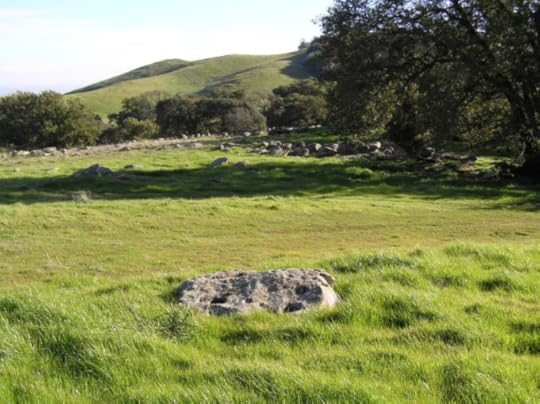
NATIVE AMERICAN INDIAN SITES is a unique book. As far as I know, there is no other book that documents the Indian sites in the East Bay. Each site has a specific lat/lon coordinates, as well as elevation. In addition, instructions for reaching each site are provided.
As an example, the section titled, "Los Vaqueros Log Cabin Village" descibes a locale of "41 bedrock mortars, 4 capules, 4 slicks, rock walls." The author suggests parking at Round Valley, then
"When you see the old barn and cabin you're close. Wander behind them."
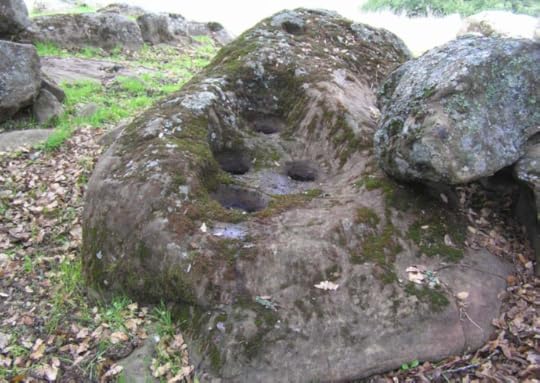
I confess I had no idea there were so many these interesting sites in the East Bay!
I have been to several of these sites, and am familiar especially with the large "City of Volvon" (in Morgan Territory) that the author documents. I appreciate the author's regard for careful preservation of these locations. As the author makes clear, do not remove any artifacts from any of these important sites.
Perhaps the most useful item is the large color map in the center of the book, which marks the position of the sites discussed in the book. 5-Stars for producing such an informative, useful guide.
For further information about these East Bay locations, check out the East Bay Hill People website. See also this excellent article on the "Lost City of Volvon" by Robert Bardell. Fascinating description of the Volvon village in Morgan Territory.
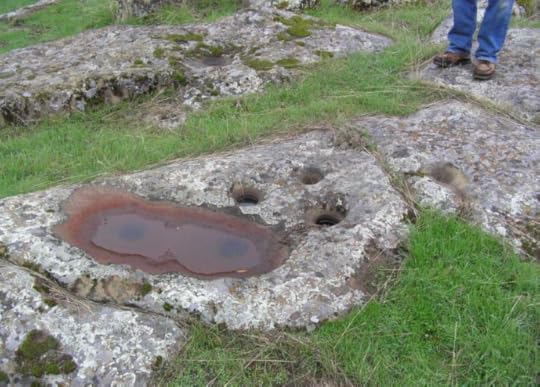
Native American Indian sites in the East Bay Hills by James Benney
August 4, 2017
The Hollywood Commandments: A Spiritual Guide to Secular Success by DeVon Franklin

I’m glad I read this book. THE HOLLYWOOD COMMANDMENTS is an amazing book, in several ways. DeVon Franklin credits Hollywood with teaching him more about life and success than the church did! “In twenty years in the entertainment business, I’ve learned some of the most surprising and important lessons about God’s intention for our success. Those lessons have enabled me to build an amazing life and thriving career that glorifies God…”
DeVon’s ideas are credible because he has achieved great success in a field that seems hostile to the core beliefs of Christianity. How can this be? DeVon gives us the answer: The power of God is not somehow obstructed at the gates of Hollywood: “God’s Power Doesn’t Stop At The Gates Of Hollywood.”
The author is not so much concerned with helping people make a boatload of money, as he is in helping people use their talents: “What I care about is seeing you live out your God-given purpose in this life, walk in your calling, and unleash the full power of your gifts.”

THE HOLLYWOOD COMMANDMENTS is NOT a how-to book, or recipe for getting rich; that is NOT the objective:
“If your goal is to get the house of a lifetime, the car of your dreams, or more money than you know how to handle, this book is not for you!”
The book has tons of good career tips, which the author has summarized under 10 “Commandments:” To give you an idea of how the book is organized, I recommend reading the “Reader Guide” near the very end of the book FIRST. If you read that section first, it gives you a good overview of the main points of the book. Then, you will understand where the book is going. (Or, you might decide this book is not for you, and you won’t waste any more time.)
Here are the 10 Hollywood Comandments:
1. Your Prayers Alone Aren’t Enough
2. You Are the Talent
3. You Have to Carry a Crown Before You Can Wear One
4. You Have to Know the Rules to Play the Game
5. Your Gut Is Hiding God
6. You Get What You Negotiate (Not What You’re Worth)
7. You Must Master the Walk of Fame
8. Your Difference Is Your Destiny
9. Your Amnesia Is an Asset
10. Your World Is Smaller Than You Think

If you are a Christian believer, you will appreciate (and understand) many of the ideas, which are often tied to Biblical passages, both Old and New Testament. The general theme of the book is to use your God-given talents to the best extent possible. God has created you as an extraordinary person, with unique talents. So get busy using those gifts!
“God gifts us each with unique talents and calls us to use them to fulfill some part of His purpose.”
I thought one of the most useful chapters was Chapter 6, You Get What You Negotiate (Not What You’re Worth.) Here, the author explains the principles of negotiation. Remember, the company won’t pay you more than it has to:
“We assume that the company will do right by us. But it doesn’t work like that. The company’s first interest is to do right by the company. . .If they can get you to settle for a dollar less than you ask for, they will.”
So all in all, I found THE HOLLYWOOD COMMANDMENTS to be an inspiring, practical book. I found the life and business lessons to be sound. The book concludes with a sobering caution about chasing after wealth:
“There is nothing in this world worth compromising your soul.”
DeVon reminds us that success in God’s eyes is not about getting a boatload of cash. It’s about serving. I thought this one passage summed up the book’s message:
“We were created because God wants us to serve a designated role in the world. That’s a thrilling idea: that you and I have been asked to play a role in the work of the Creator.”
The Hollywood Commandments: A Spiritual Guide to Secular Success
By DeVon Franklin, Tim Vandehey

The Hollywood Commandments: A Spiritual Guide to Secular Success by DeVon Franklin
August 3, 2017
Oracle Strange String Comparisons
When Oracle Pads the Numbers
Granted, this is more of a functionality issue, than performance, but it came-up during a performance analysis, and it surprised me in a big way. I bet a lot of DBAs are surprised by this. Just for fun, I took a survey of the dozen DBAs in my group. Not one DBA knew about this.
What is the Problem?One would intuitively think that, when comparing strings, the strings are only "equal" if the two are absolutely identical. In Oracle, however, this is not true. What? It's true--the two strings do not need to be identical. This can lead to confusion and surprising results.
The key is what Oracle calls, Blank-Padded and Non-padded Comparison Semantics. Let's take a look at an actual example, and see how this plays out.
Getting Bind InfoI was assisting a developer in trying to improve the performance of a particular application query. It was critical that I know the exact parameters that were used. I grabbed the bind values using this script below, so I was sure I was using the correct parameters:
Select distinct a.inst_ID,
to_char(last_captured, 'mon-dd-hh24:mi') cap,
c.name||'/'||c.value_string bind_var
From GV$sqlarea a,
Dba_users b,
Gv$sql_bind_capture c
Where b.user_id=a.parsing_user_id
And b.username != 'SYS'
And c.address=a.address
And a.sql_id = [TBD]
Order by 1,2;
During my testing, I always got 0 rows--but that's not what the result was in the production; so it seemed as though my analysis was wrong.
Essence of the Problem
The Sql I was analyzing was pretty long, but I boiled the problem down to just one clause. In this particular clause, I always got zero rows--contradicting what the application actually did in production. Here's the gist of what I was doing:
Var b1 VARCHAR2(10)
Exec :b1 := 'DIV_YS';
Select count(*) from Detail_Table Where LEVEL_2_CODE = :b1;
COUNT(*)
--------
0
Change the Data Type
I'm not sure why I thought of this, but I changed my variable type to CHAR instead of VARCHAR2. I then repeated the query:
Var b1 CHAR(10)
Exec :b1 := 'DIV_YS';
Select count(*) from Detail_Table Where LEVEL_2_CODE = :b1;
COUNT(*)
--------
10
What! Why did the answer change? I discovered that in Oracle, my code yields a functionality difference, depending on how exactly I define my bind variable. When I switched to CHAR, Oracle automatically switched to blank-padded comparison semantics. With this method of comparison, many rows in the table matched.
Let's take a closer look at this.
Comparison SemanticsWith blank-padded semantics, if the two values have different lengths, then Oracle first adds blanks to the end of the shorter one so their lengths are equal. Oracle then compares the values character by character up to the first character that differs. The value with the greater character in the first differing position is considered greater. If two values have no differing characters, then they are considered equal. This rule means that two values are equal if they differ only in the number of trailing blanks.
So, for a CHAR field, 'A' = 'A '
With blank-padded semantics, if the two values have different lengths, then Oracle first adds blanks to the end of the shorter one so their lengths are equal. Oracle then compares the values character by character up to the first character that differs.
This is documented in the official Sql reference guide: Oracle Database SQL Language Reference 11g Release 1 (11.1)
"Oracle uses blank-padded comparison semantics only when both values in the comparison are either expressions of data type CHAR, NCHAR, text literals, or values returned by the USER function."
This rule means that two values are equal if they differ only in the number of trailing blanks. That's exactly my situation in my example above.
Snappy Interviews: 100 Questions to ask Oracle DBAs
By Christopher Lawson

Biometrics Your Body and the Science of Security by Maria Birmingham, Illustrated by Ian Turner

In BIOMETRICS, Maria Birmingham gives an overview of all the different ways to uniquely identify a person. I found the book to well-written, with all kinds of fun and wacky biometric possibilities. Although the book is aimed at children, I enjoyed reading the book, and I learned a lot about the field.
The author first gives an overview of the field:
“Biometrics focuses on who you are. Since your body and its specific traits are a part of you, they can’t be misplaced or taken, and they’re extremely difficult to duplicate.”
The point is, two different people will never have identical features:
“Biometrics takes advantage of the fact that no two people are exactly alike.”

Of course, there are simple methods like signature recognition, or the classic fingerprints; but that’s not all. There are also some weird ones, like odor or vein recognition.
The author briefly explains the possible downside of Biometrics—i.e., privacy. Opponents of biometrics “Worry about the fact that ID can be collected without a person’s knowledge.”
The author identifies some really far out biometric research. Just when you think you’ve heard about all the novel ways to identify a person, there’s yet another one. In Japan, “engineers are working on a car seat that identifies you by your bum. Yup, bum recognition!”

So all in all, I found BIOMETRICS to be a fun book. Well-designed and easy to read. I thought the illustrations by Ian Turner were especially fun. I confess I was laughing so hard at some of the illustrations that I had trouble focusing on the text. I’m pretty sure, however, that Ian did NOT include an illustration of the “bum recognition” method.
Biometrics: Your Body and the Science of Security
By Maria Birmingham

Biometrics Your Body and the Science of Security by Maria Birmingham and Ian Turner
July 31, 2017
Downhills Don't Come Free by Jerry Holl

No Wi-fi here!
Within The First Thirty Minutes Of My Trip I Was Pulled Over By Alaska’s Finest
Yes, it’s true. The author was just 30 minutes into his trip before the nice policeman was already telling Jerry to got off the freeway, and onto the bike path where he belonged. The author explains that he didn’t really check out his route too much—After all, what could possibly go wrong?
In DOWNHILLS DON'T COME FREE Jerry Holl takes the reader on a scary ride. Zero bike experience? No problem—Start your cycling training with a ride from Alaska to Mexico!
“At fifty-seven, I resigned from my corporate job, and in a broader sense from my past, to take on the challenge of a bike ride from Anchorage, Alaska, to the Mexican border despite zero distance experience whatsoever on a bicycle.”
Jerry explains that his wife was very encouraging, even enthusiastic. Hmm, he thought, “Too enthusiastic?”
I found the author’s equipment selection interesting. He loaded up a LOT of gear, and his bike + gear topped 100 pounds. (I confess I doubted the author’s number, but Jerry swears the number is correct.) Not sure what gear to get? Just buy a whole bunch and try it out on your first day in Alaska.
One might also question the author’s nutritional choices:
“Once I was up and moving, I was subsisting on candy and granola bars. The simplicity of tear and eat appealed to me.”
Well, you get the idea. This is an amazing story, full of (mostly) good experiences cycling along some of North America’s most beautiful scenery. Lots of interesting characters (including some wild ones), and a lifetime of stories.

The Water District
Of course, the journey was physically grueling, but there are a few funny scenes. Not properly securing his tent, the author had to chase his tent down once:
“I came back out of the laundry area, the winds were howling— and there was my tent in the distance, bouncing and bounding high into the air like a beach ball in a hurricane as it rolled across the grassy field.”Watch out for Cement!
Despite some equipment breakages, the author escaped without serious injury until the very end of his trip. Following another rider’s mistake, Jerry enters some nice, soft concrete:
“I only had a millisecond to think, Oh shit, that’s going to hurt her—and WHAM! I was down too. . .Our front tires had dropped straight into the wet cement and slammed against the opposite wall, which dropped us both like a ton of bricks.”
Well, the injuries were serious, but not life-threatening. Note to reader: Do NOT try to ride through wet concrete, no matter how cushiony it looks.
All in all, I found DOWNHILLS DON'T COME FREE to be a fascinating, albeit a bit of a scary read. There’s lot of good lessons here on how to make a trip like this (and maybe a few lessons on how to NOT make a trip like this?) I am amazed that a non-cyclist could pull off this feat.
Finally, I cannot imagine hitting 45 MPH on one downhill, as Jerry mentions. Readers: Do not attempt this!
Downhills Don't Come Free: One Man's Bike Ride from Alaska to Mexico
By Jerry Holl
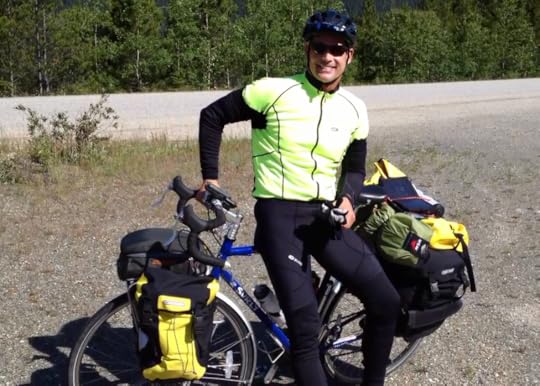
Fully Loaded
Downhills Don't Come Free: One Man's Bike Ride from Alaska to Mexico by Jerry Holl