Christopher Lawson's Blog, page 12
June 16, 2017
What Color Is Your Parachute? 2018 By Richard Bolles

Do you really need to get the latest edition of PARACHUTE?
No, it is not necessary to get the very latest version. Of course, if you are buying PARACHUTE for the very first time, get the latest one; however, if you already have a recent edition, I think that’s good enough. For slightly older editions, the main annoyance will just be some links that are outdated, or some references that are wrong.
WHAT COLOR IS YOUR PARACHUTE 2018 is jam-packed with tons of good career advice. In fact, it’s SO LARGE, that one is easily overwhelmed. Fortunately, the editors provide lots of “Bullet Point” lists that make reading easier. If you just concentrate on the sections that are relevant to you, it’s not such a formidable read. You can likely skip many sections that aren’t relevant to your own career.
I would recommend looking through the Table of Contents and picking areas or lists in which you feel you need help. Perhaps start with the preliminary, “A Two-Minute Crash Course on How Much Has Changed in the World of Work.” This is quick reading, and provides a good overview of the job search process. Being prepared and informed is just as important as being the best qualified: “In today’s world, he or she who gets hired is not necessarily the one who can do that job best; but, the one who knows the most about how to get hired.”
One of my favorite lists is near the end: “The Ten Greatest Mistakes Made In Job-Interviews.” This list is wryly subtitled, “Whereby Your Chances of Finding a Job Are Greatly Decreased.” Here are some of my favorite mistakes: #3, “Doing no homework on an organization before going there.” Or #8, “Failing to give examples of the skills you claim you have.”

The author explains the different perspective of job-seeker versus job-filler:
“Many if not most employers hunt for job-hunters in the exact opposite way from how most job-hunters hunt for them.”
His point is that the HR department wants to ELIMINATE candidates. Naturally, you do NOT want to be eliminated: “You want the job-market to be a hiring game. But the employer regards it as an elimination game— until the very last phase.”
PARACHUTE is an uplifting, encouraging book written by a master in the field. We can always do something to advance our cause:
“No matter how overwhelmed you may feel, no matter how much you may feel you’re at the mercy of huge forces that are beyond your control, some part of it is within your control: maybe 2%, 5%, who knows? There is always something you can work on…”
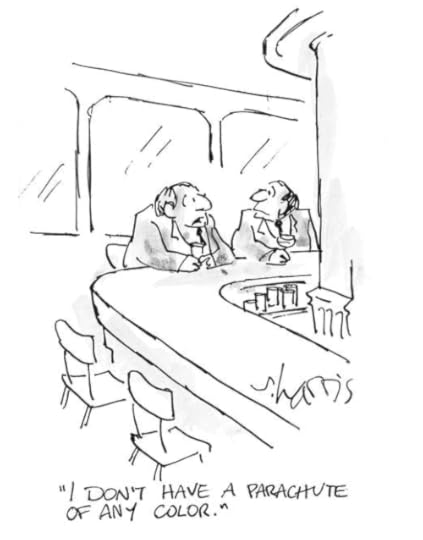
WHAT COLOR IS YOUR PARACHUTE 2018 is right at the top in career resources. For me personally, it is THE #1 career resource. The author writes well, and is ever-encouraging. If you are serious about your job hunt, get the book, and review the relevant sections. I have used this book in my own career hunt.
Finally, the sad news: The editors, in an afterword, note that the author, Richard Bolles, “passed away earlier this year at age ninety after a lifetime of service to job-hunters across the world.”
I had the chance to correspond with the author not so long ago, but regret that I never met him in person. By all accounts, Richard Bolles was a kind, decent man, who genuinely wanted to help people in their careers. In my last email, he asked me to pray for him, which of course, I did.
I feel like I lost a friend.
What Color Is Your Parachute? 2018: A Practical Manual for Job-Hunters and Career-Changers
By Richard N. Bolles
What Color Is Your Parachute? 2018 By Richard Bolles


June 14, 2017
MAD About Trump: A Brilliant Look at Our Brainless President

In MAD about Trump, there is enough to offend just about everyone. Naturally, the key target is our beleagured president, but many others get the same treatment. I think it's arguable whether this book is a "Brilliant Look," but it's still fun.
My favorite is the Trump "Mount Rushmore," which of course features Donald Trump, on every sculpture!

This is my favorite
I suspected that Donald and KellyAnne were good dancers, but now I know for sure!

So all in all, I would say that MAD About Trump is a cute book. Just look at the pictures and don't take it too seriously.

MAD About Trump: A Brilliant Look at Our Brainless President
By Various
Donald TrumpPresident Trump




Oracle Performance Tuning: Query Subfactoring
Have you ever tried to analyze a complicated sql, but there were so many clauses or inline views, that you hardly knew where to start? Well, I've been saddled with that type of code many times. But there is a better alternative. It's called "Query Subfactoring," and it's a great way to make code more manageable.
The "With" SyntaxSome folks call this the "With" syntax. Using this feature makes your code much easier to follow, and much easier to debug--both functionality-wise and performance-wise. Use of a lot of inline-views can make the code nearly impossible to understand.
Here's what it looks like--note that each "view" is enclosed within parentheses:
With View1 as (Select * from Table1 Where Col1 = 'ABC'),
View2 as (Select * from Table2 Where Col1 = 'DEF')
Select Count(*) from View1, View2 Where View1.Col1 = View2.Col1;
Using this approach, you will find it much easier to tune complicate sql. When this format, you can simply tune each part, piece by piece. So, for the above example, I would get the "View1" running smoothly, then "View2." When all the preliminary parts are running well, you can then concentrate on tuning the main body.
Use the "Materialize" HintIt's often helpful to use the MATERIALIZE hint in the preliminary views. This way, the optimizer won't try to change execution plans at the end, since the early views are already "materialized" behind the scenes.
I have used the "With" method countless times. It's easy for developers to get the idea, and I have helped many of them use it. I bet you will find it equally useful.
Snappy Interviews: 100 Questions to ask Oracle DBAs
By Christopher Lawson
Query Subfactoring

June 13, 2017
The Separatists by Lis Wiehl and Sebastian Stuart (A Newsmakers Novel)

This is the very first novel I have read by Lis Wiehl. I rarely review fiction, but I made an exception for this book.
I found THE SEPARATISTS to be a reasonably fast-moving novel, with an interesting plot. The main character, Erica Sparks, is a high-powered journalist and anchor of the highest-rated news program in the entire country. She pitches a new show, similar to "60 Minutes," and for her first episode, she features a separatist movement in North Dakota.
The movement seems non-violent, but Erica is suspicious of the charimatic couple leading the cause. Before long, bodies start turning up, including one victim who had just called Erica with important information. Other deaths appear to be accidental, but Erica doesn't believe it.
Naturally, Erica feels compelled to investigate these murders. She can't really trust everyone around her, and so decides to keep most of the information private. This includes her husband, and especially her husband's business "friend."

Besides putting in 70 hour weeks, Erica must cope with the drama of a teenage daughter and a husband who appears to be wandering a little bit far from home. Erica's own insecurity is always close at hand, with disturbing memories from her sad childhood and a dysfunctional relationship with her mother. Her past problem with alcohol adds to the mix.
So overall, I found THE SEPARATISTS to be a good read, just right for a day on the beach or beside the pool. The book kept my interest, and the pace seemed about right.
In the "needs improvement" department, the book was filled with "comma splices," which are rare in books from major writers and publishing houses. These were so numerous, that they distracted me. To be fair, it's possible that these grammatical lapses will be corrected before the final book release.
Finally, I appreciated the "bite-sized" chapters; like so many American readers, I have a short attention span, and the small chapters are a big help. (Must be from watching too much of "24.")
Advance Review Copy courtesy of the publisher.
The Separatists (A Newsmakers Novel)
By Lis Wiehl

The Separatists by Lis Wiehl and Sebastian Stuart (A Newsmakers Novel)
June 12, 2017
Strong Memory, Sharp Mind by Dr. Frank Minirth

For readers who may not know, the author, Dr. Frank Minirth, passed away in January, 2015. STRONG MEMORY, SHARP MIND is jammed with tons of ideas. That’s both a strength and a weakness. Yes, there is a LOT of good information here, but it takes a good amount of time to absorb the ideas.
The theme of the book is to encourage the reader to develop their own, personal, “Brain-Care Action Plan.” The first part of the book, “Threats to Cognitive Health,” is dedicated to convince the reader of the need to take proactive action to keep your brain healthy. Dr. Minirth explains,
“Don’t take your brain for granted. I wrote this book for those who want a basic understanding of the brain’s strengths and vulnerabilities and what can be done to reduce the risk of mental decline.”
The author cites one sobering statistic:
“An estimated 6.8 million Americans currently have dementia and 5.4 million suffer from Alzheimer’s disease.”

Each chapter of this book concludes with a Choose Well section that will help you enjoy more confidence and success throughout your adult years. “It’s encouraging to know that brainpower can be increased at any age— through childhood, adolescence, young adult, adult, and even in the senior years.”
Here’s a good tip, which actually applies to reading any work of non-fiction: “Keep a Pen and Highlighter Handy I encourage you to mark meaningful passages for frequent review and to highlight the action tips and how-to lists.”
There is a large section entitled, “Tips for Caring for Someone with Dementia,” devoted to helping the caregiver. I found the suggestions useful. For example, “Read and play memory games do crosswords and puzzles socialize with friends…” For safety, “Install safety latches high on doors limit choices to avoid confusion remove tripping/ fall hazards…”
PART 2 is called, “How to Protect Your Mind.” This latter half of the book is jammed with ideas—many of which I found excellent. For example, on getting proper sleep, “Avoid long-term use of sleep aid medications because they may disturb stage IV sleep, making sleep less productive. . . Set a regular sleep routine for bedtime and wake-up time.”

Some tips are simple, but still valuable. For instance, “Use your time wisely. Find spare moments each day for mental exercise.” Another, “What is your best biological time of day?”
Towards the end of the book, the author reveals his personal “Easy Learning Plan.” When studying a book, follow these steps:
1) Scan the entire material as quickly as possible;
2) Then read it through slowly. (Read important parts out loud to help you remember.)
3) Finally, study the material and write down a brief outline for review.
This recommended process is very similar to the "How to Read a Book" method espoused by the late Dr. Mortimer Adler, which I have personally used for 20 years.
So all in all, I found STRONG MEMORY, SHARP MIND to be a meaty book full of practical ideas on keeping our minds sharp well into our senior years. The rear of the book has some detailed appendices:
Appendix A The Brain and Memory
Appendix B Alzheimer’s Disease, Dementias, and Cognition
Appendix C Vocabulary Words
Appendix D Answers to Brain Boosters
Finally, the author provides an encouraging note, which I think nicely sums up his message:
“The good news is that your mental health responds to nurturing.”
I found this book to be full of wise advice. I wish the author were still alive, and I regret never meeting him.
Advance Review Copy courtesy of the publisher.
Strong Memory, Sharp Mind: Anti-Aging Strategies for Your Brain
By Frank M.D. Minirth

June 8, 2017
Oracle Peformance Tuning: A Matter of Life or Death!

Action, not Words
Performance tuning requires creativity and innovation. It’s not at all just a routine, drab job—it requires versatility and stepping into different roles. That’s why I like it so much. Those who read this column know that I call the overall performance tuning process “Physician to Magician.” This means that we play a different role at different times. Sometimes the analyst needs to gather facts, like a detective. At other times we simply listen to our patient, like a kindly physician. Later, when we need to synthesize a solution, we are like an artist, creating a work of art that our customer will appreciate.
Now, I admit that not all of performance tuning is exciting. There’s plenty of cases that are solved by adding an index, fixing the statistics, etc. These cases require more scientific competence than creativity. In general, however, performance tuning is not a mechanical process of “turning the crank” to spit-out a solution to a performance problem. Designing a fix that meets your customer’s needs is often not so trivial.
A MISUNDERSTANDING OF THE PROCESSThose not truly experienced in tuning tend to trivialize the process, frequently using trite phrases such as “add missing indexes” or “increase buffer cache.” This misunderstanding helps explain why relatively few DBAs become really good at performance tuning—their view of the task is simply too short-sighted. If your solution set comprises only trivial solutions like new indexes, you’re likely not going to excel in this field. Here’s a sampling of various root causes of performance logjams:
• Overly strict business requirement
• Optimizer incorrectly handling new Oracle functionality
• Optimizer predicting one execution plan, but really running another
• Program calling custom function millions of times
Note that in each case above, a good solution would not be forthcoming by a “turn the crank” approach. The solution for each case required understanding of the particular environment. Sometimes, however, even with all facts in hand, a solution is evasive, or very expensive for our client.Allow me to suggest a novel alternative—one that I have found very helpful.

We Love Performance Tuning!
A MATTER OF “LIFE AND DEATH!”
Here’s a tactic I use when I’m faced with an apparently unsolvable performance problem. I imagine that the problem is so critical that people will actually die if I don’t resolve the difficulty. I imagine that the lives of people are actually in my hands.
WHEN PERFORMANCE TUNING IS A MATTER OF LIFE OR DEATHYes, I admit this is a bizarre idea, but it actually works. If you can temporarily pretend that there are no limits, you’ll be amazed at the variety of solutions you can invent. Here’s an actual case where I “saved” a life.
A major retailer had a problem with a long-running batch job. We were able to identify several bottlenecks; unfortunately, the fix required a program redesign; however, this was not acceptable. Along with QA testing and all the paperwork, the ensuing delay would be at least several weeks, if not a month or more.

Faster is Good
In cases like this, it’s tempting to throw the problem back at the developers. Of course, this isn’t too helpful to the client. So just for fun, I pretended that my performance problem was life-threatening. I asked myself, “Is it really true that I can do nothing to speedup the job? Even if someone dies I can’t do anything?”
THE PERFORMANCE “BOOST”Given my new motivation, all limits were off. I considered all kinds of crazy ideas—server changes, init.ora changes, disk changes, etc. Finally, I thought of one very simple, but admittedly weaselly idea.
Since the bottleneck was mostly due to disk i/o, any improvement in disk access would directly affect the problem job. Since we knew the exact Sql, we could pre-run Sql that duplicated the “real” Sql that would shortly follow. That is, we would pre-cache many of the blocks that would shortly be needed.
Caching would take place within the SAN unit, as well as at the Oracle database cache. The entire performance improvement would take place with absolutely no change to the batch program! To speed-up the pre-caching program, we used multi-threading to run about 20 simultaneous database sessions (we had the spare CPU capacity). This was really simple, and made use of Oracle’s parallel query option.
We successfully ran the “Boost” program just prior to the problem batch job, reducing the runtime by several hours. This satisfied the short-term needs of the client. (Incidentally, I have used this “boost” idea several other times, where an urgent, short-term fix was required.)
WRAP-UPOkay, I admit my “life and death” scheme is an unusual way to approach performance tuning. While our fix would certainly not be considered a long-term solution, it did give the client some breathing room, so that they could fix the program design. That’s all the customer needed.
The concept discussed here is really more about the art of human creativity and motivation than about databases. One could argue it’s really just another way to “think outside the box.”
Here’s the point: You don’t really what you can do unless you’re pushed really hard. So, the next time you face a seemingly impossible problem, don’t be too quick to throw in the towel. Instead, pretend, just for a minute, that you absolutely have to fix it—or else!
Snappy Interviews: 100 Questions to ask Oracle DBAs
By Christopher Lawson
Oracle Peformance Tuning
June 6, 2017
FIRE THE B-PLAYERS! WAS STEVE JOBS RIGHT?
Striving to Make the "A-Team"
In his outstanding biography, simply entitled, Steve Jobs, Walter Isaacson chronicles a bizarre event. After the Lisa and Macintosh divisions were combined, Jobs announced to the Lisa team, "You guys failed. You're a B team. B players. Too many people here are B or C players, so today we are releasing some of you to have the opportunity to work at our sister companies here in the valley." Then, Jobs fired 1/4 of the Lisa team. (Note: I had originally thought Jobs had fired the entire group, but upon re-reading Isaacson, I see it was only 1/4 of the group. I guess Jobs was a much kindler soul than I remembered!)
At the time I read this account, Jobs' decision struck me as incredibly extreme, and simply, wrong. What an extreme thing to do! I've come to re-think that, however.
CARS AND SOFTWAREDuring the "Lost Interview," filmed in 1995 while Jobs was still "away" from Apple, he explained his thinking. Steve used automobiles as an example. He observed that the overall difference between a middling car and the best car is not huge. In the field of software, however, the difference between mediocrity and excellence can be massive--even 100 to 1. So, if that's true, he asked, why would you ever put up with "B" players?
Jobs used another example: If you were leading a 10-person startup, why would you allow a handful of "B" players? If just 3 out of 10 were mediocre, that could wreck your entire company.
If you think of your own experiences in software design, I think you will see that what Jobs said is true. In our field, the difference in performance actually achieved between two different designs can be massive. This variability applies to both the quality and the functionality of software programs. I have personally seen an entire project canceled because the designer did not understand how to efficiently make queries to an Oracle database. So, for that project, the difference in output meant failure--certainly not just a slight difference.
HELP WANTED: "A" PLAYERS NEED NOT APPLYOne way to make sure your company only gets "B" and "C" players is to specify very broad job qualifications. So, the Oracle DBA should also know a bit about C programming, network architecture, disk layout, and Java. And when he's not busy, he also is the Sys Admin.
[image error]
I might be a "B" Player
This approach ensures that all "A" players are eliminated, because true "A" players have, by necessity, spent thousands of hours honing their skills in a very specific area. It is simply not true that any of these generalists could possibly be great at any one thing. The claim of competence in many areas undermines any claim to be an expert in one.
THE COUNTRY DOCIn a remote town, far from the big city, there is only one physician. No matter what your ailment, "Doc Baker" is the one to see. He will do his best and try to solve any medical problem, whether a cold, chest pain, slipped disk, or whatever. There really isn't any other choice--Doc Baker must be a generalist, and although he is a very kind man, it is supremely unlikely that Doc Smith is an "A" player in any specialty.
Now, shift to the big city. A large hospital will have specialists in every medical field. Accordingly, the hospital makes the choice to hire "A" players for each specialty. In that way, they can handle any medical need. With this setup, the most efficient and competent way to treat medical problems is to route the patient to the "A" doctor who knows that specialty. Of course, they could have hired dozens of "Doc Smiths," but the folly of that is evident. Why would they deliberately choose to route patients to practitioners of lesser ability?
LARGE COMPANIES USE "COUNTRY DOC" MODELMost large companies follow the "Country Doc" approach to IT, even though many have the resources to use the "Big City" model. So, all-purpose Oracle DBA "Doc Bakers" are hired, who are pretty good at many things--just like "Doc Smith." That is, they are good "B" players. Send them any type of database issue, and they can likely (if not swiftly) solve the problem.
I remember applying for a contract job years ago, and the written qualification mentioned, "Familiar with C Programming." I was puzzled and asked the interviewer, "Why would a performance expert be good at C Programming?" They quickly understood my point, and immediately dropped the requirement. By coincidence, an applicant might have that background, but why make that a requirement?
WAS STEVE JOBS WRONG?I don't think "B" or "C" players are stupid--or even less capable than their colleagues. I think it just means they are inexperienced --they haven't spent thousands of hours focusing on one skill. If one accepts the notion that thousands of hours are required to gain true competence, it couldn't be any other way, could it?
So, Steve Jobs didn't get it wrong. He just could have said it a little more kindly.
Steve Jobs
By Walter Isaacson

Was Steve Jobs Right?
June 5, 2017
Find Your Whistle: Simple Gifts Touch Hearts and Change Lives by Chris Ullman

The Sub-title of this book explains the theme: “SIMPLE GIFTS TOUCH HEARTS AND CHANGE LIVE.” In other words, this is not a book about whistling—it’s a lot more than that.
FIND YOUR WHISTLE is about using your personal ability and gifts to touch others.
“Everyone has a whistle, large or small, fancy or plain. There's something simple in each of us that can make the world a better place.”
For the author, he happens to be blessed with an unusual musical gift. Chris discovered that music has a special power—like a powerful, but gentle language:
“Like love, music is a universal language. And whistling, perhaps second only to the human voice, is the oldest natural instrument.”
Each chapter in the book is an anecdote about the author and one of his many whistling performances.

The book starts off in the OVAL OFFICE! There, Chris is whistling for the president and vice-president. He performs Beethoven, as well as the theme from “Lone Ranger.” Other performances include corporate meetings, weddings, and even a funeral. (Where Chris’ wife discreetly gives him the “cut” signal to shorten his performance.)
My favorite part of the book is actually what comes BETWEEN the chapters. Between the chapters are little cameo descriptions of other people who have found their whistle. These one-page cameos are called "A Whistle That Touches My Heart."
For example, one man is a CEO of a ranch. His whistle is his hiring philosophy, which is emphasizing character over skill. Another person is a cyber security consultant. The author explains how this person's enthusiastic creativity influences others.
Do not miss chapter 25, Life Lessons Lip Learned. Here, Chris shares his experience using his gift, and what he has learned. The lessons are
1) Be humble,
2) Be grateful,
3) Be open-minded,
4) Be disciplined.
So all in all, I found FIND YOUR WHISTLE to be an encouraging book, with a great message. The book is easy to read, and I enjoyed reading the anecdotes of the author’s appearances. I love the encouraging tone of the book, and especially the admonition to use our own gifts.

Okay, I guess few of us will ever be invited to the Oval Office to whistle the “Lone Ranger” for the President, but we all have something to offer. I appreciate the encouragement.
I thought this one paragraph summed up the book:
“Each one of us is a unique gift from God, with unique skills, desires, opportunities, and challenges. It's up to each of us to make the most of our simple gift, to find, develop, and share our whistles, not keep them undiscovered or bottle up.”
Advance Review Copy courtesy of the publisher.
Author photos courtesy of Richard A. Bloom.
Find Your Whistle
By Chris Ullman
Find Your Whistle by Chris Ullman
June 3, 2017
Little Free Library Sites in San Francisco East Bay

Little Free Library
These are really fun little free book borrow or trade sites.
List of Little Free Library in SF East Bay