Christopher Lawson's Blog, page 8
August 29, 2017
More Than Just Making It by Erin Odom
In MORE THAN JUST MAKING IT, author Erin Odom provides some useful tips on avoiding financial calamity. Unfortunately for her, she had to learn these tips the hard way: “Our financial hardships were a perfect storm: the effects of poor decisions from our newlywed days, marriage trials that had led to job loss, and a nationwide recession.”
For starters, Erin provides useful information on setting up a budget, as well as some big mistakes to avoid. She calls these, “Three Spending Mistakes We Wish We Hadn’t Made:”
We didn’t live on a strict budget; We didn’t save my salary; We didn’t wait to buy a home.I think the real strength of this book is not budgeting or financial planning, but something a lot bigger. Erin learned a lot about what it’s like actually being on the receiving end of welfare. Prior to being on government assistance, the author tended to scorn people who were on aid. Now the tables were turned:
“I was ashamed, thinking anyone who discovered our secret would think poorly of us, that we were scamming the system. . . Hiding the fact that we were on welfare made me feel like we were living a lie.”
The author learned a lot about families trying to make a living: “Our experience taught me that many Americans— regardless of the current economy— are often just one paycheck away from financial ruin.” Being on government aid, Erin was forced to modify her view of welfare recipients. Of course, now she knew how important the aid could be. She also realized that her prior opinion of welfare was not very accurate.
“Our time on government aid helped me see others for who they are— people just like me.”
Besides being on government aid, the Odom family was in for another big lesson. The last part of the book covers their bankruptcy filing. She and her husband had reached the bottom, and they simply had no more options. “We lived below our means and saved our money. We never dreamed we would face bankruptcy.” They were humiliated. On the way to see the bankruptcy judge, they hoped no one would see them.
So all in all, I found MORE THAN JUST MAKING IT to be a valuable tool for financial planning—but that’s not all. Beyond the money tips, this book provides some important lessons for Christians who do NOT have financial problems. It seems to me her message is also one of compassion for those in desperate straits.
I thought this nicely summed up the author’s experience:
“If anyone has material possessions and sees his brother in need but has no pity on him, how can the love of God be in him? Scripture is unmistakably clear: We are to give to those in need.”
Well stated. I appreciate the author reminding us.
Note: For readers interested in fun ideas on saving money, my favorite money-saving book of all time is The Tightwad Gazette by Amy Dacyczyn. It’s full of imaginative money-saving tactics. I bet you would find it a fun and practical read.

Help your brother . . .
More Than Just Making It by Erin Odom


August 26, 2017
To Be Where You Are by Jan Karon
Yea--We are back in Mitford! For readers new to the series, Mitford is a safe, warm, and genuine place. Life is a little calmer, the people are kind, and their faith is real.
Life goes on at a leisurely pace in Mitford, and a similarly modest pace in this book. The folks in town try to be good Christians as well as good citizens. Most folks still say grace before meals. One woman, fond of baking, wonders:
"Lord, why did you put me here, anyway?’ Would the Lord put somebody on earth just to bake cakes?"
The Mitford folks are faithful, but not dullards; there are plenty of fun moments in Mitford #12. Things get off to a humorous start when the longtime newspaper editor (and husband to the police chief) gets an obituary wrong, and pulls the "wrong photo out of the file." Well, this is big news in Mitford--especially to the "dead" woman who sees her photo on the front page! The "deceased" is honored as a great "monument" to the town.
One main theme in TO BE WHERE YOU ARE is the story of a young boy, Jack Tyler, recently adopted by the hardworking couple Dooley and Lace. Little Jack finally gets a real home, formally adopted by these loving parents. They even let Jack choose exactly what his name will be. Meanwhile, Dooley and Lace struggle with a sudden financial crisis at the veterinary clinic. How will they pay the bills?
Well, like most folks in Mitford, Dooley, Lace, and Jack learn to trust in God--even when things look bleak. In fact, the theme of trusting in God is a recurring theme in Mitford. The entire Mitford series is founded in trust in God.
Perhaps the high point of the book is near the end, when Father Tim, the supposedly retired town priest, counsels a woman who just discovered her husband was unfaithful. The woman is bitter, bent on revenge, and asks Father Tim for some advice on getting back at him. Father Tim suggests a much better way:
‘There is another way, Brooke. But only one. Forgiveness."
Father Tim presents the Good News to the woman, but she is just not ready to hear it.
All in all, I found TO BE WHERE YOU ARE a pleasant, easy read. It was fun being back in Mitford, with all the comforts of home! It's like being with old friends again. Jan Karon writes well, and the story is easy to follow. I also appreciate the author's large vocabulary--especially the many gardening words. I didn't know, for example, that "Queen Anne’s lace" meant a wild carrot, or that "Witch Hazel" is a type of plant. Well, now I know!
I thought this one sentence nicely summed up this book:
"Thank you God for so many dreams coming true."

To Be Where You Are (Mitford Years #12) by Jan Karon
To Be Where You Are (Mitford Years #12) by Jan Karon
Yea--We are back in Mitford! For readers new to the series, Mitford is a safe, warm, and genuine place. Life is a little calmer, the people are kind, and their faith is real.
Life goes on at a leisurely pace in Mitford, and a similarly modest pace in this book. The folks in town try to be good Christians as well as good citizens. Most folks still say grace before meals. One woman, fond of baking, wonders:
"Lord, why did you put me here, anyway?’ Would the Lord put somebody on earth just to bake cakes?"
The Mitford folks are faithful, but not dullards; there are plenty of fun moments in Mitford #12. Things get off to a humorous start when the longtime newspaper editor (and husband to the police chief) gets an obituary wrong, and pulls the "wrong photo out of the file." Well, this is big news in Mitford--especially to the "dead" woman who sees her photo on the front page! The "deceased" is honored as a great "monument" to the town.
One main theme in TO BE WHERE YOU ARE is the story of a young boy, Jack Tyler, recently adopted by the hardworking couple Dooley and Lace. Little Jack finally gets a real home, formally adopted by these loving parents. They even let Jack choose exactly what his name will be. Meanwhile, Dooley and Lace struggle with a sudden financial crisis at the veterinary clinic. How will they pay the bills?
Well, like most folks in Mitford, Dooley, Lace, and Jack learn to trust in God--even when things look bleak. In fact, the theme of trusting in God is a recurring theme in Mitford. The entire Mitford series is founded in trust in God.
Perhaps the high point of the book is near the end, when Father Tim, the supposedly retired town priest, counsels a woman who just discovered her husband was unfaithful. The woman is bitter, bent on revenge, and asks Father Tim for some advice on getting back at him. Father Tim suggests a much better way:
‘There is another way, Brooke. But only one. Forgiveness."
Father Tim presents the Good News to the woman, but she is just not ready to hear it.
All in all, I found TO BE WHERE YOU ARE a pleasant, easy read. It was fun being back in Mitford, with all the comforts of home! It's like being with old friends again. Jan Karon writes well, and the story is easy to follow. I also appreciate the author's large vocabulary--especially the many gardening words. I didn't know, for example, that "Queen Anne’s lace" meant a wild carrot, or that "Witch Hazel" is a type of plant. Well, now I know!
I thought this one sentence nicely summed up this book:
"Thank you God for so many dreams coming true."
To Be Where You Are (Mitford Years #12) by Jan Karon
August 25, 2017
When Violence Is the Answer: Learning How to Do What It Takes When Your Life Is at Stake
In WHEN VIOLENCE IS THE ANSWER, Tim Larkin aims to change our view of violence, and explain what we can do about it. The key is the right mindset + the right training.
The author makes it clear that one must undergo specific, skilled training to really handle a violent attack. It’s not enough to just “sort of” have an idea of how to respond; rather, your response must be automatic. Tim calls this approach turning your brain into the “ultimate concealed carry.”
The author includes lots of stories about ordinary people who were trained to use these principles. Of special note is the surgeon who was attacked on his way to the hospital. The doctor saw what was happening, he knocked out his attacker, then ran in to perform the surgery. The author notes the reason the doctor was successful was because he didn’t have to think. He was “trained in targets and the tool of violence.”
Tim makes a crucial distinction between “Social Aggression” and“Asocial Violence.” The first is about competition; the second is about someone committing destruction. So, if we are faced with merely aggression, one should try to avoid it, rather than escalate it.
On the other hand, faced with violence, our response must be instinctive and fast. The author calls this “intent.” The point is to disable your opponent first. It’s a tie until the first big injury, so one must be ready to “use the very same tool of violence that your adversary wants to use against you.”

The author
Keep in mind that this book is not intended to be a substitute for training. Tim emphasizes the importance of thorough training, so that you will not hesitate when your life is in danger. In particular, practice must be slow and deep so that you can act without hesitation.
So all in all, I found WHEN VIOLENCE IS THE ANSWER to be a good introduction to this subject. The author writes clearly and I found the book easy to follow. It’s not too gory, but the anecdotes do relate quite a violent incidents. I was encouraged by the numerous examples of normal folks who successfully protected themselves when they had to.
When Violence Is the Answer: Learning How to Do What It Takes When Your Life Is at Stake
August 24, 2017
Oracle Performance Tuning: Finding Historical I/O
I recently had a request from an in-house customer to analyze the total amount of disk i/o performed by our application. My customer wanted to see if changes to the app had increased the demands on the disk. Fortunately for me, we had a pretty easy way to do this.
AWR IS NOT GOOD ENOUGHIf you rely totally on the AWR tables, you will not have enough history to get meaningful answers. Depending on your retention settings, you will likely have about 30 days of history. Normally, that's just fine, but not so good for historical comparisons.
We have found it useful to save a subset of the AWR tables for a much longer period. We don't bother with the massive ASH tables, since they aren't so vital for runtimes. So, everyday we save the all the entries from just five AWR tables using a daily PL/SQL job. If you restrict your long-term retention to just the tables below, the added storage will be small.
We save the data in these slightly-renamed tables, and put them in their own schema:[1]
da_dba_hist_snapshot
da_dba_hist_sqlstat
da_dba_hist_sysstat
da_dba_hist_system_event
da_dba_hist_service_stat
Once you have the mechanism in place to save this critical information, there are lots of ways to use it. Let's take a look at just one way.
A USEFUL SCRIPTFocusing on our customer request to show historical disk i/o, we can use our special table, Da_Dba_Hist_Sysstat, to retrieve the necessary metrics. I decided to roll-up the data to a week, since the daily variation may be large. Also, we have eight nodes in a RAC cluster, so I will sample one busy node, node 4. This script finds the historical number of disk reads, and groups by week number:
With S1 As (
Select /*+Parallel(X 10) */
Snap_Id, (Sum(Value/1000000000)) Gb
FromDa.Da_Dba_Hist_Sysstat X
Where Instance_Number = 4
And Stat_Name In('physical read bytes')
Group By Snap_Id),
--
S2 As (Select Snap_Id,
Gb - Lag(Gb,1) Over(Order By Snap_Id) Totrds From S1 )
--
Select
To_Char(Begin_Interval_Time, 'YYYY') YYYY,
To_Char(Begin_Interval_Time, 'WW') WW,
Round(Sum(Totrds)) GB_READS From S2, Da.Da_Dba_Hist_Snapshot S
Where S.Snap_Id = S2.Snap_Id
And S.Instance_Number = 4
And Totrds > 0
Group By
To_Char(Begin_Interval_Time, 'YYYY'),
To_Char(Begin_Interval_Time, 'WW')
Order By 1,2;
YYYY WW GB_READS
---- -- ----------
2012 17 46479
2012 18 45285
2012 19 47711
2012 20 49652
2012 21 41708
2012 22 36269
2012 23 39911
2012 24 45352
2012 25 44132
2012 26 41426
2012 27 33086
2012 28 38059

I decided to focus on the total amount of bytes read from disk. We use the "Lag" analytic function to convert cumulative statistics to delta values by Snap_Id. Also, note that we specific the Instance_Number. Otherwise, the Lag will be mixing up different instances.
Observe that the statistic name, "physical read bytes" is in lower case, like the other metrics. This is an odd way of formatting things, so be careful. When formatting the code, I accidentally changed the case; then, of course, nothing worked.
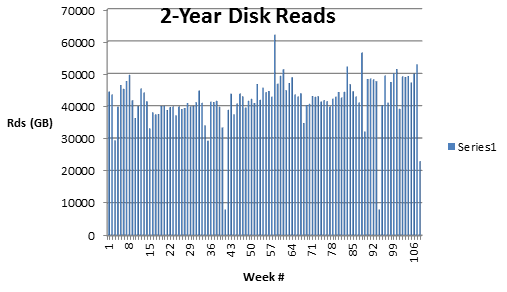
DISPLAY RESULTSAs always, I find it best to display the results graphically. In the graph below, one can see that there has only been a gradual increase in the total amount of disk reads over two years. The two large dips are apparently due to a system outage.
SUMMARY
By using our "extended" AWR tables, it's possible to get some very useful information on historical I/O. This paper illustrates just one benefit of keeping these extended tables.
Do you know how to conduct a DBA interview? Here are some good questions to ask.
August 22, 2017
No Go Zones: How Sharia Law Is Coming to a Neighborhood Near You by Raheem Kassam

NO GO ZONES describes how Western media is not fully disclosing what is happening. Both in Europe and the United States, some immigrant neighborhoods are being drastically changed, but the media is reluctant to investigate or report.
The book starts off with the author, Raheem Kassam investigating the sexual attacks in Cologne Germany. To his astonishment, the mainstream media hardly made any mention of these attacks. He was reluctant to believe that it was just being ignored:
“I was perplexed by the lack of coverage. . . My belief that this could happen almost led us to miss it entirely.”
Despite his initial doubts, Kassam was actually the one who broke the story, and then other media outlets finally joined in.
The author decided to visit various supposedly places—the reputed “No Go Zones,” in both Europe and the United States. These were said to have high concentrations of immigrants who had not assimilated, did not want to assimilate, and were hostile to their host country. The author, despite his original skepticism, did indeed find them to be dangerous places; while visiting, he was often questioned or intimidated by the inhabitants.
Besides journaling his visits to the zones, Kassam cites troubling—and scary statistics. Certain neighborhoods simply do not choose to assimilate into the surrounding culture. Moreover, they hold views that are directly hostile to their host countries. In Britain for example, polls showed that 20% of British Muslims sympathized with a bombing that killed 52 people. Similarly, 12% of young Muslims said that suicide bombings could be justified.
So all in all, I found NO GO ZONES to be an informative, well-written book—but also sort of a scary one. I found the author’s personal experiences in the No Go Zones the most interesting part of the book.
August 21, 2017
iGen: The 10 Trends Shaping Today's Young People--and the Nation by Jean M. Twenge
$17.41
By Jean M. Twenge PhD
In IGEN, Professor Jean M. Twenge summarizes the research on the next generation. There are lots of alarming findings. First off, the iGen teens do many important things less often. This includes going out with friends, working, reading—even going to parties.
Comparison to prior generations is alarming in many ways. For example, looking at teens who work, we see a drastic reduction: "The number of 8th graders who work for pay has been cut in half.”
It’s not just a matter of teens making a simple substitution of one media for another—there’s a lot more to it. Their development has been stunted. The doctor explains, “The entire developmental trajectory, from childhood to adolescence to adulthood, has slowed.”
If teens are working less, spending less time on homework, going out less, and drinking less--what are they doing? Where is their time going? The answer is not hard to find—it’s screen time:
“Teens are hanging out with their friends less, but they are not replacing that time with homework, extracurricular, paid work, or housework; they are replacing it with screen time.”
The actual time spent on smartphones is startling:
“iGen high school seniors spent an average of 2 ¼ hours a day texting on their cell phones, about 2 hours a day on the Internet, 1 ½ hours a day on electronic gaming, and about a half hour on video chat in the most recent survey. That totals to six hours a day with new media.”
This diversion of time has come with a steep price. For example, SAT scores are sliding, and compare poorly to their millennial predecessors:
“SAT scores have slid since the mid-2000s, especially in writing (a 13-point decline since 2006) and critical reading.”
The key to phones is moderation— for both teens and adults. Even experts in technology are “cautious about their kids using it too much.” The last chapter has some practical suggestions:
Find a place of moderation for how long that phone is in our hands.Don’t sleep within ten feet of your phone. (The author notes that many teens sleep next to their phone, and are interrupted by texts.)Put down the smartphone when studying or working.The author makes one point in particular that I thought was especially astute: People cannot simultaneously do serious mental work and use a smartphone. Rather, one must concentrate on one thing at a time: “The human brain cannot multitask: we can focus our attention on only one cognitive task at a time.” The iGen generation has difficulty concentrating for more than a very short time.
With all the gloomy statistics, the author nevertheless offers some hope—but it will require a marked change in behavior:
“If they can shake themselves free of the constant clutch of their phones and shrug off the heavy cloak of their fear, they can still fly. And the rest of us will be there, cheering them on.”
So all in all, I found iGen to be a well-researched, well written book. Moreover, it is an important book. The author writes clearly, and the book is easy to read. I confess I was ignorant of much of this information. Perhaps the scariest part of the entire book concerns mental health: “iGen is on the verge of the most severe mental health crisis for young people in decades.” The professor cites numerous studies linking depression with extended use of social media.
iGen: The 10 Trends Shaping Today's Young People--and the Nation by Jean M. TwengeThe Cryptic Crossword Caper: A Cozy Mystery by Russell Atkinson
In THE CRYPTIC CROSSWORD CAPER, author Russell Atkinson brings the reader a new novel--but this time with a twist. Yes, there is still a murder to be solved, but this time, the main sleuth, "Mags," is a puzzle afficiando. Mags teams up with her book club friends to solve a cryptic crossword puzzle. The group hopes that the answer to this puzzle will lead them to the murderer.

The Cryptic Crossword Caper: A cozy mystery
By Russell Atkinson
I downloaded both the Sudoku and the cryptic crossword using the URL provided. The puzzles downloaded just fine, and I was able to print out both. I had a fun time solving each; the Sudoku was pretty easy, but some of the clues on the cryptic crossword had me baffled. (What--there really is such as word, "CARGOS?")
As always, the author writes clearly and concisely. It was a nice change to have a woman as the main character (Maybe she is Cliff Knowle's sister?)
The tone of the book is lighthearted--just what one would expect from a "cozy." There is one line in the book that really made me chuckle. After a policeman is slightly injured, a neighbor cries out, "Should I call the police." The officer responds, "No, ma'am. I am the police."
So all in all, I found THE CRYPTIC CROSSWORD CAPER to be a fun read. There's no gore or violence--remember, this is a "cozy" mystery, so the murders are bloodless (well pretty much, anyway.) The puzzles were well-constructed and fair. (Well, mostly fair!)
Remember that the author is an expert at cryptography, so don't expect to just breeze through the crypto crossword. They are not "expert level," but neither are they simple. As the book club team works on the crossword, the reader can follow their logic, and glean tips on how to solve cryptograms.
Finally, I appreciate the simple declarative sentences and the clear dialogue. I have come to expect nothing less from the author. It is refreshing to see an author actually understand correct grammatical construction (e.g., no "comma splices.") I found Mr. Atkinson's latest book easy and fun to read. If you like puzzles, I think you will enjoy this book.
Advance Review Copy courtesy of Mr Atkinson
[image error]
Let's, see, "Cargos" fits . . .
The Cryptic Crossword Caper: A Cozy Mystery by Russell Atkinson
August 19, 2017
Single, Gay, Christian: A Personal Journey of Faith and Sexual Identity by Gregory Coles

I happened to spot this title at our local library. I was pretty sure what the theme would be, but I was completely, 100% in error. This book is not at all what I thought it would be. I'm glad I read this book.
SINGLE, GAY, CHRISTIAN is the story of a young man struggling to learn how he can be a faithful Christian--a sincere follower of Jesus, who has the "wrong" feelings. The author makes it clear that he didn't ask to be gay. In fact, he admits he desperately did NOT want to be gay. The author recounts the many times he prayed to be "Made Straight." Greg desperately wanted to have the "usual" desire for women--but God chose to not answer his prayer.
Fortunately, the author found a good soul and a good counselor--a pastor friend, who listened, asked questions, and didn't judge. Most importantly, this wise man told Greg emphatically, "You are not a mistake."
The author investigated the Biblical admonitions about sex. He concluded that, in order to be true to the Bible, he would have to lead a celibate life. This puts him at odds with both the Christian community, as well as the LGBTQ community. He doesn't seem to fit in either group.
Greg explains that his life as a gay Christian doesn't mean a life without love or intimacy. One shouldn't confuse sex with true love:
"Living without sex is difficult. Living without intimacy is a death sentence."
So all in all, I found SINGLE, GAY, CHRISTIAN to be an important book. The author writes well, and expressly his thoughts clearly and concisely. Gregory Coles is a brave man. I encourage leaders in the Evangelical community to read this man's struggle to be a faithful follower of Jesus.
I thought this one sentence nicely summed up the book:"
A life if longing isn't a life without happiness." On the contrary, it's a life rich with detail, alive with wonder and beauty. It's when I am happiest that I long most. And someday, when I look into the face of my Savior, I will taste the fulfillment of an intimacy a thousand times sweeter than any pale earthly imitation."
Well-stated, Brother. You are definitely NOT a mistake.

Single, Gay, Christian: A Personal Journey of Faith and Sexual Identity
By Gregory Coles
Single, Gay, Christian: A Personal Journey of Faith and Sexual Identity by Gregory Coles
Single, Gay, Christian: A Personal Journey of Faith and Sexual Identity by Gregory Cole
Single, Gay, Christian: A Personal Journey of Faith and Sexual Identity
By Gregory Coles
The author investigated the Biblical admonitions about sex. He concluded that, in order to be true to the Bible, he would have to lead a celibate life. This puts him at odds with both the Christian community, as well as the LGBTQ community. He doesn't seem to fit in either group.
Greg explains that his life as a gay Christian doesn't mean a life without love or intimacy. One shouldn't confuse sex with true love: "Living without sex is difficult. Living without intimacy is a death sentence."
So all in all, I found SINGLE, GAY, CHRISTIAN to be an imporant book. The author writes well, and expressly his thoughts clearly and concisely. I encourage leaders in the Evangelical community to read this man's struggle to be a faithful follower of Jesus.
I thought this one sentence nicely summed up the book:"
A life if longing isn't a life without happiness." On the contrary, it's a life rich with detail, alive with wonder and beauty. It's when I am happiest that I long most. And someday, when I look into the face of my Savior, I will taste the fulfillment of an intimacy a thousand times sweeter than any pale earthly imitation."
Well-stated, Brother. You are definitely NOT a mistake.
I happened to spot this title at our local library. I was pretty sure what the theme would be, but I was completely, 100% in error. This book is not at all what I thought it would be.
SINGLE, GAY, CHRISTIAN is the story of a young man struggling to learn how he can be a faithful Christian--a sincere follower of Jesus, who has the "wrong" feelings. The author makes it clearn that =he didn't ask to be gay. In fact, he admits he desperately did NOT want to be gay. The author recounts the many times he prayed to be "Made Straight."
Greg desparately wanted to have the "usual" desire for women--but God chose to not answer his prayer. Fortunately, the author found a good soul and a good counselor--a pastor friend, who listened, asked questions, and didn't judge. Most importantly, this wise man told Greg emphatically, "You are not a mistake."