Christopher Lawson's Blog, page 10
July 30, 2017
Say Zoop! by Hervé Tullet
SAY ZOOP! is a fun, creative book. Each page brings a new adventure for the child. The dots, who we find out our really "OH's," go on adventures, make friends, and invite the reader to join them. For example, "Animal Noise Time! Ready. Set. GO!" And, "Look, there's another friend! Say Waahoo! with your finger."

Many of the scenes encourage the child to make sounds, or even invent their own sounds. My favorite page is the illustration of the red and blue robot dots:
"Now in your best Robot Voice: OHOHAHAHAHAHOHAH!
The front and rear covers of SAY ZOOP! are heavy and shiny. The pages are somewhat thick, and are laminated. The inside pages are filled with a giant collage of dots.
This book was originally published in France as, "Oh! Le Livre Qui Fait Des Sons." ("Oh! the Book that Makes Sounds.") It seems like the French title actually better matches the book contents, which is all about "OH'S." One idea: Wouldn't it be fun to have both the French and English versions on hand? Maybe for learning French?
All in all, a fun, entertaining book. The artwork is simple but cute. The text is equally cute. I thought the best feature was the way the "OH's" encourage the child to get involved in tracing, touching, shouting, etc.
Don't miss the pages where you take the "Oh's" for a walk, but "Be careful, there are lots of ups and downs." (Illustration shows the dots lined up, hiking over impossibly steep peaks.)
Say Zoop!
By Herv? Tullet
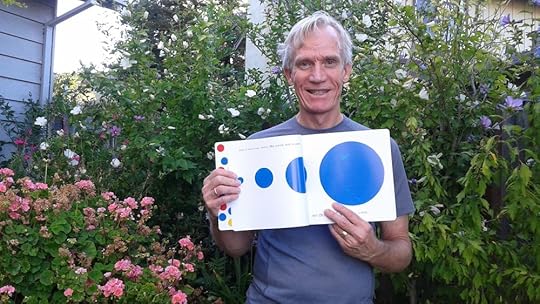
Say Zoop! by Hervé Tullet


July 28, 2017
Who Are You, Really? The Surprising Puzzle of Personality by Brian Little

In WHO ARE YOU, REALLY? Professor Brian Little presents some surprising research findings on personality. This is a fun book, and an easy read. The author writes well, and his ideas are presented clearly and concisely.
Most people think of personality as one’s attributes--such as how extroverted we are, or how detailed we are. But an overlooked aspect of personality is not just our attributes—it’s what we are DOING. This activity is identified by our “personal projects.”
The exciting part is that we can modify our projects to better mesh with our personal attributes. So, an introvert would feel a sense of accomplishment—and likely succeed, on a poetry project. (And not so much a run for political office.) By shifting to a “doing” perspective on personality, we give ourselves lots of options to improve our sense of well-being and accomplishment. We can consciously choose and adapt our projects.

We can use a general principle to select our projects:
“Projects that are “meaningful, manageable, and connected with others, and that generate more positive than negative feelings, their well-being will be enhanced.”
For example, projects that are internally motivated, rather than being done under pressure from someone else, will give us greater happiness. Ask yourself WHY you are doing a “self-help” project: “Who instigated it? If they spring from your own vision of a possible self, you are likely to feel better while pursuing them.”
Projects that are manageable, rather than chaotic also leads to greater sense of well-being. The author calls this project “efficacy.” He explains that efficacy is one of the top predictors of well-being:
“Efficacy best predicts whether a person feels that their life overall is going well.”
Although we should try to arrange projects to match our personality attributes, Dr. Little also recommends leaving a little room for chance:
“Hone your skills as the athlete you always dreamed of becoming, but be ready to change course if you begin to demonstrate a strong passion for science.”
Similarly, if you dream of writing poetry, leave the door open to writing about music.
All in all, I found WHO ARE YOU, REALLY? to be a fun, intriguing read, with some meaty ideas. I especially like the idea of being proactive in choosing projects that give me greater satisfaction. Don’t miss the Appendix, which has an interesting personality evaluation.
Advance Review Copy courtesy of the publisher.
Who Are You, Really?: The Surprising Puzzle of Personality (TED Books)
By Brian R. Little

Who Are You, Really? The Surprising Puzzle of Personality by Brian Little
July 27, 2017
The Capitalist Code: It Can Save Your Life and Make You Very Rich by Ben Stein

In THE CAPITALIST CODE, Ben Stein gives the reader some valuable money lessons. These lessons are delivered in a funny, easy fashion, and liberally sprinkled with personal anecdotes and observations.
The key point is this: Free market capitalism is an incredible machine for making wealth. Corporations “rain money” year after year. If you don’t participate, you are making a huge blunder. It doesn’t take a genius, but it does take a plan—a “little bit of knowledge and an even smaller amount of action.”
The author cites some alarming statistics, noting how poorly prepared many folks are: For example, 80% of millennials have no plan whatsoever for retirement savings. They are saving NOTHING, which the author notes is “not a formula for sleeping well at night.” Similarly, the average person says they need about $50,000 per year for retirement; but only has savings to achieve 20% of that number.
A few points along the way:
Education: “There is a clear, unequivocal , if generalized, connection between the amount of education that a man or woman achieves and the amount he or she earns.”
Spending: “You must arrange your life from the very get-go so that you are spending less than you earn.”
Picking Stocks: You don’t need to “play the market” and try to pick stocks. Just buying and holding index funds is a simple, effective method that beats money managers most of the time

The author provides a “bullet point” summary in the very last chapter of the book:
So all in all, I found THE CAPITALIST CODE to be a fun, practical read. It's a short book, and you can finish it in just a few hours. I was already familiar with the author's main points, so I didn't see any startling new ideas. Nevertheless, I still enjoyed his perspective on the subject, which he knows a lot better than me. And of course, I enjoyed his witty observations.
I thought this one line summed up the book succinctly:
“Life can be faced by moaning and complaining or it can be faced by study, work, optimism, and faith in the free capitalist system.”
Advance Review Copy courtesy of the publisher.
Capitalist Code, The: It Can Save Your Life and Make You Very Rich
By Ben Stein

The Capitalist Code by Ben Stein
July 19, 2017
How to Get Yelp Badges
Here are the standard Yelp badges, and an explanation of how to earn them.

Yelpus Maximus

Barfly
How to Get Yelp Badges
July 18, 2017
Men Without Work: America's Invisible Crisis by Nicholas Eberstadt
The points in this little book are so alarming, that I re-read the book to better understand them. On my first read, I did not fully comprehend an astonishing point the author makes (p.180):
"...For every prime-age man who is out of a job and looking for one there are three others who are neither working or looking for work."
[image error]
We like "fact based" analysis
What--this can't be! At first, I thought I had misunderstood the author--but I had not. Even after adjusting for men taking training, there are 2.5 men not looking for work for every one who is. The author points out the astonishing change in work demographics as a "revolutionary change in male attitudes toward work and dependence in postwar America."
I happened to see this little tome at my local library. I found MEN WITHOUT WORK to be a well-written book, which calls attention to an alarming problem in America. The author's charts are very helpful, although the acronyms were a little consuing for me at times.
I especially liked the latter part of the book, where two different perspectives are offered--one from a conservative, and one from a progressive.
REASONS TO READ THIS BOOKWell-written & well-arguedThe author writes in an even-handed, charitable way.Helpful charts illustrate the key pointsInclusion of differing views at end
We just skimmed the book
REASONS TO SKIP THIS BOOKJust a small amount of time given to the critique from Bernstein.I would have liked to see a more robust discussion of the points mentioned in the "opposing view" sections.
So all in all, I found MEN WITHOUT WORK to be a solid introduction to this topic. It's not an exhaustive work, but lays out the main points well. Prior to reading this book, I had no idea of the amazing change in work demographics.
Men Without Work: America's Invisible Crisis (New Threats to Freedom Series)
By Nicholas Eberstadt
Men Without Work: America's Invisible Crisis by Nicholas Eberstadt
The California Garden Tour: The 50 Best Gardens to Visit in the Golden State by Donald Olson
The CALIFORNIA GARDEN TOUR is a book designed for garden lovers. If you are not a garden lover, you probably won't even understand this book. I have been to many of the gardens featured here, and I confirm they are truly outstanding. Each garden has been an inspiring, fun trip.

The sections of the book are geographically designed. So for example there is a big section called Northern California, and of course one called Southern California. In the Northern California area, it is further divided into San Francisco & Peninsula, East Bay, Sonoma and Vicinity, and Central and North Coast.
The geographical divisions make it easy to navigate through the book. I was pleased to discover that there are many Northern California gardens close to me.

As you might expect, each garden is accompanied by a variety of color photographs, showing the highlights from that particular garden. In the San Francisco area, where I live, there's even a section on Alcatraz! I had no idea that Alcatraz would be a featured garden. I'm pretty sure that was after the prisoners were all gone when the photos were taken.

All in all, I found the CALIFORNIA GARDEN TOUR to be an inspiring, fun read. If nothing else, enjoy looking through the beautiful photographs. They are very inspiring--even the ones from Alcatraz Island.
The California Garden Tour: The 50 Best Gardens to Visit in the Golden State
By Donald Olson
The California Garden Tour by Donald Olson
July 17, 2017
How to Write a Great Book Review
Readers do not read a book review to hear how smart you are. A book review exists to help the reader make a decision, not to showcase your writing skills. Unless you are writing for the New York Times, forget about trying to impress anyone with a scholarly, or critical review.

I always try to showcase my skills
If you look at the top Amazon reviews, the highest-rated reviews are often just a few paragraphs. I know that I have a very short attention span, and I believe many readers do as well.
A book review is also not a book report. One need not provide an outline to the book, as though you had to prove you actually read the book.
We like to review romance novels
Some things to DOGet right to the review. Remember, we’re reading a book review, not a book reviewer review.Summarize the theme of the book.Identify some of the best features.Identify some of the worst features.Keep the paragraphs concise and fairly short. I just read a review that was 17 sentences long, in a single paragraph. The book being reviewed was about how to write a book review (I am NOT making this up!)Give your opinion. That’s right—explain why you liked/disliked the book.Some things to NOT DODo not blather on.Do not waste the reader’s time with an introduction to your review.Do not claim it is the “Best book you ever read” on the subject (unless, of course, it really is.)Do not interject partisan feelings; do not even HINT at them.Highlight Special Features
Finally, if there are any really unique, or helpful features in the book, be sure to call them out. For example, I recently read Men Without Work: America's Invisible Crisis by Nicholas Eberstadt. It's a concise book on the labor market. Towards the end of the book, Mr. Eberstadt includes responses from economists having different political perspectives. This latter section was really useful to me—perhaps more useful than the main body of the book.
Keep it Short and SweetWriting a good review is a lot like making a public presentation. Put yourself in the audience. Pretend you don't know much about the book. Does reading your review help you make a decision?
Uh-oh, I see I am beginning to blather. Sorry about that.

I prefer thrillers
How to Write a Great Book Review
Oracle Performance: Measuring RAC Cache Fusion Internode Time
Each RAC cluster relies on a fast private interconnect amongst the nodes in the cluster. Blocks needed by one node can quickly be sent from a node already having that block cached. This is called "Cache Fusion."
There IS a cost to sending these blocks around the nodes; the transmission is not instantaneous, and in some cases can actually become a bottleneck. Of course, the modern Cache Fusion is FAR faster than the old days of OPS, where a block had to be written to disk by one node, then read by another node. That "ping" could easily cause a 10 ms delay just for one block. Well, we are much better now!
I always blame the network
If you check the AWR report for a node on your cluster, you can see the sql that are slowed by cluster time. On the large systems I have analyzed, some sql are slowed by 10% or more due to these delays.
It is not unusual to blame "the network" for RAC performance issues. The only problem with that idea is that it's often tough to prove. So, how does one figure out how fast your Cache Fusion really is?
An Easy Way to Measure Cache FusionHere is an easy way to check the RAC internode time. One of the quickest events that Oracle uses to communicate is called the "2-way gc grant." It's normally very fast (typically 1 ms or less.) This is similar to a fast network "ping."
Here's the key point: Just think of what would happen if the time to send a block in the cluster took much longer than 1 ms. If that time doubled, for instance, your application could be seriously degraded.
We can get an historical chart, sorted by snapshot, of this fast "grant" event. In this way, you can see if RAC has been having trouble communicating amongst the nodes.

Plug-in Power
WITH BASE AS (SELECT instance_number, SNAP_ID, TOTAL_WAITS, time_waited_micro/1000 timemsec,
LAG(time_waited_micro/1000, 1) OVER (ORDER BY snap_id) AS PREV_TIME_MSEC,
LAG(total_waits, 1) OVER (ORDER BY snap_id) AS PREV_waits
FROM dba_hist_system_event
WHERE event_name ='gc cr grant 2-way'
and instance_number = 1
and snap_id between tbd and tbd
)
SELECT b.SNAP_ID, b.instance_number NODE,
to_char(begin_interval_time, 'dd-mon-yy-hh24:mi') BEG,
(TOTAL_WAITS-PREV_WAITS) "#WAITS",
ROUND((TIMEMSEC-PREV_TIME_MSEC)/(.001+TOTAL_WAITS-PREV_WAITS), 1) "RATE" FROM BASE b,
dba_hist_snapshot S
where b.instance_number = s.instance_number
andb.snap_id = s.snap_id
and (total_waits-prev_waits) > 99900
ORDER BY 1
/
In the above script, I use an analytical function, "Lag" to find the difference shown in 2 rows of the table.
Expected OutputOn most systems I analyze, the internode time is 1 ms or less. In the output below, you can see that the internode time is rock-steady at just .3 ms. In my experience, that is about the best possible.
SNAP_ID NODE BEG #WAITS RATE
--------- ---------- --------------- ---------- ----------
17236 7 13-apr-09-05:00 1942375 .3
17237 7 13-apr-09-06:00 1913682 .3
17238 7 13-apr-09-07:00 3763238 .3
17239 7 13-apr-09-08:00 2360403 .4
17240 7 13-apr-09-09:00 1694804 .3
17241 7 13-apr-09-10:00 1564779 .3
17242 7 13-apr-09-11:00 551387 .3
On a well-designed system, the interconnect rate doesn't change much. I typically see a few spikes to about 1.5 ms, but that's about it.
In the script above, be sure to put in your own snapshot_id's. Also, you may want to check the internode performance among all the nodes--not just node 1, as shown in the script above.
More InfoOf course, Cache Fusion is a lot more than just this one "grant" event. Don Burleson has a nice overview of Cache Fusion Here.
Snappy Interviews: 100 Questions to Ask Oracle DBAs
$33.99
By Christopher Lawson
[image error]
Using a Network "sniffer"
Oracle Performance: Measuring RAC Cache Fusion Internode Time
Oracle Performance: Checking RAC Internode Time
I always blame the server
It is not unusual to blame "the network" for RAC performance issues. The only problem with that idea is that it's often tough to prove.
A Better WayHere is an easy way to check the RAC internode time. One of the quickest events that Oracle uses to communicate is called the "2-way gc grant." It's normally very fast (typicall 1 ms or less.)
We can get an historical chart, by snapshot, of this fast event. In this way, you can see if RAC has been having trouble communicating amongst the nodes.
Plug-in Power
WITH BASE AS (SELECT instance_number, SNAP_ID, TOTAL_WAITS, time_waited_micro/1000 timemsec,
LAG(time_waited_micro/1000, 1) OVER (ORDER BY snap_id) AS PREV_TIME_MSEC,
LAG(total_waits, 1) OVER (ORDER BY snap_id) AS PREV_waits
FROM dba_hist_system_event
WHERE event_name ='gc cr grant 2-way'
and instance_number = 1
and snap_id between tbd and tbd
)
SELECT b.SNAP_ID, b.instance_number NODE,
to_char(begin_interval_time, 'dd-mon-yy-hh24:mi') BEG,
(TOTAL_WAITS-PREV_WAITS) "#WAITS",
ROUND((TIMEMSEC-PREV_TIME_MSEC)/(.001+TOTAL_WAITS-PREV_WAITS), 1) "RATE" FROM BASE b,
dba_hist_snapshot S
where b.instance_number = s.instance_number
andb.snap_id = s.snap_id
and (total_waits-prev_waits) > 99900
ORDER BY 1
/
On most systems I analyze, the internode time is 1 ms or less. In the output below, you can see that the internode time is rock-steady at just .3 ms. In my experience, that is about the best possible.
SNAP_ID NODE BEG #WAITS RATECustomize as Needed
--------- ---------- --------------- ---------- ----------
17236 7 13-apr-09-05:00 1942375 .3
17237 7 13-apr-09-06:00 1913682 .3
17238 7 13-apr-09-07:00 3763238 .3
17239 7 13-apr-09-08:00 2360403 .4
17240 7 13-apr-09-09:00 1694804 .3
17241 7 13-apr-09-10:00 1564779 .3
17242 7 13-apr-09-11:00 551387 .3
In the script above, be sure to put in your own snapshot_id's. Also, you may want to check the internode performance among all the nodes--not just node 1, as shown in the script above.
Snappy Interviews: 100 Questions to Ask Oracle DBAs
$33.99
By Christopher Lawson
[image error]
Using a Network "sniffer"
July 10, 2017
Naked Review How To Get Books Reviews by Gisela Hausmann
NAKED REVIEW HOW TO GET BOOK REVIEWS is a concise, well-written guide to ethical, effective ways to get people to review your new book.
Probably the best feature of NAKED REVIEW is the clear and concise writing. There is no fluff in this book. For example, page 45 covers "Asking Amazon Top Reviewers for Book Reviews." This section provides step-by-step suggestions on how to maximize your chance of getting a top reviewer to consider your new book. I found this section to be true, useful, and ethical.
Here are some areas that I thought were especially good:
The importance of getting 12 "Starter" reviews. (Hey, wait a minute--Am I one of those "starter" reviews?)
How Amazon has changed the display of reviews, giving better placement to "verified purchase."
Here's a really smart observation by the author: "Non-verified reviews will always look a tiny bit suspicious simply because Amazon does not volunteer to show them." The author has touched on a bit of a sore point for Amazon reviewers. I can vouch that her point is 100% true. (Many times my review of 7 paragraphs is not even shown, but a one-liner "verified" purchase.)
Here's the #1 tip in the entire book. The author provides a template as an example to use when emailing potential reviewers. On page 102, she suggests adding a photo of an inspirational figure in your email. This is a brilliant idea--one which I also have encouraged authors to follow.
One note/suggestion: On page 22, the author notes that Amazon restricts non-verified reviews to to 5 reviews per calendar week. I believe that is indeed the official policy, but that policy is not always followed. Amazon makes exceptions--but I don't know why or how.
So all in all, I found NAKED REVIEW HOW TO GET BOOK REVIEWS to be a helpful guide, with tons of good ideas. The author writes very well, and the book is to read. Lots of small sections for us readers with short attention spans. Keep in mind that the book is pretty short, and not intended to be an exhaustive resource on the subject.
Advance Review copy courtesy of the author.
NAKED REVIEW How to Get Book Reviews: What to do now that Amazon closed all loopholes
By Gisela Hausmann
Naked Review How To Get Books Reviews by Gisela Hausmann