Christopher Lawson's Blog, page 18
March 26, 2017
On the Run in Nazi Berlin by Bert Lewyn and Bev Saltzman Lewyn

All of us known the terrible history of what happened to Jews in WWII. That is, we know in GENERAL what happened. Of course, we know about the Nazis and their evil regime. In ON THE RUN IN NAZI BERLIN, we get to know a lot more--up close and personal. We learn how a young man--still in his teens--managed to survive a brutal regime looking to exterminate his race.
As the persecution of the Jews in Berlin intensified, the situation for Jewish people in Berlin grew desperate. Bert's parents were finally dragged away by the Gestapo--never to be seen again. Young Bert, having skill in metal-work, was required to work in an armaments factory. He and a friend were able to steal and sell motors by lowering them through a window when no one was around.

Finally, even Bert's special machinery skills were not enough to save him, and the Nazis came to take the remaining Jews away. Bert got word of this, and went underground, as a "U-Boat," as the remaining Jews were called.
As a "U-Boat," Bert lived by his wits, and was able to scrap by, living sometimes in shabby rooms, and sometimes in basements of bombed-out buildings. He couldn't be seen in public, and lived in constant fear of informants. Food was rationed, and he had to buy goods on the black market to survive. Adding to the fear was the constant bombing of Berlin by the Allies.
Perhaps the most amazing chapter describes how Bert was finally captured by the Gestapo, imprisoned, and beaten for supposedly being a spy for the British. Over a period of weeks, Dagobert, as he was orginally named, was able to create a key out of a piece of lead pipe! Eventually, he and some other prisoners unlocked a gate and escaped down a tunnel. Of course, that just meant he was on the run again as a fugitive.

Another chapter describes how the author and a friend dressed up in SS uniforms to deliver movie projectors to the Germans! They even had a car pick them up--since they were VIP's!
ON THE RUN IN NAZI BERLIN is a sobering read. It's hard to believe that these events actually happened. I can't but wonder, would I have been as resourceful as Bert Lewyn? Could I have survived in a world set out to exterminate my kind?
It is astonishing that the author survived. Of course, most didn't--including his parents. There are a few heroes in this book--kind-hearted people who opposed the Nazi regime, and were willing to hide Bert. There was also a blind communist who hated the Nazis with a passion.

On the Run in Nazi Berlin by Bert Lewyn and Bev Saltzman Lewyn


March 25, 2017
Product Review: Wall26 Mural Palm Trees on Tropical Beach
Product Review: Wall26 Mural Palm Trees on Tropical Beach
I installed the 8' wide "palm tree on tropical beach" on a wall in my garage. I smoothed the wall as best I could, but of course, a garage wall is not a smooth as a wall inside your house. Keep in mind that imperfections in the wall will show-up in the mural afterwards. Plus, they make it tough to get out all the air bubbles.
It took some patience and care to get the panels properly aligned. I used a blue "chalk like" to mark a veritical line to get me started with the first panel. The adhesive backing on each panel is like a "sticker," so you can't slide a panel around at all--you have to remove it from the wall, then re-place it. Be especially careful to NOT allow the sticky back to touch another sticky surface. I did that once, which caused me some delay.
Each panel overlaps its neightbor by about 1 inch. I found it to be tricky to make the overlap consistent.
So all in all, I was happy with the quality of the artwork and the material. Definitely takes care and patience
March 24, 2017
The Resurrection Fact: Responding to Modern Critics by John J. Bombaro
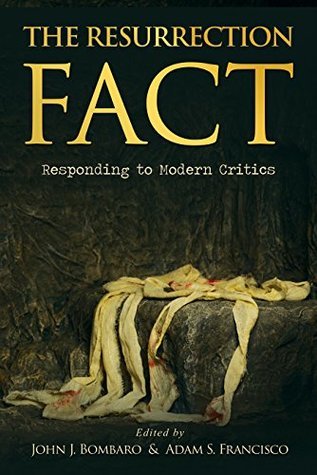
THE RESURRECTION FACT reminds me a lot of the classical works on evidential apologetics--especially the classic by John Warwick Montgomery, [[ASIN:0840756410 Faith Founded on Fact: Essays in Evidential Apologetics]]. I found the THE RESURRECTION FACT to be a well-written book, which discusses the historical evidence for key beliefs of the Christian faith--especially the Resurrection. I'm not sure I saw anything really new or enlightening, but it's a solid set of essays on classical evidential apologetics.
There's an interesting section--don't miss it! It's in Chapter 2, "Explaining the Empty Tomb." In this chapter, the author briefly mentions the question of presuppositions. In discussing Ehrman's rejection of miracles, the author notes that Ehrman starts with the presumption of naturalism, and of course, then disparages any miraculous events. Ehrman, on the other hand, accuses the Christian of believing in miracles--not because of historical fact, but just beause of their prior believe.
I wish the above subject of starting assumptions would have been explored more deeply; it's a really critical subject, which goes to the heart of apologetics. It's a little bit of a tricky subject, but worth the investment of time.
The non-believer professes to take a scientific view of history, but what is the basis for their research? On what grounds to they invetigate or come to conclusions about ANYTHING? If the universe is one giant accident, the entire foundation of science is undermined. Anything can happen at any time; there is no reason to think anything should be the same from one minute to the next. There is no "uniformity of nature."
Here's the apologetic key: An unbeliever, in order to begin to argue historical events, has to first assume the Christian's position in a God of order and design, in order to have any foundation to argue anything at all! (And of course, any basic for morality is gone surely gone down the drain as well.) If the Christian allows the unbeliever to begin discussing historical evidence, he is "giving away the store."
Anyone interested in Christian apolgetics would be wise to become familiar with presuppositional apologetics. I recommend in particular the fun read by Greg Bahnsen [[ASIN:0915815281 Always Ready: Directions for Defending the Faith]]. Probably not as much "fun" but excellent are the meaty works by Cornelius Van Til.
If you get a chance, listen to the classic audio debate on the existence of God, which took place at UC Irvine in 1985: [[ASIN:0967831776 The Great Debate: Does God Exist?]].
Advance Review copy courtesy of the publisher.
March 21, 2017
TWIRL Children's Books
TWIRL Children's Books
TWIRL Children's Books
TWIRL Children's Books
Who Thought This Was a Good Idea? And Other Questions You Should Have Answers to When You Work in the White House by Alyssa Mastromonaco

Who Thought This Was a Good Idea?: by Alyssa Mastromonaco
WHO THOUGHT THIS WAS A GOOD IDEA? is a fun, easy read. The author writes well, and I found it entertaining to get a peek "behind the scenes" with the president. Perhaps my favorite story was about how Alyssa dressed in JEANS when everyone was lining up on the White House.lawn for photos WITH ROYALTY. The president took it well, but later remarked, "Jeans?"
Lesson learned:
"When you are within 10 miles of the queen, carry a damn pair of trousers on your person at all times."
The stories are mostly pleasant--but sometimes terrifying. Honestly, I cannot imagine what it would be like with an IBS bowel problem when you going to meet the POPE! Well, Alyssa handled it with grace and style. Plus, they got her some "Presidental-strength" AD medication. The only problem--there was no water to be found. Oh well, all in a day's work.
And who knew that there were so few bathrooms in the White House?

Who Thought This Was a Good Idea? by Alyssa Mastromonaco
So all in all, I found WHO THOUGHT THIS WAS A GOOD IDEA? to be a fun, zany read. Don't worry if the politics are not your cup of tea--This isn't a political book--it's more a fun book of light-hearted memories. I wish I had been there--especially for that Pope visit.
Advance Review Copy courtesy of the publisher.
Photos courtesy of Pexels.
March 20, 2017
Deep Undercover: My Secret Life and Tangled Allegiances as a KGB Spy in America by Jack Barsky

Deep Undercover: My Secret Life and Tangled Allegiances as a KGB Spy in America by Jack Barsky
DEEP UNDERCOVER is the tale of former KGB spy-turned-American patriot Jack Barsky. Of course that name is actually the name the KGB helped him get from a dead person. They arranged for a birth certificate, making it possible for Barsky to live and work in the U.S.
The author describes in detail his childhood in East Germany, academic achievement, and eventually his recruitment away from his assumed career in chemistry. It all sounded so exciting—and of course Jack was a true communist faithful.
Jack describes how he was trained in spy craft such as, Shortwave Radio/Morse code, Cryptography, and Secret Writing. He also learned about “dead-drop” operations, where he could send/receive messages to “The Center,” short for Moscow. Although Jack did well at learning English, his trainer explained that language was only part of it:
“You must also learn how to think and feel like an American. Imagine living in their big houses and driving one of those huge cars. In order to be successful in the United States, you must think big. You must undergo a complete metamorphosis.”
He was given a complete “legend” to memorize, so that he could fake his new identity.
In America, Jack quickly got a job as a bike messenger. He was quick at the job, and began earning money to support him. He comically started his hunt for proper identification by getting an ID card at a local museum. From there, it was a library card, and so on.

Moscow wanted their young spy to get a college degree. He did so well at college that he had to give the valedictorian address. The dean would not allow him to refuse: “The irony of a KGB agent delivering the valedictory at an American business school did not escape me.”
Jack’s true identity slowly leaked out, and Moscow sent him urgent messages to prepare to leave America. The coded message read,
“PREPARE FOR URGENT DEPARTURE. WE HAVE REASON TO BELIEVE THAT YOUR COVER HAS BEEN BLOWN. YOU ARE IN SEVERE DANGER.”
Jack had a new life in American—and especially a young daughter whom he adored. He tried to ignore the summons, but Moscow would have none of it. When Jack ignored the warning, another agent warned him,
“You must come home, or else you are dead.”
The author thought of a good excuse—he couldn’t leave the U.S. because he had contracted AIDS! And they fell for it:
“I had succeeded in deceiving the mighty KGB.”
It was years later that the FBI finally closed in on Jack. They had spoken to the mother of the REAL Jack Barsky, and learned that the real Jack had passed away decades earlier. It was now clear to Agent Reilly that “they had their fish on the hook; but they had no idea how big that fish might be.” When finally detained by the FBI, Jack was cooperative, and the FBI was merciful. In exchange for Jack’s cooperation and intelligence, they allowed him and his family to remain in the U.S.
Barsky’s Christian conversion is actually a small, but meaningful part of the book. Jack had no intention of becoming a Christian, and told a colleague, “You may believe whatever you like, but please don’t think for one minute that you’ll make a convert out of me.” Nevertheless, he investigated the claims of Christianity, and slowly began to see the light. He recalls that it was like a seed being planted: “For the first time in my life, I was open to the possibility that Jesus Christ was not only a special human being but also God’s son , who had been crucified and had risen from the dead. You might say the door to faith was ajar.”
The author sums up his life in America this way: “No matter what challenges we face in our nation, as long as the beacon of freedom still shines, that’s where my home will be.” Reflecting on his conversion experience, Jack puts it this way: “Christ has taken away much of my pain, and I can live out my life on earth knowing that my sins, committed knowingly or unknowingly, have been forgiven by the enormity of his sacrifice. That is where I have landed. I am finally home.”
All in all, I found DEEP UNDERCOVER to be an interesting, but sometime sad read. It was a little depressing to read about the sad state of Eastern Europe after World War II. Perhaps the most interesting part was the account of the young spy trying to make his way in America without rousing suspicion.
In a nice touch, the Afterword is by the FBI agent who confronted the author, and later became friends with the former spy. The agent suggests that
"Our country could use more people like Jack Barsky.”

Advance Review Copy courtesy of the publisher.
Deep Undercover: My Secret Life and Tangled Allegiances as a KGB Spy in America by Jack BarskyMarch 19, 2017
Product Review: Microduino Itty Bitty City
This is the very first time I tried this product. If you're not familiar with this product line--it's quite a bit different than the more difficult Arduino system. The Microduino projects are far simpler than the "big brother" Arduino. In other words, these products are designed for younger kids.
Besides the Lego "bricks," the kit includes a varitey of sensors and display parts. For example, you use a microphone for the Windmill (it senses your hand-clap.) The sensors connect to the interconnect module via supplied cables.
I started with the first project, "The Windmill." For this first project, the software program has already been uploaded by the manufacturer to the main microduino processor; you don't need to upload the program.
PRO:
The instructions are very well done, in color. I especially liked the items needed clearly listed for each step.Each step involves adding just one layer.The product is superbly packaged . Everything is clearly arranged and identified. Clearly, a lot of though has gone into the design of this product.The beauty of this design is that no soldering whatsoever is needed. So, with some help from adults, even young children can participate.The main modules connect well. The modules are magnetic, so that they are oriented the correct way.The product worked as advertised! As you can see the windmill worked great!Con:
I had a tough time getting the lego bricks to lay flat on the bottom mat. (I did not have that problem with the main structure.)It was a little tough to get the tiny connetors onto the motor, and onto the main connection module. But with a little patience, I was successful.
So all in all, I thought this was an outstanding product. I really liked the fact that I didn't have to get out my soldering iron. Also, having the program for the very first project already installed was a smart idea. That way, you can get started really easily.
One other thing--This product is good for showing the importance of following instructions, and logical thinking. Some patience is required.

Microduino Itty Bitty City
$139.00
Microduino
Microduino Itty Bitty City
March 18, 2017
Osprey Rev 6 Hydration Pack
$78.22 $78.22
I trust this video illustrates the features of this hydration pack. I tested this pack on a long trail run, and was very pleased with how it stayed close to my body, but yet never got hot. Besides the main compartments, there are several small mesh pockets--good for small items such as snacks, phone, etc.
At first, I had accidentally purchased the Small/Medium size pack. That pack is WAY too small for a mid-sized man; I would definitely call the size "Small." Definitely get the larger size unless you are quite small in stature. Some observations:
PLUS
+ Very simple to remove the hydration bladder and fill. There is a easy-disconnect valve that you simply press to release.
+ I was able to cinch the straps to pull the pack in close to my back, so that it didn't sway or bounce around very much.
+ As with other Osprey packs, has the handy magnetic holder for the bite valve.
+ Easy to fasten the 2 chest straps.
+ As with all Osprey products, I loved the no-questions asked warranty. One of the best guarantees I've seen.
+ One pocket is actually expandable via a zipper.
CON:
- With the pack on, it's a little tough to unfold the digi-pocket, since the snap release is high, up by your neck (that is, you can't see it.) Similarly, it is a little tough to snap the button that secures your smartphone in the digi-flip compartment.
**ANY SPECIAL FEATURES?**
Yes, the "digi-flip" pocket is good for holding your Smartphone close and secure, but also making it easy to access and read the screen.
All in all, despite a few minor nits, an excellent product that I intend to use often for trail runs. I have tried several packs for trail runs, and this is the best one so far.
Osprey Packs Rev 6 Hydration Pack, Flash Green, Small/Medium
$78.22 $78.22
NOTE: No animals were harmed in the production of this video.
Product Review: 23andMe Genetic DNA Test
23andMe Genetic DNA Test
There are several different DNA tests available. Here they are, in order of popularity:
AncestryDNA: Genetic Testing - DNA Ancestry Test Kit
$99.00
Ancestry.com
23andMe DNA Test - Ancestry Service - Ethnic Composition, DNA Relatives, Neanderthal Ancestry, Maternal + Paternal Haplogroup Reports
$99.00
23andMe DNA Test - Health + Ancestry Service - 65+ Online Reports for Ancestry, Traits, Health including Wellness - Ethnic Mix - Connect with DNA Relatives - Personal Genetic Service
$199.00
23andMe Genetic DNA Test
March 17, 2017
Star Trek Cats by Jenny Parks

Star Trek Cats by Jenny Parks
Where do they get these ideas! Combining cats + Star Trek = Stroke of Genius!
Looks like these are the "real" scenes and dialogue, incluing such favorites as:
"He's dead, Jim."
"Scotty, Beam us up"
"Live long and prosper"
Star Trek Cats
$9.64
By Jenny Parks

Star Trek Cats by Jenny Parks
Well-done!.

Star Trek Cats
$9.64
By Jenny Parks
Star Trek Cats by Jenny Parks
Review Copy courtesy of Chronicle Books

Star Trek Cats by Jenny Parks