Christopher Lawson's Blog, page 5
January 10, 2018
Great at Work: How Top Performers Work Less and Achieve More by Morten T. Hansen
In GREAT AT WORK, Professor Morten Hansen reveals the results of his extensive research study, which began in 2011, and examined the activity of 5,000 workers. The author was trying to figure out exactly which factors contributed to one being an especially superior worker. The researchers whittled down the factors to just seven "Smart Practices." These seven factors, as a whole explained about 2/3 of what makes someone really effective.
The biggest factor leading to superior performance is called "Do Less, then Obsess." Great performers figure out what to NOT do. This means "Shaving away unnecessary tasks" like meetings, procedures, and useless metrics.
Perhaps my favorite section is the large chapter on the "Learning Loop." Here's the key: Spend a little time each day improving your skills. To not be overwhelmed, just "pick one and only one skill at a time to develop it." The author mentions the "10,000 hour" rule (popularized in Outliers by Malcolm Gladwell), but cautions the reader that it's not just practice of any time--it must be deliberative, focused practice.

Deliberative practice
Along with the research findings, the book includes lots of anecdotes of people who (mostly) exemplified the desired traits--but not all the stories are good ones. There is one especially sad account of one man who wanted to live his dream, but ended up losing all his money.
So all in all, I found GREAT AT WORK to be a valuable book, with lots of practical findings. I was especially interested to find that the current management fad of "collaboration" tends to reduce the effectiveness of superior employees.
The author does something really smart in this book--he includes the key points at the end of each chapter. This makes it really easy for the reader to review the main points. Professor Hansen labels the dumb idea the "Work Harder Convention," and his good ideas the "Work Smarter Perspective."

No fluff
Great at Work: How Top Performers Work Less and Achieve More by Morten T. Hansen


January 6, 2018
Joe's Table - A True Story: A Place Where Disabilities Become Gifts by Stephanie Chung

In JOE’S TABLE A PLACE WHERE DISABILITIES BECOME GIFTS, author Stephanie Chung relates the bittersweet story of her autistic son, Joseph. It was a real challenge for the entire family, but it was also a real learning experience.
The first part of the book tells the story of the author’s family, and how she met her husband. Peter was “a bachelor with an average salary who took a two-week vacation to find a wife in Korea.” Meeting at the church, Peter explained that “We don’t have a lot of time. Let me cut to the chase and ask you three questions.” Peter wanted to know if his future mate would share 1) His desire to honor God; 2) His yearning to make lots of money to support missionaries; and 3) A desire to have a big family: "When I get married, I’d like to have at least five childreWhat do you think about that?”
Well, Stephanie did indeed share his vision, and so did her mother:
“My mother’s firm belief that Peter was the one led me to marry him the following Thursday. . . Our marriage took place within a week.”
Raising Joseph was a tumultuous, tough journey. Along the way, the author learned more about the love of God, and how Joseph could actually be a missionary! She explains her discovery:
“Above all, in a world that does not willingly accept Jesus, it was incredible to discover how the Gospel bore fruit through Joseph, who could barely speak.”
Here's just one example: As a young man, Joseph especially enjoyed singing songs of praise. He especially loved the “Hallelujah Chorus” from Handel’s oratorio Messiah.
The family began a business called “Joe’s Table.” Table is really short for the Cross + ABLE. It really means Joseph is able to do everything through the power of the cross.

So all in all, I found JOE’S TABLE to be a tremendous tribute to the life of Joseph—but also a powerful lesson for us all. JOE’S TABLE tells the powerful story of how God’s love is available to us all—no matter what our ability. I thought this one testimonial really summed up the theme of this book, and the wonderful reaction of the author:
“I praise God for his abundant love, for being a Shepherd to all suffering children in the world.”
Bravo, Bravo! What a wondeful example for us all.

January 3, 2018
Crushing It! How Great Entrepreneurs Build Their Business and Influence by Gary Vaynerchuk
Readers of CRUSH IT!, published in 2009, will want to know what is different about CRUSHING IT! Here's the difference: In this new book, author Gary Vaynerchuk includes lots of case studies of folks successfully using the Crush It! principles. So this book is less of a “lecture,” and more like a "workshop" of practical suggestions. In contrast to his earlier book, Gary isn’t the only one talking:
“I want to introduce you to other entrepreneurs who have met with unbelievable success by following Crush It! principles.”
In most chapters, a great deal of space is devoted to these stories. The idea is to see how others implemented the concepts.
For readers not familiar with Gary's earlier book, in this book the author includes a summary of the Crush It principles right at the beginning of the book. I found this section to be important since I had never read the first book.
The author boils down the Crush It! principles to a pretty short list:
“What really matters is a pretty short list: intent, authenticity, passion, patience, speed, work, and attention.”

Crush principles at work
Reading this book, it soon became clear to me that CRUSHING IT! will require a TON of really hard work and sacrifice, continued for a really long time. The author has a tremendous work ethic, and encourages others to follow his example of tireless focus on developing his brand. This means little time for vacations and long coffee breaks—and hardly anything else, for that matter. I'm pretty sure I would not be able to persevere as long as Gary did.
The stories provided in this book all illustrate the passion and exertion of really successful entrepreneurs. Gary makes it clear, however, that this book is not some magic template of success, like just following 3 magic steps:
“Don’t look for a nine-step program to success here, though. I can’t give you one. The principles are universal; the path is all yours.”

No coffee breaks allowed
I most liked Gary’s discussion of “Authenticity.” This chapter really rang true to me. When I think of people who have done well in digital marketing, they always stand out as genuine. Gary makes a funny (but true) assertion about selfishness and business. He doesn’t insist your entire outlook should be focused on other people—but just enough, since everybody else is ENTIRELY self-centered:
“If your nature is at least 51 percent altruistic and only 49 percent selfish, you have a real shot at breaking out, because the vast majority of people are 70 to 99 percent selfish. . . In a world where the standard is pretty much nothing, you have to be just altruistic enough.“
There is a lot to consider in this new book, and lots of interesting stories to read. I could relate to some of the stories better than the others. I suspect many readers will focus on those stories most relevant to their personal situation.
So all in all, I found CRUSHING IT! to be a fun, inspiring read. If you are already familiar with the first book, you can probably just skim over the earlier sections of the book, since they are a recap of the original principles. It was interesting to see all the examples of successful entrepreneurs.

Authenticity
CRUSHING IT! by Gary Vaynerchuk
December 29, 2017
When: The Scientific Secrets of Perfect Timing by Daniel H. Pink
In WHEN: THE SCIENTIFIC SECRETS OF PERFECT TIMING, author Daniel Pink shares scientific, surprising findings that have serious consequences. Did you know, for instance, that the timing of your surgery is important? And if you are in court, the judge will act more leniently at certain times of day?
To work the most efficiently, it's important to figure out your own cycle of effectiveness--what the author calls "Waves of the Day." "All of us experience the day in three stages--a peak, a trough, and a recovery." Tailor your activities to match the best time for that type of task. Most people do analytical tasks better in the morning, and more insightful tasks in the evening. There is usually a poor time in the afternoon--the "trough." That time is your least effective time and "good for very little."
The author provides a simple way to figure out if you are a "Lark" (early bird) or "Owl" (late riser). Not all places are good for both types. For example, schools are setup to favor the "larks," or early-risers. This is unfortunate, since many teens are at their best much later in the day.

Probably an early-riser
The author emphasizes the importance of "restorative breaks." These are especially important during the low trough. Just a ten-minute nature walk can have an enormous impact. One Danish study showed that if students took a 20 minute break before a test, their scores were substantially higher. Here's something much more scary: A study of parole judges showed a significant difference in their rulings, based on the time of day. If your hearing was scheduled in the afternoon, good luck! However, if they took an afternoon break, they were back to their usual selves, and far more likely to grant parole. If you were unlucky enough to appear before them during the afternoon "trough," you "had essentially no chance at all."

Had an afternoon trial
Restorative breaks should ideally be outside, with nature, and away from work. It's best to be moving, and with others: "Consider a short walk outside with a friend during which you discuss something other than work."
When you start a task has a lasting effect on our attitude and our success. The author cites statistics showing the career path of graduates based on when they first started their career.
"Beginnings stay with us far longer than we know; their effects linger to the end."
So, starting anew, or a "fresh start" helps us recover from a false start. The section "Eighty-Six Days in the Year when you can Make a Fresh Start" has suggestions for starting anew. You can re-start on the first of the month, for example, or on an anniversary.

Restorative break
I found the "Science of Endings" particularly intriguing. We tend to remember events based on how they end. So, we can decide to change the ending:
"If we're conscious of the power of closing moments and our ability to shape them, we can craft more memorable and meaningful endings in many realms of life. . .
On a vacation, plan a great ending: "You'll enjoy the vacation more, both in the moment and in retrospect, if you consciously create an elevating final experience."
The same priniciple applies at work. At the end of a workday, take a few minutes to jot down your accomplishments for the day. This step of "recording what you've achieved can encode the entire day more positively." Ending the day with a moment of gratitude is a great idea. Gratitude is a "powerful restorative."
Chapter 6 has a fun set of suggestions in the concluding "Time Hacker's Handbook." You can improve your feeling of well-being by "synchronizing" with other people. For example, singing in a chorus, running in a group, joining a cooking class, etc.
So all in all, I found WHEN to be a fascinating, fun read. The author is a witty writer, who brings a lot of humor to the subject. His experience as a speech-writer is evident in the quality of the writing. I enjoyed reading about the various studies that illustrated peak times and low times. If I ever have to appear at a parole hearing, I'm definitely asking the judge to first take a "restorative break." Note: The author includes a surprising item of generiosity in the book itself. I hope you find it!

Hope it was morning surgery
December 24, 2017
Powerful: Building a Culture of Freedom and Responsibility by Patty McCord
I was very surprised by this book. POWERFUL is a short, concise book. It is also a KILLER book.
The book is written from the perspective of an HR professional. Many of the tips have to to with finding the right people, and creating a work environment that allows your great talent to do their absolute best for the company. The author cites numerous examples from her many years at Netflix to illustrate.
The author advocates ideas at variance with many traditional rules. For example, instead of trying to set pay to the industry norm, she suggests paying the TOP rate and get the absolute best people.
The book has one great feature, that I wish other books included. At the end of every chapter is a set of "bullet points" that summarize the chapter. This is called "In Brief." This really makes it easy for the reader to quickly glean and review the top points from the chapter. (Why other authors don't do this is beyond me!) There are also some "Questions to Consider" at the end of each chapter.

I don't generally get too excited about business books, how to make your company great, etc. POWERFUL was a pleasant surprise. The author is a powerhouse of solid ideas. Plus, she has the experience to back up her ideas.
Powerful: Building a Culture of Freedom and Responsibility by Patty McCordDecember 22, 2017
The Financial Diet: A Total Beginner's Guide to Getting Good with Money by Chelsea Fagan

In THE FINANCIAL DIET, author Chelsea Fagan provides a ton of practical ways to manage your money, as well as ideas on furthering your career. In the beginning pages, the author admits to her many foolish decisions as a kid. In particular, she laments this big mistake:
“The day I turned eighteen, I acquired my little card full of free money, and maxed it out within a month and a half of delirious spending.”
I bet a lot of readers can identify with the foolhardy decisions we all made when young.
The book especially focuses on suggestions for readers who are just beginning the journey on sound money management. Thus, Chelsea includes valuable tips such as, “#4. Automate What You Can Card payments, bill payments, and savings transfers should all be automatically made from your checking account. This way, you won’t tempt yourself to not save.”
The Financial Diet: A Total Beginner's Guide to Getting Good with Money
By Chelsea Fagan, Lauren Ver Hage
Here is a tip that I especially liked:
“Even if you just dedicate a few hours a month to a side job, even one additional stream of income has a huge impact.”
I’ve never really thought seriously about doing that—now I will!
Here’s another gem: Don’t slide into a “CEO lifestyle” where you tell yourself how much you deserve all the money-wasting things you buy.
There is one feature of this book that is especially commendable: Chelsea doesn’t just rely on her OWN ideas—she consults experts whom she respects for their business wisdom. So instead of just getting the perspective from the author, the reader gets advice from lots of different folks. I don’t think I’ve seen that particular format in any other personal finance book.

For example, the author consults with Bridget Casey, Award-Winning Entrepreneur, and asks her, “What are the three most important financial strategies you live by?” The author repeats this “Q&A” approach many times throughout the book. I thought this was a really wise idea.
So all I all, I found THE FINANCIAL DIET to be a surprisingly fun read—as well as a practical book. The author is a witty and funny writer. She turns a pretty dull subject into something a lot more interesting. The illustrations by Eve Mobley also add a nice touch. There is a glossary of business terms appendix.
The end of the book has a few closing exhortations to the reader. She wants the reader to figure out “What you really want out of your life— not just the “big” things, but how you want your average day to look and what you want to be doing with it. “
Good advice!

The Financial Diet: A Total Beginner's Guide to Getting Good with Money by Chelsea Fagan
The Financial Diet: A Total Beginner's Guide to Getting Good with Money
By Chelsea Fagan, Lauren Ver Hage
December 19, 2017
Oracle Performance: How Fast Can I Extract Data?

Data Pump in Action
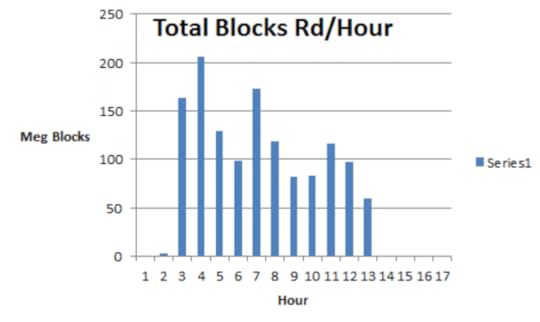
Our company needed to do a Data Pump Export of about 20 TB, using a RAC Cluster. We only had a few hours to do this, so I needed to maximize the rate of disk reads.
Finding Total ThroughputTo estimate the maximum capacity of our cluster, I checked the system metrics going back several months. I wanted to see the most disk reads in one hour for any node. It turns out that the table, Dba_Hist_Seg_Stat contains a nice metric we can use.
Here is the script I used (I've found that a little Parallelism helps a lot here):
Select /*+Leading(D) Parallel(D 8) */
S.Snap_Id,
To_Char(Begin_Interval_Time, 'Dd-Mon-Yy-Hh24:Mi') Time_Start, S.Instance_Number,
Round(Sum(Physical_Reads_Delta)/1000000) Meg_Block_Reads
From Dba_Hist_Seg_Stat D, Dba_Hist_Snapshot S
Where S.Snap_Id = D.Snap_Id
And S.Instance_Number = D.Instance_Number
And S.Snap_Id between [TBD]
Group By S.Snap_Id, To_Char(Begin_Interval_Time, 'Dd-Mon-Yy-Hh24:Mi'), S.Instance_Number
Having Sum(Physical_Reads_Delta) > 999999
Order By 1,2;
The script above yields the number of disk blocks read by Snapshot_id (in our case, hour.) This is easily converted to a chart, shown here:
It's Easy to Estimate
By using the above script to look in the past, I can see the maximum number of blocks our system has ever read. You can also group by instance, if needed.
December 14, 2017
Oracle Performance: Find Sql that are "Invisible"
It's usually easy to find long-running sql. For one thing, they show up in the first section of a typical AWR report. The cumulative runtime for all executions of problem sql are clearly shown in the "Elapsed Time" section. They will often show up in other sections as well, such as the Disk I/O or Buffer Gets sections. So normally, this is a trivial step.

I can never find those guys!
But what if the application doesn't use bind variables? In that case, there isn't any "cumultive runtime," since each sql has a different sql_id. In these cases, the sql will not show up anywhere in the AWR report. How can you spot these?
How to Spot Invisible SqlIt turns out that these evasive sql are easy to find. Here's the key: The sql statement uses the same amount of memory, even though the literal values change. Knowing this, you can do a simple query that identifies statements that have the same form.
Here's how I do it:
Select Persistent_Mem, Count(*) From V$Sql Group By Persistent_Mem Having Count(*) > 1000 Order by 2;
PERSISTENT_MEM COUNT(*)
-------------- ----------
8728 1251
1712 1621
7176 81406
Notice that in the above example, there is one form (Persistent_Mem = 7176) that is apparently run a huge amount of times. Now, run another query to identify the culprit (and cut-off at just a first few rows):
Select Sql_Text From V$Sql Where Persistent_mem = 7176 and RowNum < 5;
Invisible No More!Once you have identified the culprit(s), you can easily "roll-up" the statistics for all sql having that Persistent_Mem. You will never be fooled again!
December 13, 2017
Smart Couples Finish Rich, 9 Steps to Creating a Rich Future for You and Your Partner by David Bach
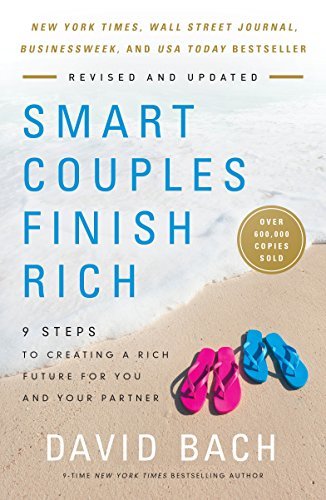
In SMART COUPLES FINISH RICH, author David Bach first explains the purpose of the updated edition. He explains that many things have changed—including tax law, investment options, and technology; he wanted to update that information.
Of course, the book has lots of financial saving/planning tips, but I thought the best part of this book was something else entirely—the question of WHY you are saving money. Bach argues that you need to figure out the things you value the most, then use your money toward that end. He explains:
“When you understand your values, you tend to live the life you really want almost automatically.”
For couples who say they can’t really save, the author has a funny idea called, “The Couples’ Latte Factor.” Bach insists that the savings problem is rarely the income; rather, it’s the spending. If you add up the cost of the morning latte, you will likely find that you could be saving money after all.
The author suggests an important exercise called “The Smart Couples’ Seven-Day Financial Challenge.” It’s a pretty basic concept, and not really anything new, but it’s still a good idea:
“Get a small pad and track your expenses for the next seven days.”
If you don’t know where you money is going, how can you save anything?

The author has an entire chapter devoted to common financial mistakes. For example, start tracking your expenses, and don’t try to time the stock market, He also cites the common blunder of not taking advantage of your company 401(k):
“If you do just one thing today after finishing this chapter, please let it be that you contact your benefits department to make sure you are truly maximizing your contributions to your 401( k).”
So all in all, I found SMART COUPLES FINISH RICH to be a well-written, solid book. The author writes very well, and comes across as a wise counselor. It’s true, the financial suggestions are mostly pretty standard, but they’re still good advice.
I thought the most valuable suggestion in the entire book was to first figure out what in life you value as a couple, and then let those values drive your money decisions. Smart idea—I’ve never thought about it that way.

Photo: Pexels/Joel Carter
Smart Couples Finish Rich, 9 Steps by David Bach
December 11, 2017
Conducting My Life: Life Lessons from a High School Music Teacher by Paul D. Everts

Paul Everts is a brave man. In CONDUCTING MY LIFE: LIFE LESSONS FROM A HIGH SCHOOL MUSIC TEACHER, the author tells the story of his journey as a high school conductor. Be forewarned: this is a tough story of what life is really like holding the baton. It’s a story of a TON of hard work, with lots of criticism and attacks, with occasional accolades.
The whole time I was reading this book, I was thinking, “Who in their right mind would want this job?” To be a high school band director, you would have to be insane, or insanely dedicated. Well, after reading this book, I’m pretty sure it’s the second option. The author explains that his goal was always clear: “I have wanted to be a high school music teacher. I have never wanted to be anything else.”
I was astonished at what Paul had to go through. Yes, there were petty parents, which I knew was par for the course. But it went a lot further than that. Some parents were not just petty—they were violent! In one case, the author actually had to hide in the choir room from one father who thought the author was “picking on my son.” (I’m pretty sure he wasn’t.)

Maestro at work
The verbal abuse was similarly intense at times. Early in his career, one rehearsal went badly, with “kids walking off the field during a rehearsal, telling me to “f*** off!” Hmmm. I’m pretty sure that’s not what the author had in mind when he envisioned his dream job.
Of course, the story is not all bad, The author also recounts times where the administration or parents really appreciated all the hard work, and the awards given.
There are funny parts as well. The author naively thought that “Visiting a Mormon Temple would have been something very positive culturally for our students.” So he had the bus drive up to a local temple. The church elders had to explain to Paul that they didn’t offer tours of their sacred site for high school kids.
So all in all, I found CONDUCTING MY LIFE to be a fascinating, yet sober read. It was tough reading about the carping and complaining directed against the author. Some fellow teachers and even “boosters” seemed to hold a grudge against him, and made it clear they “were watching him,” ready to take him down if possible. He also had to endure a false accusation from a student, who was later proven to be lying.
My favorite part of the book was Paul’s time at “Kilarney High School.” Sounds like a wonderful town.

Yes, it was all worth it.