Lucinda Elliot's Blog, page 29
November 17, 2014
Moral Transformations of a Scoundrel Through a Good Angel


At the moment I’m writing a story where the male protagonist is as wicked as Richardson’s Lovelace in ‘Clarissa’. He talks a good deal of reform, claiming that he wants a good woman to help him to reform – but sincerity isn’t exactly his strong point; as neither is a capacity for objective analysis of his own character (that isn’t easy for any of us anyway, and was a rare quality in the unselfconscious eighteenth century) his chosen good angel is in a dismal position indeed.
She is, in fact, in a similar position to Clarissa – she is being told a heap of lies by a scoundrel who delights in his own wickedness, who makes many specious promises while mentally putting off this uncomfortable reformation of character, and the uncomfortable thoughts and changes in lifestyle that must accompany it – until a more convenient time.
Well, I’m not even halfway along with this new gothic, and at the moment progressing through to the end feels like wading through treacle, but I hope to arrive their in due course. One thing is clear, though- the tone of this is a lot darker than that of either of my robber novels, and is much more like the grim humour of ‘Aleks Sager’s Daemon’.
I have in the past rambled about how reading Vulpius, Gaskell etc, and brooding on their revelation of character, especially as regards moral transformation of a ‘bad’ into a ‘good’ person, made me think again about how much revelation of a character’s’ mental life is sufficient to make that character deep and rounded without being as it were, over exposed, how much mystery there should be, how far the narrator should be omniscient in this regard, etc etc.
As I said in my last, too, the depiction by Vulpius of Rinaldo Rinaldini’s mental life and especially his becoming disgusted with his life of violence is patchy, so that he certainly doesn’t come across as a rounded character, with human weaknesses (his passion for women hardly counts). If the author had stuck to the goal of writing an exciting story, what I have seen described as ‘extrovert adventure’ that would be less of a problem – it is only because of Vulpius’ claim that his novel is ‘moral’ and his hero high minded that the reader is struck by this inadequacy.
As I have said elsewhere, this is perfectly illustrated by the fact that Rinaldini manages to be in love with three or four women at once; presumably, this surfeit of lovers is meant to arouse envy in the male reader (whether Vulpius expected to have female readers who must necessarily be less impressed with this fickleness isn’t clear). Intentionally or otherwise, by the end of the novel we still haven’t found out exactly what Rinaldini thinks about, or even what his real intentions were, towards any of these woman.
Rinaldo is, however, shown gradually becoming disgusted by his life as a ‘Captain of Branditti’ rather than suddenly transformiing as a result of falling in love with his virtuous maiden, though this disillusionment with life as a robber seems to be originally inspired by his meeting with Aurelia. At first, he appears to delude himself about how he can deceive her about his previous character if he can escape with her.
When he finds out that Aurelia is being sent to a nunnery – whether willingly or not is far from clear – he says he will ‘bring about the contrary’ and lays plans for his men to seize the carriage and bring her to him. This is foiled, however, by an attack on his band by government troops.
As I said in a previous post, his intentions when he and his band attack her wicked husband Count Rozzio’s castle are far from clear – it is uncertain whether he intends to abduct her or not – but after her plea to be allowed to join her mother in a nunnery, he escorts her there and his outburst: ‘Now I feel what I am!’ is presumably meant to indicate a dawning realisation that no idealistic girl is going to like his chosen career.
It is only towards the end of the novel, when Rinaldo is on the run from both the Old Man of Fronteja and his old associates as well as the government authorities that he seems to be willing to put much effort into breaking away from his fellow bandits – but all his efforts to escape to a life of tranquility are foiled by the ubiquitous Old Man who insists that it is Rinaldo’s fate to become a military hero. As I have said too, the moral conversion aspect is dealt with rather sketchily, but it is at least demonstrated as a gradual process.
Dislike Richardson’s Pamela as I do – and the author really has achieved something to make me dislike a young girl powerless and trapped by a lecherous employer and potential rapist – she can’t be accused of not having a vivid mental life, a defect very obvious in Mr B, the anti hero whose moral transformation she achieves.
In Richardson, as in Vulpius, a reader should expect the writer’s depiction of character to be limited by the understanding of the age in which they lived (the only exception to this limitation appearing to be – of course – Shakespeare).
As for Richardson’s rake who reforms – Mr B – he is always seen ‘from the outside’. We never know what he thinks except in so far as he reveals it through his speeches. These, for the most part, are a lot of self justifying nonsense, so one assumes his thoughts are on the same lines, along with a lot of pornographic visualisation of Pamela’s lovely bosom and ‘sweet shape’.
We see him only through Pamela’s naïve eyes, first as a black hearted wretch and then as her fiancé and ‘Dear Master’. It was fairly astute of Richardson not to include any confiding letters from Mr B in the novel; if we knew what he was thinking the plot wouldn’t work so well. Still, he remains a largely unrealized character, only just adequate for the part that he plays.
Though Mr B accepts that he has been wrong about Pamela, how far this acknowledgement of her virtue and softening towards her is meant to illustrate a general moral change is far from clear. Mr B’s moral reformation is rather questionable, like his character.
Usually, Jane Austen’s heroines are charming and a pleasure to read about. It us unfortunate that the most virtuous of them, Fanny Price in Mansfield Park, who is meant to be a personification of kindness and virtue, comes across as priggish and prudish, so horrified by the thought of an elopement that she likes awake shaking with disgust all night.
When the immoral, heartless flirt Henry Crawford (as near a character to a villain as you are likely to meet in Jane Austen, along with the ‘W’ team, Willoughby and Wickham) decides to trifle with her feelings, he ends up genuinely falling for her, a delightful touch. She is cold to him throughout, much preferring the virtuous and bland Edmund Bertram.
Yet, Henry Crawford ‘s passion for the strict Ms Price does come across as genuine – as his being persuaded into a lukewarm elopement with the former Maria Bertram does not.
I have to join with Jane Austen’s sister Cassandra in wishing that the author had brought a repentant Henry Crawford to win Fanny Prices’ grudging affection – so unfortunately, I must be open to accusations of being a romantic.
Henry Crawford’s mental processes are only vaguely touched on by the author. From what one learns of them, one gets the impression she is puzzled by such a superficial man, though heartily disapproving. His basic motivational forces seem to be a combination of vanity, cynicism and laziness.
His attempt at moral conversion seems to have been mainly inspired by a desire to win Fanny Price. We do hear that he loved her ‘deeply as well as passionately’ and that he could have won her love had he been more persistent in his attempt to be virtuous, and this gave me at least a feeling of regret that the story ends as it does.
Henry Crawford, then, is the only character in Jane Austen who comes near to being a villain who attempts a moral transformation, and he fails dismally.
Mr Darcy has a moral transformation – but he is no villain; priggish and ungracious he may be – but he is always a Good Man, though Elizabeth thinks that he is capable of treachery.
The later, infinitely less skilled (though best selling) writer of romances in the late Victorian era, Charles Garvice, portrays his characters’ mental lives almost as sketchily as Vulpius a century earlier. In that strange combination of boys’ adventure story and sentimental romance that makes up ‘The Outcast of the Family Or a Battle Between Love and Pride’ we know very little of the thoughts of Lord Heriot Fayne, the said outcast.
This hero is given a basic motivation for a rebellion which doesn’t seem to be owing to a clash of ideas but rather on a sense of outrage at being neglected by his parents.
As to what goes on his head, perhaps not much does, as we only hear of it in crisis points of the novel; for instance, when falling in love with the heroine Eva he decides that he must reform, and at once. He paces about, thinking so hard that his face becomes haggard with the unaccustomed effort. After some mental and facial contortions, he decides that he must break away from his decadent companions and their habit of drinking hard, brawling in music halls and betting on racecourses and sets off on foot to earn his living for the first time as an itinerant musician.
As I have said in an earlier post, the country air and living with country folk appears to cause a moral change in him – after a few weeks he ‘feels a change’ and stops being bad.
So that’s it – that’s the thing to do with ruffianly young men, then! Set ‘em off on a healthful tramp in the countryside as semi tramps to earn a living as buskers. Well, it makes a change from suggesting a return to the use of national service or flogging.
Leaving aside the absurdities of this peculiar cure, what is interesting here is that this popular author gives us only occasional glimpses into the workings of Heriot Fayne’s brain – and here he may be wise, for the little we do see is hardly riveting. Though the character is described as having an ‘acute gaze’ which can assess the selfishness of Eva’s father in a glance, this strange penetration isn’t accompanied by any originality of thought or moral reflection.
In fact, while Vulpius’ earlier Rinaldo Rinaldini can hold his own when discussing a moral conundrum we may be sure that Garvice’s Heriot Fayne would come out with a lot of clichés in which any idea of questioning accepted conventional moral standards would find no place. Eva is good and pure; Lord Fayne has been a naughty boy and disgraced his family; he can only find moral redemption through reverting to some state of innocence and going in for dramatic episodes of heroic self-sacrifice.
Meanwhile, Eva, though in no need of moral redemption, is also busy sacrificing herself like anything for her selfish father in agreeing to marry a man she doesn’t like, but again we only see the external symptoms of this – her white face, her dropping her head on her arms, her occasional fainting fits. As we are told she is already perfect, there can be no development of her character – except possibly in her understanding of evil in the machinations of the scheming villain which are exposed at the ending.
The moral reformation of villainous characters then, is a complex issue and difficult to portray convincingly. Did their rebellion against moral norms come as part of a general – and very likely, commendable – rebellion against convention and hypocritical moral standards? Is their violence – or their collusion in violence – any worse than that of their respectable peers? If the wicked rogue’s wish to reform is bound up with falling in love with a Conventional Good Angel, surely it must be the beginning of a long and gradual process?
When he came to write ‘Clarissa’ Richardson seems to have realized this; of course, Lovelace is meant to be morally far worse than Mr B and unlike Mr B, Lovelace ends up in raping the heroine (though I have never believed Mr B’s absurd excuses in ‘Pamela in Her Exalted Condition’ where he claims that the thought of raping Pamela never crossed his mind). Besides this he has forcefully abducted and forced himself on a woman before ‘…We loved each ohter…It’s cruel to ask a woman if she’s willing…’ This self-delusion is typical of Lovelace’s slippery character, and shows a great advance in Richardson’s understanding of character in general. This one that might well be put down to the advice of his circle of female critics and admirers (generally, and possibly mistakenly, dismissed as foolish sycophants).
The instant desire for moral transformation of Garvice’s flawed heroes (Heriot Fayne is only one of many) through the love of an innocent girl is highly unconvincing. Mr B’s moral transformation seems to have an equally questionable basis, while Henry Crawford disgraces himself by falling in love with an innocent girl and wanting to change but only making a nominal effort to reform before falling by the wayside. Shame on the cad! That did disappoint me; I would have loved to see the brilliant Jane Ausen writing about the successful moral transformation of a rogue.
Those, anyway, were some ideas that influenced me when I had my own villainous hero – Émile Dubois, decide that after meeting his ‘Goody Two Shoes’ Sophie de Courcy, he will ‘put his horrible past behind him’. It is a very difficult subject to approach with humour and a lack of sentimentality, even in a Gothic novel – but, don’t think I don’t love a story where a bad person reforms, as I do – it’s just that I like it, even in a Gothic novel, to be credible.
By the end of the story (after a striking relapse as he briefly turns into a semi monster) he has progressed far enough under the influence of ‘his angel’ Sophie to suggest to his companion in arms Georges that it is ‘High time we reformed – comparatively.’
I am a great believer in the ability of love to transform lives and to transcend social barriers of all sorts – but change for almost everyone is generally a gradual process, however dramatic the moment when a person resolves to make the effort to make that change.
So, it did seem to me that even in writing a Gothic romance a certain scepticism about how quickly the worship of a Good Angel can reform a scoundrel was in order.
Emile, of course, is only ever ‘seen from the outside’ (I used that ploy to make him the more sinister as a scheming semi monster in the middle of the novel). As a human he is generally truthful – except for to the forces of law and order -
the reader can assume that he usually says what he means and means what he says – and he his quite sincere in wanting his good angel to reform him. As an adolescent in ‘Ravensdale’ he even tells his cousin Reynaud Ravensdale that he intends to allow just such a ‘Miss Goody Two Shoes’ as Sophie to help him to undertake his reform, and in the meanwhile he owes it to this paragon to be as rascally as possible, so that she will be cheated of none of the credit for his transformation.
But Emile Dubois and Reynaud Ravensdale are essentially open hearted rogues, and have a basic respect for women. My current male lead does not, any more than did Richardson’s Robert Lovelace; and that is the difference.



November 9, 2014
Characters in John Galsworthy’s ‘The Forstye Saga’ and Simone de Beauvoir;s ‘The Blood of Others’.
 Mari Biella in a fascinating post on her blog comments on the many variables that can lead to a novel’s finding lasting fame or joining ‘The Great Slush Pile of History?
http://maribiella.wordpress.com/2014/11/07/the-great-slush-pile-of-history
I commented on this post (with dreadful typing; new keyboard, sorry) on how uninspiring I found John Galsworthy’s ‘The Forsyte Saga’.
This series remains fairly popular to this day, and I note that it is doing well in a free promotion on Amazon at the moment, though under a rather strange category, ‘linguistics’ (is this some bizarre marketing ploy, giving greater visibility to a novel by having it in a non-fiction category?).
I mused about why I found it so dull that I had to ‘plough through it’ (I’d never be so nasty about a current, living writer’s work, only his or her category; but this being a sort of classic, and the author long dead – and if he is listening, now in such a higher state of consciousness that literary criticism will slide of his form like water – as with Charles Garvice, I feel that I can be fairly outspoken).
The answer is, of course, simple. Not only did I not find the characters sympathetic, but they didn’t come alive for me, and I’m one of those readers for whom the characters being vivid matters a lot in a novel of that sort; obviously there are many genres where it doesn’t matter very much at all.
Of course, in some novels, as Mari Biella commented on another post, you can have a couple of vivid characters – like Van Helsing and the Count in ‘Dracula’ – who carry along a supporting cast of ‘lay figures’ and it doesn’t detract from the interest at all. But that tends to apply to extrovert adventure, not to novels of emotional or moral conflict.
It isn’t necessary, of course, for a writer to create characters who are likable, or even recognisably human or empathic, but they do have to be interesting (Richardson’s Lovelace is fascinating, though for his treatment of Clarissa alone it’s impossible to like him; Count Dracula is of course, an enigmatic monster and anything but dull). While many others would clearly disagree, I couldn’t find Galsworthy’s main characters much more stimulating than Dickens’ notoriously one dimensional heroes and heroines.
Irene is very unfortunate in having made a rash marriage to such an unattractive man as Soames. We are never told why she did so until very late on in the series, but it seems it was to escape an unhappy home background. Stuck with a husband she finds physically repellent, she succumbs to the temptation of a love affair with his architect Bossiney.
Bossiney, whose motives and individuality is never revealed, is engaged to her relative by marriage June. Irene doesn’t ever express any guilt over this blithe piece of poaching. While I wasn’t inclined to blame her for wishing for embraces more tempting than those of the rebarbative Soames, I did blame her for never expressing any remorse about the wrong she did to June.
But then Irene is treated by Galsworthy in such a partisan way that it is obvious that the character is based on his own wife, and his faith that nobody would recognise her because he had changed her hair colour rather touchingly naïve.
Of course, she is in the dreadful position of a trapped wife in the Victorian era, when marital rape wasn’t accepted as a crime. Soames subsequent door kicking down rape following her locking him out of her bedroom arouses the readers’ outraged sympathy (though this story being subject to the censorship of the times, none of the ugly details are given). However, it is only here that the character of Irene came at all to life for me. Of course, Irene is perhaps meant by Galsworthy to be elusive; she is always presented externally (with a constant emphasis on her hair and eye colour).
Bossiney is a cardboard character; quite why Irene is so besotted with him, except as a welcome relief from Soames, is never explained. He refuses to respond to June’s desperate attempts to communicate with him about his emotional withdrawal. If he had, he could have disentangled himself from the unwanted engagement; perhaps he is protecting Irene’s reputation; if so, he fails to protect her in any other way. He leaves her living in her marital home, and takes no positive action at all after the rape, merely staggering about London in a state of shock, finally to fall under the wheels of a tram (it’s unclear whether in the pea souper this is meant to be an accident or a suicide).
Young Jolyon is a feeble rebel who later marries Irene himself, having already disgraced himself by marriage to his children’s former governess, who conveniently dies early.
The characters of the later generation, Jon, Fleur, Michael Mont and Jon’s wife Anne aren’t particularly interesting or rounded; Jon comes across to me as weak, but as we see him after an eight years’ absence working as a strikebreaker in the General Strike, with my political views, I’d hardly be likely to take to him. Fleur is depicted as selfish, but again is trapped in a loveless marriage, though her husband, for all his odd political views (he believes that the working class should, for its own good, be subject to mass deportation to the colonies) is quite a nice fellow. Altogether, I was nearly as relieved to finish the third volume as I was to reach the top of Snowdon (no, I didn’t attempt both simultaneously).
By contrast, I found the characters in Simone de Beauvoir’s ‘The Blood of Others’ came startlingly to life for me, introspective and given to effortless discussion on Existentialist themes as they are.
There is an aspect of this novel that left my puzzled; why ever do the heroine Helene’s bourgoise parents allow her to be engaged to a working class, active communist like her dull but worthy fiance through whom she meets her beloved Jean Blomart? This improbability is never explained. Overall, though, I found it a wonderful read; and what I love most of all is that at the end not only do the estranged heroine and hero at last discover reach other emotionally, but all the main characters realize their own worth through involvement in a cause greater than themselves – the French Resistance.
This novel is of course, an exploration of the issues of personal responsibility and the consequences of individual action and inaction in the context of the build up to World War II, the Nazi invasion, and the activities of the French Resistance.
These themes are depicted through the main characters, and in particular the relationship of Helene Betrand and Jean Blomart (I apologise for leaving out the French symbols – I still haven’t worked out how to do it on wordpress).
Jean is a man who seems emotionally frozen, and who finds any sort of action a cause of tortured self doubt. Similarly, though, he finds any inaction equally subject to moral scruples; all this leads to his cautious life of rebellion against his bourgeois upbringing . He works in a print shop and though a trade union activist, his actions are intended to be ‘non political’; he conducts a passionless love affair with a woman whom he admits he wouldn’t miss if she left his life, though he treats her with remarkable respect for a man of that era: – ‘I’ve never been capable of passion. I dither about between my guilty conscience and my scruples: my one and only aim is not to dirty my hands…’
This seems partly a consequence of Jean’s guilt feelings over the death of his friend Marcel’s younger brother, whom he encouraged to join in violent political action. He feels that he won’t be able to love the teenage Helene, who has become wildly infatuated with him, as he ought; he does all he can to avoid starting a love affair with her until he is trapped into it.
Helene, by contrast, is committed to her desires; she is summed up quite well by the remarks of a shocked critic in The Tatler:- ‘Helene, the little shop girl, wild as a hare with the morality of a pirate is…enchanting’. She is in fact an artist though she works sometimes in the family confectionary. When we first see her she is deciding to steal a bicycle she covets, and at first her feelings for Jean are of the same order (though emotionally repressed, his sexual attraction comes clearly through the text).
Coerced into a relationship through the horror of witnessing Helene’s abortion (where Jean shows that he is startlingly lacking in squeamishness – a sign of things to come, when he evolves into an excellent member of the Resistance) – he fears telling a lie in saying that he loves her as he doesn’t feel he is in love with her in the passionate way that she is with him.
In fact, given her wild charm, physical attractions and adoring attitude towards him, it would probably be quite hard for a man not to fall for her, and it seems obvious to me, if not to all readers, that he loves her all along.
Naturally, the themes of alienation, of ‘nothingness’ are unswervingly explored in this novel; in Simone de Beauvoir, nothing is ever simplistic; the problems of Helene and her friend Denise stem partly from their basing their happiness on a man’s love, but this is part of a larger problem of a lack of commitment to any moral stance of value.
There are wonderfully sensitive descriptions in the book; here Helene is looking forward to escaping through love making with Jean from thoughts of their friend Denise’s lapse into insanity (she lives with an eccentric but insensitive artist who would be guaranteed to drive any woman insane): -
‘During the whole day he had escaped her; in his past, in his thoughts, near his mother and Denise, scattered throughout the whole world. And now he was there, against her flesh, under her hands, under her mouth: to be with him, she let herself slip, without memories, hopes or thoughts, into the depths where time stopped…’
The war encroaches; Jean won’t accept Helene’s attempt to get him freed from military conscription; they part, and at one time Helene even does trade with the invaders; but finally, seeing the deportation of Jews to Germany stirs her outrage and she abandons selfish desires, joins the resistance, and finds true love with Jean after all.
I found this part of the book particularly moving. It was so fulfilling that they had at last found each other through the act of self abandonment to a higher cause: -
‘”You’ll be in danger and I shan’t be near you; I cannot bear that,’ he said.
“You’ll always be near me,” she said. “Distance doesn’t matter; you are always near me.”
He put his arm about her shoulders, and she laid her cheek against his.
“You’re right,” he said. “Now, nothing will separate us, ever.”
“You know,” said Helene, “I was frightened during the first trips. Now I’m so happy that I can’t be frightened any more.”’
“My dear love,” he said.’
I’m glad that it is apparent from the text that they have been working together some time, and have discovered this mutual love and been happy before this, Helene’s fatal trip. I wish de Beauvoir had given us a bit more of a description of this happiness, as she gave us a fairly detailed one of their emotional separation.
Years ago, as a youngster, I naively asked someone, ‘Why do bad things always happen to the characters in books who you care about?’
Well, this was obviously an oversimplification: bad stuff went down with Bossiney, and I didn’t care two straws about him. But you can be as sure that there‘s a happy ending n store for the emotionally scarred Duke of Wendover and his spirited miller’s daughter bride in ‘The Devilish Duke’s Dark Desires’ (part 12). (I just made that up: I hope there isn’t a book out there called that!).
“Depends on the genre,” said my informant, laconically (like one of the cowboys n a Zane Grey novel). “Light fiction equals happy endings; the good stuff is often surrounded by gloom and doom. Not escapism, you see.’
As a matter of fact, I don’t see why writers of light fiction shouldn’t work hard to create characters you care about, and Byronic heroes are only sympathetic when they drop the pose for a while. Finally, though, I see that whether we can care about the fate of characters in a story or not, whether it’s an existentialist novel or an ambitious series challenging the social order or a paranormal romance, depends on the little human touches they are given, the care with which they are portrayed, and that huge imponderable, the reader’s individual reactions to them.


Characters in John Galsworthy’s and Simone de Beauvoir
Mari Biella in a fascinating post on her blog comments on the many variables that can lead to a novel’s finding lasting fame or joining ‘The Great Slush Pile of History?
http://maribiella.wordpress.com/2014/11/07/the-great-slush-pile-of-history
I commented on this post (with dreadful typing; new keyboard, sorry) on how uninspiring I found John Galsworthy’s ‘The Forsyte Saga’.
This series remains fairly popular to this day, and I note that it is doing well in a free promotion on Amazon at the moment, though under a rather strange category, ‘linguistics’ (is this some bizarre marketing ploy, giving greater visibility to a novel by having it in a non-fiction category?).
I mused about why I found it so dull that I had to ‘plough through it’ (I’d never be so nasty about a current, living writer’s work, only his or her category; but this being a sort of classic, and the author long dead, as with Charles Garvice, I feel that I can be fairly outspoken).
The answer is, of course, simple. Not only did I not find the characters sympathetic, but they didn’t come alive for me, and I’m one of those readers for whom the characters being vivid matters a lot in a novel of that sort; obviously there are many genres where it doesn’t matter very much at all.
Of course, in some novels, as Mari Biella commented on another post, you can have a couple of vivid characters – like Van Helsing and the Count in ‘Dracula’ – who carry along a supporting cast of ‘lay figures’ and it doesn’t detract from the interest at all. But that tends to apply to extrovert adventure, not to novels of emotional or moral conflict.
It isn’t necessary, of course, for a writer to create characters who are likable, or even recognisably human or empathic, but they do have to be interesting (Richardson’s Lovelace is fascinating, though for his treatment of Clarissa alone it’s impossible to like him; Count Dracula is of course, an enigmatic monster and anything but dull). While many others would clearly disagree, I couldn’t find Galsworthy’s main characters much more stimulating than Dickens’ notoriously one dimensional heroes and heroines.
Irene is very unfortunate in having made a rash marriage to such an unattractive man as Soames. We are never told why she did so until very late on in the series, but it seems it was to escape an unhappy home background. Stuck with a husband she finds physically repellent, she succumbs to the temptation of a love affair with his architect Bossiney.
Bossiney, whose motives and individuality is never revealed, is engaged to her relative by marriage June. Irene doesn’t ever express any guilt over this blithe piece of poaching. While I wasn’t inclined to blame her for wishing for embraces more tempting than those of the rebarbative Soames, I did blame her for never expressing any remorse about the wrong she did to June.
But then Irene is treated by Galsworthy in such a partisan way that it is obvious that the character is based on his own wife, and his faith that nobody would recognise her because he had changed her hair colour rather touchingly naïve.
Of course, she is in the dreadful position of a trapped wife in the Victorian era, when marital rape wasn’t accepted as a crime. Soames subsequent door kicking down rape following her locking him out of her bedroom arouses the readers’ outraged sympathy (though this story being subject to the censorship of the times, none of the ugly details are given). However, it is only here that the character of Irene came at all to life for me. Of course, Irene is perhaps meant by Galsworthy to be elusive; she is always presented externally (with a constant emphasis on her hair and eye colour).
Bossiney is a cardboard character; quite why Irene is so besotted with him, except as a welcome relief from Soames, is never explained. He refuses to respond to June’s desperate attempts to communicate with him about his emotional withdrawal. If he had, he could have disentangled himself from the unwanted engagement; perhaps he is protecting Irene’s reputation; if so, he fails to protect her in any other way. He leaves her living in her marital home, and takes no positive action at all after the rape, merely staggering about London in a state of shock, finally to fall under the wheels of a tram (it’s unclear whether in the pea souper this is meant to be an accident or a suicide).
Young Jolyon is a feeble rebel who later marries Irene himself, having already disgraced himself by marriage to his children’s former governess, who conveniently dies early.
The characters of the later generation, Jon, Fleur, Michael Mont and Jon’s wife Anne aren’t particularly interesting or rounded; Jon comes across to me as weak, but as we see him after an eight years’ absence working as a strikebreaker in the General Strike with my political views, I’d hardly be likely to take to him. Fleur is depicted as selfish, but again is trapped in a loveless marriage, though her husband, for all his odd political views (he believes that the working class should, for its own good, be subject to mass deportation to the colonies) is quite a nice fellow. Altogether, I was nearly as relieved to finish the third volume as I was to reach the top of Snowdon (no, I didn’t attempt both simultaneously).
By contrast, I found the characters in Simone de Beauvoir’s ‘The Blood of Others’ came startlingly to life for me, introspective and given to effortless discussion on Existentialist themes as they are.
There is an aspect of this novel that left my puzzled; why ever do the heroine Helene’s bourgoise parents allow her to be engaged to a working class, active communist like her dull but worthy fiance through whom she meets her beloved Jean Blomart? This improbability is never explained. Overall, though, I found it a wonderful read; and what I love most of all is that at the end not only do the estranged heroine and hero at last discover reach other emtionally, but all the main characters realize their own worth through involvement in a cause greater than themselves – the French Resistance.
This novel is of course, an exploration of the issues of personal responsibility and the consequences of individual action and inaction in the context of the build up to World War II, the Nazi invasion, and the activities of the French Resistance.
These themes are depicted through the main characters, and in particular the relationship of Helene Betrand and Jean Blomart (I apologise for leaving out the French symbols – I still haven’t worked out how to do it on wordpress).
Jean is a man who seems emotionally frozen, and who finds any sort of action a cause of tortured self doubt. Similarly, though, he finds any inaction equally subject to moral scruples; all this leads to his cautious life of rebellion against his bourgeois upbringing . He works in a print shop and though a trade union activist, his actions are intended to be ‘non political’; he conducts a passionless love affair with a woman whom he admits he wouldn’t miss if she left his life, though he treats her with remarkable respect for a man of that era: – ‘I’ve never been capable of passion. I dither about between my guilty conscience and my scruples: my one and only aim is not to dirty my hands…’
This seems partly a consequence of Jean’s guilt feelings over the death of his friend Marcel’s younger brother, whom he encouraged to join in violent political action. He feels that he won’t be able to love the teenage Helene, who has become wildly infatuated with him, as he ought; he does all he can to avoid starting a love affair with her until he is trapped into it.
Helene, by contrast, is committed to her desires; she is summed up quite well by the remarks of a shocked critic in The Tatler:- ‘Helene, the little shop girl, wild as a hare with the morality of a pirate is…enchanting’. She is in fact an artist though she works sometimes in the family confectionars. When we first see her she is deciding to steal a bicycle she covets, and at first her feelings for Jean are of the same order (though emotionally repressed, his sexual attraction comes clearly through the text).
Coerced into a relationship through the horror of witnessing Helene’s abortion (where Jean shows that he is startlingly lacking in squeamishness – a sign of things to come, when he evolves into an excellent member of the Resistance) – he fears telling a lie in saying that he loves her as he doesn’t feel he is in love with her in the passionate way that she is with him.
In fact, given her wild charm, physical attractions and adoring attitude towards him, it would probably be quite hard for a man not to fall for her, and it seems obvious to me, if not to all readers, that he loves her all along.
Naturally, the themes of alienation, of ‘nothingness’ are unswervingly explored in this novel; here Helene is looking forward to escaping through love making with Jean from thoughts of their friend Denise’s lapse into insanity (she lives with an eccentric but insensitive artist who would be guaranteed to drive any woman insane): -
‘During the whole day he had escaped her; in his past, in his thoughts, near his mother and Denise, scattered throughout the whole world. And now he was there, against her flesh, under her hands, under her mouth: tobe with him, she let herself slip, without memories, hopes or thoughts, into the depths where time stopped…’
The war encroaches; Jean won’t accept Helene’s attempt to get him freed from military conscription; they part, and at one time Helene even does trade with the invaders; but finally, seeing the deportation of Jews to Germany stirs her outrage and she abandons selfish desires, joins the resistance, and finds true love with Jean after all.
I found this part of the book particularly moving. It was so fulfilling that they had at last found each other through the act of self abandonment to a higher cause: -
‘”You’ll be in danger and I shan’t be near you; I cannot bear that,’ he said.
“You’ll always be near me,” she said. “Distance doesn’t matter; you are always near me.”
He put his arm about her shoulders, and she laid her cheek against his.
“You’re right,” he said. “Now, nothing will separate us, ever.”
“You know,” said Hleene, “I was frightened during the first trips. Now I’m so happy that I can’t be frightened any more.”’
“My dear love,” he said.’
I’m glad that it is apparent from the text that they have been working together some time, and have discovered this mutual love and been happy before this, Helene’s fatal trip. I wish de Beauvoir had given us a bit more of a description of this happiness, as she gave us a fairly detailed one of their emotional separation.
Years ago, as a youngster, I naively asked someone, ‘Why do bad things always happen to the characters in books who you care about?’
Well, this was obviously an oversimplification: bad stuff went down with Bossiney, and I didn’t care two straws about him. But you can be as sure that there‘s a happy ending n store for the emotionally scarred Duke of Wendover and his spirited miller’s daughter bride in ‘The Devilish Duke’s Dark Dilemma’ (part 12). (I just made that up: I hope there isn’t a book out there called that!).
“Depends on the genre,” said my informant, laconically (like one of the cowboys n a Zane Grey novel). “Light fiction equals happy endings; the good stuff is often surrounded by gloom and doom. Not escapism, you see.’
As a matter of fact, I don’t see why writers of light fiction shouldn’t work hard to create characters you care about, and Byronic heroes are only sympathetic when they drop the pose for a while. Finally, though, I see that whether we can care about the fate of characters in a story or not, whether it’s an existentialist novel or an ambitious series challenging the social order or a paranormal romance, depends on the little human touches they are given, the care with which they are portrayed, and that huge imponderable, the reader’s individual reactions to them.
November 1, 2014
The Thin Line Between the Frightening and the Ludicrous in Gothic

Dr Polidori wrote ‘The Vampyre’ perhaps the earliest British vampire story, for the competition set by Shelley and Byron and for which Mary Shelley wrote ‘Frankentstein’.
Dr Polidori wrote ‘The Vampyre’ perhaps the earliest British vampire story, for a competition set by Shelley and Byron and for which Mary Shelley wrote ‘Frankenstein’. Given the competition the unfortunate medic had to take on, and the fact that they all seemed to conspire to regard him as a figure of fun, it was brave of him to enter at all, and I believe only he and Mary Shelley completed their stories.
When the others ridiculed the lurid prose of ‘The Vampyre’, they had a point; but Byron and Mary Shelley can hardly escape the same charge in their own work, albeit much less crudely presented.
One of the great problems with the Gothic genre, and horror and ghost stories generally, must be the danger of the horrific so easily descending into the ludicrous, just as drama can so easily become melodrama, and pathos become bathetic.�� Even so skilled a writer as Elizabeth Gaskell, with her love of the dramatic, often falls into that trap.
I used to be frightened in my early teens by the horror stories of HP Lovecraft (which I found in a series of some old paperbacks belonging to my parents, called, I think, ���The Fontana Book Great Ghost Stories���; there seemed to be lots of these) . In tales such as ���The Haunter of the Dark��� the alarming theme of covert alien invasion and mind control used to give me a real sense of horror.
In one, however, the ominous suddenly degenerated into farce.���� In this story, a boy born to an unnatural mating between one of these aliens and an unfortunate human girl was breaking into a library where a version of ���The Necromican��� was held under lock and key (too bad for him there wasn���t any Amazon back then).
He was attacked by a watchdog, which tore his trousers (how humiliating, as if he was a post worker or common burglar) and inflicted fatal wounds. He was discovered by the staff, gradually turning into a pool of goo, but the lower half of his body (visible through the said ripped trousers) was truly inhuman.
This made me laugh so much that these dismal stories’ nightmare world of an encroaching, seemingly irresistible threat never perturbed me in the same way again.
A fellow blogger has pointed out to me that these stories were often published in ���pulp magazines��� and the editors often changed text as they felt like it.
No doubt this accounts for the bathetic ending to this particular story, but is a fine example of how the alarming can easily degenerate into the absurd.
This is sometimes the case with classic Gothic literature, for instance, ���The Monk��� ���Varney the Vampire��� and the first vampire story of all, ���The Vampyre��� by the above Dr Polidori, Lord Byron���s then personal physician (this story is often wrongly attributed to Byron himself).
I personally think that Byron and his friends were too dismissive of the originality of Dr Polidori���s contribution to this contest which led to Mary Shelley creating ���Frankenstein��� but it has to be conceded in that piece, the high flown, florid style is so solemn that it leaves itself open to satire.
There are unintentionally funny bits in those two classic Gothic tales ���Frankenstein��� and ���Dracula���. In ‘Dracula’ I found that the scene where Jonathan Harker sees the Count carrying out the ‘low task’ of setting the table absurd, when clearly it is meant to comprise a moment of horrific recognition on Harker’s part – that he and the Count are in fact alone together in the inaccessible castle.
If that flawed masterpiece, ���Wuthering Heights��� can be classed as Gothic, the melodrama sometimes turns into bathos, as when Cathy in a fit of temper with Edgar writhes on a sofa, ���grinding her teeth as though she would turn them into splinters��� (as someone once said, I paraphrase freely).
These tales make wonderful reads, particularly on a dark winter’s night, if possible with an open fire, schooner of sherry and hot mince pie to hand (but a radiator and a cup of tea will do just as well). I remember my delight on first discovering them.
Yet, just as writers can learn from these classics strengths, so they should from their weaknesses. Writers of Gothic are a little more aware of the thin nature of that line between the terrifying and the ridiculous today.
As I love a laugh above anything, I make a point when writing Gothic myself of depicting the terrifying and grotesque as also horribly ludicrous. Fear and laughter, the sad and the comic are anyway often so closely related that I have never found it possible to ���write straight faced���.
Then again, I can���t resist having the characters sometimes commenting on the Gothic nature of their own adventures.
Lord Ynyr (to his ex chef, who has just tried to convince him that his favourite cousin ��mile has turned into a Man Vampire): I have to remind you, Lucien, that we are not now in a Gothic novel.
Lucien: That is hard to remember, Your Lordship, down at Plas Gwyn.


The Thin LIne Between the Frightening and the Ludicrous in Gothic
Dr Polidori wrote ‘The Vampyre’ perhaps the earliest British vampire story, for the competition set by Shelley and Byron and for which Mary Shelley wrote ‘Frankentstein’.
Dr Polidori wrote ‘The Vampyre’ perhaps the earliest British vampire story, for a competition set by Shelley and Byron and for which Mary Shelley wrote ‘Frankenstein’. Given the competition the unfortunate medic had to take on, and the fact that they all seemed to conspire to regard him as a figure of fun, it was brave of him to enter at all, and I believe only he and Mary Shelley completed their stories.
When the others ridiculed the lurid prose of ‘The Vampyre’, they had a point; but Byron and Mary Shelley can hardly escape the same charge in their own work, albeit much less crudely presented.
One of the great problems with the Gothic genre, and horror and ghost stories generally, must be the danger of the horrific so easily descending into the ludicrous, just as drama can so easily become melodrama, and pathos become bathetic. Even so skilled a writer as Elizabeth Gaskell, with her love of the dramatic, often falls into that trap.
I used to be frightened in my early teens by the horror stories of HP Lovecraft (which I found in a series of some old paperbacks belonging to my parents, called, I think, ‘The Fontana Book Great Ghost Stories’; there seemed to be lots of these) . In tales such as ‘The Haunter of the Dark’ the alarming theme of covert alien invasion and mind control used to give me a real sense of horror.
In one, however, the ominous suddenly degenerated into farce. In this story, a boy born to an unnatural mating between one of these aliens and an unfortunate human girl was breaking into a library where a version of ‘The Necromican’ was held under lock and key (too bad for him there wasn’t any Amazon back then).
He was attacked by a watchdog, which tore his trousers (how humiliating, as if he was a post worker or common burglar) and inflicted fatal wounds. He was discovered by the staff, gradually turning into a pool of goo, but the lower half of his body (visible through the said ripped trousers) was truly inhuman.
This made me laugh so much that these dismal stories’ nightmare world of an encroaching, seemingly irresistible threat never perturbed me in the same way again.
A fellow blogger has pointed out to me that these stories were often published in ‘pulp magazines’ and the editors often changed text as they felt like it.
No doubt this accounts for the bathetic ending to this particular story, but is a fine example of how the alarming can easily degenerate into the absurd.
This is sometimes the case with classic Gothic literature, for instance, ‘The Monk’ ‘Varney the Vampire’ and the first vampire story of all, ‘The Vampyre’ by the above Dr Polidori, Lord Byron’s then personal physician (this story is often wrongly attributed to Byron himself).
I personally think that Byron and his friends were too dismissive of the originality of Dr Polidori’s contribution to this contest which led to Mary Shelley creating ‘Frankenstein’ but it has to be conceded in that piece, the high flown, florid style is so solemn that it leaves itself open to satire.
There are unintentionally funny bits in those two classic Gothic tales ‘Frankenstein’ and ‘Dracula’. In ‘Dracula’ I found that the scene where Jonathan Harker sees the Count carrying out the ‘low task’ of setting the table absurd, when clearly it is meant to comprise a moment of horrific recognition on Harker’s part – that he and the Count are in fact alone together in the inaccessible castle.
If that flawed masterpiece, ‘Wuthering Heights’ can be classed as Gothic, the melodrama sometimes turns into bathos, as when Cathy in a fit of temper with Edgar writhes on a sofa, ‘grinding her teeth as though she would turn them into splinters’ (as someone once said, I paraphrase freely).
These tales make wonderful reads, particularly on a dark winter’s night, if possible with an open fire, schooner of sherry and hot mince pie to hand (but a radiator and a cup of tea will do just as well). I remember my delight on first discovering them.
Yet, just as writers can learn from these classics strengths, so they should from their weaknesses. Writers of Gothic are a little more aware of the thin nature of that line between the terrifying and the ridiculous today.
As I love a laugh above anything, I make a point when writing Gothic myself of depicting the terrifying and grotesque as also horribly ludicrous. Fear and laughter, the sad and the comic are anyway often so closely related that I have never found it possible to ‘write straight faced’.
Then again, I can’t resist having the characters sometimes commenting on the Gothic nature of their own adventures.
Lord Ynyr (to his ex chef, who has just tried to convince him that his favourite cousin Émile has turned into a Man Vampire): I have to remind you, Lucien, that we are not now in a Gothic novel.
Lucien: That is hard to remember, Your Lordship, down at Plas Gwyn.

October 23, 2014
Charles Garvice as an Influence on the Modern Romantic Novel – and Caught out by Garvice’s Devices
 In my last post, I admitted to a terrible thing – I have actually been able to read four more of the novels of Charles Garvice after re-discovering that one I snorted through at fourteen – ‘The Outcast of the Family Or a Battle Between Love and Pride’.
Since then I’’ve read ‘His Guardian Angel Or Wild Margaret’ , ‘Only One Love Or Who was the Heir’, ‘The Woman’s Way’ and ‘Just a Girl’. Admittedly, I’ve done it when suffering from migraines, but still, Laura Sewell Matter’s inability to get through one after the first surely shows a more respectable taste in reading material; frequent migraines only excuse so much.
I’m sorry to say, I’ve always had a weakness for the tacky, the melodramatic, the lurid and the ridiculous ( that’s why I write spoof Gothic). I revel in badly written ghost stories ‘The Haunted Saucepan’ b by Marjorie Lawrence, anyone? ) I loved the Hammer House of Horror films. I love too absurd epics with cardboard characters, anachronisms and dramatic lines delivered in flat voices. I rather envy people whose tastes are rather more elevated, and who have no desire to pursue such stuff.
I said in my last post how there are several characteristics that unmistakably define a Charles Garvice hero. These include: -
1. Astounding good looks and wiry physique
2. Skill as a boxer
3. An ‘indefinable air of command’
4. Being closely related, usually the heir, to an Earl
and
5. Being a fully paid up, card holding member of the Anti
Dog Kicking Society.
Also -
6. The open hearted fellow is almost always afflicted with
an underhand relative or friend, often after his inheritance or
lady love or both and secretly working against him.
I’ve even become blasé about recognizing these, and other of Garvice’s Devices – for instance, the Heroic Sacrifice: here either the hero agrees to sacrifice himself for the heroine, perhaps in taking the blame for some piece of caddishness done by the sneaking fellow above (typically, ‘ruining’ a young girl) or even, a crime (in ‘The Woman’s Way’ the hero takes the blame for a forgery).
Often this leads to his flight from the country and a series of Boys Own type adventures abroad (working on a ranch, joining a circus).
Anyway, in ‘Just a Girl’ (written in 1898 and Garvice’s first international bestseller) I was startled when the author seemed to be straying from his normal rigid rules. The heroine, Esmeralda, who lives in the wilds of Australia, happens to come upon an obviously aristocratic, reckless and gallant young man with striking blond good looks; he’s fallen from his horse in a fainting fit after being shot in the leg by a caddish opponent to whom he gave a drubbing after – naturally, seeing him kick a dog.
This of course, set off the levers in his brain, and he had to punish the mean spirited coward, who then proved himself even more despicable by staggering from the floor to shoot at his back as he galloped off.
‘Ah, here we are. The hero…’ I said to myself; but I was puzzled when he was slower than Esmeralda at shooting and firing at the coward, who’s been following him (Esmeralda, brought up in a mining camp, is very gung-ho for a Garvice heroine, and can shoot and ride with the best of ‘em).
The cad, obviously a passionate defender of his right to ill treat dogs, had sneaked after young Lord Norman to kill him off. As he had was still fairly dizzy, perhaps Garvice had excused him from not being the first to see and shoot down the enemy, but this seemed to me an interesting reversal of sex roles, and I even began to wonder if I had done Charles Garvice an injustice, and he was capable of doing this. After all, this had to be he hero- he’d defended a dog.
But then , I realised, he couldn’t be – unless Garvice was breaking all the rules – as the miners in the camp all take to him, but though young Lord Norman is strong in the arms, refer to him as ‘Rosebud’ on account of his almost girlish golden haired good looks.
Surely a man subjected to this humiliation couldn’t be the hero – surely none of Garvice’s heroes could ever be mistaken for a girl – though a scene follows where Lord Norman shows astounding pluck when they get out the bullet from his leg, not even wincing. When he runs a fever, Esmeralda has only to place one cool hand on his fevered brow, and that soothes him into sleep.
Yet, despite these telling scenes, I couldn’t believe that anyone nicknamed ‘Rosebud’ could ever be a Garvice hero, and here I was right. Soon, Lord Norman is telling Esmeralda (with whom the poor fellow has fallen wildly in love) of his cousin, Trafford the Marquis, who is tall, dark, capable of knocking down a man with a straight one from the shoulder, all muscle and not an ounce of fat, with whom all the ladies are madly in love.
That could only be the hero – whom no man would dare to call a girlish name, or indeed, any sort of name without incurring one of those stunning blows straight from the shoulder – and I realised my mistake; I’d allowed myself to be diverted from the standard requirements of a Charles Garvice hero by the episode of canine championship and reckless courage; this only shows that Lord Norman is a pretty good sort and can be prepared to do the right thing in the end, which he does, in putting his aside his love for Esmeralda when he sees that she can’t return his feelings.
Esmeralda, as a missing heiress, soon ends up in England and in love with Lord Trafford herself, while he wonders if he can bring himself to do such a shabby thing as marry so fresh a girl for her money…
I was disappointed after that beginning! I actually thought Garvice was going to go in for some gender role reversal, and give us a wiry and impulsively brave, but rather effete looking hero who didn’t always shoot first. No such luck…
Ah, and I do have some sort of excuse for reading Garvice. You see, like Laura Sewell Matter’s pursuit of the missing pages of ‘The Verdict of the Heart’, it’s a form of research (looks about guiltily). I’m interested in the history of the development of the modern romantic novel.
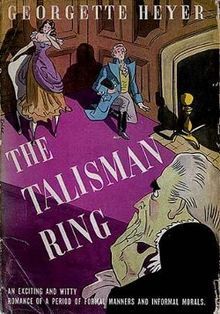
Even when I was an unreflective fourteen, I could see that Charles Garvice had written an earlier form of the romantic novel of the twentieth century. During that period of being snowed in at home in isolated rural North Wales, I also read, as I have said, one Barbara Cartland novel about a Disgraced Earl turned Highwayman (I’ve forgotten the title of that). I also read two early Georgette Heyer novels ‘The Black Moth’ and ‘The Talisman Ring’ – about respectively a Disgraced Lord turned Highwayman and a Disgraced Earl turned Smuggler .

In both the influence of Charles Garvice (who was the best selling novelist of their youth) was immediately obvious.
The bold, careless, swaggering young scapegrace hero, the innocent heroine, the mean attempts of the underhand relative to frame the said hero for his own crimes, the sentimental tone, are all there. In these early Heyer novels, there are even,albeit in a far less crude form, those elements of adventure to be found in Chalres Garvice.
Georgette Heyer didn’t, so far as I know, admit her debt to so low brow an influence as Charles Garvice. She preferred to point to the influence of Jane Austen – but Jane Austen didn’t write about Disgraced Earls turned Highwayman (Willoughby in ‘Sense and Sensibility’ is the nearest thing to that, and he doesn’t have a title or take to the road).
Charles Garvice is the unacknowledged ancestor, so far as I can see, of a substantial element of the tradition of the Historical and Regency Romance . However, my researches continue, and I may be able to add another name to the list of these; I think there was a writer of singularly lurid novels of the eighteenth century called Eliza Heywood, whom I intend to investigate next.
I said in my last post that I hoped that the outlook of women, their tastes and aspirations had developed just a little since 1890. I still do; but I can empathize with a wish to delve into foolish, predictable escapism.
Laura Sewell Matter in her witty and perceptive article on Charles Garvice ‘Pursuing the Great Bad Novelist’ says of the ‘attenuated state’ which Thomas Moult suggested was the cause of the craze for Garvice’s novels in the trench warfare of World War One: –
‘What Moult and the other critics failed to acknowledge, but what Garvice knew and honoured, are the ways so many of us live in emotionally attenuated states, during times of peace as well as war. Stories like the ones Garvice wrote may be low art, or they may not be art at all. They may offer consolation or distraction rather than provocation and insight. But many people find provocation enough in real life, and so they read for something else. One cannot have contempt for Garvice without also having some level of contempt for common humanity, for those readers – not all of whom can be dismissed as simpletons – who may not consciously believe in what they are reading, but who read anyway, because they know that a story can be a salve.’


October 16, 2014
Yes, I admit it – I’ve read some more of Charles Garvice – adds quickly, ‘Don’t worry, I can handle it, I can give it up at any time…’

 In a previous post, I mentioned how I’d done some exploration of the novels of that most mawkish and critically lambasted, but outstandingly popular of the romance writers of the late nineteenth and early twentieth centuries, Charles Garvice.
This writer interested me, because he seems to me to be at least in part the inspiration for many of the plot devices and character types of later romance writers.
I first came across a novel by Charles Garvice which my mother had got as part of a job lot of other Victoriana in an auction. This book, wonderfully named ‘The Outcast of the Family Or a Battle Between Love and Pride’ I skim read in between pacing the corridors during a spell of being snowed in at fourteen in rural North Wales. I was astounded even then by the sheer badness of the writing, the wonderful combination of sentimental love scenes and wild melodrama, the cardboard characters, the wildly improbable co-incidences and the solemn, moralising tone.
Recently, I remembered it, and my fellow writer Thomas Cotterill was kind enough to track it down for me, and I read it through, guffawing now and then. Since then I have been sampling more of this most prolific of author’s output. I’ve found a page on Charles Garvice on Wickipedia, with some wonderful covers posted (that one for ‘Lord of Himself’ is particularly lurid).
I also found a very amusing article ‘Pursing the Great Bad Novelist’ by Laura Sewell Matter on how she became intrigued by the output of this shamelessly commercial writer. In it, she comments on the astoundingly predictable nature of the plots: – ‘Little beyond the heroine’s hair colour differentiates one from another’. But they sold incredibly, making Garvice a fortune; his readership swallowed his predictable twaddle and begged for more. During the horrors of trench warfare in World War One, it even found a wide male readership in soldiers, for whom any form of tenderness, of a story with a predictably happy ending, must have been comforting.
A fellow writer assured Garvice that he would be forgotten; this has proved true; almost nobody has heard of him today; but he replied by pointing to a seaside crowd on a beach; ‘They’re all reading my novels.’ This was true as well.
One reader, though, may have literally torn his writing apart, for Laura Sewell Matter found some pages of one of his books, washed up on a beach in Iceland…
Ms Matter found it impossible to finish another one after being initially fascinated by the absurd melodrama on the few sea washed and seaweed covered pages of ‘A Verdict of the Heart’ which she found on that beach . To finish it, she had to travel to the British Library. On looking into others, though, she discovered that they are tediously similar, with the same stock characters and clumsy plot devices churned out again and again.
Yet, she finishes her article by remarking that on beaches today, women will be reading the works of romantic novelists who use the same plot devices and weary formulas (laughing all the way to the bank).
As someone who had hoped that women had moved on a little in their world view, aspirations and tastes since 1890, I find that a little disturbing. But I have to admit the truth of it.
I’m either proud or ashamed to admit that I have actually managed to read through three more of Garvice’s ‘predictable melodramas’ since rereading, ‘The Outcast of the Family’, which as an impatient teenager I skimmed through. I’ve been able to do this through suffering from migraines, when anything of a fine literary nature would be beyond me, anyway.
So, I’ve explored the purple prose and melodramatic joys of ‘Wild Margaret Or His Guardian Angel’ (I couldn’t resist a book with a title like that) ‘Just a Girl’, ‘Only One Love, Or Who Was the Heir’ and ‘The Woman’s Way’.
I’ve also dipped into a good few more. There’s some delicious titles, and it’s only a shame that the lurid dust jackets have largely been lost. There’s ‘A Heritage of Hate’, ‘Her Humble Suitor’ ‘A Life’s Mistake Or Love’s Forgiveness’ and ‘Her Heart’s Desire’. I mustn’t forget ‘Edna’s Secret Marriage’.
I wouldn’t write reviews on these ones I’ve only dipped into, as (pulls a prissy face) while I’m about ninety-nine point five per cent sure of what my opinion of them would be if I read them through, I can’t be sure. In those missed out pages they might surprise me yet…
On this unlikely surprise, more in the second part of this post. For the moment I’d like to write of Garvice’s Plot Devices. While I wouldn’t comment on their individual merit without reading them through, I think it’s fair enough to comment on some similarities I have found in the text of the ones I have read through, which are all startlingly alike.
These invariably include an innocent heroine, and a wild spendthrift of an heir to an Earldom who is manly and open hearted, but has a sad reputation. He is greatly disapproved of as a rule by the currrent incumbent of the title, and has often been castg offf. Often he’s in disguise as someone of a lower status (in ‘The Outcast of the Family’ Heriot Fayne is even mistaken by his true love for a tramp, but he takes this disguise further than the others).
Anyway, you’ll know him as the hero by four things; he’ll be very handsome, a skilled boxer,he’ll have an ‘indefinable air of command’ and he won’t tolerate any sort of ill treatment of dogs (a shame he didn’t come across Heathcliff when he was hanging that spaniel). If he sees any of that, he’ll roll up his sleeves and give the perpetrator a drubbing, and then apologise to the heroine for brawling in front of her.
There is the scheming relative after this true specimen of British manhood’s prospects or his true love, sometimes both. This nasty piece of work gets up to all sorts of mean tricks, and sometimes isn’t even a relative, but a so-called friend. He sometimes, but not invariably, ill treats animals and has pale eyes, but he can be quite nice looking. One thing, however, gives him away; unlike the open hearted hero, he is calculating and thinks too much. By contrast, when the hero of ‘The Outcast of the Family’ spends the afternoon thinking, his handsome face is haggard with the unaccustomed effort.
In ‘The Outcast of the Family’ the villain frames the hero for a murder he did himself; in ‘The Woman’s Way’ likewise for a forgery; in ‘His Guardian Angel’ he sets him up as a bigamist…
Sometimes, he’s in collusion with another of Garvice’s stock characters, the scorned woman who loves the handsome, dashing hero obsessively. Sometimes she’s a distant relative and society catch who’s intended for him until he casts himself at the feet of the innocent heroine; sometimes she’s an actress of shady character who is eager to claim he seduced her or married her and left her. Sometimes, there’s both of these types persecuting the happy pair at once, led on by the villiain of the piece. Not as if the said hero has acted caddishly by any women of dubious reputation, of course; he’ll have paid them off handosmely; but she can’t bear to let him escape from her clutches into married bliss with the sweet young girl, who is almost invariably his social inferior.
Often the hero may save the heroine, or the heroine’s dog (who needs the RSPCA with such men about) from a bolting horse. He is often placed lying in the heather for just such a fortuitous appearance.
Quite often the hero tries to escape his financial problems following his squandering of a fortune – or his tormented love for the heroine – by going to seek a different sort of fortune abroad. Both Jack Carter in ‘Only One Love’ and Heriot Fayne in ‘The Outcast of the Family’ work their way to South America as sailors, where they contact malaria and arrive back home looking very unwell, but still eager to denounce the villain of the piece, rescue the sweet heroine from his clutches, and give him a drubbing, if necessary.
Heriot Fayne leaves his devoted manservant waiting for him in his London house while he goes on this adventure, and we never hear about him again; it is to be hoped he didn’t eke out the rest of his days waiting for his master’s return. Such oversights seem to be rare in Garvice; usually, he winds up the loose threads neatly, and through a series of wild co-incidences, the main characters are all brought together for a final dramatic confrontation. Poetic justice dogs the villains, so that Stannard Marshbank, as high as a kite on ‘chloral’, falls into the very quarry in which he pushed his victim, and some of the dishonest women who have duped the hero and heroine alike sink into an unspecified decline, presumably triggered by shame.
So, when I turned to the novel that confirmed Garvice’s reputation as a best seller in the US, ‘Just a Girl’ I expected to be able to predict the plot. But I didn’t, quite.
Garvice actually surprised me! But more of that in my next post.


October 7, 2014
The (Must Have) Devoted Follower in the Classic Robber Novel


 The dashing hero – or anti hero – of classical robber novels has to have a Devoted Follower. It’s a must have accessory.
For instant Rinaldo Rinaldini has the ruffianly Ludovico. Pushkin’s Dubrovsky, by contrast, is spoilt for choice – all his band, who consist of his former serfs, are devoted. Perhaps the former blacksmith Arhip is best fitted for the role.
George Orwell in ‘Homage to Catalonia’ described the sort of man perfectly, I think – ‘The sort of man who would commit murder and die for a friend’. Personally, I have a great deal of sympathy for such an attitude – I find it in some ways far more understandable than cold calculation, a limited loyalty and an aloof moral attitude.
Accordingly, my own characters Émile Dubois and his cousin Reynaud Ravensdale, must have a devoted fellow scoundrel, too.
Georges Durrand is a handsome with his curly black hair, flashing dark eyes, devastating profile and muscular build, and can’t get over it. His self indulgent philandering in the days in Paris when he and Émile are running rival groups of robbers is notorious.
Just as the cynical Émile meets his fate in his ‘Miss Goody Two Shoes’ Sophie de Courcy, so Georges meets Sophie’s pretty, Tarot reading maid. Both of them, however, give in to temptation with another woman and accordingly end up as Man Vampires, and a menace to the women who they love.
I must admit, I thought Georges would have more admirers than he has acquired so far – unless women readers who find him appealing prefer to keep quiet about having a liking for such a ruffian (true, Émile is very violent, too, but his savagery is to some extent diluted by his intellect – Georges might be called an ideal type of a ruffian).
On the same topic, some readers have said how they admire Émile for going in to a fight to the death with Kenrick and his own devoted follower Arthur Williams to protect Sophie and the other women in his household; this when he knows as he does, having lost most of his inhuman strength that the chances are massively against him.
Yet only a couple of reviewers have commented n the heroism Georges shows when he joins Emile in that desperate fight; for while it’s certainly partly through devotion to Emile – and to protect all the women in their house, too – it’s mainly to protect Agnes, who at this point refuses to have anything to do with him.
Georges deserves some credit for unselfish devotion…
While Georges, though no intellectual, is a suitably efficient and unscrupulous partner in crime, fellow bandit and highwayman for Émile, Émile’s cousin Reynaud Ravensdale, another highwayman (the family is rather given to taking up that occupation) is a good deal less lucky in his own Devoted Follower, Jem Higgins, otherwise known as Longface. Longface is ineffectual, and has the most infuriating habit of leading the thief takers and Bow Street Runners directly to his master. Ravensdale longs to get rid of him…



October 3, 2014
‘Ravensdale’ and ‘That Scoundrel Emile Dubois’ Free on Oct 4, 5 and 6 And Some Random Ramblings on Capitalisation
The adventures of Reynaud Ravesnsdale, aka Mr Fox, and Emile Dubois, otherwise known as Monsieur Gilles, are to some extent linked and when doing a giveaway I decided to do it for them both on 4,5and 6 of October.
Somebody once congratulated me on ‘how your links never come out’. Let’s hope there’s no cause for congratulation this time.
‘Ravensdale’ is on Amazon at
http://a-fwd.com/s=lucinda+elliot+ravensdale&asin=B00JSPXQV8
while his cousin That Scoundrel Emile Dubois is on
http://a-fwd.com/s=lucinda+elliot+scoundrel&asin=B00AOA4FN4
Whew! That’s exhausted my IT skills for the day…And I got it wrong first time, and it had kindly to be pointed out to me how to include the ASIN’s…
Moving on to some rambling, readers have asked me why put in seemingly unnecessary capitalisations. Some love it, some hate it, but as to why I use them – I borrowed or stole the idea – however you want to put it – from the writer of the early and mid twentieth century Patrick Hamilton.
I loved this style of emphasizing the cliches of everyday speech, the threadbare and stereotypical archetypes of much conventional thought, when I first encountered it in his masterpiece ‘The Slaves of Solitude’.
I’ve quoted from that book in this blog before, so this time, I’ll quote from another of his, ‘Twenty Thousand Streets Under the Sky’ an earlier work which follows the fates of a barman come aspiring writer who becomes wildly infatuated with a young ‘sex worker’ Jenny, the dismal experiences of his fellow bar worker Ella, who in turn worships him, and the story of how Jenny came to ply the trade she does.
Patrick Hamilton’s writing focuses on the loneliness and dreariness that he found in a life that drove him to drink and an early death. To some extent he is the male counterpart of his contemporary, the writer on isolated women Jean Rhys, and he can rival her for gloom; his comedy is always dark. Still, his ability to see he absurd linked with the tragic was outstanding. For instance, here is Jenny expounding on her relationship with a man she once knew: -
“Well, one day,” she continued, settling down comfortably into her story, ‘I was walking about – just not far from here – when Up comes a Lady to speak to me. Oo, and she was a lady, too – all lovely fur coat and everything. An’ she asks if she can speak to me, as she’s something to say, like. An she takes me round the corner, like, an she says, ‘Now I want you to tell me what Relationship you Bear t my husband.’ she says. ‘You and I know all about that sort of thing,’ she says, ‘an’ I simply want you to tell me quite straight,’ she says, ‘An’ I’ll make it Worth your While.’ she says. See?” Bob saw…
Patrick Hamilton’s work has largely sunk into obscurity, save perhaps his classic plays turned into films, ‘Rope’ and ‘Gaslight’. ‘Twenty Thousand Streets Under the Sky’ was also made into a film, but that has largely been forgotten.
In 2005 this work was shown as a four-part series on Channel Four,and also released as a DVD. Sadly, this did not spur a large renewal of interest in his work, but his astonishing talent for minute, tragi-comic observation was exceptional, and his disappearance from the public knowledge is a great loss.
To return to what J B Priestly called Hamilton’s use of ‘Komic Kapitals’, a final, historical note…In the eighteenth century, it was the custom routinely to capiatalise many nouns, which is why my characters also do it in their letters, as I think this adds a certain vigour to them lacking our bland modern communications. However, as modern editions of the novels of this time tend to standardize spelling, grammar and punctuation according to modern notions, many readers remain unaware of this one time custom.
So, Now I Am Looking Forward to a Cup of Tea…


September 25, 2014
A Message of Hope from Kenrick to his many admirers
I have received a couple of requests for another communication from this tedious place in the beyond to which I was summarily ejected, along with my man Arthur Williams by that Scoundrel Emile Dubois.
That scoundrel, a murderous ruffian who once lived organising the criminal activities of a group of cut throats in the gutters of Paris has despatched me to this place where I must stay if I wish to avoid leaving the surrounds of Earth altogether.
And the manner of that despatch – a knife whipped from a topboot and hurled at my chest in the course of a vulgar brawl. It seems that this was the party trick of a Gallic villain rejoicing under a name which roughly translates as ‘Marcel Sly Boots’.I cannot forgive that.
It could, I suppose, have been worse; I might have been killed by his brutish manservant, another savage ruffian. That honour was reserved for poor Arthur. To be killed by a lackey! That would be a disgrace indeed.
I refuse to subject myself to such an indignity as the one I understand will be required of me if I were to leave this place to venture into the beyond. As I first left my body I heard a whisper that I had nothing to fear; that I would be treated compassionately.
Goronwy Kenrick, the great experimenter, ‘treated compassionately’?
‘Damn your eyes!’ With Arthur Williams’ favoured vulgar oath, I fled to this place.
I am in a laboratory here, with sufficient resources to amuse myself;.
I work on strange beings, whom I cook up with from a noxious mix of green jelly; clumsy, misshapen, grotesque, they are the stuff of nightmares. But they move, they exist, they may yet talk…
I have Arhur help me sew up their skins. He objected to this as ‘women’s work’. I asked him what woman was to hand to do it? He sulked; he wishes to return himself. We do not exactly relish each other’s company. He is anxious to see the second Mrs Kenrick; I gather she is re-united with her baby. I have never been keen on nursery visits myself.
On the subject of human increase, I do have some access to life in the world of the flesh here; for instance, every time Gilles Long Legs’ former poor relative, now Madame Dubois prays for me, I know of it. I see the presumptuous chit.
What a ludicrous contrast that pair do make in their characters: – the one a complete villain, the other the sole of virtue. She is now increasing, but waddles purposefully to drop heavily on her knees by her bed every night and pray for her enemies. Sometimes the ruffian comes in, candle held aloft, to interrupt her. “I trust you pray for me, my angel? Keep on with the good work; if you keep at it for a hundred years, you might yet make me a good man.” They gaze on each other with stupid adoration; what fools humans are.
You may wonder about whether I have seen the first Mrs Kenrick, my only love? No; for she was another of these tediously good women, and I must undergo the humiliations I mentioned above before we can be re-united.
I hate that Dubois villain; I swear I will be revenged. All is not over yet.
I work out my future plans. These do not involve giving up my identity as Mr Kenrick of Plas Cyfeillgar quite yet.