Lucinda Elliot's Blog, page 33
December 7, 2013
Blog Hop

Jenn Roseton – who does well written and highly sensual romance –
http://jennroseton.blogspot.com.au/2013/12/blog-hop.html?zx=79acb5912b5019d9
– was kind enough to make me one of her blog hopper’s, so I have some questions to answer.
1. What are you working on now?
My temper? Reforming into a worshipper of the status quo? After all, followers of this blog will know that my last reading matter was a sentimental Victorian novel about a reformed rebel.
That apart, as I have said a few times, I’ve been working on a spoof historical romance (and I didn’t type ‘hysterical’ that time) on the tired theme of Disgraced Earl turns Brigand due to the machinations of a Conniving Cousin and Rival in Love, and hence my reading sentimental Victorian novels (looks about guiltily, gnawing nails), as I remembered that as a perfect example of a melodrama on that theme.
‘Ravensdale’, then, which I’ve just sent off to my writing partner – the wonderful and overworked Jo Danilo- is a comedy set during the French Revolution, in 1792, just two years before ‘That Scoundrel Emile Dubois’ and is in fact about Reynaud Ravensdale, Emile Dubois’ cousin and childhood companion in delinquency.
Wrongly accused of killing one of his best friends, he becomes a smuggler and later, a highwayman (as Emile later does). Returning to the country to see his debauched father in his last illness, he runs into the strapping, hoydenish Isabella Murray, the one young women in the district who doesn’t find him a romantic figure. Becoming fixated with her, he goes in a ludicrous disguise of fussy wig and glasses to apply for a post as librarian in her house, where he can feel bliss by ‘gazing upon your face’.
Meanwhile, her social climbing parents are anxious to marry him off to his cousin (naturally) and he is eager to rescue her from such a fate.
But Isabella doesn’t want to be rescued by any man; she wants to be a Gentlewoman of the Road…
2. How’s it different from other work in the genre?
I’d say through the ironical treatment of the theme, through revelling in the use of cliche. I hope, as ever, to give readers a good laugh. Also, more than anything when reading various treatments of the Jealous, Conniving Cousin framing his handsome rival the Earl’s heir – it seemed to me that mere pecuniary motives weren’t sufficient – the intensity of the relationship between the two cousins, which often seemed more intense than that of their relations with their women love object – was neglected, or swept to one side, possibly, as Not Very Nice and too deep a topic for a romance, historical or otherwise.
In Robert Ravensdale, I am depicting a man motivated by a tormented and unrequited love that has dismal consequences for everyone.
2. Why do you write?
I seem to be driven to. I think that’s a common answer. I sometimes think that what a peasant woman from the eighteenth century called
‘writing down lies’ is very strange.
4. How does your process work?
I don’t know myself! I come by some idea and gradually it builds up. I think about it when doing prosaic things, like washing floors, gardening, etc.
I write in longhand in a notebook first thing in the morning, before and during my early morning tea. I always admire people who get 1,000 words a day done. That would be an exceptionally good day for me, I do about four hundred on average. Later I type it up.
I did suffer from dreadful writers block on ‘Ravensdale’ and it took me about a month to get over it, more, in fact. I simply didn’t see how I could get all the characters lined up for the finale, but it came to me in the end,and then I wondered how I’d had so much difficulty. It was the same with ‘That Scoundrel Emile Dubois’ and ‘Aleks Sager’s Daemon’. The first two thirds go swimmingly for me, but that last third is like swimming through a marsh (or worse) as distinct from gliding through a warm sea.



December 2, 2013
Disinherited Earls and Conniving Cousins


I had read some of the classic robber novels as a background for my spoof ‘Ravensdale’ ie ‘Rinaldo Rinaldini’ by Vulpius, ‘Dubrovski’ by Pushkin, and Schiller’s drama ‘The Robbers’ (geek, or what?).
‘Ravensdale’ is on a theme beloved by writers of historical romance ‘The Disgraced Young Earl, Condemned by his Previous Wild Reputation, Assumed Guilty of Murder Turns Brigand, partly due to Wicked Machinations of Conniving Cousin’. I remembered that this
theme, which of course, was the basis of Schiller’s ‘Die Rauber’ had featured in various novels by Georgette Heyer – off the top of my head, ‘The Black Moth’ ‘The Talisman Ring’ and no doubt others, and also in Barbara Cartland novels, ie ‘The Knave of Hearts’ .
Yes, at fourteen, during a spell of being snowed up in the Clwyd Valley, North Wales, I did manage to read these. I have to say that apart from the titles, I only remember the vague outlines to the stories…
During this spell of snow bound boredom, pacing restlessly through the unheated unnecessary rooms and long gloomy passages of the house where my family then lived, I also came across another book on the bookshelves, which my mother had to some extent furnished with books bought in job lots at auctions which she attended in search of Victoriana; it was called ‘The Outcast of the Family Or a Battle Between Love and Pride’ and was by one Charles Garvice.
It was purely terrible. Lurid melodrama, sentimental beyond belief,
a sort of Mills and Boon Taken to Extremes meets Boy’s Own Circa
1894. Snorting with merciless teenage derision, I leafed through its pages.
As this long forgotten work by a once best selling and prolific author is precisely about a Young, Wild and Disgraced Earl framed for murder by the dastardly scheming of a Conniving Cousin, I remembered it and decided to re-read it recently. For all I know, the book I read might still be up in the declined remains of my family’s property in North Wales somewhere, but a cyber friend Thomas Cotterill tracked down a much scrambled digital version for me. I have to say, if I hadn’t roughly known the melodramatic plot before, I would have found it difficult to read.
Here is my ‘Goodreads’ review.
‘…I found it even more ridiculous this time round; while I love a melodramatic read full of cardboard characters and absurd co-incidences, as for instance, Vulpius’ ‘Rinaldo Rinaldini’,somehow, I couldn’t enjoy this, absurd as it was.
I am also in a quandary; if this was a modern author, I would mark down as a matter of course to a one star rating anyone who displayed such awful anti Semitism and snobbery; but as one has to judge writers by the time in which they lived and unfortunately, a good deal of otherwise good writing of the late nineteenth century was marred by these ugly features – I am being generous, and awarding it a two and a half star rating (which will show up as a three). Unfortunately, besides having these defects this isn’t good writing either- it’s purely dreadful and sometimes not even grammatical.
Ms Matter in her fascinating article on Garvice, ‘Pursuing the Great Bad Novelist’ is kind enough to say that he’endured more ridicule than any decent human being should’. I have to say that having read this, I fully understand why. The tone is not only sententious, but arrogant.
If this man just wrote sentimental romantic rubbish, with cardboard characters and improbable drama, that would be fine – but though he splits his infinitives (regarded as shocking in those days)and writes the most hackneyed, lurid prose and has created almost an ideal type of Marty Stu hero and a Mary Sue heroine, he actually says:- ‘Eva…was full of spirit and wit,and by no manner of means at all like the fool of the ingenue one…reads of in the impossible modern novel’. He speaks scornfully of his contemporary fellow writers in a few such thrusts, and I can see that he would arouse antagonism amongst critics.
Eva, in fact, does indeed make one witty remark in the whole novel (not needless to say, at the expense of the hero, who is obviously never ridiculous, even when staggering round drunk with a bashed head dressed as a coster) but apart from hanging on to the reins of her bolting horse she shows very little spirit at all. Instead she goes pale as she sacrifices herself for her father, drops her head on her arms and occasionally, faints.
However, everybody worships her; she gives the Wicked Lord, Heriot Fayne one sympathetic look (actually, I think, two) and he is struck by a desperate urge to become worthy of asking for her hand. The Conniving Cousin, the nasty, manipulative Stannard Marshank, falls in love with her at first sight. With regard to the names,I can only suppose that Garvace, who regularly produced twelve novels a year, was running out of names to come up with such a pair as Stannard Marshbank and Heriot Fayne.
Eva’s two cousins distinguish her from ‘Ordinary girls like ourselves’; that’s the spirit, minor characters – know your place! Her father and the hero’s father compliment her on her Christian attitude of sympathy towards the Outcast Lord Heriot Fayne but nobody sees anything amiss in her coldness to the young girl she thinks has been debauched and deserted by him.
Needless to say, I did.
Also, when the Conniving Cousin makes a (nearly full) confession of his murder and dies, she does not say a kind or comforting word to this unwelcome fiance, though he is very considerately leaving her alone at last and worships her. Though he is obviously unrepentant about the murder, she makes no effort to turn his thoughts to higher things. I must admit I found this very unappealing.
Lord Fayne is, as I say, an ideal type of a Marty Sue. He is: ‘…superbly made…his head in shape and poise like that of a Greek statue, was set upon a straight, columnar neck. His eyes, of a dark brown hue, flashed with daring reckless gleam’. But – horror of horrors- this aristocrat goes about dressed like a costermonger in cords and a cap,this not because he has sympathies with the working class – his views are oddly conventional for an outcast – but because he wishes to shame and disgrace his family, and likes brawling in music halls.
Eva’s flaccidly cynical father has said why he does this: ‘ His brother was the pink of perfection, every inch an Averleigh – the eldest son was worshiped, pampered, feted, idolised; this second, this Heriot Fayne, neglected…it raised the devil that must have been sleeping in him…’
Oddly enough, though this older son has had such an effect on the development of Heriot Fayne’s character, and his rift with his widowed father and his Aunt, we never hear more about this son, even his name, and never are told what the neglected younger son thought of him.
Of course, Victorian understanding of character strikes us as being very primitive, but this is just one of the many odd blanks in the text. Another is why Lord Fayne suddenly tuns up lying on the heather near his father’s estate when we last saw him flaked out in his London apartments. One assumes it is meant to be connected with his concussion. Eva mistakes him for a tramp, but this is not depicted as being amusing. A note of humour, of ironical detachment, would actually have rendered these characters and their situation far more appealing, but Garvice was no more capable of such a subtlety than Richardson.
Anyway, I gather from Ms Matter’s articles that this Hero Concealed in the Heather in Readiness to do a Rescue is a favourite device of Garvice, and he places Heriot Fayne there to rescue Eva when her horse bolts.
On the question of the text, by the way, I would probably have found this harder to read if I hadn’t roughly remembered the plot from before; this digitally enhanced version is very poor with scrambled sentences on every page.
Heriot Fayne has contradictions in his character beyond the ones for which the author allows; for instance,he is supposed to be ‘wild and reckless but incapable of a mean act’ but he does several mean things.
In the first few pages, after the ‘row’ at the music hall (in which somebody hit his head with a decanter, leaving him clearly contused, though Heriot Fayne is far too macho to be seriously discommoded by that, let alone disgracing himself by vomiting), he returns home and encounters his drunken friends (unconvincing costers and prize fighters, I think) and a Jewish money lender:
‘” Sorry to trouble you, my lord, but that little bill…” Lord Fayne smiled, gripped him by the shoulder, and forced him over to the window. “Your bill’s all right, Levy; bother me just now and out you go.’
Lord Fayne, you see, has an air of ‘indefinable authority’ and ‘indescribable breeding and command’. He only need order ‘finish the bottle and clear’ to these sycophants, and they hurry to obey him.
Then, when Heriot Fayne finds out that his cousin has seduced the daughter of one of is father’s tenants, he says, ‘I have never deceived a confiding, innocent girl’ but we gather that he has treated other women rather badly: ‘Women had been, to him, fair game; to be hunted, beguiled, deceived; his heart had never quailed until now; Love! He had laughed at it…’
These, of course, must have been bad, naughty women who had done bad, naughty things with him; not pure girls like Eva, who doesn’t even seem to have a body.
He promises Eva he will reform, throws his whisky and soda into the fire, tears down his prints of racehorses and prize fighters and sets off as an itinerant fiddler, mingling with farm workers. This is rather odd; his associating with the urban poor is seen as a sign of his degraded character, but his associating with country commoners apparently cleanses his soul.
I suspect that this may have been because at this time, costermongers were notoriously ‘Chartists to a man’ according to Henry Mayhew, unlike the nice, forelock tugging rural population, who knew their rightful place.
Garvice’s sentimental view of rural people is all in line with the whole tone of this novel.
I haven’t yet stressed that Marty Stu as he is, Heriot Fayne is not only ‘one of the best lightweight boxers of his age’ but also a brilliant violinist, pianist, singer,sailor, athelete and horseman and he only need pick up a fork and ‘Darned if you don’t handle a fork a’most as well as a fiddle-bow, my man…’
One can only suppose the older son who so eclipsed this paragon was super human.
Soon, Heriot Fayne is reformed, one of the side effects of the country air, it seems: – ‘He was a new man, softened by contact with and sympathy for the rural poor, and the simple minded, honest country folk. Wherever he went he was made welcome, not only on account of his wonderful violin and the musical voice, but by reason of his handsome face and frank, kindly manner.’
I would like to add here that I am a great believer in the redeeming power of love – but not from a sentimental viewpoint; Heriot Fayne’s change of heart and mind is portrayed in excessively sentimental terms, and us both arbitrary and unconvincing.
Of course,even in his debauched days he always impressed people with his patrician air of command, not to mention his Greek statue appearance, but now he is obviously developing into a worthy successor to the aging Lord Averleigh. Everyone loves and admires him, from the ailing little Lily on the isolated ranch where he gets temporary employment, to whom he provides songs and stories on long journeys, , to her phlegmatic father who nurses Heriot through his bout of malaria ‘as gently as a woman’ knowing his worth. He says he hasn’t met an English gentleman before, but if Heriot is anything to go by, they are an admirable lot. He even wins over the hardened detective Jones who bursts out on seeing him during his short (and of course, stoically borne) imprisonment for the murder done by the dastardly Stannard Marshbank, ‘You’re a brick, Sir! Sorry…’
The Connniving Cousin, by contrast, has ‘pale eyes’ and is small. A successful opportunist politician, he has no friends, and acts dishonourably throughout, deliberately leading Eva’s father into financial ruin so that he can obtain power over her through him, seducing an innocent girl, murdering the man who threatens to betray him to Eva and finally, plagued by nightmarish visions and addicted to ‘chloral’, falling into the copper mine into which he pushed his own victim, thus sustaining mortal injuries.
It is never explained why he hates Heriot Fayne so much – jealousy, presumably, must play a big part – but this is only one of many gaps in the story.
Heriot Fayne sacrifices himself for Eva, believing that she loves Stannard Marshbank – not as if anybody does, everybody seems to blame him for being short with pale eyes – but the misunderstanding is all sorted out. This is done partly through the investigations of a tough but fair detective. After a series of absurd co-incidences – in one Marshbank just happens to come on a malaria suffering Heriot Fayne in a remote ranch in Argentina – all ends happily, with the reformed Lord Fayne slipping his ring on Eva’s finger and reconciled with his father and aunt.
Overall, ‘The Outcast of the Family’ is one of the worst books I have ever read. I certainly should have given it a lower rating, but I must be in a charitable mood today. Too much fresh air, I think, making me feel benevolent. Plus, I do hate awarding low star ratings to books. Where’s my whisky and soda?
I finally quote some fascinating comments from Laura Sewell Matter’s stimulating article on Charles Garvice: -
‘The question that concerned the critics was not whether Garvice’s work was high art – it patently was not – but whether he was a calculating businessman who condescended to write for the newly literate feminine masses or a simpleton who believed in the sort of twaddle he peddled. A fool or a cormorant. Either way, he was damned. I began to collect Garvice’s novels – On Loves Altar , His Love So True , A Relenting Fate. I could never get through any of them, other than The Verdict of the Heart. Little beyond the particulars of the heroines hair color differentiates one from another, and without seaweed stuck to the pages, the stories were stripped of mystery. They bored me….
‘Those critics who would rather rend his pages and toss them into the drink than sit on the beach reading them have had their way in the end. The formula that Garvice so successfully exploited – virtuous heroines overcoming numerous obstacles to attain happiness – is a predictable one, which any author might employ. His readers are now dead, and their Garvices – if they exist at all – molder in the attics of the Western world while books much like them, by authors who have learned the same lessons and applied the same patterns to their fiction, are being read on the beach today…’
But…
‘What Garvice knew and honored, are the ways so many of us live in emotionally attenuated states, during times of peace as well as war. Stories like the ones Garvice wrote may be low art, or they may not be art at all. They may offer consolation or distraction rather than provocation and insight. But many people find provocation enough in real life, and so they read for something else. One cannot have contempt for Garvice without also having some level of contempt for common humanity, for those readers – not all of whom can be dismissed as simpletons – who may not consciously believe in what they are reading, but who read anyway because they know: a story can be a salve…’
After this, you will be astonished to know that I actually downloaded and skimmed through a couple of other novels by Garvice. No, don’t worry, I am not about to protest, hands trembling, that, ‘I can give them up any time’ and ‘I can handle it’… No. I couldn’t face reading them through, but it did seem only fair to get a rough idea as to whether I found them as bad as ‘The Outcast as the Family’ with such cardboard characters, improbable co-incidences, melodramatic flourishes, absurd speeches, etc.
The answer from what I saw of ‘Only One Love Or Who Was the Heir’ and ‘The Woman’s Way’ seems to be yes. I also note that the Misjudged Rogue and the Conniving Cousin seems to be a favourite theme of his, and Heriot Fayne and Stannard Marshhank have a couple of predecessors in one of the two I read, in Jack ‘The Savage’ Newcombe and his sneaking cousin Stephen in ‘Only One Love’. In fact, Jack is not such a Marty Sue as Heriot Fayne, which makes him far more sympathetic.
I am puzzled as to why an astute businessman like Garvice, who wrote purely for profit, didn’t notice that readers don’t tend to like an over achiever like Heriot Fayne,but I suppose even he slipped up now and then as he ploughed through dictating those novels to that ‘cultured’ secretary of his.
I leave you with a couple of the most ridiculous covers. Words fail me…




November 29, 2013
That Scoundrel Emile Dubois

I have a blog tour for ‘That Scoundrel Émile Dubois’ between 1-7 December at : -
http://tonyaloveslife.wordpress.com/2013/11/17/blogger-sign-up-that-scoundrel-emily-dubois/
https://www.facebook.com/events/644227585600129/
I hope readers will visit it. Meanwhile, here’s an extract from the story.
Lord Ynyr left Plas Uchaf before breakfast, riding through the grey morning down the foothills to Plas Planwydden. The sheep stared at him, and one challenged him with what sounded like, ‘Merde!’
That was exactly what the old Émile would have said about the gothic melodrama in which Lord Ynyr found himself.
The Count – usually far from devout – was praying.
The door was answered by the fat scoundrel who passed for the butler at Plas Planwydden. It was obvious from his battered face and black eyes he had been involved in a mill* recently. The Count drew back in disgust.
The ruffian was about to speak, but Lord Ynyr cut him off. “Is Monsieur Émile at home?”
“No, he is gone out.” The Count realised that the fellow was looking at him commiseratingly. “Your Lordship, may I enquire how does Miss Morwenna?”
The Count found himself bandying words with a servant. “You dare ask me how your Master’s victim does?! He is a blood sucking monster and the villain, having very likely murdered Miss Morwenna, will not face me.”
“Did anyone else speak of Monsieur so, I would not stand for it, but Anyone who has been a Friend to Monsieur is a Friend of Mine.” The ruffian looked regretful Lord Ynyr must be acknowledged as a member of this exclusive group.
“Perhaps he is about more mischief with his fellow vampires over at Plas Cyfeillgar?” The Count thought he saw confirmation in the man’s eyes. “You disgusting fellow, most likely you are become one yourself!”
The man drew himself up, looking outraged, and began to speak, but Lord Ynyr whipped out his cross.
Instead of cowering back, gargling, Émile’s butler looked bored. “I hope Your Lordship ain’t got religion and come here to preach? But if you take comfort by it now, that is well enough by me.”
Disappointed, Lord Ynyr had to admit that the man’s teeth were normal enough. “Where is your Mistress?”
“Mistress Sophie is a little indisposed and seeing no visitors.”
“I truly believe it! No doubt your monstrous master makes his poor wife a virtual prisoner in this disgusting nest of criminal vampires. I will waste no more words on you. But if Madame Dubois is by God’s mercy still human, then I will ensure that she remains so!”
As he span on his heel, some detached part of Lord Ynyr’s mind recalled Émile’s reading out a part of ‘Madoc the Magnificent or the Vampyre’s Curse’ in which the hero Eugene made just such a speech. The Count’s back prickled as he walked to the front door, reminding him how foolhardy he was to storm into this household alone.
The man was by him again. The Count thrust out his cross. Still unaffected by it, the criminal began, “You are wrong about Monsieur. That Kenrick -”
“Silence, you disgusting vampire’s lackey!” The Count wrenched at the door and rushed down the front steps.


November 22, 2013
The Classic Robber Novels: Rinaldo Rinaldini Part Two

Rinaldo decides to flee the Old Man Of Fronteja, and departs for a tiny island, where he leads a humble existence, living in the house of ‘An Old Woman’ (hardly old by our standards, as her youngest daughter is five).
Here he intends to spend his days in peace and repentance, but by a rather wild co-incidence, here he meets again The Countess, who it may be remembered had fled Rinaldo and her castle after their last reunion.
She tells him that she did so through the threats of the Skeleton Toting brigands, and having heard Rinaldo praying, decides, ‘Surely you are now become a good man…If heaven has decided to receive you into favour,how can I reject you?’ So, she forgives the Dreadful Chief of Bandits, and they plan to spend the rest of their days together in peace and tranquility.
During this time, we finally are given an account of how Rinaldo became a bandit. He came as he said, from a poor family and was a goat herd, but fell under the influence of ‘A Hermit’ who encouraged him to read accounts of heroics and left him a small sum of money when he disappeared. We are never told in so many words that this is the same person as the Old Man of Fronteja, but it obviously is. It is not explained, either, why Rinaldo fails to recognise him as this early mentor when he turns up on his life again. However, it is even possible he does; we are only given occasional insight into the workings of Rinaldo’s mind; whether this reflects an eighteenth century lack of introspection or a fairly subtle use of mystery in portraying the character is anyone’s guess.
Rinaldo enlisted as a soldier, but having been guilty of subordination, was ”broken’ and took revenge by stabbing his superior officer.
I had always assumed that this horrible punishment was intended to be inevitably fatal,but perhaps he had only one limb broken. Anyway, he is very agile, so seems to have made a full recovery.
After this, he became a bandit, and for sure he has shown military flair in the way he organises the movements of his troops, the discipline, etc.
Then – naturally – the Old Man of Fronteja turns up again, and so does the incomprehensible Olympia. The Old Man protests that he has fallen under suspicion by Rinaldo’s old followers of having killed hm and he asks him to clear him of this suspicion, pointing out that he once saved Rinaldo’s life (possibly by far magic on the occasion when Rinaldo wanted to kill himself and held a pistol to his own head,but his arm was struck down).
Rinaldo and the Countess decide to evade him, but then the island is invaded by troops. Rinaldo decides to fight it out with them, but is distracted by seeing his old friend the Prince and his daughter, Rinaldo’s old love Aurelia in a nearby villa (this incredible co-incidence is never explained).
The troops come to take Rinaldo, the Old Man of Fronteja rushes in and stabs him, assuring him that he will save him the disgrace of execution as a bandit: ‘You ought to have been a hero, and became a robber. You wold not forsake the course you had pursued, and your tutor could not behold you upon the scaffold.’
Rinaldo falls onto a couch next to Aurelia, who swoons.
However, the spirit of the ever faithful Rosalia has appeared to Rinaldo earlier, and pressed something against his chest which seems to work to ensure that Rinaldo survives this attack.
After this, he and The Old Man of Fronteja stand trial and are banished. Oddly enough, they go off to France, ironically, in view of the slight matter of their opposition to French rule in Corsica – and as best friends.
I don’t see why the Old Man of Fronteja was so confident that Rinaldo hadn’t given up being a bandit,but there we are. We never hear which – if any – of is lady loves Rinaldo invites to share his exile or what becomes of the Countess, Aurelia, Ludovico, Olympia, or others.
Rinaldo later, as an elderly man, takes part in the American War of Independence against ‘The Tyrant George the Third’ and settles there ‘in the peaceful enjoyment of rural life’.
Hmm. A strangely unsatisfactory conclusion to the story.It’s meant to be very moral, but I didn’t find it so, particularly, unless the moral is that ‘If you are a Gung Ho type, Please Become a Hero not a Bandit.’ I make no comment on the astounding hypocrisy of the sexual behaviour of Rinaldo, except to say that when two of his women friends become pregnant – both of the poor woman later miscarry – he is astounded…Slap round head.


November 14, 2013
The Original Robber Novels
These last few months I’ve been doing some reading up on classic robber novels as a background for my spoof Historical Romance (why do I always type ‘Hysterical Romance’? Is it Freudian?) on the tired theme of Disgraced Earl Wrongly Accused of Murder Longs to Clear His Name but Meanwhile Turns Brigand.
Of course, the oldest story of an (unfairly) disgraced Earl turning brigand is Robin Hood, and that probably dates back to the thirteenth century, possibly before. However, the stories of Robin Hood were folk tales and oral poems long before they were written down, let alone put in the form of a novel.
I’d say ‘The History of Rinaldo Rinaldini’ is the oldest of the ones I’ve read so far – it dates back to 1798.
Frederich Schilller’s play ‘Die Raüber’ was, I think even earlier, written in the 1780’s though not performed until later if I remember correctly. It sets a lot of the classic themes – a Conniving Relative taking advantage of the Wild Young Aristocrat’s Bad Reputation to frame him for something he didn’t do, the surrounding of a robber band by government troops, the innocent girl who loves and is loved by the brigand, etc.
There’s a wonderful melodramatic scene in it which I’ve borrowed for my spoof ‘Ravensdale’ where the Conniving Relative paces, tormented by bad conscience, in a gallery hung with family portraits.
The History of Rinaldo Rinaldini then is probably the oldest robber novel. It is written in the Gothic tradition, and is melodramatic and to spare.
There is a hero Byronic before the term was invented, dashing, handsome, and brave, but tormented by guilt and his inability to escape his destiny as Chief of Bandits; there are ruined castles, a strange atmosphere of magic surrounding one of the characters, a guru known as The Old Man of Fronteja’, fixed battles between government troops or between rival brigands, a woman is kept captive in a dungeon accessible by a secret passage – it’s never explained why her wicked husband goes to such lengths rather than just caddishly deserting her – but anyway, she’s rescued by Rinaldo and his fellow brigand Ludovico (there’s some wonderful names in this!).
I was pleased to come across two stock characters I used myself in my Gothic ‘That Scoundrel Émile Dubois’ too, in the Ruffianly Devoted Follower (Ludovico in this, Georges in mine) and the Sinister Siren (Olympia in this, Ceridwen in mine). I didn’t have a secret passage leading to a dungeon in that – curses – nor does one feature in ‘Ravensdale’, but I’ll have to remember it as a Gothic cliché for future use.
Rinaldo is meant to be very intelligent, and for sure he does read sometimes, unusually in a robber chief. He can debate philosophical issues with a vengeance, and in fact, when we first meet him he is suffering from one of his periodic fits of conscience. I was struck by how excellent the writing is in this opening sentence, but unfortunately, here, as so often, the writing and action deteriorates into melodrama bordering on farce:
‘The boisterous winds rolled over the Appenines like the mountain waves of the ocean; and the lofty oaks bowed their lofty heads to the storm. Rinaldo and Altarverde had kindled a fire beneath a rock, and sat sheltered in a narrow dell….
Rinaldo: Once I was an innocent boy; but now –
Altarverde: You are in love.
Rindaldo: I am a Captain of Banditti…
Alterverde: Since you have been in love, one can hardly say a word to you…Have you not often been a more powerful protector of right and justice than the magistrates?…
Rinaldo: I tell you I can neither approve nor boast of my actions; and even should some of them be thought to deserve applause, yet the bad ones are far more numerous, and will doubtless some day bring me to the scaffold…’
I would say of many parts of this novel that it’s so bad, it’s good. For instance, the meeting in a ruined castle between Rinaldo and a leader of a rival group of banditti, Baptistello (another wonderful name) who has no problem in admitting to his feelings of inferiority:
Baptistello: I am Baptistello, captain of a formidable band of men who are the terror of the whole country…I am jealous of your fame; and this encounter can only end in the destruction of one of us.
After a hard fight, the cad tries to cheat by drawing a pistol, but it misfires, and Rinaldo shoots him through the head and goes back to the arms of Rosalia, a gypsy girl whom he has bought as a slave but to whom he gallantly offers her freedom. She, needless to say, is already too much in love with him to be anything but a slave in fact if not in deed.
Rinaldo isn’t always so chivalrous; his treatment of a countess who, along with her party, mocks his reputation (he is in one of his infallible disguises) is a rather shabby:
Rinaldo: You wished to see something of Rinaldini; you see him now…I have complied with your wish, and you must comply with mine, that of possessing your watches, your rings, and the trifling sum of one hundred sequins…’
I thought that was very ungallant of him, and one assumes she has hurt his pride. It is perhaps significant that he usually passes himself off as a baron or count, though he describes his origins as that of a ‘herder of goats’.
At other times as he can be very tender in his relations with women (even if he does somehow manage to be in love with three – possibly four, at once), as in his seeing a picture of (one of) his true loves, another countess, Dianora, who, like Aurelia before her, has screamed and fainted on learning that he is a bandit, and afterwards left him in horror and repentance: ‘He hurried to the picture (of the countess), took it from the wall, and kissed it with ardour…’
When he finds out that Dianora has fled from him again, poor Rinaldo decides to kill himself, but his arm refuses to work and he sees a sinister black figure who has started to give him moral sermons regarding him sternly.
As these black robed figures, who cart about an assortment of joined skeletons by way of props, are subsequently revealed to be another crew of robbers, it is far from clear how their leader managed to effect this magic.
I wish I was an expert enough at IT to copy over the two illustrations which accompany this splendidly lurid classic which I could only obtain by buying on Amazon (the British library’s copy is reference only). It depicts a man with the most over developed thighs supporting a fainting woman with an astoundingly developed bosom, looking at her face with tender concern and showing a noble Grecian profile (it is interesting that this is in fact how Rinaldo is described in the book).
Meanwhile, the Old Man closes in inexorably, and now it is revealed that he has even recruited Rinaldo’s devoted follower Ludovico into his group dedicated to the overthrow of French rule in Corsica. I have to say, I had doubts about this. Ludovico strikes me as being the sort of villain who is devoted to individuals, not to abstract notions.
Anyway, poor Rinaldo hears that Rosalia is dead,and becomes even more despondent. He has no wish to find everlasting fame as a military leader, but wants either to live in seclusion or die.
Next Post:
Rinaldo Rinaldino and Classic Robber Novels Part Two.


November 5, 2013
Plasticity and Recycled Characters – Part Two


Blush. My PC just published an empty post, and I didn’t ask it to. For once, that IT blunder wasn’t my fault. Well, I said IT doesn’t like me…
In part one I was discussing how Elizabeth Gaskell used a particular character type – based on her lost and beloved brother – the charming, brave, dashing and handsome sailor, three times, in slightly different variations.
Mark One, Will Wilson in ‘Mary Barton’ is very sweet, possesses the dark ringlets that Gaskell always gives to this type, has the liking to tell a good tall tale she always gives to this sailor type too, is upright and honourable and as his foster mother says, ‘steady’, but is essentially very simple and has very little between his ears.
Mark Two, Frederick Hale, is altogether delightful, possessed of startling good looks and the dark ringlets, he loves to tell a story, adores his fiance and newly discovered sister, risks his life to visit his family and his dying mother (he’s wanted on a charge of mutiny] and has a wonderful sense of the ridiculous.
Mark Three is a bit of a deterioration’; Charley Kinraid is ringletted, handsome, charming, dashing and brave, but emotionally superficial and something of an opportunist.
She also recycled another type at least twice – the Hardworking, Unornamental Stoic Hero type. This type deteriorated too between the early and later variation.
He doesn’t have ringlets – they’d get in the way of his Work Ethic and might attract The Wrong Sort of Woman, but he does have a boundless capacity for devotion. He is steady and some; in fact, he can be so steady he comes to resemble a rock pinning the heroine down with his insistent love – but she does comes to see his worth.
Type One is John Thornton in ‘North and South’. It is a mark of GAskell’s gift as a writer that she managed to make me feel for this character, for the man stands for everything I despise.
Until towards the end he’s a devoted upholder of merciless, unregulated capitalism, he is a ‘tireless champion of the overdog’ (no, that isn’t mine; I lifted it from a nineteen fifties film starring Arthur Askey – of all people); he believes in Hard Work.
Hmm. We all know the old saw – all work and no play… You’d need a microscope to discover his sense of humour.
He seems totally arrogant and unbending, even in his unrequited love – but – After Margaret Hale has rejected his proposal quite as scornfully as Elizabeth Bennet does Mr Darcy:
‘When he had gone, she thought she had seen the gleam of unshed tears in his eyes; and that turned her proud dislike into something different and kinder, though, if nearly as painful – self reproach for having caused such mortification to anyone.’
That did make me feel for him.
He does have moral standards – he’s a great believer in honour and he is brave enough – but there is something inhumane about them, as his love object Margaret Hale is well aware. There is something puritanical about him.
We realise that his tragic background – his entrepreneur father failed in business and killed himself, leaving his family destitute and his mother consequently embittered and emotionally frozen, though she worships her son to an alarming degree – has made him what he is; we feel compassion for him; during the course of the story, he comes to recognise the humanity of his ‘hands’, the need for human values in business as well as private life and his obligation to safeguard the welfare of his workforce.
He also learns humility when his business nearly goes bankrupt, and we leave him and Margaret Hale in tender reconciliation.
I did like that…
Philip Hepburn in ‘Sylvia’s Lovers’ is Mark Two of this mutating character, and I have to say that I didn’t like him at all. Puritanical, self righteous, cautious (except in his headlong almost masochistic passion for Sylvia) he really needs to write to a problem page about his attitude to life.
Fun? Never heard of it; interests? what are those? His interests in life are Hard Work and planning to marry Sylvia Robson.
His betrayal of Kinraid and Sylvia, when he fails to pass on the press ganged Kinraid’s message for her, is dismal. It is true that Gaskell makes all the excuses for him she can – he has just found out yet more rumours about Kinraid’s womanising and has found out, too, that Kinraid’s cousin Bessy Corney thinks that she is engaged to Kinraid at the same time that he has been pressing his suit on Sylvia – but it is still bad enough.
When discovered and rejected by Sylvia, Hepburn, full of repentance goes off to become a hero in the hope of impressing Sylvia and winning back her love.
It is an irony of the text that he does in fact become the very hero that Sylvia has wanted all along to worship, only to be so disfigured in an explosion that he becomes unrecognisable and fears that she will be disgusted by him.
Their death bed understanding slightly reconciled me to him. I could see an interesting turn of the wheel of fortune in the text. In the beginning of the story, when Sylvia first meets Kinraid, she is so impressed by his brave act in getting almost shot dead while defying a press gang that she doesn’t mind that he looks like an animated corpse – she becomes infatuated with him even before he gets his looks back; in the end, Hepburn is disfigured and dying, but still, he is the hero it is part of her psyche to need to worship, and he new found love for him is sincere enough in its own way.
This use of basic types, transforming their psyche (not as if that was a thing envisaged in Gaskell’s era) with a tweak here, a trait there, is very intriguing and as I said before,must be what all authors do. Add a quality here, drop one there, and we have a totally new individual, and one whose experiences must necessarily be different. That is one of the fascinating aspects of writing.


October 22, 2013
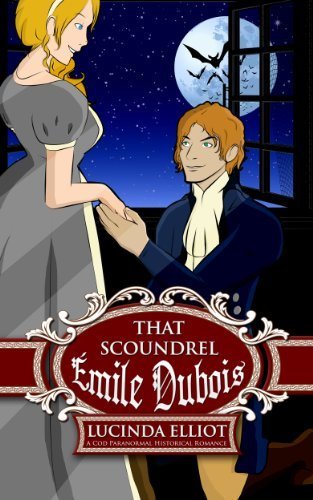
That Scoundrel Emile Dubois and Aleks Sager’s Daemon Going Free 26 October
I’m making these books available free this weekend.
Let’s hope these come out properly after instruction by Thomas Cotterill some months back…

October 12, 2013
Plasticity and Evolving Characters
I took some time off reading a selection of the classic robber novels – I’m reading ‘Rinaldo Rinaldini’ and ‘Rob Roy’ at the moment – for a change of genre with Elizabeth Gaskell’s ‘North and South’.
What interested me particularly about this book – though it’s a good read anyway, all about the terrible conditions in cotton manufacturing in mid Victorian Manchester – was how it illustrated how character types can be used and reused by the author.
They are an awkward lot, these characters! Quite apart from the fact that they take on a life of their own in one story (I don’t mean in the Aleks Sager’s Demon sense, Aagh! I mean within the pages of the novel) they can resemble viruses – they can mutate, and split into many.
I recognise two types in this book which Elizabeth Gaskell was to use again.
The first is the Handsome, Brave, Spirited, Slightly Rebellious,Yarn Spinning Sailor who always has long dark ringlets and flashing white teeth.
I suspect this character type was largely based on Elizabeth Gaskell’s beloved brother John, who tragically went missing either on or immediately after a voyage – it’s not clear which – when she was still very young. Some of his letters to her survive, and from their teasing, affectionate, observant tone it is obvious what an adorable brother he must have been for her and why she must have been so devastated by his loss.
For sure she was haunted by the image of a lost sailor who returns – he comes up in ‘Cranford’ in the form of Poor Peter, as Frederick n ‘North and South’ and as Charley Kinraid in ‘Sylvia’s Lovers’.
It seems clear to me that she had difficulties in treating this character with due authorial objectivity, and always felt obliged to give him a happy ending (the happy ending she no doubt hoped that her lost brother had somehow come by, though lost to her, in real life).
This fellow starts off quite simple as Will Wilson, the hero Jem’s cousin and Mary’s friend in ‘Mary Barton’ (1847). We read he has the said dark ringlets, is merry, tells tall tales and doesn’t like having them challenged, and his foster mother praises him for having the ‘steadiness’ his parents lacked. He falls in love sincerely with a plain girl in danger of losing her vision and they later marry.
This basic character has developed a little more complexity and sophistication when he turns up as Margaret Hale’s brother in ‘North and South’ (1856). He’s still got those dark ringlets, but this time with blue eyes – and is merry, but he is a fugitive from justice – having instigated a mutiny as a young Royal Navy Lieutenant. He’s totally lovable – impulsive, given a lurking capacity for violence but generally sunny natured, always doing things for other people, fond of his sister, risking capture to see his dying mother, devoted to his fiancé.
He makes a delightful contrast to Mary’s admirer, the serious, striving, sober and stark ‘I Pulled Myself Up By My Bootlaces Why Can’t Other’s Do Likewise’ entrepreneur John Thornton .
After this novel, Elizabeth Gaskell used this character type again to good effect – in Charley Kinraid, the love interest in her 1863 novel ‘Sylvia’s Lovers’ .
This character, however, is anything but ‘steady’. His womanising is a by word when he pays court to the protagonist Sylvia, while his moral convictions are equally mutable – in the course of the novel he goes from shooting dead two press gang members as Specksioneer of a whaler to inevitable collusion with them when, having been impressed into the Royal Navy, he has risen through the ranks to be Captain.(I’m sure Thomas Cotterill, if he’s reading this, will still completely disagree with me about Kionraid’s character).
He does, however, have a flashy charm, dark ringlets, and like Othello wins Sylvia’s heart with his stories.
Unlike the other two main characters in this melancholy tale, Charley Kinraid comes by a (in my opinion undeserved) extremely happy fate. On finding out that he cannot marry Sylvia Robson, he storms off and is married to a doting heiress in no time.
This, like Frederick Hale’s happy marriage to a doting wife and successful career (outside the UK) no doubt is just what Gaskell would have wanted for her own beloved sailor brother.
This transmutation of characters by an author is inevitable; there are all the stories that we might have told, using a particular character type, and all the traits which we didn’t develop in the story we ended up writing.
For instance, in my own first novel I had the Aristocrat literally Turned Bandit in Émile Dubois, ex- smuggler and highwayman (leaving aside his running an eighteenth century protection racket in revolutionary Paris). Émile Dubois when not in a mood for violence, is agnostic, cynical and wise cracking, good humoured and self mocking, while his love interest Sophie de Courcy is devout and romantic, with ‘Clarissa’ her favourite reading.
I’m at work on my third where the protagonist Reynaud Ravensdale (a distant cousin of Émile’s) is also an Aristocrat Turned Bandit, but by contrast he is the romantic one, in fact adopting what would later be called a Byronic pose. By contrast, his love interest Isabella Murray is decidedly cynical, and finds Ravensdale’s histrionics purely ridiculous…
Next Post: Another type from Elizabeth Gaskell: the Hard Working, Unbending Outwardly Cold (but inwardly passionate) Entrepreneur and True Lover…


October 3, 2013
Aleks Sager Daemon – Out and 0.99 on Kindle…
Back after an enforced break. The telephone line went down, and stayed down (I think I have said before that technology doesn’t like me! ).
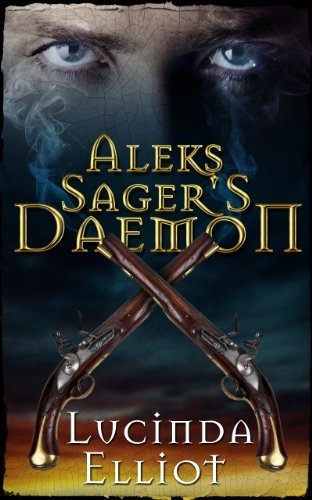
In the interim, Dane Law designed a striking cover of Aleks Sager’s Daemon, just exactly what I wanted, and it’s now up and going cheap on Amazon (the cover and the ebook, I mean).
‘Links, Lucinda: those things that don’t come out for you.’
Oh yes. Ahem. Watch these go wrong…
September 15, 2013
Thank goodness, finished editing ‘Aleks Sager’s Daemon’


The relief!
After going over every inch of Aleks Sager’s Daemon for the last time, I’ve sent him off to Smashwords. I’m sick of the sight of him.
So really that title should be something swaggering on the lines of ‘Soon available! “Aleks Sager’s Daemon” by Lucinda Eliiot (what do you mean, who’s that and so what?).
I hate reading the same thing all over again, and again.
I hate how with editing how something always gets overlooked, despite your best efforts.
I know of some cases where a writer’s e book formatters actually put in a load of new mistakes when trying to rectify a couple of original ones, and so things got worse, and worse.
So, even when the formatting has been done, just in case something untoward has happened, you have to read it all over again.
It can be torture if its comedy, or even if it’s not comedy, has a fair amount of humour in it.
Are the same jokes funny after reading them ten times? Answers on a postcard.
Actually, I did know a man who would tell you the same joke again and again if you didn’t laugh at it enough the first, time, convinced that you can’t have appreciated the depth and breadth of his wit, but people sidled away when he entered the pub, so…
I hate editing. I hate it, I hate it!
But I didn’t do it carefully enough on the first version of That Scoundrel Emile Dubois (Naturally, I’m not saying that my first formatters were one of those mentioned above!) and that isn’t a mistake I’m going to replicate.
By the way, ‘That Scoundrel Emile’ is available at half price on amazon this week and is due out soon in paperback.
And also on:
Or ought I to say, ‘Should be due out soon on paperback’ because knowing me and technology it may not be…
I put in the pictures of ‘Eugene Onegin’ because having finally got round to reading that amazing poem (and seen the film!) about a year ago, I was inspired to write ‘Aleks Sager’s Daemon’ on the theme of a man who writes about a distant cousin of that enervated rake Eugene Onegin’s, with unfortunate results, for him and others, as he finds himself haunted by his own character…