Lucinda Elliot's Blog, page 34
September 2, 2013
The basic plots

My lovely friend Lauryn April (lovely in all senses of the word) recently wrote a blog post about plagiarism and every author’s fear of being accused of ‘copying’ ideas, characters, key situations, etc.
http://laurynapril.blogspot.co.uk/2013/06/rip-offs-inspiration-and-coincidences.html
I found it thought provoking; it is excellently written and well worth any author’s reading. It is absurd that readers and reviewers should accuse writers of stealing ideas, characters, etc, for one simple reason – there are no original plots or characters.
Another writer friend, Mari Biella, was kind enough to state recently that she thought that in deliberately using cliché in my e book ‘That Scoundrel Emile Dubois’ I had managed to make the problem of the hackneyed in the horror genre into a strength, and I was immensely flattered.
That is my way of coping with the problem, the sideways wink at the readership:
Lord Ynyr: I would remind you, Lucien, that we are not in a Gothic novel now.
Lucien: That is hard to believe, Your Lordship, down at Plas Planwydden.
However, we can’t always be revelling in the clichéd, and this is a problem that worries a lot of writers, so on this question of originality…
Now, when I started writing this article, I thought I was going to be a wise guy and write down a list of the basic plots, which were famously set out by someone about two hundred years ago and which are general.
I thought I had the list to hand in the one interesting thing in a boring How To booklet from a writing course from a body I won’t name full of sententious advice that I bought years ago, hated, and didn’t finish – but if I do have that booklet, it’s up in the attic somewhere, and the one I have to hand doesn’t list them.
This being so, I’ll have to work them out myself. I think it said, thirteen. Hmm. I suppose, thinking about it, as all the how to books emphasize conflict, all the plots are essentially about different sorts of conflict. (nobody emphasizes that better than James N Frey in ‘How to Write a Damn Good Novel’. he won’t hear me, but thank you, James N Frey; love that attitude!)
Conflict as man loves women, she doesn’t love him.
Conflict as women loves man, he doesn’t love her.
Conflict as though man and women love each other, there are external problems.
Conflict over loss of honour or social status and trying to regain it.
Conflict over seeking honour and social status
Conflict with nature
Conflict with the supernatural
Conflict with other people, family, etc
Conflict over loss of friendship
Conflicts caused by loss and time
Conflicts caused by clashes with authority, the law, the army, etc
Conflict, conscious or unconscious, within the protagonist’s own self
Conflict over unattainable goal
Conflict over goal attained and no longer desired
This is all just off the top of my head, and I’m sure I’ve left important ones out. Now, that just about wore me out; I don’t like thinking too much these days. Anyway, you get the general idea; plots are very general.
Now I’ve got a list from the web, which was the one I thought I had to hand; here it is.
1. Supplication (in which the Supplicant must beg something from Power in authority)
2. Deliverance
3. Crime Pursued by Vengeance
4. Vengeance taken for kindred upon kindred
5. Pursuit
6. Disaster
7. Falling Prey to Cruelty of Misfortune
8. Revolt
9. Daring Enterprise
10. Abduction
11. The Enigma (temptation or a riddle)
12. Obtaining
13. Enmity of Kinsmen
14. Rivalry of Kinsmen
15. Murderous Adultery
16. Madness
17. Fatal Imprudence
18. Involuntary Crimes of Love (example: discovery that one has married one’s mother, sister, etc.)
19. Slaying of a Kinsman Unrecognized
20. Self-Sacrificing for an Ideal
21. Self-Sacrifice for Kindred
22. All Sacrificed for Passion
23. Necessity of Sacrificing Loved Ones
24. Rivalry of Superior and Inferior
25. Adultery
26. Crimes of Love
27. Discovery of the Dishonor of a Loved One
28. Obstacles to Love
29. An Enemy Loved
30. Ambition
31. Conflict with a God
32. Mistaken Jealousy
33. Erroneous Judgement
34. Remorse
35. Recovery of a Lost One
36. Loss of Loved Ones.
Much better than mine, I think, and it inspires you at once; but again, you see what I mean. That is all the plots there are; thirty-six…
What fills them out is characterisation, historical setting, vocabulary, humour, style, etc.
And here the minefield begins. How many original characters are there?
None again. I suppose we MIGHT write about an original character, if we wrote about someone, say, whose only interest in life was keeping a pet spider, who had an obsessive need to count pillar boxes, and who went about wearing a pair of football boots, a grass skirt, and a top hat – but how many people would want to read about such an individual? (On this note, I have to say that I always wanted to read a story someone described to me about a man who did nothing but sit with his feet up all day resting on a door knob; I was never able to track this story down; I don’t think even my friend Thomas Cotterill could, though he located ‘The Outcast of the Family’ for me).
How many original situations are there? Very few again, unless we chose to write about something totally recondite.
So, if we want to write about people who have a reasonable appeal, and write about interesting situations, by definition we must write about something that has been used before – many times; many, many times.
The whole thing is, how this theme is treated.
As Lauryn says – it isn’t plagiarism to use an idea that has been used recently, because almost certainly that idea was explored several times before that recent use of it.
The originator of the vampire story was not Bran Stoker in ‘Dracula’, or Sheridan la Fanu in ‘Carmilla’ or the writer of ‘Varney the Vampire’ J M Rymer, or even Dr Polidori in his novella ‘The Vampyre’ written in a competition with Lord Byron and Shelley. We have no idea who it was – the traditional vampire legends in Eastern Europe go back many centuries.
So I don’t think reviewers should be eager to accuse writers of ‘copying ideas’ too quickly. As Lauryn says, it can’t be avoided.



August 22, 2013
Edinburgh E book festival…

My gifted fellow writer Mari Biella has been working for the Edinburgh e book festival.
http://maribiella.wordpress.com/2013/07/
Typically, she’s been promoting other people’s work and not her own. She’s come up with some fascinating finds and insights into the world of horror, for instance:
http://maribiella.wordpress.com/2013/08/19/psychological-horror/
This being so, I am going to turn the tables, and say that I think ‘The Quickening’ was one of the best written, evocative and sophisticated psychological ghost stories that I have read in a long time.
Here’s my review of it from ‘Goodreads’.
‘I love a psychologically slanted ghost story, and classic ghost stories generally, and this is a combination of the two.
I was sometimes put in mind of ‘The Turn of the Screw’ and also of ‘The Woman in Black.’ Not because there is anything derivative about this story, but through the power of description and the skilful building up of an atmosphere of a remorseless, impending doom closing in on the characters, struggle against it though they do.
Reminiscent of classical ghost stories though this is,the characters are depicted with a depth and realism that is only possible to a more sophisticated age than the Victorian one.
The story is told from the point of view of Lawrence Fairweather, amateur botanist, a determined atheist and believer in rationality, who together with his wife Julia and their daughter Hazel, is struggling to come to terms with the loss of their younger daughter, Emily.
The shared grief about which the couple find it impossible to communicate has driven them apart. They cannot comfort each other. Lawrence, a naturally passionate man, represses his emotions beneath a surface of icy calm and drinks steadily; the sensitive Julia has been overwhelmed by her grief, taking refuge in morphine and opium. Their daughter Hazel refuses to speak, and concern over this drives a further wedge between the unhappy couple.
And yet, passionate feeling still remains between Lawrence and Julia Fairweather; this story became so real to me that I found myself longing for them to find each other again.
The two adults’ different interpretations of what it is that is causing an atmosphere of increasing fear and despair in their family home in the lonely Fens is gradually tearing the family apart. Meanwhile Lawrence Fairweather’s friend the local Doctor tries to help keep things on an even keel, while his sister Sophie has brought up from London the medium Mrs Marchant, in whom Julia desperately wants to believe, and who embodies everything that Lawrence Fairweather despises.
The writing is sensitive and evocative. There are wonderful word portraits, of states of mind, of the stark Lincolnshire countryside.
I could quote many, but here are three of the best: -
‘I sensed that whatever lurked there in the passageway wished me ill …It’s anger and hostility seemed to seep through the wood of the door and to radiate across the bedroom.’
‘A scarlet sun slunk towards the horizon, and stained the water in the dikes and the drains…The reeds crackled and hissed in the strengthening wind. A crow gave a strange, wild cry at my approach, and soared into the ashen sky.’
‘She carried her secrets with her like a child; I imagined them curled up in the warm cradle of her body, awakening, quickening.’
Mari Biella leaves it to the reader to judge whether or not there is anything supernatural in the sensations and visions that plague the Fairweather family.
An excellent, disturbing and absorbing read.
You can get ‘The Quickening’ on
http://www.amazon.com/The-Quickening-ebook/
http://www.amazon.co.uk/The-Quickening-ebook/
So there, Mari! You deserve a bit of unexpected promotion…


August 15, 2013
Paul Debreckzeny’s Crticism of Pushkin’s ‘Dubrovsky’

There is a paucity of criticism on Pushkin’s prose works in English, and this is particularly true of his robber story ‘Dubrovsky’ which I described in my previous post (before pc was down for some time!) as notably Pushkin’s attempt to reconcile popular and ‘worthwhile’ literature in a novella form.
As I said there, there has been critical division (when isn’t there?) on how far he succeeded in this aim of bringing together popular tastes – excitement, romance, and a high literary quality to a story.
This is, of course, an area that impinges on all writers who are out to produce something of quality – how far to cater for popular taste?
Rosemary Edmonds, in her introduction to ‘The Queen of Spades and Other Stories’ describes ‘Dubrovsky’ as ‘One of Pushkin’s masterpieces’.
‘Melodramatic in subject, it is extremely simple in style. The fairly elaborate plot develops swiftly against against a background which presents an illuminating picture of rural conditions in Russia and Russian legal procedure under Catherine II…The two noblemen, Troyekurov and Vereisky, along with the Byronic hero, the young Dubrovsky, are impressive creations in Pushkin’s portrait gallery.’
She considers that ‘The heroine is more of a lay figure’ and indicates that this is one of the reasons why Maria Kirilevna doesn’t elope with Dubrovsky when she is given the chance after her forced marriage (which, as she hasn’t made the marriage vow, is no marriage at all in fact); having thought it ‘most romantic’ to be kidnapped from the alter by her brigand suitor, when the enforced marriage to the elderly prince goes ahead she is quite happy to slip into the role of another ‘heroine’ – that of the ‘devoted wife’.
Another critic writing of Pushkin’s prose works – Lezhnez in his book, ‘Pushkin’s Prose’, while only mentioning Dubrovsky in passing, makes a telling point about the strangely uplifting quality to be found in this, as in all Pushkin’s works, however sad their content.
‘Life in him smiles, though sometimes with a terrible, but charming, smile…Dubrovsky leaves without taking revenge, and without tearing Masha out of the arms of the old prince; he has lost his name, his love, and his property…But the sun shines. And the moving shadows of leaves tremble on the earth. And people know how to love selflessly and to sacrifice themselves. There is a spirituality in them, simplicity, generosity. They have faith in life, and Pushkin injects us with this faith….’
For my own part, I agree with this judgement, and think it is one of the reasons why, for all the drawbacks to it’s melodramatic romantic plot, ‘Dubrovsky’ is a great story.
With regard to the weaknesses in the presentation the melodramatic romance, Paul Debreczeny ‘The Other Pushkin’ is almost merciless on this topic and comes to the conclusion that Pushkin himself stopped writing the novel because he could see that his attempt to combine ‘the serious with the entertaining’ had failed.
Debreckzeny takes the view that the problem begins with the presentation of Vladimir Dubrovsky, which is at first detached and ironic, in much the same way that the depiction of the tyrannical Kiril Petrovitch and the elder, proud and unbending Dubrovsky are portrayed; when we first meet Vladimir, he is a rakish officer of the guards, with little thought for the future ‘Irresponsible and ambitious…Occasionally, the thought crossed his mind that sooner or later he would be obliged to take to himself a rich bride’.
Later, the narrator remarks that young Dubrovsky, who has been from home since boyhood, values family life all the more highly for ‘having had so little opportunity to enjoy its peaceful pleasures’. However, Debreczeny remarks that the portrayal of Vladimir Dubrovsky soon becomes ‘the unhumorous stock in trade of romantic literature.’
Certainly, the meetings between Dubrovsky and his true love Maria, Kirol Petrovitch’s daughter, are depicted in a straightforwardly melodramatic way as Eugene Onegin’s courtship of Tatiania, for instance, never is. When Dubrovsky tells Maria of his developing love for her, for example, he admits to having stalked her in her grounds: ‘I followed you in your careless walks, dodging from bush to bush…I established myself in your house (as a French tutor).These three weeks were days of happiness for me; the memory of them will be the joy of my melancholy existence…’
Debreckzeny’s point if very valid; this wild devotion of Vladimir Dubrovsky to Maria is touching, but the picuture it sums up of his stalking her in the garden is also faintly ludicrous and the turns of phrase are too melodramatic (in fairness, this is a translation; the effect may have been different in the original Russian, though one doesn’t get the impression from Debreckzeny that it is).
It is arguable that the problem could have been overcome by Pushkin using his habitual ironical detachment as narrator, so that the reader feels both moved by Dubrovsky’s hopeless passion and amused by it. It may have been Pushkin’s intention to revise the work, and do away with this ‘straight’ presentation of the lovers contrasting with his detached one of the other main characters.
That, anyhow, is my opinion, but Debreckzeny takes a dimmer view of the central cohesion of the novel: ‘Although the robber theme could be fused with the theme of social or political protest, in Pushkin’s novel it does not serve to shed light on or further elaborate the problem of peasant rebellion…It’s only function is to somehow bring a romance into relation with a revolt…’
I don’t personally see why story of social protest can’t also involve a romance, and think that one of the fascinating aspects of ‘Dubrovsky’ is its combination of romantic melodrama and it’s depiction of a nobleman rising against his society in company with his erstwhile serfs.
Debreckzeny however is of the opinion that a lack of interest in ‘Dubrovsky’s love life’ leads to the various oversights in the text, the timing of the old princes’ proposal and Dubrovsky’s offer to Maria to rescue her from a forced marriage distasteful to her and so on, even down to peculiarity of Maria refusing to run away with Dubrovsky when he does belatedly rescue her, which the critci argues is based on literary precedent (ie, from Walter Scott’s writings) rather than a moral stand.
This critic is dismayed at a scene I particularly enjoyed – the one where the ‘French tutor’ unmasks himself as the Dubrovsky the leader of the robber band in the dead of night to the treacherous man who perjured himself to help Kirol Petrovitch take his estate: ‘Be quiet, or you are lost. I am Dubrovsky.’
Pushkin was a perfectionist and seems to have been unable to appreciate the literary value of even those works he considered failures; while a lesser talent, delighted by what s/he had achieved in this novella, might well have carried on with the story, attempting to work out the problems in the plot, varying tone, narrotor objectivity, etc, Pushkin cast it aside and never returned to it.
Instead, he went to work on his history of the Pugachev rebellion. He also completed a long short story or novella connected with it, ‘The Captain’s Daughter’ which I actually found far less absorbing than the flawed but fascinating robber melodrama ‘Dubrovsky’.


July 28, 2013
Combining the Popular and the literary – Pushkin’s ‘Dubrovsky’


Ooh, goody, here’s another topic inspired by Mari Biella’s excellent latest blog post about popularity and literary merit (and censorship).
http://maribiella.wordpress.com/
This is a topic which I am going to enjoy. I love going on about books that fascinate me, I only wish I had more time these days…
Aleksandr Pushkin was always intrigued by the notion that it might be possible to emulate Shakespeare in his ability to combine the popular with the outstanding. He wrote to a friend when discussing the possibility of starting a literary journal ‘The populace, like children, demands diversion, action.’
Unfortunately, the literary journal that Pushkin founded was a commercial failure, but these issues were very much on his mind when he wrote his unfinished novella, ‘Dubrovsky’.
He hoped that in order to captivate and in time educate, the populace, it was necessary to ‘stoop to commercial tricks’ as Paul Debreczeny says. He wished to write a novel that was both of literary merit and also had popular appeal. Accordingly, ‘It would have to have an entertaining plot with a love interest’ (to use Paul Debreczeny’s words again).
Pushkin wrote most of the text for his novella ‘Dubrovsky’ in the autumn of 1832, writing almost all of its approximately 30,000 words in a few weeks. He added a last paragraph in February 1833, and never returned to it before his premature death in January 1837.
The novel, which depicts the combined themes of the disaffected aristocrat as bandit and that of social revolt, had various precedents in European literature including
Frederich Schiller’s ‘The Robbers’ (1781) Vulpius ‘penny dreadful’ ‘Rinaldo Rinaldini’ (1798) Victor Hugo’s drama ‘Hernani’ (1830) and Walter Scott’s ‘Rob Roy’ (1818).
This latter was not an easy topic to get past Pushkin’s personal censor, the less than democratically inclined Tsar Nicholas, but Pushkin was clever enough to put in his story a speech from the brigand hero to his rioting serfs and later fellow brigands that seems likely to have been intended to mollify Nicholas; ‘The Tsar is merciful. I will appeal to him- he will not see us wronged, we are all his children…’
In Pushkin’s novella, the Byronic hero, Vladimir Dubrovsky, is the victim, as is his impetuous father, of the social tyranny and the corruption of local judicial processes of the powerful landowners, in this case the uncultured, insensitive Kirol Petrovitch Troyekurov, who has fallen out with the older Dubrovsky and in combination with the corrupt assessor Shabashkin, finds a ‘legal’ way of dispossessing his former friend of all his property, claiming it for himself, and taking over ownership of all his ‘souls’.
This leads to a riot amongst Dubrovsky’s serfs. The younger Dubrovsky, outraged at the thought of Troyekurov invading his family home, sets fire to it. The local blacksmith disobeys his order of leaving the doors open, and so the local head of police and the court officials who are sheltering there are killed in the fire and Dubrovsky becomes an outlaw.
He takes to highway robbery, heading a band of former serfs, and living in the forest that formed part of his former estate. He also goes in for a spot of arson (it seems to have become a habit with him) though like Robin Hood and the predecessors in the robber novels, he targets only the wealthy.
He plans to kill Troyekurov by setting fire to his mansion, but his fate is changed when he catches sight of Maria, Troykurov’s daughter…
The novella, then, combines serious themes with the popular themes of a robber hero and a love interest. Personally, I loved it, and enjoyed it all even more than ‘The Queen of Spades’ and regretted that Pushkin never finished it (but then, I am an incorrigible romantic).
Critical opinion seems divided as to how far Pushkin succeeded.
As unfortunately, most of the literary criticism of Pushkn’s work is in Russian, and the greater part of the English criticism concentrate on his better known works like ‘Eugene Onegin’ (another great read for an incorrigible romantic, but that’s by the way), I have only been able to find two books in English that touch on the topic.
NEXT POST
Paul Debreczeny and Rosemary Edmonds on Pushkin’s Dubrovsky


July 19, 2013
Loyal Reader Award…

My kind friend, Tersia Berger, who doesn’t forget to think of others in her own troubles, which is unusual, nominated me for this award.
I wasn’t able to copy over the last, but I am very happy to accept this. Thank you, Tersia, I am honoured.
The rules are simple. Answer a rhetorical question of the author’s choosing and nominate people you consider deserve the award.
Tersia’s question was: ‘If you were on a deserted island, how would you survive?’
My answer, ‘I would be very surprised if I did survive, but if I did, I expect I would go off my head soon enough (some would say that I already have).
If i was marooned with a group of other women, think Lord of the Flies as to what would happen to me. I had a discussion with a friend once about this, and she said I would be a female Simon, but I think she flattered me. Maybe I would be Piggy (I can just see that happening to me, though I’m athletic; I’d probably fail to keep my silly mouth shut and sound off abut needing to keep the fire going as a signal and end up being thrown over a cliff and swept out to sea). I thought she would be a female Ralph. We named the female Jack and Roger and others we knew, but they shall remain nameless…
My rhetorical question has been inspired by Mari Biella’s latest post on
http://maribiella.wordpress.com/2013/07/19/an-old-favourite-revisited-the-master-and-margarita/"
which is, by the way, a wonderfully stimulating blog, but I won't give this award to Mari, though it is deserved, as she avoids accepting awards.
My rhetorical question is:- Would you rather be world famous after your death for writing something worthwhile, or rich in this for writing something you knew to be of no literary merit at all?
I'd go with the first, with a regretful look over my shoulder at the second…
Loyal readers I know.
First, Thomas Cotteril (May this link come out) a good friend and the writer of a fascinating blog on :-
http://thomascotterill.wordpress.com/
Then, my wonderful writing partner, Jo Danilo, who’s writing I love- and who doesn’t need to feel in any hurry to accept this award form Emile and Co but who writes an intriguing blog on :
http://mymykerikeri.wordpress.com/
Then, the talented writer and also a friend Lauryn April on:
http://laurynapril.blogspot.co.uk/
Then, another friend and great writer, Rebecca Lochlann, who I am sure has written some classics in her ‘Child of the Erinyes’ series:
http://rebeccalochlann.wordpress.com/
And a very helpful reader Francis Franklin on:
There are many others who deserve the award, but am running out of steam in this heat…Thank goodness I am not on that desert island, with the female Jack and co setting fire to it…


July 12, 2013
Aleks Sager’s Daemon – how horrible to be haunted by one of your own characters…

For those who are interested (looks about encouragingly and sees one mouse listening) ‘Aleks Sager’s Daemon’ is with my writing partner, awaiting her comments, and she is something of a perfectionist, so I expect rewrites before it sees the light of day…
I’m at work on my next; ‘Ravensdale’ : this is a spoof of the romantic theme so beloved by romantic historical novelists, The Misjudged Heir, Disinherited, through the Machinations of a Wicked Cousin, Turns Brigand. This is a light comedy, and a return to the highwayman theme that was part of That Scoundrel Émile Dubois, and is set only a few years before. Ravensdale is even a distant relative of that rogue…
After the black comedy of ‘Aleks Sager’s Daemon’ and the fact that I had to kill off one of my three main male characters, I felt like a bit of light relief. This spoof, like the romantic novels it’s based on, naturally has a happy ending.
It was odd how I thought of the plot for Aleks Sager’s Daemon.
Synchronicities are always plaguing me; that is another story, but the point is that I began to think about a strange topic, namely, how horrible to be haunted by one of your characters whom you’ve treated badly (and all authors know full well that when it comes to characters, we don’t treat them the way we like to be treated ourselves or there wouldn’t be a story worth reading) . At the same time, I came across a book by a fellow Indie author, Haresh Daswani, called ‘Evolution of Insanity’ (yes, I know, highly appropriate!): one of the short stories in that was about a character who turns on his creator (a splendidly coarse and comic sequence, by the way)…
So, I began to think that I might add to the plot of Aleks Sager’s Daemon, which I already intended to be a story about a writer who is increasingly disturbed that his life seems to be turning into a weak semblance of the last couple of years of Alexandr Sergeevitch Pushkin, when he began to be overwhelmed by his financial problems and the wild, obsessive pursuit of his lovely wife Natalya by the handsome young officer of the guards d’Anthes.
The character (it would be giving too much away to say how he comes to know that a horrible sort of magical correspondence links his life with the creative powers of the writer) is outraged at a vulgar fellow daring to profit from writing about his unsuccessful love affairs. He is a would be Byronic type from Pushkin’s own age, and he would like to challenge Aleks Sager to a duel, but to do that with a commoner would be too demeaning; however, a spot of defenestration is another matter again…
Besides, he’s seen the lovely Natalie Nicholson, whom Aleks Sager is eagerly pursuing, and has decided that he wants her for himself, at all costs.
But how horrible to be haunted by one of your own characters. How fearsome one gloomy, overcast evening when the wind howls round the eves (I know, Mari! That is a horror cliché for sure) to be writing in your study (in my case, the spare bedroom with a desk in it, in Aleks Sager’s a real study), to hear the door open, and to see that a strangely familiar person is lurking in the doorway, an expression of fixed hatred on the face and murderous intent in the eyes…


June 27, 2013
Patrick Hamilton’s dark humour.

A number of readers have said how in my story ‘That Scoundrel Emile Dubois’ they enjoyed my facetious use of capitals to emphasize certain phrases (there are probably many who did NOT enjoy it, but never mind about that).
I borrowed the idea from a famous writer and playwright of the early part of the twentieth century, Patrick Hamilton, though I am sure other writers have used versions of it .
I remember reading ‘The Slaves of Solitude’ (not quite such early reading for me as ‘The Queen of Spades’ or ‘Carmela’ but in my teens, anyway) and being delighted by the dark humour that pervades that story.
Patrick Hamilton’s own life was to some extent tragic, though he achieved so much as a writer.
Born into an upper middle class background with an overbearing father who took out his frustrated authoritarian tendencies on his wife and family, Patrick and his beloved brother Bruce retained scars from their childhood all their lives. Patrick slipped early into alcoholism, tormented by and a horror of life, which he feared was meaningless.
His success came early, in his twenties, and he went on to write the fascinating trilogy depicting isolation in the London of the late nineteen twenties ‘Twenty Thousand Streets Under the Sky’.
His masterpieces, however, are ‘Hangover Square’ (from the preface to which I learned the poem ‘The Light of Other Days’) and ‘The Slaves of Solitude’.
Looking for a creed in which to believe, he became a communist. Bitterly disillusioned by the exposure of Stalin’s dictatorship and the degeneration of the bouyant hopes of a better world which supported so many through terrible war against Nazism into a society based on consumerism, he became a sad and backward looking figure. for the last few years of his life he was hardly able to write at all.
That wonderful sense of the darkly comic aspects of life, of the delightful absurdities to be encountered every day, of the pathos and bathos of life are unique.
I’d like to quote from ‘The Slaves of Solitude’ here, where the dreadful boarding house bully, Mr Thwaites, is ridiculously drunk following Christmas dinner in the local pub (the date is 1942).
‘”Methinks it Behoveth me’, said Mr Thwaites, ‘To taketh me unto my mansion. Doth it not? Peradventure? Perchance?”
“Yes,” said the Lieutenant. “Come along the. Get a move on.”…
“Come along Mr Thwaites.” said Vicki (the vulgar, Hitler admierer who coquettishly who encourages his advances).
“Ah, the Beauteous Dame.” said Mr Thwaites. “The beauteous damsel that keepeth me on tenterhooks.”
“Come on then,” said the Lieutenant. “Take my arm.”
“Hooks. Tenter One.” said Mr Thwaites. “See Inventory.”
“Aw, come on, will you?” said the Lieutenant.
“Damsel, Beauteous, One.” said Mr Thwaites.”Hooks, Tenter, Two. Yea, Verily.”…
“April, too.” said Mr Thawaites. “Thirty days hath November.”
At this he lurched forward, and the Lieutenant caught him…”‘
This book, which deals with a microcosm of the menace of fascism during the huge theatre of World War Two, ends with what I consider a truly inspired phrase from this most irreligious of writers.
‘God help us, God help all of us, Every one, all of us.’
Hamilton’s life was to a large extent tragic: dominated


June 20, 2013
Always Here When Needed Award

Now, here’s a lovely badge, I love butterflies. I am ancient enough to remember when before the crop sprays and other environmental destruction hadn’t exterminated most of them, and I remember a pile of stones my father had left to create a rock garden being covered in basking butterflies on a hot summer’s day.
Rant, rant…
Leaving that aside, to comply with the rules of the nomination, I would like to thank Thomas Cotterill
for the award. We disagree about many things, politics, what the author was attempting to demonstrate regarding characters in books (I’ll just go for a bit of teasing by saying something that will be obscure for most people, but not for him: ‘I still maintain Charley Kinraid is a superficial opportunist, Thomas etc, etc, rant, rant…’) but he has been a wonderful source of support and encouragement for me. My first novel was complex, and that has meant that some readers don’t like it or don’t finish it, but Thomas delighted in it, and that really made me feel good.
His blog is always excellently written and stimulating and can be found on
June 15, 2013
All Author’s Blog Blitz


All Authors Blog Blitz
I would like to welcome the very talented and cerebral Victoria Adams, who I feature today as part of the All Author’s Blog Blitz.
She is obviously able to cope with anything, as my eccentric sense of humour leaves her unfazed…
For the other half of the sandwich, I should be featured on lovely Jenn Roseton’s blog http://jennroseton.blogspot.co.uk/2013/06/this-is-bit-embarrassing.html?zx=d09a093ecfbecc59
Lucinda’s Place
So, how does one conduct one’s self when you are invited into someone’s internet home and asked to create a guest blog? I for one like to try to do something that fits the décor, the mood, the general interests of my host. After all, that’s what folks do for me! Browsing around in Lucinda’s home, opening doors, gazing through windows, and peeking in closets I found that she loved gothic, humor, and heroes and heroines that filled slightly different roles. I think she would have had great fun with Shakespeare. I also discovered that she lives in Wales. Now, what little bit of something can I find that will fit in with interesting basket of thoughts?
Well, I live in the United States and I’m afraid that during our “Gothic” period it was pretty much tribal lands and a few Vikings. I suppose toward the end of the period some fellow sailed across “the pond” and wiped out half the continent with yellow fever. Not a particularly jolly topic there. After some head scratching I realized that there was a series by one of my favorite authors I could introduce. I was a bit odd in school and actually enjoyed putting book reports together (what future writer wouldn’t); I never got over it. Here then is a bit of a blurb about a different kind of hero and his different kind heroine during the early 20th century here in the United States. Allow me to introduce you to Isaac Bell and his lovely lady Marion Morgan.
I love historical fiction. That is, I love historical fiction when the author can take me there, walk me down the streets, show me the culture, the language, the feel of the place. One of my favorite authors, Clive Cussler, does this quite well. The majority of his books start with some small vignette in the past with a mystery. Then he launches you into a world of adventure and intrigue in the modern world while his characters unravel the mystery and save the globe from terrible fates. His series using his hero Isaac Bell is a bit different in that the series is staged entirely in the past. Isaac Bell is the son of a successful banker that has decided he’d rather be a detective. His employer is the “Van Dorn Agency” which is modeled a bit after the Pinkerton Agency.
Some critics will say that some of the dialogue is reminiscent of the period, but well, that is the fun of it all, I think. The first novel takes place at a time period that covers the San Francisco earthquake of 1906. It is when Bell meets his heroine and together they solve the mystery and save the day. The rest of the series is centered on cases that Bell takes and his lady is always there somewhere, helping him think through possibilities, and advancing her own career as a moving picture director. That, you see, is something I do like about Mr. Cussler. His lady characters are always accomplished in something. When these maidens are in distress they usually find some way to help everybody out of a pinch.
Lucinda’s discussion regarding the stereotyping of lead characters did get me to thinking about why certain authors hold my attention. Yes, Cussler’s men and women are overachievers. Most of them are good looking and in great shape (sort of a job requirement here). But they also have interesting hobbies such as refurbishing old cars or building boats by hand. There are no wilted daises in this group and some of the stories are really quite the lark.
Well, this is a taste of what you might find in my little corner of the world. My favorite subjects are in the areas of philosophy, science, history (and all that is related) and religion. My first book, Who I Am Yesterday, is about my first year of adjusting to my husband’s dementia. It has become popular enough that I have started getting speaking engagements. My work-in-progress is a book about the Book of Job. I feel I have a slightly different point of view regarding what we can expect from the cosmos and what we are supposed to be doing about it. Tune in sometime. You never know what closet you’ll find of interest.
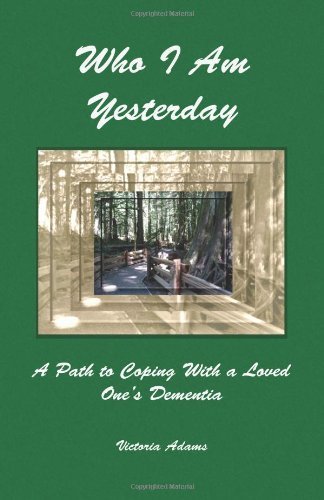
Who I Am Yesterday: A Path to Coping With a Loved One's Dementia

June 11, 2013
Blog Blitz
 Coming soon – Goodreads Indie Author’s Support Group’s Blog Blitz.
I’ll be featuring a very cerebral and interesting author named Victoria…
We’ll all be doing a feature on another member, so I’ve keyboarded off (hey, I like that phrase) about my own writing elsewhere…
I apologise for that rather pathetic looking banner. It’s meant to be impressive, and that’s what I come up with. Me and IT…Must go and investigate quite what’s gone wrong…
Later: I HATE IT! I’ve been trying to edit the thing, and did it fail work out? Did Robin Hood and his Merry Men perforce have to evacuate in the woods?
Anyway, honour is satisfied. I said I’d feature the banner,and so I did, in minature.
How much better I’d weild a quill pen…