Lucinda Elliot's Blog, page 37
January 27, 2013
News from Citizen Gilles

Georges’ piratical lieutenant isn’t able to make any money by letting Gilles Longlegs know where the blonde Englishwoman has gone. She seems to have vanished completely.
A couple of weeks later, Georges is in his room behind the workshop which serves as a necessary cover for his activities, entertaining two women once again (perhaps this time one of them won’t pass out).
People might call them ‘Women of Easy Virtue’ or ‘Women of the Night’ but women have to make a living as best they can, particularly in times of social upheaval. Anyway, he sits with them perched one on each knee, and as the dark one of is a strapping girl he is even more proud than usual of his strong legs, heavily muscled like the rest of him. He has a hand on the blonde girl’s knee and is surreptitiously pinching the dark girl’s bottom.
He’s interrupted by a small boy running in, and glances down slightly irritated. “Yes, boy?”
“Citizen Gilles said to give you this.”
“Oh, did he?” Georges huffs. “If he thinks that I am coming to terms so easy over the cooked meat shop…”
The girls are all admiration at the ease with which he scans the note, but can tell from his dilated eyes and quickened breathing that the news isn’t good.
“Is it heavy news?” The dark girl is caressing his chest. “You read?”
The note says, ‘The truffles were gone before I knew of it.”
Georges flashes his white teeth in a wide smile. “Reading ain’t good for you.” Certainly, after only reading one line, his mood has changed completely. He goes on, ” I must disappoint you girls – but not as much as myself. I hope you will take a little gift from me..”
He tosses a coin too, to the gawping child. “I suppose I must talk with them others over this. Take me to Gilles”
One of the girls kisses him. “Do not be naughty and get into a dispute with him…” The other is too busy putting the money in her bosom.
Georges sees the girls out gallantly. So Emile’s parents have gone unexpectedly to the guillotine…



January 22, 2013
Southern Georges revels in excess.
 Meanwhile, Georges, Emile’s companion in roguishness and one time servant, is disporting himself – as usual in his time off from his warlord existence – in female company when he hears the news about Monsieur Gilles’ romantic misadventures from one of his lieutenants.
He’s eating onion soup, and a very voluptuous woman with Titian colouring is feeding him croutans. Another girl was with them, earlier, but having taken too much wine, she has retired to a chair in the corner to doze and giggle.
Georges finds this bandit’s lifestyle rather more to his taste than his life as servant in the Dubois family chateau in Provence; true, he worked for Emile – as democratic and easy going a master as he would be likely to find – but he was only a servant, reliant on his devastating profile, flashing dark eyes, curling dark hair and muscles to attract the women.
He knows that it is rumoured of him that he has bedded half the married and unmarried women in his area; of course, he hasn’t; but he swells with pride when he hears such stories.
Georges’ lieutenant is sweaty – possibly with enthusiasm for a new project - but more likely because it’s warm spring weather and he has no access to a bath, and he likes to tie his head up in a scarf after the manner of a pirate, a style of headress that Georges finds ridiculous in a landsman.
“Southern, fun and games over with Gilles Long Legs’ lot; seems he was much taken with some little blonde bourgoise he took to one of them parties that that Marcel Sly Boots keeps having, and she’s vanished.”
Georges’ eyebrows go up and he puts down his spoon. Something flickers in the depths of his eyes, perhaps, but his underling doesn’t see it and Georges returns his eyes to the girl sitting across from him, who has undone several fastenings on her dress.
“If I was him, I’d've kept in with that Lola. She was some woman! That bosom, that rump…”
The girl jerks her chin in annoyance, and Georges says hastily, “Nearly as good as this beauty, here…Don’t tell me you interrupted us to tell me about some minx running off from Gilles?”
“No, but he was looking for her all night, sent others out looking too. I heard all about it from My Source. Maybe he’d pay well lot to find her again.”
Georges has pulled up the woman’s skirts under the table, and is exploring underneath; she reaches across too and his voice comes out constrained. “Do him a favour, then, and see if you can find the wench…”


January 18, 2013
Liebster Blog Award!
The lovely (see photo, and you’ll see) Lauryn April, writer of ‘Into the Deep’ has nominated me for the Liebster Award.
The rules of the Liebster Award are as follows:

1. Thank your Liebster Blog Award presenter on your blog and link back to the blogger who presented this award to you.
2. Answer the 11 questions from the nominator, list 11 random facts about yourself and create 11 questions for your nominees;
3. Present the Liebster Blog Award to 11 blogs of 200 followers or less who you feel deserve to be noticed and leave a comment on their blog letting them know they have been chosen. (No tag backs)
4. Copy and Paste the blog award on your blog.
So, thank you so much Lauryn April, who wrote the delightful ‘Into the Deep’ and who’s blog is at laurynapril.blogspot.co.uk Love you!
Random Facts About Me:
1. I think all the literary agents who rejected my writing or those of my cyber writer friends should have their heads held under a cow’s behind.
2. I’m dyslexic.
3. I’m addicted to Lucozade and tea.
4. I’m an environmentalist geek.
5. I think Kirk Douglas was a great actor (no doubt still is, if he’s still acting). I am sorry to have to admit, fanatical about the topic of rape though I may be, that he even made the rapist Einar in ‘The Vikings’ sympathetic enough for me to feel very sorry for him. Now, there’s an achievement…
6. I detest it when people begin posts on the thread where they’re going to disagree with you with the exclamation, ‘Wow!’ ( Wow! I’ve handed out some ammunition there!)
7. I spent three and a half years of my childhood living in a beautiful Regency rectory (no, we were’t rich, my family used to do up old houses in the days before it became fashionable). Those beautifully proportioned light rooms! Avoid doing that if you’re not going to stay, everyone. Every house since has been a bit of a let down after that…
8. My favourite Shakespeare play is ‘All’s Well That End’s Well’ (I would be awkward!) That reminds me, I’m heading a discussion about it over on Goodreads if you happen to be interested.
9. I’d like to go for a long holiday in Provence; can’t afford it, though.
10. I’m quite little – 164 centimetres.
11. I am completely, totally, hopelessly, pathetically bad at IT. I am trying to improve it, but it’s a long, long time coming, like the Ealing to Richmond number 65 bus.
Answers to Lauryn’s Questions:
1. What got you into blogging?
Well, it was a good opportunity to run off at the mouth about my opinions and all those Publicise your Ebook articles recommended it, so…
2. Favorite TV show and why?
Don’t have one at the moment, Lauryn. I’m sorry to say I was enjoying the revamp of ‘Dallas’ until it stopped. it was so bad it was good!
3. When writing books are there any reoccurring themes in your work, or if you’re not an author are there any reoccurring themes in the books you like to review?
Gothic and paranormal or occult stuff, for sure; I like strong women characters with a sense of humour.
4. What were you like as a teenager?
Awful! Unreasonable, opinionated, argumentative…a bit like I am now, in fact.
5. Paperbacks or e-books and why?
Not sure if you mean my own or someone else’s? My own ebook ‘That Scoundrel Émile Dubois’ is over the top Gothic adventure that I suppose could be termed ‘Steampunk’. I love reading a lot of genres, and my recent favourites have been:-
‘Into the Deep’ by one Lauryn April.
‘The Year God’s Daughter and ‘the Thinera King’ by Rebecca Lochlann
‘The Fire Nigh Ball’ by Anne Carlisle
‘Watermelon’ by Kate Hanney
Also, my writing partner Jo Danilo’s work, ’11.42′ and ‘The Curtain Twitcher’s Handbook.’ She’s must get them out there.
Also, at the moment I’m enjoying reading ‘On the Evolution of Insanity’ by Haresh Dashwarni.
Do you have a funny vacation story?
The funniest I can’t tell, as they might hurt someone’s feelings. A grotesquely funny story was where I got salmonella abroad, and when I got home, looking like an animated corpse, complete with sticking-out bones and ghastly complexion, staggering along, leaning weakly on furniture, etc, a women I knew said, ‘Oh, so you had salmonella. What a shame you didn’t get a sun tan?’!!!!
7.. Have you ever been out of the country and where did you go?
Across to Europe, manly, but once as far as Tunisia. I want to come and see the US.
8. Book you’re most looking forward to reading this year?
Rebecca Lochlann’s got ‘In the Moon of Asterion ‘ coming out and that wil be a firecracker. Lauryn April’s next is eagerly awaited, too, and Anne Carlisle’s sequel to ‘The Firenight Ball.’ I’m also looking forward to reading Kate Hanney’s ‘Safe’.
9. Biggest turn off in a book?
The main male character, or one of them, being one of those guys without human weaknesses, you know the sort, invariably irresistible to all the women, who just roll over and swoon at the sight of them. The women equivalents are called ‘Mary Sue’s’ but what are the men called? I heard somewhere that they could be called ‘Adrian’s’. Seems like a good idea to me.
10. What are you doing when you’re not reading or writing?
I do spend quite a lot of time making a fool of myself and getting things wrong. When not doing that, I turn into a dung bettle and the things I get up to don’t bear thinking about…
11. Favorite holiday and why?
France. I love that country.
Questions from me:
1. Born where? Were you brought up thereabouts?
2.. Least favourite subject at school?
3. Most hateful; character you can think of in classic literature?
4. Most embarrassing memory you care to reveal?
5. Guilty pleasure in the way of a terrible film you love?
6. Are you bossy?
7. How often a week do you travel by : -
a. Donkey b. Camel c. Elephant d. Farm cart e. Shanks Pony?
Favourite poem?
Favourite author?
Are you a romantic (in either Byronic or vaguely modern sense of the term?
Are you prepared to give a deserving cause (in this case, one Lucinda Elliot) a donation? If so, fill in attached form …Do you find it annoying when charities send what looks like a survey, but it’s really a way of trying to embarrass you into donating? I’d much rather they asked at once and directly myself, and I always send it back saying I might well have donated if they had made a straightforward request, which is the truth. What do you think?
Eleven nominees: -
Lovely Jo Danilo, my invaluable writing partner, love you! mymykerikeri.wordpress.com
The outstanding writer Rebecca Lochlann rebeccalochlann.wordpress.com
My next nominee won’t be in any mood to bother about nominations, or suchlike, but I’m giving it because she has written on a subject we most of us can hardly bear to contemplate, but we should. The death of a child. tersia.burger:wordpress.com
Next, with congratulations on finding that publisher to Anne Carlisle, I so loved Marlena, your heroine: annecarlislephd.blogspot.co.uk
To Buebirdsunshine, once CaramelloKoalaLover, with love bluebirdsunshine.wordpress.com
Thomas Cotterill, excellent blogger and writer, a man amongst this monstrous regiment thomascotterill.wordpress.com
Then, Kate Hanney. Loved that Watermelon! www.katehanney.com/new-teenagefiction-blog
And this blogger may have over 200 followers, probably does but she’s been so helpful and we’ve been having such a laugh on Goodreads I have to nominate her: rebutler.wordpress.com
Finally, Justin, a second man, who’s got a great spooky website and had the misfortune to interview me recently (his IT went wrong at once, wouldn’t you have guessed with me about?) http://jbienvenue.webs.com/apps/blog/
As Bluebirdsunshine tells me she already has the award, I’m nominating Emily Guido instead, another excellent blog. http://authoremilyguido.com/
Keep on with the good work, everyone.
These blogs are all fascinating, so do take a look…


January 13, 2013
Sophie longs for adventure, wriggling her toes by the fire and reading ‘Clarissa’…
Content

How that wind does howl round the eaves! Sophie wriggles her toes some more, putting aside ‘Clarissa’ to stare into the flames as they curl and dance.
It being a Sunday, she should be reading her Bible. Instead, she is illicitly reading a novel and thinking of desires highly inappropriate to a Sabbeth (though to be sure, the Countess and Lord Ynyr are far from strictly religious; they even indulge in a game of cards of an evening, as long as the servants cannot see) .
Sophie wants a dashing young buck to come and sweep her off my feet, like Lovelace in ‘Clarissa’ (only- goodness – without that horrible ending).
She knows she really must be sensible and plan how to draw in a worthy man for a suitable match; without a dowry Her Ladyship’s companion isn’t going to attract a queue of suitors and sadly, the local curate is married… Lady Llewelyn (that does sound so Welsh, but she is a Frenchwoman, originally from Provence) would surely consider Sophie a sad ingrate, for she has been treated with amazing kindness. Who ever heard of a poor relative companion being given such a suite of rooms, a lady’s maid, and music lessons?!


January 6, 2013
Giveway of my ebook ‘That Scoundrel Emile Dubois’

I’m doing a giveaway of my ebook ‘That Scoundrel Émile Dubois’ on Amazon on 10, 11 and 12 January 2013 (not as if, not being caught in a time warp, I’d be likely to mean January 1913 lol).
I do hope lots of people take the opportunity to get a copy to read now, later, or during a wait while
a. Awaiting public transport
b. While waiting to see a doctor
c. While waiting to be put through to a Call Centre’s customer services to complain about waiting to be put through to a Call Centre’s customer services…
d. While waiting for Life to Get Easier.
e. Waiting to Take Over the World
or
f. Other (fill in as appropriate).
I hope that people find the combination of down to earth late eighteenth century rascals and the over the top Gothic adventure incongruously entertaining as the eponymous Scoundrel and his villainous cohorts are drawn into a world of time warps and man vampires.
If it doesn’t make you smile at least once, I’ll eat my bootlaces (wonders if she can purchase a pair of those old fashioned liquorice ones).
I also did an interview with Justin Bienvenue on his website and he had to put up with a lot of joking but survived to publish it. Here’s the link to that excellent site and is that Gothic butler in the icon on his homepage ever grotesque, you can just picture his creaking voice…’Y-E-S, Sir – Shall-I- keep-them-forever- locked- in-cyber space now?’
Here’s the link to that excellent website: http://jbienvenue.webs.com/interviews.htm


December 31, 2012
Some thoughts from a Dowager Countess’ Companion…
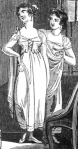
Sophie and Agnes no doubt chatted like this as Agnes laced her, admiring that neat waist of hers…
Some internal dialogue from Sophie de Courcy, toasting her toes in front of her bedroom fire in December 1794: -
Brisk footsteps sound in the corridor, and here is my lady’s maid, Agnes (I still cannot get the better of my astonishment that a poor relative should be given one).
I love her already, though I to conceal it; I could not resist giving her a large present I could ill afford on St Nicholas’ Day.
She is pretty, that cap set upon her glossy brown hair looks more like an ornament than anything; some might say that short nose is a bad feature I think it makes her look the more fetching. “Nasty cold wind, Miss Sophie. You are wise to wear your thick shawl.”
On my first eve at the Manor, she made me laugh indeed by coming out with the most absurd predictions about a couple of young men coming into our lives from overseas, destined to be an admirer for us; how I may yet have my heart’s desire (as will she) but only if each of us can defeat the forces of evil, which will manifest themselves through a man in mourning, and the wicked acts of a dark woman.
I told her it was very shocking and not a Christian activity, looking as strict as brother John’s wife Harriet does, when rebuking a maid.
The irrepressible girl giggled; “That may be, Miss, but my Tarot cards is never wrong,which is more than you can say for the Vicar, saying as we would have a better harvest if we prayed more, and then we had the wettest summer in years…”


December 25, 2012
Mansfield Park Fanny Price and Henry Crawford Part II: While Fanny Price resists Henry Crawford, Sophie de Courcy falls for Émile ‘Like a Ton of Coals Being Delivered’

Life at Mansfield Park livens up with the arrival of a dashing brother and sister to a neighbouring house, namely Henry Crawford and his sister Mary.
Poor Fanny Price has been in love with her older cousin Edmund for years – while he regards her with discouraging, cousinly affection. He has been kind to her, while his sisters Maria and Julia have treated her insensitivly, scorning her as their social inferior; she has been treated as a sort of higher servant as often as not, and this attitude has been encouraged by their officious Aunt Norris; now she has to watch her beloved cousin falling in love with the pretty, charming Mary Crawford.
She is also outraged by the heartless flirting of Henry, who encourages both Maria and Julia, presumably out of a combination of having nothing better to do and vanity, as he doesn’t have serious designs on either of them and he is hardly going to scheme the seduction of either girl (at this point).
Maria, disappointed that Henry’s admiration had no serious purpose, insists on going through with the loveless match with Mr Rushworth, seemingly out of hurt pride as much as anything. Even the less-than-senstive Sir Bertram advises her against it.
Henry now turnshis attentions to Fanny Price, that bastion of virginal purity. He thinks it will be amusing to make her fall in love with him; not, he tells his sister Mary, too badly, but enough for her to think on his going away ‘that she will never be happy again’. Mary makes a very cursory objection to this targeting of an innocent girl, and then seemingly dismisses any concerns about Fanny Price from her consciousness, being too taken up with trying to discourage Edmund from taking orders to worry any further about his poor relative’s feelings. For her, every vicar must be a Mr Collins (the hypocritical toady from Pride and Prejudice); she cannot marry a vicar.
Fanny Price, of course, can think of nothing better than marrying Edmund when he takes holy orders…
Henry Crawford works hard at winning Fanny’s approval, and in so doing, the worldly cynic finds himself falling in love with her for real. The tables are nicely turned, and it is impossible for the reader not to think that it serves him right. Having hurt so many women with his trifling, it is only fair that he should suffer himself for a while, and suffer he does, for he is truly in love with Fanny Price and longs for her in a romantic way that has previously been beyond his imagination. He speedily proposes, and receives as speedy a rejection; Sir Thomas Bertram is outraged…
For all that, though, I did want her to return his feelings and for him to prevail in the end; the careless rogue brought to heel and a happy ending, with Mary reconciled to Edward’s becoming a vicar (a happy ending for poor Maria Rushworth is obviously not possible).
Sadly, it doesn’t work out like that; Henry has been dismissed to his country estates to do good works by the peremptory Fanny. He humbly starts off, but encounters Maria Rushworth in London society, who now treats him with repellent coldness.
This potential Eugene Onegin situation ends up with an oddly passionless sounding elopement between Henry and Maria. Fanny is so horrified that she spends nights shuddering at the thought of that irregular relationship while Mary Crawford disgusts Edmund by her matter- of-fact attitude about it; Henry soon tires of Maria and goes womanising off, while poor Maria is made to go and live in seclusion with her toady Aunt Norris. Edmund falls in love with Fanny and they marry.
Hmm.
As I have said, I agree with Cassandra Austen that a nice, romantic true conversion of Henry would have been just the thing. Not that I believe that women should ‘fix’ abusive men, but because I would like Henry to realise the error of his ways through his having, for the first time, felt love himself.
Jane Austen refused to change the ending; she only modified it to the extent of admitting that if Henry had behaved himself and Edmund married Mary, then Henry’s courtship of Fanny must have won her over in the end…
‘Like a Ton of Coals’ being delivered is how Agnes the maid puts her Tarot reading prediction of how Sophie will fall for Émile in my own story concnerning the relationship of a Poor Relative Companion and her socially superior womanising admirer. I used to hear that CRASH! in my own childhood, and it is pretty spectacular.
Of course, as Sophie has already been infatuated with The Scoundrel from afar for years (she does love a romantic dream and has the habit of reading novels by Richardson on Sunday afternoons instead of her Bible), the groundwork has already been done for him. He’s her hero because he managed to smuggle his sister Charlotte out of France and risked his life for years trying to get his parents out of prison.
The stories of Sophie’s grand relative’s bravery would, of course, come back from France, cut of from Great Britain by the war, in a series of dribs and drabs from other émigrés. Little do people know how Émile lives as Gilles Long Legs, running a sort of eighteenth century protection racket along with Felix the Professor and Marcel Sly Boots.
Agnes also warns Sophie that both the dark and fair man coming from abroad are ‘rascals’; Sophie is confident then: ‘Really, Agnes! I would never encourage the advances of a rascal’. There speaks the voice of inexperience.
When the fair and the dark men do arrive in the form of Émile and his valet Georges, Sophie is astonished at Émile’s insistence that they have met before in some romantic encounter in Paris, where she knows she could not possibly have been. She even wonders if he has been driven a little off his head by his misfortunes – his sole sibling to survive the firing of the family Château – sister Charlotte – having recently died and his parents having now been guillotined – but for all this, he can’t conceal his besotted attitude and she soon starts returning it, while the misunderstanding between them leads to his responding to the advances of the sinister Ceridwen Kenrick, who has an agenda of her own.
Unlike Henry Crawford’s feelings for Fanny Price at the beginning, Émile’s feelings for Sophie are always sincere – though he comes to suspect her of having what he sees as a disreputable secret to conceal in her refusal to acknowledge that they met in Paris, which leads him to make a practical, but from her point of view shocking offer for her to come and be his mistress at Dubois Court – but like Henry Crawford, he has a rakish history and seems a bad prospect for an innocent young girl. Even his doting Aunt can see that, but Sophie is happy to chance far worse dangers from him than being an unhappy wife.
Émile’s wooing of Sophie is, of course, immeasurably helped by the fact that unlike Fanny Price, her sexuality is not repressed; she is well aware of her own sensuous nature, and is happy to start replacing Émile’s family with him asap…


December 15, 2012
Jane Austen and Mansfield Park
Readers have commented that they see a lot of the influence of Jane Austen in my story ‘That Scoundrel Émile Dubois’ and they are so right.
I love that acid wit of Jane Austen’s – and even without it, which is hard to imagine – the books would be fascinating period pieces and an invaluable source of information about life in Britain during the Napoleonic Wars.
Most people like best ‘Pride and Prejudice’ and for sure, that novel is the liveliest and funniest, the most romantic, and in Elizabeth Bennet contains the most likable heroine, witty, impatient of snobbery, lively, fond of dancing and flirting yet always acting from ‘active moral principle’ as her creator would put it.
My favourite (trust me to be awkward) is not, as might be expected, that satire on the Gothic, ‘Northanger Abbey’ but is in fact ‘Mansfield Park’.
In ‘Mansfield Park’ the heroine, Fanny Price, is, like my own character Sophie de Courcy, a poor relative to a grand family who is taken on by them as a sort of higher class servant to help with Lady Bertram’s fidgety requirements; Fanny Price is destined to be, like Sophie, a companion, to live in the household in a sort of social no-man’s land, a social inferior, beneath the family members yet above the servants.
My own character, the Countess of Ruthin, is of course even more ineffectual than Lady Bertram as regards sewing, but Sophie is lucky in that she is treated with remarkable generosity by the Count of Ruthin’s household.
While the officious Aunt Norris makes sure that at Mansfield Park Fanny Price endures unheated rooms and a Spartan lifestyle, Sophie is astonished to be given a suite of rooms previously reserved for guests complete with roaring fires, and a canopied bed.
She even has her own lady’s maid, the irrepressible Agnes, and 
Lord Ynyr arranges music lessons for Sophie to improve her already impressive singing and playing skills.
Her duties are ‘ridiculously light’; arranging the flowers and creating table centrepieces, unpicking the Dowager Countess’ sewing and entertaining the company in the evening. She is also, like any Nice Young Lady of the time, expected to do good works amongst the poor and afflicted in the local area, and kind hearted and democratically disposed as she is, that is something to which she is particularly well suited.
Obviously, the Dowager Countess wishes to make a daughter out of her. Another girl lives with them, of course, who might have been able to fulfil this role, but Morwenna is very confident, poised and with her acid tongue no doubt the Countess finds her rather too overbearing a character to be easy to spoil.
Sophie, however (though given to rebellious and sensual thoughts) is sweet natured, and ideal for the part. If, encouraged by her ambitious brother John and his conniving wife Harriet she initially dreams of extracting a proposal from young Lord Ynyr, then the Countess is blissfully oblivious to such presumption.
Sophie is soon to change the object of her desire when the sole surviving member of the Dowager’s brother Armand Dubois comes to stay with them.
If Jane Austen’s Henry Crawford, the Lothario neighbour who comes along and pays court to all three of the girls at Mansfield Park – only to fall in love himself with the poor relative, is a rascal, then Émile Dubois is an outright criminal, newly come from ‘terrorising the roads about Hounslow Heath’ in the company of his wicked valet Georges…
Next
While Fanny Price didn’t fall for Henry Crawford, Sophie falls ‘Like a ton of coals being delivered’ for Émile Dubois’.


December 6, 2012
Carmilla – Sophisticated Precurser to Dracula


I have only come across a few of the stories of Sheridan le Fanu (descendant of Byron’s old carousing partner Sheridan) but I have always been very impressed by them. There is a sophisticated control about them, a understated style that makes the horror of the Gothic terrors portrayed the more telling.
Carmilla was one of the first two adult stories I read (the other being Pushkin’s The Queen of Spades and it made a big impression on me.
I was also sufficiently sophisticated to be aware of the undercurrents of lesbian vampirism running through the story, which though of course, handled within the constraints of what a Victorian reading public would find acceptable, are certainly unmistakable for anyone from the Post Freudian age.
Just as in the later Dracula, the setting is superb; the isolated castle, the surrounding woods, the lonely bedchamber where poor Laura begins to face regular ordeals from a terrible, suffocating and clearly sexual presence.
It is of course, pure co-incidence that her widower father has just taken into their castle for an extended stay the lovely Carmilla of the flowing hair, who has a sort of panic attack when Laura joins in a hymn being sung by a funeral procession of peasants and who says absently in response to Laura’s naïve questions about her first ball ‘It is so long ago, I scarce remember…’
Well, after a couple of hundred years, it would fade from her memory.
In this story, there is also the wise unconventional doctor who is called in to solve the conundrum (surely the inspiration for Van Helsing), one Dr Martin Hesselius, from whose casebook Carmilla is supposedly drawn in le Fanu’s 1872 collection of five short stories ‘In a Glass Darkly ’.
There is a telling episode where a pedlar teases Carmilla, who is laughing down at him with Laura from the window, about her long eyeteeth. She flies into a fury and says that her father would have had him whipped till the blood ran down his back. We see at once the cruelty hidden behind her fragrant beauty.
For anyone who wants to sample a classic, brilliant vampire story (and perhaps doesn’t have the time to progress through Dracula) I believe Carmilla to be perfect.


November 29, 2012
Dracula – The Classic Vampire Novel – Part III
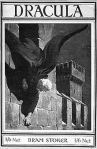
Dracula climbing down the wall of his castle, from a 1916 edition of the work.
I think it will be obvious from my other two posts that I think the first part of Dracula – the part where Jonathon Harker goes to give legal advice to the sinister Count and comes increasingly to suspect that he is being kept a prisoner – is the best part of the novel.
It isn’t that the remainder of the novel isn’t an enthralling Gothic adventure story, for it is. It is brilliantly researched, evocative, and makes for a wonderful read. The ever present menace of the scheming, demonic Count, his marking down Lucy Westenra as prey, Mina Harker noticing Jonathan’s horror at seeing the vampire Count in central London, the friends’ horrified destruction of a female vampire, Dracula’s scorn at the idea that these presumptuous humans could possibly defeat him, the collusion of the unfortunate Renfield, Dr Seward’s patient, the nightmare visit of the friends to the terrible cellar of the Count’s house, the fearsome Count’s preying on the women, all make for a gripping read.
Nevertheless I don’t think the atmosphere of the first part of the novel can be surpassed. It is only at the end, when Van Helsing and Mina Harker (who has now been brought into a horrible telepathic relationship with the wicked vampire) that the ambiance of subtle menace returns quite so strongly as in those inspired first chapters.
As the book comes to its climax, they are chasing the Count back to his home land as he travels by river. Time is of the essence, for now Mina too is threatened by the vampire infection.
The resourceful Van Helsing is, of course, implacable and fearless in his pursuit of Dracula, withstanding terrors that make a shiver run down the reader’s spine; he knows that if the Count calls Mina to him, then she must go and has to protect them both:
‘We were near the top of a steep rising hill on summit of which was such a castle as Jonathon tells us of in his diary…..I drew a ring so big for her comfort…and over the ring I passed some of the Wafer, and broke it so fine that all was well guarded…Presently the horses began to scream and tore at their tethers till I came to them and quieted them…In the cold hour the fire began to die, and I was about stepping forth to replenish it , for now the snow came in flying sweeps and with it a chill mist…the mist began to wheel and circle round, till I could get as though a shadowy glimpse of those women that would have kissed him (Jonathon Harker)…I knew the swaying round forms, the bright hard eyes, the white teeth, the ruddy colour., the voluptuous lips…’
You don’t get better Gothic horror than this wonderfully chilling depiction. I think all writers of Gothic, like myself, yearn to be able to bring off such a sinister ambiance. I won’t write a spoiler for those who haven’t read the original story, but the culmination of this novel is all that you could wish.