
Lynne M. Spreen's Blog, page 27
December 9, 2013
Review of Private Life by Jane Smiley
 Private Life by Jane Smiley
My rating: 3 of 5 stars
Maybe this book is better than my capacity to appreciate. I don't tend toward writing that is obscure, or dense (or makes me feel dense). However, sometimes it's better to roll along with the storytelling and let the deeper meaning work its way up from subconscious to conscious.
The ending of this book is extremely powerful. Margaret, due to the traumatic incident that happened when she was five, lived in a fog her entire life, married to a wacko genius, and not waking up until she was in her sixties and everything/everyone is sad and tired. Yet she seems to catch fire, fueled by bitterness, in the very last 3 sentences of the epilogue. It was a long time to wait for the enlightenment.
I gave the book 3 stars because there's too much backstory too soon, making it hard for me to develop an interest in the story. Once there, I felt frustrated at the repetitious nature of Margaret's obtuseness, even though she's a bright woman, and her deferring to Andrew, even though this is what people - women especially - do.
It went on for her whole life! That she was living in a cloud due to, I believe, the trauma of the childhood incident, and that she was ill served by those around her, didn't make it any easier to like this story. I know Smiley is a master writer, and I feel like a goof not giving her a better rating, but this is my honest reaction.
View all my reviews


December 6, 2013
RIP Nelson Mandela
I had a post ready to go, about reaching for your dreams in the new year, but somehow it seems disrespectful in view of Nelson Mandela’s passing. Instead I will cherish the feeling I’m left with, of being motivated to reach higher, to do better, and to be a better person. My condolences to all who loved him. Mid-Friday update: I just became aware of a beautiful, thoughtful post about Mr. Mandela. I recommend you check it out here.


November 28, 2013
Happy Thanksgiving
Twenty-five people are coming to my house today. We’re serving turkey and ham. My guests’ ages range from 19 months (hide the breakables! no candles!) to eighty-eight. Everything’s set up. I invited my mother and two sisters to come by this morning for a champagne-and-strategy session, because they’ll be helping me keep this thing on the rails later today. I’m grateful I can do it, and for the health and goodwill of my family. And for you, dear reader. Thanks for sharing your thoughts, wisdom, guidance, humor, tips, tricks and anything else you’ve volunteered through the years, not the least of which is, simply, your presence. We’ll get together again next Friday. I can’t wait.


November 22, 2013
Review of The Last Original Wife by Dorothea Benton Frank
 The Last Original Wife by Dorothea Benton Frank
My rating: 4 of 5 stars
I really enjoyed The Last Original Wife by Dorothea Benton Frank, the story of a sixty-year-old woman finding herself after a lifetime of putting everyone else first. From the very beginning, the voices of the two main characters, Leslie and her husband Wes, were funny, compelling, and realistic. Although Wes was more shallow, Leslie's internal dialogue reflected the drives and misgivings of "second adulthood" very well. Who are we at this age, she wonders, and where do we go from here? A very timely topic.
I enjoyed peering inside a bubble of affluence that includes dysfunctional adult children, trophy wives and Masters of the Universe in action. The descriptions of Atlanta and especially Charleston are lush with detail about modern life and the history of the place. The author is adept at keeping the dramatic tension high, and I couldn't put the book down; it's well-written and well-edited. Lastly, I enjoyed learning about Josephine Pinckney and other strong women who've been inexplicably overlooked by history.
The only knock on the book is that in some (very small) places the dialogue seemed more geared toward informing the reader than entertaining. One example is in Leslie's ruminations with her brother about Pinckney, which went on a bit long. Also, some of the restaurant descriptions (e.g. menu items) seemed overly detailed, but as a writer I'd probably do the same thing in hopes the establishment would show me some love in return, next time I dropped by. And having eaten at Magnolia's in Charleston, I certainly understand!
In summary I very much enjoyed this story, feel happy to have discovered Ms. Frank, and look forward to checking out the rest of her novels.
View all my reviews
November 20, 2013
Review of Spider Woman's Daughter by Anne Hillerman
 Spider Woman's Daughter by Anne Hillerman
My rating: 3 of 5 stars
A good story. Anne Hillerman brings back the magic of Navajo country, and the world of Chee and Leaphorn, which made me happy. Also, the main character is a woman, Navajo police officer Bernadette Manuelito, which I enjoyed - a real switch for the Hillerman series.
The only problem is Anne isn't the writer her dad is, but she has promise. I hope she continues to work at the craft and improve, because this world of Bernie, Joe and Jim is too precious for us to let go of. I appreciate her contribution, and now I'm motivated to go back to Tony Hillerman's early works.
View all my reviews
November 15, 2013
Little Difference between Young and Old
What if there is no meaningful difference between people of different age groups? We tend to stereotype based on age, but the similarities between the groups might be more numerous than the differences. Here are some common ones:
Naivete or innocence: A young person may be exploited due to lack of experience, but other ages fall victim as well.
Independence: Young people can’t live alone or drive a car. Some older people are in the same situation. Commonality, not distinction.
Appearance: Older people may start to look funny, but remember those pictures of yourself as an adolescent? You say the younger people will outgrow it? So will the elders.
Dreams: Older people set out on the path of new dreams at every age. And some younger people just aren’t interested.
Frailty and illness: An older person may have physical limitations, but when I was in elementary school, a classmate missed a whole year due to rheumatoid arthritis. She was infirm. She was very young.
Death of friends and relatives wounds all of us.
Intellect: do I even have to explain?
We all go through physical and hormonal changes in life. Think of your own pubescence. Now think of menopause. Was either more fraught?
Yes, some characteristics are more typical of a certain age group, such as physical decline, but we certainly have a lot of commonalities. Why do we ignore those in favor of artificial differences?
I think because it’s easier. We stereotype people, throwing them into groups, because it saves us from having to see a person as an individual. We label them for our own convenience, but labels might dictate how a human is perceived or treated, leading to a huge waste of potential, not to mention heartache. Besides, labels and stereotypes change over time. One hundred years ago, in the United States of America, women were forbidden to vote. Everyone agreed they were insufficiently intelligent or rational to handle that responsibility.
Maybe someday our perceptions about age will change, too. We might come to think the differences between young and old are so trifling as to be immaterial. Why not start now? Let’s focus on what we all have in common, and beyond that, get to know each other as people. And as far as allowing those labels to limit you, stop right now. Decide who or what you want to be, and become that, regardless of age.
Your time on earth is finite and precious. Don’t waste it trying to comply with some soon-to-be-antiquated standard of behavior.
I’ll be away for the next two weeks. Enjoy your Thanksgiving! See you on December 6.


November 8, 2013
Living Well in the 2nd Half
Do you sometimes feel that your time is past? It happened as I read Scott Adams’ new book, How to Fail at Almost Everything and Still Win Big. It’s funny and informative, but some of his advice is geared toward younger people; for example, how to persuade more effectively, overcoming shyness, and the importance of good grammar. (Before you question the value of the entire book, he also talks about the impact of social biases; tracking your personal energy level as the most important metric in your pursuit of a successful life; and his belief that the mind is a “moist computer you can program.”)
But back to my original problem. We, the People of the Second Half, have harder questions that I rarely see addressed, certainly not in popular best-sellers. Here are a few:
How do you cultivate a happy, productive life when half of it (or more) is over? How much work do you put into this effort? Should you speed up or slow down?
How do you feel confident in your maturity when you’re denigrated for it?
Where do you go to find answers in this youth-obsessed society?
Luckily, I have answers for you, because I found a teacher.

Dorys, writer and wise woman
Last Friday, at a writing retreat, I sat with a wise friend, Dorys, and asked about her life at eighty-five. She admitted that sometimes it strikes her hard that “I’m fifteen years away from being one hundred!” And yet, her eyes danced with humor and kindness as she answered the pathetic questions of this 59-year-old.
One was about being alone long-term. In response, she told me about a day she spent recently in which the phone did not ring, no one knocked on her door, and she had no reason to get in her car and drive anywhere. Instead of feeling lonely, Dorys reveled in the solitude. How lucky I am, she thought, to have one entire day all to myself, where I don’t have to go anywhere or do anything, no obligations, a whole landscape to explore without interruption, free to do whatever I want. With just her kitty for company, she had a day of golden solitude.
A therapist once told me that to live happily alone, we must first become ALL ONE. Whole. Dorys says that is a major prescription for life. Here are the highlights of her advice to me:
Stop overthinking the aloneness question. We expand what we focus on, and thus might give too much power to the fear. With maturity, this and other issues won’t seem insurmountable.
Don’t underestimate the power of distraction when the blues or loneliness hit you. She might escape into a movie or two. Usually, by the time the movie ends, her attitude has shifted.
“Give of yourself to someone, or fill a need,” Dorys says. “I volunteer in a hospital one day a week; I also volunteer at the community theater, and I’m a political advocate working with our local politicians to make improve our community. I participate in an annual variety show. I am learning Spanish.”
“My philosophy is to choose where you want to spend your time and with whom. The minutes we are given are precious.”
And along those lines: “Wasting (time) worrying about what might be is like preparing yourself for it to happen.”
“Find your authentic self or seek out your passion, embrace it and learn to fill the void you are consumed with.”
“Keep your life in perspective. You may be having a blue afternoon, but there’s someone out there who’d kill for your blessings.”
I appreciate Dorys. She’s an inspiration and a source of comfort. Life is complicated, but if you find a good teacher you might feel happier and more at peace with the unknowable. Manage what you can and develop the confidence to leave the rest alone.
Do you have any suggestions for living well in the second half?


November 1, 2013
Fun, Part 2
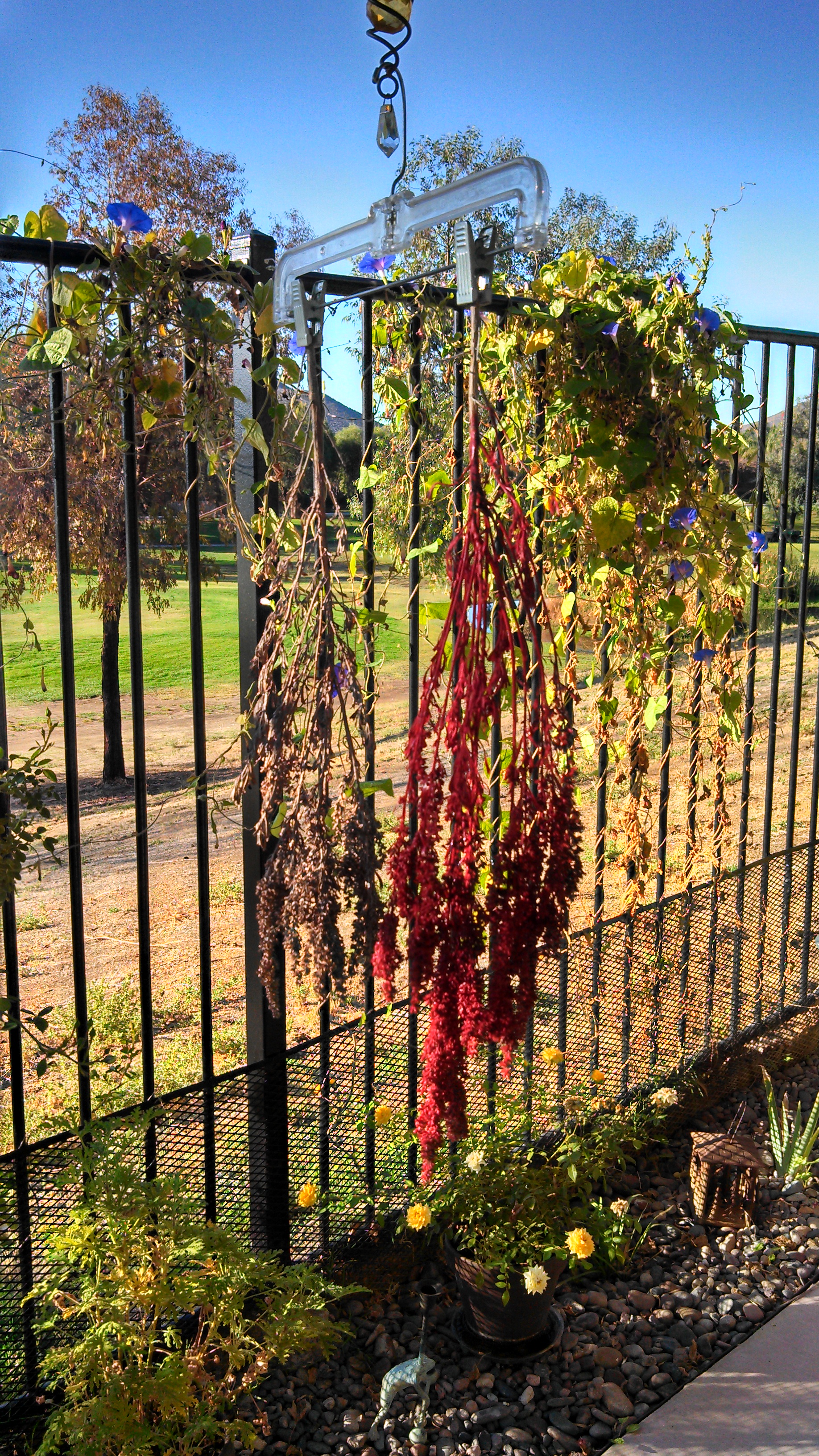
Last week I wrote about collecting dead/dying vegetation to bring home and spray paint as decorations for my house. I said I’d get back to you if the arrangement worked out okay, and guess what – success! You’ll see the finished “bouquet” at the end of this post, but first, the process. After hanging the plants in a closet for a week to dry, I prepared a place where the paint would do the least damage:

a
My paint supplies:

a
The drying room:
a
After a few hours of drying, I assembled this fragile foursome like so:

I’m really happy with the results, except that my new “tanned” feet look like I spent the day at the beach. I didn’t realize how far the overspray might drift, or that I shouldn’t wear flip-flops for this job. I also dusted the cement with a rosy glow, accentuated by the sharp gray rectangles that appeared after I removed the newspaper. Bill said at least I didn’t get the car.
It was worth it, but too much mess. In the future, I’ll stick to hanging roses and statice upside down in the coat closet to dry:

This was fun! A nice diversion from work. See you next Friday.


October 25, 2013
Did You Forget to Have Fun?
My sister asked, “If you had all the time in the world, and weren’t always working, what would you do for fun?”
I had to think. To me, work is fun. Always has been, even as a youngster. These days, writing, blogging, public speaking and hanging out on social media are my work and my hobbies. But those aren’t things I can do with a buddy on a Saturday.
Suddenly, I felt like Poindexter, always in the lab, hunched over another invention, cackling to myself.
Rallying, I told her I liked to go on field trips to gather dried plants, which I could then spray with metallic paint and use as decorations around my house. Calculating silently, I realized, but did not admit to her, that I hadn’t done that for at least fifteen years.
Two days later, Sis and I borrowed my husband’s truck and drove up to our local mountains. We spent the day taking pictures of the fall landscape, and gathering dried, dead or otherwise promising plants for my project. When we tired of hiking, clipping and snapping, we retreated to the Idyll Awhile Wine Shop and Bistro for a glass of wine and a fruit and cheese plate. We had a blast.
I hung the clippings in the garage to finish drying. In a few weeks you’ll see how they turned out, if they do. I also took the tree picture you see at the top of this page. A nice souvenir of my day.
I had fun. Hanging out with my sister and climbing around in the hills made me feel like a more complete person, even though, truth be told, I yearned to get back to my “work.” Yes, that’s the Poindexter mindset.
Still, her question set in motion an experience that reminded me:
we need friends
we need fresh air
exercise is good
once in a while, you need to turn off the computer, go outside and play.
What hobby or leisure activity have you been putting off?


October 18, 2013
Amazing Eighties
Eighty! You’re eighty? Eighty’s really old, right?
That’s how I used to see it when I was younger. Maybe you, too.
But now that I’m around 60, and involved with writers and writing groups, I have friends that age. Girl friends who will sit with me, drink wine, and whine about whatever. We discuss our writing, our dreams, other people, sex, wanting to lose a few pounds…
Here’s the news: Age is irrelevant. It truly is “just a number.” People age differently these days. We’re all over the map. You cannot stereotype based on a number, because people differ so substantially at this point in life.
One of my friends, MJ, is 82 and her hair’s on fire. She’s working on her second novel. Another friend, Ray, will be 90 next May. He’s published thirty books so far and there’s no end in sight. My mom is 88. She attends exercise class three times a week, has tons of friends, and loves the novels I recommend. (We had the best discussions after Water for Elephants, Cutting for Stone, and Two Old Women).
What’s going on? Weren’t these people supposed to be in rocking chairs, gazing vacantly into space? Whether due to better nutrition, changing societal expectations, or something else, elders have kicked it up a notch. They’ve been places, they’re doing things and they aren’t done yet.
And I think they have tons of information we’d all benefit from hearing.
The people who really have something to teach us are in their seventies, eighties, and beyond.

Mary McPhee
Mary McPhee, 87, wrote a book based on her blog. The book, called “” is about moving to a retirement home. She is sharp, productive and independent, with her own apartment and car. Very unusual, I think, to move to a home under your own steam while you still have choices, but she did so because it was a nicer place to live at the same price as her mortgage, for one reason. I suppose the Midwestern winters had something to do with it. Mary is thriving while enjoying the security and comfort of the home. In Nora, Mary reproduces her blog posts, most of them funny or lighthearted. However, she occasionally makes an observation that reveals the thoughtful elder behind the comedic persona. For example, this is a reflection on a couple of her neighbors who are aging faster, mentally, than others:
It didn’t take much to amuse them. They were on leisure time; holding-pen time; lame duck time; they had no cares or worries in the world. Which of course was not true because they still had plenty – their families and their own health – but nature had relented a little, softening their brains so these things weren’t so sharp for them anymore. Or they had the ability to forget their cares and worries for long periods, if forgetting can be called an ability.
Mary has written twelve books so far in her life, and she’s still writing. Here’s her story.
 “As a child, I fell in love with words. I read constantly and collected words which I inflicted on helpless people, often mispronouncing and using them incorrectly. When I was nine, I started ‘publishing’ newspapers for my father, who traveled Monday to Friday, to tell him what had happened during the week.

“I got a degree in Journalism from Oklahoma State College, but lacked confidence in my writing so mostly did secretarial work before marrying. Five children later, in my mid-thirties, I began to write. I wrote casual, humorous pieces about raising children. Over a hundred of these were published in newspapers and magazines, each earning between $50 and $150. An article on the women’s liberation movement in the 1970s was featured in the Chicago Tribune’s Sunday magazine. $250 for this. But all the time I wanted to write fiction.
“I churned out twelve novels, but I couldn’t get an agent. Then I discovered blogs, and by this time, widowed and my children grown and gone, I moved to a retirement community, and began blogging Code Name Nora. I was eighty. Some readers thought I was a fraud, a much younger person. Writing the Nora blog helped me adapt to community living. I am somewhat shy, preferring mostly to observe, but living in the Twilight Zone, as I called it, helped me to be more outgoing. I moved to my new retirement home because it’s much nicer and the rent is the same as before.
“Then I discovered self-published ebooks on Amazon. It was difficult to learn the technical aspects but I finally managed to put eight novels on Kindle. I wrote several new novels and dusted off some old ones.
“I write early in the morning for an hour or so. I used to write by hand but now on the computer. I belonged to Rocky Mountain Fiction Writers, a large group in Denver that offers critiques, but I don’t any more. I don’t have any beta readers but wish I did because writing is lonely.
I think existential angst is part of the creative make-up. Art of any kind is a way to deal with it.
“Despite what we might have to offer, people my age are frequently left out of discussions with younger people, which is hurtful. This is ironic for me because
I have never felt as creative as I do now at the age of 87.
“But then I remember when I was young and felt older people wouldn’t understand or would be accusatory. And of course, many older people have trouble hearing. (I do, and wear hearing aids.) I mostly listen but when it seems a good time to speak up, I do. Sometimes younger people laugh at what I say, and I’m not always sure what that means. Older people appreciate being listened to but they shouldn’t talk too much or about their ailments.

“I have ideas for new books but none coming out just yet. I’m busy promoting the eight books I have on Kindle. A Fresh Start in a New Place, my memoir about dropping out of big-city life at age 53, to live in a tiny Vermont hamlet, is my next promotion at which time the price will be discounted.
“My blog is MaryMac’s Booktique and my Facebook page is here. The cover for A Fresh Start uses a picture one of my daughters painted when she was eighteen and spent the summer with me in Vermont. The other image is one of the front pages of two of my childish newspapers, yellowed with age. You may need a magnifier to read them. I just include these for fun. Oh, and my blog is kind of a mess. I need to work on it.”
Lynne again: I’m 59. I admit, sometimes my sisters and I feel anxious about getting older, but then I remember people like MJ, Ray, and Mary, and I relax. We have these awesome trail-breakers forging the way for us. They are powerful role models from whom we can draw strength. I am grateful for them.



