
Lynne M. Spreen's Blog, page 30
August 9, 2013
Finding Order in Chaos: How to Handle Your Role as Caregiver
Today’s post is written by Cameron Von St. James. He’s a husband and daddy, and he’s got some helpful information for you about dealing with the burden of caring for a very ill loved one. Here’s his story:

Cameron Von St. James
Less than four months after my daughter Lily was born, my wife Heather and I were handed the worst news imaginable: Heather had been diagnosed with malignant pleural mesothelioma. A rare cancer directly linked with exposure to asbestos, her illness offered slim chance for survival. During what should have been a happy time celebrating the joys of new parenthood, our lives were thrown into chaos. I became an instant caregiver. Our lives would never be the same.
Caring for someone suffering from a devastating illness requires every ounce of strength you can muster. Whether your loved one suffers from Alzheimer’s, cancer or any other serious illness, your life changes forever in the blink of an eye. I had to learn using a “trial by fire” method, and while there are countless resources to help support cancer patients and their caregivers, none of the material can really prepare you for the fight ahead. Fortunately, Heather overcame the odds and beat her cancer. Seven years later, I’m here to share her story and offer guidance for those facing the challenging role of caregiver.
Over the years, my work with the Mesothelioma Cancer Alliance has afforded me the chance to meet many families facing similar situations. I’m often asked how I handled our struggle and what advice I could give. Over the years, I’ve learned a lot about taking care of my family from fellow caregivers and my own trial-and-error experiences. I now offer you the same advice so that you don’t have to face this challenge alone. Here are five of my most useful tips for providing care to someone suffering from a serious illness. I hope they prove useful to you and your family.
Tip #1: Accept help when it’s offered.
Help comes in a variety of forms. It could be a week of casserole dishes or a help getting all the laundry done. Small acts of kindness build into large sources of relief. You’re going to face a lot of challenges while providing care for your loved ones, so it’s important to reach out to people and accept the help they offer. You’ll feel better knowing that things have been taken care of, and you’ll have a little less on your plate to deal with. (Lynne: If I ever have to do intensive caregiving again, I will ask my family or friends to take over long enough for me to go to a movie, get a massage, or just take a nap. I didn’t do that when Bill had hip replacement surgery and I paid the price, because I’m a worrier. I ended up with my own cardiologist, for a time. The heart doc said a husband’s health is a very common cause of heart problems in women. Common! Word of warning, ladies.)
Tip #2: Maintain your own health.
Because you’ll be so focused on caring for your loved one, you might neglect your own well-being. Don’t fall into this trap. You need to maintain your own health in order to stay sharp and focused. I found that replacing sleep with food sometimes worked to maintain my energy levels, but I couldn’t do it for more than a few days. At some point, your body will succumb to exhaustion if you don’t give it the right nutrients and rest. Take a walk or go for a quick jog around the neighborhood. Keeping your body well-nourished and fit will increase your energy and reduce your stress. Both will help you become a more effective caregiver. (Lynne: Nawp, didn’t do this either. But next time, I swear! If there is a next time, and I hope there isn’t.)
Tip #3: Learn everything and stay informed .
Knowledge is definitely power in a situation like this. Learn everything you can about your loved one’s illness, its side effects and possible treatments. Seek second, third and sometimes fourth opinions. If you have questions, ask your doctor for full explanations. I found it useful to take a notepad with me to Heather’s appointments so that I could jot down notes and additional questions to research later. Joining local support groups will help you establish connections with fellow caregivers, and you can exchange stories and ideas. You may also want to spend some time online using sites like this one and others dedicated to caregiving resources. (Lynne: but Cameron, I fear a person can get overloaded and anxious after gathering so much information. Any tips for that?)
Tip #4: Get organized.
Over the course of your loved one’s treatment, you may receive dozens of prescriptions, appointment cards and other documents. You’ll also have to keep up with appointment times and everyday life. Staying organized will help you manage the burden of keeping up with everything. Use a good calendar or your smartphone, tablet or computer to keep track of everything. You’ll handle everyday tasks and unexpected occurrences much better if you stay organized.
Tip #5: Make a list of priorities.
Everyday life continues despite the devastating blow of a serious illness. You still need to pay your bills and take the dog for a walk. While you might be tempted to shove everyday tasks to the back of your mind, you’ll need to maintain a sense of normalcy during this time. Make a list of priorities, and enlist the help of friends and family when necessary. You can eliminate extra challenges by focusing on the most important tasks first and taking everything one step at a time.

Heather, Lily, and Cameron
Cameron Von St. James is the husband of mesothelioma survivor advocate Heather Von St. James, who was diagnosed in 2005 at the age of 36. A seven year survivor of this rare cancer, Heather and Cameron now work with the Mesothelioma Cancer Alliance to bring awareness to this often neglected disease. They hope that by sharing their story, they can bring hope and inspiration to people facing any sort of illness or disability, and the caregivers who support them. Heather and Cameron live in Roseville, MN with their daughter Lily, who is now 7.



August 2, 2013
The Convenient Accusation of Dementia
The young woman was upset about her mother. “Mom bought me a house a few years ago, and believe me, I’m grateful,” she said to the advice columnist. “But I’ve had some financial setbacks, like losing my job in the recession and having to file bankruptcy. I’m doing the best I can to pay Mom back, but the other day she complained to my aunt about my financial dependency. I can’t believe my mother revealed this confidence. She’s normally so private. I’m worried she’s starting to show signs of dementia.”

The advice columnist responded, “She might just be resentful about your financial situation, and kept it to herself all these years. But definitely try to get her to go with you to her doctor,” she said. “Have her get a full checkup…”
I don’t like what you did. I think you need to see your doctor.
Maybe some of us DO get old and cranky, and maybe we shoot our mouths off about not wanting to be doormats any more. Maybe we’ve seen enough bad behavior by this point that we’re way less tolerant of it, and we’re comfortable saying so out loud. How convenient to assume we’re losing our marbles.
Impending dementia provides a handy explanation for discomfiting behavior. (For younger people, we cluck that they “may be bipolar.”) Neither assessment should be made casually. If you see something, observe without panicking, and if there’s a pattern over time, discuss it privately with a professional. If you receive guidance to take it further, so be it. But don’t jump into it haphazardly.
Humans like to control their environment. A crabby senior might look like a candidate for muzzling but tread carefully. An irresponsible charge of dementia can cause us to resent you and begin second-guessing ourselves. Life is fast-moving and complicated these days. Plenty of people forget things, sound stupid, or lose their tempers. Ageism alert: if you wouldn’t accuse a young person of dementia in a certain situation, don’t accuse an old person of it either.
Please don’t be mad at me. I swear I’m in my right mind. Such as it is.



July 29, 2013
Kent Haruf is a Genius
 Plainsong by Kent Haruf
My rating: 5 of 5 stars
I read Benediction first, which was my introduction to the beauty of Kent Haruf's writing. Now that I've read Plainsong, I want to buy everything else Haruf has ever written but first I have to catch my breath.
The setting of this story is the high plains outside Denver in a poor ranch town. It won't appeal to everybody. It's not a tropical beach, or a lush forest or a cityscape where you might spot a celebrity or spend a month's pay on a pair of shoes. But it calls to me in the same way as did Dakota by Kathleen Norris, The Whistling Season by Ivan Doig, Bad Dirt by Annie Proulx, Breaking Clean by Judy Blunt, and Gilead by Marilynne Robinson. I liked the self-sufficiency, humor and ethical bent of the good people, and the nastiness of the bad. The plainspoken dialogue is written without quotation marks as if to reflect the sparseness of the land. The real wealth here is in the relationships between the people, which a good storyteller will use to create dramatic tension. I found myself staying up too late, skipping ahead to see what would happen next, and then going back the next morning to reread dozens of scenes in order to savor them properly.
I realize I haven't actually described the story, so I'll steal a quote from the National Book Awards on which I cannot improve: "Kent Haruf reveals a whole community as he interweaves the stories of a pregnant high school girl, a lonely teacher, a pair of boys abandoned by their mother, and a couple of crusty bachelor farmers. From simple elements, Haruf achieves a novel of wisdom and grace--a narrative that builds in strength and feeling until, as in a choral chant, the voices in the book surround, transport, and lift the reader off the ground."
View all my reviews
July 26, 2013
How Does It Feel to Be 82?

Dory by Sallie Bailey
I asked my friend Sallie Bailey that question because I think the more we know about aging, the less chance we’ll waste a lot of time being freaked out when we get there. Sallie is an award-winning artist and writer (here’s a link to her website). She’s practical and smart, and she said I could quote her, so here goes.
Frankly, it’s a pain. Literally. Arthritis has taken its toll. Joint replacements help but there’s a lot that brings me up short, limiting my mobility. I’m very fortunate that I’ve dodged all the major bullets – no serious health problems. The brain still functions. I firmly believe that creativity is the answer – I think we writers/artists have an enormous advantage. It’s my opinion that our ceaseless brain activity keeps that organ healthy – keeps it young. I have more ideas than I can carry to fruition. Time can be a problem there – but it’s always been a problem.
That brings up another facet of aging well – curiosity. Many of the normal occurrences of aging surprise me. Physical changes – some small, some more pronounced. I observe and reflect on them.
I consider myself very fortunate to have been gifted with a fine sense of the ridiculous. Laughter certainly helps. My father, mother and brother lacked that. Our youngest son and my brother’s oldest daughter have it. (The niece, knowing I’m partial to art glass, sent me on my 80th birthday an art glass marble on a little base along with the note that it was to replace any marbles I might have lost!) My husband has it – actually both arthritis and a sense of humor.
Death? I don’t like the idea of dying at all. I don’t don’t believe in an afterlife and I don’t like the idea of missing anything. On the plus side – people like us leave footprints. They may be lost but they’ll always be there to be found – art, writing, whatever. Another plus – at least someone else will have to clean out our dresser drawers………
I love what Sallie said about being curious and having so many ideas that time is a problem. As long as we’re hungry, life is good. I have another friend who’s in her early eighties and when we get together to talk about the novels we’re writing, we get so excited we talk over each other. We drink wine and rant about our ambitions and dreams.
Want to feel inspired? Here’s a short video interview with a 94-year-old artist who’s making money on his paintings. Thanks to David Kanigan for the lead.
Readers, I’m curious. What is it like being your age?


July 19, 2013
The Clock is Merciful
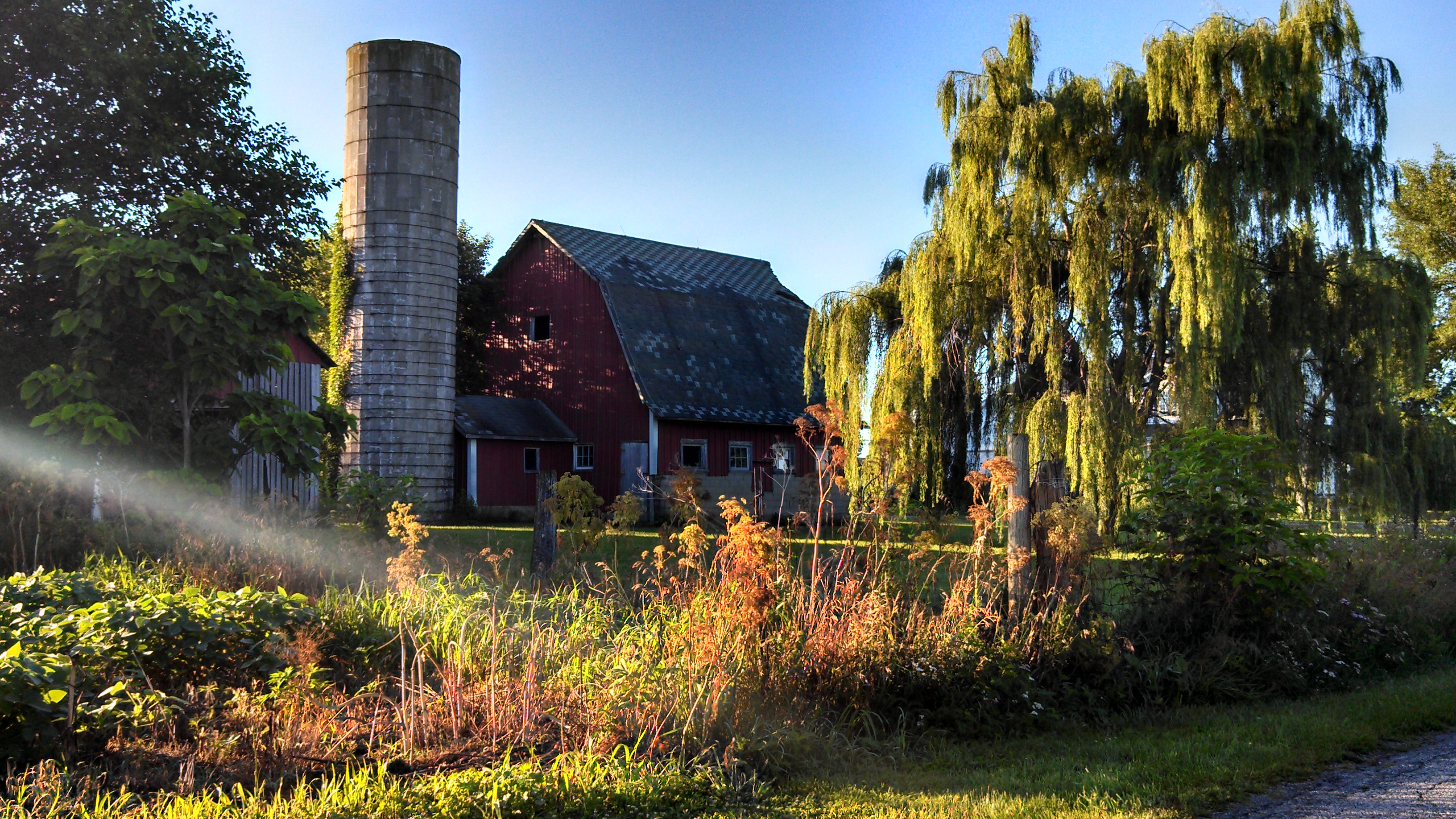
That’s a saying I invented recently. It means no matter what you’re going through, the minutes keep passing, and eventually you’ll be done and things will get better. I know I said I couldn’t post, and really, I’m racing. I have to run. Won’t be able to answer your comments, if any – sorry! – but just this: our first week in Indiana was wonderful. Lots of beautiful countryside (see above) and loving family. Our second week, in Missouri (misery?) is the opposite. See you next Friday.


July 12, 2013
Present in the Moment

Mom is eighty-eight. Her last surviving siblings are declining so I offered help Mom travel to the Midwest to see them one last time. My cousin Kathleen joined us and we flew out of LAX last Tuesday. Our first stop is Rushville, Indiana, where Aunt Katherine lives. Today we went on a field trip to see one of the last covered bridges still standing.

Aunt Katherine (l) and Mom at the entrance to the bridge. They are looking out over Indiana farmland. The corn must be ten feet high and sparkling from yesterday’s storm.
I would like to tell you more but it’s a whole story, including heartache, frustration, love and devotion. I need to take care of my roommate – Mom – and be a good fellow traveler. With your indulgence I’m going to step away from the blog for a couple of weeks to spend time with my family. I want to put the laptop away and be present in this most precious moment. More later. Love, Lynne


July 5, 2013
Claris Healthcare Responds
After last week’s unfortunate review of the Claris tablet by a magazine called FastCompany, I got in touch with Claris Healthcare. One of Claris’ founders said they don’t have any control over a journalist’s choice of headings, but she was dismayed by the “firestorm” that reviewer had created. It seemed fair to offer Claris a chance to say something on their own behalf, so here is their statement from Kara Wood:
Simple is Smart
There has been quite a bit of discussion about a recent article titled ‘A Tablet So Simple, Even An Old Person Can Use It’. As a founder of Claris Healthcare, the company that makes Claris Companion – the subject of the article, I appreciate the opportunity to offer my perspective.

Kara Wood, Founder, Claris Healthcare
There are a lot of older seniors that enjoy keeping pace with today’s rapidly changing technology. But there’s also a portion of the population (independent of age) that isn’t interested, or because of a physical disability, isn’t able to benefit from being online. We developed Claris Companion to help anyone connect with friends, family and caregivers by removing the barriers imposed by modern computer design.
The latest tablet is great if you want to learn all about the pages of icons, settings, menus and options. But what if you aren’t that interested? As my 92-year-old mother would put it, “I never had to enter a user name and password to answer the phone, or launch a web browser and enter a URL to read a letter”.
She’s far from alone. Yes, seniors are the fastest growing population of Internet users (see Sparkbeat 2012/07/03) – not to mention the fastest growing segment of the population, period – but there are a significant portion who simply don’t want to climb the learning curve to get the benefits of the Internet, or due to disease like arthritis or Parkinson’s, have trouble with devices that were specifically designed for a different demographic of users.
So our design challenge was to make a device that can engage anyone in online communications – sharing of email, text messaging and photos with family in a way that most others take for granted. And there is a much larger issue at play here. Access to the Internet is not just about photos and email; but for our aging population, it is increasingly critical to their care and wellbeing. That’s because our healthcare system simply cannot withstand the wave of aging boomers that is coming. We will no longer be able to provide prolonged care for older seniors in hospital or extended care facilities – increasingly people will have to age at home. So effective delivery of self-care assistance and monitoring at home will be critical to successful aging-in-place.
The answer is to be sure that the immediate benefits outweigh the effort required to use the technology. The benefits side of this equation is easy –most people (including older seniors) are very happy to engage with sharing photos, email and text messages with family – and even adopting personalized self-care assistance if and when they want.
It’s the other side of the equation that is challenging – how to design something that doesn’t require any training at all to use. This is not about ‘dumbing down’ computers to make them ‘so simple even old people can use them’. This is about designing something where the benefits are much greater than the effort required to use it. That’s what we believe we have achieved with Claris Companion.
Apparently, we have found that balance for my mother. She now gets photos sent to her from everyone in the family and dashes off emails to us too. But what is even more important to me is that she has now decided to turn on the medication reminders and I get a notification each day confirming that everything is okay.
In spite of the recent issue, we at Claris Healthcare hope that by creating this product we’ll be able to open doors to people who are currently unable to access the benefits of technology.
A
Lynne again: I read a statistic recently that seniors who are online are 20-28% less likely to be diagnosed as depressed. Also, aging in place is the gold standard – what we all want. If anybody can develop a product that allows seamless web access to people who are otherwise unable to access the Internet, I think that’s a product worth supporting. It’s too bad that a magazine, FastCompany, virtually slandered Claris. However, I hope this post will help clear up who was at fault here. Kara Wood will be available to respond to your comments if you have any concerns, and I appreciate her for being available for that. What a lively and vibrant discussion! I an grateful to all of you for your involvement and passion. Thanks for getting involved.


June 28, 2013
FastCompany to Old People: You Must Be Stupid, Stupid, Stupid
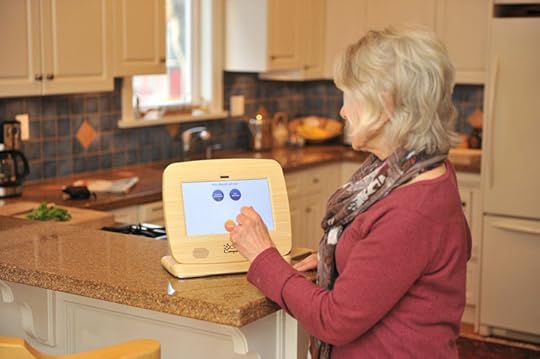
“A Tablet So Simple, Even An Old Person Can Use It
Technology can be scary, with its buttons and beeps and boops.”
That’s the exact wording in a review by FastCompany of a new Claris product. It”s in poor taste, obviously, but it’s worse than that. I don’t think they’d ever say, “A Tablet So Simple, Even a Woman Can Use it,” because that would sound sexist. Or “A Tablet So Simple, Even a (insert ethnic minority here) Can Use It,” because that would sound racist.
But it’s okay to stereotype people due to their age, apparently.
Why FastCompany would choose to look so unsophisticated and dense is beyond me. We’ve tried calling it to their attention. The Yo, Is This Ageist blog talked about it, but nothing changed. I thought it would be fair to email the editor, Morgan Clendaniel and tell him I planned to run this post with the above “stupid x 3″ title, hoping he’d reconsider. We went back and forth a few times and then he stopped answering, so I have to assume he’s cool with it.
Here’s what he said.
You are, I think, unfairly putting into our mouths the most offensive option for why the tablet needs to be simple for seniors to use it. At no point do we say it’s stupidity, nor–emphatically–do we think it is…it was created for older consumers who are not so-called digital natives and who may be uncomfortable with the various bells and whistles–not to mention small type and ungainly interfaces–of the current crop of tablet computers and would like something more simple.
A
You should also note that in a recent Pew Survey, only 1% of adults aged 66-74 and 74-85 said they owned a tablet. Nearly half of adults aged 74-85 don’t even own a cell phone. So the idea of technology being an alienating factor for older Americans isn’t just a myth made up by some snot-nosed kids. It’s a fact that Claris reader is trying to address. I assume they think they can sell a lot of tablets to that 99% who still don’t have one, and that they think that the reason those seniors don’t have one yet is that they’re too complicated.
Clendaniel’s statistics aside, he’s missing the point:
The headline is ageist.
What is ageism? Here’s a very brief definition that cuts to the chase:
…Another common instance of ageism is in the case of older adults or senior citizens, when they are portrayed in the media as being feeble or weak-minded (from the Southern Poverty Law Center.)
Clendaniel seems not to get it, but he’s not alone. Negative stereotyping of older people is the rule, not the exception. It’s so common it’s not even noticed. This concerns me; society seems oblivious. We’ve become quite knowledgeable about mistreatment of other protected groups, but not older folks. That should change, because ageism isn’t just stupid. It can lead to a waste of talent and resources from older people who can’t get hired and then have to go on the dole. That’s just one example. Ageism is discouraging, unfair, cruel, and it can be illegal. You’d think big, fast companies would know that.


June 27, 2013
I Can’t Stop Myself from Posting This
Forgive me for shouting, but this feels good! A friend, Jim McFarlin, shot this pic at the Fresh Produce store on El Paseo.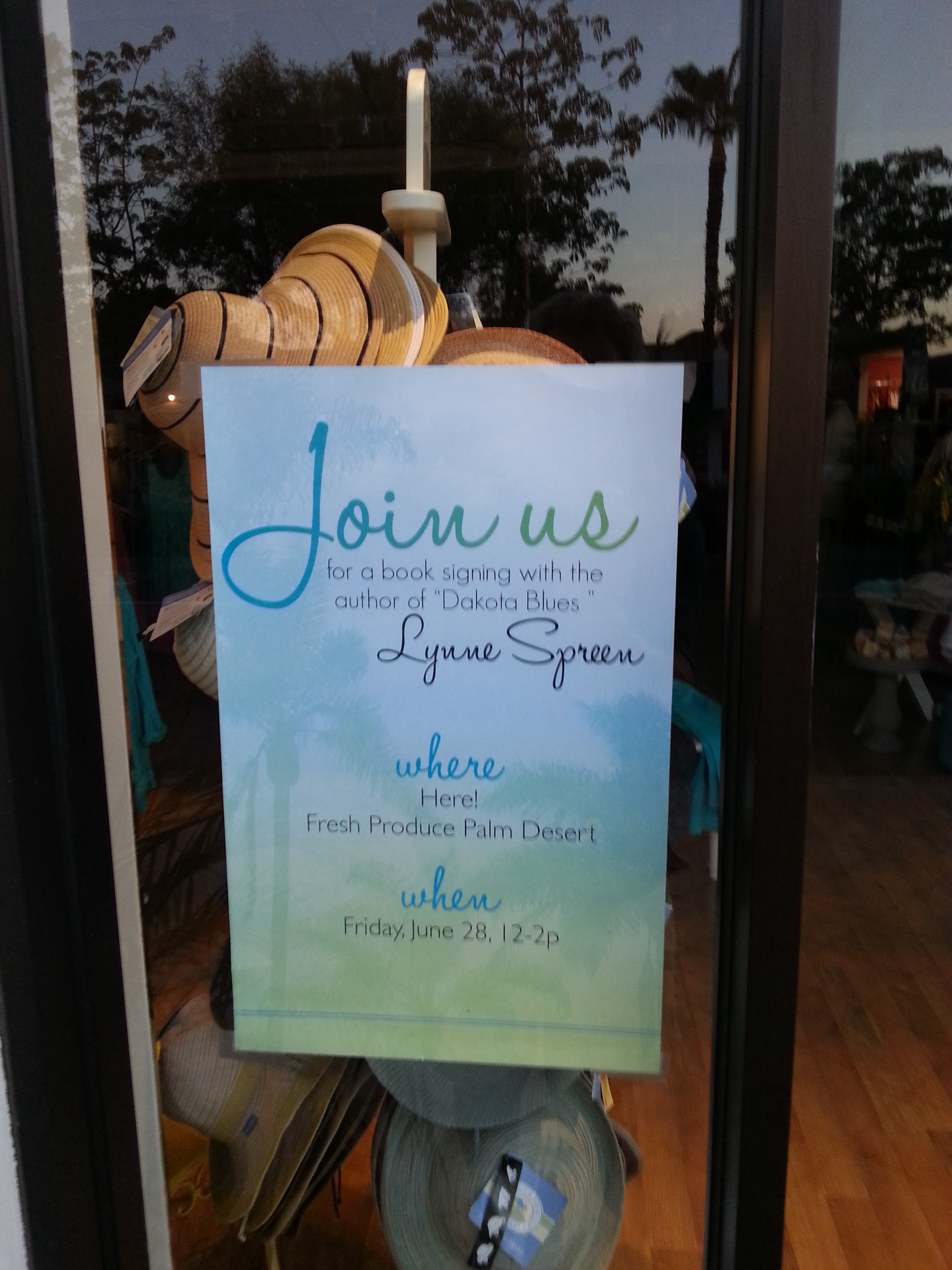


June 21, 2013
Why North Dakota? And Other Reader Questions
 I’ve been lining up book signings and speaking gigs lately, and some of the same questions come up. As promised, here’s a roundup of the answers:
How long did it take to write Dakota Blues?
Ten years (gasp!) In the early years, my part-time job would intrude, or some kind of life challenge like surgery, and I’d stop writing for months at a time. Also, I was learning to write as I wrote, so a lot of it went in the trash. Picture a potter’s wheel, and a grey lump of clay getting fat, then skinny, then fat again as the wheel spins. That was Dakota Blues in the early days.
Another trial-and-error aspect that ate up a lot of time: I did not have a good idea of how a novel should be structured, or how (and whether) to outline it. I went through several different systems and ended up using the one by Larry Brooks (StoryFix.com) called “Story Structure.” I recommend that if you’re inclined to outlining.
Do you write every day? What’s your schedule?
I write as many days in sequence as I can, because if I skip a day or two, I forget details. But I had to find that out the hard way.

DAKOTA BLUES is a love letter to North Dakota before the oil boom
Your descriptions seem so real. Are they fictional?
Mostly real. When I visited Dickinson, North Dakota with Mom in 2008, I knew in my heart it had to be based there. As we drove from Denver to Dickinson and back again, and all during the visit, I recorded my observations into an audio recorder. I also took pictures. It was the trip of a lifetime. Mom and I still talk about it, and I had a photo album printed for her as a memoir.

This was the farm’s chicken house, where Mom as a 5-year-old collected eggs.
Much of my story is really Mom’s story. The anecdotes about the ancestors coming to America, and the hardships they faced to give their children a better life, are all true. So is this quote from my people, Germans from the Banat region of Europe:
To the first generation is death, to the second generation is suffering, to the third, success.

North Dakota yard art
Dakota Blues describes Dickinson before the oil boom hit. That lovely small town has changed, with the building of new hotels and houses, and big rigs rumbling through town 24/7. Also, the house where my main character, “Karen,” grew up was actually that of my grandmother’s. Mom took us four kids back to Dickinson every summer on the Union Pacific out of Los Angeles. We stayed at Grandma’s house at 119 First Ave. SW. Which is now gone. Only the trees remain on a vacant lot, but some of the planks, partly buried now, remain from her vegetable garden out back.

This is all that remains of my Grandmother’s property in Dickinson. The house burned down in the early 2000s.
Are you going to write a sequel?
I don’t think so. I’m not sure I could do justice to Karen’s dream life, where she **SPOILER ALERT** goes off to live life on her own terms. I have so many other stories in my head! But Dakota Blues will always be more to me than just a novel and first book. It’s a record of my family’s history and my love for North Dakota.
I see that, having included pictures, I don’t have room for more Q & A, but this was a fun reminiscence. Thanks for asking, and we’ll come back to it another time. Enjoy your summer.



