
Lynne M. Spreen's Blog, page 33
February 8, 2013
Adulthood: One Size Fits All?
I was filling out a form the other day, and had to select an age category. Here were the choices: infant, toddler, adolescent, teenager, and adult. And I wondered, is that all there is? They break down the first twenty-one years into four stages, but after that, we get one?
Guess we’re all the same after age twenty-one. No need to make distinctions based on the amazing, challenging, heartbreaking, inspiring, devastating, and empowering stages during the sixty-some years many of us are blessed to live, once we reach “adulthood.”
I disagree, and propose we assign four categories of adulthood, based on emotional development/wisdom/maturity rather than a number.
YOUNG ADULT, when you’re just getting started in your independence.
MIDDLE ADULT, when you’re more settled and your life seems on a path (you think so, youngster, but ha ha! Just wait.)
GROWN ADULT, when you’re past child rearing or nearing retirement/menopause/independence/scary new changes. Now you’re all up in the air again, trying to figure out the second half.
SENIOR, when you’re pretty sure of yourself again. Hopefully you’re now feeling settled and wise.
 Dr. Bill Thomas suggests there are two phases of the adult stage: adulthood and elderhood. He’s a geriatrician, one of only six thousand in the USA at present. (Yes, I’m worried about that number, too.) But anyway, he started out as an OB/GYN guy, and says he’s so lucky to have had a career that began with welcoming little humans into the world, and now helping them when it’s time to leave.
Here’s a wonderful TED talk he did about the categories thing, called Elderhood Rising. Isn’t that a great title? He makes so many great points. Here’s one: society – and that includes us – judges older people against the standard set by youth. The more we’re like THEM, the more value we have. So if we’re not STILL driving or waterskiing or climbing Mt. Kilimanjaro, we “are disappeared,” Dr. Bill says. The video is about twenty minutes, so if you’re in a hurry, skip to the halfway point and you’ll get the gist.
So, what do you think of my proposed categories, and where do you think you fit? And BTW, have a happy Valentine’s Day next Thursday. See you on Friday.



February 1, 2013
Elder Wisdom Needed
I humiliated myself, but it wasn’t my fault. It was the fault of my elders, who play things so close to the vest.
One day when I was in my mid-fifties, I was having lunch with friends who are twenty years older. We were discussing a very elderly couple in our writing group. The husband was 90, the wife 85. They still wrote and published, and were incredibly vibrant. “They probably still have sex!” I said.
My friends were appalled. “Well, why wouldn’t they?” one asked.
But how was I to know? Who talks about the intimate details of life in the oldest years?
Okay, now I get the sex thing, but here’s what I really want to know: how do very senior peeps deal with mortality? I apologize for sounding stupid; yes, I DO in fact realize that I, at 58, could go any minute. I’ve almost “gone” three times already (1 car accident at 17, and 2 surgeries later in life). But I want to know how to deal, when I get to be eighty-plus. Getting very old must be existentially challenging. One loss after another, one medical scare after another. How do you manage it emotionally?
We just learned that my uncle, who is 85 and has Parkinsons’, has to go live in an elder care facility. To quote the renowned geriatrician Dr. Bill Thomas, my uncle has been given a life sentence for the crime of frailty. Later today I’ll ask Mom how she’s handling it, because if it were my brother I’d be flattened by grief. But Mom’s been through so much, I suspect she’s stronger than me. Is that the answer? That we grow stronger in old age?
I see all these vibrant eighty-plussers living happy lives. They must have a strategy. I’d like to know what it is.
Recently, my husband, who is 65, said he figured he had about ten more “good” years. A few years ago, I would have bitched at him about that comment, but now I accept the logic of it. Maybe he’ll be wrong but we don’t want to take a chance. So I say, HELL YEAH, LET’S PARTAY. Let’s go on cruises, let’s go on road trips. Let’s golf, make love, go out to lunch and a movie. Let’s drink too much and eat two desserts.
Alice Walker, in her poem “Until I Was Nearly Fifty,” said of this inter-generational wisdom-sharing:
Those who sit
Skeptical
With hooded
Eyes
Wondering
If there really
Is
A path ahead
& Whether
There really
Are
Elders
Upon it.
Yes. We are there
Just ahead
Of you
Looking back
Concerned for you…”
So in that vein, ladies and gentleman of the forward wave, do you have any advice for coping with the upcoming blows to body and heart? Any words of wisdom or strategies to share? I for one would be so grateful, and I doubt I’m alone in my desire to learn.


January 25, 2013
Do You Lack Purpose?
After you retire, you sometimes lose your way. People who are working fulltime, and especially those who are also caring for dependent family members, don’t have this luxurious problem. But if you’re lucky enough to have a lot of free time, you sometimes feel guilty, as if you’re wasting your days. Lethargy swamps you. You can’t seem to move forward. You need a jolt, something to wake you back up.
At one time in my life, I felt that way. I was between careers and drifting. I thought of signing up for some kind of mindfulness retreat, a weeklong camp for indolent introspective old farts. And then my mom asked if I would help her get back to Indiana to see her dying brother-in-law. It was early December and she was too frail to go alone. We were gone a week, during which time I lived with, and like, my sick and elderly relatives. This experience snapped my head around. By the time I got back, I felt reborn, newly grateful for the world of possibility in which I lived.
But if you don’t have a week, you might attend a funeral. Preferably of someone you don’t know.
I used to be a professional funeral-attender. Like a US Vice Prez, I dutifully attended numerous services, representing my employer during my thirty-year career. Although I didn’t suffer as much as those who’d lost a loved one, it was still hard to see them grieving. After a couple hours, I could leave, and I would feel a guilty appreciation for my own more fortunate circumstances. I was alive. My child was well. I had a job, and a roof over my head. Life seemed blessed.
Or, lacking available funerals (or too classy to attend as a voyeur), you might help out at your local elder care facility. Mom spent three weeks in one while recovering from a broken leg, and I visited her twice daily just to straighten up, make sure her water jug was refilled and her necessary supplies within reach. These places are always understaffed and an inmate can go hours without a drink of water. Walk out of there, my friends, and you’ll feel like turning cartwheels for the great gift of independence.
You don’t know how free you are until you survive cancer, a car accident, terrorist attack or heartbreak you thought would flat kill you. At your age, you’ve already gone through some of that. If you’re feeling brave, you might close your eyes and let your mind drift back to those harsh times. Visualize those days when you were suffering. Remember how it felt to be paralyzed by illness or grief? Now open your eyes, grab a hanky, and blow. Good God – you’re still here! You’re okay. For the moment, you’re safe, and you have the world at your feet. What are you going to do with it?

Nanci celebrates her retirement as an elementary school principal by leaping out of a perfectly good plane.


January 18, 2013
Inspired to Change in Midlife
Whether you lost your job in midlife or feel the need to change/reinvent yourself for more benign reasons, it helps to see what other people our age are doing. In this article, a half-dozen older workers describe how they picked themselves up off the floor and created new work lives. I felt inspired by their stories. Maybe you will, too.

Joanne Hardy
Sometimes success takes a while. Author Charlotte Rogan got her first book contract at the age of 57, but she’s a baby. My friend Joanne Hardy is from the generation ahead of Charlotte’s, and Joanne just published her magnum opus, The Girl in the Butternut Dress.
I asked Joanne how she learned to write so well. She described persevering, and said:

The best class I ever took was Robert McKee’s three day seminar called “Story.” It is so dense and so thorough…I have taken it three times. He is just fantastic. When you go there you will see a block of seats reserved for well-known media groups, like Disney; they send their writers to him…I thought it well worth it. I came home and restructured my novel.
Not all of us are climbing career ladders. Some are struggling to figure out who and what we are at this stage, which can be intriguing in itself. My friend Ellen Cole created a blog, 70Candles, where women share their thoughts about aging mindfully. My own reinvention took the form of letting go of my corporate identity, and refusing to be judged for shedding my power suit. I decided I was good enough as a person, without the trappings of career to prove my worth to the world. One of my proudest accomplishments at this point in my life is providing day care for my grandbabies. It’s a big shift for a gal who never got to be a stay-at-home mom, but I think I’m at a point in my maturity where I can appreciate it better than if I were younger. Except for my aching back.
Yes, we’re getting older, but there are definitely some great benefits.
More Magazine surveyed 1200 women age sixty and up, asking them to rate their lives. What were they happy about? What did they regret? What have they learned about finding their true paths? Here are the high points:
The Betty White Boost: A distinct spike in confidence occurred at the uppermost end of the respondents’ age group. Quite simply, the older the women were, the more likely they were to give themselves high marks for life decisions. Women age 80-plus were the most likely to feel satisfied with their life choices. (Although More only surveyed women, this phenomenon has been documented in men, too.)
Know Your True Path: A majority of respondents said they found their true path in life after age forty.
Cool with Not Being Superwoman: a majority said having it all is a crock. Do what you can and pat yourself on the back, and that it’s okay to ask for help or to say NO.
I’m curious about you. Are you starting over in any way, with work or family or personal truths? If so, what did you change, and is it working? Are you feeling stronger or are you drifting? Do you have any bits of advice for us? I’d love for you to share your thoughts if you’re so inclined. (And now the baby is waking from his nap so I have to run!)



January 11, 2013
Evolution in Three Parts
Like most of you, I’m from that awkward generation between people who grew up without computers and those whose thumbs are changing shape due to texting.

My office was proud to show off the Xerox 860, the ultimate in word processors.
I remember how excited we were at work to get our first word processor, a Xerox 860. We even hired a carpenter to build a special cabinet for it, to protect it from dust. It took up as much room as a small freezer. People came from other offices to look at it. I’m surprised we didn’t genuflect as we passed the thing.
My first office computer was an Apple IIe. Those two drives under the screen? For 5-inch floppies.
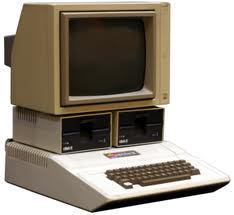
This was before Windows, when everything was DOS. You know when you restart your computer after it crashes and there’s a black screen with white letters and a blinking cursor, and you can only use the arrow and “Enter” keys to navigate because your mouse doesn’t work? That’s pretty much DOS. Try writing disciplinary memoranda on that sucker.
I’ve come a long way. Before they invented blogs, I built my own website using Dreamweaver. That was about ten years ago and I still have a headache.
When I first started using email, I was a little annoyed that a lot of my contemporaries weren’t. These are women who, like me, worked with IBM Selectrics and rotary-dial phones. At the time, a lot of them still shared an email address with their husbands. Something cute like Two4theRoad@BigFatRV.com. Or they got their email through the corporate server, which wasn’t accessible at home. Since they didn’t have a computer.
My kids, all Gen X, don’t check their email very often. Like it’s painful for them, due to the time and effort it takes. Much less tedious to text.
I joined Facebook three years ago. Seems like a lot longer. Now I’m addicted. It’s the first place I go in the morning, before email or news, and I check it throughout the day. There are a couple of groups I belong to – okay, ten or twelve – but one, GenFab, is like insanely active on FB. And I’m afraid if I don’t check in, I’ll miss something important. Like pictures of their dumbest outfits from the eighties, or what sex toys are hot now for boomer women. Weird how things change. Today they’re debating whether using “#FF” on Twitter is relevant anymore, or if it’s basically a scam. And if not, what is the etiquette that would accrue thereto?
You can only shake your head.
But technology has really enriched my life. My mother, who is 87 and has lived without it, is deprived. I’m not trying to be funny. She has a curious mind and if she were a few years younger, would be Googling all day long. About a year ago, I tried to show her how to use the internet, but I came pretty close to doing more harm than good. She got discouraged, and that tore me up. But that was before her cataract surgery. Maybe I should try again.
Still, sometimes my head hurts. I was born too soon. I was in my thirties by the time all this tech-stuff started coming out.

Early laptop. Really.
I remember bringing my first personal computer, a DOS laptop, to a union negotiation at the behest of my boss, the chief negotiator for Management. He intimidated Labor by setting it on the table between the two sides, turning it on (so it beeped), and frowning intently at the screen. Labor was nervous, but looking back on it now, I think we must have looked like monkeys with forks.


January 4, 2013
Hillary, When Do You Stop?
 I was going to write something funny today, but with the news about the blood clot in Hillary Clinton’s skull, I think this might be more important.
Many people speculate that Hillary Clinton is planning to run for president. I don’t think so.
I think the fact that she’s letting her hair grow long is an announcement, conscious or otherwise, that she’s transitioning away from public service. She has plenty of power, plenty of interests. She could have an amazing retirement.
As Secretary of State, Hillary set records for global travel. At any age, that kind of schedule can take a toll on one’s body, not to mention the stress of her job. Now consider the health concerns of running for and perhaps taking on the job of president. Every one has aged visibly in office, disproportionate to the number of years in that role. Why should Hillary throw herself onto that pyre?
As a private citizen, Hillary would have the world at her feet. Reputed to have an IQ of 140, she probably knows she could serve on any board; learn, observe, participate in anything; travel anywhere. Any number of global titans would be happy, I’m sure, to lend her a jet and a vacation home. Wouldn’t you think?
“I am so looking forward to next year,” Hillary told Gail Collins recently. “I just want to sleep and exercise and travel for fun. And relax. It sounds so ordinary, but I haven’t done it for 20 years. I would like to see whether I can get untired. I work out and stuff, but I don’t do it enough and I don’t do it hard enough because I can’t expend that much energy on it.”
If she does return to civilian life, most of us would nod with understanding. Some things are more important than being Leader of the Free World. Like sleeping in, or turning off your phone for a couple days and catching up on the last few years’ worth of movies or books.
Some say that after menopause we’re more like who we were at age eleven. I think we long to return to who we were before all the obligations and transformations were required. Before we started changing ourselves into that nice young lady, that girlfriend, that worker, that wife, that mother, that corporate person. In the case of HRC, that global politician. Wouldn’t it be crazy to explore that path?
We yearn for authenticity. We miss the real us.
I’m reading a book about professional women transitioning into retirement. Many of their essays contain exhaustive lists of the equally high-level, professional accomplishments they expect to achieve in this new phase. It appears they expect to work part-time until they are prevented from doing so by death or disability. I understand remaining active and not turning into a sloth, but at what point will we feel we’ve earned the right to fritter away our time in joyful nothingness?
Perhaps we still feel a need to prove ourselves. Perhaps as older people we’re afraid of being marginalized, so we work hard to earn our keep and deflect criticism.
Yet, getting a blood clot in your skull can force you to reprioritize. You see that it might be okay to simply park your ass in a lawn chair and savor the quiet of mid-day on your own peaceful patio. Sure, it’s good to be productive. But here we are on this good Earth. What are we doing with that privilege?
Hillary is powerful, well-traveled, and accomplished. She’s a warm and loving person with a throw-her-head-back guffaw. I would award her Crone status. I admire the hell out of her, and I wish her the greatest happiness and hopefully, many years of dolce far niente.


December 28, 2012
Your Amazing, Aging Brain
This is the last of four posts about all the cool things going on in your aging brain.
Ten years ago, Sister Bernadette died of a massive heart attack at the age of eighty-five, after a lifetime of academic achievement and renowned intellect. Right up to the end, she aced any cognitive test the researchers could throw at her. She had arranged to donate her brain to science, and when they took a look inside, what they saw changed brain science forever.
In spite of her brilliance, Sister B was in the final stages of Alzheimer’s.
After this discovery, the concept of “cognitive reserve” gained traction. It seems you might be able to build up your brain so that, if and when you get dementia, its effects will be diminished or delayed until you have time to die of something else. If you do die of dementia, having good CR might result in a shorter period of decline. Steeper, but shorter. Once it hits, it’s over quickly. Preferable, when you think about it.
How can you build up cognitive reserve? Exercise, for one.
Two more factors for staving off dementia are the attainment of more education rather than less, and the performance of a more complex occupation throughout one’s life (i.e. one dealing with humans) rather than less (i.e. repetitive motion on an assembly line). Did you ever think that by encouraging our kids to continue into higher education, we might be saving them from dementia later in life?
Another way to build up resistance to dementia is to encourage your brain to regenerate. Remember, years ago, we were told that brain cells were finite in number; they could only die off, not grow? Wrong.
It’s been proven beyond doubt that the brain regenerates itself, giving birth to new brain cells in the area responsible for memory and cognitive ability.
Again, the best way to get your brain to create those new cells is exercise. Yep. You needed incentive for that New Year’s resolution? There you go. Cognitive reserve and fresh brain cells. But there are several other things you can do to encourage your brain to get generating.
Focus on a task that’s highly complex (like writing these last four columns. Dang.)
Focus on a specific goal (like your NY resolutions.)
Together, building cognitive reserve and birthing new brain cells would seem to give you a significant hedge against deterioration in the brain at any age, but wait! There’s more. Keeping your brain toned might be as pleasant and simple as:
Hanging out with friends, and
Hearing positive things about aging. (No, I did not pay them to say this, but yes, it seems as if this might be a good reason to visit Any Shiny Thing.)
According to Barbara Strauch, from whose book I’m quoting, “There’s increasing evidence that being with other humans helps tone our brains’ dendrites.”
But not just any humans. You want to be around NICE humans, because mirror neurons in our brains make emotions contagious! We not only feel the joy and pain of others, we adopt their moods. And, according to researcher Barbara Levy, our moods are surprisingly important to our brains. Levy found that the memories of older people improved after simply seeing positive words about aging.
So if you needed motivation for changes in 2013, I hope I’ve provided it.

And I know Christmas is over, but here’s a little gift anyway: Marc and Angel’s 7 Things You Will Smile About When You’re Older.
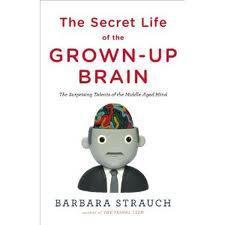 Thanks a million to Barbara Strauch, author of The Secret Life of the Grown-Up Brain, without which I would not have been able to share all this fantastic information. Believe me, I’ve only scratched the surface. Her book is fun, easy, enjoyable, and written in a conversational tone that makes you feel you’re following a friendly scientist through the halls of research, mouth agape in delight at all the new things you’re learning. I recommend it.
Next week, we’re going to take a break. Do something silly and simple. Maybe I’ll riff on family drama and how much I hate the holidays. Or I might just indulge my grandmotherly heart and post pix of my adorable grandbabies. Whatever we do, I wish you health and happiness. Happy New Year, my dear, funny, kind, happy, smart friends.


December 26, 2012
Dakota Blues and Skyfall!
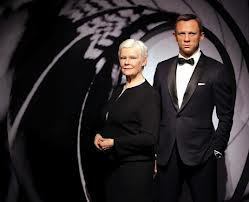 I was so excited I almost embarrassed myself in the theater, quoting enthusiastically along with M (Judi Dench).
We went to watch Skyfall on Christmas Day, and toward the end of the movie, when M is staring down a parliamentary inquiry committee, she quotes the same passages from Ulysses by Alfred, Lord Tennyson as I have in the dedication of my book, Dakota Blues. I was thrilled! I found this poetry when I was in high school, and for some reason, it stuck with me. (I was weird even back then.)
Here it is, the end of the great Ulysses:
“Tho’ much is taken, much abides; and though
We are not now that strength which in old days
Moved earth and heaven; that which we are, we are;
One equal temper of heroic hearts,
Made weak by time and fate, but strong in will
To strive, to seek, to find, and not to yield.”
I didn’t expect Skyfall to have as a subtext the question of “Am I too old? Am I unable, due to my age?” Both Bond and M grapple with this debilitating question, and they answer it in spectacular fashion. How empowering for those of us who watch for evidence of the courage, wisdom, strength and determination that come with age.
My regular column will appear on Friday, and will be the last of the four in which I share reasons to celebrate your amazing, aging brain! See you in a couple days.


December 21, 2012
Grandma Will Save Civilization
This is the third of four posts celebrating the good news about the way the brain ages.
Mayan calendars aside, older people could save civilization. I’m not kidding.
There’s something called the Grandmother Hypothesis, so named because researchers discovered that chimpanzees lived longer if they were part of a band that included elder females, who helped the mothers find and share food.
Of course, researchers speculate about the application of this hypothesis to humans. One benefit of having elders in the tribe is because at about age forty, people start getting really good at regulating their emotions. According to studies in 2003 and 2004 by MIT researcher Mara Mather:
Although the brain wants to focus on the negative (it’s a survival skill), the aging brain makes a deliberate effort to focus on the positive, which is actually harder. Studies show that emotions grow stronger, not weaker, as people age.
Mather theorizes this positive focus may be an evolutionary trait. When we’re young, we need cautionary knowledge so we focus on threats more, but at older age, we’ve accumulated so much of that cautionary knowledge that we view danger in a more complex fashion.
This ability may have evolved because it works well for the species in general. As we get older, we have more mixed emotions, allowing for a more nuanced response to the world. This slows us down, restricting impulsive acts, and that’s good for individual and group survival. Especially since our world is becoming so much more complicated.
Alice Walker hints of this in her essay, All Praises to the Pause.
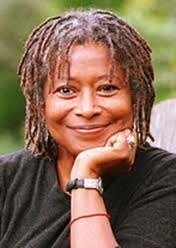
Alice Walker
I am convinced that in earlier times women during menopause drifted naturally to the edge of the village, constructed for themselves a very small hut, and with perhaps one animal for company – and one that didn’t talk! – gave themselves over to a time without form, without boundaries. They were fishing in deep waters, reflecting on a lifetime of activity and calling up, without consciously attempting to do so, knowledge that would mean survival and progression of the tribe.
More and more good news:
1. According to the Seattle Longitudinal study, our brains are awesome after forty. Seattle tracked the same 6000 people for forty years, finding that people reached their highest cognitive ability from age forty through seventy. This was in four of six areas: vocabulary, verbal memory, spatial orientation and inductive reasoning.
2. We’re also, in the new century, aging more slowly. Researcher Elizabeth Zelinsky found that her group at age seventy tested similar in cognitive ability to the historic levels of women in their mid-fifties.
3. Here’s another goody for you: There’s a substance called myelin, the fatty outer coating of the trillions of nerve fibers in the brain. The white matter acts like insulation on a wire and makes the connections work. Get this: the development of myelin in the brain area relating to language peaks from the 50s to the 60s (2001, Bartzokis). The insulation allows the neuron to recover faster after signals have been sent and get ready to send the next signal more quickly, giving brain cells what Bartzokis calls greater bandwidth. “As myelin increases, it builds connections that help us make sense of our surroundings.”

I was going to end with a wisecrack like I usually do, but I guess I’d rather get serious. We often feel unhappy about getting older, because we’re moving closer to the Great Beyond. Also, we’re inundated with messages from the media 24/7 saying we’re pointless if we’re not young. It’s easy to fall in line and drink the Kool-Aid.
But once you know about all the brain-benefits of age, you might talk about them more. You might celebrate the good news (“I’m more intuitive at this age. Really!”) and spread it around. It might become common wisdom, and attitudes might begin to change in this youth-obsessed country. Wouldn’t that be the gift that keeps on giving? Like to our kids?
Merry Christmas, my friends.


December 14, 2012
Midlife Crisis is a Hoax, and Other Good News about Your Middle-Aged Brain
 More good news: midlife crisis and the empty nest syndrome don’t exist. There is no scientific research to support them.
In the 1970s, a Yale psychology professor handpicked forty men to study. He then concluded they were suffering from midlife crisis. That’s about it.
Although people still believe in it (try Googling “midlife” and see what comes up), there is ample evidence to the contrary. In 1999, for instance, one of the biggest studies of middle age, the MacArthur Foundation Research Network on Successful Midlife Development, concluded:
Between the ages of thirty-five and sixty-five, people across the board reported increased feelings of well-being.”
The feminine version of midlife crisis is empty nest syndrome. Here again, there is evidence not only that this “syndrome” doesn’t exist, but that the opposite is true. According to Barbara Strauch and researcher Karen L. Fingerman,
…no one has ever been able to find a true empty nest syndrome in a scientific way. Instead, even among women who devote all their time to raising their kids, studies find mostly a ‘great deal of satisfaction’ when the kids become independent. ‘They feel they have done a good job and they suddenly have the freedom to do new things,’ says Fingerman. ‘They feel great.’
I could say more about this, but you might instead want to pick up a copy of The Secret Life of the Grown-Up Brain, by Barbara Strauch, whose words I’m using in this post.
Now that you’re all warmed up (flex fingers, crack knuckles here), let’s talk about the power of the midlife brain. Last week I mentioned the brain in midlife powers up instead of gearing down. There’s a particular trick your brain learns in midlife, and it was only accepted as scientifically irrefutable in the late 1990s. It’s called bilateralization.
See, when the younger brain needs to solve a problem, it tends to use the factory settings. If it’s a logic problem, the left brain gets a workout. Creativity? The right side lights up. Young brains are so powerful, this works fine. However, when you’re older, your brain realizes that in order to do the best job possible, it’s going to have to reach across from one hemisphere and borrow circuits from the other. Thus, both sides of the brain are engaged in a task where in the past, only one side would have been. In addition to pure processing help, there may be an almost magical benefit from this strategy.
As we age, and the two sides of our brains work together, we are able to see bigger patterns, have bigger thoughts, reaching – according to one researcher – the level of art. According to Gene Cohen, who studies the connection between art and neurons,
The brain’s left and right hemispheres become better integrated during middle age, making way for greater creativity…The neurons themselves may lose some processing speed with age, but they become ever more richly intertwined…”
Last week we discussed the fact that as the brain ages, it begins to default to its daydreaming mechanism to process new data. Unfortunately, this is why it takes us longer to learn new things. On the plus side, some scientists think that tendency to daydream, combined with the ability to use both sides of the brain in an integrated way, might result in better problem solving, deeper insights, and more creativity. And I’d say that’s something to celebrate.
Next week: how grandmothers could save civilization.



