
 Sorry, you must be a member of the group to do that. Join this group.
Lynne M. Spreen's Blog, page 32
April 19, 2013
We’re Too Old and Smart for This
Am I too old for this?
Should women over X wear Y?
Do you ever see such questions directed at men? But it’s too early in the post for me to start digressing.
Why are we still trying to be The Good Girl? Haven’t we outgrown the need for approval from that anonymous authority, They? As in, “They say you shouldn’t wear shimmery eye shadow after forty.” Or, “They say a woman over fifty should never wear shorts.”
In this article, a woman wonders if it’s still okay for her to want to wear sparkly things, at her age. She says:
I want to sparkle…just a bit.
Isn’t that OK? Does it really matter how silly a middle-aged woman may look with sparkles on her backside?
I took it to Twitter a few weeks ago and threw it out there…
When is a woman too old for bling on her back pockets?
I’m wondering when does a woman get too old to let people tell her what to wear. Here’s what They said on Twitter:
If she has to ask, she probably already knows the answer.
I understand the desire to look appropriate. You wouldn’t wear torn jeans to a wedding, or a see-through blouse to a job interview. But when it comes to age, any article questioning whether we’re too old for a certain style annoys me, because it implies there’s an authority to whom we owe obedience. Really, at this age? Listen, if I have to live with the wrinkles-and-turkey-neck thing, I need compensation, and compensation in the form of bucking authority sounds good to me.
It does take a certain amount of self-confidence to wear what you like, public opinion be damned. For me, it’s a little hard to wear flashy costume jewelry and scarves on an everyday basis, but it’s either that or I’m going to donate them to the Goodwill.
These days, I try to resist being told what to do. If at all possible, I make up my own mind, now that I know what it is. Besides, I’ve worked too hard over lo these many years to develop a backbone, and I like the feel of it.
A couple of my friends blog about fashion for women who love being over fifty. They’re excited about creating a brand new style for themselves. One is Donna Pekar at Rock the Silver, and another is Lisa at Privilege. Here is Lisa, below, and I think you’ll agree she personifies the type of woman who would never allow anyone to dictate fashion to her.
Especially not with those shitkickers on.




April 12, 2013
Invisibility is a Choice
Got your coffee? Here’s the “news” from Salon.com:
WOMEN OVER 50 ARE INVISIBLE
Rampant ageism and sexism have left women of a certain age virtually powerless in American society
Virtually powerless? Holy crap. I had no idea we were in this much trouble.
But first, great news!

Jane Friedman
I tweeted about the above article, and Jane Friedman responded. We’d met briefly before, when she was at Writer’s Digest Magazine. Jane is now a top editor at the Virginia Quarterly Review, and a renowned publishing and media expert.
Turns out, she was bugged by this, too. We agreed to do a tandem blog – she would address the under-fifty perspective, and I – since today is my 59th birthday – the over-fifty. I know you’ll find her POV extremely interesting. Mine will probably be better, because I’m older, but as soon as the whippersnapper gets a few more wrinkles, she’ll be all right.
Okay, back to the article. The author, Tira Harpaz, is an accomplished woman. Yet, she feels invisible, and thinks we are, too. Her comments below describe the pain she’s feeling.
“It hits you in areas where you feel most vulnerable–a loss of attractiveness and sex appeal, the end of fertility, a glimpse of a slow, lingering decline.”
“People I met at parties would look slightly disappointed and then look past me, and gradually, I began to shrink inside.”
“As I eased into the row, the 30-something man sitting in the window seat glanced up at me. It was a brief glance, but it conveyed disappointment and complete disinterest.”
“When the radiologist no longer asks if there’s any chance you’re pregnant. When the cashier at the movie theater, glancing indifferently at your gray roots, suggests you might want the senior discount, years before you might qualify. When people in the subway don’t really look at you as they politely offer you a seat.”
As much as I disagree with Harpaz, she’s not alone. You’ve heard it yourself. Maybe even felt it. However, today, I’m going to suggest an alternate explanation, one that might set you free. Sort of.
I think invisibility isn’t about age. It’s about gender. It’s about being female.
Let me make my argument. From the time we’re old enough to raise our hands in a classroom, we’re ignored in favor of the boys (Altermatt, Jovanovic, & Perry, 1998). While boys often speak out of turn and assert themselves, little girls sit back, waiting for the teacher to call on them.
Invisible.
Per Linda Babcock and Sara Laschever, school children were asked to perform a small task and then pay themselves what they thought they deserved. (First graders were asked to award themselves Hershey’s Kisses.) In first, fourth, seventh and tenth grades, girls consistently paid themselves 30% – 78% less than boys.
Invisible.
In her new book, Lean In, Sheryl Sandberg laments how young, professional women discount themselves, from second-guessing their readiness for promotion to declining an offer to sit at the table with the decision-makers.
Invisible.
So it seems we don’t think that much of ourselves in the first place. Meanwhile, men, who occupy 96% of the top CEO jobs and 80% of Congress, don’t notice us unless we radiate fertility.
And then that goes away.
Whether it’s gender or age, women can change the culture, and they can start today. For more on this, read the excellent In the Company of Women – Indirect Aggression Among Women: Why We Hurt Each Other and How to Stop, by Drs. Pat Heim and Susan Murphy. They cite research showing that women hang back, out of fear that other women will punish them if they act like they’re special. The authors call this the Power Dead-Even Rule, and it’s pretty chilling. You can read a summary of the most important points here.
We older women should model powerful behavior for our girls, and encourage them as if their futures depended on it. If I were counseling younger women, I’d say stop waiting for an invitation. Grab the reins and demonstrate your presence. Older women: You were raised to be nice, and to put others first. Are you still waiting for permission to live? Stop right now. Take off your shoes and walk on the lawn.
Finally, all of us need to support, rather than snipe at, powerful, amazing, barrier-busting women.
Sexism exists. So does ageism. (For proof, reread Ms. Harpaz’ statements, above). But if you feel as I do, you might agree that invisibility is a choice. And as for me? I choose to resist.
What do you think? Is this invisibility real, and if so, do you think it’s because of gender or age? Let me hear from you.
PS: Blogging with Jane is the best birthday present ever! Be sure to check out her post here.


April 5, 2013
Are We Allowed to Slow Down in Retirement?
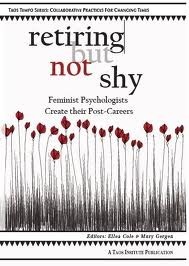
Several years ago, a friend and I were talking about what we would do after we “retired.” I wanted to start a new career writing, teaching part-time, doing public speaking gigs, and blogging. She wanted to start a preschool! After decades at our corporate jobs, this was how we viewed retirement.
I was reminded of our conversation as I read the excellent book Retiring but not Shy, by Ellen Cole and Mary Gergen. The book is a collection of essays by women psychologists on the subject of their own retirement. Although some essays were by women who retired a while back, the ones I found most troubling were by those who were either considering retirement or had recently retired.
Like my friend and I, these bright, well-educated women had laundry lists of all the incredible new tasks and initiatives they would undertake. Retirement meant converting from busy/busy to busy/busy. Beyond financial security, many seemed afraid that giving up their jobs meant they would no longer “matter.” These stellar professionals, some of minority ethnicity, feared being marginalized by society after retirement.
Especially for us feminists, it’s hard to imagine walking away from the battlefield. We struggled against the social tide for those degrees, titles, professions and salaries. The achievement of professional stature became our our identity, our source of power, our protective shield.
When I gave up my profession, I didn’t feel special anymore, and looking back, this was where my post-retirement life got interesting. I found myself tackling some heavy questions.
Did I have value to society without my work? Does anybody?
Did I fear a judgment I’d attached to others who didn’t work? (As a society, this question has implications with elders as well as stay-at-home parents.)
Would I ever have the confidence not to work? To give up positional power? To still see myself as special, even without the hard-won mantle of office?
Ultimately, the greatest triumph of my sixth decade was gaining a sense of self-worth exclusive of my profession. To value myself without the suit and heels meant I had to view the rest of society in a more forgiving way. to look beyond the uniform and titles – or lack thereof.
In the book, one of the writers asks: if work equates to feminism and independence, to what does retirement equate?
I have come to see retirement as a time of enlightenment and the letting go of ego.
 One writer says “I believe that even in retirement women must contribute to make a difference, to be perceived as powerful and to have power.” But powerful in whose estimation? We cannot make society respect us – we can only respect ourselves. And as for feminist battles, can’t we just model feminist principles as we putter in the yard, go to church, or help out down at the shelter? Why do we need to start a new national/international effort toward whatsis?
Will we ever accept that we are good enough?


March 29, 2013
The Best Argument for Mindfulness
 One of the joys of my marriage is that Bill and I both like to read, and occasionally to each other. He’ll share a particularly moving passage; I’ll share a turn of phrase that delights. A few days ago he read something that got under my skin, that maybe even changed my life.
He was reading The Ship by C.S. Forester, a beautiful, thick-paged old book published in 1943. Forester wrote the Hornblower series, among other works. Here’s the passage that affected me:
The Captain experienced a feeling of elation…He was a man who was profoundly interested in the art of living. Rembrandt gave him pleasure, and so did the Fifth Symphony; so did bouillabaisse at Marseilles or Southern cooking at New Orleans or a properly served Yorkshire pudding in the North of England; so did a pretty girl or an elegant woman; so did a successful winning hazard from a difficult position at billiards, or a Vienna Coup at bridge; and so did success in battle. These were the things that gilded the bitter pill of life which everyone had to swallow. They were as important as life and death; not because they were very important, but because life and death were not very important.
How profoundly these words affect me! In them I feel the comfort of knowing that life’s difficulties aren’t unique to me. I also understand that there’s a way to build resilience to the bitter pill(s) all of us will eventually be compelled to swallow. It is this: whenever possible we should be fully present, absorbing every sweet morsel of life that’s available to us, storing it in our memories for the hard times.
As Bill and I discussed the passage, he told me that during a recent family blowup – I told you we’re brawlers, apparently. Lately it seems that way – he would have trouble falling asleep. At those times he’d call up the sweet memories of holding our 10-month-old grandson. The two of them have such a bond; after a nap, and after finishing his sippy cup of formula, Andrew will snuggle with Grandpa in the recliner. He’ll examine his toys and talk in his happy, wordless way, occasionally arching back to grab Bill’s nose or hang upside down, studying the world from that perspective before wriggling around to be set on the floor.
I get happy just thinking of that.
Right now, I’m sitting in a quiet hideaway – a part of the cruise ship where we’re spending our spring break before returning to our babysitting duties. The hideaway is silent, thanks to my resourceful sweetheart who found the audio controls and cut the disco music to this cocktail lounge that is deserted at eight in the morning.
Bill sits twenty feet away from me, reading. I see him framed against the sea, and feel almost teary with gratitude that we are still healthy and able, and that we enjoy each other’s company. He makes me laugh; earlier we were considering the size of a new ship. “It’d have to be big,” Bill said. “You figure, four thousand passengers at five hundred pounds each…”
I’m also feeling a bit more understanding about those who seek the finer things in life, not purely for consumption’s sake, or the drive for status, but as a pleasant positive to offset the inevitable negative.
Whatever we have can be taken away. Better to lay in supplies for that cold inevitability. A better argument for mindfulness, I haven’t found.


March 22, 2013
Confused and then Freed by Forgiveness
Forgiveness is confusing.
When my dad died a few years back, a family member and her husband flipped out and attacked the rest of the family. I figure they misunderstood something, panicked and overreacted, and then they couldn’t back down for years, probably out of embarrassment or just not knowing how to stop without feeling stupid.

Then Mom fell and broke her leg and things began to change. The family member (FM), moved in with Mom. She helped with Mom’s convalescence and also organized and packed almost the entire house, which Mom had agreed to sell. Mom was scared and angry. She grieved Dad’s loss, that of her network of friends and of her beloved high desert. FM had to deal with that, as well as her own physical pain. She wasn’t in the best of health herself, but she remained stoic and kept working.
As time went by, FM began hinting at remorse and a desire for a better relationship. Which is what happened.
After all that went down, I can’t believe I came around to a place where forgiveness is possible. I don’t mean the kind of forgiveness where you accept that the offender is a total asshole and walk away, just to keep yourself healthy. No, this is the old-fashioned kind of forgiveness, where I actually feel compassion for FM, and derive no joy from her remorse.
Which is confusing. I had clung to my anger out of self-respect. Having been physically and verbally abused all through my childhood and first marriage, I swore I would never allow anyone to do that to me again. Forgiving an abuser feels like I’m still a doormat, like I’m once again capitulating to the dark forces.
Given the above, will I ever be able to maintain a self-protective wall of anger? Isn’t it necessary? How can I preserve my self respect if I go around forgiving all the time?
After a lot of thought, I’ve found my answer. I share it with you because it’s beautiful. It’s my gold watch, my gift of a long lifespan, the reward of having lived through family vitriol and come out the other side with my sanity:
Sometimes, it just doesn’t matter.
That’s the answer, and it’s shocking to me. Sometimes, it’s just not important to hang onto the anger. To quote one of my friend’s favorite sayings, “The tide comes in. The tide goes out.” Everything changes.

Recently, there was another dustup in my family (I know; we must be a bunch of brawlers, right?) But based on all the above experience, I’ve decided this too will pass. Or not. It doesn’t matter. I’ve gone on with my days, and I don’t think about it anymore. It’ll resolve itself or it won’t, but everything changes. You just have to go on, and have a good life. No sense spending all that precious energy hanging on to the anger.
This is yet another gift of older age. After a while, you earn resilience. Quite the silver lining, wouldn’t you say?


March 15, 2013
Nurse Was Right to Refuse CPR
A couple weeks ago a nurse made international headlines when she refused to perform CPR on an elderly, dying woman in Bakersfield, California. The tape of the frantic 911 dispatcher was played over and over again. Newscasters spoke of the need to expand “good Samaritan” laws. The country was outraged.
Somewhat surprisingly, the woman’s family declined to sue, saying she had wanted no extreme measures to prolong her life.
Extreme measures? It’s just CPR, right?
Maybe not. In some cases, denying CPR may be the most humane option.
The following is a quote from the horrendously enlightening article, How Doctors Die by Dr. Ken Murray. I read it a year ago but it was so profound, it stayed with me. I’ll never forget this:
Some doctors are so afraid of having their Do Not Resuscitate orders ignored that they have NO CODE tattooed on their chests.
What could cause doctors to fear life-saving measures? Here’s an excerpt of one doctor describing resuscitation measures:
The patient will get cut open, perforated with tubes, hooked up to machines, and assaulted with drugs. All of this occurs in the intensive care unit at a cost of tens of thousands of dollars a day. What it buys is misery we would not inflict on a terrorist.
Did you know CPR often breaks ribs? I didn’t either. Here’s more:
Feeding into the problem are unrealistic expectations of what doctors can accomplish. Many people think of CPR as a reliable lifesaver when, in fact, the results are usually poor. If a patient suffers from severe illness, old age, or a terminal disease, the odds of a good outcome from CPR are infinitesimal, while the odds of suffering are overwhelming.
This article in Forbes laments the fact that there was no “Do Not Resuscitate” order on file at the home, and I agree. However, even if you have such an order on file with the facility, over-zealous or lawsuit-shy staff may completely disregard them. “Jack,” who had such orders on file only to have them ignored, was lucky enough to be removed from life support by the doctor who wrote this article. The doctor said:
Although he had thoroughly documented his wishes, Jack hadn’t died as he’d hoped. The system had intervened. One of the nurses, I later found out, even reported my actions (i.e. complying with Jack’s DNR orders) as a possible homicide.
It’s difficult to imaging leaving a patient to die without taking measures to revive her. However, I read the Murray article before the Bakersfield incident occurred, and thus my first thought was that the nurse was a hero, courageous enough to honor the patient’s wishes. It’s apparent that the family felt the same way.
But I still kind of feel like getting a tattoo.


March 8, 2013
I Wear Boomer Goggles
If I got the opportunity to have a drink and conversation with Clint Eastwood or Tommy Lee Jones or those other formerly hotsie-totsie male celebs, (you know who I’m talking about), the passage of time would have changed them not one bit. Not in my eyes. I would still see them as they were then. The magnetism doesn’t go away. Have you noticed that? For example, this guy:

to me, will always be this guy:

This guy:

will never be this guy:

This guy:

will never really be this guy:

This guy:

will never be this guy:

I don’t see this guy:

I see this guy:

You can’t stop seeing him:

When you see him:

The fire and charisma they exhibited when they were young lions will never go away, in my opinion. When you hear them talk or see them on TV, it’s like THEM from the old days, only better, because of all they’ve been through, learned, mastered, and been humbled by. It’s not about looks. It’s about the inner guy, the cool guy who still harbors that young lion inside, no matter what changes time might carve into the exterior.
That’s how most of us see ourselves, too. We’re surprised when we look in the mirror.
Where did that old broad come from? Is she really me?
We’re proud when an old photo surfaces at a family gathering – something of us from back when we looked bitchin‘. We linger a bit, aware the kids are agog at our then-beauty, wanting them to see us now as we were then.
But like so much else we endure, we have to find it in ourselves to feel proud no matter what. WE know who we were, and layered on top of that is who we have become.
So wear your Boomer Goggles, my friend. You’re even more awesome now than you were back then, even if you’re the only person who sees it.


March 1, 2013
Aging: One Long Downhill Slide?
A few days ago, a blogger friend wrote that she was discouraged about getting older. She posted this:
I’m kicking, running and screaming from the downhill slide. How did/are you all handling the realities of aging? What’s your secret weapon (person, place or thing)?
The blogger got a lot of input from her discussion group. Here were some of the suggestions:
Exercise
Spanx
Meditation
Good food
A wardrobe update
Change to more age-appropriate makeup style
Have a positive outlook
All good ideas, but here was mine:
Why do you consider aging a downhill slide?
Life is what you make it. If you see yourself as cranky, crotchety, wrinkled and sexless, you probably are, in which case, it’s time for an attitude make-over. I mean, I get the thing about death and all, but if you’re sixty, you might have 25-30 (or even more) good years left. That’s a gift! That’s as long as it took to work your career, or create a fully-formed batch of offspring.
Hey, I’m not in denial about the crappy side of getting old, but a bad attitude about aging can hurt you. According to Barbara Strauch in her wonderful book, The Secret Life of the Grown-up Brain, seniors who were tested for memory did better when they were first given positive information about aging. The group that was told negative things? They didn’t do as well.
You can dispute the study, but you’ve lived long enough to know that attitudes and words matter. What happens if parents repeatedly tell a child she’s stupid, incompetent, clumsy, or bad? What will happen to that kid? Why is it different for us?
Margaret Gullette, a researcher at Brandeis University, says we’re victims of the “ideology of decline.” We’ve allowed ourselves to be “aged by culture,” and taught to think of ourselves in an “age graded” way, based on the sense that “the body fails at midlife and this bodily failure matters more than anything else,” while the positive aspects of aging, such as maturity, competence, and compassion, are not seen as age-related. According to Gullette,
(This) ideology works to enclose us in self doubt, embarrassment, shame, humiliation, despair…By learning to concentrate on an ‘aging’ body, the twentieth century midlife subject learns how isolated and helpless he or she is.
If we’re allowing ourselves to be “aged by culture,” maybe we should look to a different culture. My good friend, Julie Mahoney, told me that the Japanese have no word for menopause. The closest they come is konenki. Literally translated, ko means “renewal and regeneration,” nen means “year” or “years,” and ki means “season” or “energy.” Isn’t that beautiful?
So, I challenge you to counter our hair-tearing assumptions about aging. If you need scientific backup, I wrote here about your incredible aging brain.
And here is Isabella Rossellini with her “Surely you jest” attitude about aging.
Finally, here’s how my Mom got over on those who would devalue her due to her age and diminutive stature.
Okay, I’ll stop with the links or you’ll never get anything done. Have a great weekend.


February 22, 2013
Let’s Kick Back Today
We’ve been working hard lately. All these heavy posts about coping with life in the second half, brain function, and mortality. I don’t know about you, but I could use a break.
Yep, you know what’s coming. Grandbaby pix!
Once upon a time, I “retired.” Now I provide a significant amount of childcare for my grandbabies. We (yes, Bill is there alongside me) work four days a week, ten hours a day. It’s challenging, but we get back more than we put in. I love seeing Grandpa read to the little gal, his voice all high, babytalking.

And hearing the ten-month-old sing along (“ah yah yah yah yah”) when I “play” the piano. I’m just making up stuff, but he doesn’t know. He loves it, grinning and showing all eight teeth.
I don’t have time or energy for the gym, but with the babysitting gig, who needs it? According to my pedometer, last week I walked twenty miles and climbed fifty-two floors. I climb up in the playhouse and get down on the floor. I crawl (carpet only – the skin on my knees provides no cushion anymore between tile and bone). I run. I lift. I carry, as when the little gal got obstinate at the end of our walk a few days ago. We were a long block away from home, but I gave her a horsey-back ride the whole way. And here I am, lifting thirty pounds of two-year-old with just my forearms:
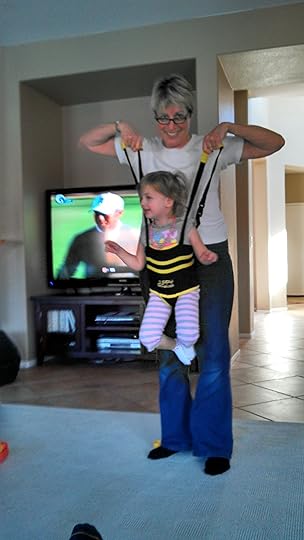
I still have a business to maintain, though, and having to fit in blogging, writing, and marketing Dakota Blues during naptimes and on weekends is a challenge. But they’re growing up so fast! Any day now the baby will be walking.
Here they are making Sand Soup.

Thanks for taking a break with me. Enjoy your weekend. See you next Friday.


February 15, 2013
Facebook Erases Me, and I Feel Liberated
A couple days ago my Timeline and Activity Log on Facebook disappeared. Three years of posts, links, and interaction erased! All that remained of me on FB were my About page and photos. I was outraged! I was in despair! So much of my life history zapped into nothingness. How dare they! (Ha ha. Like Facebook owes me anything. A good wake-up call.)
Silver Lining #1
Soon, I got my brains back. I remembered that as a Boomer, I grew up without any of this electronic crap. How important was it, really? Sure, if the photos were ever lost, that would be a bummer, but with digital photography, I’ve got so many photos on my hard drive right now, would I even notice?
Silver Lining #2
But all that Internet history erased, lost as a historical record. I would never be able to back and access it again. And then I thought – Really? Would I ever have done that, seriously? And don’t I feel better to have that big chunk of data scrubbed from their data base? Kind of a relief, even though I’m not one to post topless photos of myself smoking a bong. But still. Clean slate!
Silver Lining #3
Have you ever wondered what you’d do if one of your networks became unusable, say they started charging or went belly-up or redesigned the site in a way that you hated?
When I thought FB erased me, I quickly made an alternate plan. I would leave my page intact, but add a referral to my profile on Google+, LinkedIn, or somewhere else. Who cares where? There’ll always be a place to “live” on the Internet.
Because here’s another stupid situation that suddenly provides a brilliant solution: Have you ever felt frustrated that you’re connecting with the same people on multiple networks? (i.e. Twitter, FB, LinkedIn, Pinterest, Goodreads, Google+, etc.)? Doesn’t it seem like overkill? What good is all that duplication?
However, it could be useful, because if you left one platform, you could go somewhere else and most of your friends would still be in touch with you. (If you’re one of those people with 20,000 Twitter followers, I’m sorry. I guess.)
Maybe that’s how this saturation of social networking is going to end up. The people who really like what we have to say, or want to keep up with what we’re doing, will always be with us. The rest? They’ll churn and reattach, to us somehow, or to someone else.
The upside of all this crazy profusion of platforms is we’re all cross-networking. And the result of that? I think we become our own presence, our own brand. If one platform is sold or shuts down or becomes a corporate asshole, we pivot to another. Our followers follow, because we’ve made it a point to be WORTH following. And life goes on. This, I think, is the future, and the only path to true independence as a web-reliant entrepreneur.
For what it’s worth, Facebook restored my life. And I just really don’t care.



