Polly Campbell's Blog, page 35
June 12, 2013
How to Not Take Everything Personally
 It’s tough to not take things personally; to not feel hurt when the bad behavior of others is deflected onto you. Yet, when we personalize what is going on around us, we open the door to even more suffering and hurt for no reason at all.
The opinions and actions of others are never about us. Not really. They simply reflect the beliefs and attitudes of the involved person. In other words, what others do and say is always about them and most of the time they aren’t thinking about us anyhow.
When we remember that, we are also reminded that we get to call our own shots. If someone is acting in a way that makes you uncomfortable, then you get to decide how you will experience their behavior. You do get to create your own reality.
Here are some of the things I do to avoid personalizing matters so that I can create more of what I want through my own experience.
1. Give people the benefit of the doubt. People are busy and stressed. They are dealing with big stuff and just trying to get by. They are probably not thinking about you at all. Like the guy on the freeway who cut you off? He may be rushing to get his kid to the hospital, or maybe he’s late for a job interview, or maybe he just made a mistake. Really, it’s not about you. Let it go.
2. Shift focus, help someone else. When you are caught up in thoughts about how others don’t like you, or how they are out to get you; when you are feeling inadequate and insecure because of what others said or did, get out and help someone else. Shift your focus to the needs of others and you’ll feel better and you’ll be reminded how you create your own experience, it isn’t what others do to you that defines your life, but what you choose to do.
3. Be compassionate to yourself and others. We get our feelings hurt, people do things unintentionally, we all blow it from time to time. Act with compassion and forgiveness. Know that the hurt wasn’t about you, it was about the other individual’s own history and belief system and that’s what they have to work with. Even when someone chooses abusive behavior, that individual is showing you who they are, not who you are. You don’t have to judge them, but you certainly don’t need to stay either. Be kind to yourself, and get out. The bad behavior of others isn’t something you have to endure, and it certainly isn’t the result of something you’ve done.
4. Talk it over. If you have personalized a situation and you’re feeling upset or insecure, share your feelings. Take responsibility though. Use “I” statements, share your experience without blame, because remember nobody did anything to you, you simply interpreted their actions as about you. Explain that and be open to what you hear in return.
5. Be still, get curious, and examine the thought. When I’m feeling particularly vulnerable and find myself personalizing everything, I find a quiet space and just examine those thoughts. You don’t need to act on them, just notice. Challenge yourself and your beliefs. Ask yourself why you weigh the opinions of others more than your own. Often, we’ll be able to uncover our own limiting beliefs and false interpretations of external events. The things that we personalize generally do not hold up under scrutiny. So get quiet, and consider your beliefs about the situation and you’ll recognize, once again, that the circumstance has little to do with you.
Image by Stock.xchng




June 10, 2013
It’s Not All About You – and That’s a Good Thing

Yesterday, a car cut in front of me in the parking lot. Then an editor rejected a story idea and my daughter didn’t like the salmon I cooked for dinner. Then, my friend, never, ever called back.
I didn’t blink when the car cut me off. Whatever. The rejection? Part of the job. The whining kid? Also part of the job. But, then, after all this, when my Amiga didn’t call, I began the slow strut toward “I-wonder-if-she’s-mad-at-me-ville.”
Seriously, people, I’m a grown up and yet every once-in-awhile I take it all too personally and get wrapped up in me-ness in a way that not only makes me feel bad but keeps at the edge of reality looking in.
Anytime we take anything personally, we are in big-time trouble. Seriously. It is so not about you – or me. My business – how I believe and behave in this life is up to me – it has nothing to do with what you think about me. What happens around me, outside of me is not my business. That is someone else doing what they do and it really doesn’t involve me.
Do Not Take it Personally
In Don Miguel Ruiz’s big, little book The Four Agreements, he lists this as his second agreement:
“Don’t Take Anything Personally: Nothing others do is because of you. What others say and do is a projection of their own reality, their own dream. When you are immune to the opinions and actions of others, you won’t be the victim of needless suffering.”
Right.
The world is not out to get us. Nobody is against you. Nobody is doing anything to you. Ppeople are simply doing what they do. In fact, the external reality as we see it, isn’t really concerned with us at all.
So, when the little and big stuff comes down, like say, your husband hits you – that is not your fault. He is simply doing what he does. You didn’t cause it, nor should you feel guilty for then getting up and doing what you do and getting the heck out of there. He gets to choose his experience – that’s about him — and you get to choose yours – that’s about you. This doesn’t require self-judgment.
What Others Do Is None of Your Business
When we internalize things, when we make it all about us, then it becomes something we did. From this position the opinions and behaviors others hold about us become our problem rather than the responsibility of the person who was thinking of it in the first place. See how crazy this sounds? What others think and do is not our problem.
Instead, allow others to have their experience. Even if it catches you in the crossfire, their behavior isn’t a statement about you or your gifts or failings or capabilities. It is not an indictment of how good or bad you are. It is simply how they are choosing to behave.
When you know this and can live with this you are free to create your own experience, your own life. That is liberating.
But, boy can this be tough to do. Seriously. It’s tough not to personalize things. It’s something I’ve been working on for years, and it helps me so much when I remember and practice this principal. Good news is I’m getting better at it and you can too.
On Wednesday, I’ll share some of the things I do to keep my mind on my own business instead of worrying what others are up to.

June 5, 2013
How to Communicate Better with Your Partner
 The best communication between two people isn’t always in what is said, but in how it is said. The tone, gestures, timing, and talk used can bridge a gap to understanding or explode that same bridge into pieces so tiny that nobody will dare try to cross it again. Ever.
If you want to bridge that gap successfully, here are some things to try.
Do Mention what you’d like, don’t focus on what isn’t working. This is one of the many things I’m working on. We have a tendency to express our displeasure first a la: you didn’t wipe off the counters, you forgot to pick up the milk, when you grill the steak for 20 minutes you make jerky. This approach generally just ticks people off. Try saying what you’d like: “if you cook the steak for about 10 minutes, it should be just right,” “I really appreciate it when you wipe off the counters” and “It would be great if you could run out and get the milk.” The clear sentence lets others know what you need, the positive tone helps them to hear it without becoming defensive.
Do make it “we” or “I,” instead of you. When working through a conversation about a tricky topic, it’s easy to get angry or become polarized simply because of the words we choose. Be careful not to put words in other people’s mouths or speak in absolutes with words like never and always. Do express how you feel, take responsibility for your role, and show that you are committed toward working together to improve things by using words like “team,” “we” and “I”.
Phrases like “We can really do this better”. Or, “if we work together I think we’ll both feel better in the relationship” can ease the sore spots without placing blame.
Do ask questions and listen for the answers. So much relationship confusion and hurt is created when people make assumptions or interrupt others. Instead of jumping to conclusions, ask good questions, then get quiet and listen up. Don’t judge what you hear, just listen – you’ll have time to express your feelings about it later, right now if things are messed up, ask your partner how she is feeling and hear what she says.
Ask what he or she thinks would be a good way to work through the difficulty, and again, listen up. Don’t interrupt. Don’t disparage. Don’t judge. Your job here isn’t to determine whether the solutions your partner presents are good or bad or whether they are right or wrong, it’s only to listen and understand how they are feeling. To know what they are worried about. Then, you have good information to work with. That understanding and insight will also lead to greater intimacy in the relationship.
Do put yourself in your partner’s shoes. Ah, the old empathy thing rises up again. But, think about it: if you are going to propose an idea, ask for help, criticize or cajole it’s helpful to consider how your partner will feel about what you are expressing. If you are launching into a monologue about all his shortcomings, that could cause hurt and quickly end the conversation. If what you really want is positive change, then a little empathy will help you bring up the topic in a kinder, gentler way that will result in a positive conversation for the both of you.
Do stop talking. Once you’ve been through it — he’s heard you, you’ve heard him — stop talking. Let things settle a bit. This doesn’t mean ignore the issue at hand or never to bring it up again, but it does mean that after you both have fully expressed your views, it’s o.k. to move on and come back to it at different times down the road.
One of my favorite hobbies is to over talk every little challenge, scenario, plan. I don’t recommend it. When I’m in my talking mode, it only takes a few minutes before my husband zones out, which ticks me off and then communication declines.
Say what you are feeling, listen well to your partner, validate each other’s feelings and then agree to continue the dialogue about the issue in the days and weeks to come. Then take a deep breath and a time out, or offer a hug, or do something else together that allows the intensity to subside and shift. Not everything needs to be solved on the spot. Relationships evolve as does our communication when we are committed to caring for each other and doing it better.

June 3, 2013
How to Talk to Each Other
 A couple of weeks ago I heard the Dalai Lama speak about how dialogue was the key to peace.
I listened well. I nodded and clapped in agreement. Then, I went out and got in an argument with my husband.
We were trying to communicate about a real issue, my husband and I, but neither of us was listening. We were both talking, sure, but not really to each other. We were staking out our positions, sharing our opinions, fighting to be right, but not communicating in a way that prompted any real interaction or insight. There was no real dialogue going on here. In fact, we got nothing but mad.
Later, when we did slow down and listen better, we understood each other and resolved the matter. Such, is the power of dialogue done well.
What is Dialogue?
Dialogue does not involve telling people anything. It’s an exchange of ideas, a two way conversation that requires both people to share and listen, to ask questions, act with empathy and understanding and to validate each other’s experience. When it’s done right this kind of conversation can be illuminating, intimate and interesting. It certainly can build consensus, make it easier to work through challenges, and foster connection.
But the whole empathy, understanding, listening part, can be downright tricky. You’ve got to try to understand (not agree with) and validate where the other person is coming from even if they are coming from crazy, right?
For example, when I’m trying to explain to my husband why dirty dishes stuck to our counter overnight is akin to moving our family into a fraternity house, the rules of dialogue require him to listen, understand where I’m coming from, and validate with something like this: “I am hearing you say that dirty dishes make you feel as though our home is turning into a fraternity” all without loud sighs or eye-rolling. See why this stuff can be hard?
Course, this also means that when he is entering into conversation with me, I am not allowed to interrupt. I’ve also learned that it’s best not to laugh sarcastically or say anything that rhymes with “Seriously, what were you thinking?” Even the tone can derail him, you see.
But, in the spirit of His Holiness the Dalai Lama, we’ve been talking and trying out different dialogue tactics around here and honing the skill of give and take in a conversation. While it has challenged us to change some bad communication habits that have sprung up after nearly 11 years of marriage – see the aforementioned interruption and eye-rolling – it has also made it so much easier to deal with our stuff.
We are connecting in a deeper way and getting down to the issue/plan/schedule/ idea that needs discussing without having to wade through the irritation that springs up during a poorly managed conversation. I feel like he’s listening better and I’m more conscious of not filling up the air by over-talking every point.
As you enter into conversation with the people in your life today, become conscious of how you talk to each other. Just pay attention. Are you talking and telling? Or, are you sharing some, listening a lot, and asking good questions to learn more? If you’re operating from the latter, you’re probably having some good dialogue and that, as the Dalai Lama says, is the path to peace in your household and even the world.
In Wednesday’s post I’ll give you some tips to foster better-feeling communication.
Photo by: Stock.xchng

May 30, 2013
Know Your Motivation to Insure Success
 I intend to lose a few pounds. Feeling a little sluggish and slow after the winter months and I’m ready to get my body into better shape, and release some of the weight I acquired during my hibernation.
There are several other things, too, that I’d like to accomplish, learn about, improve. Yet I also believe and say repeatedly that I’m also good enough with all that I am. I think you are too. I believe that we have all that we need to cope with anything that comes, that we have all we need to live the life we desire and make a positive contribution to the planet.
So, what gives? How can we be just right and still make the positive moves we need to make to amp our lives?
Examine Your Motives
It comes down to motivation. Why do want to change? Is it because you want to align with your own values, your essence to live your best life, to expand into your greatest potential?
Or, do you want to make your mother happy?
Sometimes it’s easier to keep your mother happy – I get that. Boy, do I get that. But in the long run, if you are working to change something because you think you must be different to be worthy, well, that’s going to lead to a whole lot of frustration and dissatisfaction, but not a whole lot of improvement.
By our very nature we are expansive, creative, growing beings. We feel good when we learn new things and have new experiences. We feel alive when we pursue an important and meaningful goal. Self-growth and improvement is a powerful aspect of who we are and it can lead us to our best selves. But, if you’re doing it for someone else, it will lead to failure, resentment, disappointment.
So, consider your motivation before choosing your next goal and consider these three questions.
1. Do the changes and improvements you are considering – losing weight, starting your dream job, going back to school, having children, moving to a small town, working on the marriage – feel good and right because they align with your authentic self or are you just doing what people expect you to do? It’s essential to pick something that is important to you no matter what other people think.
2. Do you get a little excited when you think about taking on the new challenge or making a positive change, or do you feel worn out, uninspired, depressed even?
When we are on track and working toward creating our most authentic life, it feels good. Even when the work is difficult, we often feel energized. If you’re not feeling it, chances are you’ve picked a goal that doesn’t align with who you are.
3. Do you have a sense of what you want to accomplish or try, but feel stifled by the expectation of others? Reevaluate your values and pick the goal that aligns with those and you’ll have the courage to pursue it no matter what others expect.
After considering the questions above, begin to think about what YOU want. What would make your soul sing? What would help you feel and live your best life? What do you need to do to grow and expand and live with passion and purpose?
Make a list and read the following post for some quick tips to help you to get after those goals.
Photo provided by Stock.xchng

May 29, 2013
The Five Secrets of Success: Take action every day
Jack Canfield father of the Chicken Soup for the Soul and overall success guru calls it the Rule of Five.
I think of it as living a life of inspired action. It’s all the same principle that says: By taking steps every day toward your purpose or goal, success is unavoidable.
When you take consistent action toward your dream, you’re bound to get it. And not only does the action move you toward what you want, it give you momentum and you step into the flow of the Universe even before the tangible, concrete results show up.
This is the way to catch success. Really, this way, it catches you.
Canfield says to do five things every day that move you toward your highest vision.
If it is professional success you’re after you could make several sales calls to grow your business, hire a business coach to help direct your efforts, take a computer class to learn the secrets of computer marketing, solicit customer feedback to improve customer service, go to a networking lunch. Do five of these or other focused actions a day and your business is bound to grow.
Want to have a more loving relationship? Write your partner a love note, let a criticism go unspoken, smile and greet your parnter when he walks in the door, share an appreciation with your partner, give silent thanks for having that person in your life.
See how this works? Take inspired action – five actions each day that are inspired by your greatest goal, your greatest purpose, your biggest dream – and you’re bound to pull it into your life.
Have fun coming up with the five. Repeat those that yield great results. Get creative. Try new things, be open.
Here are some other ideas that might help get you where you want to go:
Read or listen to something motivational
Exercise
Clean out clutter in your house
Write down what you’re grateful for
Reach out to new clients
Ask for referrals
Take a class
Eat five servings of vegetables
Ask others with specialized knowledge for help
Forgive
You can see that this list is as broad and diverse as your desires are. It will shift and grow with your dreams. But it will always keep you moving toward.
What five things will you do today to reach your ultimate goal?
Photo by: Stock.xchng

May 22, 2013
How to Live Like the Dalai Lama
 I’m not male. I’m not Buddhist. I’m not a monk. Hey, I have a husband – whom I occasionally snap at, so you it’s clear that I have little in common with His Holiness The Dalai Lama. I mostly wear sweats, while His Holiness goes about in his traditional maroon and gold robes. He is wise, I am working on it. He is enlightened, I am, well, not even close.
But, I do believe, like he does, that all of us sentient beings are connected. That if we look out for one another, take care of each other, we are also taking care of ourselves. I do agree with His Holiness that my quality of life, in fact, my very survival is directly dependent on your quality of life. That if we help each other out not only will we do better on this planet, but we will feel better.
The Dalai Lama has practiced this kind of tolerance and community for decades. Since he began his study as a toddler. It is his way of life. And, as I noticed when I saw him speak a couple of weeks ago, he exudes all that good energy. But, no matter how little we have in common with His Holiness, we can share these qualities. We can practice compassion, and tolerance, and make it our way of life too. We can greet the world with kindness and live a little more like the Dalai Lama.
It starts with practice and awareness and here three quick and easy things you can do every day that will make a ridiculously big difference in your health, your relationships, and your life.
Gratitude – Each day notice the goodness in your life. Go looking for it. Pause to notice it, give thanks and feel the positive feelings that come from gratitude. Soon, you’ll find yourself hunting for the good things and appreciating all that comes. Gratitude also yields joy.
Mindfulness – Pay attention to the present moment. Notice the physical sensations, observe your thoughts, become present to what is without projecting to the future or stressing about the past. Practice through meditation or by slowing down and giving your attention to your daily tasks. Next time you are wiping off the counters, become mindful by feeling the texture of the sponge and hearing the sound as it swipes across the counter. Smell the cleanser and feel the moisture on it’s rough surface. Each chore and every moment can be a mini-mindfulness exercise if you choose. Simply pause, take a deep breath and focus on what is in front of you right now.
Compassion and Kindness – Instead of judging others touch them with kindness. Be tolerant, patient. Connect through conversation and support. Offer what others need, not what you think they should have and be present in their pain. Often, the people who need our compassion the most are the ones that are angry and difficult. Be fair, and loving, and tolerant and accepting. Know, that everyone deserves our compassion; there is no criteria that must be met. Practice this with your spouse or partner by listening well, instead of interrupting, by responding with acceptance rather than criticism and judgment. Add some fun, by practicing random acts of kindness, or send a thank you note for a job well done.
Try these in-the-moment practices and soon you’ll be living like the Lama.
Image provided by: Tsemtulku.com

May 20, 2013
Dialogue, Education Can End Violence, says Dalai Lama
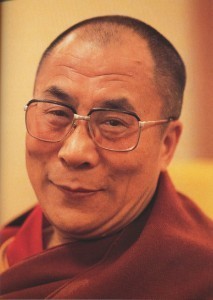 A couple of weeks ago I got to see His Holiness the Dalai Lama speak at a local college.
He wore his traditional maroon and gold robes, along with a bright purple visor from the college to shield his eyes from the harsh stage lighting. He was funny, mostly because he laughs at himself. He was humble, smart — quoted neuro-scientists and ecologists — and referred to relevant studies. For a time he even had a tutor in quantum physics, though he claimed he didn’t learn much.
He radiates warmth and kindness. I’ve heard people say that he changes the energy in the room with his presence, and he does. He is infused with positive energy and you can feel it even when you are sitting 20 rows up. When you consider what he puts into his life – the practice of mediation, the act of compassion and tolerance; when you realize how long he has studied these habits and rituals – since he was around two years old — you understand that he exudes love and compassion and tolerance because that’s what he is. It’s not an attitude. It’s what it within him, so of course that is what comes out. Even when minor mishaps showed up – he was interrupted, he fell off topic, even got tired – compassion, tolerance and humor is all that came out. Not impatience. Not frustration.
His Holiness is not a big presence in any physical way. He is small, thin, a bit frail seeming when he walks. He speaks low and quiet like we’re having a conversation. He is not a chest-thumper. But there he was this little man amid thousands of people, and when he spoke there was silence. Quiet reverence. Awe. Everyone was riveted and respectful. He was firm and clear and loving. And, he was heard.
Education and Dialogue Key to Ending Violence
The Dalai Lama said that he believes the tide of violence and hostility is shifting in the world and has been since the Vietnam War. He is hopeful and optimistic (interesting since he’s witnessed so much violence firsthand and was driven from his country at age 24 when China invaded) that there will be world peace. He said that if we commit to “modern, secular ethics” not ethics based on religious roles or personal status, but education and dialogue, that we could end world violence and make this the Century of Peace.
He was consistent with the Buddhist teaching of oneness. He reiterated that we are all sentient beings connected and reliant on each other for survival. We are not separate or different no matter where we live or what we know. He said if we commit to educating ourselves from preschool on, about the practice of affection, compassion, and dialogue, tolerance and forgiveness, that violence would end globally, except for a “few hundred mischievous people.” He said there will always be those troublemakers (my word) but out of seven billion people he could live with a couple hundred of the others.
“If we nurture the basic human needs through education [we will] develop a generation who has a more compassionate strive, said His Holiness. He called for a practice of “secular ethics,” a lifestyle built around acting out of concern for one another. A lifestyle centered on looking out for the well-being of others.
He advocated personal responsibility and education instead of prayer. He said that strength of emotion and mind rather than strength of body and artillery will help end the violence.
“A peaceful world comes from inner peace,” said His Holiness the Dalai Lama. “It is an individual initiative.”
I, like everyone else I know who has heard him speak, was touched by his energy, joy, and optimism. I left feeling hopeful and I think that’s part of his charisma. He reminds us who we are at our core: good, loving, creative people. He reminds us who we can be if we act from this place.
Sometimes we stray from it, of course. We start thinking that we are on our own. We take things personally, fight for what we need – even if it means leaving others without. We get a little judgy, and self-righteous, angry and intolerant. We become impatient. But that isn’t ever who we are. Not really. We have the same qualities the Dalai Lama radiates: compassion, love, joy. We simply need to practice those things so that they become essential in our lives once again. We need to fill up on those things, so that is all that comes out.
To develop then, the kind of secular education His Holiness talked about, we must go to that goodness within. We must enter into dialogue before we enter into war– to develop the habits and practices that will center us in compassion and gratitude and tolerance.
Inspired by the Dalai Lama, I begin my practices again with renewed commitment and vigor. On Wednesday, I’ll offer up three of my favorites so that you can begin your practice again too. Just remember, you are already a compassionate and spiritual being, all you have to do in reconnect to that inner source, rather than something external.
Image supplied by Kechara

May 15, 2013
Quick Ways to Reduce Stress in the Moment
 Stress is our favorite antagonist.
We like to blame it for cancer and chronic illness. We complain that it tears apart our marriages and our friendships, undermines our productivity, and quite literally keeps us awake at night. We stress about how much stress we are under.
But, when we get clear on all this, we recognize that stress isn’t the culprit, it’s how we manage our stress (or not), that causes the big problems in our lives.
Plenty of research, like the study from researcher Jeremy Jamieson mentioned in Monday’s post, indicates that some, positively managed stress is actually good for us. It motivates us, keeps us moving, growing, learning. It helps us adapt to changing circumstances.
In other words the blend of excitement/anxiety you feel when you start a new job = good thing, or eustress. Remember this from psychology 201? The blend of foreboding, overwhelm, insecurity, anxiety that hijacks every waking thought creating stories of failure, homelessness, destitution when you sit down to pay the bills = bad thing or distress.
The challenge is to manage our stress so that we can have more eustress without the icky, threatening distress.
Here are three ways to do it:
Get clear. So often our stress is sourced from the fictional story we create in our minds about a situation. A cancer diagnosis, when installed in our brains, becomes super stressful because we project all the trouble the might occur in the future. Buying a house, which can be a positive form of stress can rocket out into negative distress if we create a story about how we can’t afford the house, or how the new neighbors are probably trolls who play rock music at 2 a.m. Stop the story. Instead, get clear on what is happening right now and you’ll minimize the stress about what might be.
Eat comfort foods. Note: I did not say eat a gallon of ice cream or a giant bag of M&M’s but if you are stressed and craving something sweet or carb-loaded indulge in a small amount. During stressful times our serotonin levels can drop – that’s the natural chemical our bodies use to create feelings of calm and comfort. So, next time you’re wigging out enjoy a square of chocolate or a couple of crackers and you’ll get some relief. Then, go to the source of the stress and look at how you can minimize it before it ramps up next time around.
Fake smile. Seriously. We all now the power of humor and laughter (watching a funny movie or show is another stress-busting strategy) when it comes to easing stress and actually contributing to our physical health and well-being. But, when you are stressing you are probably not feeling all smiley. Who cares? Fake it. Go to the mirror (I’ve even done this by looking in the rear view mirror at a red light – yes, I’m the silly woman next to you). Stretch your lips across your face wide and hold for about 20 seconds. Can’t muster a faux grin then say “cheese” in an exaggerated way and your cheeks will move on their own. In the 80s psychologist Robert Zajonc published began seriously studying the power of a smile and discovered that when the small facial muscles move into the shape of a smile they also trigger specific brain functions that are associated with happiness. So trigger those smile muscles, you’ll feel a bit happier and that positive emotion will help diffuse the stressful feelings.

May 13, 2013
Stress for Success?
 I made the mistake of looking at my To Do list when I got out of bed at 6 a.m. and immediately felt the jolt of stress.
Too much to do + not enough time = freaking out.
The equation for stress. But, then I decided to use that stress in a positive way. Instead of complaining, I laughed at myself and the irony that one of the things on that To Do list was to write this article about stress management. I ate some peanut butter on toast and got down to work.
Instead of letting the stress overwhelm me, I used it to motivate me. And that changed my entire day.
Stress is a part of our daily lives but how we view our own stress response determines in large part how successful we’ll be.
In a study published in Clinical Psychological Science, psychologist Jeremy Jamieson found that participants who were faced with a stressful public speaking challenge did better when they were told in advance that the stress response their body experienced — sweaty palms, increased heart rate — was actually there to help them cope.
Instead of seeing those signs as a negative occurrence, they were taught to view them as part of the body’s natural, healthy response. That shift in perception helped them adapt to the stressful circumstance and thrive.
Some Stress Can Help
Some stress can even be helpful, if we learn to manage it properly.
A short burst of stress can actually strengthen our immune function, according to the Stanford University Center for Stress and Health Management. It can also fire-up our brain function, improve our resilience, and according to some research, it can cause us to be more generous and friendly.
Ongoing chronic stress, though, can make us sick, dissatisfied, depressed and stuck. So, the key is to not eliminate the stress altogether – who can do that anyhow right? – but, it is to use it in a way that actually improves our performance.
Reframing your stress response is one way to do it. Next time you are stressed and feeling the pressure of the moment acknowledge that everything you are feeling is there to help you thrive in the moment. Simply knowing this will help you move toward greater success rather than being threatened by the stress of it all.
On Wednesday, I’ll also offer some unconventional stress-management tips you can use to move through your own stressful moments and into a place of calm motivation.
Image by: Stock.xchng