Polly Campbell's Blog, page 31
October 30, 2013
How to Make Your Own Luck
 If you believe you are lucky, guess what? You’ll get lucky. But, if you believe bad things are bound to happen, you’ll be right on that too. Our beliefs lead to behaviors and our behaviors create tangible results in our lives. One thing research by psychologist Richard Wiseman and others has shown, is that the people who seem to have all the luck are also the ones who expect good things to routinely happen to them.
That is a habit we can all adopt. You don’t need a lucky rabbit’s foot or other charm to lead a charmed life. But you do need to adopt the habits and mindsets and start living like you are already lucky.
Here are a few tips:
1. Be open and curious, relaxed and engaged. Lucky people, and not coincidentally, happy people according to Wiseman and others like Michael Steger and Todd Kashdan who study happiness and meaning in life, are active, engaged, curious. They participate in life, and open to new experiences and possibilities. This primes them for good luck. Because the more things we do, the more people we meet, the greater the likelihood that we’ll encounter those with possibilities rich in positive benefit.
2. Prepare for the possibility. I studied and practiced writing for years before ever writing a book proposal. And, I imagined myself as a person who writes books. So when I sold my first book, I felt “lucky” that all the pieces had come together. But, I also knew that I had done everything in my power to give myself the best shot at a sale. Examine your beliefs, your talents, your abilities and make sure that you are learning and growing and preparing yourself for all that you want to achieve in this life. Imagine yourself in the role you want to be in. When luck dawns with a great opportunity, you’ll be ready.
3. Live with awareness. So often good things are happening right in front of us and we don’t notice. Case in point: I put a piece of candy on the counter for my daughter when she arrived home from school. Instead, she walked into the house, went to the cupboard where we have nuts and granola and other healthy snacks, and pulled out a banana without ever noticing her favorite candy on the counter. Lift your head up. Expect the good stuff. Look at the familiar in a new way and see the sweetness all around and you’ll invite luck in.




October 28, 2013
Believing You are Lucky Can Invite Good Fortune
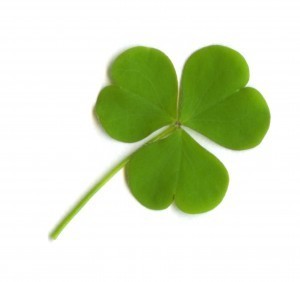 I never write on the first page of a notebook. And during football season, if my team is winning, I wear the same t-shirt and khakis for every game. I’ve been known to wish upon a star and I always pick up pennies I find laying in the street. For good luck? Not really, mostly just because I’m cheap. But, if I find twenty bucks on the ground I’m picking it up and calling it “my lucky day.”
Oh, and I knock on wood as often as possible.
These habits are quirky, sure, but not uncommon. Nearly have of us are at least a little superstitious, according to a Gallup poll, and many of our modern-day beliefs spring out of ancient tradition. Take knocking on wood for good luck. Ancient druids thought that spirits lived in wood and knocking on wood was one way to wake them up for our protection.
But, modern-day research suggests that s0me of our superstitious behavior and lucky charms may actually pack some real-world benefit.
In an study published in the Journal of Experimental Psychology: General, researchers found that people who took avoidant action – like knocking on wood by pushing down and away from the body, throwing salt away, over the shoulder, as opposed to up and toward – felt as though they had nullified bad luck. And people who took some action to push the bad luck away were less likely to think that they would be unlucky.
In another study led by Lysann Damisch at the University of Cologne, researchers found that people actually performed better when they were given a lucky charm or encouraged with luck-invoking statements such as “break a leg” or “keep your fingers crossed” before taking on a physical or mental challenge such as putting a golf ball or memory and puzzle-solving problems.
The good luck charms and phrases worked to boost the participant’s confidence, researchers say, which was enough to improve their performance.
Believe You Are Lucky
In much the same way, psychologist and author Richard Wiseman found that people who believe they are lucky, tend to have better luck because they actually take on the behaviors and habits that draw good things to them.
For example lucky people often believe themselves resilient and therefore approach challenges with more of a growth mindset and optimistic attitude often leads to better outcomes. They turn bad luck into good.
We know the beliefs and ideas we hold go a long way toward shaping our reality. Though they are merely thoughts, our behavior springs from them creating tangible results. If we think ourselves lucky, we will take on behaviors that create luck.
So, go ahead and drop that lucky charm in your pocket, and be sure to knock on wood, but there are several other habits you can adopt in your life to bring in the good fortune and positive beliefs. In Wednesday’s post I’ll share them with you.
Image by Stock.xchng

October 23, 2013
Six Ways to Get More Doing Without Doing as Much
 Chances are you have a to-do list that stretches longer than a roll of toilet paper. But you’ll be more productive, healthier, happier if your list includes things that add meaning and purpose to your life. In other words: Spend some time doing what matters and you’ll get more done the rest of the day.
Think you don’t have time? Baloney. Here are six ways to make time for meaning, without adding extra stress and drama to your day.
1. Get a good night’s sleep. Seriously. You will get more done in your day if you get a solid night’s sleep, or even if you fit in a nap during the day. There is plenty of research out of Stanford University and elsewhere that indicates people who are well rested are perform better, have faster reactions, are more productive and have better working memory than those who are tired. You’re also less likely to experience burnout or illness. Don’t believe it? Try it for a bit. Sleep eight to 10 hours a night and keep track of how much you get done during the day. Then, go for a couple of weeks without adequate sleep. Chances are you’ll do a better job and get more done when you are well rested and on the job.
2. Appreciate what you are doing. When we rush from one task to another we end up feeling more frantic than fantastic. We are also more likely to make mistakes that waste our time. But, take a two minute pause to write or say aloud the things you appreciate about the tasks at hand and you’re awareness will increase and your mood will improve. For example, the other day, when I was unloading the dishwasher, I took a minute to be grateful for the time saving appliance and I publicly gave a shout out to all the dishes we have that are there to clean. It changed the moment, boosted my gratitude and added meaning. It also fired me up for the next task because I felt better.
3. Stop multi-tasking. No matter what you think, (unless you are part of a rare class of Super Taskers, and you probably aren’t) you’re more likely to get more done if you stop multi-tasking and take on one thing at a time. So, put down the cell phone, and stop making your daughter’s lunch. Take on one at a time and you’ll make fewer mistakes, breeze through the essentials and have time leftover for things that matter.
4. Be decisive. We spend lots of time trying to make up our minds. When you are faced with lots of choices – a la the variety of drinks at our fancy coffee shops or too many cereals on the shelf – stick with the variety you usually go with. During our day we are forced to make dozens of decisions on a slew of issues. When we face too many choices our self-control takes a hit, according to researcher Kathleen Vohs, and it becomes harder to make a good decision. Instead, keep it simple and you will save time and self-control for the things that matter.
5. Define your essentials, and do those. Not everything is essential. We’ve all got to take care of business — that reminds me: I need to make the house payment today — but, there aren’t many things that absolutely have to be done right now. Texting is NOT essential. Do what you must, but get clear that not everything is a must do, every day. Once you’ve finished an essential task, take time to do something you’re passionate about and you’ll feel energized and more productive during the rest of your day.
6. Schedule time for your passion. Living with passion and purpose IS essential if you want to live a happier, healthier life. And who doesn’t? So, reserve at least 15 minutes a day for something that feels good. Drink a cup of tea in the garden. Sleep in if your body needs it. Meet a friend for lunch. Listen, uninterrupted to your favorite music. Read a book. Do something, every day that makes you feel good, that inspires and excites you. When you live with passion – even for a few minutes a day – you are rejuvenated. That energy will carry over and you’ll find yourself more productive and engaged in all that you do.

October 21, 2013
Redefine What Matters and Get More Done
 Today, I fed the cats, and injected the fat one with insulin. Then I woke up my daughter, made breakfast, packed her lunch, put in a wash, walked her to the bus, ate my own breakfast, took a shower, responded to six emails, tagged a friend on Facebook, ran to a doctor’s appointment, picked up milk on the way home and then settled in to research and write the article about performance anxiety. All that was in my first three hours of the day. But, after all that, with plenty of work still to be done I took a long lunch break, and read a book by the fire. And, I felt restored.
Taking time out like that has been a gradual change for me. I used to work long hours – always — never took a vacation. Sometimes, I still do work long hours, for weeks at a time even, to meet deadlines. And, I have hectic days and mornings with too many activities and demands. But, then I may take a break, or do something fun, or interesting or quiet. Each day includes some of the essential tasks and some of the things that are essential to me. That, I have discovered, is the key to productivity. Yep, I get more done, by doing more of the things that matter.
Notice What You Are Busy Doing
We are all busy, busy. Busy with the routine of life. Busy with DVR-ing the programs we’ll be busy watching later, busy running the kids to afterschool activities, and responding to e-mails, and texts, and voice mails and Facebook messages. We are busy doing, but rarely do we notice what.
I started paying attention to how I spent my time, particularly on the days when I was feeling most frantic and frazzled. Those were the same days, it turned out, that I didn’t take time to do anything I was passionate about. I didn’t slow down long enough to connect with the people I cared about. I didn’t laugh enough or hug enough. I certainly didn’t have time for fun. Nor did I meditate to take time alone to be still and quiet. Sometimes I hadn’t even eaten lunch. On those days, I was busy being busy, overscheduled, uptight and stressed out. I was getting the chores and errands and obligations done, but I wasn’t too efficient. And, by the end of the day I felt wiped out and a little empty because I had not done anything meaningful.
Keeping busy is not something I aspire to any longer. But doing meaningful work, being a good friend and family member, nurturing my own soul, body and brain – that stuff matters to me. And now, I make sure I spend some time doing those things every day.
When you do that a crazy thing happens. You feel better. More energized, efficient. And When you focus on consciously creating a life that includes a combo of essential task and meaningful ones, you’ll find you have something left over at the end of the day. You also enjoy it more.
In other words, sometimes the very best way to get a lot of things done, is to take the afternoon off to hang with your kid, or go to the spa, or lunch with the girls, or meditate or pray or take a hike.
Paying the Bills, Soothing Your Soul
Of course, there will always be bills to pay, groceries to buy, work deadlines to meet, and other essentials. And, I do get those things done, too. But, when we start upping the level of our lives by filling our moments with more of the things we find meaningful, we discover that all those things we once thought were essential, really aren’t.
The world is not going to end because you don’t change the sheets on Tuesday, or decorate for the holidays the day after Thanksgiving. I’m telling you from personal experience, you can go a long time (and I do mean long) before you need to clean the refrigerator. Not every text needs an immediate response.
But, slowing down long enough for a hug or a thank you or a smile, dipping into your passions, or sitting in the quiet, chatting with with friends these are the true essentials of life. If you are going to fill your to do list, fill it with these things. Fill your life with these things. And take notice of how good it feels.
Building A Meaningful Life
Psychologists tell us that the people who live the longest and healthiest lives – those with the greatest well-being – are the ones that have purpose and meaning in their lives.
But meaning doesn’t just land in your life. You’ve got to create it. Look for it, become aware. You’ve got to act and engage in this life.
I know it sounds like a luxury to sit quietly and enjoy a cup of coffee on a Saturday morning. Feels indulgent to pick up the watercolors again, or meet a friend for dinner, or take a walk on a lunch break instead of sitting hunched over your desk. But if you truly want to get more of everything done, and you want to be more present for your family and friends, you need to spend a bit-o-time on the things that matter most to you.
And, there are some surprisingly easy ways to do that. On Wednesday, I’ll tell you about some little life tweaks you can make to get more done in less time and boost up the meaning in your life.
Image from Stock.xchng

October 16, 2013
Kindness is a quick pick-me-up and you can try it at home
 Feeling low? Go do something for someone else. Not kidding.
Generosity reduces stress, improves immune system response and helps the heart and improves mental health, says Dr. James Doty director of The Center for Compassion and Altruism Research and Education at Stanford.
And it doesn’t take much to make a difference. You don’t have to suffer or sacrifice. You don’t have to go without so that others can have. Though, it is a good idea to share the remote on occasion – and yes, I know this CAN be a sacrifice. But, generally compassion is always affordable, available, and demands little time. An “open heart” is all that is required, Doty says.
Bottom line: You have more to lose by NOT acting compassionately, he says.
Still, we fuss and worry that we can’t make a difference, won’t do enough to ease the suffering in the world; feed the hungry; facilitate peace in the Middle East – so we do nothing. But, the power of giving is is in the small acts. A quick smile, sincere thank you. A love note.
With that kindness, we touch each other and connect with our own essence.
Ready to connect with your compassionate side? Here are some easy-peasy ways to brighten somebody’s day , including your own:
Leave the change in the pop machine at work
Send a note telling someone what you appreciate about them
Mow the neighbor’s lawn
Deliver meals to the elderly
Make a meal for a friend
Take your car to a student car wash and leave a big tip
Donate money to the local food bank
Pack a special lunch for your partner or child
Leave a love note for your spouse
Take a friend’s kids for a few hours Friday evening so she can have a “Date Night.”
Look the people who serve you in the eye and offer a sincere “Thank You.”
Tell someone when they’ve done a good job
Apologize, genuinely, when you’re wrong
Make a special lunch for someone you care about
Drop off a load of groceries for someone who doesn’t have a car
See it isn’t all that hard. What will you do today to add a bit o’kindness to the world?
Note: The post originally ran in July of 2011, but I don’t think kindness will ever be outdated.

October 14, 2013
Feel Happy By Doing Good
 Happiness. Next to money it’s probably the thing people want most. We go after it. We read books about how to get happy. We buy products to make us happy. We do fun things, go places, laugh with friends, move into relationship, watch movies, and, we eat ice cream, well at least some of us do – all to make us happy. It works. For awhile.
Such is the nature of happiness – at least the kind we often pursue. That kind is dependent on something else, something external, something outside of us. When we get the new shoes, we feel happy. When the kid behaves well, we get happy. But within minutes, the happy dims.
But, it doesn’t have to. There is another form of happiness that neuropsychologists call eudaimonic well-being. This happiness starts within when we have a deep sense of purpose and meaning. Those positive feelings build when we do good.
Steven Cole, a UCLA professor of medicine, and Barbara Fredrickson, a positive psychologist and researcher at the University of North Carolina studied how the human genome – which is a complete set of DNA and genes containing all the body’s information –responded to positive experiences and emotions. They discovered that genomes – the very building blocks of the body – do respond differently in people with greater eudaimonic happiness.
People with a sense of purpose and meaning in life, those who give to others, do good, and make a positive contributions, had lower levels of inflammation, stronger levels of antiviral and antibody genes, and stronger immune cells. We are healthier and happier when we do good and live with purpose.
Even though study participants often shared the same expressed emotional state those who had greater eudaimonic well-being had a greater immune response. People who had what the big wigs called hedonic well-being, or the type of happiness that comes with those little moments of self-gratification, had higher levels of inflammation and lower antivirals and antibody response.
How Living With Our Values Boosts Happiness
This ties in with the values-based happiness I write about in Imperfect Spirituality. This too is a sustainable form of happiness because it emerges out of how we live our lives. When we are on track, living close to the things we deem important – the things we value – we feel happier. This isn’t flash happiness, it isn’t the kind that lasts for a few minutes when we get a new toy, or enjoy a concert. This is the kind that lingers in the background of our lives. The kind, that even in moments of sadness or frustration, never completely disappears, because if we are living a values based-life we are also living with meaning and purpose.
The Joy of Giving
Often, part of our purpose is to do good on the planet. To make a positive contribution, a difference. And we act on that by helping others. That, is happy making at our very base level. Altruism boosts immune function, improves our moods, and is linked, not only to a higher quality of life, but a longer one, according to Stephen Post, at Stony Brook University.
Those who help others also experience a “helpers high” when their bodies are flooded with feel good endorphins and other natural chemicals. It’s pretty basic: When we do good, we feel good.
And I think this is essential to living our best lives, because when we feel good we do better. We are more productive, we are more loving, we are more open and aware and engaged. You see the cycle? These good feelings open up more possibilities to do good and when we do good, we feel good and the happy continues.
We make this hard though. We think we can’t make a difference. We don’t have enough money, or time, or we aren’t worthy, or our efforts will be rejected or, whatever.
Move on people. Your small act of goodness can make a big difference in the world and you’re genes will be happier for it.
In Wednesday’s post I’ll offer up some simple ideas for doing good.
What are some of the ways you help others? How does it make you feel?
Photo by: Stock.xchng

October 9, 2013
Three Ways to Prime Your Mind
 Imagine yourself working through the daily routine, while wearing a wet suit and flippers. What if you went shopping at an underwater grocery store or had to wade through a floor lathered with peanut butter, or set the table in a windstorm?
What would the challenges you are facing now be like if you were 30 years older than you are now, or living in a foreign and far-off land?
When we play with our imagination, we often move into abstract thinking and that, not only unleashes our creativity but also creates a little psychological distance that can help us cope with the challenges we face and make better decisions.
And while, I’m a big fan of concrete, in-the-moment living – I think it’s a very effective way to handle stress and a way to live a bold and engaged life – our greatest strengths emerge when we can shift between abstract and concrete thinking, depending on what the situation calls for. This kind of flexible thought is also an aspect of resilience.
My goal then is, to not get locked and constrained by any one way of thinking. I practice living in the now. And, other times I’m shifting into abstract creative forms of coping.
Abstract thinking helps us conceptualize, associate and problem solve because it allows us to see patterns – or make connections to things that aren’t in our immediate physical reality.
When I deliberately practice or play with abstract thinking I feel excited. It opens up all sorts of creative avenues and it feels fun and possibilities abound. Here are a few ways you can fuel your abstract thoughts.
Three Ways to Use Abstract Thought to Cultivate Creativity
1. Look at the situation from outside of your present reality. On this fantastic site PsyBlog authors offer a great little mind hack to move you into a more abstract way of thinking. Think about yourself living in a distant land, or far into the future, or even as a different person. By imagining a reality separate from the one you are in, you create psychological distance that can be a boon to problem solving and decision making.
2. Cue your imagination. In Imperfect Spirituality I write about an exercise psychologist Ben Michaelis uses with his clients: imagine yourself taking on a routine task while in a different scene or environment altogether. Such as, imagine yourself sleeping in a treehouse or folding laundry upside down. Simply by thinking about our world in a new way — outside of our comfort zone — we are more likely to draw interesting associations that can help us problem solve in the present moment.
3. Let your mind wander. This isn’t the time waster we once thought it was. Mind wandering or daydreaming, according to researchers at the University of British Columbia and elsewhere, is a way to cultivate creativity or even solve nagging problems. So, leave a little time for it. Pause for a few minutes throughout your day and prime your mind with a happy childhood memory, or provocative question and let it go off. Build in colors and aromas and sights and create a bold daydream and pay attention to what shows up.
Often, I prime my mind with a question right before I take on another more routine, yet undemanding task. For example, if I’m struggling with the structure for a story, I’ll take a short break and pose the question: “What is another way for me to treat this story?” Then I’ll go do the dishes or take a shower or go for a walk and allow my mind to percolate and wander. Same deal with a parenting situation or health challenge. I’ll ask “what are some good, unique ways to deal with this situation?” Then I’ll go do something else and let my mind go.
Inevitably, this abstract way of thinking yields just the concrete solution I need to navigate the real world challenge.
Photo by Stock.xchng

October 7, 2013
Abstract Thinking Helps Us Create, Innovate, Problem Solve
 This weekend my daughter made a fort in the garage. She used umbrellas as a roof, snow discs as placemats, and a recycling bin as a wall. Then she cooked me a meal of pine needle stew and immediately began planning how we would live in the future if the entire house began floating downstream in a flood. We live in Oregon so this plan isn’t totally without merit.
She was playing around too, with abstract thoughts, and having a good time doing it. As time went on, she began drawing connections between many of her elaborate, abstract ideas and the potential for real-world application. That is one of the secret powers of this kind of imaginative play and abstract associations. It can yield real world benefit.
What is Abstract Thinking?
Abstract thought allows us to conceptualize, to make symbolic representations, or draw connections and patterns to things that are not necessarily present or real to us now. This allows us to shift, adapt, predict, plan, and draw conclusions that move us into a place of engagement or deeper meaning or understanding.
When we are in concrete thinking mode we are drawing from the facts before us. We are rooted in what we can see and sense right now. We tend to be more analytical in this moment, more mathy and sciency.
Abstract thinking allows us to experience spirituality, plan vacations, imagine how it will feel when we complete our goals. Concrete thinking gets us to write down what we need to do right now to achieve our goal. It prompts us to read a book, take the steps necessary to cook a meal, call the doctor. Both forms of thought are essential and our ability to bounce between them are an indicator of our resilience. Our ability to adapt and deal with each situation with the appropriate and most helpful way of thinking – abstract or concrete — creates a flexible mindset and it is an aspect of the growth mindset that helps us thrive.
Getting Some Distance from the Problem
Abstract thinking can also help us create psychological distance. If we imagine ourselves living in the future, or in a different scenario or environment than the one we are presently in, and then dealing with the matter at hand, we feel a bit removed from the trouble.
Several studies indicate this kind of psychological distance makes a difficult task easier to deal with and keeps us from heading into the emotional deep end when things go wrong. By seeing ourselves as distant from the problem, we become less reactive and more able to glean insights we need to move forward. This can even help us make better decisions.
From this kind of abstract approach we are free to draw from our memories and random associations and connections to innovate, create, and problem solve. And this is fun too, abstract play is more than just building a fort of umbrellas on the garage floor, but a way of connecting the disparate pieces of our world.
In Wednesday’s post, I’ll tell you how to do it.
Image by: Stock.xchng

October 2, 2013
How to Validate the Feelings of Another
There are moments when we all feel a little unraveled or overwhelmed. Doesn’t mean it’s always smart or even necessary to feel that way — but as a human beings we experience deep emotions and when they start to run away with us, a little validation can help us get a grip and start coping again.
When you validate another – whether it’s a family member, co-worker or even an over-worked bag boy at the grocery store — you are recognizing and accepting their experience (this does not mean you have to agree with it) and helping them to feel valued and heard.
That’s a powerful way to connect and help each other out.
Here’s how to do it:
1. Listen well. Do. Not. Interrupt. Actively listen. Nod your head, pay attention, say uh huh a few times. Be respectful. Hear them out then go on to number 2 below.
2. Ask pertinent questions. Be open and willing to learn more about their experience. Ask them more about their feelings and how they are coping.
3. Be compassionate. You don’t have to agree, in fact you don’t have to judge their experience at all, you can just allow them to have it.
4. Accept and reflect. Accept that what the other person is sharing with you is real for them and reflect back their experience with statements like “I hear that you are feeling overwhelmed…I can see how that situation could be stressful.”
When we validate each other’s feelings and experiences we are more likely to participate in life and share more of ourselves. That’s good for everyone.

September 30, 2013
Why it is Important to Validate Others
 My big lug of a cat was injured last week. Then his diabetes kicked up and then he stopped eating and things weren’t looking good and since he’s already used up about 13 of his nine lives, I felt like my heart was cracking and I was wound up in worry.
The emotional stress of providing the care he needed and the financial stress of paying for it contributed to a cycle of anxiety – some of it rational, much of it irrational – that kept me stuck. I felt overwhelmed.
Until my husband validated my experience. He listened to my concerns. Asked questions that showed his support, reflected back my feelings in a way that showed me he was paying attention. He didn’t tell me not to worry, he just heard that I was.
In just a few minutes I went from feeling crazy to feeling calmer and more able to cope.
What Validation Does
Validation satisfies our deep human need to be seen. It is the recognition of another’s experience or emotional state. And we all need that from time to time.
We all want to be understood, we all want to be accepted. And, when we can validate someone else’s experience by listening well, respecting their feelings, and accepting their experience we can support them in the moment and build stronger relationships.
Validation doesn’t necessarily imply agreement. My husband, for example, didn’t necessarily view the cat crisis as a reason to eat a vat of macaroni and cheese, but he was able to listen to me talk about my concerns and he did understand my stress. That helped me to find a bit of perspective in my own experience.
It also made me feel valued – unlike its evil counterpart invalidation, where your feelings are rejected, poo-pooed, disregarded or seen as dumb, and wrong, ridiculous or over-reactive. That breeds more stress and loneliness. Mostly, all we really want is to be heard.
And when you are, you’re more likely to engage in the world. You’ll feel more comfortable sharing who you are.
Imagine if you are at work on a new project and your co-workers constantly interrupt, put down your ideas, or ignore your feedback — it’s unlikely you’ll feel like participating. You won’t bring anything.
But, when we validate each other when we acknowledge each other’s thoughts and feelings, when we hear them and respect them — whether we like them or not – people are more likely to share and participate. They feel important, as though they matter. And, of course they do. Everyone has something to contribute.
When people show up and engage, because they are validated by the others, they are more likely to be effective problem solvers and innovators – something every workplace and family, for that matter, needs. Validation is important for the person being heard because they feel valued and understood. It’s important for the rest of us because we can all benefit from their ideas and perspective.
Validation builds understanding and participation and it helps people move through difficult emotions and challenging situations. It builds connection and that’s really what this life should be about anyhow – looking out for one another. On Wednesday, I’ll tell you how.