Polly Campbell's Blog, page 16
April 27, 2015
Start Over When a Bad Mood Threatens
 Sweet P recently came home with some advice and I’m glad I was paying attention.
It wasn’t the usual “Kids get more homework done when they eat lots of candy.”
Nor was it a suggestion I’ve heard before about converting the garage into a kid’s fort with an iPhone and a refrigerator with pop where no grown-up are welcome. NOT EVER.
This was advice about how to get through a bad day and it’s simple: Start Over.
At any point, she told me, you can decide to start again. You don’t have to hold on to the stress of a crazy morning when you almost forgot your lunch, or the anger at your mom when she says you CANNOT wear the shorts that EVERYONE-IS-WEARING-YOU-DON’T-UNDERSTAND. You don’t have to hold onto the unkindness of others from the moment before. You can give them the benefit of the doubt and in the very next moment, start your day with something better.
Let it Go and Keep Going
If someone is unkind, then, instead of feeling hurt or angry or wanting to hurt back, you can, Sweet P says, “like look at the person and remember that they have felt hurt before too. Or like maybe they had something going on that upset them and maybe like when they acted bad to you it was because they were feeling bad about themselves so you just remember that and start again.”
In other words – like, you can just move on.
Let it go and keep going into something better. You don’t have to take it personally, be buried in the emotion of it, nor do you have to put up with bad behavior. Notice it. Then start again, either with a new attitude or in a new place that feels better.
People do crappy things and third graders will tell you ALL about it. Apparently a vast number of third graders also pick their noses during lunch and don’t think it’s cool to tie their shoes. So, there’s that.
But from this third grader I was also reminded that I don’t have to take in that snark. I can be more compassionate, remember that everyone has a backstory – and their story does not have to be a part of mine. I can help, if needed. And I can move on. Silently wish them well and start the day over in a way that might feel just a bit better.
This is a compassionate approach for all of us, I think. And keeping cool and compassionate when others aren’t is one of the most powerful things you can do to stay grounded and calm in an uptight world. It also leads to better feelings all around.
What do you think? How do you cope when others drop their rude mood on you?
What helps you to move on?




April 22, 2015
How to Get Unstuck

Erin Cairney White
We all have times when we feel like we are stalled in the fast-lane of life. Stuck in the routine. Bored and maybe even burned out. In Monday’s post, which you can find here, I offered some tips to get unstuck. Here are a few more worth trying.
Do something for someone else. Tough to remain stuck when we move outside of ourselves to help another. This is the easiest way to get back in the game of life. Go sweep a neighbor’s porch. Hide love notes around the house for your partner. Make a casserole for the new mom down the street. Go eat lunch with your daughter’s class at school. Drop food off at the local food bank. By making the world better for others, we also reset our own self-focused pattern to something more global, or at least neighborly. Kindness is a quick way to boost your mood.
Quit the thing that no longer holds meaning for you. We are always expanding and growing and so it’s likely, expected even, that our desires, needs, and values will change and grow as we do. Yet rarely do we tweak our routine to accommodate this growth. We may want different things, yet we repeat the same behavior patterns. This creates an energy-sucking dynamic where what we do every day is no longer consistent with who we are. Meaning and inspiration are lost.
Time to regroup and reboot. Look at the activities you are spending your time on. Are they essentials – like paying the bills? Are they things that excite, inspire, energize you? Or, are they the should do’s — things you do because you have always done them?
Drop the should do’s. You don’t have to organize the staff party just because you did last year. Nor do you have to coach soccer, volunteer at school, or go to church if those things no longer align with your values and desires. Instead, keep up with the essentials and replace the should-do’s with things that fit where you are now. Things that inspire, add meaning, and provide room to grow.
Create something. We are expansive beings and we feel better when we are expanding. Creating. Make something each day. Paint or write on a book. Get out and work in the garden, or try a new recipe. Come up with a new walking route in the neighborhood or a new workout routine.
Stuckness leaves us feeling as though we are tethered to a single path. We are locked into the same route, living the same patterns. Life begins to feel like a copy of the original.
When we create something, we move beyond that rope and we are free to explore our world emotionally, spiritually, viscerally. This creates energy and excitement. It leads us to new passions and sometimes just reminds us how to laugh and have fun again. This is all hopeful, of course, engaging and satisfying.
And just like that, then, you are no longer stuck.

April 20, 2015
How to Get Your Swagger Back — Part 1
 There are only so many meals you can cook, commutes you can make, bills you can pay, socks you can match before life begins to feel a little mundane. Boring even.
You know the feeling when the same ol’ stuff, feels drab and uncomfortable. Motivation is flagging and you no longer feel fired up about the work or activities that you used to enjoy.
You are stuck. Been there done that.
It’s not uncommon to hit a point where we feel depleted and worn by the daily routine. But you don’t have to stay stuck in in that overall sense of is-this-all-there-is dissatisfaction.
When you are ready to reset your life experience just a bit and make the routine more bearable and fun again, there are some simple steps you can take to get your swagger back.
Three Swagger-building Strategies
1. Wash your hands. Studies show that washing your hands will actually clean off the cloying psychological residue of past feelings and behaviors and provide a clean start. Plus I like the ritual of it. Do this deliberately and mindfully. Become present to the moment. Notice the feel of the water, the sounds, the smell of soap. Then, quietly notice your thoughts and allow the stuck feelings to simply wash off and down the drain. Then dry your hands and do something fun, or slightly different in the next moment to symbolize your fresh start.
2. Get comfortable with discomfort. Getting unstuck requires a willingness to do some things differently. You must shift you out of your comfort zone – which has become way too comfortable anyhow, right? So, notice what it is you are feeling as you embark on new activities or behaviors. Exhilaration can sometimes feel like anxiety. Excitement can sometimes come with fear. Feeling a little uncomfortable isn’t necessarily a bad thing. Make peace with it and start exploring the next phase of your life.
3. Focus on the next five minutes. Stop worrying about what you’ll be doing five years from now. Focus on the now. Our lives are strung together by scores of little moments. If you do something in the next moment that feels good, engaging, interesting, it will buoy you in the moment after that. You can create an entire big ol’ happy life by paying attention to this moment, then the next. Get up. Make this moment feel good. The future will take care of itself.
And, for now, the future — otherwise known as Wednesday — holds more tips to help you Get Your Swagger Back.

April 15, 2015
How to Get Grit
 Grit, say psychologists, is the quality that makes us willing to commit to the long-term goals and see them through despite adversity. It’s a stick-to-it-ness requiring tenacity and a combination of other qualities like courage, social support, conscientiousness, optimism, and self-motivation.
Researchers at the University of Pennsylvania who study resilience and grit say that grit is even more important than intelligence or talent when it comes to succeeding in school, work, and at other tasks. Grit is even the quality, according to research, that helps cadets survive at West point and kids win Spelling Bees. It leads to exceptional performance.
But, it isn’t some magical quality. We can all get grit.
If the only grit you can find in your life is in the grout between the tub tiles, then it’s time to take on some of these grit-building behaviors.
Face your fears. Obstacles are often a product of our fears. When we recognize our fears – loss, uncertainty, conflict, failure, whatever – and continue on despite them, we are building grit.
Ask for help. Those with the most grit, resilience, and determination leverage friends, family, support groups and other connections to support them during the difficult times and to encourage them during the good.
Engage your brain. Conscious awareness and engagement are aspects of grit. Gritty people become aware of their thoughts and work with them to persist. They also engage in activities that they are passionate about. They work hard and continue grow and learn what they need to know to accomplish their goals. They are flexible thinkers and able to see opportunities in the midst of chaos. They don’t believe every thought, but remain open and flexible finding the thoughts that serve them.
Find meaning and purpose. It’s easier to persist and bounce back from adversity when we care about what we are doing. When we feel like we are acting on purpose and pursuing something that matters, something that adds meaning and value not only to our lives, but perhaps the lives of others, we are apt to keep going even when it’s tough. A meaningful life isn’t always a comfortable life, but it contributes greater life satisfaction and well-being.
So next time you hit the wall consider muster of a few of these grit-building qualities. They’ll help you access the resilience you need to continue on.

April 13, 2015
What it Means to Be Gritty
 Yesterday, my husband finished a marathon.
An achievement for sure. The fact that he’s even walking around today and has already done the grocery shopping is, in my eyes, a mega-achievement. After all, walking to the mailbox can wipe me out.
But, it isn’t the strong finish that I was most impressed by or that he stayed awake on the drive home. Noteworthy, yes. Impressive no.
I was most impressed with all of the work he put in ahead of time. How he prevailed in training.
Almost every Saturday for a year, Mr. J would get up before dawn, throw on his fluorescent running gear, strap on a geeky-headlight so that he could see where he was running in the early-morning darkness, and run for three hours.
He would run at other times too, after work – sometimes around 9 p.m. after he’d put our daughter to bed. Or early, before guests arrived for the holidays. Six days a week he’d run. This went on for nearly a year. He stuck to it. He trained. He prepared. He just kept going.
That takes grit. And that is why, when he came racing over the finish line Sunday morning, I wasn’t at all surprised to see him looking so strong. He was ready before he even started. He had already prevailed.
Grit is the difference maker.
Grit it like persistence and optimism and dedication and resilience all boiled into one super power and researchers like Angela Duckworth say it’s the greatest predictor of success. Gritty people more likely to do the work, put in the effort and see their goal to the end even when it means climbing out of a warm bed at 4:30 a.m. to get in 20-miles before your family wakes up.
In Wednesday’s post, I’ll share some of the strategies for expanding on some of the natural grittiness we all posses, but for now consider this:
What are you willing to do to get what you want?
And, how will you keep after it, even when the path is clouded with obstacles and challenge?
What will you do to keep going?

April 8, 2015
Contagious Optimism: How To Pick It Up And Pass It On
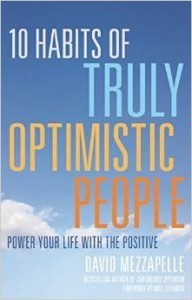 David Mezzapelle is the author of two books including t
he recently released
10 Habits of Truly Optimistic People: Power Your Life with the Positive.
David Mezzapelle is the author of two books including t
he recently released
10 Habits of Truly Optimistic People: Power Your Life with the Positive.
As humans, we are all born with a bias towards optimism. No question there. Well-respected doctors, scientists, and spiritual advisors, such as Dr. Martin Seligman, Dr. Tali Sharot, and even Dr. Norman Vincent Peale, will go deep into how and why we are this way. However, on a very simple level, we believe that when we wake up we will not be hit by a bus, struck by lightning, or die suddenly for some unknown reason. This is a bias we all have; even the most pessimistic people have it. This bias is a good thing and it serves as the foundation of how and why we can all find optimism in our lives.
On a more scientific level, our bodies react positively to optimism and happy experiences. Every one of us releases biochemicals, such as oxytocin, serotonin, dopamine, and even endorphins during periods of euphoria. This release is what gives us that sense of excitement, ecstasy, or elation. The release can be from something as simple as having fun with friends or solving that difficult math problem. Or, it can be more intimate such as kissing a significant other or having sex. It can even be from delivering that great talk or buying that new car. No matter what it is, our body knows it’s good and it rewards us for it.
Optimism is Contagious
I believe optimism comes from seeing how others have overcome obstacles and adversities similar to our own, and then realizing that if they can overcome it, then we can too (hence “contagious”). Watching and reading about others who have found optimism in even the most difficult times strengthens us.
That comes from understanding that if we think positively and persevere, we too can emulate the successful outcomes of others.
Among all the stories we see from around the globe, there seem to be 10 common denominators. I actually believe that there are ten steps to finding or maintaining optimism in our lives. Let’s check them out:
Ten Steps of Optimism
1). Gratitude. Gratitude for even the smallest things is important along with savoring every moment. It truly prevents us from sweating the small stuff and allows to appreciate the blessings in our lives.
2). Stories. When people are going through tough times, they tend to think that they’re alone. However, when they hear stories of how others have persevered, it gives them hope. And hope is the foundation of optimism.
3). Magnet. “Optimism is a happiness magnet,” -Mary Lou Retton. You want to surround yourself with good, uplifting people. Their happiness and positive attitude is certainly contagious. It brings you up and adds light to your day.
4). Reflection. Look in the mirror and remember that what others do or say is a reflection of their own self, not a reflection of you.
5). Altruism. No matter what is taking place in your life currently, helping others is tantamount to your own happiness and to the happiness of others.
6) Embrace Change. If you accept change and embrace what life offers, it is more likely that you will be successful when you come across the peaks and valleys that we all encounter.
7) Believe in Yourself and the Value You Possess. Every one of us has value, unique value. And no one person is more or less valuable than another person.
8) Service the Engine. Healing not only comes from medical and spiritual professionals, but it also comes from within.
9) Reclaim Your Personal Power. No matter what life holds, you are not alone. There are people who have been through it and together you can surmount the obstacles.
10) Stay Inspired. Inspiration is fuel for the heart, fuel for the mind, and fuel for positive living.
In closing, picking up optimism and passing it on is something that the world can never get enough of. Whether we are experiencing peace or war, recession or prosperity, sunshine or clouds, etc. there can never be enough hugs, enough smiles, enough elation, or enough love to keep us all going. The cost is zero but the rewards are priceless. The key is for us to share our experiences with others because everything we do in life (successes and failures) serves as the basis of our wisdom. And sharing wisdom is a major way to facilitate contagious optimism. It’s the key to evolution and the constant improvement of mankind.

April 6, 2015
Why We Need Stories with Happy Endings
About once a year, my dad tells the story again.
You know, the one where he accidentally poked his brother with a pitchfork and then tore the soles of his own feet while jumping over cinder blocks while racing home to tell his mom who was tending to his sister who’d gotten got caught by a fishhook and everyone needed tetanus shots but laughed about it later?
Everyone except his mother, I presume. I mean come on, that poor lady.
But, you probably have one of those stories too, right? Many of them, even. Stories of crazy, we’ll-laugh-about-it later moments of resilience or resurrection, or tales of overcoming hardship and adversity.
Our lives are shaped by the stories we tell. They help us to know ourselves and connect to others. They help us to pull together and go on by making some sense of our experience and fostering optimism.
Most stories are universal. While your experience will be unique – I’m thinking few of you have been stabbed with a pitchfork (here’s hoping) — they will also share threads of loss and joy and pain and strength.
And how we tell these stories from the past, has a direct impact on the lives we live today. They contribute to a belief system that determines our reality. Whether the beliefs are true or not, we often act on them and that creates tangible outcomes.
Tales of Optimism
When we tell a story of overcoming adversity – the manuscript was turned down 53 times before it sold, but then I did it — our minds make a little check-mark next to the “I did it” part. The story reminds us that we’ve faced challenge before and prevailed.
In his book 10 Habits of Truly Optimistic People, author David Mezzapelle uses these kinds of stories to help us reconnect to our own optimism. The book is filled with the tales of others who believed that despite challenge and pain and unexpected outcomes, they could find a positive way through the experience. And they did.
Optimism doesn’t dissolve the adversity or pain, it simply allows us to believe in better outcomes so we work to make them happen. We tend to work harder, make healthier decisions, and endure when we think optimistically. And when we surround ourselves with optimistic stories – stories that remind us that anything is possible – we “catch” that optimism ourselves and go forward a little stronger.
Be the Hero
So, what narrative are you telling? Are you repeating tales (to yourself or others) where nothing works out right, nothing goes your way, you are never good enough?
Or, are you the hero in your own tale, rising up despite setback, laughing in the face of adversity, to create the life you desire.
Pick the story with a positive ending and use it to guide your toward a positive reality.
Special Note: On Wednesday, we are thrilled to have a guest post from author David Mezzapelle. Through his work he has identified 10 qualities that help us cultivate our optimism.
In the next post, he’ll tell you what they are.

April 1, 2015
How to Live Deliberately
 When I feel really strung out it’s usually because I’m doing TOO MUCH and not focusing on ANYTHING.
You know that feeling when you are pulled in every direction and instead of stopping to stand still for a moment, you take responsibility for EVERYTHING including Global Warming — which you totally created with all those backyard barbecues.
Yeah.
That’s usually when I get just a teeny bit sarcastic and say things – with a big sigh of course – like “Apparently I HAVE to do IT ALL around here.”
Only I don’t and I can’t and when I try I just get freaked out and spacey and I don’t do a good job anyhow. I’m being pushed and pulled by external circumstance and I’m trying to keep up.
The antidote is to stop. To slow it down a little bit and to live to deliberately. To notice what you are doing. To be conscious when you are doing it. And when you do this, you realize real quick that most of that stuff you’ve been doing, isn’t all that important.
Three Ways to Live Deliberately
1. Slow. It. Down. I have a bell that rings on my phone every hour. The chime is my reminder to slow down, and move my body. I can get so caught up in work at my desk, or so focused on “getting it all done” that I don’t even notice what I’m doing. So, I use an app to remind myself not to buy into that unconscious pattern. When the chime rings, wherever I am, I pause. Make a deliberate movement – mindfully walk to the coffee pot or stand up and stretch – and give a quick thanks for something I’m grateful for. Then I get back to it. The pause feels good and reminds me that my best work comes when I am conscious and aware.
2. Savor. When we are living by default it feels like we’ve been swept up in a moving crowd that nudges us toward a door we never wanted to go through. We just do what we think we ought to, pushed along by external influences — without giving them any thought. By the end of the day we are tired. We feel like we worked hard yet, have nothing to show for it. Instead, pause throughout the day to savor the little things.
Savoring helps you notice the amazing that is all around — a sleeping cat, a beautiful tree, the smell of a fresh soup in the kitchen — and that helps you tune in and be more deliberate with your actions.
3. Act with intention. When we set the intention for the experience we want to create, we more mindfully go about creating it. Set an intention for the day when you first wake up in the morning. I usually go to mood. I intend to have peaceful interactions, today. Or, I intend to be loving, or productive, or mindful as I go through the day.
Then, throughout the day, when unique circumstances arise, use other intentions to root you in the experience. Before a phone call, set the intention for the kind of communication or outcome you’d like to create. Before cooking dinner, set an intention. Do it before you pick your daughter up after school.
With deliberate action you’ll create a day that is satisfying and meaningful rather than one that is a flurry of frantic, stressful, mindless activity.

March 30, 2015
Learn to Love the Life You are Living
On May 3rd you can kiss those bad feelings goodbye.
In a SPECIAL event with Decorus Motivational Seminars
Author Polly Campbell will show you how to:
Rediscover Your Passion and Purpose
Tap your Own Super Power
Love the Life You are Living
And that’s just during lunch
at Oregon’s beautiful Reserve Vineyards and Golf Club.
Register NOW

Deliberate Attention Eases Stress
 Four days into Spring Break, I was restless – checking the email on my phone every few minutes. Making lists. Running through calendar items to see what I had coming up the next week.
I was getting up earlier too. I crept into the home office, my head wrapped around work, trying to get a few things done before my daughter Sweet P, awoke.
I don’t know whether it was the squeak of the chair or the clack of the keyboard, but she always woke up about the same time I sat down at the desk.
She’d come in, wrap her arms around me and tuck her head in the crook of my neck. I’d feel her warmth and swell with soft feelings.
Then, I’d feel myself becoming impatient.
Attention to Everything and Nothing
I wanted to get back to the work routine. I had stuff to do. I wanted three hours straight to get the requests off my desk, and make the calls, and finish the correspondence. I needed time to write more than a sentence. I was so behind and feeling overwhelmed by it.
Sometimes, I would slip into the office, while she was practicing piano, or taking a bath. When she was reading or playing the tablet, I’d settle in for my own screen time and return emails. “I’ll be just a moment,” I’d say. But the moments were becoming longer and I was feeling more like a collage – a picture parent made up of fragments of different roles.
My attention was everywhere and nowhere. I made quick, impulsive decisions. Gave rapid-fire yes answers — or grumpy nos. I made typos trying to hurry. Forgot to send emails.
I was really spacey.
Live Deliberately
Until, I remembered that life is not a To-Do List. It’s one huge experience made by rattling back and forth between other experiences. When we miss that – when we do all this stuff without paying attention – we miss a little of life. And we feel just plain crazy.
So, at the peak of craziness, instead of trying to do it all, I decided to stop it all. To do nothing. To wake up without a plan. To go with the flow, which for this Type-A Momma, was a tough thing to do.
I decided to live deliberately. Do one thing at a time. And soon I felt better. My connection deepened with my daughter. And guess what? When I did go into the office, I was more creative and less frantic there too. I made fewer mistakes. Produced more.
When I acted deliberately I paid attention to what I was doing, rather than thinking ahead to what I needed to get done. Each life experience began informing the other. Everything got easier.
Some other things I noticed:
Sweet P’s vision for the world, which I learned while we worked on a jigsaw puzzle, is mostly amazing. Aside from the sheer numbers of animals – stuffed and real – that she intends to care for, I think we’re in good hands.
I was still feeling deep-down sad and disappointed over a deal gone bad two weeks ago. I hadn’t allowed myself to think of it much because it left me feeling insecure. This time I paid attention to those feelings. It felt icky. But, then, I understood it better and by the end, the disappointment moved on.
I say, “OK, honey, just give a minute” A LOT. And that the minute goes so much longer. I’m not comfortable with that, so I think I’ll mostly stop doing it.
One afternoon, I even just sat out on the front step. My daughter spied on the neighborhood from the tree in our front yard (my deliberate tree-climbing days are WAY over). I didn’t have my phone with me. Not a book or notebook. I felt the sun on my hair, and smelled fresh-cut grass in the wind. And right there, I came up with an opening for a story I’d been struggling with.
Clarity in the Moment
In each moment there was a new kind of clarity. Peace really, that came from giving my attention to one thing at a time.
Today, we’re in back in the routine. When she hops the bus to school, I will head back to work. I can’t wait. I love it. And, my to-do list is long. I’ll work hard, but, I’m no longer going to hustle mindlessly.
I’m going to be deliberate. Give my attention to this moment. Then the next. Piece by piece.
This will require me to form so new habits. To slow down. It won’t always be easy. And I don’t expect to do it well 100 percent of the time.
But, when we do this, even sometimes, our minds clear. We make fewer mistakes and feel less stressed. Impatience and irritation ease a bit and we become kick-ass productive. When we give our attention to the moments of our lives, we find more moments to savor.
At the end of one of my deliberate days during Spring Break we went around the table sharing our goodnesses — the things we were grateful for.
My daughter looked at me and said, “Remember when I was drawing and you were reading and we were just there together – not talking or anything but, still, just there together?”
“Yes, I remember.”
“I liked that the best.”
Me too, honey. Me too.