Polly Campbell's Blog, page 14
July 1, 2015
Imagining Success Helps You Create It
 When my daughter was about four-years-old she often played “restaurant.” She’d hand around homemade menus and then prepare our orders with wooden food and Tupperware containers in her model pink kitchen in the corner of the living room. I always ordered a salad with spaghetti or whatever the special was for the night. And, while she worked to prepare the meals, she also talked to her pretend kitchen staff about how to make the recipes.
She didn’t know anything about ingredients, so each time she had to imagine what went into spaghetti sauce, or how to bake a cookie, and she worked it out in elaborate and insightful ways. Listening to her play and work through the faux challenges and recipes reminded me of the power of our imaginations. After all, she learned how to make guacamole first by imagining what would go in it.
Our imagination can work this way for us too. It can help us work through real-life fears and challenges and accomplish real-world goals.
We can visualize the interview going well. Imagine our recovery from surgery to be fast and without complication. Or create images in our mind’s eye around how we want the dinner party to go or the wedding to look or the meeting to conclude. And when we do this within our imaginations, we also change reality.
Guided Imagery Eases Stress
By creating pictures or impressions (not everyone sees pictures but it is equally powerful to draw from the other senses and emotion to create an imagined sense of sights, feelings, mood, colors, sounds) through a a practice called visualization or guided imagery, you can alter your reality for the better.
The process is so powerful that more than 3,000 hospitals nationwide use some form of imagery or visualization to treat patients. It’s effective in helping people cope with cancer symptoms and the side effects of chemotherapy; it’s useful in managing chronic pain; and visualization even helps people recover from surgery faster.
According to one study published in Alternative Therapies in Health and Medicine, levels of cortisol, the so-called stress hormone, drop significantly in people who participate in a guided imagery session. Other research has shown that when stressful, anxiety-producing experiences are replaced with healthier, happier, positive mental images people relax significantly and that helps folks feel better, especially since stress can often cause pain to flair.
Those patients who were taught to visualize their pain in a different, more positive way were better able to manage their discomfort, according to an article in the journal Pain Management Nursing.
I use imagery to manage arthritis pain and for all kinds of things, but mainly to manage my stress. When facing a big challenge or difficult work project, I’ll go to bed and spend a few minutes imagining details of the situation. I’ll visualize how to write an article or imagine saying just the right things in a conversation with my daughter or the editorial meeting. I’ll see it all playing out perfectly in my imagination.
When we can imagine the process or experience, we reduce our stress – which makes everything easier – and prepare our bodies and brains to create just what we want.
How to Visualize
Many therapists are trained in guided visualization and plenty of CDs and MP3’s are available to lead you through a session on your own.
Here’s how you can get started.
Relax. Stay alert, but get as comfortable as you can. I sometimes do this while lying in bed or sitting upright with feet flat on the floor. Take five deep, slow breaths, or become mindful of your heartbeat. Denis Waitley, an expert in visualization and human behavior, also suggests listening to Baroque music from Bach and Vivaldi as a way to quiet the mind and open it to imagery. Settle your thoughts and begin to imagine.
Imagine your ideal circumstance and the emotions that come with it. Once relaxed and quieted, imagine a comfortable body, free from pain, or a smooth day at work, or an intimate conversation with a loved one. Imagine what you want to create. You can also envision a beautiful location, or your perfect day. Don’t worry if the images aren’t perfect, go for the sensation. Some people “visualize” through auditory cues or physical sensations. That’s fine too.
Imagery doesn’t have to be a picture per se but it does have to invoke your emotions. The power of visualization lies in the feelings you create.
Deal with the details. Infuse your image or sensation with specific details. See your body moving easily, free from pain. Imagine yourself free of stress and filled with vitality. Imagine the work project coming together easily leaving only feelings of satisfaction and calm.
Fill your imagery with the smells, textures, noises, emotions, and other details specific to the scenario to make it feel plausible.
A visualization exercise can take an hour or a few minutes. It can be done in the shower, or during a meditation, once or several times a day. Use it as needed, but don’t take yourself too seriously. Have fun. Fire up your imagination. Play with your positive story line. Once you begin the practice, you can expand your visualizations to include any possibility.




June 29, 2015
How Guided Imagery Helps
Your imagination is pretty good at figuring out how to put together Lego houses, and mold mini-pretend pizzas from Play-Doh.
But it can also help you manage a budget, come up with a creative compromise, and even help you manage pain and recover faster from surgery. And now more research shows that using your imagination may actually help you more than practice when it comes to successfully completing a task.
Vanderbilt researchers found that it was visualization instead of practice that helped people respond faster and more efficiently when seeking a specific target.
Study participants were asked to imagine a target – the letter C. Then, during the experiment they were asked to watch a series of images on the computer screen, which included various Cs all in different colors and orientation, and find identify whether a specific C was on the screen or not.
Those who had imagined looking for the target did much better during the test than those who had only practiced the exercise before.
“Imagining the search changed how participant’s visual systems worked,” said researchers, “proving that imagery can not only help us perform but improve our sensory processes early on.”
Four Ways Imagery Can Help You at Home
OK, but most of us have no need for target spotting. So what’s in this for us?
Aside from helping us manage pain and stress and recover from injury – all biggies – imagery can also help us move through the day a little easier. Here are four ways to use it at home.
1. To improve your workout. Before exercising, imagine your muscles, joints, and cardiovascular system working efficiently to propel you through your workout. Imagine them firing just right so that you feel strong and healthy and fluid. Then go workout.
2. When dealing with difficult issues at home. A couple of days ago we all went to bed mad. My daughter was upset over something I’d said ‘no’ to, I didn’t handle the situation well and then my husband and I disagreed about the process. When I woke up the residue of conflict was hanging with me to I sat on the edge of the bed and visualized just how I wanted my interactions with my family members to go that day. It helped me start the day out on a more positive note and the imagined good mood translated into reality.
3. To work through aches and pain. When I’m feeling stiff and sore, I’ll relax my body and visualize it as soft and flexible, like a wet noodle. It helps me to relax, and the joints feel easier to move and once there is movement the pain and stiffness.
4. While managing a work or house project or another large task. When I take on a new assignment – especially one that makes me feel a little excited and nervous – I’ll spend a few minutes visualizing the process. I see myself sitting down, writing fluidly and clearly and getting the job done in an efficient manner. I’ve done this kind of imagery with household projects, during travel – when I have a logistical challenges – and while juggling tasks with multiple steps that have me feeling pressed for time.
Each time, I’ll imagine the ideal. I’ll see myself carrying out each task quickly and easily and completing the challenge without stress. Usually, that imagined outcome becomes reality. No matter what happens in the end though, visualization is a powerful stress reliever and that alone helps us heal and stay focused and calm when we are taking on a big task.

June 24, 2015
A To-Do List for Life
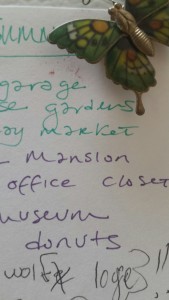 A butterfly magnet holds the summer to-do list to the fridge.
On the list my daughter has written in purple metallic ink: Go to Great Wolf Lodge, eat a Voodoo Donut, play with friends. I’ve added in black: clean the garage, visit the Pittock Mansion. My husband wants to go to Crater Lake. There are a half-dozen other things on the list and more items are added each day.
Sweet P wants to learn how to play Rockin’ Robin on the piano, I just want her to get through a practice without whining. I want to stroll the Japanese gardens. Mr. J wants to get the pond out back working again.
But there is so much more that I want for my daughter. So many things that will never go on the list, but stuff she’ll need to learn to thrive. Pieces she’ll need to know to create her own happiness and survive when her heart is breaking.
It’s a to-do list for life, maybe. Things we can all practice and learn just by showing up.
What I Want Her to Know
I want her to know courage and the exhilaration of overcoming.
I want Sweet P to do something that scares her a little. Climb a tree, play piano for an audience, try out for a play, water the tomatoes even with the bees hovering.
This is where she will learn courage, how to face down rejection. She will know the exhilaration of doing something she didn’t know she could do. There is strength in this. This will teach her that she is capable of anything.
I want her to know the satisfaction that comes from doing your best, even when the task is hard.
She’s not going to like this one, when I add chores to her list or recruit her to help me clean the garage. But, I want Sweet P to know what it is to work hard and then to be appreciated for a job well-done.
And I want her to cultivate the focus needed to stay in and get the work done even when there is no one there to notice or care. Because in that she’ll learn to motivate herself. There she’ll find self-respect.
I want her to know the satisfaction of working hard to do your best even when the task seems impossible and your best isn’t all that good. Even then I want her to keep going. To finish the job even when the Slip ‘N Slide is waiting.
I want her to know the pride that comes from contributing to make some cleaner, better, more beautiful.
I want her to learn this now, while she has still has years to practice because this kid – ALL KIDS – are going to change the world. No matter. But, I want her to do it in the right ways.
Drinking from the hose, caring for those who need care
This summer, while I hope she slows down long enough to drink from the hose, and bury herself in a book so deep that she loses track of time and needs a mother reminding her to eat, I want her to know too, what it feels like to help others. How to be kind even when no one is watching. To help those who need it, without judging their circumstances. I want her to know, just a little bit, what it’s like to give of yourself so that others can be more of who they are.
This summer, on the night she tumbles into bed with sidewalk chalk under her nails, still wearing the t-shirt streaked with dirt because she is too tired to change, I hope she knows that these moments are her life. That life is not only in the graduations and weddings and jobs and new cars. It is in these everyday moments. The ones that happen in between, all day long.
The moments when we hold a lady bug, or the neighbor boy smiles at us. The moments when we sacrifice our favorite Band-Aid for the knee of a friend, and fall asleep next to the kitten in the sunspot on the floor. Little moments, so easily overlooked.
They shouldn’t be. They can’t be overlooked. Because in the end, it’s a collection of precious little moments that make for a big, grand life.
I hope Sweet P swims in a swimming hole not made with concrete and drinks Slushees made in the home blender with lemonade and I hope she lays on the floor daydreaming and memorizing all the words to some pop tune I’ve never heard of. I hope she learns how to comfort herself when she hurts – AND to come to mom for a hug — or a kick in the behind if needed — to let the hurt go.
I hope she learns to say Thank You to others not because it’s the polite thing, but because she feels gratitude so deeply that there is nothing – not one thing – left to say but Thank You. Oh, my. Thank you.
See Beauty Everywhere
And this summer, I want Sweet P to find beauty everywhere. I want her to go looking for it in the wave of the centipede’s legs that she finds under the potted plant and in the way the sun shines through the window leaving a spectrum of color on the carpet. The beauty in the smell of a summer rain on hot pavement and the heat of my skin when we hug.
And when things don’t feel good when she’s mad at mom because of EVERYTHING and she doesn’t have any friends and I-just-don’t-understand, I hope she can find the beauty even then, in velvety fur of the kitten that comforts her.
It is all around us, this beauty. So easy to spot when things are grand. But beauty becomes even bolder during times of heartache, or frustration, or despair, if we remember to look. Because in it is a reminder that all is not lost. All is not bad or terrible. That even in a difficult world there is a sun that keeps rising and places to explore, things to learn, books to read, people to love.
If Sweet P can learn through living even one of these things, she will begin to see possibilities in the impossible and she will begin to know how awesome she is.
Most of all, that is what I want her to know. That is what I want us all to know. Our own awesome.

June 22, 2015
How to Learn
 When I was growing up, family dinners were often interrupted by a mad search through the encyclopedia. During our discussion some question would invariably arise and my dad or one of us would get up from the table and come back with a World Book volume containing the answer.
The practice fueled my curiosity and more than a few Trivia Crack victories.
I’m still in the habit today. Something will come up during our dinnertime conversation and my with my daughter or husband will seek out the answer. But, this time, it doesn’t come from a book. It comes from Google. And that may not be the best way to learn.
Okay, Google
New research by Gordon Pennycook and Nathaniel Barr indicates that Google is giving us the answers even before we think through the questions or problems ourselves.
Instead of actually analyzing a problem or tapping into our own intelligence answer questions or come up with new solutions we are using the smartphone as an “extended mind,” Barr says. And that reliance on technology is creating a culture of lazy thinkers.
How to Learn
In fact, the best way to learn new material, doesn’t come from Google at all. Learning is best done through distributed practice, according to a paper published in Psychological Science in the Public Interest reviewing different learning styles and the research into them, is distributed practice.
Distributed practice is the fancy phrase for Not Cramming. Instead of filling you head full of material all in one night, you “distribute” (get it?) your study sessions. When we load up on info in a single session, most of that is lost after a few days. When we study the material over time, we tend to retain it.
Practice also makes a difference when it comes to learning – but not necessarily if we repeat the same steps over and over.
In a study led by Tom Stafford, of the University of Sheffield, the people who improved the most while playing an online game were the ones who spaced out their practice sessions (though both groups had practiced the same amount of total time) or explored different aspects of game play early on. By experimenting a bit in the beginning and distributing their practice time, they were able to optimize learning.
Highlighting Doesn’t Help
Re-reading parts of the material you are studying, highlighting important material, and summarizing information, were among the least effective learning styles, according to the report.
Highlighting actually prevents you from soaking up needed knowledge because it limits your focus to individual facts rather than helping you connect to the overall idea, according to the research led by Kent State University professor, John Dunlosky.
The best way to learn new stuff, then, is to put down your smartphone and practice. Play with ideas, techniques, solutions, over time, and you might just experience a boost in your brain power without reaching for your smartphone.
*portions of this post, written by Polly Campbell, originally appeared on Psych Central.

June 17, 2015
How to Make a Bad Day Better
 Some days it can feel like life is piling it on.
You spill coffee on your suit, forget that you were supposed to volunteer at the kids’ school, and then there is car trouble and traffic jams and you’re late for the meeting and wa, wa, waaa.
One thing after another seems to bring new challenge. And the trouble is bound to continue unless you shift the energy and disrupt the cycle of negativity with something a little better.
Not saying it’s easy, but I AM saying it will make a difference in your day.
Here are three quick ways you can do it:
1. Look for the goodness. It’s there too. At exactly the same moment you are stopped in traffic on the highway, you can rock out to your favorite song on the radio, or appreciate the air conditioner, or heck – even the car. At exactly the same time the bad stuff is going down, there is also GOOD stuff happening. Challenge yourself to find the good and you’ll feel better. When you feel better you act better and THAT is enough to improve your day.
2. Go with the flow. A friend of mine was telling me how her travels plans became disrupted in France when travel conditions changed. But, the disappointing situation turned out okay when she decided to go with the flow and accept whatever showed up instead of worrying about it. Often we cannot change circumstances but, we can change how we respond to them. Usually, responding positively, with a curious, let’s-see-what-happens-now, creates greater possibilities and much less stress than getting all uptight and complaining about what has already happened.
3. Take a distant perspective. University of Michigan researchers Ethan Kross and Igor Grossmann found that when we gain some distance from difficult or intense emotional situations, we tend to manage better and make wiser decisions. Next time you feel buried in the emotional landslide of a bad day, talk to yourself about it in third person, or take the view of an outsider watching it from afar. When we get upset, we tend to personalize things. But, by taking a step back you can better manage the upset without creating more.

June 15, 2015
Look for the Good

Sweet P woke up this a.m. cycling through the same drama from last night: Stress over a lost paper, a disagreement with a friend, a “Daddy-doesn’t-even-understand” (he did, he just didn’t care after 15 minutes of solid whining), and, “Now,” Sweet P says, “I even have insomnia.”
After testing her (because I’m that kind of mom) to see if she knew the meaning of the word (she did because she is that kind of kid), she reiterated that the world is ALSO a horrible place because I won’t let her wear flip-flops to school.
And I got to thinking about how we all do this. We find something that feels hard or upsetting — something real that bugs us — and we hang onto it as evidence of our bad day. And then we pile on with other little moments of negativity until we are rolling in bad feelings about things that just a moment before were only a little inconvenient or irritating.
We feel out of sorts and then we go looking for more bad stuff until we become buried by it.
While at EXACTLY the same time you are noticing all this rotten stuff, the sun is coming up again. People, it does this EVERY DAY. Remarkable.
And then your eyes open wide to see it, and your heart beats even without you thinking about it.
At EXACTLY the same time you are feeling like things are terrible and lost, somebody’s life is better because you are in it filling a little piece of darkness with your light – without even knowing it.
At EXACTLY the same time you are feeling like the day has been too hard, you get to take a sip of fresh water and fill your belly with food. You can turn up the tunes during the morning commute and shake it to Uptown Funk all alone in the car and then you get to laugh and think of the all the music you love, and about that concert you went to with your girlfriends and wasn’t that JUST AWESOME?
And oh my, you love your friends. Like really. In fact you love other people too and that is just so dang lucky and good.
Do you see? At EXACTLY the same time that you are holding to all that is bad, you are missing all that is good. It’s here too. Right now.
It is all here in the same moment. The confusing and creative and bad and good and loving and lonely and sad and happy and beautiful and ugly. It is all in every moment.
The outcome of your day, then, will be determined by what you focus on.
I encouraged (read: nagged) Sweet P to get in the shower. And suggested she wash the bad feelings away (as well as the stink of the day).
After all, we’d dealt with the real challenges, felt the sadness, came up with solutions. No need to hang onto the icky residue.
I heard her turn on the water, and slip into the tub. A few seconds later, her little voice was singing again.

June 10, 2015
How to Make a Good First Impression
 We met our freshman year in college.
She was a snob. Not interested in others and really not a whole lot of fun. Or so I thought.
She thought I was a nerd – too boring to bother with.
We were both wrong. And not only is she hilarious and giving, but she’s been one of my besties for nearly 30 years.
After months of living in the close quarters of a college dormitory — in other words we couldn’t avoid each other — we overcame our first impressions to build a rock-solid friendship.
First Impressions Are Hard to Change
Research shows that even when our first impressions are wrong, it can be tough to change the opinons of others.
On Monday, I wrote about how to be more open-minded and how to avoid passing quick judgment, but chances are folks will still be judging you, so, it’s worth thinking about how you show up in the world and how to make a good first impression.
Four Ways to Make a Good First Impression
Be authentic and sincere. Not everyone is going to like you, but most will respect you if you are real and true to yourself. Don’t say you like something if you don’t. Don’t go for false flattery. Don’t be a rude schmuck either, if you don’t like something you don’t have to say anything at all. But be sincere in what you do present. We can all spot a faker and most of us don’t like that. When someone is real, they exude confidence and that’s a good thing.
Be open. Don’t judge others in the room, be open to however they show up. Get curious. Engage with them. Ask about them and their goals. Smile. If we are caught up in ourselves we are not reaching out and connecting with others. This can shut down a meaningful connection before it has a chance to start and make us less approachable.
Be agreeable. Don’t pick a fight your first time out. Don’t create conflict. Show interest. Be compassionate and empathetic. Look for the best in others and others will see the best in you.
Be polite. Introduce yourself, and others, if you are in a group. Remember names. Offer proper goodbyes, rather than just wandering away with promises of “we should ge together.”Proper greetings and basic courtesies go a long way toward making others feeling included and comfortable around you.
You don’t have to be buddies with everyone you meet and there will be plenty of people you don’t want to hang out with or even see again. But, it’s unlikely you’ll know that within the first few minutes of your first meeting. So stay open and the remember the best way for you to make a good first impression with others, is to be kind, polite, and authentic. The more comfortable they feel when they are with you, the better impression they will have about you.

June 8, 2015
How First Impressions Hurt Us
 In the time it takes to shake hands or offer a smile, a first impression has already been formed.
In just a few seconds, we size up others and make decisions and assessments about them based on how they dress, chew their food, talk, stand, act, laugh. Sometimes we do it without meeting the person at all, forming opinions based on a rumor we have heard. And, others are doing the same with us.
Trouble is a negative first impression – even after it’s found to be completely wrong — can be tough for even the best person to overcome. And that can stifle both of us, unless we give it a second thought.
In a new study published in the Journal of Personality and Social Psychology, researchers Thomas Mann and Melissa Ferguson found that you can change a bad first impression. It isn’t easy, but it is possible with new information and reasoned thinking.
Go With Curiosity Over Judgment
Of course this challenges us to slow down long-enough to take a second look, gather more information, stay open. It requires us to rush to compassion, rather than judgment. To pause and remember that there is no way ever that we know the whole story about another. To admit that we have no clue why people present the way they do, why they show up angry or stressed or stinky or rude. Probably none of our business anyhow.
We can stay in conversation with curiosity instead of judgment. We can encounter others, pass by even, without even forming an opinion. We can observe and notice without labeling and stop defining without the details.
In Ferguson and Mann’s experiment they gave participants only part of the story. They told about a man “invading” people’s homes and taking “precious things.” Study participants automatically decided that this guy was a schmuck. But when they heard that the homes he invaded were on fire and that the “precious things” he was taking were trapped children, their impressions began to change.
When people are given information that helps them see the initial negative information in a new way their implicit judgments can shift quickly, according to the researchers. As long as they have a chance to think about it. A follow up experiment showed that when people are distracted while receiving that new, more favorable information they are less likely to make the shift.
First Impressions Limit
In reality though, most of us are not going to get the follow up story. We aren’t ever going to know all the details.
We are never going to hear, for example, that the mother who let her kid scream in the grocery store as she rushed down the aisles seemingly without a care, was exhausted and needing to get home after radiation treatment. Or that the CEO, who we judged as greedy and self-absorbed, was once homeless and now donates millions each year to foundations and non-profits to help others.
These are the things we miss, the things we will never know. But perhaps – since everyone has a backstory – we can just head into every interaction with an open-mind, and genuine interest. This is not only more reasonable for those we meet, but a smarter strategy for all of us.
After all, think of all those missed opportunities. People and situations that we avoided or misjudged early on — because of a few first impressions — that could have led us to the Next. Big. Thing. The next business deal or friendship. The next innovation or passion.
Stay curious and you might find yourself challenging those first impressions with a little more insight.
**some portions of this post appeared at www.psychologytoday.com

June 3, 2015
Three Ways to Surf through Stress
 Some days feel as though I’m standing at the ocean’s edge where the ground is solid until the next wave comes in and chisels away the sand around my feet. Then, I’m unsteady and off-balance. The earth below me washing away, changing into something new. If I stay here, in this precarious spot, another larger wave will come in and knock me over in the tide.
But of course, I don’t just stand there. I take just one, baby step and that step moves me onto solid ground again, at least until the next wave.
Life can be like this. Sending waves of opportunities and challenges our direction. Both – even the good stuff like a new baby or marriage or new job– can leave us a little unsteady, uncertain as we learn our way and move to more solid ground.
We can freak out about it all. The pain and uncertainty and challenge and change. Or we can move with the surf. Learn from it.
I used to be the freaker-outer. Not so much anymore. Sure things get to me, but I’ve learned that it’s better to move with the current than flail around in the tide. Stress and upset draw too much energy from me. So, when I feel myself being sucked in by it, I return to three practices that help me regain balance.
Do Accept. People get all fired up about this one because they think acceptance is endorsement. It is not. I accept my arthritis. Don’t like it, but I’ve got it so I accept that it will be part of my experience. Acceptance is to see what is in this moment without judgment. This is a relief, because we don’t have to do anything. We don’t have to have an opinion. Acceptance is the place between resistance — the fight of it — and action. It allows us to see our circumstances realistically. It’s only when we fully accept our circumstances that we can identify the next inspired action that will help us through it.
Get Curious. Curiosity is a game-changer for me. I find it’s nearly impossible to be upset when I’m curious about something. Last week I got some disappointing news about work. I began to stew and worry and ruminate. Until I got curious. Instead of worrying then, curiosity got me wondering — What now? What can I learn from the situation? Who will I meet? What will I do? — and that transformed the moment of upset into positive action. It doesn’t eliminate pain or disappointment but it gets you moving through it.
Create Now. Once you are engaged and curious, you also become more creative and THAT makes you a better problem solver. Creativity isn’t just for the Monet’s of the world, it’s for the mothers who are juggling work and household responsibilities, and couples dealing with challenges in a marriage, and those who are managing the bills and the business. All of those things require creativity. Good news is we are all creative. You can always figure something out. Rework a situation. Rewrite your story. Learn something new. Do something different.
When you can pause in your stress long enough to take a breath, accept the circumstances, and began to explore and create new possibilities, you are actively moving through pain and challenge. The difficulty moves into something a little more positive, and becomes a little easier to live with. And then you are too busy moving through the stress and uncertainty to worry about it.

June 1, 2015
You’ve Got This

There was the “but-all-the-other-kids-wear-flip-flops-to-school” tantrum a minute before the bus arrived. Then the cat threw up, I got edits back just before 5 p.m. that needed to be done TODAY and then I discovered my husband had remembered only half of the things I needed from the store. The forgotten groceries coincided nicely with ALL of the ingredients I needed for the dinner I was planning to cook. Scratch that.
By the end of the day, I decided I’d do better with a margarita on the back deck. Except for one little thing. We had no tequila.
One of those days.
Life can smack us around pretty good some days. Little things can feel like a big struggle. Then, when you you throw the big life stuff in like love and loss and aches and pains and bill-paying while check-waiting and life can feel pretty hard.
You Can Do It
Life, if you are actually participating in it, is big and busy and vibrant and chaotic and uncertain. And fun. It can be so fun. But it will throw things at us we aren’t ready for. “NO! You cannot have shorts that show your butt cheeks.” “YES when I put milk on the list it really does mean we need milk.” “No I will not give you the account number to claim my Nigerian lotto winnings.”
Then there are the biggies that life lobs our way. The death of a partner. Bankruptcy. Divorce. Cancer. And you will think you cannot SURVIVE.
Then you will.
All you need to know is this: You can do it. Whatever IT is, you can handle it. The bigs and littles of life are not going to wash you away. They might batter you a bit – but tough moments DO NOT have to equal bad days or bad years or a bad life. They don’t have to run away with you. And if they do – and sometimes they do for a bit – you can always find your way back. You can center yourself again.
I know this from experience because for a very LONG time I was really good at getting STRESSED about EVERYTHING.
Now I know better. I’ve learned some easier ways — acceptance, curiosity, creativity — these things make life is easier. There is more flow.
Action is an Antidote to Worry
Do I still get stressed? Well, to quote a friend, (for real) ‘Does a fat baby fart?” Yes. I get stressed and I come unraveled. Sometimes I cry and I’ve even been known to rant a bit. And worry and stew.
I’ll wake up in the middle of the night fretting about how Sweet P is doomed to live alone without friends (and shoes, apparently, since she can never find them) and five seconds later be thinking about how her great friends and how AWESOME she is, which takes me right back to thoughts about how she definitely won’t have any friends if she’s too bossy and PLEASE those table manners – at-least-chew-with-your-mouth-closed-when-dining-with-the-Queen, some day. If we get through this one.
Then, I wake up (exhausted of course) and get going again. Moving – some days even gliding — through the very things that had me worried and off balance and afraid. Action is the antidote to worry.
So, enough of this little pep talk. All I’m saying is this: CRAP is going to come down. AND, you can handle it. You have GOT this. No matter how big or how small, you can do it.
In Wednesday’s post, I’ll tell you more about the three things that have made ALL the difference in my stress levels. Things that mostly keep me centered and engaged without letting the stress and worry derail me. I’m thinking they might work for you too.