David Pilling's Blog, page 54
June 28, 2019
Philip the not-so-fair
JF Verbruggen on Edward's cousin and contemporary, Philip IV of France, known as Philip le Bel or Philip the Fair:
"Philip IV had an acute, probably too acute, sense of his royal dignity. His reign marks the culmination of the medieval French monarchy. From 1285 to 1314, all his enterprises were executed with an extraordinary constancy, leading to an increase of the royal might and the destruction of the persons, groups and institutions that opposed or obstructed it. To attain these results, all means were good: obstinate war against the Flemings till the end of the reign, and spectacular trials well ordered, the accused going from interrogation to torture, accused of sorcery, heresy, crimes against nature, and eventually going to the stake."
Colour me cynical, but these medieval potentates were all the same. Philip arguably took things to extremes by perverting the course of justice to tear down Christian institutions such as the Knights Templar, but whatever.
"Philip IV had an acute, probably too acute, sense of his royal dignity. His reign marks the culmination of the medieval French monarchy. From 1285 to 1314, all his enterprises were executed with an extraordinary constancy, leading to an increase of the royal might and the destruction of the persons, groups and institutions that opposed or obstructed it. To attain these results, all means were good: obstinate war against the Flemings till the end of the reign, and spectacular trials well ordered, the accused going from interrogation to torture, accused of sorcery, heresy, crimes against nature, and eventually going to the stake."
Colour me cynical, but these medieval potentates were all the same. Philip arguably took things to extremes by perverting the course of justice to tear down Christian institutions such as the Knights Templar, but whatever.


June 27, 2019
Wolf meat
Another line from the WIP (Work in Progress). This is a further sequel to the adventures of Hugh Longsword.
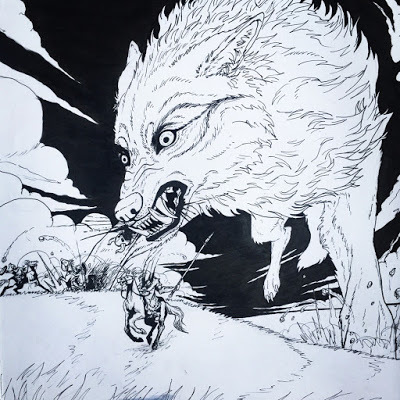
"A strange lull fell over the place of slaughter. Somewhere in the deep forest – Art later wondered if he imagined it – a wolf howled. The carrion-eaters were impatient for meat."
"A strange lull fell over the place of slaughter. Somewhere in the deep forest – Art later wondered if he imagined it – a wolf howled. The carrion-eaters were impatient for meat."

June 26, 2019
Galloglass
A poetic description of a galloglass warrior in Ireland, from Edmund Spenser's Faerie Queen:
"All armed in a coat of iron plate,
Of great defence to ward the deadly fear,
And on his head a steel cap did wear
Of colour rusty brown, but sure and strong;
And in his hand an huge pole-axe did bear,
With which to wont his fight, to justify his wrong."
Spenser, a colonial administrator in Ireland as well as a poet, knew the galloglass well. He was writing in the 16th century but his account could apply just as well to the galloglass of the medieval era.
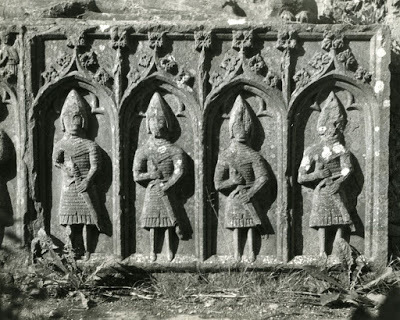
Their first certain appearance in Irish history is apparently in the Annals of Loch Cé for 1259, which records a band of eight score óglaigh (young warriors) as part of the escort of the daughter of Lord Dugall MacRory of Garmoran, Argyll, on the occasion of her wedding to Aodh O'Connor of Connacht. Attached is a pic of stone carvings of galloglass on a tomb at the Dominican Priory of St Mary in Roscommon.
"All armed in a coat of iron plate,
Of great defence to ward the deadly fear,
And on his head a steel cap did wear
Of colour rusty brown, but sure and strong;
And in his hand an huge pole-axe did bear,
With which to wont his fight, to justify his wrong."
Spenser, a colonial administrator in Ireland as well as a poet, knew the galloglass well. He was writing in the 16th century but his account could apply just as well to the galloglass of the medieval era.
Their first certain appearance in Irish history is apparently in the Annals of Loch Cé for 1259, which records a band of eight score óglaigh (young warriors) as part of the escort of the daughter of Lord Dugall MacRory of Garmoran, Argyll, on the occasion of her wedding to Aodh O'Connor of Connacht. Attached is a pic of stone carvings of galloglass on a tomb at the Dominican Priory of St Mary in Roscommon.

The White Hawk! The White Hawk!
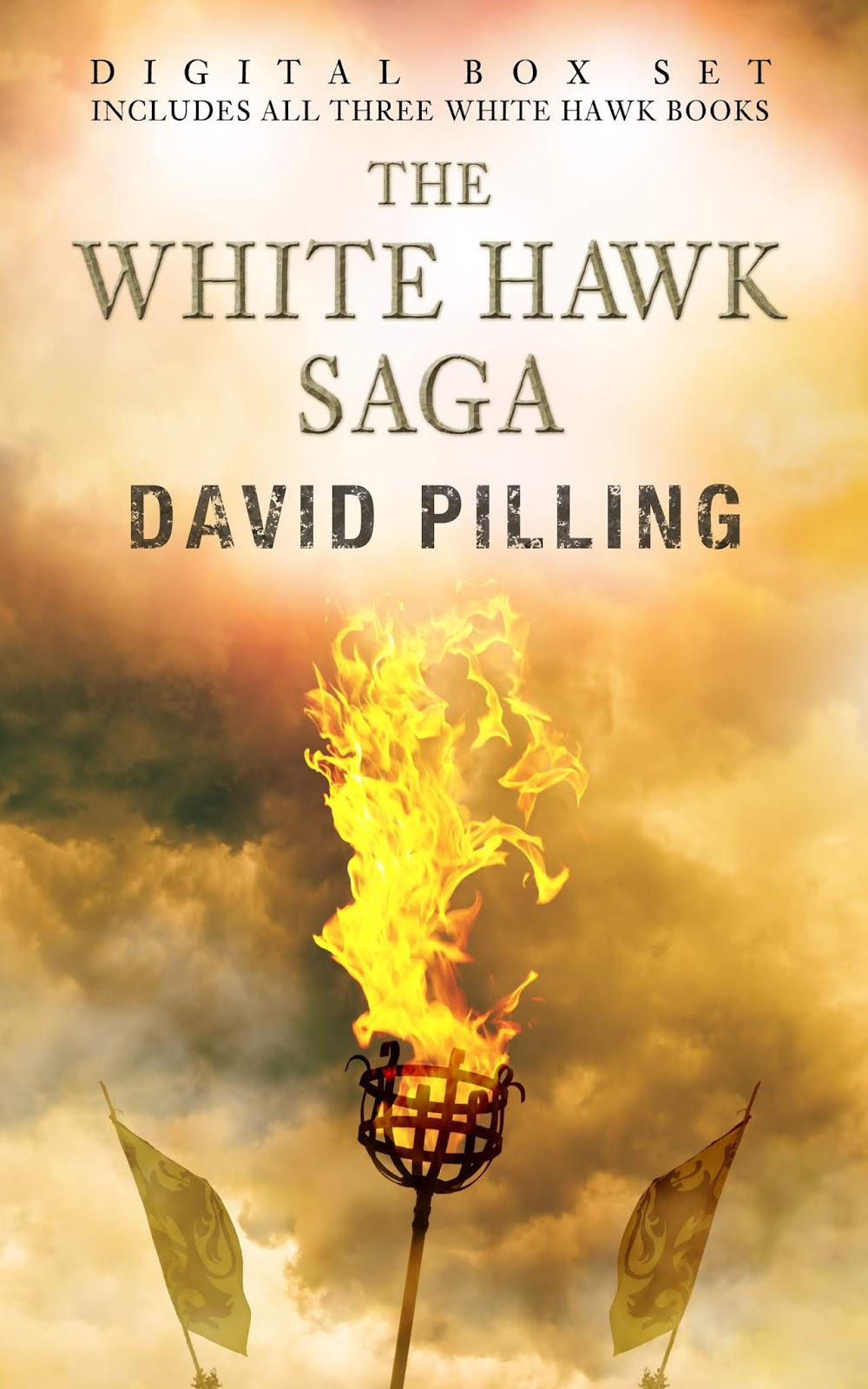
The White Hawk Saga is now available as a box set on Kindle! Don your armour, grab your sword, try not to trip over your lance and for God's sake remember which badge to wear - it's going to get messy.
 "England, 1459.
Following her final defeat in The Hundred Years War, England has plunged into the bloody chaos of civil war. King Henry VI, the feeble son of the victor of Agincourt, is unable to prevent the rival houses of Lancaster and York from tearing each other to pieces. Included in The White Hawk Saga are all three novels from the series:
Revenge
Loyalty
Sacrifice
This epic tale follows the fortunes of a family of Lancastrian loyalists, the Boltons, as they attempt to survive and prosper in this world of brutal warfare and shifting alliances. From the pitiless massacre of Blore Heath to the blood-soaked hell of Towton, they must fight like wild beasts to protect their lands and their king. More than 200,000 words of action-packed historical fiction, ideal for fans of Bernard Cornwell, Conn Iggulden, David Gemmell and Simon Scarrow."
The White Hawk on Amazon US
The White Hawk on Amazon UK
 "England, 1459.
Following her final defeat in The Hundred Years War, England has plunged into the bloody chaos of civil war. King Henry VI, the feeble son of the victor of Agincourt, is unable to prevent the rival houses of Lancaster and York from tearing each other to pieces. Included in The White Hawk Saga are all three novels from the series:
Revenge
Loyalty
Sacrifice
This epic tale follows the fortunes of a family of Lancastrian loyalists, the Boltons, as they attempt to survive and prosper in this world of brutal warfare and shifting alliances. From the pitiless massacre of Blore Heath to the blood-soaked hell of Towton, they must fight like wild beasts to protect their lands and their king. More than 200,000 words of action-packed historical fiction, ideal for fans of Bernard Cornwell, Conn Iggulden, David Gemmell and Simon Scarrow."
The White Hawk on Amazon US
The White Hawk on Amazon UK
A gentle romance
Extract from the new WIP (that's Work in Progress, hem hem). And it's all kicking off in Ireland in 1275.
"The noise and the confusion was enough to drive a man mad. Screaming horses, shouts and orders and curses and whimpers of pain, clattering blades, the swirl of pipes and blast of horns. Wounded and crippled men lay in pools of blood and dung and piss. Others tried to crawl to safety, dragging shattered limbs or spouting blood from gory stumps. An English squire, still a boy, his nose hanging from a strip of skin, stood over his weeping master and fought off all comers with a broken spear. A galloglass knocked him down and plunged his axe into the squire's chest, shattering every rib in his body. A dying horse rolled in its guts, limbs flailing, its piercing shrieks horrible to hear. Two galloglass squabbled over the boots of a dead knight, then fell on each other with daggers drawn, teeth bared, spitting curses. One killed his rival with a stab to the eye and stole his purse. He was still counting out the handful of copper pennies when an English mace crushed his skull from behind..."
"The noise and the confusion was enough to drive a man mad. Screaming horses, shouts and orders and curses and whimpers of pain, clattering blades, the swirl of pipes and blast of horns. Wounded and crippled men lay in pools of blood and dung and piss. Others tried to crawl to safety, dragging shattered limbs or spouting blood from gory stumps. An English squire, still a boy, his nose hanging from a strip of skin, stood over his weeping master and fought off all comers with a broken spear. A galloglass knocked him down and plunged his axe into the squire's chest, shattering every rib in his body. A dying horse rolled in its guts, limbs flailing, its piercing shrieks horrible to hear. Two galloglass squabbled over the boots of a dead knight, then fell on each other with daggers drawn, teeth bared, spitting curses. One killed his rival with a stab to the eye and stole his purse. He was still counting out the handful of copper pennies when an English mace crushed his skull from behind..."
Patrick of the droppings
The arms of Patrick IV de Dunbar, Earl of March, a Scottish nobleman.

Patrick was an important magnate in Scotland and one of the Competitors for the crown of Scotland after the death of Alexander III. He was one of those who sent an appeal to Edward I, called the Appeals of the Seven Earls, asking for the English king’s help against Bishop Fraser and John Comyn, both of whom were Guardians. The earls claimed they had the right to make the king, and to place him on the throne. Meanwhile John Balliol was already describing himself as heir to the Scottish kingdom and making some interesting promises of land worth 500 marks to Antony Bek, Bishop of Durham and Edward’s right-hand man.
Like so many Scottish nobles, Patrick also held lands in England, which made him eligible to do military service for King Edward. In 1294 he was called up to serve in Gascony. As earl of Dunbar and March, he swore fealty to the king at Wark in 1296. He appears to have been opposed by his wife, who took the Scottish side and held the castle of Dunbar against the English. Prior to the battle of Falkirk, it was spies in the service of Patrick and his colleague, the pro-English earl of Angus, who discovered Wallace’s army when Edward was on the point of falling back to Edinburgh for supplies. At the battle itself Patrick fought in the Bishop of Durham’s bataille.
To have any hope of controlling Scotland, Edward needed men like Patrick. Possibly there was no love lost. In 1304 the king accused Patrick of cowardice and negligence in the face of the enemy, and compared him to a pile of wolf droppings.

Patrick was an important magnate in Scotland and one of the Competitors for the crown of Scotland after the death of Alexander III. He was one of those who sent an appeal to Edward I, called the Appeals of the Seven Earls, asking for the English king’s help against Bishop Fraser and John Comyn, both of whom were Guardians. The earls claimed they had the right to make the king, and to place him on the throne. Meanwhile John Balliol was already describing himself as heir to the Scottish kingdom and making some interesting promises of land worth 500 marks to Antony Bek, Bishop of Durham and Edward’s right-hand man.
Like so many Scottish nobles, Patrick also held lands in England, which made him eligible to do military service for King Edward. In 1294 he was called up to serve in Gascony. As earl of Dunbar and March, he swore fealty to the king at Wark in 1296. He appears to have been opposed by his wife, who took the Scottish side and held the castle of Dunbar against the English. Prior to the battle of Falkirk, it was spies in the service of Patrick and his colleague, the pro-English earl of Angus, who discovered Wallace’s army when Edward was on the point of falling back to Edinburgh for supplies. At the battle itself Patrick fought in the Bishop of Durham’s bataille.
To have any hope of controlling Scotland, Edward needed men like Patrick. Possibly there was no love lost. In 1304 the king accused Patrick of cowardice and negligence in the face of the enemy, and compared him to a pile of wolf droppings.
June 25, 2019
Daddy got drunk
I'm cut off from my internet sources today - damned Internet Archive is offline - so here is a quote from Fiona Watson on the Falkirk campaign:
"The army he [Edward I] mustered in the early summer of 1298 was immense by medieval standards, numbering some 3000 horsemen and over 25,000 footsoldiers. This was a testament to how miraculously the previous year's troubles had evaporated in the aftermath of Stirling Bridge and Edward's tacit acknowledgement - through the reissuing of Magna Carta - that he had treated his people badly. The king was absolutely determined to make 1298 a much better year than 1297."
Short of being hit in the face by a comet, it is difficult to see how 1298 could have gone much worse for Edward than the previous year. The defeats of his armies at Bellegarde and Stirling Bridge, the fiasco of the Flanders campaign, the domestic chaos in England, all combined to make 1297 one massive anus horribilus for the English king.
Edward seems to have finally cracked at the wedding of his daughter, Elizabeth of Rhuddlan, where the king got rotten drunk and threw Elizabeth's coronet into the fire. For good measure he also beat the crap out of a defenceless squire with a stick: possibly in a fit of hungover guilt, Edward later paid the boy the hefty compensation of £13 8 shillings and 6 pence.
"The army he [Edward I] mustered in the early summer of 1298 was immense by medieval standards, numbering some 3000 horsemen and over 25,000 footsoldiers. This was a testament to how miraculously the previous year's troubles had evaporated in the aftermath of Stirling Bridge and Edward's tacit acknowledgement - through the reissuing of Magna Carta - that he had treated his people badly. The king was absolutely determined to make 1298 a much better year than 1297."
Short of being hit in the face by a comet, it is difficult to see how 1298 could have gone much worse for Edward than the previous year. The defeats of his armies at Bellegarde and Stirling Bridge, the fiasco of the Flanders campaign, the domestic chaos in England, all combined to make 1297 one massive anus horribilus for the English king.
Edward seems to have finally cracked at the wedding of his daughter, Elizabeth of Rhuddlan, where the king got rotten drunk and threw Elizabeth's coronet into the fire. For good measure he also beat the crap out of a defenceless squire with a stick: possibly in a fit of hungover guilt, Edward later paid the boy the hefty compensation of £13 8 shillings and 6 pence.
June 24, 2019
Loving and courteous language
An oddly neglected Close Roll entry from 17 May 1297. This is a lengthy instruction from Edward I to his commissioners of array in Wales, detailing how they are to go about raising Welsh troops for the king's war in Flanders.
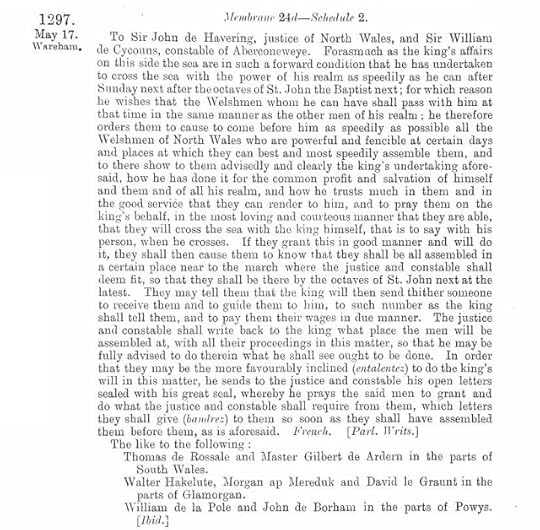
Interestingly, the language of the instruction is couched in terms of a request. The king's officers are to lay his arguments for war before the leaders of Welsh communities, and persuade them that the war is to the 'common profit' of the realm. The officers are to mind their language and persuade the Welsh with 'the most loving and courteous manner that they are able'.
From a Welsh perspective, the only 'common profit' of a war in Flanders was the prospect of wages and plunder. So much is admitted in the instruction, whereby Edward offers to pay wages in advance. To further sweeten the deal, open letters sealed with the great seal are to be carried into Wales and shown to the Welsh as proof of the king's good faith.
The offer of money did the trick: in August John de Havering, justice of North Wales, reported that the North Welsh were coming into the muster 'of good will'. The same positive response was repeated elsewhere. In effect, the Welsh chose to fight in Flanders and get the king out of a tight spot, since he could raise very few men in England. The entry is thus another example of the ambiguous conditions in postconquest Wales.
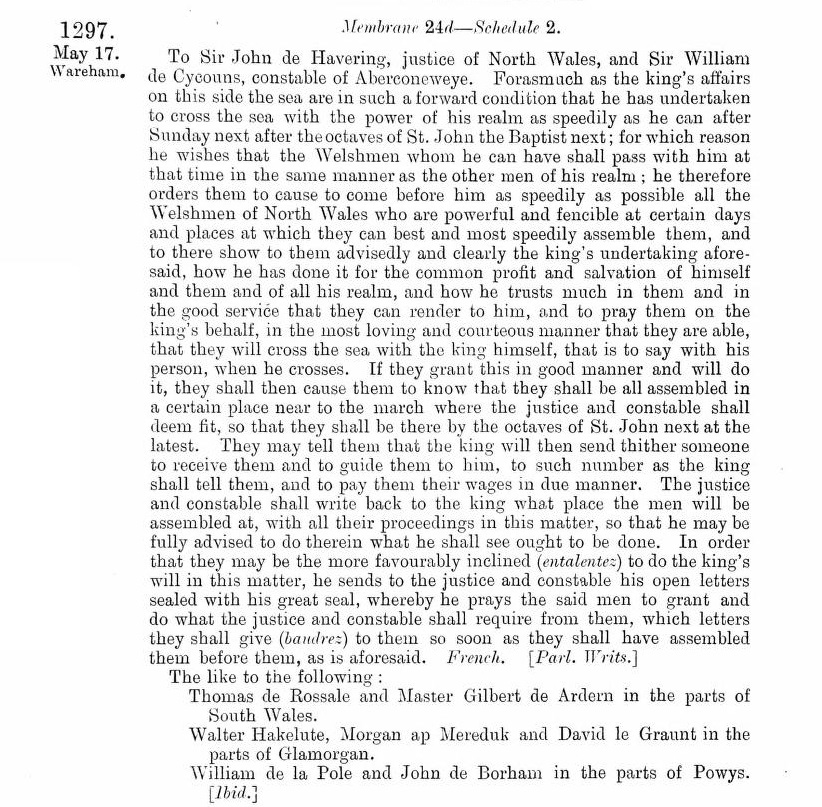
Interestingly, the language of the instruction is couched in terms of a request. The king's officers are to lay his arguments for war before the leaders of Welsh communities, and persuade them that the war is to the 'common profit' of the realm. The officers are to mind their language and persuade the Welsh with 'the most loving and courteous manner that they are able'.
From a Welsh perspective, the only 'common profit' of a war in Flanders was the prospect of wages and plunder. So much is admitted in the instruction, whereby Edward offers to pay wages in advance. To further sweeten the deal, open letters sealed with the great seal are to be carried into Wales and shown to the Welsh as proof of the king's good faith.
The offer of money did the trick: in August John de Havering, justice of North Wales, reported that the North Welsh were coming into the muster 'of good will'. The same positive response was repeated elsewhere. In effect, the Welsh chose to fight in Flanders and get the king out of a tight spot, since he could raise very few men in England. The entry is thus another example of the ambiguous conditions in postconquest Wales.
Of bastard he was none
The arms of Sir John Botetourt, 1st Baron Botetourt and lord of Mendlesham. John was once thought to have been a bastard son of Edward I, a myth that remained popular until quite recently: he appears as the king’s ‘massively tall and sombre-eyed bastard’ in Nigel Tranter’s series of novels on Robert de Bruce.
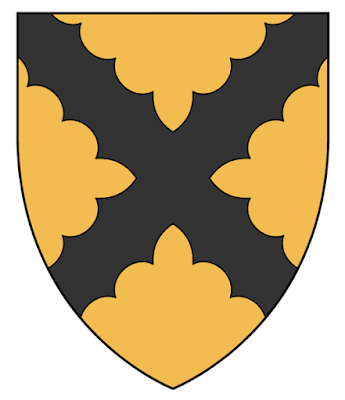
Whether or not he was a massively tall sombre-eyed bastard, John was no son of Edward I. The mistake stems from his inclusion in a genealogical table in a Hailes Abbey chronicle, where his name is scribbled over an erasure. No explanation is given for John’s appearance on the table, and his alleged bastardy is not explicitly stated in the chronicle or anywhere else. He was in fact the son of a Norfolk knight, Guy de Botetourt.
John began in royal service as a falconer and rose to the status of banneret. In 1295, as admiral of the Yarmouth fleet, he burnt and plundered the town of Cherbourg on the coast of Normandy, as well as the abbey. He did the usual exhausting round of military service required of so many English knights in the latter part of the reign. In the summer of 1295 he led a relief force to Gascony, where he was wounded in action, apparently while defending two Franciscan monks from the French. John also served in Scotland, where in 1298 he fought in the king’s bataille at Falkirk.
Like many of Edward I’s veterans, John reacted with horror to the doings of the old king’s successor. He loathed the royal favourite, Piers Gaveston, and helped the Earl of Warwick to carry off Piers from the protective custody of the Earl of Pembroke. John made his peace with Edward II in 1313, but later went back into rebellion under Thomas of Lancaster. He fought on the losing side at Boroughbridge, and for some reason was excluded from the stiff round of executions that followed. He was pardoned on 8 October 1322 and died in 1324, leaving a grandson to succeed him.

Whether or not he was a massively tall sombre-eyed bastard, John was no son of Edward I. The mistake stems from his inclusion in a genealogical table in a Hailes Abbey chronicle, where his name is scribbled over an erasure. No explanation is given for John’s appearance on the table, and his alleged bastardy is not explicitly stated in the chronicle or anywhere else. He was in fact the son of a Norfolk knight, Guy de Botetourt.
John began in royal service as a falconer and rose to the status of banneret. In 1295, as admiral of the Yarmouth fleet, he burnt and plundered the town of Cherbourg on the coast of Normandy, as well as the abbey. He did the usual exhausting round of military service required of so many English knights in the latter part of the reign. In the summer of 1295 he led a relief force to Gascony, where he was wounded in action, apparently while defending two Franciscan monks from the French. John also served in Scotland, where in 1298 he fought in the king’s bataille at Falkirk.
Like many of Edward I’s veterans, John reacted with horror to the doings of the old king’s successor. He loathed the royal favourite, Piers Gaveston, and helped the Earl of Warwick to carry off Piers from the protective custody of the Earl of Pembroke. John made his peace with Edward II in 1313, but later went back into rebellion under Thomas of Lancaster. He fought on the losing side at Boroughbridge, and for some reason was excluded from the stiff round of executions that followed. He was pardoned on 8 October 1322 and died in 1324, leaving a grandson to succeed him.
Box set!
Check me out and my sexy Kindle box set. This is a repackage of The White Hawk, a three-part family saga set during the Wars of the Roses. Further information and release date to be announced!