David Pilling's Blog, page 23
May 10, 2021
The eagle of Savoy
 In January 1246 Henry III of England obtained the homage of Count Amadeus of Savoy for the castle of Susa and other fiefs either side of the Alps, covering the approaches to the Great St Bernard Pass. This was in exchange for a lump sum and an annual pension. The county of Savoy was a state of the Holy Roman Empire, stretching south of Lake Geneva to the Western Alps.
The Plantagenet hold over Savoy was strengthened by Henry's alliance with Peter II, 'the Little Charlemagne', who held the Honour of Richmond in Yorkshire and was Count of Savoy from 1263-68. He was the founder of the Savoy Palace in London.
In 1256 Henry's brother, Richard of Cornwall, was elected King of Germany. Despite paying a lot of money for it, the title never held much significance. However, Richard did exercise power by granting several towns near Bern and Fribourg to Count Peter.
This transaction sowed the seeds of a later conflict. When Peter died in 1268 his only surviving child was a daughter, Béatrice. His lack of a male heir meant the towns granted by Richard of Cornwall should have reverted to the empire. Peter's brother and successor, Philip, refused to give them up.
Richard's successor as emperor, Rudolph of Hapsburg, was a very different character. Unlike his absentee predecessor, Rudolph was very much involved in German politics, and determined to claw back lost rights and territories. These included the lands granted away to the counts of Savoy.
Things started to heat up a little. In 1273 Count Philip did homage to the new king of England, Edward I, for the fiefs that had originally been secured by Henry III. These included the four chief castles in Savoy, which meant Philip was now Edward's vassal. A picture of one of these castles, Bard (reconstructed as fortified complex in the 19th century) is shown above.
This no mere token submission. From Philip's perspective, it made sense to acquire the king of England as a buffer against the empire. For Edward, the renewal of feudal ties with Savoy gave his dynasty some useful leverage in a distant part of Europe. It also gave him access to talented Savoyard diplomats and engineers such as Othon Grandson and Master James of St George.
Relations between the emperor, Rudolph, and Count Philip steadily plunged from cool to freezing. In May 1278, their quarrel exploded into open warfare.


May 7, 2021
The price of a horse
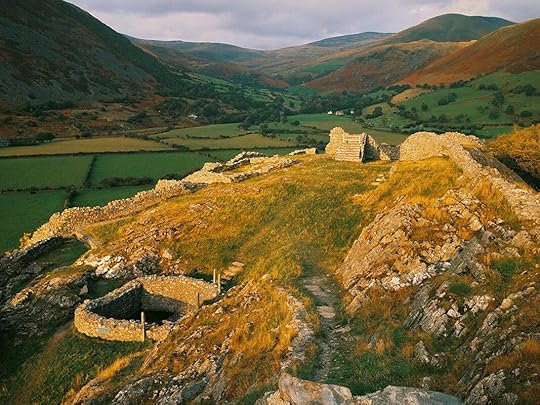 Hywel ap Rhys Gryg was a grandson of the Lord Rhys of Deheubarth and uncle to Rhys ap Maredudd, the last prince of the ancient House of Dinefwr. A relatively minor player, his career was defined by the intolerable pressures that led to the downfall of the native princes of Wales.
Almost everything we know about Hywel dates from the period 1276-83. Before this he is known to have sworn homage to Prince Llywelyn ap Gruffudd in 1258, and his name appears on a handful of records issued by Llywelyn's chancery at Bangor. Up until 1278, he appears to have been unquestioningly loyal to Llywelyn. In contrast, his nephew Rhys ap Maredudd was a lifelong enemy of the rulers of Gwynedd.
When war broke out between Edward I and Llywelyn in 1276, Hywel and his kinsman Llywelyn ap Rhys were the only lords of the west to resist the king. Together they abandoned Carreg Cennen and fled north to join Prince Llywelyn in the mountains of Snowdonia.
Sometime in 1278, after Prince Llywelyn had submitted to Edward, Hywel was taken back into the king's peace. He had lobbied the chancellor, Robert Burnell, to have his lands back. This was also granted. On 21 July he was at Llywelyn's court at Aberconwy, witnessing a document. Therefore he was still loyal to Llywelyn at this point.
Shortly afterwards his relationship with the prince broke down. Prince Llywelyn sent a plea to the king, in which Hywel is described as a 'traitor to him' because he had refused to pay homage. Edward responded that nothing could be done without the consent of Hywel's nephew, Rhys ap Maredudd. Instead the king confined himself to ordering the release of one of Hywel's men, imprisoned at Cardigan.
In short, the king regarded this an internal affair. The princes could wash their own dirty laundry. There is no further record of Hywel until 10 July 1280, two years later, in which he is described as a 'fugitive and outlaw' living in the wilds of 'Landarak' in west Wales. On that day the king re-granted Hywel's lands to one Richard de la Motte, who held them for the service of one barded horse in time of war. In effect, his lands had been forfeited for the price of a horse.
For some unexplained reason Hywel had ended up landless and destitute, living as a hunted outlaw in the woods. Since the king had washed his hands of the affair, Hywel must have owed his dreadful fate to either Prince Llywelyn or Rhys ap Maredudd. Since Llywelyn had no authority outside Gwynedd after 1277, it can only have been Rhys who disinherited his uncle.
Hywel vanishes for another three years. Despite being accused of treason, he worked his way back into the confidence of the rulers of Gwynedd. He did so just in time to take part in the final catastrophe. On 2 May 1283, at Llanberis in North Wales, Prince Dafydd ap Gruffudd issued one of his final charters. Hywel was among the witnesses. A few days later King Edward's forces burst into Gwynedd and the princely court disintegrated. Dafydd and his followers fled in all directions.
Hywel appears one last time. On 2 April 1284 Philip ap Hywel ap Meurig, a crown royalist, delivered a group of prisoners to be incarcerated at Castell y Bere inside Meirionydd. The only named captive was Hywel ap Rhys Gryg. He and his fellows were taken into custody at Bere and probably died there.
May 5, 2021
The sound of grinding axes
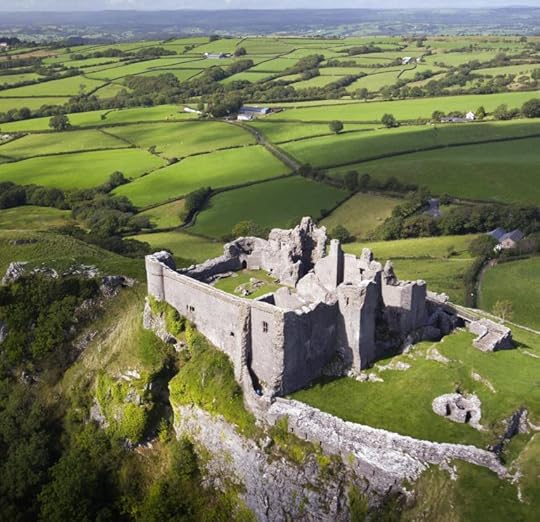 My new book on Edward I and Wales is crawling towards completion. No release date yet, but the final round of edits is now with the publishers.
I have tried to approach the subject from a neutral perspective: I am not an apologist, a revisionist, a nationalist or a fantasist, and have no axes to grind, secrets to hide or agendas to push. I am mainly interested in power politics and how people react in high-pressure situations.
As an example, the stakes didn't get much higher than in West Wales in 1277. Twenty years earlier, the lords of the west had united under Prince Llywelyn ap Gruffudd and smashed an English army at Cymerau. This unity did not last. When war broke out again in 1277, the next generation failed to put up the same kind of resistance.
There were many reasons for this. Rhys ap Maredudd, the most powerful of the western lords, inherited an old grudge against Prince Llywelyn. As a youth, Rhys had been held hostage at Criccieth Castle in North Wales as surety for the good behaviour of his father Maredudd. The rivalry between the houses of Gwynedd and Dinefwr went back generations, and Llywelyn could not heal the breach. Rather than accept the authority of Gwynedd, Rhys offered his allegiance to King Edward.
The surrender of Rhys, on 4 April 1277, signalled the collapse of local resistance. Edward had promised Rhys the castle of Dinefwr if he could conquer it from his cousin, Rhys Wyndod. To save himself, Rhys Wyndod offered his surrender five days later. Immediately afterwards his brother, Llywelyn ap Rhys, and uncle Hywel ap Rhys Gryg, abandoned Carreg Cennen and fled north to join Prince Llywelyn inside Gwynedd.
Further ructions followed. Sometime in 1277-8 Prince Llywelyn complained to the king that Llywelyn ap Rhys and Hywel ap Rhys Gryg 'stood as traitors to him because they did not do homage to him'. This petition was sent to Edward at Rhuddlan and probably dates to the summer of 1277.
Thus, it appears that the two fugitives fled to join Llywelyn, only to refuse to pay homage to him. In response Llywelyn branded them traitors and asked Edward for redress. Not for the first or last time, internal politics had undermined the political resolve of the Welsh princes.
May 1, 2021
Absolute peace
 On 26 September 1256, at Dax in Gascony, a peace treaty was sealed between two warring barons. These were Raymond-Guillaume V, viscount of Soule, and Guillaume-Arnaud, lord of Tardets. The agreement, described as a treaty 'of absolute peace', was undertaken in the presence of the Lord Edward. Among other clauses, it was stipulated that the viscount promised to send several of his knights on pilgrimage to the Holy Land, to compensate for slaying the lord of Tardet's men. If they did not wish to go, Guilluame promised to drive them out of his land.
This edgy truce was the result of Raymond's awkward status as viscount of Soule. He owed homage to the kings of England and Navarre, and clearly preferred the latter. A few years previously he had attempted to defect to the Navarrese, only to be whipped back into line by Simon de Montfort. After Simon's dismissal as seneschal of Gascony, Henry III had granted the title of Duke of Aquitaine to his heir, Edward. Not content to be a mere figurehead, Edward set about stamping his authority on the rebellious lords of the duchy.
In an effort to control Raymond, Edward placed a garrison inside Soule and appointed Guillaume as watchdog. His job was to ensure Raymond behaved himself and planned no further treachery. Perhaps inevitably, tensions between the two rival lords boiled over into violence. Edward was forced to step in again and force them to make peace.
The young duke soon decided that Raymond's position was untenable. He had twice raised arms against the English crown, broken his homage, and intrigued with the king of Navarre. Besides which, the viscounty of Soule was in an important strategic position. Raymond's castle of Mauléon controlled the route to and from Navarre, and well-placed to guard against invasion. For all these reasons, Edward decided the time had come to destroy the independence of Soule.
On 24 August 1257, Edward engaged another Gascon lord, Garcie-Arnaud, lord of Navailles, to conquer the viscounty of Soule and the castle of Mauléon. Shortly afterwards Garcie and the seneschal of Gascony, Stephen Longespée, invaded Soule and stormed the castles of Beloscare and Ároue. Raymond was killed in arms, defending his land, so the defence of Soule passed to his widow, Marquese, and their sons.
April 28, 2021
Tales of the old castle
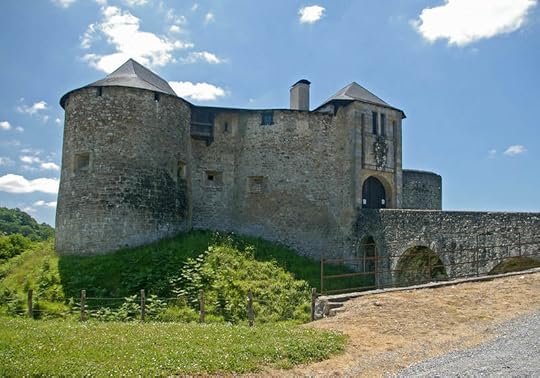 The castle of Mauléon, known as vieux château or 'old castle', stands inside the Pyrénées-Atlantiques département of southwest France. It originated in the 11th century as a rough motte-and-bailey erected on a hill; a wooden tower flanked by a farmyard, guarded by a moat and timber palisade.
Mauléon was built to guard the viscounty of Soule, first established in 1023 by Sancho VI, Duke of Gascony. The castle lay in a strategic location that guarded the mountain passes from the marches of Aquitaine to the Iberian peninsula. It worked as an access point from Aquitaine in the North to the kingdoms south of the Pyrenees, especially the kingdom of Navarre.
In the mid-thirteenth century the little viscounty of Soule was at the heart of a series of wars between England and Navarre. The descendents of Duke Sancho held onto their land by paying homage to both crowns; an awkward arrangement that relied on the viscounts clinging to a policy of strict neutrality. When they started to dabble in politics, disaster ensued.
Things started to unravel in the time of Raymond-Guillaume V, who became viscount in 1238. When the king of Navarre started to threaten English Gascony, Raymond was one of several lords of the south who chose to support the Navarrese. In the wars that followed, the English ceded territory but eventually managed to crush the revolt inside Gascony. After visiting the duchy in person, Henry III appointed Simon de Montfort, earl of Leicester, as his seneschal or viceroy. When the king went home, Simon's task was to clear up the mess and force the rebel lords to renew their allegiance to the English crown.
In 1252 Raymond failed to attend the summons, and as a result was arrested and forced to pay a ransom of 2000 livres. His castle of Mauléon was taken by storm and held by Simon's men until the ransom was extracted from Raymond's tenants. Three years later Raymond was partially rehabilitated when the Lord Edward, Henry's heir, took him into royal service. However, he was clearly distrusted. The viscounty of Soule was still occupied by Earl Simon's men, whom Edward did not remove. Instead he gave command of them to another lord, Guillaume-Arnaud, with orders to guard the land of Soule from any injury or insult from the viscount.
In short, Raymond was a marked man. He had his freedom, but strictly on parole, with armed men on hand to whip him into line if he made trouble. Soon enough, there would be trouble a-plenty.
April 26, 2021
Death of kings
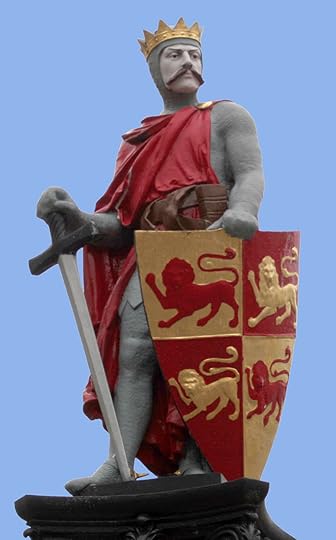 In 1194 Llywelyn ab Iorwerth, known to later generations as Llywelyn the Great, defeated his uncles Rhodri and Dafydd in a series of pitched battles. He did so in alliance with his cousins, Gruffudd and Maredudd ap Cynan, who are more or less forgotten. This is no accident, since the memory of these battles is largely preserved in the poetry of Llywelyn's bards, Cynddelw and Prydydd y Moch. These men were hired to sing the praises of their employer and downplay everyone else.
The third and final action was fought at Coedana (Coedaneu) on the Isle of Mon/Anglesey. Almost nothing is known of the fighting except a single line in one of Cynddelw's works;
“Cad anhawdd y coed aneu...”
(Battle was hard in the Aneu wood)
The lack of evidence may suggest this was not a full-scale encounter, but the results are clear enough. Llywelyn and his allies were completely victorious, while the defeated Rhodri and Dafydd were forced back to their remaining strongholds. Rhodri, the 'Dragon of Mon' died the next year at Holyhead, perhaps of wounds received in the conflict.
Dafydd, self-styled King of North Wales, clung on for another three years. He still retained three castles – Denbigh, Rhuddlan and Basingwerk – and for a time at least was propped up by the English government. In 1195, after striking a truce with the French, Richard I made an effort to strengthen his neglected defences on the Welsh March. In Shropshire the Lestranges refortified Carreghofa castle, while in the north the bishop of Bangor placed a small garrison of twelve horse sergeants in Denbigh castle for forty days. This was meant to aid Dafydd, who was now under extreme pressure.
He managed to hold out until 1198, when Llywelyn launched another assault and finally expelled Dafydd from Gwynedd. A curious fragment of the Aberconwy chronicles records that Dafydd was captured and murdered by his nephew:
“Llywelyn ab Iorwerth Dryndwyn strangled and killed his prince, Dafydd ab Owain, at Aber, and thus he raised himself over the principality of all North Wales...”
However, this gruesome tradition can only be traced back to the fifteenth century. The contemporary Welsh annals merely state that Dafydd was driven into exile in England, where he died:
“In that year Llywelyn ab Iorwerth expelled Dafydd ab Owain from Gwynedd, and he died in England.”
Thus perished Dafydd ab Owain Gwynedd, the last native Welsh ruler to officially call himself a king. After the premature death of his allies, Llywelyn ab Iorwerth would seize power in North Wales and adopt the title of prince or 'princeps', though he never claimed to be Prince of Wales. We probably should not make too much of this: the general modern assumption is that a prince is lesser in status to a king, but that was not necessarily the perspective of the medieval Welsh.
April 24, 2021
The oak door of Aberffraw
 THE OAK DOOR OF ABERFFRAW
In spring 1283 the armies of Edward I stormed into Gwynedd. This was the final drama of a very long war: for two hundred years, the princes of Gwynedd had attempted to forge a united Wales, in the teeth of resistance from the English crown. They almost succeeded, until Prince Llywelyn ap Gruffudd came up against Edward I, nicknamed 'Longshanks'. In the early part of his career Llywelyn exploited a civil war in England to gain control of much of Wales. He crowned his success in 1267 at the Treaty of Montgomery, whereby Edward's father Henry III acknowledged Llywelyn as Prince of Wales.
There was a sting in the tail. In exchange for recognition, Llywelyn had to agree to swear homage to the English crown. This was a formal ritual whereby Llywelyn knelt before Henry, placed his hands between the king's and swore to be his 'man' in perpetuity.
After Henry's death in 1272, Llywelyn was required to swear the oath to the new king, Edward. Despite being summoned on five separate occasions, the prince refused to do so. The result was a tense stand-off, which in the summer of 1276 degenerated into open warfare. After a year-long campaign, in which Edward made efficient use of superior resources, Llywelyn offered his surrender at Aberconwy in November 1277. He was then obliged to accompany the king to London to swear the delayed homage.
Edward was content to let Llywelyn keep his title, though his power was much reduced. An uneasy peace followed, in which the people of Wales were badly treated by the English administration. At last, on Palm Sunday 1282, Llywelyn's younger brother Prince Dafydd attacked the royal castles of Flint and Rhuddlan. The revolt quickly spread across Wales, until Edward had a full-scale insurrection to deal with.
The war that followed was much more desperately fought than the previous conflict. Llywelyn enjoyed support from the other Welsh rulers, and his supporters defeated English forces at Llandeilo Fawr and Moel-y-Don on the Menai strait. Yet Edward was determined to have victory. In late 1282 Llywelyn was killed in an ambush in mid-Wales, and command of the Welsh forces passed to Dafydd.
English reinforcements poured into North Wales. One of the last actions was fought at the dramatic mountain stronghold of Castell y Bere inside Meirionydd. Here, in April 1283, Dafydd's men were besieged by a royal army drawn from west Wales and the Marches. After a short resistance, the defenders accepted a bribe of £80 in silver to surrender the castle. In a fine example of administrative penny-pinching, they only received £56 of the promised amount.
Among the defenders was Gruffydd ap Yr Ynad Coch, a Welsh bard who composed a magnificent elegy for the slaughtered prince, Llywelyn. Gruffudd may well have produced his masterpiece while trapped inside the walls of Bere, surrounded by hostile forces. A translated section of the poem reads:
“Heart cold in the breast with terror, grieving
For a king, oak door, of Aberffraw,
Of Llywelyn
I grieve for a prince, hawk free of reproach,
I grieve for the ill that befell him,
I grieve for the loss, I grieve for the lot,
I grieve to hear how he was wounded...
Mine, rage at the Saxon who robbed me,
Mine, before death, the need to lament,
Mine, with good reason, to rave against God,
Who has left me without him...”
January 7, 2021
Rise and fall (and rise and fall again...)
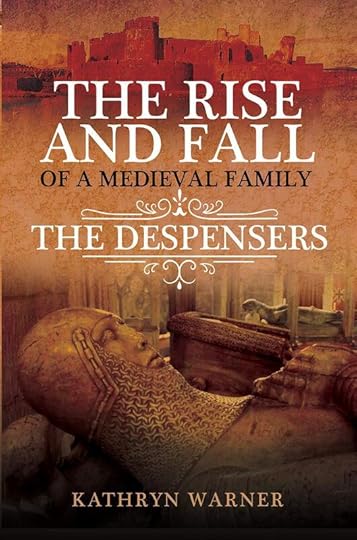 As the title suggests, Kathryn Warner's latest book is a history of the Despensers, a remarkable medieval family who rose and fell (and rose and fell again) over the course of two hundred years. In common with other noble families of the period, they showed a spectacular lack of imagination when it came to naming male heirs. Just as the Montforts produced so many Simons and Amaurys, the Despensers churned out a bewildering array of Hughs, Thomases and Edwards. For the purpose of this review I have enumerated the two main Hughs as Hugh (1) and Hugh (2).
The narrative begins with the slaughter of Evesham in August 1265, where Hugh (1)'s father – named Hugh, unsurprisingly – was butchered on the field along with Simon de Montfort and many others. If Henry III had possessed the same bloodthirsty tendencies as the later Plantagenet and Tudor kings, the tale might have ended right here. Fortunately, he took pity on Hugh's widow Aline, and in the following decades the Despensers were able to reconstruct their fortunes.
This was largely down to the efforts of Hugh (1). Only a child at the time of Evesham, he made himself useful in the latter reign of Edward I as a soldier and diplomat. As a result plenty of rewards came his way – disproving the notion that Edward was mean with patronage – and he became wealthy and respected. Sadly, Hugh (1)'s talents were offset by a vicious streak. Even by the standards of medieval nobles, he was violent and grasping, and abused his position to prey on his neighbours. Warner cites several examples of men forced into exile so Hugh (1) could steal their lands, or locked up on false charges until they agreed to surrender their inheritance. In the context of the time, there was nothing particularly unusual about this behaviour; however, the Despensers took it to dangerous extremes.
Things got much worse under Edward II. When the rivalry between Hugh (1) and the king's cousin Thomas of Lancaster ended in the defeat and execution of the latter, the Despensers rose to dizzying heights. Hugh (2), the most notorious member of the family, appears to have exploited Edward's vulnerability and even had a sexual relationship with him. Unlike the king's earlier relationship with Piers Gaveston, where mutual affection was involved, this was most likely a means of control. So long as they retained Edward's favour, the Despensers could do what they liked. After 1321 they embarked on a reign of terror, in which they plundered the landed class of England. Instead of restraining his favourites, Edward not only permitted but connived in the wholesale robbery of his own subjects. When an invasion of England was launched by Edward's estranged consort, Isabella of France, and her ally Roger Mortimer, the English refused to fight for their king. Whatever his more amiable qualities, Edward had forfeited the loyalty of his people.
It is an unpleasant tale, and leaves a bad taste in the mouth. Warner rightly points out that Edward's enemies in England were no better, and that the rebellious Marchers plundered and ransacked their way across England. The revolt of the Marchers, given the events of the previous reign, is a fascinating subject in itself and worthy of further study. The role of the Mortimers of Wigmore in particular should be highlighted: in 1282 they conspired to destroy Prince Llywelyn of Wales, and in the next generation made a determined effort to seize power in England. Personally I suspect their revolt had been brewing for a long time: the misrule of Edward II and the Despensers simply handed them an opportunity.
The two Hughs, father and son, had made themselves pariahs. This is shown by the brutality of their downfall. Hugh (1) was hanged, chopped up and fed to dogs. His son was executed with almost delirious cruelty. Yet, once again, the Despensers weathered the storm. Just like their rivals, the Mortimers, they were able to revive under the patronage of Edward III, who did not deal in revenge for its own sake. Hugh (2)'s son, nicknamed 'Huchon', distinguished himself in the French wars and eventually earned the king's respect. A grandson, Edward Despenser, was entrusted with delicate missions to Italy and enjoyed a high reputation as soldier and diplomat. By the 1370s the family were completely rehabilitated, no mean feat in the circumstances.
Warner carries the story onto the reign of Richard II, which reads like a weird echo of Edward II. Once again the Despensers rode high in the favour of an unlucky and inept monarch, and once again paid for it. Just like Edward, Richard ended up riding haplessly around South Wales in the company of a Despenser. After the king's downfall, Thomas Despenser organised a conspiracy against the new monarch Henry IV. The so-called Epiphany Rising was a disaster, and ended in Thomas being lynched and beheaded by an angry mob. This sealed the fate of Richard II, now plain Richard of Bordeaux, who was quietly done away with.
Incredibly, the Despensers continued to endure. By now they were intermarried with other high-ranking families, notably the earls of Warwick, which enabled them to survive. The last section of the book is really the story of Despenser women, who at least could do no worse than the men. Thanks to marriage alliances with the Beauchamps and Ferrers (among other families, the web gets rather tangled), the Despenser bloodline was not extinguished. Indeed, it survives to this day, bubbling away in the veins of various gentlepersons.
This book is an invaluable resource of information on a prominent medieval family. Warner's research and attention to detail is meticulous, and the text is spiced with anecdotes from surviving letters and chronicles. On the debit side, I would have preferred more analysis and commentary at the expense of genealogy. Perhaps this is more an issue of personal taste, but I found the depth of detail regarding births, marriages and deaths unnecessary, and at times a distraction.
December 26, 2020
Crusaders and Revolutionaries
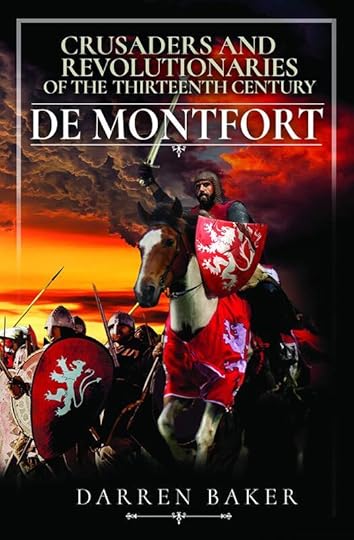 Darren Baker's latest book is a narrative history of the Montforts, one of the most famous noble families of the medieval era. It follows on from his previous works on Simon de Montfort and Henry III and their consorts, the two Eleanors.
 This is an ambitious work, and covers the history of the family from their origins in the eleventh century as mere wardens and foresters, to the height of their power in the thirteenth century. As with most high-status families in this period, the Montforts had an awkward habit of using the same names for generation after generation. There is a bewildering abundance of Simons, Amaurys, and Henrys, so to distinguish them Baker helpfully enumerates the leading lights: Simon III, Simon IV, Simon V, etc.
The origins of the family are obscure – one theory is they originally came from Hainault in modern-day Flanders – and information on the earlier generations relatively scarce. Even so, it is clear the Montforts were always a colourful bunch. One of the early lords, Amaury II, was nicknamed 'the Strong' (le Fort) and met his end impaled on a lance. His half-brother Richard was killed attempting to seize an abbey. From the start, the Montforts were haunted by violence and tragedy, usually the consequence of ambition.
Some of the early Montfort women outshone the men. I was especially taken with Bertrade de Montfort, only daughter of Simon I, who seduced the king of France and plotted to kill his son. When abduction failed, she turned to sorcery and poison; the latter method almost worked, and her target only survived thanks to a skilled Moorish doctor. Bertrade cannot be faulted for trying, but all her schemes failed and she ended her days in a convent.
While these chapters on the forebears are highly entertaining, the meat of the book is really the history of Simons V and VI. These are the alpha Montforts, the (in)famous father and son who left an indelible mark on history. Prior to reading this, I knew very little about the Albigensian crusade, except that it was remarkably unpleasant and that Simon V met a sticky end. Baker's narrative of the crusade makes for compulsive reading, though I would advise readers to study the maps at the start beforehand. I am reasonably familiar with some of the geography of Gascony and the Agenais in this period, but many of the locations were new to me. Unless one knows the ground, Simon's relentless marching and counter-marching is a bit of a blur.
That said, it is clear that Simon was a furiously committed and determined individual, capable of overcoming endless setbacks. It helped that he was one of the finest soldiers of his day, although he benefited from some mediocre opposition. His two chief rivals, Raymond of Toulouse and Peter of Aragon, constantly underestimated Simon and were firmly of the belief that God favours the big battalions. As Simon showed at Muret, where his much smaller army routed Peter's host in just twenty minutes, God tends to favour those who favour themselves.
With regard to Simon's persecution of heretics, I was left a little uncertain. At one point Baker states that Simon burnt innumerable Cathars or 'perfects', as they were known. Later on he argues the actual death-count may have been less than a thousand. He does, however, ably make the point that many of the perfects were all too eager to die: they regarded this world as filthy and corrupted, and there are many accounts of them refusing to recant to save their lives, or even leaping into the fire. There is also the general savagery of the crusade to consider. While Simon was as bigoted as the next medieval crusader, he is not known to have indulged in the same excesses of cruelty and torture as his peers. One particularly harrowing account of monks being strung up and tortured – with ropes, if you care to imagine – left me wincing for days.
Overall, I found Simon V an ambivalent figure, and have always felt the same way about his more famous son. Simon VI has benefited from a glowing press: contemporaries heaped praise upon him, while recent novels have promoted the image of Saint Simon the Just, the founder of Parliament and English democratic systems. Most popular heroes turn out to have feet of clay, and so it is with Simon. As Baker argued in his last work, The Two Eleanors, saintly Simon was anything but. The real man was just as grasping and self-seeking as his peers: or, as this book places in context, his ancestors. There are too many examples of Simon's mendacity to list here, but the standout example is his blatant attempt to sabotage the Treaty of Paris, all so he could force Henry III to satisfy an outstanding dower claim. Granted, the money was long overdue, but Simon's willingness to sacrifice the peace of two kingdoms for his own gain is unattractive.
Perhaps the heroic image is not entirely artificial. Simon appears to have had some kind of epiphany in 1259, when he started wearing a hair shirt and stopped sleeping with his wife. He also declared his wish to do right by the 'poor people' who lived on his lands, and admitted he had oppressed them in the past. In the modern age, any politician who came out with this stuff might expect to be laughed at. Whatever their beliefs and prejudices, the political classes of 1259 were no fools either. Richard de Clare, the hard-boiled earl of Gloucester, refused to buy into Simon's apparent conversion. Soon afterwards the two men almost got into a fistfight over outstanding land and dower rights claimed by Simon's wife. Unfortunately the two men were pulled apart; one decent punch, landed square on saint Simon's saintly jaw, might have restored a sense of perspective.
It is impossible to deny Simon was popular among the English, especially the commons. In July 1264, after his victory over Henry at Lewes, Simon issued a clarion call to the people of England to defend the coasts. So many peasants flocked to answer his summons that one chronicler remarked 'you would not have believed so many men ready for war existed in England'. Whatever his intentions, it appears Simon had triggered a new sense of national identity in England. Ironically, as Baker points out, he was not an Englishman.
The story of Simon V's fall from power and gruesome death at Evesham has been covered many times. The final drama is still compelling, and the author reminds us why the carnage at Evesham was so horrific. Simon's brief putsch had threatened to destroy both the Plantagenets and many of the landed class in England. At this point I turned back to an earlier section, which deserves to be highlighted in any future histories of this period. Back in 1212, a renegade group of English barons had elected Simon V as king of England. Had their revolt succeeded, King John and his sons would have been killed and the Plantagenet dynasty obliterated, to be replaced by the Montforts. They failed, but the Montfortian threat weighed heavy on John's heirs: not for nothing did Henry III once inform Simon that he feared him more than all the thunder and lightning in the world.
All of which explains the slaughter of Evesham, and what followed. Henry's heir, Edward I, was not a man to ignore such a clear and present danger. Especially when the Montforts kept reminding him of it: further civil war raged in England for years after Evesham, and in 1271 Simon's VI's sons butchered Edward's cousin Henry of Almaine in a church in Italy. When Amaury VIII and his sister, Eleanor, attempted to get into Wales to forge an alliance with Prince Llywelyn ap Gruffudd, Edward's reaction was swift. The two were captured at sea and Amaury held in prison for years, despite the pleas of English bishops and successive popes for his release. Amaury was finally released in 1282, shortly before the final Welsh war in which Edward crushed any hope of a Montfortian/Welsh alliance. Amaury's sister Eleanor died in childbirth, her husband was assassinated, and their daughter Gwenllian – Simon VI's granddaughter, lest we forget – cooped up for life in a remote Linconshire convent. The 'old seed of malice', as Edward termed it, was rooted out forever.
That was the end of Montfortian ambitions in England, though the legend of Simon VI lived on in popular memory. Elsewhere the family were no less unfortunate. Another branch of the Montforts flourished in the Holy Land for a while, as well as Sicily and the Italian mainland, but the family curse was inexorable. The Sicilian Vespers and consequent wars finished off the Montforts in Sicily, while their cousins in the Latin east went down with the crusader states.
It is not entirely a tale of woe. The family name was revived in the early fourteenth century through Yolande of Dreux, a descendant of Amaury VII. Her grandson, John de Montfort, would eventually win the war of succession in Brittany in 1365. Here was some comfort, but the duchy of Brittany was a far cry from the glory years of the Montfort clan, when they aspired to supreme power in England, Wales, France, Italy, Sicily and the Holy Land.
Overall, the Montforts might have done well to heed the advice of one of their own. In 1119, after King Louis of France had suffered a defeat in battle, Amaury III gave him this comfort:
“Fortune is like a revolving wheel; it overturns in a moment those whom it has suddenly raised, and on the other hand frequently lifts higher those it has prostrated and rolled in the dust.”
October 17, 2020
Herding cats
 In early November 1254 Henry III left Bordeaux and headed for Paris. Now Gascony had been reduced to order – or a semblance of it – he had pressing business elsewhere and left his heir, Edward, to deal with any remaining problems.
 Edward wasted no time in asserting himself. In a document drawn up at Bayonne, he had himself declared 'princeps et dominus' – prince and lord – in Gascony, signalling that he was no mere figurehead. Instead he meant to wield power in the duchy as if he ruled in his own right.
His first challenge was to deal with his new father-in-law, Alfonso X of Castile. Since Edward's marriage to Eleanor, the Castilian threat to Gascony had receded. However, Alfonso continued to intervene on behalf of his former allies in the duchy: these were Gascon lords who had broken their fealty to Henry and defected to Castile, before the English king landed in Gascony and whipped them to heel again. Alfonso had appointed Gaston de Béarn, that perpetual nuisance, to take the oaths of fealty from his Gascon allies.
Henry was aware of Alfonso's meddling, and left orders for the terms of the peace treaty to be confirmed without delay; this would deprive Alfonso of any cause for breaking it. Edward threw himself into this task: he multiplied his father's orders, pardoned certain of the Gascon rebels, restored land to others, commanded that the worst offenders be brought to justice.
His next task was to settle the notoriously fractious gentry. This was the most difficult job of all: it had proved completely beyond Simon de Montfort, whose hard-line attitude had only antagonised the Gascon nobility. This was, Simon reported in a letter to Henry, much like herding cats:
“...for they will do nothing but rob the land, and burn and plunder, and put the people to ransom, and ride by night like thieves by twenty or thirty or forty in different parts.”
Edward was required to deal with three major problems. Arnaud Odon, vicomte de Lomagne, was at feud with Géraud, comte d'Armagnac. Henry had summoned them twice to perform homage, but Arnaud had refused. There was also a dispute between Gaston de Béarn and Eschivat de Chabanais, while Arnaud-Guillaume of Gramont had refused to yield up his castle.
The prince dealt with each in turn. In October Géraud was induced to perform the delayed homage to Edward, who also brokered peace between the vicomte and his rival, Arnaud Odon. An enquiry was then set up to investigate their grievances. Shortly afterwards Edward intervened personally between Gaston and Eschivat, and persuaded them to accept his arbitration. The prince took more direct action against Arnaud-Guillaume, and laid siege to the castle at Gramont. However, this also ended in negotiation: Arnaud-Guillaume entered into peace talks with Gaston de Béarn, who persuaded him to surrender and accept the judgement of Edward's court.
Thus, in his first real test, Edward had deployed an effective combination of diplomacy and military action to smooth the feathers of the Gascon nobility. For a man usually perceived as a 'hammer', incapable of the diplomatic arts, he had shown a surprisingly delicate touch. Clichés, however, will always be with us (like that one).