Karen Brooks's Blog, page 7
October 21, 2013
Book Review: Elizabeth’s Women by Tracy Borman
This is a brave book. Brave because it dares to tackle one of the most popular subjects available to historians and try and breath new life or at least create a different context for understanding the remarkable, mercurial and difficult Elizabeth I, “Gloriana.”
The key to the book lies in the title – the ways in which female friendship, enemies and rivalry influenced Elizabeth’s personality, upbringing, loves, and ultimately her reign.
Commencing, as many histories of Elizabeth do, with her mother, Anne Boleyn, and father, Henry VIII’s relationship, Borman tries to explain how Elizabeth would have understood the mistakes and triumphs of  the significant women in her life, the manner in which they handled themselves, found a place in such a patriarchal society, and learned from that. Starting with Anne, who was executed when Elizabeth was so young, and examining how her mother would have been represented to and thus remembered by Elizabeth is apt. In her childhood and adolescence, Elizabeth’s fortunes were contingent on those of other women – from her mother’s rise in her father’s court, to the overturning of the Catholic Church before she was even born, to her execution. Henry’s marriage to Jane Seymour and the birth of the royal prince and heir Edward, the quiet and dignified withdrawal of Anne of Cleaves after her father Henry VIII rejected her, Katherine Howard’s flightiness and deadly flirtatiousness, to the independence quiet Catherine Parr achieved as a widow would have all helped to shape the person young Elizabeth was to become.
Then there were her governesses and Ladies of the Bedchamber – many who stood by Elizabeth during the fraught times when her older half-sister, Mary, reigned (and Elizabeth stood accused of plotting against the throne and worse) and again, when her brother Edward became king. These women, such as Blanche Parry, Kat Ashley and many more besides took care of Elizabeth’s emotional and psychological needs as much as her physical ones, performing the role of mother, sister and family among others. Variously wise and silly, they steered Elizabeth through and sometimes into dangerous waters, but she never forgot their loyalty and trusted many of them implicitly, rewarding them and their families when she came to power. These were her “real” friends, one senses from Borman’s words, in ways that many other women were not. In fact, historian Alison Weir (who praises Borman’s scholarliness), in her biography of Elizabeth argues that the Queen saw most women as “threat”. Borman’s book would counter that claim as well as support it – Elizabeth either adored or loathed you – and not just women either.
Understanding the subservient role demanded by her sex, Elizabeth nonetheless tried to find ways to exert her authority once she came to the throne – sometimes that involved demeaning her own sex or highlighting her masculine qualities such as she did in her famous speeches – at Tilbury and, at the end of her reign, to parliament. As Borman writes, “Sixteenth-century society was shaped by the Church, which taught the misogynistic lessons of St Paul. Women were the authors of original sin; instruments of the devil. Their only hope for salvation was to accept the natural inferiority to men…” This was not to be disputed but taken as a fact that underpinned contemporary attitudes, including those towards Elizabeth for whom it was thought only a husband could provide the necessary qualities to govern England. Elizabeth’s elevation to the throne was regarded as simply the first stage in gaining England a male ruler - this she would accomplish through an auspicious marriage which would later produce an heir.
The way Elizabeth staved off this compromising of her power is explored as well as some reasons for this proffered. Even the men who appreciated her intellect and cunning and were fiercely loyal to her such as William Cecil, Francis Walsingham and Robert Cecil, were also frustrated by her “weak” womanliness, her prevaricating, overt favouritism of certain men; what was regarded as the “problem” of her sex, and urged her to wed and resolve the accession issue.
It wasn’t only the men of Elizabeth’s council and court such as William Cecil (later, Lord Burghley), who believed that a male ruler was essential, there were even those who sought to use Elizabeth as leverage for their own climb to power and take her as a bride such as Thomas Seymour (a scandal that nearly destroyed a teen Elizabeth and has given source to countless fictive (and factual) speculations about what really went on between them) and, later, Robert Dudley (the same can be said for his relationship with her – something the infamous Leycester’s Commonwealth – published in 1584 - fuelled with its dreadful claims). For the first twenty years of her reign, Elizabeth appeared to taunt her Privy Council by considering very respectable offers (and some not so desirable) of marriage from foreign rulers (and even the local boy, Earl of Arran) before discarding them and remaining a spinster – the Virgin Queen, a title that, twenty years after she took the throne no-one dared dispute but instead, began to embrace. When it came to husbands, the error in judgement of other women around her (in this case, her sister “Bloody Mary” and her unhappy marriage to the despised Spanish and Catholic Philip and the problems that wrought for England as well as Mary Stuart’s poor choices of men), would have been apparent to her. Borman also speculates a fear of childbirth, though that’s to be understood in this period when mortality rates for mothers and infants were high.
Taking the reader through all the major stages of Elizabeth’s reign, focussing on politics, relationships, scandals, triumphs, dress and pageantry but explaining the importance of the latter to the maintenance of both a royal persona and a façade of control, Borman explores many of the queen’s intimate and not so close relationships, including the complex love/hate, friend/rival, threat/promise of Mary, Queen of Scots, Bess Hardwick, the Greys, the Knollys, making it clear that though Elizabeth was whip-smart and a politician par excellence, she was also capable of great loyalty, jealousy, pettiness and cruelty when it came to women – events surrounding her upbringing could not have her any other way.
What was also interesting in terms of modern concerns was Elizabeth’s paranoia around ageing and her attempts to conceal what’s a fact of life from her courtiers and foreign dignitaries – with the exception of the women of her chamber. Wigs, heavy make-up and a rigorous exercise regime were upheld almost to the last, even when small-mindedness and in-fighting was rife throughout the court in the last couple of years of Elizabeth’s rule. Determined to demonstrate her capabilities, Elizabeth appeared to understand that for a female particularly, appearances counted as much as performance (plus ca change!). While a woman was not to be trusted and was seen as inconvenient and incapable, an old woman was worse. In the end, age was a great foe that not even Elizabeth could defeat.
An interesting book that is very easy to read and highly accessible – even for those who do not know too much about Elizabeth’s reign – though a basic if not sound knowledge does enrich the book and allows the reader to critique some of the claims – which is always a fascinating exercise. It’s terrific to be offered challenges to “facts” and think about what might have been and different ways about what was. Thoroughly enjoyed this as a welcome addition to the Elizabeth canon.


Book Review: Mad About the Boy by Helen Fielding
This review is sponsored by Grammarly. I use Grammarly’s free plagiarism checker online because copying other people’s work is just plain wrong!
Discovering that there was a new Bridget Jones novel out was certainly a cause celeb for this reader; that was until I learned about the GBS – the Great Big Spoiler. Those of you who have read the book know what I am talking about – it was all over the media in the days leading up to and after the launch. Those of you who don’t know what I’m talking about, read no further please because I am about to reveal what has to be the worst kept secret in the literary world – that is, in this latest (and last, I assume – though Jones in her dotage might be hilarious – imagine Bridget in a nursing home?) book, fifty-one year old Bridget is a widow. Yep, that’s right folks, Mark Darcy, the human rights lawyer and man who swept singleton Bridget an d the rest of us off our feet is dead. Our Bridget Jones, 133lb (v.g), texting, sexting, tweeting (or twunking), alcohol-unit-recording diarist is a widow with two adorable children to raise all by her v. lonely self.
Reeling at first when this was revealed, I nonetheless wanted to know how BJ, or Mrs Darcy, was coping and what sort of a mother she’s turned out to be and what curlies life would throw at her this time. Most importantly, I wanted to know if she could possibly find love again after Darcy – a question, it turns out, that’s pretty much foremost in Bridget’s mind as well. That, her kids, weight, body, dating, dating websites, social media, school, school teachers, her screenplay (a modern retake on Henrik Ibsen’s Hedda Gabler which Bridget misspells Gabbler and believes is written by Anton Chekov) and the trials and tribulations of her constantly loyal friends, are all playing on Bridget’s mind, a mind that cannot help but dwell on her adored Darcy and how much she misses him….
So, when Bridget begins dating a much younger man, the handsome, smart and very funny Roxster, it looks like she’s slowly getting her act together again – but this is Bridget and it is very, very slow and never really accomplished. Being a “cougar” doesn’t sit quite right with her, and dating turns out to be more complicated than she first thought and, though people invent profiles on sites like OKCupid in the hope of luring or finding someone, there’s also a degree of façade-erecting going on in real life too and Bridget isn’t sure she can maintain it, especially as the demands from the film production company grow, her kids needs outweigh her own, and criticism of her lifestyle and choices start coming from all sorts of quarters.
Perhaps love is a once in a lifetime thing and middle-aged and ageing Bridget has had her quota? Will she be content being a single mum? Does she really need a man in her life when she has such marvellous friends? These are the kinds of questions, among others, the novel poses and, fortunately for this reader at least, I wanted to see answered. The good news is they are and in ways that are often predictable, but also delightful and unexpected.
I confess, after reading quite severe criticism of the book (often written by people who, learning of Darcy’s demise didn’t even read the novel but, for some reason, thought it was appropriate to rate in one star – puhleez! Or, in Bridget’s new and aggravating parlance, Gaah! What is it with that? Or by some reviewers who seemed to think that Fielding should have written something equivalent to the likes of Virginia Woolf’s literary creations or George Eliot’s and take her to task for not making Bridget more complex or confident without a man – this is BJ we’re talking about! I was so cross, I wrote a column about it), I didn’t have high expectations. But, there is a certain comfort returning to the life of a woman who, in many ways defined a specific “post-feminism” of the nineties, was a child of “Cosmopolitan culture” and coined terms like “Smug marrieds” and emotional F*$kwittage and “singletons.” I loved discovering how she had and hadn’t matured. And, while many of the tropes that appeared in the first two Bridget Jones’ books reappear here, there was a certain satisfaction in that as well. After all, didn’t we all, like Darcy, want Bridget “Just the way she (is)”? Yes, she’s older, but not necessarily any wiser, though she is a wonderful mother who loves her kids and whose heart has always been (and still is) in the right place.
Using Bridget as a vehicle, Fielding offers some scathing and very funny observations about motherhood, pretentious kids, helicopter parents, the mummy mafia, ageing, online dating, social media and plethora of other contemporary phenomena that are as frustrating and mind-numbing as they are fun to engage in and with.
Many of the old characters from the first novels reappear: Tom, Jude, Woney and her oblivious husband, and Daniel Cleaver (just to name a few) and there’s a certain pleasure in observing how they’ve turned out and what their take on life is twenty years on as well. New characters also appear and pepper the novel in light and not so light ways, hovering around and careening into Bridget in order to further her search – not so much for Mr Right – she’s had him, but for someone to share her life and responsibilities with, male and female.
This is the heart of the book – the fact that as human beings, we’re often most fulfilled by being with others – loving, caring, sharing and all that a relationship entails – the good bad and ugly. There are some very poignant moments in this novel and while I laughed and rolled my eyes (and sometimes not in a good way – the fartage stuff was a bit OTT after a while and the “Gaahs” drove me nuts), I also cried. Yes, I shed a tear over Bridget and her gorgeous kids as well as her thwarted dreams and her attempt to rebuild after having everything implode in such a horrid way.
Mad About the Boy doesn’t pretend to answer everything or aim to be regarded as some literary zeitgeist in the way BDJ’s Diary was (which was never intentioned but happened organically as people responded to Jones) nor is it a blueprint for middle-age, though some reviewers seem to talk about it this way – but it is a light and warm-hearted read. I felt like I was revisiting old friends, sort of like a school reunion but better. I don’t know if being the age Bridget is now helped, but it didn’t hurt either.
I have to add that one of my favourite parts of the book was a scene involving a near tragedy at the children’s school. Heroes are made that night and, one of the teachers, instead of calling for counselling and mollycoddling the kids (who are all fine) and parents, offers a different kind of comfort by acknowledging their resilience and capability in the event of an almost tragedy. He tells the shell-shocked parents and excited kids to go home and celebrate (not sook). I wanted to cheer when I read this and wish there could be more of it. In many ways, sadly, this was probably the greatest piece of fiction in the book – especially in a day an age where we’re so ready to lay claim to “victim” status and all the (negative) attention that entails.
Don’t be put off by the criticisms, judge Mad About the Boy and this chapter in Bridget’s life for yourselves – take what joy or pain you can from it. Like me, you might be very pleasantly surprised.
October 10, 2013
Book Review: Ember Island by Kimberley Freeman
Needing a great story to slip into and escape for a while, I was delighted to see that Kimberley Freeman’s latest, Ember Island had downloaded on my Kindle. Loving Freeman’s previous books, I couldn’t wait to snuggle down with this one. Cup of tea: check; cushions to rest against: check; silence and no interruptions: check. Big sigh of contentment… open book … And….
Immediately, I was transported to Ember Island, a fictional place in Brisbane’s Moreton Bay, and the struggles of internationally renown but reluctant writer, Nina, who, discovering her property on the island (once owned by her grandmother) has been damaged in a storm, arrives to oversee repairs. Only, the house isn’t the only thing needing fixing. Nina is nursing a wounded heart and suffering from terrible writers’ block and, as the story unfolds, readers learn she is burdened from carrying a guilty secret as well.
The story shifts gear back to the late 1800s and the life of orphaned Matilda Kirkland who, after her beloved grandfather dies, follows her new husband, Jasper, to Guernsey in the Channel Islands to take up life as a wife and all that entails. Only, when Tilly (as she is known) arrives, nothing is as it seems and her dream future with the dashing Jasper soon becomes a nightmare from which she must wake or perish.
Segueing between the two stories of two very different women, the connecting thread being Nina’s grandmother, Eleanor or Nell, and the diaries she has left of her childhood on Ember Island, the reader is immersed in their separate travails and quest to find both love and peace, a place to settle their restless souls, but without sacrificing their sense of self.
While Freeman segues between the narratives and times, she doesn’t compromise pace or plot and the reader is allowed the time to not only get to know the characters, but to enjoy the unfolding tale as well. At first, I confess, I found Nina a bit whiny, though I did appreciate the descriptions of the crippling doubt even a famous author experiences and her inability to shake these demons. Still, I also wanted to slap her and tell her to appreciate the success she clearly has had, the supportive people in her life and to just get on with it and stop complaining! It’s testimony to Freeman’s prose that I responded to Nina that way; she is a realised character and certainly, the further you get into the story the more you come to appreciate why Nina feels the way she does.
Tilly is both a product of her era and someone who struggles against the shackles of imposed gender roles and male authority but without sacrificing veracity. Sometimes, however, she is too easily seduced by those who don’t have her best intentions at heart; the lessons she learns from them and their actions are hard indeed. The younger characters in the book, especially precocious Nell, are endearing and wise beyond their years.
This is a romance, and while it features good men and bad, it also explores female friendship and the ties that bind and those that are severed and why. I really enjoyed the female relationships and the love and trust and betrayal that are explored within these.
Overall, this is a marvellous page-turner over which I lost sleep trying to get to the end because I simply HAD to know what happened. Though I saw a couple of the twists, there were one or two I did not, and they quite took my breath away!
Anyone looking for a great read, pick up Ember Island, slip into its pages and escape – though here’s a warning: you might not want to come back!
September 25, 2013
Book Review: Daily Life in Elizabethan England by Jeffrey L. SIngman

This is the second book I have read in this series and it certainly won’t be the last. Part of the “living history” movement, this volume seeks to really immerse the lay reader in and provide them with the basic tools for reimagining what it would have been like to live in Elizabethan times. As Singman writes in the introduction, “If history only touches the historians, it is truly a lifeless form of knowledge.” Hear. Hear.
Daily Life in Elizabethan England seeks to correct the notion that history might be lifeless by first creating a context for understanding the times (which were fraught with religious tensions, espionage, plots and amazing discoveries) and then describing the daily life of people from different classes and professions – from the highest to the lowest and back and forth. Focusing on such things as religion and religious practices, literacy, education, clothes (patterns for various garments are included), music (there are lyrics and some basic sheet music), entertainment (there are various card and board games as well as others described at the end in detail), including jousting, bear and cock-baiting and other sports, relationships, family, trades, Singman beautifully sets the Elizabethan scene. Allowing us to imagine wandering crowded streets, entering a crofter’s or gentleman’s house, travelling across the country or abroad, he endows with the rudimentary knowledge to make our way. Warning us of diseases like the plague (which struck England many times throughout this period), the “sweating sickness” and other ailments, and to be wary of pickpockets, cut-purses and highwaymen, he also urges us to enjoy the delights of the theatre because of course, this was the era of Shakespeare, Marlowe, Johnson and many other wonderful creative souls.
Reminiscent of Ian Mortimer’s The Time Traveller’s Guide series, this one functions as a compliment rather than replicating the information and I found it provided information Mortimer’s didn’t and vice-a-versa.
Written in an easily accessible and always fascinating style, this is a must-read for teachers or students of history, a fabulous reference for writers and a great read for those curious about a resplendent, violent, rapidly changing, and extraordinarily inventive milieu.
September 19, 2013
Book Review: The Queen’s Agent by John Cooper
This marvellous book, The Queen’s Agent, by John Cooper, while ostensibly a biography of one of the hardest working men in Elizabethan government, Sir Francis Walsingham, is also a tale about espionage and counter-espionage, war, religious conflict, suspicion, betrayal, stupidity and cleverness, during the reign of Elizabeth the First.
Coming to the throne amidst religious, international and other turmoil, Elizabeth, as a single woman, was perceived by many as an easy target for unscrupulous deals – at their peril, as it happened. But while Elizabeth presented a relatively calm face to various threats – real and imagined – as well as marriage proposals and grumblings from the Commons and the Privy Council, working furiously behind the scenes to ensure stability and the removal of any danger, was Walsingham, Lord Burghley and a host of secret agents. These were recruited and posted across England and Europe – most of whom Walsingham personally chose for the skills and connections they possessed and which he could use for the benefit of queen and country.
Cooper’s biography allows access to a man who is sometimes, in a dash of over enthusiasm as it turns out, credited as being the father of MI5 and MI6. Reading the book, however, doesn’t make it seem the exaggeration Cooper professes it to be, as Walsingham, with varying degrees of success, ran agents, double-agents, invented and broke ciphers, used invisible ink , colluded with adversaries, and was not above converting enemy spies – either through gentle but deadly coercion and bribes or torture.
A staunch Protestant, Walsingham was able to reconcile the brutality he sometimes resorted to with his beliefs as he saw Catholicism as a stain on the country and, indeed, the world, which must be wiped out at any cost.
Playing various roles throughout his career, we learn that while a young man he escaped England during Mary’s reign and resided briefly in Padua and then in Basel, both times being exposed and responding to the kind of Protestantism he later endorsed. A diplomat, he was multi-lingual, clever, extraordinarily hard-working and, as is often the way with people who are workaholics, prone to illness. But it’s as Elizabeth’s Secretary of State and “spymaster” that he’s probably best remembered.
That’s partly because there isn’t a great deal known about his personal life as papers that might have given us insight were destroyed and it’s to Cooper’s credit that in the telling of Walsingham’s career and professional relationships, we are given sense of the man. Upright, uptight and not always faultless, he was a conspiracy theorist par excellence – I couldn’t help but think that he and Fox Mulder or Carrie from Homeland would have got along famously J. Connected by family to other well-known names and personalities of the period, his one daughter, Frances, married first Philip Sidney and later, the charming but doomed Earl of Essex. He lived long enough to see that union made, but not, fortunately, the end it met.
Involved in many an effort to find a suitable husband for his liege, Walsingham was also behind efforts to dissuade her from less than popular matches – such as with the Duke of Anjou. What I didn’t know about was Walsingham’s keen involvement in England’s explorations of the New World, his interest in expanding west and establishing colonies there. An entire chapter is dedicated to the often futile attempts to establish colonies on what would become American soil and while Walsingham doesn’t feature strongly here, his mark is evident.
Working side by side with Lord Burghley (William Cecil), with whom he often disagreed with, Walsingham always tried to put his monarch and country first. Responsible for uncovering many treasonous plots against Elizabeth, including Mary, Queen of Scott’s collusion in the most well-known of all, the Babington plot, he fell in and out of favour with the Queen. Unlike his peer, Burghley, Walsingham did not garner riches for his diligence and determination to root out all popery and assassination attempts; to protect Britannia. On the contrary, when he died, he had little materially to leave his second and beloved wife, Ursula, as not only did he take on the debt of his dead son-in-law, Philip Sidney, but also he often used his own monies to ensure the flow of information and thus the knowledge network he built was maintained.
Preferring to dress in black, dour of face and loyal in faith, and to her majesty, though he often bemoaned her sex and the foibles and idiosyncratic behaviours he felt came with it, Walsingham cuts a mysterious figure.
Cooper, with all the revelations and wonderful information he provides, still maintains this sense of secrecy, adding a particular frisson to the book. I loved this about it – quotes from Walsingham’s letters and first hand reports about the Secretary of State conceal as much as they reveal and though Cooper offers analyses of the psychology of the man, he also allows our imaginations and interpretations room to manoeuvre.
Wonderfully written, Cooper conveys the period and the threats that were faced, all the while balancing them against the benefit of hindsight and another version of historical reality. Impeccably researched and eruditely presented, this book is a must for history buffs and those who love to know more about the machinations behind the throne of one of the most colourful monarchs in English history.
September 16, 2013
Book Review: The Life of Elizabeth I by Alison Weir
Having read Weir’s non-fiction, The Princes in the Tower, and thoroughly enjoyed it, I knew that this biography of Queen Elizabeth I would be worth investing in as well. It was much more than that. Impeccably researched and beautifully written, Weir’s work on arguably one of the most significant English historical figures is a tour de force. Commencing before Elizabeth’s birth in order to provide a familial, cultural, social and religious context for the monarch she was to become, Weir quickly establishes the fraught times into which the second daughter of Henry VIII was born.
The period leading up to Elizabeth’s ascension to the throne is well known: the decapitation of her mother, Anne Boleyn, for apparent treason when she was only three; her half-brother Edward VI becoming king at nine, dying at 15 and, in order to ensure England remain Protestant removing his sisters’, Catholic Mary and Protestant Elizabeth from the succession in favour of his cousin Lady Jane Grey; Lady Jane’s ousting in favour of Mary after only nine days; England plunging into religious schism as Catholicism was restored and heretics burned, suspicion of heresy and treason falling upon young Elizabeth, who living with Henry’s last wife, Katherine Parr had to endure the unwelcome (?) sexual attentions of her step-mother’s new husband Thomas Seymour, as well as having to hide her Protestant leanings from her older sister- and that’s just some of the events! Witness to so much turmoil, when Elizabeth finally took the throne at 25, in 1558, it’s no wonder that she took a more moderate line on religion, refusing ‘to open windows on men’s souls’ or that she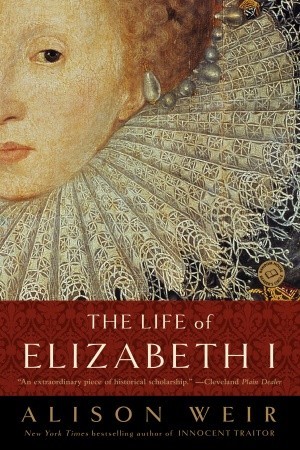 was reluctant to relinquish her unexpected but hard won autonomy and power to a husband.
After ‘Bloody Mary’s’ reign, Elizabeth was regarded by many as a saviour of the country, but her sex was always, even by those who respected her fierce intellect, ability with languages, and creativity (she was a gifted poet, musician and translator of the classics) struggled with her sex. Weir carefully explores the way Elizabeth kept both the Privy Council and the Commons dancing to her tune, enduring and appearing to consider their constant demand for her to find a husband and thus produce an heir while actually procrastinating continuously. Weir offers both psychological and practical reasons for Elizabeth’s ‘Virgin Queen’ status that are fascinating and plausible.
Virgin or not, ‘Gloriana’ enjoyed and encouraged the attentions of men and was a consummate flirt. Men were attracted to her power and, one imagines initially at least, her beauty. Robert Dudley, the Earl Of Leicester, his “stepson”, the Earl of Essex, Raleigh, Drake, foreign princes and dukes came into her orbit, but only a fortunate few were not destroyed by the encounter. Mercurial, demanding, vain, whip smart and with an enormous capacity to understand her people, proud, generous, haughty, Elizabeth was a handful. Prone to tears and tantrums, she also succumbed to flattery, particularly in her declining years.
Not all men fell for or pretended to yield for her charms (though none could deny her intelligence) and the queen, Weir makes clear, had a knack for surrounding herself with talented and loyal men such as William Cecil (Lord Burghley), his son, Robert, and Francis Walsingham. Women too, while not Elizabeth’s preferred company to keep, were among some of her closest and most beloved companions, such as Kat Ashby.
Earning the love of her people, the enmity of Catholic Europe, and the grudging admiration of her closest counselors, Elizabeth ruled England for decades, escaping assassination attempts, rebellions and Catholic uprisings, two papal bulls, never mind the Spanish Armada and countless attempts to marry her off. Weir not only gives us a fabulous portrait of the queen on the throne, but the woman beneath the white make-up, wigs and sumptuous gowns.
This is a marvellous biography that brings Elizabeth and the period to which she gave name to life. The problems – famine, greed, failed harvests, plague, disease, Catholicism – and the triumphs – the flourishing of the arts (theatre, writing, poetry, pamphlets, music, art) exploration, creativity, firmer establishment of the Protestant faith – with her unerring eye, gifted imagination and erudite mind. This is for lovers of history and those who enjoy a terrific read.
September 15, 2013
Book Review: Police by Jo Nesbo
This is such a hard book to review because even the smallest detail about the content – the way the story unfolds (which can be very persuasive in a review) – runs the risk of spoiling what is an absolute cracker of an addition to the Harry Hole canon. All I can say is that the narrative didn’t begin as I anticipated at all, even though it follows on from the events in the last book, The Leopard, and it’s this defying of expectations that sets the standard and pace for the rest of the tale. As Police opens, we’re back in Oslo, there are grisly murders a-plenty only, this time, the stakes are even higher as it’s members of the force that are being killed. Not only that, but their deaths are a brutal reenactment of cold cases – cases that the new victims were once assigned to solve. As the body count grows, so does the pressure and the fear – who will be next and why?
Never has the act of reading been so analogous to riding a roller coaster as you are lifted to great heights before being flung into complete, heart-stopping despair; there are twists and turns, false corners and such sharply angled ones, you sustain the equivalent of literary whiplash reading this book.
What is also evident from the moment the story starts, is that you’re in the hands of a master. There’s a sense in which, as gruesome as this bloody tale of revenge and thwarted intentions is, Nesbo is having fun with the reader… He is playing mind games with us and they damn well work. Persuading us into one way of thinking only to reveal another, Police, perhaps more than any other of the Hole books, allows us to identify with the investigation, gives us access to the minds and feelings of the frustrated investigators as we share their experiences, concerns and suspicions. Nesbo not only leads us up one garden path, that he has cobbled, bordered with plants, lit brightly or plunged into darkness, strewing it with characters we expect to find and those we do not, he then strands us in the middle of what we quickly understand isn’t a path, it’s a labyrinth. A psychological, emotional and physical one that familiar characters and new ones inhabit with varying degrees of comfort and control. There is never a dull moment in this tale, nor is there an opportunity to catch your breath. Not for the faint-hearted, this latest (and I hope not final as has been rumored) addition to the Hole series is simply brilliant.
September 12, 2013
Book Review: Longbourn by Jo Baker
I am ashamed to admit I hadn’t even heard of this book until I read a wonderful review of it on author Kate Forsyth’s blog. Being a lover of Jane Austen since I was very young, I was dazzled by the premise of this novel; in fact, I was awed by the imagination and ideas underpinning it – Baker has taken the story of Pride and Prejudice and created something completely original using the well-known tale of Elizabeth Bennett and Mr Darcy as a frame narrative but telling it from the point of view of the Bennett family’s servants.
Don’t for a minute believe this is Upstairs/Downstairs Austen-style. Longbourn is so much more than that. For a start, “upstairs” is only relevant in regard to the impact it has on “downstairs”, but that’s not to do this novel justice either. Richer, more complex, imbued with a period-appropriate sensibility that manages to gesture to larger things, to a wider world and the promise of more, it also imagines a milieu at once familiar and strange and all together believable.
While the cha racters we know and love from Pride make an appearance, Lizzie, Jane, Lydia, Kitty, Mary, Mr and Mrs Bennet, Mr Bingley, Mr Darcy and Mr Wickham along with many others, it is those we’re not so familiar with, the characters who were mere whispers in the hallways, shadows in the corners of the rooms, absences that nonetheless made meals appear, cleaned the house, did the laundry, emptied chamber pots, drove the coaches, prioritised the needs of the upstairs family over their own and, in one barely memorable exchange, we’re told fetched shoe roses, who are centre stage in this book.
In Longbourn (named after the village in which the Bennett house stands), we follow the daily life of housemaid Sarah, the much put-upon housekeeper and cook, Mrs Hill, her gap-toothed husband, young Polly (Mary) and, later, the footman James. Through mainly Sarah’s eyes we come to understand that life upstairs runs smoothly but only through the hard work and sacrifices, the constant scrutiny and awareness of those who suffer (without complaint) downstairs. But because they accept what life has meted out, how birth gifts or damns you with blood and social position and the possibility or not of rising above it, it doesn’t prevent them dreaming of different things, different outcomes for themselves and those they care about.
Assumptions about the servants and the indifference with which their needs and emotional wants are treated (or ignored) by the Bennetts and others who cross their sometimes chaotic threshold is subtly exposed. Lizzie Bennett, the woman many readers swooned over (almost as much as Mr Darcy) and cheered as an early champion of feminist principles and modern relationships is, in Longbourn, revealed to be as much as a myopic product of her class as any other gentlewoman of the period. Even Jane, who is generally thought to be considerate and kind, is unable to empathise with her servants – her gestures and questions revealing her ignorance – not wilful, but inevitable. That the Bennett girls, even giddy and selfish Lydia and Kitty, are never held to account by the servants who share their lives, that there’s no resentment, demonstrates an acceptance of circumstance and treatment a modern reader might find difficult to handle. Baker is masterful in her gentle peeling back of private layers to show how ingrained social practice and birth are in Austen-times and thus readers also come to accept that this is how it is and the story rolls on, across the hills and dales, through muddy fields and streets, the dark narrow lanes of town and in and out of the rooms of the Bennett house.
The love story of Mr Darcy and Lizzie takes a back seat in this tale as a slow-burning love affair unfolds downstairs, as complex personal histories, reasons for certain behaviours are hinted at and skeletons are spied in servants’ closets too. As the tale progresses and the Bennett girls move towards that which their mother wants more than anything for them, marriage that will elevate them socially, it’s below stairs that the action and poignant drama takes place – yearning looks, snatched conversations, overheard exchanges, caution thrown aside or bundled close.
What I particularly loved about Longbourn and the way in which Baker makes every scene and event in Pride and Prejudice match those in her book, is that she also bestows characters in Austen’s novel with a darkness and complexity that’s as unexpected as it is gripping. I won’t say anymore except that you will never think of Mr Bennett in quite the same way and as for Mr Wickham – well, if you thought him a bounder in Austen’s hands, in Baker’s he becomes something much worse.
Baker also takes us beyond the final pages of Pride and Prejudice and allows us a glimpse into Lizzie’s life as Mrs Darcy. It’s testimony to the power and beauty of Baker’s tale that this, while a nice curiousity, is very much rendered second place to the much more interesting and heartfelt outcome awaiting her main characters. I couldn’t credit that I was longing for Lizzie and Mr Darcy to vanish so I might know more of Baker’s creations and their dénouement.
Written in beautiful, evocative prose that like the barley sugars so beloved of Polly and Lydia, you want to hold it in your mouth so as to savour the sweetness, Longbourn recreates a time and place we thought we knew but are invited to revisit and see it through different eyes and understand its alternate hues.
As much as I adore Pride and Prejudice, Longbourn deserves champions as well and I am happy to be one. It gives voice to the silent, a presence to the shades that walked the halls of stately and not so stately homes; it allows the young men who sacrificed themselves for the politics and wars of others to stand up and be briefly counted, to be remembered for other than their officers’ gambling, partying and distractions. Not afraid to explore pain, desire, loss, grief and sacrifice, Baker also imbues the often bleak tale with humour, love, friendship and a deep compassion.
Simply stunning.
Book Review: Time Traveller’s Guide to Elizabethan England
Having read Ian Mortimer’s wonderful Time Traveller’s Guide to Medieval England, I sort of knew what to expect when I began reading The Time Traveller’s Guide to Elizabethan England and was so looking forward to immersing myself in Elizabethan times as if I was a tourist with an extremely knowledgeable, obliging and sympathetic tour guide for company. For this is the magic of Mortimer’s work – he places the contemporary reader in the landscape and culture of a bygone era, ensuring we’re rubbing shoulders with people of all classes, and talks us through what we’ll find both familiar and strange and in doing this brings the past to life.
Beautifully written, this wonderful book invites us into a time that we sort of know through literature and film but in many ways we do not. Mortimer is at pains to overturn or at least challenge many of th e shibboleths that accompany this period – such as those around cleanliness: personal and household. Of the brutality of the times, he doesn’t hold back, and descriptions of executions, fights, brawls and their victims litter the book in much the way severed heads did the Tower or London Bridge. Gird your stomach before reading.
A violent era where it really wasn’t safe to wander towns or cities at night and if you chose to move along the highways you should do so with guards, it was also a period where culture boomed – particularly music, poetry and theatre. Elizabeth, a proud, haughty queen who firmly established Protestantism as the faith of her land and had to cope with assassination plots, as well as disgruntles Catholics, foreign rulers, wars and Puritans, was also a great patron of the arts and it’s because of the context she created that it flourished.
While bear-baiting, cock-fighting and other amusements are, to the modern reader, an anathema and would have us calling the RSPCA, and taverns, ale-houses and other places you could get “cupshotten” (drunk) and often find a whore or two, dotted the landscape, especially of London, there were also places and spaces (such as the courtyards of inns and nobles’ establishments) where poetry and plays were performed much to the crowds’ delight.
The last chapter devoted to “entertainment” reminds us that it was during these times that William Shakespeare and Christopher Marlowe wrote their plays as well as Ben Johnson, Phillip Sidney and Edmund Spenser their gorgeous poesy (and more besides). Despite plague and petitions that sought to shut down the playhouses of Southwark and London, they grew in number and size, some entertaining around 2000 people a day each.
Popular entertainment also diverted the masses from the problems that beset them in this period such as famine, numerous outbreaks of plague and lack of work. Homelessness is not peculiar to the modern world and in Elizabethan times it exploded as more and more land was fenced to cater to sheep and the new market of wool and tenant farmers were ruthlessly thrown out without any regard for their welfare by greedy landholders. Laws were passed that made succouring or offering a roof to a vagrant illegal and so these destitute souls, who moved to the towns and cities seeking work, resorted to stealing just to feed themselves and their children and were more often caught and given a grim sentence. What the book tells us briefly, is that Poor Laws were later introduced that ensured villages and towns took responsibility for their homeless and thus the Poor House (which morphed into the notorious Workhouse) was born.
Mortimer doesn’t hold back when discussing the legal system in Elizabethan times, a system that required and had a great deal of policing at all levels but, as he also makes clear, not much justice. Brutal and quick or painful and slow were the most common forms of rough justice and those administering it were not above some torture too. The only way of avoiding it was by bribery and as corruption was rife, it might be the only way to save your skin.
Social hierarchy was strict and generally adhered to – from nobles, to gentry to the rising middle class and merchants to yeomen and peasants. Mortimer also points out that due to the invention of printing in the last century, literacy was on the rise and many people could read, even if it was just to be able to quote a passage from the Bible and thus claim “Benefit of the Clergy” if they were caught committing a crime! This reduced if not abolished the sentence.
Of course, if you want wealth, a rounded education and even the prospect of change this is still very much the time to be a man (preferably a noble or the gentry), women are still chattels and objects of exchange, despite Elizabeth being on the throne. Being a woman and reading this book makes you glad you’re time-travelling and not, as interesting as the era is, confined to it.
The book also discusses food, clothes, accommodation (the latter two, while improving over the course of Elizabeth’s reign often being flea and louse-ridden, again depending on class), bathing, washing, modes of address, the landscape, travel and manages to answer most questions about the era – even how women dealt with menstruating and both sexes with going to the toilet!
This was also a period of great discovery and travels, Sir Walter Raleigh and Sir Francis Drake being among the illustrious explorers and Mortimer tells some wonderful anecdotes about these men and others.
There’s a reason this period is called “Elizabethan” and that’s because the monarch cast her spell over the country in ways other kings did not. “Gloriana”, the “Virgin Queen”, Queen Elizabeth managed to rule Britannia with an iron fist, imposing her will and ways beyond mere religion. Her mercurial personality, low tolerance for fools, disloyalty and “popery” and her patronage of those she felt deserved it, served to confuse suitors, advisors and enemies alike and allowed her to maintain sole power for such a long and rich period.
A fabulous trip, Mortimer’s book is a great read for lovers of history, those curious about times gone by and, of course, for time-travellers. This is the literary person’s Tardis and I look forward to another journey with Dr Who – I mean, Mortimer – soon.
August 27, 2013
Book Review: The Devil’s Star by Jo Nesbo
The fifth book in the Harry Hole sequence, The Devil’s Star, is quite simply, a cracker. Fast-paced from beginning to end, it is brutal, unrelenting and always fascinating. I cannot put these Harry Hole books down and know when I pick one up, I am in for long nights and an emotional ride – The Devil’s Star was no different.
The novel commences in a steamy summer in Olso when a young woman’s body is found with a finger severed and a small ruby five-pointed star is secreted in her body. This being a Ne sbo novel, it’s inevitable that where there’s one body, others will follow. Soon there’s a trail of brutality and bloodshed that Harry and his team have to try and stop. But this novel isn’t only about bodies in apartments; it’s also about skeletons in closets and Harry’s private and professional life spiralling out of control. In trying to come to grips with the loss of fellow detective, Ellen Gjetlen (who met her death in the brilliant third book, Redbreast), something he feels responsible for, Harry spirals back into alcoholism and the reader recoils and gasps as he stumbles from flashes of brilliance and terrific work to dejection, loss of control and the demon drink. The way Nesbo portrays the thrall of alcoholism, the seductive and terrible allure of the bottle is unlike anything I’ve read before and you ache for Harry but also understand why he gives in to its power.
On top a difficult case, Harry also has to deal with the threat of his colleague, the charismatic and dangerous Tom Waller, whom he suspects of crimes far worse than those he’s encountering as they involve betrayal of the worst kind. Add to that that he’s about to be sacked from the force, and the plot becomes thicker than treacle and just as dark – you never see what’s coming. That’s the beauty of Nesbo’s books, you cannot second guess the story, or predict Harry’s actions.
Though tautly plotted, I found the motivation for the main crime less convincing than usual, and the final scene between Harry and the killer a tiny bit overplayed. Having said that, the enthralling cat and mouse game between Harry and his nemesis that begins the moment you open the book more than compensated for this. Brilliant, the rush towards the climax and how this particular storyline is resolved is breath-taking and utterly believable.
Nesbo would have to be among the finest writing in this style – the anti-hero hero who is more flawed than faultless, clever yet vulnerable and with a heart of gold. Harry is someone who is capable of fixing everyone else’s problems but not his own; who inspires love and often returns it only to discover his greatest love will always triumph and thus ensure his relationships are always doomed. The Norwegian setting (and others) is so beautifully drawn, it too becomes a beguiling yet seedy character to which you long to return, no matter what the reading cost – mostly sleepless nights and eagerness for the next book.
A fabulous addition to a terrific series.