Karen Brooks's Blog, page 11
February 24, 2013
Book Review: The Unquiet Bones by Melvin R Starr

What a wonderful surprise this tightly written, historically very accurate and beautifully paced book turned out to be. This novel, set in the 1300s, follows the career of Hugh of Singleton, the youngest son of a knight who, while at university, discovers his calling is surgery. Setting up practice in Oxford, he is soon lured to the small town of Bamford and into the service of local lord, who asks him to track down the killer of a young woman whose body is found in the castle privy.
Unwilling at first to become involved, but understanding he has little choice, Hugh not only learns more about medicine than he ever bargained, but how to track clues and the uncanny ways in which killer’s minds operate – all of which put him and others in danger. Added to this is the presence of his lord’s lovely but unattainable sister, the fair Joan, a class above him, or is she?
Starr writes sparsely but with wit and an accuracy that pays homage to the period but without ever sacrificing plot or story.
The tale reminded me of C.J Sanson’s Shardlake novels, but without the richness of the prose or world-building, but still with a wonderful tone. If you’re looking to dip your toes into the medieval period, enjoy a quick murder-mystery (albeit when life was slower and, seemingly, fuller and crueller), then this is perfect. I’m already halfway through his next Hugh the surgeon book and loving it as well.


Book Review: Henry IV by Ian Mortimer
When is a non-fiction book completely fabulous and unputdownable? Ironically, when it reads like a work of fiction. So it is with Ian Mortimer’s engaging and exciting biographical work on Henry Bolingbroke, The Fears of Henry IV: The Life of England’s Self-Made King who was a son of John of Gaunt, cousin to Richard II, and who was mostly known as a usurper and murderer. He’s also, it turns out, one of the most under-rated kings in British history.
Mortimer begins by informing the reader that good ol’ Will Shakespeare has a lot to answer for. The reason he states this is because contemporary impressions and understanding of Henry IV are mainly drawn from the bard’s portrait of the man across a few plays. As a consequence, the man and king we “know” is largely a distortion drawn not for historical purposes so much as political and dramatic ones. Stating his case, Mortimer sets about trying to set this inaccurate portrait straight.
While each of the chapters has as an epigraph a quote from Shakespeare, the content is rigorously researched using the few extant documents available from the period – many of which are financial records of Henry’s court, all of which leave a terrific and interesting trail (at one stage, Mortimer knows where Henry is because of the toilet paper – cloth –he’s ordered to be at his residence! He literally follows his leavings) for us to follow. He also draws upon French and other documents about the period, analysing their biases or possible inaccuracies in the process. Finally, he also uses contemporary historians, emphasising where they may have misread or misinterpreted a fact or hit the nail on the head. In other words, this is a thoroughly researched book that also contains fascinating appendices, an extensive bibliography and from which a few academic journal articles arose as well.
Commencing in Henry’s childhood and creating a context for his later antagonism with Richard, Mortimer describes the cousins’ early years and is at pains to point out their differences: Richard was quiet, aware of the throne he was to inherit, greatly coddled, not an intellectual and certainly not a fighter. By contrast, Henry, as the eldest son of John of Gaunt, was well educated, privileged, a fine warrior (he was one of the youngest nobles ever to enter a jousting ring – fourteen!), travelled a great deal and was a deeply pious man who believed in the Holy Trinity with a passion.
What may have started out as familiarity, bred through ties of kinship, later became contempt, possibly fuelled through frustration, jealousy, fear and loathing – on both parts. I’m simplifying something here that is complex and which Mortimer explains and explores with the finesse and erudition of a forensic psychologist, profiling with expertise these two very dissimilar men.
Mortimer is at pains to show how Richard’s fears, cruelty and insecurities bred a particular type of response, not simply among his courtiers, but from political allies and enemies, as well as the king himself, and how these also led to Henry becoming and acting a particular way. He doesn’t judge or condone, but he does unpack the diverse approaches of the two men, the way they interact with others and how they understand their roles as men, leaders, friends and sons.
It’s these differences, physical, emotional, spiritual and intellectual that set these men apart in every way and which lead to the huge schism that later divides England along the lines of Richard’s supporters and Henry’s.
Without going into too much detail for those who don’t know the story, Richard’s reign and Henry’s actions and reactions under it are explored – the battles, the pilgrimages, the attempt at crusades, the longing for public acknowledgement, the rewards, riches and punishments – all of which were delivered at the seeming changeable whim of an insecure and nasty king.
When, in 1399, Henry returns to England and takes the throne, it’s to a land confused about what’s happened, torn asunder by petty rivalries and jealousies and on the cusp of common – not rule – but legislature. It’s into this that Henry, a man never raised to be king, steps and takes the reigns of power. Wielding them as best he can it’s inevitable that he makes mistakes and earns the enmity of those who don’t seem to give him a chance. But, if there’s one thing Mortimer makes clear, it’s that Henry Bolingbroke, despite treachery, many, many assassination attempts, a treasury forever in gross debt, foreign countries plotting, scheming and changing sides, and a constant movement to dethrone him in other ways, survives.
While not remembered for performing any great deeds, nor leaving behind any churches or buildings of state (the only memorial to Henry IV is a statue on the east end of Battlefield Church at Shrewsbury), Mortimer proves that Henry was indeed a self-made king – someone who grew into the role and who did the best he could against formidable odds.
Tall, handsome, smart and deeply committed to his wives and children, Henry was a loyal man who nonetheless understood justice, even when it came at a high cost. Terribly ill from his late thirties on, he ruled against the odds in all sorts of ways. Reading his story, I felt like I was plunged into an action-adventure on minute, a political thriller the next, a romance with medical overtones after that. Marvellously told, rich and exciting, Mortimer is such a talent. He literally brings history and the people who made it to life on the page.
An outstanding book for those who love a good read, for the voracious history buff, and for anyone wanting to shed light on England’s past and thus present by looking at the lesser-known figures and their contributions – great and small, I cannot recommend it highly enough.
February 14, 2013
Book Review: The Wayward Apprentice by Jason Vail
Recommended to me by a good friend after I placed a social media call-out for books set in medieval times that I haven’t read (it’s becoming harder!), I purchased The Wayward Apprentice by Jason Vail, not really knowing what to expect. At 99 cents on Amazon, it’s beyond a bargain and, I have to say here (as both a writer and reader), that it astonishes me that bo oks can be sold so cheaply – especially when you consider the labour and love, the research and time that goes into the production never mind the fact that there are writers out there trying to make a living from this. I do become concerned that when something like a book is sold so cheaply, it isn’t really valued and consequently that impacts on the perception of all books, writers, publishers and, ultimately, the act of reading itself. The Wayward Apprentice is certainly worth valuing as a well-written tale and for the knowledge and history underpinning the story.
OK. Off my soapbox now and onto the review…
Part of a series featuring an injured knight, Stephen Attebrook, who takes on the role of Deputy Coroner in Ludlow, The Wayward Apprentice introduces us to the main character, the town he lives in and some of the colourful characters who inhabit the area. Called to investigate the death of a man found in a field and who it’s assumed was so drunk he stumbled into a puddle and drowned, it’s only later that Stephen discovers his initial misgivings about the manner of death may yet prove to be right. When, along with his clever friend, Gilbert (a former priest who now runs an inn with his wife), Stephen is asked to find an apprentice who has absconded before finishing his contract, he finds connections between the dead man and the missing youth.
The further Stephen examines both cases, the more trouble he finds himself in as dead bodies, attacks, distressed damsels and mayhem ensues.
A medieval who dunnit (and that, and that), it faithfully recreates the period but without being didactic or obvious in its detailing. The prose is stark but effortless and while the mystery isn’t complex, the characters, for all the brevity of the novel, are. There are shades of light and dark to the melancholy knight, Gilbert and his long-suffering wife as well as the apprentice and the other women who populate the novel. Faithful to the social and gender mores of the time, this book isn’t complex or confusing (as some mysteries are wont to be) but it doesn’t sacrifice a sense of reality either and as a consequence, is very entertaining.
If you like the Sister Frevisse mysteries, then you will like this too. I also have to add that I’d have been very happy to pay more for this book.
Book Review: The Watchers, by Stephen Alford
Sent The Watchers, A Secret History of the Reign of Elizabeth Ist, by the publishers, I really looked forward to reading what’s ostensibly a behind the scenes account of Queen Elizabeth I’s reign but from the point of view of the “watchers”: that is, reporters, listeners, spies – the men whose speciality was espionage. Elizabethan times, it turns out, are notorious for their extensive use of spies and networks, all of which were established to protect England and ensure the queen’s successful reign. As Alford writes in the introduction, while Elizabeth and her council worked hard to maintain “clever and persuasive projections of political stability, empire, self-confidence and national myth” there was, in fact, “a darker story… set against a Europe divided and oppressed by religious conflict, c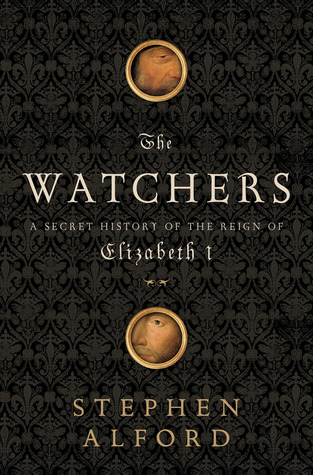 ivil war and the ambitions of kings and princes.”
Taking the crown after her half-sister “Bloody Mary” tried to purge the Protestant stain, and trying to stabilise an England divided by religious schism and rapidly changing succession, Elizabeth’s job was not easy. Declaring England as Protestant, but claiming that Catholicism would be tolerated, Elizabeth nonetheless was acutely aware of how precarious her position as ruler and religious head of a reeling nation was. Plots to declare her rule invalid, assassination attempts, never mind trying to overthrow Elizabeth and place Mary Queen of Scots on the throne abounded. Then there was the job of trying to find Elizabeth a suitable husband, all of which meant that though the kingdom flourished in terms of exploration, the humanities and arts, there was also a seething underbelly that threatened to erupt and destroy everything at any time. The greatest threat was that of the Catholics who, discontent with Elizabeth’s heretical leadership and perceiving it as ungodly, sought to rid themselves of Henry VIII’s daughter and restore the “true religion”. Working from within their homeland, their overseas networks were extensive, travelling across Europe and involving some of the most powerful people abroad as well.
The stage is thus set for espionage, betrayal, treason, propaganda, secrets, torture, faith, martyrdom and lies all of which Sir Francis Walsingham and his successors sought to control.
Carefully researched and very well-written, this book is an eye-opener that also makes the mind boggle. The lengths to which various individuals would go to inveigle themselves into (Catholic) families or communities in order to uncover plots and treasons were phenomenal. Conspirators were discovered frequently, many from noble families. The Throckmorton plot was one of the most famous and this is covered in detail throughout the book. Fascinating in its complexity and the degree of commitment and sacrifice believers were ready to make, uncovering it was to prove an even greater triumph.
The book goes onto explore the stories, derring-do, successes and failures of many spies and traitors, how far they were willing to go (disguise, denying their identities for long periods, sacrificing family and a “normal” life for little reward) and from these we also learn how disposed Walsingham and his men were to use torture to uncover secrets and plots and how brutal their interrogation methods were. Some of the spies, or intelligencers, were gentleman and even poets, others were criminals, but many were chameleons, able to shift, camouflage themselves and change with subtlety. There was William Parry, Thomas Phelippes, Gilbery Gifford, Chrales Sledd, Sir Robert Cecil, Burghley, simply to name a few (forgive my memory) – names both known and unknown to history buffs. Perhaps, for those names less familiar, it’s testimony to how well they performed their roles – they disappeared not simply into the woodwork, but became lost in the pages of history and time until Alford recovers them. Uncovering the plots and deeds of desperate men, these watchers brought many to trial and death and, in doing so, ensured Elizabeth’s long reign.
Utilising surviving records, Alford has done an amazing job and recreated in detail a tumultuous but fascinating period. Almost akin to a Renaissance version of Tinker, Tailor, Soldier, Spy, I found this book fascinating, challenging (to keep track of the different names and roles), but also a wonderful insight into what occurs behind the doors, under the tables and in the shadows and whispers of a colourful and deceptively confidant queen’s reign. Like an ice-berg, it was the seven-eights we didn’t see that ensured the topmost part remained afloat. Alford has given us access to that which we don’t normally witness and exposed the intricacy and deadly seriousness of spying in Elizabethan times.
A great read for history buffs, writers, anyone who loves tales of espionage and appreciates solid research delivered in an entertaining and engaging manner.
February 6, 2013
Book Review: The Emperor’s Tomb by Steve Berry
There’s no doubt that when Steve Berry decides to write a book set in a different country to his native one, he researches every last fact he can – from its people, politics, climate and geography, to its history. The Emperor’s Tomb is no different in that regard – the tomb referred to being the one containing the terracotta warriors associated with one of the ancient Chinese dynasties and, as it turns out, so much more as well.
 The story features Cotton Malone, former naval pilot and lawyer and member of the mysterious Magellan Billet who, two years earlier, retired to run a second bookstore in Copenhagen. Only, we rarely if ever get to see Malone in the store let alone reading as he’s always called upon to intervene in a global crisis – including in this novel.
When he’s sent a mysterious note with a web address and logs on to find his friend, the marvellously named and very beautiful Cassiopeia Vitt being tortured, he embarks on a whirlwind adventure that will take him to China and immerse him in a conspiracy that involves the Chinese government, the Russians and, of course, the United States as well. That his life is constantly at risk goes without question, but so is that of others, including a four year old boy.
On the brink of a new era, the current Chinese government is due for a change of leadership and there are two men currently vying for the role: one is a ruthless Legalist who will stop at nothing, destroying whatever and whoever stands in his way to achieve power. The other follows a different ideology and eschews violence as a solution unless it’s absolutely necessary, only he lacks the knowledge and support to be a serious contender.
With the Russians, Americans and the powerful Ba sect, a group of eunuchs who seem omniscient, pulling the strings and operating behind the scenes, saying one thing, promising and doing another, violence seems to be the only recourse for everyone. Enter Cotton Malone – not afraid to be the knight errant or even enter communist countries illegally if it means he will save the world. And, of course, violence is his middle name.
But Malone hadn’t counted on Chinese ingenuity, their ability to twist the truth or the past; nor can he rely on those he once believed could be trusted. And so the stage is set for a showdown of epic proportions, one that can change the balance not only in China, but the world.
For all that I can appreciate the research Berry does, and the travel he engages with and his passion to include a great deal of what he learns in his stories to give them authenticity, I feel this novel overdoes it. The plot was quite convoluted and the characters very two-dimensional, stereotypical and predictable. Further, the level of didacticism in this book took away from the story and slowed the pace to a crawl at some points. There were even repetitive bits – for example, on how one is made a eunuch. It was wince-worthy enough the first time (as well as interesting) but reading the details twice smacked of error and poor editing and diluted the effect. Likewise, a number of interesting facts about China were also repeated, rendering them redundant the second time around.
While the biotic and abiotic oil issue was fascinating, again, the plot had so many levels and unnecessary twists and turns, it became more like a labyrinth and I needed Ariadne’s thread to find my way out again.
Overall, however, it was a quick read – a bit of adventure brain candy and, hey, it featured Cotton Malone, a literary chick’s version of the stuff. So, in many ways, it served its purpose but I don’t think it’s as good as some of Berry’s other books.
February 3, 2013
Book Review: Watching the Dark by Peter Robinson
I have read quite a few Inspector Banks novels by Peter Robinson and though I’ve read them out of order (Which is fine to do) I’ve grown very fond of the ethical, gruff and clever DCI Banks and have read enough to be both rewarded and frustrated by where he’s at professionally and personally now – as I’m sure Robinson intends.
Watching the Dark is the twentieth book in the Banks series and in this novel we find the intrepid inspector investigating the murder of a convalescing peer, DI Bill Quinn, a man recently widowed and who, for some reason, never quite recovered from not being able to solve a case from six years ago about a young English woman who went missing in Estonia. When Quinn is found dead with a crossbow in his chest, and compromising photos are found in his room, Professional Standards in the form of the lovely Joanna Passero arrives to partner an irascible Banks on the case.
Not long after Passero is assigned, another man, who appears to be an illegal European immigrant, is also found murdered. Connections between Quinn and this man and the cold case of the young woman start to emerge. It’s at that point that Banks understands he has to travel to Estonia and perhaps solve an old case in order to bring the current one to a close and find the killer. Given permission to travel overseas, he is furious and frustrated to discover that Passero is to accompany him. Able to get under his skin, it’s not sparks that fly so much as hair and teeth when Passero and Banks are forced to work closely together.
Added to this is the fact that Banks’ old partner, Annie, who has also just come out of extended convalescence, has returned to work. Determined to find form and fast, Annie refuses the favours offered by Banks and their boss, except where it means being treated as a fully-functioning member of the team. Throwing herself back into her job, she’s forced to confront her fears and memories and finds, once she becomes heavily involved in the case that the professional can be and is personal as well.
Nothing and no-one is as they seem in this case and the further Banks and Annie delve, the darker and deeper they’re drawn into the shady world of prostitution, illegal immigrants and drugs and the cruelty that other humans can and do inflict upon each other…
I find the more I read these books and love them, the more uneven they can be as well. Robinson has a fabulous way of bringing the characters to life on the page but sometimes, just sometim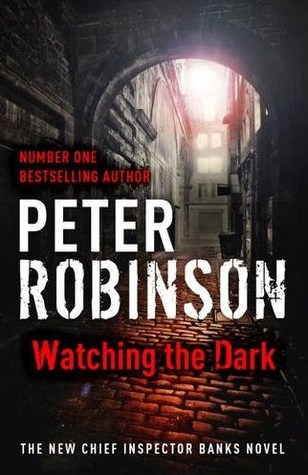 es, their actions don’t always ring quite true and seem to solve a particular narrative purpose rather than be part of their motivation. For me, one example here, was the relationship between Passaro and Banks. While initially we understood that Banks was annoyed and felt hobbled by the presence of someone from Professional Standards, when he and Passaro have it out and, in his own mind he acknowledges that his beloved Annie also worked for that section and she’s not tainted, past novels tell us that Banks would have moved on and work at building the professional relationship with Passero. In this novel, it doesn’t happen and Banks’ attitude to Passero, particularly when they’re in Estonia and he reverts back to resentment, galled a bit. Banks is not a misogynist though, typical of his generation, he struggles sometimes with women and what they want, but he has always been respectful and appreciative of what they bring to their professional roles and the workplace – this is proven with Annie. With Passero, he becomes, as Winsome accuses him at one stage, childish. But then again, I also put this behaviour down to a growing sexual attraction that he might feel for Passero and the emotional toing and froing that can cause. Likewise, after Passero unloads to Banks about her personal life, the door is open down the track for romance, so perhaps my comments are unfair and this is what Robinson was setting up; but there were times in their relationship at least that the Banks we’ve grown to know and I guess rely on to be stable was not and that was disconcerting. Love might explain a great deal, however J
Robinson also explores the seamy and seedy side of the underworld with ease, introducing characters you hope you never meet on a dark night. While at the same time, he also manages to bring the beauty of Estonia to life, the novel sometimes reading like a travel book, but as seen through Alan Banks’ eyes – not a bad way to view another country and culture.
Overall, I really enjoyed this book as I have the other Banks in the series and will look forward to trawling back and discovering more of his life and cases and fleshing out the holes that currently exist in my knowledge of DCI Banks.
January 31, 2013
Book Review: Time Traveller’s Guide to Medieval England by Ian Mortimer
Historian Ian Mortimer does something really interesting with this book: he sets out to recreate the period (the Twelfth Century) as if he were writing a travel book for tourists as opposed to researching and explaining a forgotten time. In other words, he places the reader in the moment, advising you where to go, what to see, how to behave, speak, dress and what to expect should you happen to have the good fortune to be transported back to not-so-merry old England in the 1300s.
After my second reading of this book in less than a year, I wish I had access to Dr Who’s Tardis because, with Mortimer’s well-thumbed book under my arm, I would head straight for Exeter, where the book opens, prepared for the ordure of the aptly named, Shitbrook, the breath-taking sight of the cathedral, avert my eyes from the remains of criminals clinging to the gallows, and be careful not to stare at the bright and strange clothes the people are wearing, while tripping along the cobbles, one hand firmly on my money so a cut-purse does not take it.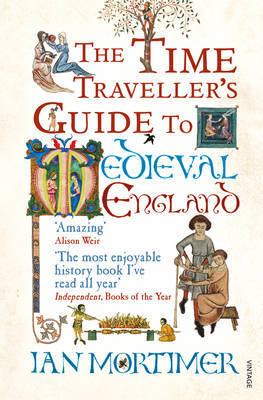
Like many contemporary historians, Mortimer believes in social history, reconstructing the past in order to understand how it was lived and not simply by kings, queens, monks, lawyers and nobles, those who have left records of their deeds and desires for us to absorb and through which we judge them. Instead, Mortimer turns to all classes and all experiences and takes the reader on a magnificent and fascinating journey back to a character-filled society with its own delights and dangers. It was so good the first time, I did it again and liked it even better.
Explaining where to stay, how to tell the time, greet people (Eg. “fellow or friend, ye be welcome”), about the sumptuary laws, what certain coins look like and what you might be able to buy and where, what diseases we might succumb to if we’re not careful, what we might be served and how to eat it whether it be in an inn, a peasant’s house or a king’s castle (all of which are thoroughly described as if you’re on a guided tour), Mortimer runs the gamut of class and place in this vivid recreation that is at once hugely informative and always vastly entertaining.
Even how to avoid running foul of the law and what punishment might be meted out is made clear as well as the significance of religious observances. Medieval humour is also explored as well as, for those so inclined, where you might find the best er hum, sexual services (Southwark, the Stews, in London, in case you wanted to know). He also discusses how to entertain ourselves while we’re there (the Stews aside) and who, among the great figures known to us now, we might expect to encounter on our journey – Geoffrey Chaucer anyone? He has rooms above Aldgate.
Just when you think you’ve stepped back into the present, Mortimer will remind you to take a deep breath and stop. Listen, he advises. What do we hear? Very little. Maybe some bells, the sounds of birds and animals and, above all, the chatter and clutter of people should we be near a town or city. Or, if present at a joust, the thunder of hooves. The medieval world is a very quiet place, something I hadn’t considered, along with many of the other preconceptions and yes, prejudices I had about this period and which Mortimer’s grandest of tours manages to overturn.
If you’re looking for a book that will literally transport you to another time and place, than I cannot recommend this one highly enough. A fabulous read.
Book Review: Women in the Middle Ages by Frances and Joseph Gies
I love anything written by this couple; always entertaining, always educational, they do their research, combine it with their sound knowledge of the era or people they are writing about and produce something that history buffs, writers, or just those with a healthy curiousity about the past will thoroughly enjoy.
Women in the Middle Ages is no exception. A concise book it starts with a working definition of the Middle Ages (around 600AD to the end of the Fourteenth Century) before explaining popular misconceptions and some facts about the role women played in these fraught and fascinating times. They then explain the primary models against which women were measured – Eve and Ma ry – sinner and saint, mother and whore, basically. Reductive they might be and yet they set the framework against which women lived, worked, loved, worshipped, ruled, and died.
The second part explores specific women, using contemporary sources, in more detail. We are introduced to (or reacquainted with) Hildegarde of Bingen, one of the most highly educated and clever women of the Middle Ages, an Abbess; the magnificent Queen Blanche of Castille a canny ruler who, despite enemies seeking to capture her throne managed to rule beside her husband and later, as a regent, handling the power thrust upon her with courage and intelligence; Eleanor of Montefort, sister to Henry III, devoted mother, wife to the courtier and warrior Simon de Montefort (their relationship is beautifully and sympathetically explored by Sharon Kay Penman who, though working in fiction does extensive research and she paints a softer portrait of Eleanor), and someone very aware of and prepared to fight for her rights. We also meet Agnes Patiniere of Douai, a woman who lived in a city and who had a successful trade, negotiating the politics of the guilds. Then there’s Margherita Datini, an Italian woman who became literate later in life, helped run her husband’s business and avoided succumbing to the plague. Finally, there’s Margaret Paston, member of one of the most successful families of the Middle Ages who rose from crofters to wealthy landowners (and later, Earls) and who are survived by abundant correspondence (the book of their letters, The Pastons, is enthralling) that reveals their daily lives, enmities, private and more public relationships and even their ambitions for themselves and each other.
While it seems sad that there are so few women to draw on in order to explore their diverse roles over such a long stretch of time, when considering the division that occurred in medieval lives – men = public, women= private, and the fact most females were confined to domestic space, it’s fortunate we have anything. The Gies’ also ensure they compare and contrast the women they discuss in relation to place and class and draw analogies with literature (eg. Chaucer’s Canterbury Tales) as well demonstrating how women’s role altered (for better and worse) over time.
The contradictions in women’s roles are evident in this book, as is how women worked within and against popular and religious expectations, how they managed, sometimes against impossible odds, to find and create their own spaces and lives – some more successful than others.
Overall, this was an interesting and enjoyable read.
January 28, 2013
Book Review: Heresy by SJ Parris
This was a strange book in so many ways – and I mean that more positively than to infer the opposite – strange can be good, right? Ostensibly a historical novel that, while a work of fiction features real people – the main one being the lead character, the excommunicate Roman priest and humanist philosopher, Giordano Bruno – it also uses quite modern if literary language to tell its Elizabethan tale of murder, mystery, spies, religious heresy and mayhem. Due to this, it asks for a leap of faith from the reader – of the literary rather than the religious kind – and we do this willingly.
Establishing Bruno’s credentials as someone genuinely disenchanted with the Catholic church (he’s caught reading inappropriate materials and the Inquisitor is sent for, which forces him into exile), he arrives in England years later to be hired by Queen Elizabeth’s great spymaster, Walsingham himself, and is sent to Oxford University. Travelling there to debate the forces of the u niverse with the Rector, Bruno is also asked to uncover any heretics – Catholicism having mostly gone underground during this period – as a plot to assassinate the queen has been discovered and the search for those involved (directly and indirectly) is underway.
While at Oxford, a series of “maytyr” murders take place – gruesome and clearly spelling a warning – but to whom and why is not immediately clear. Determined to unearth the killer, Bruno hasn’t quite accounted for the prejudice of the English towards foreigners, the passions of Catholics nor the unexpected pleasure of the Rector’s beautiful and clever daughter, Sophia.
The closer Bruno gets to the finding the killer or killers, the greater the danger grows until it’s not simply Bruno’s soul that’s at risk, but his very life.
While this novel is an Elizabethan mystery, it’s also very self-consciously historical and in that sense, it sets out to be accurate in its descriptions and in the way it characterises some of the people it introduces into the story. I always enjoy that kind of didacticism if it’s done well and, mostly in this book, it is. Parris (a journalist) knows how to do her research and incorporate it in an interesting manner. And so you have long dinner conversations that demonstrate both the ignorance of the era as well as the cleverness of the protagonist (and in real life, he was), as well as lovely details about Oxford University, it’s buildings and rules and the relationships between staff, students and servants and the various rituals that make up the day.
Where I found the book pushed the boundaries a little too much was in its tendency to introduce characters either for the purposes of “proving” this was a dinky-di historical novel (eg, the extremely annoying European nobleman Bruno is forced to accompany to Oxford and Sir Phillip Sidney, both of whom didn’t really serve any useful narrative purpose except as genuine figures from the past) or as devices to wrap up plot points. There’s one character particularly from whom Bruno finds out a great deal of information that leads to the identity of the killer. This character is a “simpleton” and in one scene, even while doubting the wisdom of telling Bruno everything (ie. that he possibly shouldn’t), he still spills his guts, allowing clever Bruno to put five and five together. In other words, this character was created purely to reveal a great deal of information at the right time and I found that a tad clumsy, even though I liked the character.
Some of the characters are also a little too black and white as well as smart alec, but in a stupidly disrespectful way, though this also adds to the tension.
The scenes describing torture and execution are very well done, if grisly, and also reveal Parris’ knowledge of and appreciation for the era.
Overall, while I tended to skim read small parts of this, I really enjoyed others and if you like a good historical murder mystery that isn’t quite in the league of The Name of the Rose, but is nonetheless very good, then this is for you.
January 20, 2013
Book Review: Web of Deceit by Katherine Howell
I don’t know why I do this to myself. Every time I pick up a Katherine Howell book, my fate is sealed. For the next how ever many hours, I will barely eat, sleep or blink until I finish the novel. And don’t try talking to me while I have my nose in the story – I am unable and have no desire to hold a conversation let alone compose a coherent response to a question – I simply have to know what happens next. Call me a glutton for punishment or someone who just knows a wonderful book when she opens one – maybe both.
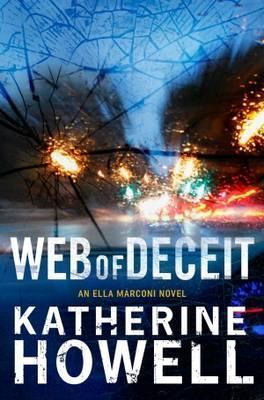 Now, imagine this is how I have responded to all Howell’s Ella Marconi novels and then multiply that reaction a hundredfold with the latest in the series, Web of Deceit. This book is an emotional, psychological and narrative time bomb that ticks away, putting you on the edge of your seat and making it impossible to leave the gritty, complex and marvellously tangled world and crimes that Howell has woven.
Web of Deceit opens with two paramedics, Jane and Alex, being called to an accident where a vehicle has hit a pole. No speed is involved and the driver has no injuries yet, he refuses to leave the car. Terrified, convinced someone is following and “out to get” him, it takes a great deal of persuasion to get him to exit. When, later that night, Jane and Alex are called to an apparent suicide at a train station and recognise the victim, events are set in motion that draw in both the paramedics, their families and, of course, detective Ella Marconi and her partner Murray as well.
Determined to prove the suicide was in fact a murder, Ella finds herself up against a new, number crunching boss for whom over-time and even lateral thinking around a case, appears to be an anathema. Combined with demands from her family and cutting her teeth on a promising new but frail relationship, Ella has to work against the odds to bring justice to the dead man.
Parallel to and interwoven with Ella’s dogged investigation is the story of Alex and Jane both of whom have their own lives and problems. As these are played out in ugly and complex glory, they find that the sinister warnings and fear of the man in the car may not have been the product of a deluded mind after all and, in fact, are simply a prelude to an all too real and terrifying series of events….
What I particularly love about Howell’s novels, apart from the tight and utterly believable plotting is the way she portrays her characters. They are never two-dimensional but fully rounded personalities whose motivation, while you might not always understand or approve (which makes you anxious for them) makes sense. She gives them back-stories and rich, interesting lives, even when they are quite ordinary, demonstrating their strengths, weaknesses, self-doubt, mistakes and hubris and the consequences of all of these.
Howell also has this marvellous ability to not only bring the paramedics’ work to life, but to show their humanity and the stress and strain under which they work as well. There’s a specific scene about halfway through the novel that is so heart wrenching and heart-warming, the words were swimming all over the page and it was a while before I could compose myself and move on. Kudos to Howell that in the middle of a grisly investigation, where tension is mounting, she could include such a scene and without missing a beat. On the contrary, it adds another layer to the tale and the characters.
Similarly, th e way relationships are constructed and deconstructed in the tale rings so true – both professional and personal. There are characters you love and champion but whose actions you sometimes question – just as in real life. There are also those you loathe and others who arouse a visceral fear, the type that makes the hair on your body stand to attention and your heart race that little bit faster.
Reading isn’t just about the eyes and mind, not when you’re in the hands of a master – and Howell is undoubtedly that. She plays with all the readers’ senses making the act of reading almost as exhausting and exhilarating as Marconi’s investigation.
Full of twists and turns, always narratively dependable but never, ever predictable, Web of Deceit will keep you captivated until the very last line. It’s as if you’re riding in an ambulance, the siren wailing, and someone else is driving, their foot increasing the pressure on the accelerator as you’re taken on a ride, replete with running red lights, dodging cars and pedestrians; one you’ll never forget or regret.
Completely enthralling, Web of Deceit places Howell right up there with the absolute finest in the genre. Even among such luminaries, she shines.
Available from the 1st February 2013, I was lucky enough to read an early copy. Don’t miss out!