Karen Brooks's Blog, page 13
November 12, 2012
Book Review: The Secret Keeper by Kate Morton
Li ke all of Kate Morton’s books, The Secret Keeper, a novel that is set in three different periods and follows the lives of three very different women, all linked by a terrible secret, is a rare treasure. This is because it’s a story like those you used to read of old, when you were a child and believed that dreams could be fully inhabited, and that your wardrobe really could lead to other worlds, and boarding schools were invented simply to enjoy high teas with friends. This is what I think of as a rainy day novel, the type transports you out of your lounge room, off your cushion, and into another time and place; immerses you in the lives of others making you care, dislike or even love them deeply. So much so, that when the tale ends, you feel as if a little part of you has dimmed.
So it is with Morton’s fourth book and, in my mind, one of her best. The Secret Keeper, as the blurb on the back teases, starts in a sleepy, gentle 1961, when young Laurel, a teenager on the brink of womanhood, witnesses her mother, Dorothy, plunging a knife into a strange man’s chest, killing him instantly.
Propelled away from the violence and into 2011, we meet Laurel once again, this time as an accomplished actor in her sixties at the twilight of a brilliant career. Dorothy is about to turn ninety and all the children are summoned home to be beside her, knowing her days are finite and precious. One of five siblings, Laurel is the eldest and, being back with her mother conjures up memories of her past and that inexplicable day when her dreamy, imaginative mother committed a terrible crime – a crime for which she was never held accountable and which Laurel has always kept secret.
As her mother’s health fades, Laurel determines to uncover the secret that she has kept, to find out who the murdered man was to her mother and what prompted her parent to act in such a way. Discovering a photo she’s never seen before, an inscription in a book that bears the name Vivian, Laurel is given her first clues and so, with the help of her brother, Gerard, she sets out to solve the mystery that’s shrouded her entire life.
This is a sublime novel that moves between 1941 and the London Blitz, to 1961 and then forward to contemporary times, shifting gently, like a soft pressure on the back, as if in a slow dance. It also segues from England to Australia and, in doing so, captures the lives and mores of different women in very different eras. Through the eyes of ambitious, romantic and fanciful Dorothy, who believes herself born to be exceptional, we come to war-torn London, where women worked in service and for their country. Physically attractive, Dorothy turns her back on her family in order to tread the path she believes the fates have carved just for her. Meeting Jimmy, a photographer with an eye for beauty and a loyal heart, she finds love, but it’s when she becomes the companion of an elderly rich woman and meets her neighbour, the enigmatic and beautiful Vivian, married to a famous author, that more than fate intervenes with tragic consequences.
Then, there’s Vivian herself, a child of the antipodes who, through terrible circumstances finds herself in England and at the whim of cruel and dangerous forces, which work to shape and change her.
From different classes and with very different outlooks on life, Laurel cannot fathom what brought her mother into Vivian’s sphere or vice-a-versa, but as she slowly uncovers letters, journals and more pictures, and begins to make the connections, Laurel begins to understand that she’s not the only one keeping secrets…
Morton has very much made secrets, letters, memories and diaries, the never mind photographs and stories within stories part of her very female (but not so it excludes male readers, many of whom I know devour her books too) ouevre. In her gifted hands and wonderful imagination, she uses these tropes deftly and smoothly, allowing different voices to share in the story in which readers inevitably become lost.
There is something lilting and magical about Morton’s prose, her turn of phrase; her exquisite way of rendering the ordinary extraordinary. One example is when Dorothy (Dolly) is working for her peevish lady: ‘“Perish the thought,” Dolly said, posting the boiled sweet through her mistress’ pursed lips.’
The simple word “posting” (think what else could have been used) is so perfect and transforms what Dolly is doing, making the action something you don’t just read about, but witness. That’s the beauty of Morton’s writing – it appears effortless, flows, but words like that reveal the thought and choice that goes into every sentence. A friend of mine (a fellow writer) once wrote that she had word-envy when reading a particular author. I understand that emotion when reading Morton.
What I particularly liked in this book as well is that Morton is not above giving the critics a bit of a serve. At one point in the novel, she has Laurel reflecting on her prefect childhood:
“The sort of home life that was written about by sentimental novelists in the type of books branded nostalgic by critics. (Until that whole business with the knife. That’s more like it the critics would have puffed.).”
Managing to be both self-aware and slightly self-deprecating at the same time she also silences those who might suggest (as some reviewers have) that Morton has become too formulaic, almost saying, what’s wrong with that? Or I choose to write this way. I cheered when I read that and thought what’s wrong with capturing a corner of the market like Morton has and relishing “nostalgia” and “family drama”, celebrating it and making that niche your own? For this is what Morton has certainly done. Not that there’s anything wrong with that – not when novels like this are produced.
The Secret Keeper is best described as a delicious book. It’s something you’ll want to savour, to reflect upon, to appreciate for the work of literary art that it is before you return for a second and third serve.


November 8, 2012
Book Review: Shine Light, Marianne de Pierres
Shine Light, the final book in The Night Creatures trilogy, is an unforgettable conclusion to an original and thrilling series.
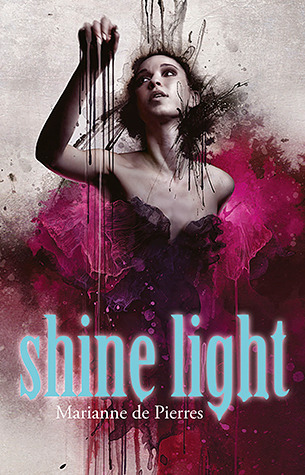 Now that Naif has learned the shocking reasons behind why young people are sent to the dark island of Ixion, she returns to expose the truth and try and liberate them from their oppressors. Her mission is urgent as the badges, which all folk are given upon entering Ixion and which control life or death, are failing. While Naif has had her badge rescinded, there’s her brother and others she cares for deeply who are at the whim of its force.
Urging all the different factions to unite and overthrow their enemy and embrace liberty, however, is no easy task. Sometimes, as Naif learns, the truth doesn’t set you free, it merely complicates everything. Nonetheless, loyal and gutsy, she determines to fight the Ripers, release those they’ve enslaved through drugs, hedonism and wanton selfishness, and shine light into the darkest recesses of Ixion and beyond.
At the heart of Naif’s deadly quest, is also a truth she must face: where does her loyalty really lie? With her fellow rebels and revellers or with the creature whom she loves so deeply, the enigmatic and sensual Lenoir?
Fast-paced and so beautifully and tautly written, this final instalment is a wild ride from start to finish. The elegance and economy of the prose means you’re plucked out of your own reality and deposited firmly in the middle of Ixion, among its toxic politics and unravelling social structures. Darkness becomes an even more powerful metaphor in this novel, representing as it does, not only ignorance and the abuse of power, but the evil that lurks about and within. Straying from the light is not only lethal in this book, it’s imbued with possibilities for deadly transformations and is offered as a temptation to which those who give up the battle succumb.
In many ways, the darkness and the Ripers signify a particular state of mind, whether drug-induced or not, and as such, function as representations of the blacker aspects of the soul, of young souls specifically. There’s a sense in which Ixion, and those who are brought there have, throughout the trilogy, been presented as being analogous to the angst-ridden teenage years: the desire to fit in, to be different and indifferent, to regard oneself as immortal. In this space, all the confused and driven psychology and emotional states of youth are realised, personified and become places and spaces as well – and it’s terrifying.
All the books have explored the various pressures of adolescence; how there are those who will stray from the “paths” – knowingly and unknowingly, willingly and unwillingly – and reap the consequences of their choices. But what the books also reveal is how those whom young people trust with their care can abuse that responsibility; exploit youthfulness for their own benefit and that realisation is the most disturbing of all – for everyone.
Through Naif, the young people of Ixion (and others) are given the opportunity to come into the light of their own power and choices and thus shine. But will they take it? Will Naif be able to resist Lenoir’s allure and the hold he has over her or will she succumb? Will Ixion surrender its terrible secret in time?
You’ll have to read this marvellous book to find out.
November 5, 2012
Book Review: Cinder, Marissa Meyers
Talk about judging a book by its cover! While searching for a completely different book, I found Cinder, book one of The Lunar Chronicles by Marissa Meyer and was intrigued by the stunning cover – it’s one that warrants closer examination and functions beautifully as a metaphor for the entire story. The title grabbed me as well as I adore retellings of the old tales (if they’re done well) and “Cinderella” (the Grimm and earlier versions) was always a particular favourite.
Set in the city if New Beijing, in a future where World War Four happened over a hundred years earlier creating new geo-political allegiances and countries, the Moon is not only settle d but is populated by a hostile race of “Lunars” who utilise “magic” (which is rationalised scientifically) as a form of control, a strange plague is decimating the people of the city, this a science fiction novel par excellence that dives straight into the story and lets the world building occur organically, within the telling. Cinder, the main characters is not only a cyborg, but a gifted mechanic who works in a crowded bustling market where she is all but ignored by the other retailers, but not customers who appreciate her talents. But it’s when one particular customer enters her premises, that her life changes…
Following the fundamental tropes of the original tale from which it draws, and paying homage to Anime at the same time, Meyer’s book nonetheless manages to offer something unique. While Cinder is an orphan who was adopted at the age of eleven and lives with her step-mother and two step-sisters, there’s a prince and a ball, that’s where the similarity really ends (bar a couple of additional bits, but I don’t want to spoil the story). Cinder is a loyal and courageous young woman whose self-esteem has been crushed but not broken by her step-mother. Her talent as a mechanic allows her a level of freedom and access to others, as does her friendship with and ability to repair robots and her own mechanical limbs.
Aware she is a cyborg and that they’re regarded as inhuman and less than second-rate citizens, Cinder harbours no ill-will, only a painful awareness of her lack of worth which translates into an acceptance of sometimes harsh and unfair penalties.
When the dreaded plague impacts upon Cinder and those she loves, and the hostile Lunar Queen descends to earth with an offer she won’t allow to be refused, Cinder is forced to confront not only her past, but her destiny as well.
Tight prose, believable characters, a once magical plot grounded in science and futuristic tropes, this is a terrific read that should tick all the boxes for lovers of science fiction, romance, recast fairytales and just well written imaginative novels. It also explores friendship, xenophobia, disease and the terrible toll i! takes, loss, refusing to be victim and staying true to oneself.
The ending sets up the next book in the series reasonably well, though also obviously if not clumsily (when you read it, you’ll see what I mean – the action/motivation doesn’t quite ring true – I don’t see why what’s suggested has to wait). Nonetheless, I am looking forward to the next novel in this series very much and will be interested to see how Meyers, who used the original tale so well thus far takes this beloved character and plot into new territory.
November 4, 2012
Book Review: Plain Truth by Jodi Picoult
This was another book recommended to me by a friend as something I might enjoy reading while on holidays. Ally, my girlfriend, has been telling me for a while that Picoult is a terrific author and if Plain Truth is anything to go by, Alison is right.
This is well-crafted tale, gripping and moving, set mainly in the Pennsylvania, in the Amish community of Paradise, where, one morning, a dead baby is found in a barn. No-one knows how it came to be there and no-one lays claim to the babe. Police are called in and quickly identify not only the young mother, but the shocking possibility the infant wa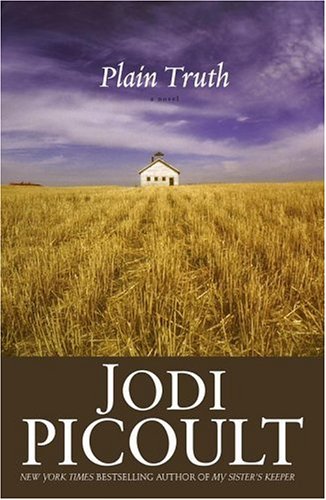 s murdered.
In another part of the country, lawyer, Ellie Hathaway, is confused about her relationship and her professional life. As a defense attorney, she’s often called upon to defend the indefensible and, when her last very high-profile case finishes, she needs time out to recoup and rethink all aspects of her life. She feels like her ethics, sense of self and what she wants from life have been compromised. She escapes to her Aunt’s house near Paradise and finds herself drawn into the case surrounding the murder of the baby.
Working pro-bono, she reluctantly becomes more involved than she ever intended when she takes responsibility for the suspected murderer, a young Amish (Plain) woman, Katie Fisher, who is unmarried and maintains, despite all evidence to the contrary, that she never had a baby. Confounded by this teen, as well as by the Amish way of life, which stresses others over the self and work over leisure, she calls in an old friend to help – what she doesn’t yet understand is that the young Amish woman isn’t the only one needing aid.
This book like so many good ones, draws upon a range of genres to tell its tale. I mistakenly thought it was going to be a crime novel and, while a crime does take place, and a portion is reserved for the fascinating unfolding of the case in the courtroom, it isn’t only these things, but so much more. It’s about human relationships, family, the bonds that unite and tear us apart. It’s about choices, love, loss, about humility, community and faith. It’s about the way the modern world makes us selfish and afraid, but also how denial can be both a blessing and a curse. It’s also a novel about generational difference and the power of female friendship and trust.
At the centre of the story are two women – both strong and remarkable but for the moment, lost. The question is, will they let themselves be found?
Looking for a wonderful tale to lose yourself in? This might be it.
Thanks Ally!
November 1, 2012
Book Review: Feed by Mira Grant
When going on holidays recently, I asked FaceBook friends for some reading recommendations (this was despite having about forty books in my “to-read” pile). Feed, by Mira Grant was one of them and, why I chose it from the many other wonderful suggestions I received was the way it was “sold” to me by another writer, the lovely Mandy Wrangles. I still remember. She wrote something along the lines of, “It’s a zombie book, only, it’s not. It’s so much more. Don’t let the zombie thing put you off. This is an amazing book, dystopian and about communication, the media and politics and it’s just incredible…”
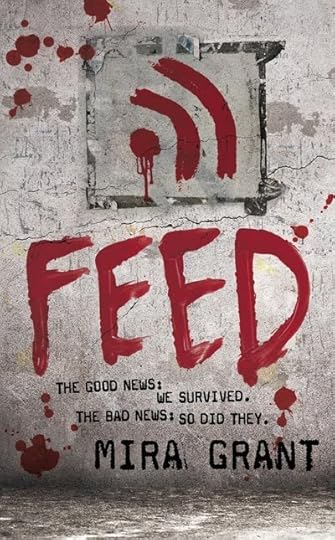 To be fair, Mandy said it far more eloquently than that, but that’s how I absorbed it and was intrigued. Much preferring zombies on the screen than on the page, I’d resisted anything remotely zombified before, but I was going on a holiday, why not challenge myself? Take a holiday from my usual genres? Am I glad I did. Oh. Boy. Mandy was right, Feed, the first book in the Newsflesh Trilogy, was not what I expected – even with Mandy’s wonderful affirmations, it thoroughly exceeded my expectations.
Set in the very near future, after a zombie plague has basically wiped out a great deal of the civilised world, facilitated the establishment of gated communities, serious and constant health checks, and armed protection services, and seen the mainstream media not replaced, but in healthy competition with bloggers (the reason being that when the uprising of zombies began, the media were in denial and, due to government control and censorship, inclined to perpetuate fallacies – it was bloggers who told the truth and won reader loyalty and trust), this tale centres around prominent blogger, Georgia Mason, who along with her brother Shaun and their IT specialist, win a contract to accompany a candidate throughout the drawn-out presidential election. Overjoyed at such a coup, they quickly accept and join the convoy, travelling throughout parts of the US, being given insights into not just the political machinations of the party and those who belong, but the media and the plots and cunning of desperate men, including the biggest secret of all – the terrible conspiracy behind the infected….
This is a wild, hold-on-to-the-edge-of-your-seat book that, after an ETesque opening (but with zombies, death and destruction on the protagonists’ bicycle tail), immerses you in this post-apocalytpic reality of a country/world torn apart by a mass infection and its consequences. Orphaned at a young age, brother and sister Georgia and Shaun, though they’ve been adopted, have to survive on their wits and intelligence and neither of these are in short supply. Nor is their sense of justice and determination to see it meted out.
Though the zombies (the infected) hover at the edges of the story the entire time, bursting into the narrative at opportune and sometimes unexpected moments, the real story here is the politics – not simply Republican versus Democratic, though that’s there, but personal politics as well. How individuals manoeuvre themselves into positions of power, the politics around the stories we tell, about ourselves, each other – what’s omitted, what’s included, the impression we strive to give and maintain- and the strength of meta-narratives to colour and infect the smaller ones. It’s also about belonging, connectivity, being an outsider – of family, society and beyond. It’s about truth, lies and everything in-between. It’s about when to compromise – morally, physically, intellectually – and when it’s appropriate not to.
As story-tellers with credibility, Georgia and Shaun know how important their job is, how much the surviving masses rely on them to keep the lines of communication open, to spread the “truth” and to provide informed opinion. But story-telling in this world is also big business, and ratings are important. Hence, risks must be taken, not with the truth, never with that, but with reputations, uncovering relevant information and, for Georgia and Shaun, it also means putting their lives (and that of others) on the line.
This never becomes more important or real than when they discover the truth about the zombies…
This is such an original and compelling book. Alternately shocking and heart-wrenching, capable of blood-thirsty scenes and great pathos, the characters are strong, purposeful to a fault, but also ever-so vulnerable, the combination is intoxicating and nerve-wracking. You invest so heavily in both Georgia and Shaun, shout at and with them from the sidelines, revel in their ingenuity and disingenuousness. The narrative twists and flows in ways that are never predictable but always true to the overall arc and intentions of the book – you believe in everything that’s happening and the rationale behind it. An example of this is the reasoning behind why there are zombies in the first place. An interview with Grant (at the end of the book) reveals that she was always frustrated by films and other books that took zombies for granted, that is, the writer/s never explained how they became that way, except to point to biting and contagion through other means as the answer. The origins of the infection and what happens in the body of a human who becomes a zombie is rarely if ever dealt with. Feed addresses this in a scientific and acceptable but never dull way. The explanation simply feeds (excuse the pun) into the logic of the setting and time the author has created. I thoroughly enjoyed this aspect as well.
Whether or not you like “zombies” (what’s NOT to like J), whether or not you enjoy dystopian narratives, this is a great book. But, if you’re looking for well-crafted, tightly written, imaginatively conceived stories that take you on an incredible, high-octane adventure while simultaneously exploring some serious ethical and philosophical issues and offering a critique of modern media with kick-arse, wonderful rich and complex characters and a plot dripping with intrigue, this is the book for you.
Touted as young adult, it’s not. It’s for anyone who loves astonishing novels.
I have bought the second and (er um) can’t wait to sink my teeth into it.
A huge big thank you to Mandy!
Book Review: The Servant’s Tale by Margaret Frazer
I quite enjoyed this medieval murder mystery, part of a series written by Frazer and featuring the clever and intrepid nun, Sister Frevisse who, it happens, was a great-niece of Geoffrey Chaucer. Though this is the second book in the series, it’s the first I’ve read and it stands alone nicely.
Steeped in historic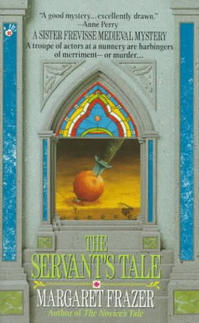 detail that deposits you in the period easily (approx 1430s), the pace of life and religiosity of not only the nuns who share the nunnery with Frevisse, but the villagers as well is described. It’s Christmas time, and a group of travelling players seek the hospitality of the Nunnery as the only child among them is sick. So, we discover, are many of the nuns who have succumbed to the time of year, the bitter temperatures, drafty halls and lack of warmth and a lurgy that spreads. Coughs and sneezes punctuate prayers and hymns and Frevisse herself is fighting off a malady and finds the constant sickness of her peers (and herself) frustrating.
It’s just as well then that, halfway through the book, something happens to distract her. A young villager, Sym, the son of one of the nunnery’s servants, dies after a fight in a tavern. When she examines the body, which is brought to the nunnery for the rites, the sister discovers that it wasn’t the fight in the tavern that killed this feisty, disagreeable sixteen year old, but another, deeper and deliberate wound.
Determined to get to the bottom of this case before the Crowner arrives to investigate, what Sister Frevisse doesn’t expect is the body count to rise – but it does. Suspicion naturally falls on the travelling players, but Sister Frevisse isn’t convinced. Can she overcome the biases of the Crowner and the villagers and see justice done? Or will the travellers pay for a crime they didn’t commit? Or did they? Can she discover the perpetrator before even more people die?
This was an easy to read book that was also a little slow. Setting the scene and time took pages and pages – and while the writing is tight and the characters wonderfully drawn, nothing actually happened till almost the halfway point in the book. After that, the action was swifter, but only by comparison. If a reader is looking for a murder mystery (as the book is advertised), they might be disappointed. As an historical novel, however, the book is excellent.
October 28, 2012
Book Review: Last to Die, Tess Gerritsen
I’d never read a Tess Gerritsen book before Last to Die – in fact, I’m ashamed to admit, I didn’t know much about this author. Encouraged to try her work by another fantastic crime writer, Australian, Katherine Howell, I picked up her latest, not realising that Last to Die was actually the tenth book in a series featuring Boston PD, Jane Rizzoli and her friend, Medical Examiner, Maura Isles. The fact I read this book out of order was irrelevant. Having never watched the TV series either, the women and the setting were unfamiliar to me – so I came to this novel fresh and uninitiated. Not that any of this changes the fact that Last to Die is an exciting tightly-plotted a nd paced thriller that keeps you on the edge of your seat.
When three young people are the only survivors of brutal massacres that should have, by all rights, taken them as well – not once in their lives, but twice, Rizzoli knows that something terrible is brewing. That these three young people also find themselves boarders at a Maine school, Evensong, for young victims of crime is no coincidence either. A haven from the outside world, the school has been designed to protect its students, kids who have all suffered in some way at the hands of others, felt crime firsthand. But not even the fortress-like Evensong, with its alert and empathetic instructors and Edenic surroundings can protect these three kids from a killer with a fixation… and, it appears, neither can Rizzoli or Isles, especially when they are unable to convince those who can offer security that something or someone dark and dangerous is waiting in the shadows, someone who will do anything to protect the past, a past of which these kids were a part.
While this is ostensibly a crime novel, the setting and plot, especially the notion of endangered children and the cloistered and closed principal setting of a Gothic boarding school, likens it to a thriller/horror narrative as well. The concept of threat lurking in every corner, of even the most normal of surroundings being inflected with menace and thus transforming into something sinister, infuses the pages and adds a particular frisson to the narrative. Grisly murders are graphically described adding to the sense of impending doom that the two principal female characters seem unable to prevent. Only the young people appear to be able to take what’s happening in their stride. I confess that when some of the boarders set up a club to aid the adult investigation into what’s happening in their school, I thought readers were going to be given a cross between Harry Potter, his friends and Hogwarts and Alfred Hitchcock’s, The Three Investigators. But the young students’ desire, in fact, need to render assistance works well and believably and becomes a wonderful opportunity to explore relationships, trust and communication between generations and even professions.
Overall, this was a terrific read and certainly won’t be the last Gerritson I read.
Book Review: World Without End, Ken Follett
 In many ways, this book would be more aptly entitled, “Novel Without End” as much like a soap opera, it’s a never-ending story. Having said that, it’s also a very entertaining read that, using the setting established in Pillars of the Earth, the imagined Kingsbridge and Shiring (UK), moves readers familiar with that landscape and events forward in time roughly one hundred and fifty years and introduces us to a new set of characters but, in many ways, a very similar story. It’s almost as if Follett, having such success with the first book, uses the template for that as a basis for this novel as well.
I never read Pillars of the Earth. I did watch the TV series and enjoyed that thoroughly. I had every intention of engaging with the written version, but when I picked up the book, I didn’t want to invest in over one thousand pages of a narrative that I already knew, so I moved straight to book two. I know that was naughty and that books have so much more depth than their filmic equivalents, but I just couldn’t face that many pages when I knew pretty much what occurred never mind the ending.
Instead, I moved on to the second book and, despite some minor reservations (which I will get to) was not disappointed.
WWE basically follows the lives of five people who, at the beginning of the story are united by a dramatic incident. There’s a man named Thomas, and four young people, Merthin, Caris, Merthin’s brother Ralph, and Gwenda, all of whom either bear witness to and/or participate in a terrible crime and agree to keep it a secret (there is something else that occurs, but I don’t want to spoil the book). The seeds are thus sewn for an epic tale of love, loss, murder, grief, humour, sex (some very squirmy, clumsy sex scenes, I have to say), betrayal, cruelty and so much more. Despite class and spiritual differences, these five people share something that means they are forever linked and while we at times, as readers, can forget this, Follett will ensure that at some point over the years that are covered (decades), we’re given reminders of why the initial incident is significant and the awkward bond that exists between these characters.
Of course, these are not the only individuals in the book; neither are they the only important ones. So many populate this story and, it’s testimony to Follett’s writing and his ability to juggle what in other hands might have been an unwieldy cast that we not only know these people too, but we empathise (or not) with their decisions and the consequences they face as a result of their actions. Where I did struggle a little, is that I felt some of the characters were too black and white – the religious figures particularly. For example, the monk Godwyn and his assistant Philemon were predictable precisely because they generally acted out of self-interest – they never deviated from this pattern throughout and thus never grew or changed, not even when anyone else in the same situation might. Not once did they demonstrate the capacity to think outside their own needs and were constructed as fine little sociopaths. This galled after a while and actually elided some of the drama and tension with which they were associated.
Nonetheless, drama and tension abound as beloved characters are tested in ways that make you ache for them – but also, I confess, become frustrated as you want to screech, “Give them a break!”. I don’t think that phrase is in Follett’s vocabulary and, at times throughout the over 1000 pages of WWE, the relentless trials that beset these characters, from accusations of witchcraft, foiled love, murder, plague, self-abnegation, decei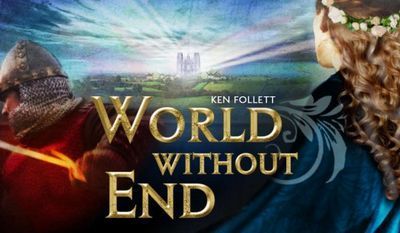 t, failed enterprises, bullying, and the machinations of others undermining talent and good intentions, grow tiresome. But they also keep the story moving along and readers turning pages – well, at least this reader.
Was this a satisfying read? Yes, it was. Not only because the overall story arc is gratifying and the fact the huge investment first begun when that small group share a terrible secret pays off, but because the sense of place and time underpinning the entire novel, the rich history of the period, is beautifully and painstakingly evoked. Not in a didactic way, but in such a manner that the characters in situ are brought to life and even the inanimate spaces, such as the monastery, hospital, taverns and other places, inventions of Follett’s imaginary Kingsbridge, have life breathed into them. It’s no wonder an eight part television series has been made of this book as well - produced by Ridley and Tony Scott (among others) and starring Cynthia Nixon and Miranda Richardson. Will I watch it – the jury is out on that for same reasons that I didn’t read Pillars…
If you like historical novels full of drama, pathos and which are unapologetically soap-opera-ish, and are prepared to commit to a huge undertaking by reading this story, then World Without End is for you. For me, it was time well spent.
October 23, 2012
Book Review: The Casual Vacancy, J.K. Rowling
W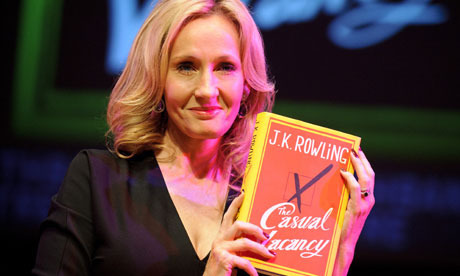 hy is it that when a songwriter or singer changes genres we applaud their daring, write, and speak about how multi-talented they are; how fortunate we are to gain so much pleasure from their creativity? But, when a famous author dares to switch genres, there are rumblings and grumblings and unfair expectations placed upon them – before the work is even published? Warning the marketplace that The Casual Vacancy would be nothing like the Harry Potter books, that it was for adults and quite depressing, Rowling was nonetheless encumbered with criticisms and snubs for having the literary presumption to leave Potterworld. Yet, she was blunt: if you were looking for Hogwarts and wizards, she warned, they would not be found in the pages of her new book. Yet, so many reviewers have come to the novel with the expectation that, for some reason, they should be there, even if just a glimmer, whisper or peek. They practically accuse her of letting readers down, of abusing her position as a world-famous writer instead of giving her the benefit of the doubt and congratulating her for demonstrating such imagination and lexical dexterity.
Frustrated by attitudes, stories and some reviews (which were not reviews because it was clear the book hadn’t been read, rather they were more rebukes) the publication of this book produced, it was hard not to let them tarnish the reading experience. I tried to approach this book as I would any other by a beloved author who decided to try their hand at something different and read and rate it on its own merits – and I was not disappointed. But, as Rowling warned, it’s no Harry Potter: the only magical thing is the writing, which is superb.
The Casual Vacancy is, frankly, brilliantly awful. Set across two English towns, Pagford and The Fields, one with a very acute awareness of its history, the other a by-product of late modernity, they are inhabited by a cast of mostly toxic characters who illustrate, through 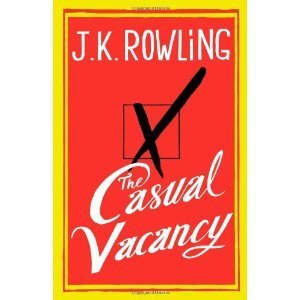 their small-mindedness and mean-spiritedness, the pettiness that can exist in supposed idyllic English village-like communities. As I read, I kept thinking of a quote about academia that’s been attributed to Henry Kissinger (among others), that “the politics are so vicious because the stakes are so low” – I think this sums Rowling’s book up nicely.
After the death of a member of the local council, Barry Fairclough, various members of the Pagford community vie for his vacant seat. As they do, the reader is drawn into the complexity and ugliness of what should be simple lives, albeit, affected by mourning and loss. Populated by ego-centric, gossiping, classist, racist, homophobic, alcoholic, drug-taking self-interested people, Pagford and The Fields appear to be governed by folk who can barely function in their own lives, let alone make decisions that will affect others. And, as the council move towards another election, it becomes clear that one person’s loss is potentially another’s gain.
Not even the children in this miserable tale are spared the less attractive qualities the adults so readily exhibit, and is it any wonder when the grown-ups are their role-models? The kids have learned their lessons well. Dishonest, thieving, sneaky and risk-takers, they are both effect and cause of the outcomes.
As the story progresses, Rowling demonstrates her uncanny ability to mine a character’s emotions and psychology, to peel back layers to explain even the most unlikely or heinous of behaviours, to provide a context for understanding (but rarely approving). Piecing together the jigsaw of individuality, family and community, she mercilessly flays the characters, forensically dismantles their psyches and leaves them in the equivalent of a mortuary for us to gaze upon in horror.
For example, there’s Simon, violent, bad-tempered and his ineffectual wife, Ruth; their two boys, Andrew (called “pizza-face” by his aggressive, abusive father) and “Pauline”; Parminder, the local doctor, surprised by her reaction to a fellow-councilman’s death and who appears to understand the bodies and minds of all the townspeople in her care but not her own children. Her dashing heart-surgeon husband, Sukhvinder, regarded as a hero by those he loathes, especially the Mollisons – a work of gruesome art – for whom Rowling shows very little sympathy. Empathy is reserved for some of the residents of The Fields as well as the children in the novel who can do little more than suffer their parents and their foibles, until they discover the means to revenge – not served cold, but molten hot.
The race is on to secure the vacant council seat and, as the story progresses, skeletons are exposed, secrets uncovered. Everyone in this novel is damaged – severely and, when terrible tragedy unfolds, it’s only the myopic townsfolk who didn’t see it coming.
The writing is what makes this bleak book. While Rowling does head-hop (a cardinal sin in most author’s hands), she does it with aplomb and there’s a sense in which this becomes a stylistic of the narrative. We drift from one character’s thoughts to another’s, caught in the current of activity, the plots and plans of little men and women. In terms of the tone, I was reminded of Elizabeth George’s marvellous and heart-rending What Came Before He Shot Her, only this book is firmly rooted in the middle classes (though there are those who feature who can no longer claim a place there) and the life decisions that can affect generations. Also, George’s book redeems some characters – see if you think the same happens here. I have also heard, again before publication, that the book was likened to Midsomer Murders. The Casual Vacancy make Midsomer Murders seem like Narnia – before the White Witch.
Drugs, suicide, rape, incest, adultery, criminal activity, violent abuse, shocking neglect, fear, anxiety, OCD, dark fantasies, cruelty, it’s all there – relentless, but darkly fascinating at the same time. Rowling really raised (or lowered) the writing stakes with this book.
No, this wasn’t what anyone expected… but how marvellous is that?
Book Review: Hurricane by Hugh Howey
I f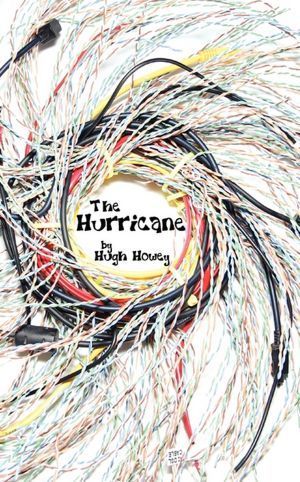 irst encountered Howey’s writing with the incomparable Wool (which I also reviewed) so I very much looked forward to reading another of his novels. Hurricane isn’t what I expected at all, which was a disaster story of epic proportions. Instead, what I discovered was a very sweet coming of age story which focuses on the unpopular, insecure, middle child Daniel, who is more often the butt of cruel jokes (and the cruellest is perpetrated at the beginning of the novel) than he is a hero.
Daniel is also decent, loving and protective of his family, especially his little sister, Zola, and is beyond proud of his big brother, Hunter.
When Hurricane Anna tears through a quiet town “near Charleston”, in which Daniel lives, leaving behind terrible physical devastation, the inevitable rebuilding takes on emotional and psychological significance as well. Forced to emerge from the cyber-cocoon and media bubble in which they dwell, Daniel and his family rediscover not only themselves, but also each other. Along with this comes introductions to neighbours they didn’t know existed and, as they rebuild shattered houses, the foundations for solid friendships and even love is also laid.
But it’s when Daniel’s estranged father reappears suddenly that house repairs take on a whole new meaning.
This was a very different book to Howey’s last one and to what I expected. Gentle, reflective, the entire story is a metaphor for so many things. I really enjoyed it and the meanings it softly, despite having a Hurricane at its heart, imparts.