Karen Brooks's Blog, page 5
March 2, 2014
Book Review: Roses Have Thorns by Sandra Byrd
Really enjoyed this novel about real-life lady-in-waiting to Queen Elizabeth the First, the Swedish Elin (Helena) von Snakenborg. Travelling with her queen to the court of the English ruler, we first meet Elin when her fiancé has abandoned her for her sister, her dowry has been spent, and she in a conflicted rather than heartbroken state as she makes the dangerous and long voyage from her home in Sweden to England.
Beautiful, smart and not overwhelmed by English court politics and games and understanding she has little to return home to, Elin is given a position at Elizabeth’s side. Earning the Queen’s trust and friendship, she is rewarded with marriage to the highest noble in the land, and becomes the Marchioness of Northampton – second only to the queen. Happy in her relationship, she also enjoys serving a ruler who demands the utmost loyalty from her woman and men, regardless of the personal cost.
Surrounded by Catholic traitors and those who plot to take her throne near and far, including Mary, Queen of Scots, Elizabeth is both cautious and capricious and Byrd tries to capture the tension, beauty and fierce intellectualism and creativity of Elizabeth’s reign, using Helena (as she’s now called) as the lens through which to view it.
When her first husband dies and Helena remarries someone of much lower station, however, she is forced to choose, not just between her heart and her head, but between her loyalty to the throne and the man she loves.
Evoking the era, the personalities and the politics, the book works hard to be historically accurate but, sometimes, I felt as a reader is was at the expense of story. My favourite bits were those with Helena and her beaus, when fiction rather than fact were apparent. Byrd quotes from Elizabeth’s own correspondence as well as known documents of the time, so careful is she to be true to history, yet, sometimes, history drowns out narrative, turns the characters into two-dimensional beings rather than passionate (or not) living breathing beings with whom we feel invested. The use of the quotes (or words straight from the horse’s mouth, so to speak) also make the book feel more like a non-fiction read at times than one that uses history as a backdrop to a wonderful story.
Nonetheless, I did enjoy it very much and can recommend to lovers of history and especially, the Tudor period.


Book review: The Goldfinch by Donna Tartt
I didn’t s o much read The Goldfinch by Donna Tartt as I was swept up in its powerful and sublime narrative with its exploration of love, loss, beauty, material objects and the relationship we can form with these and other people in our lives and how the choices we make, which are embedded in a moral code, define us.
The novel tells the tale of Theodore Decker who, suspended from school because of a questionable friendship he has formed as opposed to his own behaviour, has his life upended and shattered when he survives a tragedy that rocks New York. In the moments before and in the immediate aftermath of the disaster, he forms a bond with a young girl called Pippa and old man named Welty, both of whom become touchstones in what his life will become. Amid all the horror and shock that unfolds, Theo does something quite strange, he takes something extremely valuable and beautiful and tells no one what he has done
The consequences of this one action will echo and influence his life choices, merge into the memories of his past and erupt into the present in a prescient manner offering escape, promise and danger.
The novel then follows Theo’s life and the impact loss and accidental gain have upon him. His grief, his torment, the monotony and loneliness of his days are charted as he becomes not so much a victim of circumstance, but a victim of those determined to follow bureaucratic processes, tick their boxes and do the ‘right thing’ by this silent and oft sullen young man. This section of the book is heart-wrenching as well-intentioned people fail to see or understand how much Theo needs connection, longs for real communication and feeling, for someone to do more than simply satisfy the social niceties and offer platitudes. The only thing that allows him a link to his life before the tragedy, to experience and build any kind of emotional bridge is the object he has stolen. It speaks to him in ways that the humans in his life, even those closest to him, cannot.
It isn’t until he meets James Hobart, Hobie, an antique restorer and friend of Welty’s, and is reunited with Pippa that a semblance of meaning, if not hope, enters his life. But even this is transitory as Theo is at the whim of forces he cannot control and so his life is taken on journeys, undergoes trajectories he can neither navigate or foresee and, on the way, he collides and connects with others: his recalcitrant father, the ebullient and wonderfully strange Boris, the aloof but kind Barbours. Anchoring him on the ride his life becomes is his great secret, the object that has come to fill the hole left by the absence of those he loves.
From New York to Las Vegas to Amsterdam, from high society to the seedy underworld of crime and shady deals, drugs and booze, the novel follows Theo from his teens to his late twenties. Exquisitely written, it is a story I could not put down. Tartt’s ability to enter the mind and hearts of adolescents and adults is acute and heartfelt. Often philosophical and littered with references from popular and ‘high’ culture, the reader is swept along in the currents and eddies of Theo’s life in much the way he is. Filled with rich and complex characters, humour in surprising places, touching scenes that wring the heart and others that leave you frustrated and discontent, there is never a dull moment and, frankly, I was astonished by a few readers’ reviews that declared nothing happened in this novel. It may centre on a character who fundamentally embraces nihilism – or attempts to – but everything happens in this book. Everything that makes us human, that drives our needs, desires and hopes is explored. It seeks to understand what is free will, what is determinism. It ponders the great questions that have entertained and confounded philosophers since Aristotle, questions about life and death and meaning. It also asks, do we make our own luck or misfortune or is it somehow predestined? It is a morally and ethically complex novel that among many notions teases out the idea: do good acts necessarily lead to good outcomes and vice-a-versa? What if the wrong or bad decision can lead to the right ending? Or a good one bring about catastrophe? Does that make the entire choice or the person making it evil or their choice necessarily wrong? These are questions characters unconsciously embrace and finally ask outright. It’s left to us, the reader, to decide whether or not the answers are worthy or right (or not).
A fantastic story that lingers in the heart and head and which, like the object at its centre and the young man who obsesses over it, captivates you and whispers, “I have been written for you alone.” (Something that will make sense once you have read this utterly beautiful and haunting tale). Cannot recommend highly enough.
February 5, 2014
Book Review: Victims by Jonathan Kellerman
This is only the third Jonathan Kellerman book I’ve read and I intend to remedy that tout de suite (as Poirot would say). Victims is number 27 in the Alex Delaware series, so I am glad I have many more stories about this psychologist with a wicked sense of humour and fine capacity to read people and situations and his cop buddy, Milo Sturgis (the books recall to me Michael Robotham’ s sensational series) to delve into. Victims is one of the more gory books I’ve read in this oeuvre, the story opening with a really gruesome murder of a cantankerous old bitch who no-one liked and everyone is not-so-secretly glad is dead. If it wasn’t for the almost ritualistic and brutal slaying, Sturgis and Delaware would have numerous suspects.
But an interesting and dark psychopathology is at work here and as more bodies, are slain and in similar ways, but with no apparent connection, Delaware and Sturgis realise they have a very sick serial killer on their hands. The only way to discover the identity of the murderer is to uncover a link between the victims. At first, this seems an impossible task, but as more people are found and connections are made, not only do Delaware and Sturgis start to hone in on the killer, they start to realise he’s closer than they think…
A fast-paced, oft-times scary book, it delves into the capacity of humans for both cruelty and revenge and the sickness that resides inside. Dark, but laced with humour and really well-rounded characters, I couldn’t put it down, despite the fact I found the descriptions of the murders both brutal and graphic. I think because they didn’t feel gratuitous but built a profile of the killer, I was able to stomach it, to see it through Delaware’s eyes and thus be drawn into the narrative.
Book Review: Friend of the Devil by Peter Robinson
Number 17 in the Inspector Banks canon, Friend of the Devil, was the first of Robinson’s books that I’d seen as a TV show (terrific) before reading. As a consequence, I read the novel with a sense of knowing the outcome but not being one hundred per cent sure 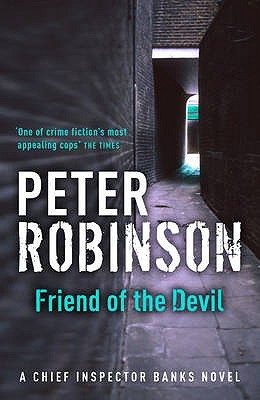 – and that’s the beauty of book to TV translations, they are never quite the same. The book, of course, has far more detail, takes time to unpack scenes and explore characters inner thoughts in a way the TV cannot. So, even though I “knew” the story, there was a sense in which I didn’t and that made reading a double pleasure.
The novel commences with DI Annie Cabbot being called to the vicious death of a wheelchair bound woman by the sea. When she discovers the identity of the woman who is linked to an old and horrific case that first introduced Annie into Bank’s life, the stakes change. This is a high profile case where, it’s felt, justice has at last been served. But that doesn’t change the fact that a murderer has struck and must be brought to justice. At the same time, Banks is called to investigate the murder of a beautiful, clever and popular young woman who is found in an area known as The Maze in Eastvale.
At first, there seems to be nothing in common with the two cases but, as the investigations proceed and both Banks and Annie are forced to think outside the square, commonalities begin to emerge – commonalities that lead them to discover the lies that have kept dark secrets hidden, and that the killer or killers are closer than they thought.
What I love about Robinson’s books, apart from the cases themselves, is that he also delves into and as a consequence develops, the personal lives and friendships between the central characters. Banks and Cabbot have had a rather tumultuous personal relationship and, in this book, it’s no exception with Annie making mistakes, feeling judged (something which she is perfectly capable of doing to herself and far more harshly than those close to her, despite what she thinks) and failing to trust those who only have her best interests at heart. Likewise, Banks doesn’t know how to recapture the friendship he’s enjoyed with Annie nor reconcile the loss he feels now that their intimate relationship has ended.
Nonetheless, this doesn’t directly affect their ability to work together as a team nor acknowledge each other’s strengths just as they accept each other’s weaknesses. Something all the officers do to a greater and lesser degree.
Another fine addition to such a consistently strong and utterly readable series.
January 30, 2014
Book Review: The Winchester Goose by Judith Arnopp
This book took me completely by surprise. I’m still not sure what I expected when I first started reading, but it certainly wasn’t a tale that grippe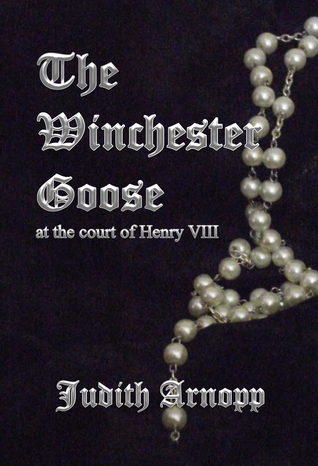 d me by the scruff of the neck with one hand, and clenched my heart with the other and refused to let go.
“Winchester Geese” was the collective name given to the prostitutes who worked in Southwark and Bankside in Medieval times, in an area or the liberty owned by the Bishop of Winchester. From these women and the places in which they lived, the bishop collected rents and hence a tidy earning. That a man of God made a living – or part of it – off women’s backs, turning a blind eye to their shocking conditions, illness, poverty, cruelty, and the enforced sexual slavery that some endured, and the brutality of their often brief lives and the lack of choice that led them to such a profession, while preaching against sin etc. was not lost on contemporaries or history. So, immediately, the title of this book intrigued me.
Set in Tudor times, during the latter years of the reign of Henry VIII, 1540, the book uses first person and, to commence, four different voices to tell a tale of love, lust, hope, marriage, desperation, loss and tragedy. The main protagonist is Winchester Goose, Joanie Toogood (great name) who, due to the death of her parents when young, gained responsibility for her two younger siblings turning to the oldest and only profession available to her as a single woman of a certain class. Big of heart, popular among locals and with oodles of common sense, Joanie is a delight. When she falls for the rather shady but young and dashing Francis Wareham, a gentleman who seems to stumble from bad choice to poorer ones, her life changes. But so does that of two other women from a completely different class who also encounter the dashing courtier: Evelyn Bourne and her sister Isabella.
Lovely young gentlewomen, they are brought to the Tudor court to join the maids serving Henry VIII’s new queen, Anna of Cleaves. Hoping their prospects for marriage will improve through exposure to the royal court and eligible bachelors and widowers, the young sisters could never have foreseen the way their lives were to be changed.
All four of the main characters, Joanie, Francis, Evelyn and Isabella are given voice in this novel and such different and compelling voices they have. The common denominator in their stories is Francis. As a reader, you think you see where these women’s relationships with handsome, swaggering Francis will lead, but nothing prepares us for the brutal and heart-wrenching reality.
Told in an uncompromising fashion, one that allows us to experience the lack of choice, the utter despair and injustice of women in certain positions during this time, the novel can make for bleak reading – only, despite the shocking events that unfold, it never falls into that dark trap, but allows hope and possibility to hover at the edges. Without sentimentality, it explores the heights and depths to which choices – good and bad – can lead, and how all it takes is one chance, one generous act of faith in fellow humans to bring about transformation.
Evocative and moving, the period is also brutally and wonderfully drawn. I really enjoyed the fact that the court and the large figures that people in it such as King Henry, Anna, Katherine and the courtiers, were mere backdrops to a passionate and searing tale of ordinary folk.
Readers of historical fiction, romance and just a damn fine book will love this. Looking forward to reading more of Judith Arnopp.
Book Review: Prophecy by SJ Parris
The second book in the Giordano Bruno series is set in 1583 and finds the Italian heretic and former monk, Bruno, ensconced in the French  Ambassador’s residence in London, where plots against Queen Elizabeth’s throne fly thick and fast. Still working for the spymaster and queen’s secretary, Sir Francis Walsingham, Bruno keeps his ear to the ground, discovering unlawful correspondence and Catholic conspirators everywhere he turns… Or are they? Told to rely on another of Walsingham’s men, Fowler, for help, Bruno finds himself reluctant to share information. On the one hand, he is uncertain just who is inciting treason and who isn’t and wants to be sure before he accuses, on the other, he wants to deliver the culprit to justice himself. At the same time, celestial events are attracting a great deal of attention and Bruno is drawn into Her Majesty’s conjurer, Dr John Dee’s, strange practices, and the notion that a prophecy that predicts the downfall of the queen draws nigh.
As the book opens, however, Bruno’s position as both spy for Walsingham and member of the Ambassador’s household, becomes even more complicated when a young woman and one of the queen’s ladies is found ritualistically murdered in the palace. The way her body has been displayed indicates not only occult involvement, but also connections to the French Ambassador’s home and Dee’s predictions. As the body count grows and the signs point more overtly towards the French and the fulfillment of a prophecy, Bruno knows he has to act. But just as Bruno watches those who he suspects of terrible intentions, there are those who watch him and will stop at nothing to make sure their plans succeed.
Parris has really done her homework here, using known events and a documented conspiracy as a backdrop for this exciting, fast-paced novel. Just as Bruno is a real historical figure, so too are most of the characters, the plots and the correspondence that’s used in the tale. That a mole working for Walsingham dwelled in the French Ambassador’s residence throughout this period is also known. Going by the name Henry Fagot, he did indeed alert Walsingham and thus Cecil to the dire goings on and plans between the French, Scots and even the Spaniards, providing invaluable information. While Fagot’s real identity is unknown, Parris clearly inserts Bruno in this role (and some historians believe it could well have been him) and it works wonderfully well.
The French Ambassador had a reputation as a fine host whose table not only provided delicious food but also scintillating conversation, something Bruno particularly was expected to provide. It’s no surprise then that Parris dedicates quite a bit of the story to table conversations, recreating the dangerous and witty repartee with flair, as well as the religious schisms, strange beliefs and fears and cunning of desperate men and women. Not only that, Parris breathes life, ghostly, smelly, exciting, deadly, into Elizabethan London, making it is as much a character in the novel as Bruno.
A highly superstitious era that both loved and feared all things prophecy and magic (both were illegal as well), Parris weaves the precarious position of Dr Dee and the gruesome murders into her tale to create a tense and forbidding atmosphere where shadows, double-speak, ciphers, codes and mists rule. Nothing and no one is as they seem and it’s against this backdrop that Bruno must solve the murders and uncover the truth of the plots against the crown.
A terrific novel that any lover of mysteries, crime, and historical fiction will appreciate.
January 27, 2014
Book review: Her Majesty’s Spymaster by Stephen Budiansky
From the moment I started reading this book, I was captivated. Budiansky has such an accessible style of writing and while he relies very heavily on the definitive biography of Walsingham for this book, the three-volume work by Conyers Read, Mr Secretary Walsingham, his style makes his retelling of Walsingham’s life exciting and, despite some of the grisly content, entertaining as well. Starting with the St Bartholomew Day massacres in Paris (strictly speaking, the book commences on the two days before with the attempted assassination of Gaspard de Coligny, Admiral of France who was shot in broad daylight and only bending to tie a shoelace saved his life in this instance), we follow Walsingham’s career and the little that is known of his personal life.
Sir Francis Walsingham is often credited by many contemporary commentators and modern historians with inventing espionage as we understand it. Budiansky is no exception. He knows his subject and the era that birthed him and it’s easy to mistake a light hand and easy style with superficial research – yet, as a principle source, Conyers’ work is sound, and Budiansky is eminently readable and for those who know nothing about the intrigues of the era and Walsingham’s role or simply want reminding, this book is a terrific introduction.
Budiansky inflects his prose with wit, empathy, understanding and humorous insights, weaving records of the era with substantiated opinion. The effect of this is a non-fiction book that reads like a terrific spy-cum-historical novel. As a consequence, we learn about all the major plots that Walsingham directly foiled from the Ridolphi plot to the Throckmorton and Babington ones, but from the inside out. But these were just vindication for Walsingham’s fierce collection of information and insistence that this was essential to protecting Elizabeth’s fledgling Protestant realm. They were also incidental in his larger schemes, which were to prove once and for all that Mary, Queen of Scots was a ‘she-devil’ plotting Elizabeth’s destruction and his quest to find evidence of the Spanish intention to invade England. Walsingham left no stone unturned, trusted no-one (except perhaps his first son-in-law, Sir Philip Sidney), and while not popular with the queen or many of her counselors (he fell out with them all during his lifetime), there were those who respected and appreciated the personal and other sacrifices his unflinching belief in his duty and his impeccable record in carrying in it out, as Sir Francis Drake’s letter to him after the Armada was defeated attests. That Walsingham endorsed torture and double-dealing might sit uncomfortably with modern readers, but in his mind and heart, it was all done for the protection of the realm and was thus essential. He has no patience for those who didn’t understand that. The fact he succeeded in proving Mary was a traitor and helped foil the Spanish Armada in 1588, have become questionable legacies because of the way he achieved these goals.
Nonetheless, history has accorded Walsingham the importance he deserves and Budiansky’s entertaining and easy to read book allows the reader to appreciate why. Couldn’t put this down. But again, it is more an introduction and original retelling of known facts as opposed to shedding new light on a mysterious and compelling historical figure.
Book Review: Deserving Death by Katherine Howell
I have to commence this review with a disclaimer: Katherine Howell is a beloved friend of mine with whom I regularly share the ups and dow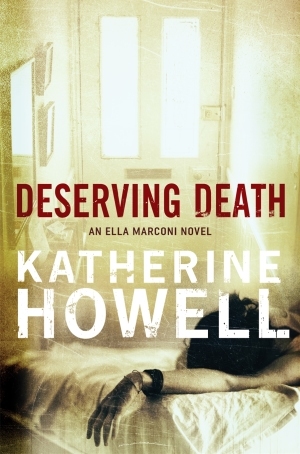 ns of being a writer, discuss politics, movies, books and the kind of things friends do – including the roller-coaster journey she went on writing this book. She even gives me a beautiful mention in her acknowledgements. Imagine my delight when I received my copy. I could not wait to read the published version of a tale that had wrung so much creative energy out of my talented friend.
Now, part of me didn’t want to admit to my friendship with Katherine – and you know why? I worried that it might colour the review I’m about to write – that reading it, others might think, well, she would say that, wouldn’t she, Katherine is a friend. The truth is, I don’t write reviews that don’t reflect how I feel about the book and the experience of reading it. I am much too professional for that and I would rather not write a word than be dishonest. That Deserving Death happens to be one of the best crime books I’ve read in a while has nothing to do with my friendship with the writer, but it does make me very, very proud that my mate wrote such a sensational novel.
Deserving Death is the latest in the hugely popular Ella Marconi detective series and, like the others (and what makes this series unique), is each book also has a principal protagonist, a paramedic (or two or three) and describes the inter-relationships between police and emergency services as well as what occurs in the daily and personal grind of our girls and boys in blue/white. In this book, paramedics feature more strongly than usual, occupying many different roles.
The story opens with the second brutal murder of a female paramedic in four weeks. Discovered by two colleagues, Carly and Tessa, the investigation of the woman’s death is handed to Ella Marconi and Murray Shakespeare who realise very quickly that not only are there connections between this death and the earlier one, but various witnesses and suspects linked to the women and thus the crimes are hiding the truth.
This is something Carly also recognises and, after being frustrated, hurt and confused by the blatant lies she’s being told – and by those she thought she knew and trusted – decides to take matters into her own hands, sacrificing friendship, professional and even personal relationships in the process. But as she steers close to discovering the truth of what’s being hidden and the identity of the killer, little does she suspect that she may yet be forced to make the greatest sacrifice of all…
Relationships are depicted as complex and oft-times fragile things in this novel. Just when you think you know a person, or their motivation, something will emerge or enter a conversation and change everything. I loved the way Katherine built the various connections – from Carly and Tessa’s professional bonds, to those they have with their boss, Mark Vardy, and the dead woman, to the deeper, more complicated ones that dominate their personal lives.
Running parallel to the investigation and the various liaisons and secrets it uncovers, are those that entangle and complicate the personal relationships in the book. One of the most significant secrets, and which is beautifully rendered, is the “coming out” of Carly’s currently clandestine relationship with Linsey. Forced to hide their love because of how Linsey’s family and, at the macrocosmic level society might judge them, the stronger Carly gently urges and supports her girlfriend to find the courage to be who and what she really is, not the version her parents want and which gives lie to her feelings. In a sense, this sensitively drawn (and very topical) plot-line cleverly mirrors others in the book as well.
Hidden from view are the feelings and emotions that draw people together and tear them apart, whether it be Carly’s love for Linsey and Linsey’s fear of what knowledge of her sexuality will do to her family, or the dreadful reality of what brought Ella and Callum together in the first place and which they tip-toe around, loathe to discuss lest it erupt into their present and destroy the fragile relationship they’re building. Then, there’s the bond between Tessa and her mother – who literally prefers to dwell in the shadows, refusing to face what she’s become – and how you can hate what someone does but still love them unconditionally as well.
Functional and dysfunctional relationships abound in this book, as do secrets, falsehoods and the reasons they exist and why. Sometimes, it’s safer to dissemble – for self-preservation, to protect those you care about, or because fear renders you inert and silent. But then there are also the secrets evil people and/or deeds forces one to keep and how these can commit even a good person to a path that’s fatally destructive.
I could not put this book down. I laughed, I cried, I gasped in horror and genuine fright. By the time I’d finished, I knew I’d been in the hands of a masterful storyteller from whose clever and careful hands I did not want to be released.
If you enjoy great crime stories and one with real heart, I cannot recommend this book highly enough.
January 19, 2014
Book Review: The Tudor Conspiracy by C. W Gortner
While I really enjoyed The Tudor Secret by CW Gortner, I simply loved The Tudor Conspiracy. Picking up a short time after the events in  The Tudor Secret, we find Queen Mary upon the throne and negotiations for her marriage well under way. Our hero, Brendan Prescott, and his love, Kate are embedded in Elizabeth’s household at Hatfield. Not for long. Summoned by William Cecil, Brendan has no choice but to journey to London and find employ at the royal court, feigning an allegiance to Queen Mary, the woman he once helped. Though he is sympathetic towards Queen Mary, Brendan is really at court to protect the Princess Elizabeth from the plots and cunning of not only the Spanish delegation, but even Elizabeth’s so-called friend and Brendan’s former employer, Robert Dudley who, though locked in the tower, appears to be manipulating events. With the Spaniards determined to indict Elizabeth for treason and deliver a death sentence and the Dudley’s working for their own ends, Brendan has his work cut out.
Ensconced among the courtiers, Brendan doesn’t know who to trust, or where to turn and is forced to make decisions, decisions that prove deadly and place not just his Princess at risk, but those he loves.
Fast-paced, evocative and well-written, this is a page turner par excellence that takes known history and turns it on its head in exciting and plausible ways. Cannot wait for the next instalment.
January 12, 2014
Book Review: A Knight in Shining Armour by Jude Deveraux
Still on my fiction set in Elizabethan times kick, I wasn’t sure what to make of this book at first. I think the clichéd title worried me. It tells the st ory of the wonderfully named American, Dougless Montgomery, who is holidaying with her boyfriend (and she hopes, though it becomes rapidly apparent God knows why, soon to be fiancé), Robert, and his precocious and horribly spoilt teenage daughter in England. Meant to be the trip of a lifetime, within pages, things rapidly deteriorate between the couple and flashbacks indicate that Dougless’ dreams of an overseas holiday and a proposal of marriage are far from the reality of her situation or relationship.
Left stranded in a church in a small village after being accused of all sorts of poor behaviour and intentions, Dougless weeps by the altar of long-dead Earl, bemoaning her situation, revelling in her misery but nonetheless with the optimism that the reader soon learns characterises this increasingly endearing if somewhat feckless young woman.
Lo and behold, a knight in shining armour literally manifests before her and what started out as a story about a grossly mismatched couple turns into a time-travelling tale about a seemingly mis-matched couple. Given little choice but to help this out-of-time Earl, Nicholas Stafford, Dougless learns what she can about his place in history discovering his philandering and generally poor reputation, a reputation that at first appears deserved, but the more time they spend together, the more Dougless realises that history has been unjust to her knight. Determined to help Nicholas change the legacy for which he’s remembered, and to understand why he was accused of the things that destroyed his family name, she discovers a traitor in the Stafford mix – but what use is the knowledge if she can’t alter the outcome?
In order to make a difference, Dougless must take an enormous risk and an extraordinary leap of faith and, lately, her faith in men has been severely compromised. But time with Nicholas has changed Dougless and she is no longer the woman she once was – but even with her new-found strength, can she change the course of history?
And what about her feelings? Will she sacrifice what could be for the sake of cultural memory? These questions and more pepper the second half of the book and make for quite a page-turner.
I have to say, Deveraux has done a grand job of time-travel and romance and not since Diana Gabaldron have I enjoyed the concept so much (Oh, hang on, I also loved The Time Traveller’s Wife, but that was different). Lighter in touch than Gabaldron, Deveraux brings a great deal of humour to the notion of a Sixteenth Century knight in the 1980s and there are some genuine laugh out loud moments, but without compromising tenderness or the core of the story, and still managing to tug at the heart-strings. I also enjoyed the fact that this book didn’t try and do big picture stuff – eg. Quuen Elizabeth and all the huge personalities and figures and plots that surrounded her reign. It really was about Nicholas, Dougless, Robert and intimate relationships – about family, soul-mates, love, compromises and what’s important to sustain feelings. Even so, it does hover around the edges of emotional and psychological abuse and gender subordination within relationships as well, which gives it a depth that enriches the narrative.
Overall, I found this hard to put down and thoroughly enjoyed the historical detail that Deveraux was at pains to present but without spoiling story.
A delightful time-travelling romp for lovers of romance and lighter historical novels.