Michelle Ule's Blog, page 27
December 8, 2020
Charles Wesley: “Come Thou Long Expected Jesus”
Charles Wesley wrote the Christmas hymn “Come Thou Long Expected Jesus” in 1744.
He based the text out of Haggai 2:7:
And I will shake all nations, and the desire of all nations shall come: and I will fill this house with glory, saith the Lord of hosts.
Haggai 2:7 (KJV)
And from that text “weaved this prayer” into the hymn:
“Born Your people to deliver, born a child and yet a King, born to reign in us forever, now Your gracious kingdom bring.
By Your own eternal Spirit, rule in all our hearts alone; by Your all sufficient merit, raise us to Your glorious throne. Amen.
David Baker in Christianity Today
He used the hymn to express excitement about Jesus’ birth, while also pointing toward His second coming.
What does the Wesley hymn mean?
The carol is only two stanzas long. Here it is:
1. Come, thou long expected Jesus,
born to set thy people free;
from our fears and sins release us,
let us find our rest in thee.
Israel’s strength and consolation,
hope of all the earth thou art;
dear desire of every nation,
joy of every longing heart.2. Born thy people to deliver,
born a child and yet a King,
born to reign in us forever,
now thy gracious kingdom bring.
By thine own eternal spirit
rule in all our hearts alone;
by thine all sufficient merit,
raise us to thy glorious throne.
As an evangelist, Wesley understood Jesus’ birth meant good news to people who had lost hope.
By the time of Jesus’ birth, it had been 400 years since a prophet had come to Israel. The Romans controlled Jerusalem and the country. By that time, the idea of a Messiah probably seemed far fetched.
So, the Christmas carol told the important truths about Jesus, but also about the people He came to redeem: the citizens of Israel, yes, but also us.
The hymn, known as a Festival hymn, became well known after Charles Spurgeon mentioned it.
Spurgeon made a Christmas sermon in London in 1855 when he was 21 and included sections of “Come thou long expected Jesus” in it. He did this to illustrate his point that very few are “born king” and that Jesus was the only one who had been born king without being a prince.
Godtube
What does the carol say about Jesus?
You can write it in a list:
He was:
Born to set the people free from fears and sinsProviding rest to their soulsThe nation’s strength and consolation.The hope of all heaven and every nation.Able to provide joy to every longing heartBorn a child, yet He was a king.Also born to reign forever.Born to bring His kingdom to earth.Eternal, ruler, meritorious.Able to raise us to His throne in Heaven.
Jesus sounds worthy of praise to me!
Like so many of Wesley’s texts, “Come, Thou Long-Expected Jesus” alludes to one or more Scripture passages in virtually every phrase. The double nature of Advent is reflected in this text, in which we remember Christ’s first coming even while praying for his return.
Hymnary.org
Did Wesley write the music?
No.
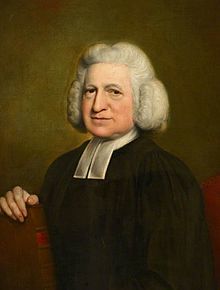
It started as a poem and was set to music later.
It did not appear in the Wesleyan hymn book until after 1875.
That year, it was paired with a Welsh tune and became singable.
According to Eunice Wernecke in her book Christmas Songs and Their Stories, Hyfrydol was:
composed in 1855 by Rowland Prichard (1811-1887), of Bala, Wales, who was a song leader, soloist, and composer. . . . The tune’s marked characteristic is the simplicity of its melody. . . . Being a happy tune and at the same time firm and smooth, it is an appropriate setting for this exhilarating hymn.”
(It’s worth mentioning Hyfrydol is also the tune used for Wesley’s “Love Divine, All Loves Excelling.”)
Who was Charles Wesley?
Charles Wesley and his brother John were the founders of the English Methodist movement. They were the sons of a clergyman of the Church of England, and they attended Oxford University.
While there, the brothers formed a “Holy Club” with friend George Whitefield. The group took exception to various behaviors in the Church of England. Because of their methodical personal religious habits, they became known as “Methodists.”
Both John and Charles became clergymen. Charles followed his brother to America in 1735 and spent a year in Georgia with him and Whitefield during the Great Awakening.
Charles returned to England, continued preaching, married a Welsh woman, and wrote some 6500 hymns during his 80 years of life (1707-1788).
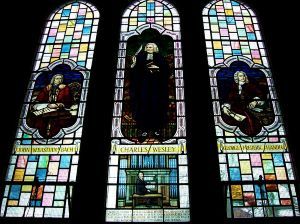 In august company at Birmingham, UK’s Cambridge Rd. Methodist Church
(Wikimedia Commons)
Devoted to Scripture, Wesley recognized the value of using the Bible in his many hymns. His themes generally focused on the love of God.
You probably know more of his hymns than you realize!
Tweetables
Based in Haggai, “Come Thou Long Expected Jesus” is an obscure Christmas carol! Click to Tweet
Why is “Come Thou Long Expected Jesus” a Christmas carol? Click to Tweet
The post Charles Wesley: “Come Thou Long Expected Jesus” appeared first on Michelle Ule, Author.


December 1, 2020
From Heaven Above to Earth I Come

“From Heaven Above to Earth I Come,” is a 1534 Christmas carol written by Martin Luther for his family.
This is one of many he wrote, and his German title is “Vom Himmel hoch, da komm ich her.”
Catherine Winkworth, a noted British hymnologist of the 19th century, translated it into English.
Fifteen verses to tell the story!
According to my friend Linda, who wrote a Christmas play about the carol, it tells the nativity story. The first five verses are the angels’ song.
It begins with the good news from the angels:
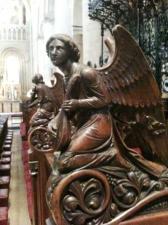 Angel in Christ’s Cathedral Oxford
1. “From heaven above to earth I come
To bear good news to every home;
Glad tidings of great joy I bring,
Whereof I now will say and sing:2. “To you this night is born a child
Of Mary, chosen virgin mild
This little child, of lowly birth,
Shall be the joy of all the earth.
Were these the angels in the field addressing the shepherds?
They certainly were full of glad tidings and joy when they announced the Savior’s birth.
Who Came Down from Heaven to Earth?
Surely that was a central question?
Sound like the Messiah, the Savior, to me!
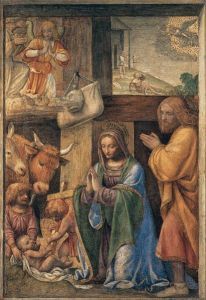 Bernardino Luini
 (Wikimedia Commons)
3. “This is the Christ, our God, and Lord,
Who in all need shall aid afford;
He will Himself your Savior be
From all your sins to set you free.4. “He will on you the gifts bestow
Prepared by God for all below,
That in His kingdom, bright and fair,
You may with us His glory share.5. “These are the tokens ye shall mark:
The swaddling-clothes and manger dark;
There ye shall find the Infant laid
By whom the heavens and earth were made.”
Luther uses the carol to explain who came and why he came.
Remember, most people had given up looking for the Messiah by the time of Jesus’ birth.
The neighborhood about the Judean hills was excited after the remarkable events of John the Baptist’s birth. But they hadn’t put together the real Savior was on his way.
The birth of God’s son was truly a joyous day!
He’s here from heaven. Now what?
So, what do we, the readers/singers, do with this knowledge?
It’s a birthday party, right? Let’s celebrate with the angels and shepherds!
6. Now let us all with gladsome cheer
Go with the shepherds and draw near
To see the precious gift of God,
Who hath His own dear Son bestowed.7. Give heed, my heart, lift up thine eyes!
What is it in yon manger lies?
Who is this child, so young and fair?
The blessed Christ-child lieth there.8. Welcome to earth, Thou noble Guest
Through whom the sinful world is blest!
Linda explained the seventh through fourteenth verses were the children’s song.
Looking ahead to Jesus’ life
It’s hard for us on this side of the history, to think of Jesus simply as that baby meek and mild.
He’s more than that and those of us who know what is coming in his life, can feel pricked by that same sword Simeon prophesied for Mary’s heart.

Thou com’st to share my misery;
What thanks shall I return to Thee?9. Ah, Lord, who hast created all,
How weak art Thou, how poor and small,
That Thou dost choose Thine infant bed
Where humble cattle lately fed!
These 1.5 verses remind us that while we’re celebrating a birth day, we’re also welcoming the Creator of the Universe into our world.
He came for our sakes, not his own.
Wait, who is this, really?
Martin Luther never lost sight of the God he worshipped. He always saw the contrast between God in heaven, and the world He sent Jesus to.
10. Were earth a thousand times as fair,
Beset with gold and jewels rare,
It yet were far too poor to be
A narrow cradle, Lord, for Thee.11. For velvets soft and silken stuff
Thou hast but hay and straw so rough,
Whereon Thou, King, so rich and great,
As ’twere Thy heaven, art throned in state.12. And thus, dear Lord, it pleaseth Thee
To make this truth quite plain to me,
That all the world’s wealth, honor, might,
Are naught and worthless in Thy sight.
The monk who recognized the truth of Jesus in the book of Romans, knew he was undeserving of such a Savior.
I recognized that, too, one Christmas.
But this is a Christmas carol!
So, let’s rejoice, along with Luther!
Christmas carols are for celebrating the Redeemer’s birth in the world.
How does His coming affect me, and Luther, and you, personally?
13. Ah, dearest Jesus, holy Child,
Make Thee a bed, soft, undefiled,
Within my heart, that it may be
A quiet chamber kept for Thee.14. My heart for very joy doth leap,
My lips no more can silence keep;
I, too, must sing with joyful tongue
That sweetest ancient cradle-song:15. Glory to God in highest heaven,
Who unto us His Son hath given!
While angels sing with pious mirth
A glad new year to all the earth.
The last verse, the fifteenth, was for the entire congregation in full throat!
“From Heaven Above to Earth I Come,” provides a full theological and singing experience for us during Advent.
It’s theologically rich, albeit obscure for me, personally.
Let’s sing it this Christmas!
Erin Bode: A Cold December Night
This is part one of “Obscure Hymns with Deep Theology,” written for December 2020.
Tweetables
What does the Christmas carol “From Heaven Above to Earth I Come,” mean? Click to Tweet
An obscure Luther Christmas carol with deep theological meaning. Click to Tweet
The post From Heaven Above to Earth I Come appeared first on Michelle Ule, Author.
November 24, 2020
Thankful in 2020

What are you thankful for in 2020?
Besides knowing it’s only five weeks until 2021?
During Thanksgiving week, I like to reflect and review reasons to be thankful in a given year.
2020 has proven a challenge, but I came up with five major categories
First, why be thankful in 2020?
Several years ago, I had a major disappointment.
I didn’t handle it well.
My hopes and dreams dashed up against reality and I had a difficult time “turning the prism,” and seeing anything positive.
I sulked, complained, whined, and made the people around me miserable.
I allowed myself two months to wallow, and then I knew I needed to release the issue and move forward.
But it was hard.
How could I get past all the disappointment?
So, while most people will agree 2020 has been one long disappointment, I’ve chosen to look for the good.
Five Reasons to be Thankful in 2020
Increased time with my husband
He plans to retire eventually.
Would we be able to spend hours, days, weeks, months, and even years together?
So far, so good.

We don’t get in the way of each other’s daily routine. He exercises early, I walk later.
We don’t necessarily eat breakfast or lunch together unless by coincidence.
I quit working at dinnertime and turn off the computer.
We talk, sit together, occasionally watch a movie at night, and read.
We’ve been married a long time. It’s working.
The ability to exercise
We had a beautiful spring, summer, and now fall (albeit a bit scorched) in Northern California.
With my gym closed, I walk about an hour every day.
 Photo by Gary Ellis (Unsplash)
I’m so thankful we live in a safe place. Our neighbors put in gardens and flowers bloomed profusely.
Interesting podcasts abound and I listen while I walk. (On my phone app: Women Worth Knowing, The Eric Metaxas Show, The Pastor Writer, God is Not a Theory, Historical Fiction Unpacked, Novel Marketing, Writing at the Red House, Blogging Bistro Podcast. I’ve been a guest on half of these shows.)
That hour is splendid and I’m thankful for fresh air and friendly waves along the way.
Learning Opportunities
This is the first time in nearly 30 years I did NOT lead a Bible Study.
(You’d think I’d be done talking by now, but the Word of God is new with every reading! LOL).
So, I purposefully chose to be a Bible student.
We have access to so many Bible study tools these days.
I’ve written before about how much I love the Bible Project–and how extraordinary it was to watch (three hours a night for five straight nights), the entire Biblical canon in one sweep.
I’ve learned so much from reading one Bible chapter a day of Calvary Chapel Santa Barbara’s teaching pastor David Guzik‘s commentary. (See EnduringWord.com )
 Photo by Icons8 Team (Unsplash)
On nights I don’t sleep or days when I’ve heard all my favorite podcasts, I listen to Enduring Word’s audio teachings.
On painful nights, I sometimes listen to two or even three hours of Enduring Word audio! (Which is how I got through Kings, Samuel, Luke, several minor prophets, and am now in Jeremiah!)
I’ve also been learning surprising Biblical lessons on healing and prophecy through Orbis Ministries.
And I just updated my Logos.com software.
Since the aforementioned husband is always around, conversations are lengthy and fascinating!
Thankful, even, for Zoom
I’d been using Zoom for several years, so I didn’t have a learning curve.
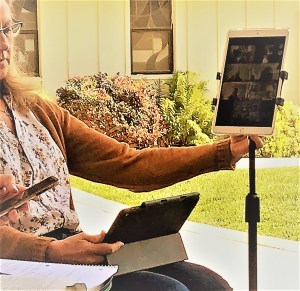 We’ve even learned to Zoom outside!
Still, even I get tired of it . . .
But, I’m so thankful it enables us to see our family and friends on screen regularly.
My Sunday school class meets via Zoom, and we’re very engaged.
These are wise folks who are usually too busy serving to see each other, so it’s been wonderful to share insights with them.
Work life, interviews, friendly people, Bible teachings. It’s all been good.
And for this Thanksgiving, the extended family will gather around their screens and toast two new babies–from wherever in the world we are!
Never Last: Thankful for God, Jesus, and the Holy Spirit
In his book, God Is Red: The Secret Story of How Christianity Survived and Flourished in Communist China, atheist author Liao Yiwu explored the secret.
It basically came down to two facts. Christians, despite persecution, believed two things about God and their relationship with Him:
He would never leave nor forsake them.He provided a peace that passed all understanding.
Those facts are true for all of us and bear thankfulness:
Do not be anxious about anything, but in everything by prayer and supplication with thanksgiving let your requests be made known to God. And the peace of God, which surpasses all understanding, will guard your hearts and your minds in Christ Jesus.
Finally, brothers, whatever is true, whatever is honorable, whatever is just, whatever is pure, whatever is lovely, whatever is commendable, if there is any excellence, if there is anything worthy of praise, think about these things.
Philippians 4:6-8
What are you thankful for today?
Tweetables
5 Reasons to be Thankful in 2020 Click to Tweet
So much to be thankful for in 2020! Click to Tweet
The post Thankful in 2020 appeared first on Michelle Ule, Author.
November 17, 2020
What is a Christmas Carol?

It’s Christmas carol time.
Many folks have sung Christmas-themed songs since childhood.
But what are they?
What does “Christmas carol” mean?
Songs sung in December with a theme revolving around Christmas.
Carol means song or hymn.
That’s pretty simple.
They’ve been around for a long time.
The first noted Christmas-related hymn was written and sung to celebrate Jesus’ birth at a church service in 129 Rome!
The Christmas carol received more wide-spread writing and singing as early as the fifth century.
Those were written in Latin. (How many of us can sing “O Come, O Come Emmanuel” in 12th century Latin? (“Veni,veni, Emmanuel,” or even “Adeste Fidelis?”)
Francis of Assisi began writing “nativity plays” in the 13th century.
The people in the plays sang songs or ‘canticles’ that told the story during the plays. Sometimes, the choruses of these new carols were in Latin; but normally they were all in a language that the people watching the play could understand and join in! The new carols spread to France, Spain, Germany and other European countries.
The History of Christmas Carols
Martin Luther and Christmas
German Reformer Martin Luther loved Christmas and many traditions we celebrate today originated in him.
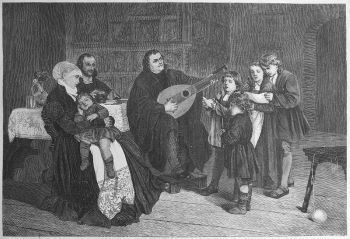 Luther family singing (Wikimedia Commons)
Most notably: the Christmas tree, Christmas carols, and presents opened on Christmas eve.
He was such a reformer he “shifted” the concept of The Feast of St. Nicholas (December 6) to Christmas Eve.
(That later morphed into the Santa Claus tradition–which was not Luther’s idea or intention).
Luther wrote a famous Christmas carol still being sung, “From Heaven Above to Earth I Come.” (Total giveaway, it’s to the tune of “A Mighty Fortress is Our God,” Luther’s greatest hit.)
Why would Christmas music be controversial?
Are you a Puritan?
They influenced traditional celebrations–as in none–and England didn’t sing much during the 17th century.
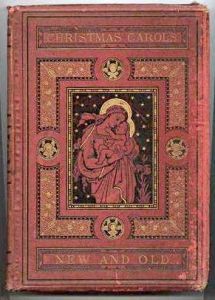 1871 caroling book
 (Wikimedia Commons)
People sang them in private, so Christmas carols didn’t disappear, but they weren’t sung in public for many years.
Queen Victoria’s husband, Prince Albert, was raised in Germany. He loved Christmas celebrations, including the tree, and wanted to share them with his children.
Two British music-lovers, William Sandys and Davis Gilbert visited villages, wrote down the songs, and soon singing Christmas carols returned to the community.
Christmas caroling–groups of people in the frosty snow visiting homes to sing holiday music–became popular as a result.
Who wrote Christmas carols?
Who didn’t?
Up until about the 18th century, most carols were written in and for church settings.
Thus the writers were bishops, monks, priests, pastors, and choir directors.
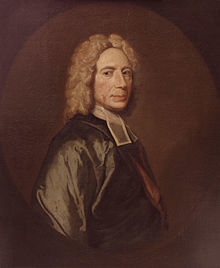 He wrote “Joy to the World!”
(Isaac Watts; Wikimedia Commons)
Some of the most famous popular religious carols still sung were written by Isaac Watts, Felix Mendelsohn, and Charles Wesley.
After the popularization of the holiday in the 19th century, however, writers came from all walks of life and faith (or even non-faith). They include Irving Berlin, James Lord Pierpont, and even Mariah Carey!
Here’s a list of the most popular Christmas “singles” in the United States.
Doesn’t everyone enjoy hearing Bing Crosby croon? (Yes, but for a whole album, I prefer Nat King Cole.)
Regardless of the type, the voice, or even the meaning, enjoy Christmas singing this year!
A Christmas carol quiz!
Here’s some fun. Can you guess these carols?
 Unknown cartoon found in my files.
 Tweetables
What’s a Christmas carol? Click to Tweet
It’s that time of year! A Christmas carol quiz! Click to Tweet
Christmas-Carol-Quiz-and-AnswersDownload
Enjoy!
The post What is a Christmas Carol? appeared first on Michelle Ule, Author.
November 10, 2020
A Kindred Spirits Devotional
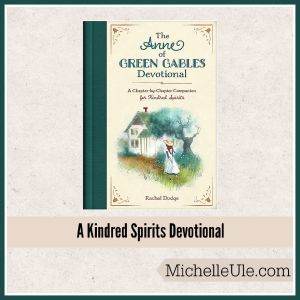
The Anne of Green Gables Devotional: A Chapter-by-Chapter Companion for Kindred Spirits by Rachel Dodge released November 1, 2020.
It’s charming, delightful, and wise.
Just like Anne of Green Gables!
Indeed, I bought five copies of the devotional. Don’t tell the girls what they’re getting for Christmas!
It’s perfect for kindred spirits–girls or otherwise– who love the books, the movie, or devotionals.
What’s a Kindred Spirit?
Kindred spirits are people who “get” you. They love the same things you love, share your interests, and are dear friends.
As Anne herself explains:
“True friends are always together in spirit.”
and
“Kindred spirits are not so scarce as I used to think. It’s splendid to find out there are so many of them in the world.”
Anne of Green Gables
Over the course of the 1908 novel, orphan Anne discovers there are more “helping people,” to love her than she ever knew. They became kindred spirits.
What does that have to do with a devotional?
Who loves you best but God?
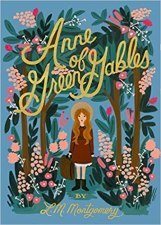
Dodge examined Anne of Green Gables to draw out spiritual truths from every chapter.
I’ve read all the books and seen the movies countless times since childhood.
This devotional brought to mind all the priceless scenes following Anne’s youth in Avonlea on picturesque Prince Edward Island, Canada.
Dodge took those scenes and applied spiritual truth and Biblical verses to explain them in a way I hadn’t seen before.
The 40 chapters left me encouraged, thoughtful, and thankful I grew up, as did my children, with such an excellent model for living.
Indeed, while the book’s author, L. M. Montgomery, didn’t set out to write a Christian young adult novel, she managed to infuse it with many Biblical truths.
Dodge pointed them out.
Who is Rachel Dodge?
 Rachel Dodge
A literature and writing teacher, Dodge is also the author of Praying with Jane: 31 Days Through the Prayers of Jane Austen.
I wrote about that splendid devotional here.
Dodge brought to Anne of Green Gables an affection for Anne with the spiritual eyes of adulthood. (She’s loved the novel since her mother gave it to her as a young girl.)
She designed the Anne of Green Gables Devotional with readers of all ages in mind, including children.
Each daily entry has a thought for the day from a chapter of Anne of Green Gables, a Bible verse to read, and a prayer to pray. I hope you enjoy growing in your faith with Anne Shirley!
To aid parents who may be reading along, Dodge posted a guide to match chapters in the book.
Dodge’s devotional highlights what is eternal about Anne’s story.
I wish I still had a child at home to read through this book with me.
What about the movies?
I hope you’re asking about the Kevin Sullivan films made in the 1980s and featuring Megan Fellows as Anne? (Forget the rest).
That’s exactly where I turned after I finished the devotional. (My books are visiting elsewhere).
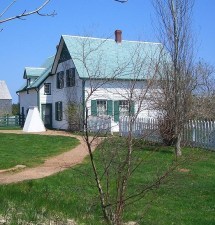 Green Gables on PEI today.
 Photo by Chensiyuan
(Wikimedia Commons)
We watched the first two (never the awful third), and smiled in memory all the way through.
My grandchildren have all watched those two movies (hearing how their fathers enjoyed them as children) and are knowledgeable and conversant with Anne, Marilla, Diana, Matthew, and the ever-faithful Gilbert!
I gave them to red-headed relatives when they were young and on sad days, one of them still curls up with the film and books.
The author and Anne’s legacy
L.M. Montgomery, the author, was married to a Canadian clergyman and authored many other books.
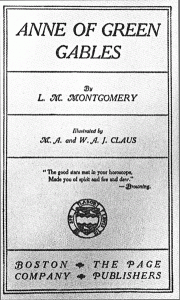 The original front page
 (Wikimedia Commons)
Anne’s story is the one that has reverberated ever since. Montgomery did not have an easy life, but she infused Anne’s character with lessons that can help us all grow into our challenges.
Millions of readers loved the book, including Mark Twain!
Twain said Anne was “the dearest and most moving and delightful child since the immortal Alice.”
According to Wikipedia, Lucy Maud Montgomery was the first Canadian woman to be named a fellow of the Royal Society of Arts. She was invested Officer of the Order of the British Empire in 1935.
Montgomery might not have thought she wrote a great work of literature, but Anne Shirley’s life and story have well stood the test of time.
Not bad for a red-headed orphan who now has a book of Christian devotions written about her!
Anne of Green Gables is out of copyright. You can read a free PDF here.
Tweetables
A wonderful devotional for kids and adults alike based on Anne of Green Gables! Click to Tweet
Anne of Green Gables, God, & life for kids & adults! Click to Tweet
The post A Kindred Spirits Devotional appeared first on Michelle Ule, Author.
November 3, 2020
The Didache and Christians
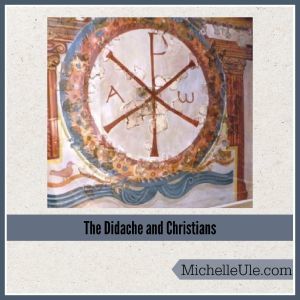
Do you know what The Didache is? (DEE-Da-Kay)
I didn’t either until a teacher recently mentioned it in passing.
“You might consider looking at The Didache to learn how the first century Christians treated each other.”
He warned it wasn’t Scripture, it’s not part of the Bible.
It’s a short book for first-century Believers to apply what they knew about Jesus to their fledgling church life.
The Didache ≠ Scripture
The actual title is “The Teaching of the Twelve Apostles to the Nations, Known as THE DIDACHE.”
Scholars believe it was written about 65-80 AD/CE. That period began within a few decades of Jesus’ death. It included the years when the Romans destroyed Jerusalem.
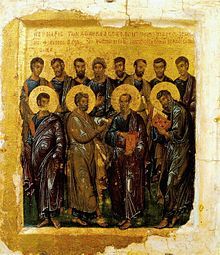 The Twelve Apostles
 (Pushkin Museum, Moscow)
(Wikimedia Commons)
(By the way, few, if any, Christians were in Jerusalem by 70 AD. Most heeded Jesus’ warning and fled.)
Christian Apologetics and Research Ministry provided insight:
The work is cited by Eusebius who lived from 260 – 341 and Athanasius 293-373. In the Didache, 16:2-3 is quoted in the Epistle of Barnabas in 4:9, or vice versa. The Epistle of Barnabas was written in 130-131 A.D.
The Didache is not inspired but is valuable as an early church document.
Wikipedia weighs in:
The Didache is considered part of the group of second-generation Christian writings known as the Apostolic Fathers.
Written in Koine Greek, it’s considered one of the first forms of “Church Orders.” It describes how Jewish Christians should adapt to Gentile Believers. (See many of Paul’s writings on this subject in the New Testament!)
Where did the Didache come from?
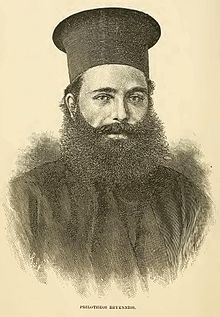 Philotheo Bryennios
(Wikimedia Commons)
An Eastern Orthodox Arch-Bishop, the Greek Metropolitan, Philotheo Bryennios discovered the ancient manuscript in Jerusalem Monastery of the Most Holy Sepulchre.
(He also found other ancient manuscripts experts dismiss as “spurious”).
A well-educated professor, Bryennios recognized he’d made a significant find. While third and fourth centuries Christian writings had referenced the work, no one had seen it for 1700 years.
He published The Didache in 1883.
So, what’s in it?
Or, why should I look at it if it isn’t really Scripture?
The Didache is in the public domain. You can download it for free, which is what I did. The PDF is here.
It’s only 17 pages long, and I read it out of curiosity.
So many changes happened to those believers in the first century–particularly after Jesus went to heaven and the Holy Spirit came.
They didn’t have our advantages. They didn’t have a written Bible. While the priests could read the Torah and the Old Testament on scrolls at the temple, if you had a question, you couldn’t read it yourself. (Of course, there was no temple after 70 AD/CE)
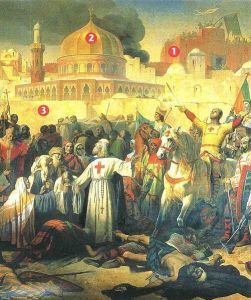 1 Church of the Holy Sepulchre, 2. Dome of the Rock. Émile Signol: Crusaders free Jerusalem (Wikimedia Commons)
In the period after Jesus died and Paul began writing his letters, many questions and questionable practices arose.
Having a small portion like The Didache could help followers understand the new Way.
It reads much like the Gospel of Matthew.
To me, like a simple version of the Sermon on the Mount.
The Didache samples
The English version linked above is full of cross-references. Here’s a sample from the opening:
There are two ways, one of life and one of death, and there is a great difference between the two ways.
Cross references: Jeremiah 21:8; Matthew 7:13
The way of life is this. First of all, you shall love the God who made you.
Second, love your neighbor as yourself.b And all things you would not want done to you, do not do to another person.c
b: Leviticus 19:18; Matthew 22:37-39; c: Matthew 7:12.
All those statements sound familiar to me.
As I read through the work (in about ten minutes), not much surprised me.
But there was this:
You shall not practice sorcery.z You shall not murder a child by abortion, nor kill a child at birth. You shall not covet your neighbor’s things.a
z: Deuteronomy 18:10; a: Matthew 5:40
The conclusion has a reference to The Epistle of Barnabas 19:8. I’d never heard of The Epistle of Barnabas, which took me on a search.
Here’s the conclusion:
Beware, lest anyone lead you astray from this way of righteousness, for he teaches apart from God.
For if you can bear the whole yoke of the Lord, you will be perfect; but if you cannot, do as much as you can. t
t: The Epistle of Barnabas 19:8.
I didn’t read anything in The Didache which sat poorly in my soul.
Do we need to read the early Christian letters?
No.
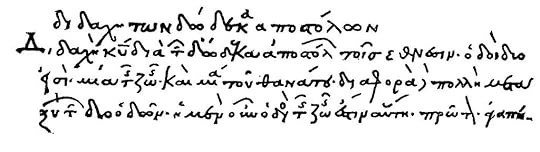 The Didache opening lines. It’s Greek to me. (Wikimedia Commons)
We don’t need to read the Apocrypha either–I haven’t.
But, they can be illuminating if we’re curious about what the church was like in its early days.
Think how hard it would have been for those early Christians–particularly the Jews.
Their temple, the place where they sacrificed for their sins, was destroyed.
Jesus came to earth and died in a shocking way. How did they live without Jesus?
He sent the Holy Spirit to enlighten His followers. Men who knew Jesus wrote about Him: John, Peter, Luke. And then the Apostle Paul saw the light and explained all.
The book of Acts is full of dynamic changes. Galatians, Ephesians, 1 and 2 Corinthians, all deal with early church issues.
And then, of course, the book of Romans puts everything into perspective.
But, for an historian like me–and maybe some of you–it’s interesting.
I try to wrap my mind about what early Believers were thinking. How did they know what was Scripture? Who could you trust?
(See LaTayne C Scott’s fine book about Priscilla and Aquilla: A Conspiracy of Breath. Or, Tessa Afshar’s Bread of Angels or Thief of Corinth.)
Believers at the time wanted to know, too. The Didache allowed them to get a sense of what Jesus taught and how they should live in their house churches.
Fortunately for us in 2020, we can hold a book of God’s words to teach of us.
All we have to do is open it up and read the truth.
Tweetables
What is The Didache and why should I care? Click to Tweet
Is there value in non-canonical early- Christian writing? Click to Tweet
The post The Didache and Christians appeared first on Michelle Ule, Author.
October 27, 2020
Entering Babylon’s Gate

We walked through ancient Babylon’s gate one day.
It’s now located in Berlin’s Pergamon Museum.
They call it the Ishtar Gate.
We visited the museum shortly after I finished teaching a Bible study on the subject, but I didn’t know exactly what this gate was.
Travel guru Rick Steves told us to stop in and marvel. I didn’t pay attention to why.
I stepped into the corridor and stopped in my tracks, my mouth dropping open.
Lions roamed the gate and the hallway.
This was Daniel’s gate!
Nebuchadnezzer II (604-562 BC) built it.
Why is Babylon’s gate in Berlin?
 The excavation site, 1930
(Wikimedia Commons)
German archaelogists found it and shipped it home.
According to information in the museum,
At the very beginning of the evacuations in Babylon in 1899, the architect Robert Koldeway’s attention was drawn to pieces of broken blue-glazed bricks. Subsequently, evacuation were started in the area of the city in which they appeared particularly frequently.
Pergamon Museum
They found a jumbled pile of the glazed tiles and after negotiations with the then-Ottoman Empire, shipped the first batch back to Berlin in 1903.
500 crates worth of broken tiles, carefully marked from where they found them, followed suit after World War I.
The rebuilding of Babylon’s Ishtar Gate and Processional Way in Berlin was one of the most complex and impressive architectural reconstructions in the history of archaeology.
Hundreds of crates of glazed brick fragments were carefully desalinated and then pieced together. Fragments were combined with new bricks baked in a specially designed kiln to re-create the correct color and finish.
Wikipedia
Or, “like a 2500 year old Babylonian jigsaw puzzle,” Steves wrote in his Germany guidebook.
This exhibit is only the smaller front gate. Because the other half of the double gate is too big to display, they stored it in a museum warehouse.
The site is located in modern day Iraq.
 Photo by Annemarie Schwarzenbach Swiss National Library (Wikimedia Commons)
Lions everywhere!
I love seeing lion statuary all over the world, especially in Europe.
But, the thought that this was a gate through which the Old Testament prophet Daniel must have walked, overwhelmed me.
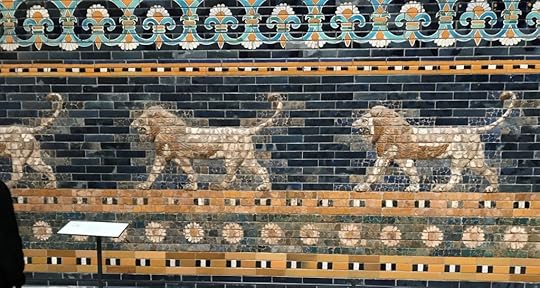
Imagine, walking down a long corridor, lined with lions, to enter the grand ruler’s citadel. And then later, meeting the despot’s lions in person!
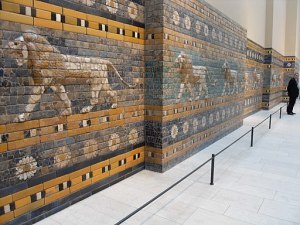 Photo by Jonomac46 (Wikimedia Commons)
Daniel and his Jewish friends Sharach, Meeshah, and Abednego were young men taken from Jerusalem to serve the Nebudchadnezzer. The book of Daniel tells their story.
I wanted to touch a glazed tile, marveling Daniel could have seen or touched one, too.
I knew better, of course, but the beauty mesmerized me.
The dust from the Israelites, and other prisoners, touched these tiles more 2500 years ago. How could that be?
That’s the reason history and the Bible can feel so very close.
Or, as Calvary Chapel Santa Barbara teaching pastor David Guzik said in his audio commentary on Daniel 5, “Don’t you love it when the Bible confirms archaeology?”
Pergamon Museum presentation
The museum does a fine job of showing how the gate appeared in Babylon.
Several displays show what the gate looked like in place, particularly the processional walk.
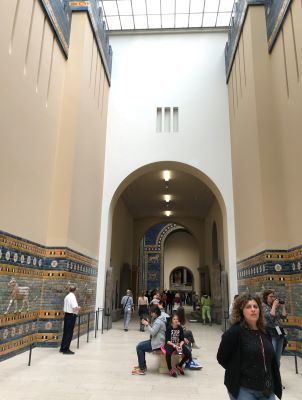
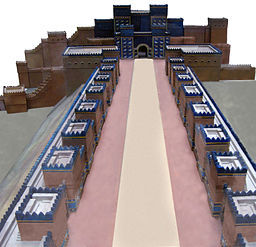
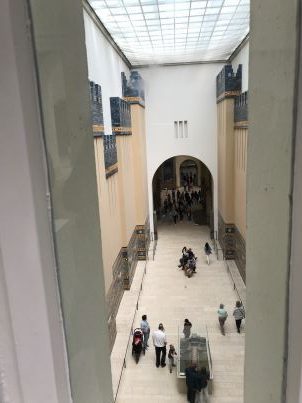 The corridor is long, as you can tell from the middle museum mock up, and from above.
The Ishtar Gate was only one Babylon gate of eight total.
11 miles of wall surrounded Babylon and 200,000 people lived there.
The gate stood 46 feet tall and 100 feet wide. The processional way stretched as far as half a mile.
Other than an American Space Shuttle which I saw in Los Angeles, this is one of the largest indoor museum exhibit I’ve ever seen.
But, what happened when I walked through the gate?
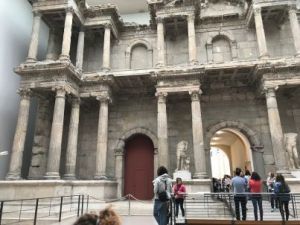 I faced Rome’s Market Gate of Miletus!
Rome!
Tweetables
Astonishing: the OT prophet Daniel walked through this gate. Click to Tweet
Visiting ancient Babylon’s most beautiful gate in Berlin. Click to Tweet
The post Entering Babylon’s Gate appeared first on Michelle Ule, Author.
October 20, 2020
Fire Lessons–2020

We learned more fire lessons in 2020.
Some of you will remember we learned a lot in 2017.
Well, there’s always room for additional wisdom, especially during and about natural catastrophes, isn’t there?
Fire Lessons #1: Preparation Helps
Local tools have improved in the last three years. Cameras located all over northern California provide us with up-to-the-minute shots of potential hot spots.
They’re bookmarked on our computers, along with maps showing the current status.
Practice helped us review them, real time.
We followed the maps and the fire cameras for several days. Together, we made strategic decisions.
 Looks clear today!
We watched and debated if the fire would cross 15 miles over the hills–rugged mountains, green vineyards, relatively empty landscape–to our neighborhood.
Too often, we stood on the front lawn facing east, to watch smoke billowing into the sky.
Our Neighborhood Page and the Sonoma County Firestorm Facebook page were of enormous help.
I followed the discussions and warnings. We froze ice for the refrigerated food.
When the fire reached a vineyard owned by friends, I calculated the distance.
Nine straight miles away and north of us, with little in between. That’s when we started packing.
(This is where Facebook provides value. We only left our house in 2017 because friends took the time, while careening down narrow rounds dodging burning trees, to post they were fleeing. They lived only 5 miles away).
Oh, and the air quality index website is now bookmarked on our computers. That helps, too.
Fire Lessons #2: Don’t Wait
We were asleep in 2017. A phone call from our son alerted us to danger.
Because the smoke was blowing southwest on that horrific night, we weren’t particularly worried.
I packed for several hours, watched the sky, conferred with neighbors, desperately sought information on the Internet, and finally concluded we needed to leave.
The black sky in the hills north of our house was filled with flickering red reaching high and ominous.
In 2017, I sat in the car two blocks from my house for an hour inching my way to the main artery a mere mile from our house.
I watched flames advancing down the hills that year, in my rear view mirror.
I never want to do that again.
In 2020, we decided to leave early rather than wait until the mad rush out.
 2 hours after we left in 2020. We live 5 blocks toward Mordor.
(Photo by Dino of Dino’s Greek Food on Facebook)
Just after calculating the distance from the winery to our house, we got the NIXILE putting us into an evacuation warning status.
Because we knew what we wanted to take, we got things into the cars in an orderly manner and took off 45 minutes later.
The sky looked terrifying.
I took a different route to the main artery, and as I sat in traffic waiting to turn right (5-minutes in 2020), our neighborhood went into mandatory evacuation.
Hearing those “high-low” sirens in your neighborhood is electrifying.
This time the heavy traffic got me on the artery in time to watch all the “lights and sirens” scream pasts us toward the fire.
Fire trucks, sheriffs, police, and then two enormous flat bed trucks carrying gigantic bulldozers.
Just as in 2017, I didn’t realize until I sat in traffic, “this is serious.”
Fire Lessons #3: Anticipate Strong Emotions
Adrenaline flooded at the sight of flames.
Our local family gathered at my son’s house between 9:30 and 10 pm. While most sort-of went to sleep, my daughter-in-law and I were wide awake.
We scanned social media, checked the news, and at 2:30 in the morning, I watched firefighters light backfires a block from my house.
We remained awake and vigilant most of the night.
At 6:15 am, our relative returned my message and said of course we could go to the coast house. What a relief!
At 6:30, our son’s home came under mandatory evacuation
We took off before the high-low sirens and headed southwest.
My husband and I stopped to purchase groceries.
Suddenly, I felt totally lost. I couldn’t think. What did we need? What should we buy?
Surprised by my hesitation, my husband said, “Choose enough for three days.”
Three days. I could do that.
But then, in the produce department, I felt overwhelmed. “I’m a fire refugee. Again.”
I leaned against him and cried.
I didn’t think our house would burn.
But I didn’t know.
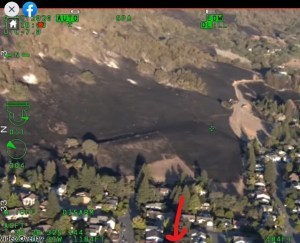 Our house is three down from the red arrow. We saw this Cal Fire map four days later.
Feeling like a refugee–and kindness
Intellectually, even at the moment, I understood my “refugee status” is not what most of the world is enduring.
I wasn’t wearing an old life vest riding in a deflating Zodiac across the Mediterranean with just a phone in my pocket.
My chiding brain kicked in: “You have money, you have jobs, you have relatives who will take you in. No one died. You can find everyone. You’re not a ‘real’ refugee.”
That was my brain. My heart and my emotions were a mess.
I couldn’t manage checkout. I went to Starbucks to buy coffee and breakfast.
But, I hadn’t been to a Starbucks in eight months. Tears overwhelmed.
The kind Starbucks employees walked me through the choices. My husband arrived in time to use his credit card.
Residents of the coastal town, too, were very kind.
Even after we learned our house survived, I felt brittle and shaky.
It can take a long time for the alert/flight response to calm down.
Be kind–to each other and to yourself.
#4: Focus on Being Thankful
In heightened sensitivity, I spent my time–when I wasn’t freaking out–focusing on all the things for which I was thankful.
There are so many, just as in 2017:
All the first responders, of course.The reporter on the scene who explained, “The bright yellow and red lights you’re seeing are not from fire. They’re the emergency vehicles’ lights.” Burning homes are bright white with heat.The many people who prayed for us. The many who texted me their prayers and love as I evacuated with a palpitating heart and a yowling cat.My training from the Dark Ages as a newspaper reporter, which enabled me to set aside emotions and calmly interpret the scene for others. (Before falling apart again).All our past experiences and training. “We’ve gotten too good at this,” my husband said.Our neighborhood came through fine.No one died in the fires.Mr. Rogers’s quote about children looking for the helpers in an emergency is always good to remember. They were everywhere.The generosity of our relatives, yet again.The God who never leaves us nor forsakes us. Who has a plan for all of us and it is good–no matter what happens.
Tweetables
4 Fire lessons learned in 2020. Click to Tweet
What’s it like to go through a wild fire in 2017 and 2020? Click to Tweet
Do you ever get used to a wildfire evacuation? Click to Tweet
The post Fire Lessons–2020 appeared first on Michelle Ule, Author.
October 13, 2020
Who was W. E. Blackstone?

Have you ever heard of W. E. Blackstone?
Was he important?
If you’re interested in Christian world evangelism, he was.
The self-educated evangelical’s 1878 book, Jesus is Coming, sold millions of copies in the late-nineteenth century.
Blackstone’s basic facts
Born in 1841 New York, William Eugene Blackstone grew up in a Christian home that stressed devotion and service to God.
Sharing the Gospel and helping others was central to his family’s life.
Physically weak, WEB (his preferred nickname) applied to join the Union Army during the American Civil War.
Authorities turned him down but he volunteered through the U. S. Christian Commission–a group similar to the Red Cross.
Following the war’s end, WEB married and moved to Chicago where he worked as a real estate developer.
Once he achieved financial success, he left his business behind and devoted the rest of his long life to God.
Jesus is Coming
Described as a “veritable reference source of American thought,” Jesus is Coming uses Scripture passages and Blackstone’s enthusiasm to remind readers Jesus is coming back.
Published by Moody’s brother-in-law Fleming Revell, it popularized the idea of premillennial and post-tribulation eschatology.
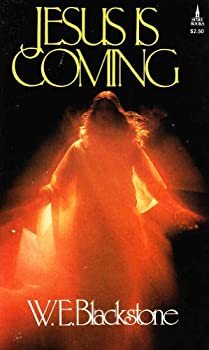 Who knows how many editions?
It was translated into 48 languages. Blackstone gave away the book for free. (Click on the link to read it free yourself).
As one reviewer wrote:
It is a wonderful book which proves by scripture the end time scenario of the rapture of the church and the establishment of the Jewish led Kingdom of God on earth as heaven and earth come together at the end of Revelations.
Amillienialists beware. Dispensationalists rejoice.
Amazon review
WEB had no formal religious training beyond years of personal Bible study and teaching, as well as ministries within a wide variety of churches and para churches.
His friend Dwight L. Moody supported and encouraged him.
One of the hallmarks of Dispensationalism is a belief that God has never abandoned his special relationship with the Jewish people.
Embracing the concept, WEB sought the reintroduction of the Jews to Judea in Palestine.
He also launched the Chicago Hebrew Mission in 1887.
Blackwell Memorial
By 1880, the Ottomans had ruled the Holy Land for more than 300 years.
Blackstone traveled through parts of Europe during this period and after witnessing how Jewish people suffered, decided to do something about it.
(See the movie Fiddler on the Roof to get a sense of how Jews were persecuted in Russia at this time).
An inveterate head of committees and organizations, WEB began to organize as “God’s Little Errand Boy,” to find a solution to the persecutions sweeping the continent.
In 1891, WEB and 413 other notable Americans signed a letter or memorial to then US President Benjamin Harrison. Called the “Blackstone Memorial,” the letter went to all heads of the US government, including the Chief Justice of the Supreme Court.
It called for American and world support to create a humanitarian solution to the Jewish suffering in Russia.
He urged the Ottoman Empire to allow Jews to return to Palestine.

Published in the Chicago Tribune, not much came of the memorial, though 25 years later, his work inspired others to consider WEB the “Father of Zionism.”
California and China
WEB traveled the world founding organizations and schools.
Sharing the Gospel with everyone was his goal.
Following a move to California at the turn of the century, he became the first dean of Biola College‘s education program.
He helped develop a “Jewish Department,” and taught missionary classes.
During his travels, WEB often met poor young Christians. He paid for their travel and educations at Biola–specifically for training in Gospel work back home.
He was “all in” for the Gospel.
WEB sailed for China in 1909.
As a trustee of Biola’s Lyman and Milton Stewart Fund, Blackstone and his colleagues gave out Bibles, Bible portions, and Gospel tracts.
He returned home, 70 years-old in 1914. They had handed out 33,000,000 Bibles.
The Oriental Missionary Society
Charles Cowman met Blackstone in either Chicago or Los Angeles, perhaps through Moody’s Church.
He was so taken by the concepts of Jesus is Coming, Cowman took a leave from his job at Western Union to study the book. He wanted to make sure it lined up with the Bible.
As a result of the book, Charles and Lettie Cowman decided to support evangelism as much as possible.
Cowman began to donate the majority of his considerable salary to evangelism. At one point, the couple took in two women boarders so as to donate the rent money to missionaries
In 1916, the Cowmans were in Los Angeles fundraising on behalf of the Japanese Great Village Campaign.
In need of funds, Charles Cowman made an appointment and shared the story with WEB.
Blackstone wrote a check for the 2020 equivalent of $375,000.
Going one step further, he underwrote the travel costs for ten men headed to Japan, thus enabling the Great Village Campaign to complete the project in 1918.
William Eugene Blackstone died in Glendale, California in 1936 at the age of 95.
He didn’t live long enough to witness the creation of Israel in 1948, but by the end of his life, had distributed over $3,000,000 for missions.
Rev. Steve Williams published a biography about him in 2020: Rev. William E. Blackstone: A Trailblazer of the Church.
Tweetables
A remarkable missionary & early Zionist: W. E. Blackstone. Click to Tweet
The “Father of Zionism,” as a Christian dispensationalist. Click to Tweet
The post Who was W. E. Blackstone? appeared first on Michelle Ule, Author.
October 6, 2020
Overcoming the Mother Tongue.

The “mother tongue” trips me when I’m writing and often makes me laugh.
I’m referring to the language I learned, well, from my mother.
Which is how my English dictionary defines it, too, or “the language learned as a baby at home before a child goes to school.”
You’ve got one, too!
What’s the issue with the mother tongue?
If you were raised by English (fill in your own language) teachers who also spoke with correct diction, care with usage, and proper grammar, this may not be an issue for you.
My mother taught P. E.
A college graduate, she spoke English and wrote just fine.
But it wasn’t her native tongue.
I never gave much thought to it until my writing started being edited.
Oh, my. This writer with a degree in English Literature twists the grammar all the time.
But, I’m generally not erring with verb tense issues which often trip people.
It’s the placement of the noun and the subsequent commas trying to wrangle the grammar into place.
Mom’s native language was Italian.
I’m skipping around with the romantics over here!
What difference does it make?
For most people, none.
 Photo by Sai De Silva (Unsplash)
 Indeed, the influences of our native languages give our conversation flair, fun, interest.
Malapropisms, “the usually unintentionally humorous misuse or distortion of a word or phrase,” make us laugh. (See Richard Sheridan’s play, The Rivals, or listen to anything Yogi Berra said.)
Colloquialisms, “an informal word or expression that is more suitable for use in speech than in writing,” are absolutely appropriate in dialogue.
However, they indicate something different about the author when they crop up like weeds in professional writing.
Few people listening to me would think I have a mother tongue problem.
I didn’t think I had a problem with language.
I felt confident until an editor took a red pencil to my work, and worse, Grammarly started commenting.
Learning Language
We learn our native language first through words, then sentences, and so forth. Grammar and reading come later.
God designed us for communication and that’s why we’ve got two ears and one mouth!
In my case, I learned English from my Sicilian native mother, mutt American father, and Croatian babysitters in a multi-lingual town.
I turned out to be a musician and I have an ear for how things sound. Music, yes, but also the way people express themselves and their word choices.
I grew up loving the accents–everyone I knew had some sort of accent or swirl to the way they spoke and the words they used.
The zest of French intrigued me. Slavic languages sounded dense and ponderous; I’d always tense up–was someone in trouble?
The Cuban Spanish whispered by Anamaria Pestana (what a lyrical name!), sounded rounded and I could almost smell roses.
 I was spared German articles
Photo by Jonathan Kemper (Unsplash)
Texans in my family drawled slow and laconic, stuffed with images that meant nothing to a city girl.
My Sicilian grandmother trilled high and half the time reminded me of the chickens she tended.
But I added them all to my speech, and used them in the stories constructed in my imagination and whispered in my dreams.
How does the mother tongue influence?
I’m editing these days. I’m aghast at the gnarled sentences I wrote. The Grammarly extension is horrified as well–though it does like my “impressive” vocabulary. (Thanks, Dad).
Sentence by sentence, I read through the manuscript–first in paper, now on the computer again. For the twentieth time.
(Of course, I’ve run spell and grammar check many, many times. I can’t explain how poorly Word’s version of Spellcheck is failing me.)
There on the page, I see my mother tongue. More specifically, my mother’s.
I shake my head. Grammarly insists, and it’s right, the expression is “a couple OF hours,” not “a couple hours.”
Hey. That’s how I heard it. Why would I think differently? (Of course, I had it wrong).
My mom and her sister both would begin a sentence with a gerund/verb, and then put the noun in the middle.
Example: “Wearing a blue cotton dress, Gloria paused to brush off the red dust.”
That’s not necessarily an incorrect sentence, but when you reread it with an editor’s eye, can you see how it tumbles unnecessarily?
It’s far clearer to write, “Gloria paused to brush off the red dust from her blue cotton dress.”
My mother tongue did that to me.
So what?
In normal life, it doesn’t matter at all.
Indeed, the influences of our mother tongues make our speech and conversation more interesting.
We learn new ideas, new ways of expressing thoughts while encountering different language usages.
That’s why English is such an elastic language, and what makes it fun.
In speaking, your word choices and grammar may or may not make a difference.
But it does in writing.
I’m a writer. I just finished writing another book. The grammar needs to be correct. The colloquialisms need to be tamed. (I wish it had a malapropism because I think they’re hilarious. Alas, no.)
With the editing now done, I (wait! is that clear?) can now hand the manuscript off to a professional and not be so concerned my mother tongue will betray me.
And if it does?
Well, in the immortal words of Yogi Berra: ” It’s like déjà vu all over again.”
Tweetables
Wrangling the mother tongue into proper English. Click to Tweet
Adventures in editing: taming the mother tongue. Click to Tweet
The post Overcoming the Mother Tongue. appeared first on Michelle Ule, Author.