Michelle Ule's Blog, page 24
July 6, 2021
What are Bible Women and how to Become One.
Bible Women have been of great importance in the world of evangelism for a long time.
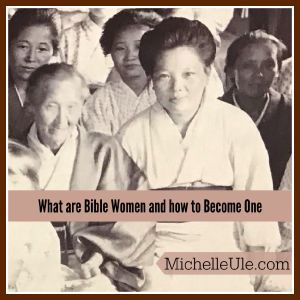
But I’d never heard of them before I began research on Lettie Cowman.
The Oriental Missionary Society (OMS) deliberately trained women at the Tokyo Bible Institute because of their effectiveness.
So, what are Bible women?
In missions history, a Bible woman was a local woman who supported foreign female missionaries in their Christian evangelistic and social work.
https://en.wikipedia.org/wiki/Bible_woman
Think how effective a local woman could be in a new mission field.
W hen Hudson Taylor’s work began in China, women did not have a “voice” within society.
Women have often tended to be more interested in the Gospel at first than busy men, and with ears tuned to the life-giving word of Scripture, often become Christians much sooner than their menfolk.
 Miss Hartwell and Bible women in the Foochow Mission, 1902. (Wikimedia Commons)
(Cheryl Brodersen explains this better in the Women Worth Knowing podcast about Priscilla Studd, 17 minutes in.).
As a result, a local woman had more access to other women than a western male missionary could ever gain.
She had a unique knowledge of the local culture and the lives of her sisters.
Using the Bible, often reading it to women who were illiterate, Bible women could explain the liberating news that God not only sees them but He loves them.
(The same is true for you, no matter your sex).
The Importance of training Bible WomenComing to faith is the first step. Training women to read and understand the Bible so they could share it with authority and confidence was the second step.
The OMS knew the importance of training women before founders Juji Nakada, Charles, and Lettie Cowman arrived in Japan in early 1901.
 1911 Japanese Bible Women (OMS Archives)
The Bible school they opened two months after their arrival always included classes for women.
Cowman and Nakada taught the men and women together each morning. In the afternoons, the students fanned out into the community to share the Gospel.
For some students, converting to Christianity resulted in their families rejecting them. They needed a place to live while attending the Bible Training Institute—which is why the school provided housing for students.
Yuki Sugeno attended a meeting at the Central Holiness Gospel Hall one night and met her Lord and Savior. Her furious father beat her when she announced her conversion.
One of her relatives intervened and with gifts provided by Lettie, Julia Kilbourne, and Nakada, Sugeno could attend school. Once she graduated as a Bible woman in 1905, she preached and helped in many Tokyo churches.”
OMS Archives Box 32.2
In 1911 fundraising for the Bible Training Institute, OMS missionaries calculated $4 a month or 13.3 cents a day ($122 US in 2020), would support a missionary, male or female, for a month.
PreachingLettie Cowman, in particular, admired the determination of the many Japanese Bible women with whom she handed out tracts. In 1903, she met a Bible Woman who had been sharing the Gospel for 20 years.
Lettie liked to describe the women’s work in both God’s Revivalist Magazine and the OMS Electric Messages.
In one story, she described how as a western woman in rural Japan, she drew a crowd of curious onlookers while handing out Christian tracts written in Japanese.
Once a sufficient group surrounded her, she turned to one of the Bible women traveling with her.
I’ve written elsewhere about the enormous decision one Bible woman made after graduating from the Bible Training Institute.
One Bible Woman’s Shocking DecisionOur Bible woman preached, and as she told the story of the cross, the glory shone in her soul, and with tender weeping she pleaded with souls, giving a touch of her testimony.
Last year, within three months of graduating from the highest college in Japan, and all the glories of a brilliant career before her in the world, yet all forsaken for Jesus sake and counted as nothing.
God’s Revivalist Feb 12, 1903
I’ve written elsewhere about the enormous decision one Bible woman made after graduating from the Bible Training Institute.
Already abandoned by her high-ranking, near-royalty family for becoming a Christian, O-Chan gave her life to God, unconditionally. When she completed the coursework at the Bible Training Insitute, she waited for God’s direction.
 O-Chan and the Chief many years later (OMS)
God took her up on her pledge and she learned a Taiwanese/ Fomosan jungle chief had become a Christian and longed for a wife.
Marry him?
Yes.
And, by the way, the tribe had a past, and unfortunately current, history of killing tribesmen from other tribes and eating them.
Well-trained in the Bible, O-Chan gulped and sailed to Formosa to meet her groom.
She lived in the jungle the rest of her life, teaching the people–men and women–about Jesus, raising a family, and using her western health knowledge, to improve their lives.
But it was the Gospel that meant the most to everyone.
Bible women todayWe continue sharing the Gospel through teaching the Bible, often just to women, in churches, missions, foreign lands, and anywhere God sends us.
While I never attended Bible school, I’ve led women’s Bible studies ever since I graduated from college.
I’ve studied the Word of God with women in all four corners of the United States and in Hawai’i.
It’s been an opportunity to learn how God works in different ways, in different lives, and circumstances.
But, most importantly, it’s been a terrific way to hear God’s directions, and share love and affection with many women whom I never would have met otherwise.
I’m sure many of the Bible women spread around the world would agree that sharing and studying the Bible was the most important work we did/do.
Thanks be to God.
The post What are Bible Women and how to Become One. appeared first on Michelle Ule, Author.


June 29, 2021
Delight Yourself in the Lord–but Why?
“Delight yourself in the Lord and He will give to you the desires of your heart,” says Psalm 37:4-6.

What does that mean?
It starts with the definitions, of course.
What is delight?Delight is an emotion which distinguishes itself with fun words and, often, actions.
Cognates include:
“Amuse, bliss, charm, ecstasy, elate, enchant, enjoy, enrapture, entertain, gladden, glee, happiness, joy, jubilation, mirth, pleasure, rejoice, thrill, wow.”
The Flip Dictionary
It provokes movement and often overwhelming feelings.
It does not sit still in a black bonnet on its head with hands neatly clasped, in a sedentary lap.
No, delight leaps to its feet, shouts and sings, twirls a few times and laughs.
Abandoned? Maybe. But you really don’t care.
What makes you feel that way?
The Lord?Maybe some of us shouldn’t start with Him.
So, who? Or what?For a variety of reasons I had muted emotions. I kept them in a narrow lane and only allowed them to overflow with laughter. The concept of joy eluded me, but I managed just fine.
One day, however, my son’s band teacher leant me an oboe.
I’d never been allowed to play the oboe, “reeds are too expensive,” my parents said.
 That’s what they look like. I couldn’t play that music! (Wikimedia Commons)
Instead, I played the clarinet–a lovely instrument (which I still play), but it lacks the unusual reedy sound of an oboe.
I love that sound (particularly if it’s in a Mozart concerto.)
But during a band parent meeting, I happened to ask him if he had an extra oboe not being used.
“Yes. Would you like to borrow it?”
As I drove home with the instrument beside me, a bubbly, excited, happy, dare I say, joyous, feeling erupted.
I could hard wait to get there. I had a reed, I didn’t know anything about the oboe, but I wanted to try, so very much.
The first attempts were not good, but the joy–that was the emotion!–drove me to play, and sway, and to savor.
I took a lesson, read the books, and eventually could play.
“I’ll buy you an oboe,” my husband volunteered.
The instrument felt so different in my hand: light and lithe.
But, I can control my clarinet’s tone, but not keep the oboe in tune.
After six months I returned it to the generous band leader, thankful for the opportunity.
The instrument is delightful.
Have you felt delight?Yes.
It bubbles and laughs, sings and dances.
My family put up with the out of tune notes–because they saw how happy it made me to play.
How do I transfer that feeling to the Lord?
Who is the Lord?Creator of the Universe.
Redeemer of the World.
First and Last (Alpha and Omega in Greek).
Lover of my soul. Yours, too.
 Even King David danced with delight in the Lord–and following an oboe!
 (Wikimedia Commons, Pieter van Lint)
The Spirit moving where He will.
And so forth.
He gives meaning to life, joy in events and relationships, and loves us.
The Lord delights when we follow His will, His commandments, His love, to wherever He leads us.
Indeed, variations of the word and concept appear 265 times in the Old and New Testament.
King David explains all in Psalm 37.The pertinent parts of Psalm 37 are from verses 3 through 7a:
Trust in the Lord, and do good;
dwell in the land and befriend faithfulness.
4 Delight yourself in the Lord,
and he will give you the desires of your heart.
5 Commit your way to the Lord;
trust in him, and he will act.
6 He will bring forth your righteousness as the light,
and your justice as the noonday.
7 Be still before the Lord and wait patiently for him.
Psalm 37 English Standard Version
Look at those verbs: trust, do good, dwell, befriend faithfulness, delight, commit, be still.”
Those are actions people can take to get to know God better.
“The reason many apparent Christians do not delight in God is that they do not know him very well, and the reason they do not know him very well is that they do not spend time with him.” (Modern pastor James M. Boice)
In knowing Him, His character, His behavior, we can better appreciate Him–which leads to delight.
How do you get to know someone well?
By spending time with that person.
What is the result?
Charles Spurgeon:
How do I delight in the Lord?“They said of Martin Luther as he walked the streets, ‘There comes a man that can have anything of God he likes.’ You ask the reason of it. Because Luther delighted himself in his God.”
Charles Spurgeon: “Sunshine in the Heart.”
Usually through gratitude, choosing to give thanks in all things looking for how God is at work.
 Not me, but that’s the spirit!
 Photo by Hannah Olinger (Unsplash)
Today, though, as I sat outside in the golden California sunshine, listening to a tinkling fountain, hearing bird call, and feeling the breeze rustling the tree leaves, I thought of another way.
I kicked off my sandals, stepped onto the grass, and danced.
King David would have been proud.
Not of my form, oh not.
But, because I danced.
When was the last time you danced in delight before your Creator?
Why not try it soon?
Tweetables
What does it mean to delight in the Lord? Click to Tweet
What does delight feel like, much less, how do you delight in the Lord? Click to Tweet
The post Delight Yourself in the Lord–but Why? appeared first on Michelle Ule, Author.
June 22, 2021
The Intercessor Life: Joy or Work for the Pray-er?

What does the intercessor life look like?
This is a follow-up post to the most-read story on my blog over the last two years.
So, while we may know what an intercessor is, what does it look like to be one?
Intercessor life basicsPeople called to intercessory prayer are interested in the needs of others.
They’re attuned to tears, fear, grief, worry, and uncertainty.
They feel a passionate need to help.
Sometimes they feel overwhelmed by the needs they recognize.
But they know who can answer those needs, so they pray.
It not only affects the people being prayed for, but the intercessor, as well.
Oswald Chambers observed, “Intercession is putting yourself in God’s place; it is having His mind and His perspective.”
The intercessor life includes a willingness to stop, even if the timing feels ridiculous, and pray for someone.
People in crisis often don’t remember that God can provide what they need in that situation.
An intercessor, in essence, puts out a hand to encourage them. S/he serves as God’s minister and can point them back to their Creator.
Intercessors often are changed, themselves, as a result:
Intercessor life on the road
You cannot truly intercede through prayer if you do not believe in the reality of redemption. Instead, you will simply be turning intercession into useless sympathy for others, which will serve only to increase the contentment they have for remaining out of touch with God.
True intercession involves bringing the person, or the circumstance that seems to be crashing in on you, before God, until you are changed by His attitude toward that person or circumstance.
My Utmost for His Highest
How do you react when you hear an ambulance or a fire truck?
Perhaps you get impatient even as you pull over to the side of the road?
Do you pray for the people involved?
 Photo by Jonnica Hill (Unsplash)
I do.
I ask God to bless the people going through one of the worst days of their life as they’re hurried to the hospital.
Here in fire country, we always pray the fire engine and firefighters will get there on time.
Short, quick, done.
While playing tennis one day with my teenager, I noticed smoke not far away.
I kept looking at it as I volleyed the tennis ball, I finally called her to the net and pointed.
“It looks like a house on fire. Let’s pray.”
She put down her head, I prayed a quick prayer, and then we returned to the game.
Firefighters arrived in time, based on the smoke color.
Two days later, I learned the house– 2/3 burned–belonged to a Bible study friend.
Wow. God ministered to people I knew that day. When I wrote them a letter, they were blown away with gratitude.
The thought someone knew and prayed meant a great deal to them.
Time and the intercessorAs described above, intercessory prayer can be quick and immediate.
 Photo by Chichi Onyekanne (Unsplash)
But it also can take a long time. Rees Howell’s Bible School of Wales prayed every night of WWII for the war efforts–often going from seven in the evening until midnight.
Part of the intercessor’s job is to listen and wait for the Holy Spirit to direct the prayers.
Even if the intercessor is not physically with the person for whom they are praying, the Holy Spirit can (and usually does) encourage continued prayer.
That may look like the intercessor can’t shake the person’s need or request–it keeps coming to mind.
I always see that as having been enlisted in God’s prayer army–and it’s a call to pray.
Intercessory prayer often involves praying at odd hours–immediately, but then maybe in the middle of the night, or even first thing in the morning.
If we are willing to pray on behalf of another person, time becomes less important. Asking God on behalf of someone else is the important part.
How is intercessor prayer work?You need to pray.
It can be work–especially if you can’t sleep for concern about the prayer request.
Or, if you wake up all night long and the first thing your mind goes to is the prayer request.
Oswald Chambers wrote about intercessor prayer in My Utmost for His Highest on December 13:
Our work is to be in such close contact with God that we may have His mind about everything, but we shirk that responsibility by substituting doing for interceding. And yet intercession is the only thing that has no drawbacks, because it keeps our relationship completely open with God.
My Utmost for His Highest
It often changes the person praying as well as the circumstances for the person being prayed for.
What’s the joy?Joy comes from lots of places.
Hearing a surprising answer to your prayer.Knowing God used you to encourage and console a person needing prayer.Being astonished at how God used your feeble request.Awe at the answer–even if you didn’t pray quite that way.Connecting with God on behalf of someone else.Intercession differs for everyone. Chambers noted:
Kingdom Work–always
Your intercessions can never be mine, and my intercessions can never be yours, “…but the Spirit Himself makes intercession” in each of our lives (Romans 8:26).
And without that intercession, the lives of others would be left in poverty and in ruin.
My Utmost for His Highest November 7
God needs people to pray.
We need to pray for one another.
Interceding–praying–for the needs of all is important.
Tweetables
What does an intercessor’s life look like in practical terms? Click to Tweet
Work or joy? Praying for others in every day life. Click to Tweet
The post The Intercessor Life: Joy or Work for the Pray-er? appeared first on Michelle Ule, Author.
June 15, 2021
Narrating Mrs. Oswald Chambers: How I did it.

I’ve been narrating Mrs. Oswald Chambers: The Woman Behind the World’s Best-selling Devotional for the last several months.
And now it’s done and for sale.
It was harder than I expected.
Fortunately, my “audio producer,” our friend Gregg, was a wonderful, patient, good sport with this narrator.
I enjoyed the whole experience–even the breaks when airplanes flew too low overhead for unexplained reasons.
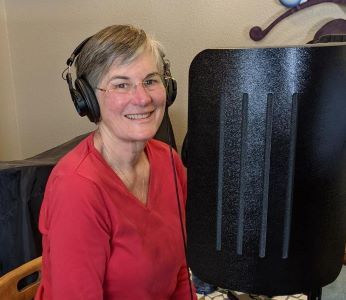
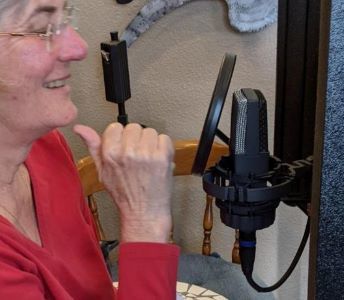
The narrating set upGregg’s recording studio included all we needed.
He sat at a table with the necessary equipment.
I took a tall chair before a microphone, a black rounded muffler, and a small window.
Through the window I could see my Ipad screen open to the book.
I put on a pair of headphones and marked the distance between my mouth and the microphone (Just like in the movie The King’s Speech).
Greg counted down and I began to read carefully and not too fast. (One Internet guru advised reading no more than 150 words per minute).
Magic.
As long as I could read, he could manage the recording.
 A Few Narrating Tricks
Why yes, I am an experienced reader–to children.
That experience didn’t always transfer over to narrating an entire book.
My sentences are longer than Dr. Seuss’ sentences–and they seldom rhymed.
That meant my paragraphs were longer, too.
Mrs. Oswald Chambers featured a number of quotations from Oswald Chambers, Biddy, and Kathleen.
I needed to be able to differentiate them from each other with my voice–which involved a bit of acting.
To help me remember how to alter my voice (I only did so for those three), I physically adjusted myself.
For Oswald, I clenched my right hand and firmly set my arm at a 90-degree angle. Then I read the line.
For Kathleen, I sat up straight and spoke forthright.
And for Biddy?
Ah, Biddy.
I relaxed to make my voice softer, more round, and often gently circled my two hands away from my body.
I think it worked.
Unexpected challenges with narratingThe biggest problem?
I’m an American.
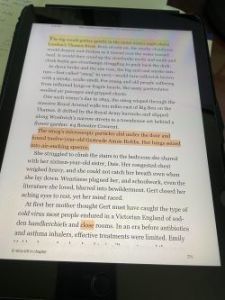
A lot of these words–which look like American English on the page–were actually British English. (The video suggests watching The Crown to get a feel for the issue. That would be ish-you, by the way.)
The place names were the worst!
Fortunately, you can find anything you need on the Internet. Several websites helped me ensure I pronounced words like Woolwich, or Herefordshire, correctly.
Try saying those names yourself, then click on the links.
To counter this problem, I read three chapters aloud the day before each narrating session. I then marked words in my Kindle version that I needed to check the pronunciation.
 Can you find the mistakes? None!
Most were easily identified and practiced. (Do you know how many times I practiced saying, “Herefordshire?” I’ve got it now!)
Some words didn’t yield a check–Port Said is my own pronunciation. (Sigh-eed).
The other issue was a “clicking” or “smacking” sound I didn’t even realize I had. Gregg excised them easily.
After only a few chapters, he could tell where I smacked by how the audio file looked on his computer screen.
My emotional responses to the book Available on Amazon
I hadn’t read Mrs. OC in quite a while, so it felt new–even though I remembered and recognized everything!
Several times, I blinked away tears. I got choked up while reading.
I reread those passages!
But I came away impressed, yet again, by the dedicated woman who gave up so much for the sake of the Gospel and her love for Oswald Chambers.
My admiration for Biddy continues unabated. I’m so thankful I had the opportunity to tell her story in words on a page–and now through my voice on an audio book.
How did I do?Giveaway, June 15-20We’ve got a five-day raffle for three audiobook copies of Mrs. Oswald Chambers through both Audible US and Audible UK (three for each country, based on which Audible [or Amazon] account you use).
a Rafflecopter giveawaya Rafflecopter giveawayTweetablesA new audiobook: Mrs. Oswald Chambers and how her author narrated the book. Click to Tweet
A first time narrator described the process to make an audiobook. Click to Tweet
A free raffle for Mrs. Oswald Chambers as an audiobook; US and the UK. Click to Tweet
The post Narrating Mrs. Oswald Chambers: How I did it. appeared first on Michelle Ule, Author.
June 8, 2021
An Individual’s Value to God

The value to God of each person is immense.
Jesus explained it best in Luke 15:
What man of you, having a hundred sheep, if he loses one of them, does not leave the ninety and nine in the wilderness, and go after that which is lost, until he finds it?
And when he has found it, he lays it on his shoulders, rejoicing.
And when he comes home, he calls together his friends and neighbors, saying unto them, “Rejoice with me; for I have found my sheep which was lost.”
I say unto you, that likewise joy shall be in heaven over one sinner that repents, more than over ninety and nine just persons, who need no repentance.
Luke 15: 4-7 King James 2000 Version
The God who created each individual for His purposes, knows us by name.
He knows all the hairs on our heads.
He knows the span of our lives.
With that knowledge–of the past, the present and what is to come–God created each of us for a specific time and place.
Each individual is so precious to God, Jesus died to forgive their sins and enable them to go to heaven.
The Gospel Song telling of a person’s value to GodA famous gospel song tells the same story.
“Lord, Thou hast here Thy ninety and nine;
Are they not enough for Thee?”
But the Shepherd made answer: “This of Mine
Has wandered away from Me;
And although the road be rough and steep,
I go to the desert to find My sheep.”
“The Ninety-nine and the One” verse two by Elizabeth Cecilia Clephane
Missionaries used this song as a triumphant chorus when they gathered in “deputations” to explain about their overseas work.
Charles and Lettie Cowman, founders of the Oriental Missionary Society (with Juji Nakada and Ernest Kilbourne), in particular, found inspiration from this tale.
When they stood before a seemingly impossible mission field, the reminder of Jesus’s desire for each individual to know Him, sent them out.
The unknown value to God of one person listeningOne person listening and responding to God’s direction can change many lives when ministering to the one.
 The only one who went forward. (OMS archives)
A small village in 1877 Indiana held a revival service one weekend.
The visiting preacher gave an “altar call,” numerous times, urging people to come forward and give their lives to Christ.
Over the entire weekend, only a nine-year-old boy knelt at the altar seeking to follow God.
Church members deemed the meetings a failure, because only one boy went forward.
The work the Cowmans and the Oriental Missionary Society (OMS) began in 1901 is still going strong today.
No one knows how many people have come to faith as a result of that one boy coming forward.
It only took one.
Was that revival meeting a success or not?
The value to God of an little-known womanBorn to a wheelwright and his wife in Suffolk, England in 1866, Margaret E. Barber felt called to China.
After teaching in Foochow–midway between Shanghai and Hong Kong–Margaret moved to White Teeth Rock, a small nearby village.
 Margaret E. Barber (Wikimedia Commons)
She lived in a humble house and waited until one day a student came in to visit. She talked about God, prayed with him, and suggested books by John Bunyan, Andrew Murray, and the Bible. Margaret also taught her one student, Watchman Nee, “the way of the Cross.”
“Lord, I am willing to break my heart in order that I may satisfy Thy heart!“
But even the villagers recognized her worth and wondered,
“Why doesn’t she go out and establish meetings and work in a bigger city?” Instead, she lived in a small village where it seemed nothing was happening. It seemed that it was a waste for her to be there.
One brother shouted at her, “No one knows the Lord as you do. You know the Bible in a most living way. Don’t you see the need around? Why don’t you go out and accomplish something? You just sit here seemingly doing nothing. You are wasting your time, energy, and money; . . . everything!”
M.E. Barber, The Story of Her Life
Margaret Barber saw herself as God’s seed sown in China.
This seed surely went through loneliness, humiliation, and seclusion. But God made her blossom and bear fruit. Only God knows how many people received spiritual help from her directly and indirectly.
M.E. Barber, The Story of Her Life
Nee’s books about the Christian life are still used today. (My husband frequently teaches on and gives away copies of Sit, Walk, Stand.)
But M. E. Barber isn’t completely forgotten. Lettie Cowman included her poem in Streams in the Desert’s May 27 reading.
Why does one individual have value?In our data-driven world, it seems foolish to waste so much time and energy for only one person’s soul.
Surely missionary work could be better spent where the outcome is more likely to win many souls to Christ?
And yet that verse from Luke 15 above reminds us, Jesus cared enough for each person, he would have died for only one.
That means me. Or you.
The post An Individual’s Value to God appeared first on Michelle Ule, Author.
June 1, 2021
Homesick? But for Which Home or Place Do We Yearn?

I felt homesick as the plane descended into Seattle’s SeaTac airport.
To the west, the Olympic Mountains, my Olympics, sported a light covering of snow.
Above, the sky was a glorious blue.
Hmm. I remember the Puget Sound area mostly in shades of gray.
But that day in May welcomed me home instead.
I knew I was feeling homesick.
But for where?
We moved away more than 25 years ago.
Homesick for the Washington past? Or the present?It can be hard to know.
The four years we lived in Washington were wonderful.
Our former house is long sold. The children grown up and out into the world.

Do I miss Kitsap County? My house? My life? The Navy?
Maybe all of them.
How can I go to Seattle and not take a ferry ride–and then see friends?
This time it was a two-day trip. We watched the sunset over Kitsap County, a view we seldom saw.
We’ll visit next time.
But Washington isn’t the only place I feel this tug.
Aloha HomesickAfter Washington, we moved to Hawai’i.
I’ve been back four or five times since–always stopping in O’ahu to visit favorite spots.
Almost all my friends have long moved away.
The church remains, however, and we like to visit the pastor and his wife.
 U.S. Navy photo by Mass Communication Specialist 1st Class James E. Foehl
On the last trip, I drove my daughter crazy as we went past all the libraries I used to frequent.
“How come you know where all the libraries are?” she asked, incredulous.
O’ahu was a place for reading and dreaming.
The major writing and research began there, too.
I’m not sure what I miss the most–well, okay, it’s the trade winds.
What about Connecticut?“They” say you were the happiest wherever you lived when your children were young.
I had enough children spread far enough apart, therefore, to have been happy in Connecticut, Monterey, Washington, and Hawai’i.
Few in my family, however, remembered our years in Connecticut–and that includes my husband. (Who was out to sea, of course).
To drive past all my favorite haunts, all changed or gone now, can be a challenge.
After the last visit with the family, when they didn’t recognize anything, I decided to take charge of the memories.
“It was a perfect life. Meals were always balanced, the laundry always up to date. My hair looked terrific, my figure perfect, and I never raised my voice.”
Why did they look suspicious?
If they can’t remember reality, why shouldn’t I improve the story?
Can we ever really go home?Physically, we can always drive the old streets and see the land’s contours.
 I can smell the ocean, can you?
But the life, the house, the people?
Several houses where I’ve lived are gone. (14 moves will do that for you.)
The people I loved there are scattered or dead.
But I can stand on street corners, face the wind, and I’m a little girl once more.
The scent of flowers, the baking sun, the feathery pepper trees–are all part of home.
And the stories never end.
I’ve written down a lot of them.
Reading through them always makes me smile–homesick, maybe.
But mostly thankful for all the opportunities to live in seven states and know many, many wonderful people.
What am I really homesick for?
No place, no one. They all live in my heart and memory–safe and full of blessings.
Tweetables
Can you be homesick if there’s no home? Click to Tweet
The post Homesick? But for Which Home or Place Do We Yearn? appeared first on Michelle Ule, Author.
May 25, 2021
A Child’s Name and Family History
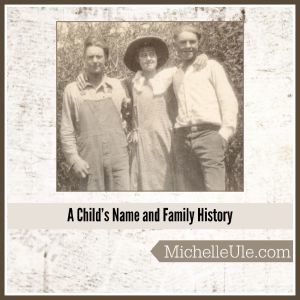
“Why is your child’s name Zipporah?”
If I’d married a man named Smith, that would have been a great question.
But, I married someone with an uncommon name, which gave me the freedom to name my children all the basic, non-unusual family names which sprinkle our family tree.
When a child asked, I explained that while Anne may not seem all that exciting, she’s named for a host of women whose DNA floats through her.
Since I’m a genealogist, I can pull up the stories.
Matching a child’s name with family photosThree young girls in my family were here today and we spent a fun 20 minutes talking about names and faces.
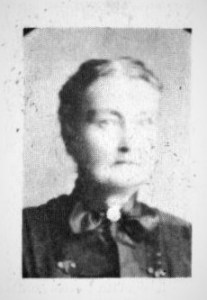
I’ve been scanning family photos and could pull up one girl’s great-grandmother’s photo.
“You were named for her.”
I told them stories of her college years, why she made the choices she did, how much she loved her family, and how she would have enjoyed these little girls.
 Mumps!
We turned to older photos and counted the number of great-greats on our fingers.
My grandmother, her great-great-grandmother, shares a name with my granddaughter.
The little girl peered closer. “Really?”
My other grandmother shares the same name–with an Italian flare. We’ll get to her another time.
With those connections made, they wanted to hear stories.
The stories and photos took us all over American history and even to the question, “What are mumps?”
She’s been vaccinated and will never see them in her lifetime.
But someone took a photo of my grandmother with a very swollen face!
How do you match a child’s name with a family story?Start with the connection.
Children named Anne, Elizabeth, Mary, Rose, or a host of other fairly common names, often appear in my family tree.
 We sat in Ballard’s pew at Williamsburg’s Bruton Parish Church.
For genealogists, unusual names provide “markers” for finding family lines.
Ballard, for example, is a family name.
“What kind of a name is Ballard?’ my sister-in-law, understandably, asked.
It took me years, but I learned it’s an historic family name–which enabled me to trace one our lines to colonial America.
Thomas Ballard sold a cow to a man named Nathaniel Bacon one day in 1675.
Shortly thereafter, Bacon led a Rebellion against the Virginia Colony.
Ballard’s wife ANNE was used as a hostage during the rebellion. Ballard himself tried to mediate.
Bacon called Ballard a, “wicked and pernicious counselor.”
And with that, we’re able to link a child’s name to a moment of historic importance.
(We have, however, declined to name anyone Ballard for three generations so far).
Making connections with current family membersA friend’s granddaughters are named for their great-grandparents, one of whom is still alive.
 The most recent Ballard looks surprisingly like a current family member.
Telling children family history stories is a powerful way to link them with the past and their present.
It’s a way of widening their understanding of who they are within the family tree, but also can make a connection between the child and the great-grandparent she sees on a Facetime screen.
My friend is headed off to see her mother soon and I’ve written a list of questions.
The hope is, she can sit down and either record or film, her mother answering them for her great-grandchildren.
(Cell phones make this SO easy to do–assuming your subject will talk and tell stories!)
My friend can then make a book of family photos and include short stories for her granddaughters.
Connection made.
Perfect.
Questions to ask/answer about a child’s name and family historyWhy did your parents name you __________? (Ballard’s mother died when he was a toddler. I doubt he knew).Were you named for anyone in particular? (One Ballard’s mother gave all eight children family heritage names! I love Elizabeth Ballard Smith!)What does your name mean to you? Do you like it? (Oswald Chambers didn’t like his first name. Who knew?)How did your name affect your life? (Everyone assumes I’m French. You have to go back to 1701, but I am!)Tell me about your childhood.Who did you play with? What sort of games did you play? (Have the kids heard of hopscotch?)How old were you when you learned to read? What were your favorite books? (Consider reading one to the children yourself. My mother used to make tapes of herself reading a book and then send the book and tape to the children)Did you know your grandparents? What were they like? What were their names? (Bonus questions for budding genealogists.)What kind of toys did you have? (My mother always claimed she only had one crayon and it was black. Was that true?)What sort of clothes did you wear? (Why couldn’t you wear jeans to school?)Do you like to sing? Do you play a musical instrument?What were your favorite songs? Nursery rhymes?Did you ride a bike?Did you learn how to swim? Where?What was your favorite movie where you were little? TV show?What was my [name the parent/grandparent] like as a little girl/boy? Questions-for-family-connections DownloadWhat’s the reason to tell a child family stories?Family stories match our heritage.
They’re ways to teach about your beliefs, traditions, joys, and sorrows in a personal setting.
One granddaughter is studying the California Gold Rush. She knew about the Oregon Trail. But hearing her 4xs-great-grandmother walked it, brought the reality alive.
Especially when I showed her Kirsten’s picture, and pointed to the organ she bought sitting in our living room.
Then the descendent of pioneers sat down, started pumping, and played.
History, family, names, were alive!
Tweetables
Using photos to make family history connections. Click to Tweet
How to use questions and photos to share family history. Click to Tweet
The post appeared first on Michelle Ule, Author.
May 18, 2021
Trees and Faith
Trees and faith provide an excellent lens for life.
There’s the obvious: trees stand tall, but they’re vulnerable to fire, storms, and insects.
But their very nature, they way trees grow, can be an analogy for the life of faith.
Roots: for trees and faithThe life of a tree is found in it’s roots.
Many varieties of a well-tended tree soaked in nutrients, sink roots deep into the ground.
There, the tree roots spread and grow. Some trees are larger–more wide spread–under the ground than over the ground.
The depth of the roots enables a tree to stand through all the forces nature sends: winds, floods, cars, children on bikes.
The deeper the roots, the harder it is to knock down a tree.
Faith elementSo it is with faith.
[image error]Sinking the roots of our faith and beliefs deep into our souls enables us to withstand all the horrors life–and Satan–not to mention loved ones and friends, throw at us.
The more time we spend nurturing our faith: through worship, reading the Bible, praying, listening to God, the stronger we’ll remain.
Jesus, of course, talks about vines, not trees, but the same truth remains.
We need to be like branches (above ground roots!), connected to the vine (God), to be nourished and flourish.
Sure, we could be shallow-rooted in our faith, but that never works well for the long haul (See the parable of the sower in Matthew 13:1-23, Mark 4:1-20, and Luke 8:4-15).
Community (a grove of trees) for help and nourishmentSome trees are shallow rooted–like the majestic redwoods.
[image error]Photo by tatonomusic (Unsplash)A walk through the redwoods with a ranger friend revealed surprising information that parallels the life of trees and faith.
A redwood belongs in a community, a grove, of other redwoods to flourish.
The roots grow wide underground, grabbing hold and mixing with one another as they establish themselves.
Redwoods are shallow-rooted trees. The roots spread wide across the forest floor.
That helps keep them upright in their grove but also enables them to get water if they’re growing far from a source.
Standing together in a foggy area, they share moisture through their needles and those intertwining roots.
FaithThis is the same reason churches are important to and individual’s faith.
We need each other.
Hebrews 10:23-25 explains it this way:
“Let us hold fast the confession of our hope without wavering, for he who promised is faithful. And let us consider how to stir up one another to love and good works, not neglecting to meet together, as is the habit of some, but encouraging one another, and all the more as you see the Day drawing near.”
Nourishment, encouragement, holding each other up, those are only a few reasons.
Newspring Church provided four. Our faith, like trees, needs help weathering storms. It needs others to share the fruit of the spirit. We need each other, in a grove, to stand before the lashes of nature, and the sadness of the heart.
Sure, we can go it alone in our faith.
But it’s a lot more fun to be with others like us–if only to provide shade (“I’ll help you”), words (the Bible), food (“how about a potluck?”), the water of life (Jesus) and the joy of intertwining branches (“Let’s do life together!”).
[image error]My yard, today. The red bottle brush tree attracted bees to fertilize apples.One more thing!What comes from first the flowers, then the fruit of a tree?
Or from your faith?
Food.
Joy.
Companionship.
Growth.
Looks like a circle of life to me! 
For more about trees and faith, see Dr. Matthew Sleeth’s fine book Reforesting Faith: What Trees Teach Us about the Nature of God and His Love for Us.
Tweetables
How trees and faith provide metaphors for each other. Click to Tweet
How are trees like faith? Click to Tweet
The post Trees and Faith appeared first on Michelle Ule, Author.
May 11, 2021
Women Worth Knowing: A Podcast

Women Worth Knowing is my favorite podcast.
It’s just been on the air since April 10, 2020–a COVID-year bonus!
I’ve listened to every episode, usually first thing Tuesday mornings.
After writing two biographies of influential women who were not particularly famous, I so appreciate this weekly podcast.
It’s a joint effort of author Cheryl Brodersen and history teacher Jasmine Alnutt, both affiliated with Calvary Chapel Costa Mesa.
The two love to read missionary biographies and Alnutt teaches courses on Missionary Biographies, Church History, and Women in Church History at Calvary Chapel Bible College
What’s Women Worth Knowing about?Long-time friends and ministry partners, Brodersen and Alnutt often discussed how God used men and women through history.
 Cheryl Brodersen (Calvary Chapel photo)
One day, Brodersen explained,
We realized most of our friends didn’t know these great stories or their own history.
In the Bible, God was always reminding the Israelites of their forefathers and their history.
Our Christian forefathers and mothers help us to know who we are and how to build our faith.
The podcast’s goal is is to build faith and a sense of identity. These are our close relatives in the faith.”
Alnutt’s parents are missionaries in London where her mother volunteers with a ministry called Book Aid.
The organization provides Christian literature for ministries and churches around the world. As the ministry is funded through used book shops, Mrs. Alnutt amassed a large collection of biographies found in the shop.
(Note: Book Aid has shipped more than 30 million books to “book hungry” areas since 1988!)
All those biographies seeded Jasmine Alnutt’s interest in church history.
I weave many biographies into my Church History class because I don’t want my students to just learn facts and dates. [I want them] to be inspired by God working in the lives of ordinary people like us.”
While attending one of Alnutt’s Missionary Biography workshops at a retreat several years ago, I took home pages of notes–and a list of books to read!
What can we learn from these “close relatives in faith?”
The theme of Alnutt’s Missionary Biographies class comes from Daniel 11:32: “The people who know their God will be strong and carry out great exploits.”
She likes to pull out a key theme in the life of each missionary and, in telling their stories, draw our lessons.
How we know God, our perspective of God, determines how we will live our lives.
I believe the key to every great exploit that these missionaries accomplished was the result of KNOWING GOD.
[Knowing God] is something any one of us is able to do, regardless of intellect, talent, background, or resources.”
Brodersen noted that many of the women they highlight in the podcast came from unremarkable backgrounds or faced great obstacles.
Yet, through their faith and perseverance, God used them in extraordinary ways.
We believe every woman who places her faith in Jesus is worth knowing and probably has a story that needs to be told.
So, another aim is that women would begin to discover their story in Christ, or maybe begin to seek the stories of the Christian women in their lives.”

To that end, they like to include “ordinary lives,” in addition to the more-famous women believers like Elisabeth Elliot, Florence Nightingale, Harriet Tubman, or Harriet Beecher Stowe.
Those less-famous women include Granny Brand, current missionary Sarah Yardley, Eliza Davis George, and Wycliffe Bible Translator Joanne Shetler.
Alnutt explained:
Where do they find Women Worth Knowing?
We want to bring stories that are relatable. Stories that show these normal, flawed people are just like us, who trusted a BIG God to work on their behalf.
In fact, we want to stir our audience to have a bigger view of God and to walk by faith in whatever He calls them to do.”
They both have extensive libraries full of biographies.
Brodersen calculates she currently has at least 30 biographies to read. “However, I’m always hearing about some Christian woman I didn’t know before and searching out that person on the Internet.”
She noted that while researching Elizabeth Blackwell, she discovered three African-American women who became the first female doctors of color. She also encountered Susan LaFleshe Picotte, the first Native American female doctor.
Alnutt mines her class notes and appreciates opportunities to do more research. “It’s been fun to have an excuse to read stories I’ve been meaning to get around to. One of my new “friends” is Hannah More.”
Which biographies personally affected them?As a child, Brodersen read Amy Carmichael’s works and loved Catherine Marshall’s Christy. “However, it was Gladys Aylward who got me hooked on missionary biographies.”
 Jasmine Alnutt (Calvary Chapel photo)
“Which one hasn’t changed me?” Alnutt laughed.
And she was off!
“When I was in high school, Shadow of the Almighty by Elisabeth Elliot really shaped my Christian faith and my desire to really go for it with the Lord, holding nothing back. Since then, my favorite biographies are probably Hudson Taylor’s A Retrospect [free!] and Eileen Vincent’s No Sacrifice Too Great about the lives of C.T. and Priscilla Studd. (Yes, CT was a crazy radical, but the way Vincent tells their story is so challenging and convicting, it has really impacted me!). But I have also been greatly influenced by: the honest struggles of Isobel Kuhn (also an excellent writer). the patience and perseverance of William Carey and William Wilberforce. the practical ministry of Elizabeth Fry,the sterling character of John Woolman, the sacrifice of John and Betty Stam, and William Borden. I have to add that Adoniram and Ann Judson will always hold a special place in my heart, if it’s possible to name a favorite, I think it’s probably them!Listen in. You’ll probably hear about most of them in the coming years. Join me!
Tweetables
Wonderful biographies podcast every week on Women Worth Knowing. Click to Tweet
Encouraging, fascinating, and fun: Women Worth Knowing podcast. Click to Tweet
What kind of women are worth knowing? Click to Tweet
The post Women Worth Knowing: A Podcast appeared first on Michelle Ule, Author.
May 4, 2021
How to Recycle Vegetables

Do you know how to recycle vegetables?
I’ve been doing so this year in California.
I’ll tell you how.
And show some photos from my own recycle vegetables.
Recycle vegetables that still have rootsIt’s easier if they have their roots.
Green Onions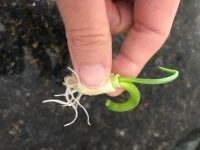
Take fresh green onions, slice off the white section, about half inch down.
Position the root in water, watch.
When a bit of green begins to grow from the white section, plant in your garden.
Done!
Mine, planted last fall, is now about to throw seeds.
Bonus!
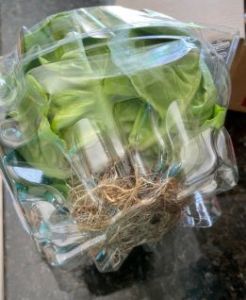
LettuceWhile explaining this concept to my grocer, he handed me this box of lettuce.
I have a guy who comes in here every six months or so, buys five boxes of this butter lettuce–notice it still has its roots–and just eats from them until they are finally depleted.”
I’ll have to let you know how this works, but it looks pretty convenient so far!
How to recycle vegetables already trying to growWhere there’s life (or roots), there’s hope!
Carrots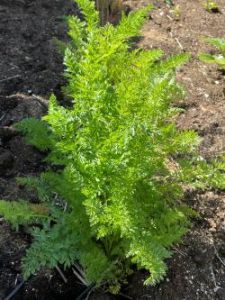
I know the grocer because I stopped one day and asked him not to remove the greenery from the carrots.
(True confession, I hate the sliminess of those pre-packaged “baby” carrots and only buy the real thing. How hard is it to scrape them, anyway?”)
He handed me a bunch with greenery still attached.
I took them home, cut off the greenery, about a half-inch down, and put them in a shallow pan of water.
(I actually reused a plastic egg carton which was perfect).
Several weeks later, I spied the beginning of roots, took them outside, and planted the fledgling carrots into the garden.
Look at them now!
Voila!
Notice on the right the butter lettuce my grocer handed me today after the aforementioned conversation!
This week’s salad and perhaps next month’s salads, too?
Potatoes Growing this morning!
But, if they stay in the dark pantry too long, roots can begin to sprout.
You need to examine them carefully.
If the potato isn’t green or doesn’t look suspicious, I take it outside.
I dig a hole in the ground or garden bed, maybe a foot down.
 Child now grown, but he ate it.–cooked!
I then cut the potato into chunks maybe 2 x 4 inches with a sprouting eye, and place it into the bottom of the hole.
Cover lightly and wait.
When the green leaves appear, I put more dirt around the leaves, all the way to the top leaf.
And so on, eventually filling the hole as the potato plant grows.
We’ve eaten the potatoes when they’ve been new and small.
Delicious!
Watch them grow themselvesThis is the story of strawberries–which are basically a weed!
Several years ago at the end of the growing season, I saw a six-pack of tired strawberry plants.
I bought them for cheap, brought them home, set them in our graywater garden, and went inside for the winter.
By spring, we had a lot of little strawberry plants!
I knew to pinch off the flowers that first round–it encourages the plant to grow rather than produce fruit.
Soon, I had more plants as the strawberry “mother” plants sent out their runners.
 I like to cage the wild ones early!
Once the “baby” strawberry plants were well rooted, I cut the “umbilical” runner. The new plant began to produce flowers as it grew more established in the soil.
Pinch. The plant sent the roots deeper.
A month later, more flowers, berries!
Easy.
And if you’ve planted tomatoes in the past–who doesn’t have volunteers?
What about herbs?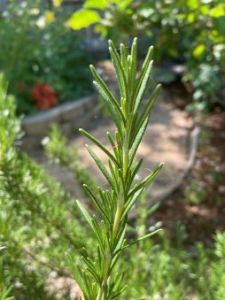
Aren’t they just weeds in disguise?
This rosemary is the daughter of a clipping I took from a friend’s rosemary bush 20 years ago.
Same practice: clip, grow roots in water, plant.
When I left my former home, I took a clipping of the original clipping (now three feet by four feet wide), and planted it here.
I’m not sure how often I’ve cut it back–but we’ve always got fresh rosemary!
The grocer’s story about how to recycle vegetables.The grocer enjoyed hearing my stories today, and then told me one.
A friend had a south facing kitchen window on a hillside.
One day, he hauled in a load of topsoil and dumped it just below the window.
All summer long, he tossed his vegetable scraps out the window.
He did nothing else.
By the end of the summer, many of those scraps had rooted. He ate his own recycled vegetables for several months, laughing that he didn’t have to do a thing!
A few photos of my process

Tweetables
How do you recycle vegetables? Click to Tweet
The amazing way vegetables can be recycled into new ones! Click to Tweet
The post How to Recycle Vegetables appeared first on Michelle Ule, Author.