Michelle Ule's Blog, page 26
February 15, 2021
Why Ash Wednesday? Why Wednesday?
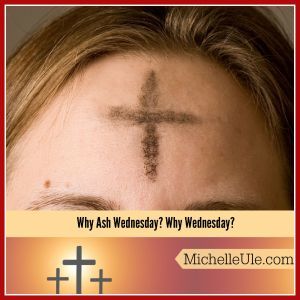
What is Ash Wednesday and why do people “celebrate” it?
(This post is running a day early in 2021).
Well, perhaps “celebrate” isn’t the right word.
Acknowledge it, soberly, for what it means to Christians.
Ash Wednesday and the liturgical churchGenerally speaking, Ash Wednesday in liturgical church traditions is the beginning of Lent.
It marks 40 days of spiritual preparation for Easter.
Roman Catholics, Anglicans, Lutherans, Eastern Orthodox, Methodists, and Presbyterians, generally, are the denominations that mark it on their church calendars.
My Lutheran Church has a solemn service on Ash Wednesday, along with a simple soup and bread dinner in non-COVID years.
We gather for Wednesday night services through Lent, reflecting on Jesus’ life, death, and resurrection.
Those of us in the choir sing solemn songs marking a time of abstinence for many, additional prayers, and times of reflection.
While Lent, per se, is not mentioned in the Bible, the concept of meditation, mourning, contemplation, and reflecting on our sins, runs all through it.
Ash?Ashes are a symbol of mourning and repentance.
Ash Wednesday marks the beginning of this “season.”
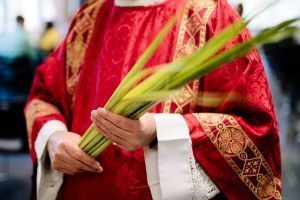 Photo by Grant Whitty (Unsplash)
At our church services, we walk forward and the pastor marks the sign of the cross on our forehead, or the back of our hand.
We usually walk out of a dark church, quietly, contemplating how we will prepare our souls for the glory of Easter 40 days away.
Learn Religions explains where the concept comes from in the Bible:
The Bible does not mention the custom of Lent, however, the practice of repentance and mourning in ashes is found in 2 Samuel 13:19; Esther 4:1; Job 2:8; Daniel 9:3; and Matthew 11:21.
LearnReligions.com
Some churches, including the Lutheran church we attended in Hawai’i, burn the celebratory palm branches from the previous year’s Palm Sunday, to make the ashes.
Why Wednesday?Since Easter is always on a Sunday, the beginning of Lent is always 40 days before, which makes it a Wednesday.
Simple.
The number 40, itself, is significant in the Bible and usually is the length of a testing period.
Noah and his ark experienced rain for 40 days and 40 nights. Jesus went to the desert for 40 days of fasting prior to beginning his ministry. Moses fasted and prayed for 40 days before God gave him the 10 Commandments.
Moses lived as a prince in Egypt for 40 years. He was away from Egypt in Midian for 40 years. He returned to lead the Israelites through the wilderness for 40 years.
In the early Christian Church, baptisms only took place on Easter. Those awaiting baptism spent the 40 days prior to the event preparing their souls.
Their preparation took the form of fasting, praying, confessing their sins, and awaiting their “new birth” as a follower of Jesus.
This may be where the concept of “giving up something for Lent” came from.
The day before Ash WednesdaySome traditions call the day before Ash Wednesday Shrove Tuesday.
Mindful that fasting, penance, and contemplation begins the next day, people may confess their sins to “clean house.”
They also may indulge in foods, activities, or one last splurge on whatever they plan to “give up for Lent.”
Many people eat pancakes!
Mardi Gras, or “Fat Tuesday,” celebrates similar behavior.
Fat Tuesday, of course, refers to eating fatty or indulgent food, the day before Lent begins.
Lent ReflectionsAmy Boucher Pye wrote a book on Lent preparation called The Living Cross: Exploring God’s gift of Forgiveness and New Life.
She’s got some great ideas on how to prepare for that glorious Easter morning only 40 days away!
Tweetables
Why Ash? Why Wednesday? Click to Tweet
What is Ash Wednesday? Click to Tweet
The post Why Ash Wednesday? Why Wednesday? appeared first on Michelle Ule, Author.


February 9, 2021
Historic Photos in Color

I love examining historic photos in color.
I’ve written about colorization here and here.
But, after marveling my way through two books using historic photos, I’m even more excited.
Marina Amaral: historic photos artistI’ve followed Marina Amaral’s twitter feed for several years.
She regularly posts extraordinary historic photos she digitally colorized.
In the last two years, she has joined British historian Dan Jones to produce two books: The World Aflame: The Long War 1914-1945 and The Colour of Time.
Jones wrote the historic explanation, covering the times (and including a timeline), that connects the photos colorized by Amaral.

(The subtitle “The Long War,” is how many European historians describe the two world wars. “One long war with a long armistice in between.”)
It’s a broad overview, not detailed, but it sets up each photo in the books.
The Colour of Time covers 1850- 1960, hitting the decade highlights.
Photography was a new technology in 1850, which is why the book started in that decade.
The power of historic photosI recently spent time with two young relatives.

The ten-year-old didn’t want to attend her history Zoom lesson.
“The teacher is so boring! She just talks to us for two hours, we have to take notes, and then turn them in.
“But it’s so boring. I don’t like history.”
How could one of my relatives not like history?
I pulled out Amaral and Jones’ The Colour of Time and we began.
For the next two mornings, we spent the half-hour before school turning the pages, admiring the historic photos, and I told the stories.
I recognized most of the people, yes, but I also was able to link the girls (her sister joined us) to their family history.
“Do you know what this is a photo of?” I asked.
“Is that a kite with a man in it? asked the eight-year-old.
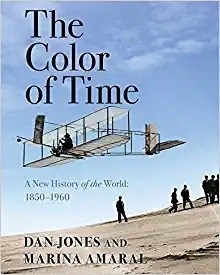
Look at the book cover on the right.
Is that a kite?
No. it’s a colorized photo of the first airplane her great-great-grandfather ever saw.
(He saw it on exhibit at the Field Museum in Chicago, not long after the Wright brothers flew it).
The girls looked at me with wide-eyes.
The colorization of the historic photos drew them, but the stories made history come alive.
The people looked real.
Using photos to tell storiesAs we worked through the book, I was startled to see a colorized photo of Lenin and Stalin.
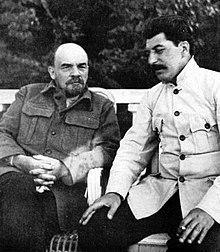 Lenin and Stalin
 (Wikimedia Commons)
Here’s the black and white version.
(I’m not using Amaral’s colorized photos because I assume they are copyrighted. Get the books and marvel yourself!)
The children didn’t know these men, so I explained about how many people they may have been responsible for murdering.
Wide-eyes again.
But, as I continued through the 1920s, 1930s, and 1940s, the history lesson–vivid though it was through my telling–got increasingly grim.
Who was responsible for more people dying? Stalin or Mao Tse Tung?
“This man is the reason your great-grandfather went to war,” turned into an explanation of the Korean War.
When I turned a page and came upon a colorized photo of a beheading–the like of which I’d never seen before–we hurried.
So much war. So much killing. Truly, the 20th century was blood thirsty.
Which historic photos did the children like?The younger girl loved seeing the elegant dresses, vivid in sparkling colors and jewelry. (Mata Hari was a big hit).
Her sister liked photos with horses, “They [the horses] look the same.”
They recognized several people.
“That man looks familiar, but not quite right.”
“What if he had a beard?” I asked
“Oh, yeah. But who is it?”
“Abraham Lincoln.”
The good news is by the time we finished reviewing The Colour of Time, the girls didn’t think history was quite so boring anymore.
Tweetables
Using colorized historic photos to teach history. Click to Tweet
How colorized photos changed a little girl’s thoughts about history. Click to Tweet
The post Historic Photos in Color appeared first on Michelle Ule, Author.
February 2, 2021
A Mission Begins in Japan

Charles and Lettie Cowman began a mission on February 1, 1901, when they first sailed to Japan.
That mission and ministry are still going strong today.
They met their friend Juji Nakada in Japan three weeks after they left San Francisco.
Within a short time, they found a building and transformed it into a Gospel Mission Hall.
The trio opened a Bible school and began to share the Gospel with everyone they met.
Their organization soon became known as the Oriental Missionary Society (OMS).
120 years later, One Mission Society (a more recent name) is in a lot more countries.
Why become a missionary?Like many missionaries, Charles and Lettie Cowman got a “call” from God to go.
It began with an interest in the missions field, birthed at a conference.
They’d been Christians about a year when in 1894 they heard A. B. Simpson (founder of the Christian and Missionary Alliance Church) describe a faith-based mission.
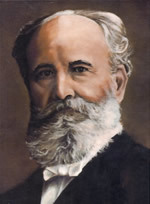 A. B. Simpson
 sparked the idea idea.
(Wikimedia Commons)
Simpson knew a couple who had sailed to a mission field based solely on their faith God would supply all their needs.
Unlike many missionaries of the time, they did not have the financial backing of a mission board.
(Mission boards were usually associated with a specific denomination and funded missionaries through those boards).
The idea of a faith-based ministry invigorated Charles Cowman, a successful Western Union executive at the time.
When the convention passed an offering plate designated for Simpson’s missionary friends, Charles emptied his wallet into it.
When the plate came around a second time, he dropped in his solid gold watch and chain.
Then he looked meaningfully at his wife Lettie’s diamond engagement ring.
She twisted it off and placed it in the plate.
Once this couple made a decision, they did not flinch. They moved forward.
When Simpson called for volunteers to become missionaries, Charles Cowman looked at his wife.
PreparationThat means you and me. Let’s stand and show our colors.”
Missionary Warrior (Abridged) p. 41
The Cowmans were pragmatic. They knew they weren’t spiritually ready.
So, they enrolled at the Moody Bible Institute, studied the Bible, shared the Gospel with people they met, and prayed.
Charles, always believing your money followed your mouth, began to give away the majority of his substantial income.
They even took in boarders to donate extra funds.
When Charles determined they should set their sights on India, Lettie blanched.
A petite woman, Lettie had heart problems. She went to the doctor for an exam. He shook his head and told Charles his wife wasn’t strong enough to live in that country.
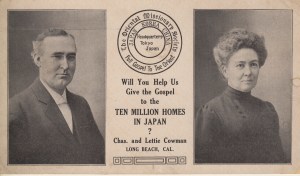 1910 card (OMS Archives)
They were part of the Holiness Movement and believed in physical healing. Charles listened and crossed India off the list.
Lettie would either be healed, or another foreign mission would need them.
Meanwhile, the man himself began preaching at gospel-centered halls in the Chicago “Little Hell” neighborhood. He wanted to be experienced when the call came.
The day after he was “born again” into a life dedicated to God, Charles applied his faith. He began to tell everyone he knew at work about Jesus’ death and resurrection to enable all to become one with God.
The first person he spoke with, colleague Ernest Kilbourne, merely listened. But he returned to work the next day to say he had given his heart to Christ.
Why Japan?The men began to pray together, particularly after Charles attended the mission conference. They both became convinced they needed to serve as overseas missionaries.
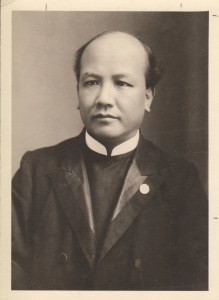
That certainty only grew when they met a new student at the Moody Bible Institute: Juji Nakada.
Nakada, known as the D. L. Moody of Japan because of his evangelistic fervor, invited them to come to Japan. Kilbourne and Cowman began to pray specifically about Nakada’s idea.
Kilbourne, however, had a vision of a road that went to China.
That would come later.
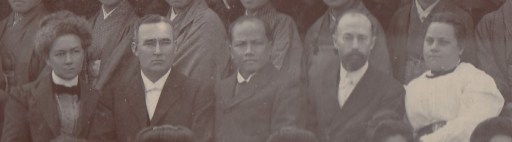 Cowmans, Nakada, Kilbournes (OMS archives)
Lettie, meanwhile, spent long hours praying and reading her Bible each morning. One day, in July 1900, Lettie discerned that God wanted the Cowmans to go to Japan.
She decided not to tell Charles. If God told him the same thing, it would confirm her “call,” and they could move forward in confidence.
One morning, Charles, too, believed he had heard from God.
He wrote the date in his Bible: “Called to Japan, August 11, 1900, 10:30 am.”
When he went to Lettie, she laughed. She confirmed his call!
Faith trainingHaving accepted the call, the Cowmans took the responsible step of applying to a mission board.
The Missionary Society of the Methodist Episcopal Church was willing to send them to work in a Japanese school. (Charles to teach English, Lettie music).
But, the missionary society needed the Cowmans to wait a year for the next year’s budget.
 Juji Nakada
 (OMS archives)
Once they made a decision, they acted. They believed their call meant now, 1900.
Charles resigned from his job, they sold their possessions and left Chicago to attend the brand-new God’s Bible School in Cincinnati. They were the first of 72 students to enroll in the first semester of classes.
Principal Martin Wells Knapp welcomed and liked them. But, he also challenged them, why wait for a missions board?
Charles and Lettie fasted and prayed. They became more convinced they should go immediately.
Juji Nakada urged them to come to Japan. They could open a Bible school together.
They decided God wanted them to start a faith-based mission.
Initial funds for the missionWhen a young woman gave them a quarter, they were excited!
A week later, it got more exciting.
As Knapp recounted the story:
“I shall never forget his [Charles’s] cry as he swung the check in the air, “O Japan! Japan! Glory to God! Japan.”
Lettie ran up to him, “Charlie, what is it?”
“Look,” was the only answer.
By this time a number of students had gathered and such a time of rejoicing! Sister Cowman crying, Brother Cowman laughing and shouting. God knows how to answer.”
When the Fire Fell, citing God’s Revivalist Magazine, November 15, 1900
A farmer had sold property and tithed 10% to the Cowman’s trip.
The money, worth $9200 in 2020, paid for their steamship passage to Japan.
Friends pledged to support their monthly living expenses with prayers and donations for the first year. Someone else donated money for the first year’s rent.
Leaving AmericaAt noon on February 1, 1900, a small group of friends from the local Holiness Movement, waved them off in San Francisco.
Their first steamship voyage was on the SS China Maru and included a stop in exotic Honolulu.
The couple raised in Iowa who had never been so far west, watched the Pacific Ocean with wide eyes. Three weeks later, they caught a glimpse of Mt. Fuji’s triangular shape at the end of the horizon.
About their arrival, Lettie later wrote:
We stepped out by faith to follow our Lord to dark heathen shores, knowing naught of what the future held.
We did know, however, that we were called of God, as we heard Him saying to us, ‘Go ye into the vineyard.”
God’s Revivalist Magazine, April 4, 1901
At the sight of Juji Nakada’s beaming face and welcoming wave, Charles and Lettie Cowman’s mission had begun.
Tweetables
How did the Cowman’s recognize a call to Japan? Click to Tweet
How did the OMS began 120 years ago. Click to Tweet
The post A Mission Begins in Japan appeared first on Michelle Ule, Author.
January 26, 2021
A Little Library
A Little Library sits in front of my house today.

My family gave it to me for Christmas.
I’m utterly charmed.
And so are my neighbors!
What is a Little Library?It’s basically a lending box you place in front of your home or business to share books.
Two other Little Libraries reside within a few blocks of my house and I visit them regularly.
Not being able to enter my public library was a challenge in 2020. This is the longest period of time in my entire life I haven’t entered a library.
There’s a difference between browsing and hunting and while I’m grateful I can “order” books to be held, I miss just looking around.
The Little Library down the street helped me get past that.
They’ve been sources of books for me and the children in my life to read.
Basic facts about owning onePeople can take books at will. They’re all free to share.
The library is open as long as it’s got books to share.
Don’t put out books you want returned.

You own it and can obtain one from anywhere you like.
My family bought mine through Share with Others, and they decorated it.
My husband waterproofed it, dug the hole, and placed the Little Library in the ground.
Some cities may have zoning issues and you need ensure you don’t hit water or gas lines.
It’s courteous to check with your neighbors before you erect one on your property. (Make sure, too, you know where the property line is.)
Where do the books come from?What? Books don’t flood into your house from everywhere?
We have stacks all over the place.
With the closure of our libraries 10 months ago, my ability to donate books to the Friends of the Library ended.
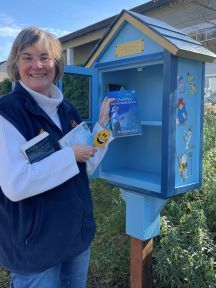
Friends have been moving–and giving me books to donate.
My neighbor was thrilled when the Little Library went up. “Finally, I can clear our my kids’ rooms and donate all those children’s books!”
Children in my life regularly pass along books they’ve read, don’t like, or don’t have room to store.
The Little Library had only been up two hours before I realized several people had made donations.
I did prime the pump with several (signed) copies of my own authored books.
What if you object to a donation?Well, if that happens, I can pass the book along to the library at the top of the hill.
I could put up a notice reminding visitors that children live across the street and may visit.
If it’s really offensive, well, one hates to be a censor, but . . . the neighbor’s recycle bin frequently sits just opposite the site.
What I love about my Little LibraryBesides the idea, I love the creativity my family used in decorating it.
Like the birdhouses that line our back fence, this library is visible out the front window whenever I walk down the interior stairs.
It’s colorful and covered in special words, memes, and decorations.
The back quote is from Oswald Chambers:

All the other symbols represent family members.
They asked me to guess which one went with whom. It was easy.
The two sides incorporate children’s book characters my family particularly loves.
“I just looked at the books you gave us,” my daughter-in-law laughed before painting them in.
The west panel
Can you guess the characters on the west side?
The best two-year-old birthday present. We wore out five copies.
A British fellow (with marmalade).
A king punished without dinner (or not).
A trio of good friends. We went through three copies of one book.
(Go, Dog, Go; Paddington Bear; Max of Where the Wild Things Are; Lowly Worm, Huck, and the clever Goldbug of Cars and Trucks and Things that Go!)
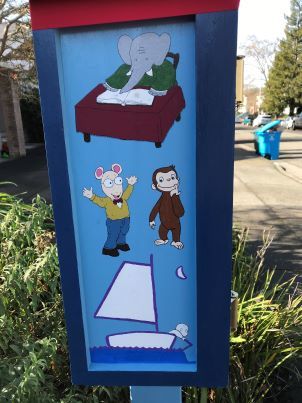 The east panel
An adventurous French-speaker.
Another book lover. We loved his PBS show, too.
A far too curious simian. Why would anyone keep him at home?
An artist who wields crayons.
(Babar; Arthur; Curious George; Harold of the purple crayon.)
Celebrating the written word!That’s what this Little Library means to me.
If you’re interested in learning more, check out this website which explains how to start your own and includes maps to local versions in your neighborhood.
And if you see one, drop off or pick up a book.
It’s all joy.
Tweetables
The joy of a Little Library in your own front yard. Click to Tweet
What’s a Little Library and what can you do with one? Click to Tweet
The drawing winner of a copy of Night Bird Calling and My Utmost for His Highest, for signing up for my website was Dorothy C. Thanks!
The post A Little Library appeared first on Michelle Ule, Author.
January 19, 2021
Cathy Gohlke and Night Bird Calling

I wrote last week about Cathy Gohlke and her new novel Night Bird Calling (released January 2021).
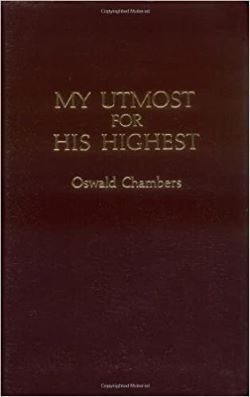
I was impressed by how she used My Utmost for His Highest to craft a story about the southern United States just prior to World War II.
Her answers to my questions were fascinating. I’m sharing the interview here.
How did My Utmost for His Highest relate to a rural North Carolina town?Perhaps no surprise to us with siblings, her brother helped.
Several years ago I wrote a number of short stories about the colorful characters set in this fictional town of No Creek, the one I imagined during a visit to North Carolina with my brother.
When I decided to write a novel, I needed to develop a character from outside the town to connect those stories. I needed someone able to view the town and its quirks and troubles through an outside lens.
That character was Lilliana. She needed to escape a controlling church and abusive marriage, things I’d encountered early in life that the Lord has helped me work through.
What has the devotional meant to Gohlke?
My Utmost for His Highest has been an integral part of my journey, as have the Scriptures, dear friends, and many other works of Christian writers.
I wanted to bring the gift of My Utmost for His Highest to readers in the hope that they will experience similar blessings.
How does a British devotional apply to a rural town?
Oswald Chambers’s insights run deep. Even though I’ve read this devotional for several years, a day does not go by but I gain something new.
Chambers holds a high bar, one that at times feels unobtainable. But then I realize the answer is not my climbing up a ladder but diving deeper into Jesus Christ.
By sinking into Him until He absorbs me, until I am truly His and He is mine—all in all– then daily life finds a clearer, cleaner lens and takes on a different hue.
Reading My Utmost for His Highest has made me more aware that it is not what I do for Christ that lasts. Rather, what He does in me for all eternity, is what lasts.
Everything that I do for Him or for others in His Name simply follows.”
What I love about Jesus is that everything He said over 2,000 years ago in Israel speaks to all nations in all generations. How can a devotional that leads us deeper into Him not do the same?
The meaning of the words, the writing in My Utmost for His Highest, is sometimes difficult to grasp. It probably would not be known or read widely in a rural town like No Creek at the time of my story.
That’s why in Night Bird Calling the devotional readings are first given by Rev. Willard. (He studied Chambers’s writings while in seminary.) They’re related through Biddy’s letters to Hyacinth—women who’d met earlier in life and became friends.
Through Rev. Willard’s sermons and the discussions of characters, we see how applicable Chambers’s writings are to daily human life and frailty—in No Creek, just as they are for us.”
Why Night Bird Calling?I love including Christian classics and writers from the past in my stories. I hope new generations will read their writings, be inspired, and share them with others.”
 Rural North Carolina
Photo by Cathy Gohlke
Why do racial sensitivities and injustice themes resonate in Gohlke?
As a little girl living in Farmington, North Carolina, summer nights came alive with the call of the whippoorwill. It is one of the earliest sounds of nature I can remember.
After my father sold the property and we moved away, the next owners named it “Whippoorwill Farm.”
Some are superstitious about the call of the whippoorwill and other night birds. For me, their call has always been comforting and reassuring, a signal of hope. I loved including that special memory in the story for characters that lay awake at night.”
Gohlke wrote Night Bird Calling long before the 2020 tensions daily appeared on the front pages. I wanted to know how and why they spoke to her.
My family lived in a very old farmhouse in rural North Carolina when I was born. The house had a sealed room my great aunt believed was used on the Underground Railroad. Our nearest neighbors were a very dear older African American woman and her grandchildren. I learned very early a person’s skin color has nothing to do with their worth or the content of their character.
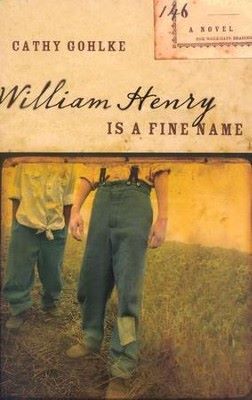
From the time I learned about the Underground Railroad and that people had helped others escape the cruelties of slavery, I knew my first book would be about that, and it was.
is used in schools to this day to bring that history alive for students. “
As a girl later living in Winston-Salem, I witnessed the cruel workings of Jim Crow. I saw the unfair and humiliating treatment of brown and black people by some white people. I recognized social cruelty aimed at other students during years of bussing and desegregation.
Gohlke on historical novelsAll of that, and the brave work of leaders like Martin Luther King, Jr., awakened in me a strong sense of injustice and a determination to learn more and do better.
Writing craft for Gohlke.
From the time I was five years old and learned books are not created by magic, but real people, I wanted to write.
Since writing William Henry is a Fine Name, I’ve written up the time line of history. All of my books draw inspirational lessons, speaking of life and world events, through the lens of history. Each one champions the battle against some kind of oppression. Each novel celebrates the freedom found only in Christ.
Night Bird Calling is a complex novel with many characters and storylines. How did she weave them together?
The “intended” reader?
I long knew the town and the characters, but I needed a main storyline to weave everything together.
By setting the story in 1941 in the rural south, it was not difficult to find inherent historic trends of racism, poverty and abuse. (Trends that continue in many forms today). The growing fear of war also played a role.
But it was Lilliana’s story–her history of marital and church abuse, her need for refuge, redemption, and to understand that God loves and values her– that tied the story together.
Those needs are universal and weave through the lives of many of the characters, even though their troubles differ.”
While Night Bird Calling is an important novel for all, Cathy Gohlke wrote with sensitivity about marital abuse. I asked why.
The importance of books
I was thinking especially of women who’ve been abused or bullied, either through marriage or church or both.
As a young woman I ran away from an abusive marriage and an oppressive church. My journey toward emotional and spiritual healing took many years.
I want women in similar situations to know that they are not alone and that God loves them so very dearly and that the views of their oppressors do not come from God.
I also hope readers gain insight, sympathy and empathy for those who’ve been abused or pushed down and see ways they can help. There are two sides to every coin. I wrote for both.
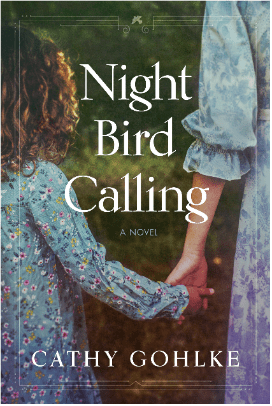
Sometime after fleeing my abusive marriage as a young woman I bought an old trailer in a run down neighborhood—the best I could afford at the time.
Children in that neighborhood ran as wild and untended as weeds in a garden run amuck. I befriended many of those children and bought a used bookcase and books at yard sales. I then opened a lending library right there in my trailer.
Children came for hours, sometimes to color pictures, read or be read to, enjoy glasses of milk and homemade bread with jam. Often, they asked questions about life and God and prison. (One father served time)—everything imaginable.
Parents often took advantage of their community’s new “free” babysitter, but those were precious and healing days for the children and for me. Years later I became a children’s school librarian. Those memories inspired Aunt Hyacinth’s lending library in Night Bird Calling.”
Tweetables
Night Bird Calling: a complex story with great insight. Author interview. Click to Tweet
Challenging subjects with sensitivity & justice. The novel Night Bird Calling. Click to Tweet
The post Cathy Gohlke and Night Bird Calling appeared first on Michelle Ule, Author.
January 12, 2021
Night Bird Calling and Chambers
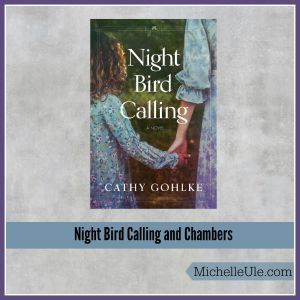
I read Cathy Gohlke’s new novel, Night Bird Calling, with great interest.
Gohlke uses themes from My Utmost for His Highest as a catalyst for change in “No Creek,” North Carolina prior to World War II.
The small mountain town in 1941 has been riven by racial divide since the American Civil War.
Problems come to a head when a woman fleeing marital abuse finds solace in her great-aunt’s home.
Lilliana needs to heal, and the old family home is where she begins.
Her Aunt Hyacinth is depicted as a friend and correspondent of Biddy Chambers, as well as a deep appreciator of Oswald Chambers’ devotional My Utmost for His Highest.
She’s also blind, so the town pastor regularly visits to read aloud Biddy’s letters and also My Utmost for His Highest.
What does My Utmost for His Highest have to do with North Carolina?In and of itself, the devotional doesn’t influence events.
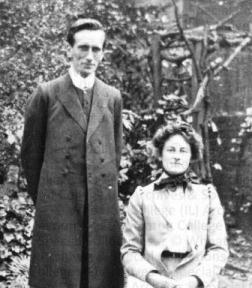 Oswald and Biddy circa 1914 (Wheaton College Special Collections Library)
Except, Gohlke uses several readings to mark and affect significant change.
Night Bird Calling touches on abuse, racial tensions, injustice, and desperation.
Gohlke tells the story through the eyes of Lilliana, a woman seeking sanctuary and a precocious pre-teen, Celia, trying to make sense of life complications beyond her maturity.
As both woman and girl struggle to understand their place in the world, Gohlke uses a line from My Utmost for His Highest to set the theme:
“It takes God a long time to get us out of the way of thinking that unless everyone sees as we do, they must be wrong. That is never God’s view.”
My Utmost for His Highest, May 6
No Creek is riven with racial tension and issues of poverty and wealth. Lilliana in innocence steps into trouble when she agrees to help her Aunt renovate the house and then reorganize Hyacinth’s vast library.
What to do with it?
Why not open the retired teacher’s library to all the residents of No Creek, whether Black or White?
Many people don’t like the idea, including members of the Ku Klux Klan.
Dealing with Outsiders in Night Bird CallingLilliana is an outsider. She doesn’t understand.
The doctor is a refugee Jew. While he can treat the townsfolk, they don’t respect him.
A young “drifter” and his pregnant wife have nowhere to go. Celia takes them in.
Released prisoners, former slaves, bootleggers; Night Bird Calling has plenty of “different” characters to bring judgment and distress.
In a stirring scene that underscores the theme, the pastor reads a passage from My Utmost for His Highest:
Jesus and sufferingEvery wrong thing that I see in you, God locates in me. Every time I judge, I condemn myself.”
My Utmost for His Highest, June 17
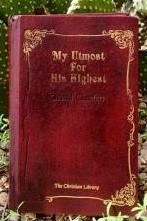 Photo by Linda Livingstone
Lilliana is afraid–for good reason. Her view of God is distorted–for good reason.
Many people remain caught in a similar vicious trap.
Living with the No Creek folk, hearing wisdom from a variety of wise people who know God, helped free her from the senseless idea she deserved brutal treatment.
A 100-year-old woman confronted Lilliana after her aunt’s death.
“Let those ghosts rest and move on in the freedom God give you. Jesus didn’t die so you can suffer. He died to free you from sufferin’.”
Night Bird Calling
The words startled Lilliana into recognizing she did not deserve to suffer.
They rang true in her ears because she had heard a similar piece of wisdom read recently to her aunt from My Utmost for His Highest.
This is often how God speaks to us–using words from someone else to confirm what we are grappling to understand.
Night Bird Calling contains so much spiritual wisdom!
What’s the answer?It’s the same for all of us.
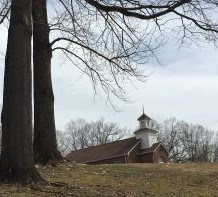 Rural North Carolina church (Photo courtesy Cathy Gohlke)
No Creek residents have no special evil. We all sin and fall short of the glory of God.
But, in this novel, sin confronts them on December 7, 1941, the day Pearl Harbor’s bombing launched the United States into World War II.
Reverend Willard “was just finishing a long-winded sermon on repentance and forgiveness.”
The church members, that day, were particularly thoughtful given the enormous crises which had hit their community.
And now hit their world.
They took a moment to reflect, gasp, and then hear a call to repentance.
Conviction of sin is one of the rarest things that ever strikes a man . . . when the Holy Spirit rouses a man’s conscience and brings him into the presence of God, it is not his relationship with men that bothers him, but his relaiontship with God–‘against Thee, Thee only, have I sinned, and done this evil in Thy sight. . . .
Anything less than this is a remorse for having made blunders, the reflex action of disgust with himself . . . Examine yourself and see if you have forgotten how to be sorry.”
My Utmost for His Highest, December 7
A few weeks later, the reverend’s sermon also touched Chambers’ words:
Jesus says regarding judging–Don’t. . . . There is no getting away from the penetration of Jesus. If I see themote in your eye, it means I have a beam in my own. Every wrong thing that I see in you, God locates in me. Every time I judge, I condemn myself.”
My Utmost for His Highest, June 17
Convicted yet?
Chambers and Night Bird CallingUsing fine literature as a catalyst for a new project has been occurring throughout history.
 Cathy Gohlke
Little that Shakespeare (or Marlowe!) wrote originated with him.
Studying history, literature, and ideas encourage creativity in artists.
(You can see how author Patricia Raybon did the same in her article “The Dead White Man Who Could Fix Our Race Problem: Oswald Chambers.“)
I think Oswald and Biddy Chambers, both, would be pleased with how Cathy Gohlke used their themes for God’s glory.
Night Bird Calling certainly gave me plenty of food for thought.
Cathy Gohlke has been producing videos discussing her book. This week’s discussion includes a giveaway–Night Bird Calling AND either Mrs. Oswald Chambers or A Poppy in Remembrance.
Cathy talks about Night Bird Calling in this video–which includes two giveaways.
Along with the fine Night Bird Calling, you could win a copy of either Mrs. Oswald Chambers OR A Poppy in Remembrance by signing up for her newsletter by this Sunday, January 17.
Tweetables
Using My Utmost for His Highest as the backbone of a southern novel. Click to Tweet
Eternal themes: My Utmost for His Highest and Night Bird Calling. Click to Tweet
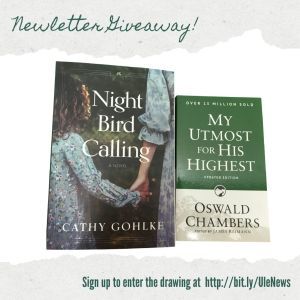 Sign up
BY January 14, 2021 to enter
Sign up
BY January 14, 2021 to enterThe post Night Bird Calling and Chambers appeared first on Michelle Ule, Author.
January 5, 2021
How to Choose a Devotional
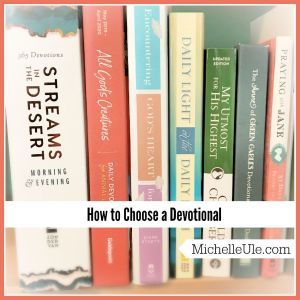
Choosing a devotional for the new year is a topic among my friends these days.
Some are debating and seeking a specific word from God for them this year, too.
There’s something about the start that makes us consider our options and wonder what they should be.
The calendar is fresh, what should spiritually undergird our year?
Amazon.com currently lists “over 100,000” devotional book options.
I’ve written a lot about devotionals, their history, their writing, their organizations.
Here are five ideas about how to choose a devotional.
What are you looking for in a devotional?
The majority of people in the world for the last 500 years, have chosen to read the Bible itself as a devotional book.
A Bible-based devotional is a way to read a prescribed snippet without actually having to locate a Bible.
Most are curated and often focus on a theme.
But they all use a Bible passage–short or long–to set the theme.
Good examples are the classics My Utmost for His Highest, Daily Light on the Daily Path, Charles Spurgeon’s Morning and Evening.
How much time do you have?
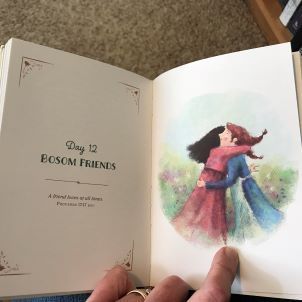 The Anne of Green Gables
devotional
The Anne of Green Gables
devotional has charming pictures!
When you choose a devotional, it’s helpful to be realistic about the amount of time you have to read and to think about the words.
While God’s word does not return void (Isaiah 55:11), it doesn’t go “deep” if you don’t apply it to your life.
For that reason, a devotional featuring a shorter Bible verse might be more helpful in terms of consistency.
Devotion writers know this, of course, and to keep the size manageable, generally have only one day per page. A good devotional generally runs between 250-400 words in length.
Where will you read the devotional?
If you’re looking for a devotional to read while you’re commuting, for example, you might want a book small enough to carry in a bag.
I have a copy of My Utmost for His Highest that measures 4 x 7 inches.
Jesus Calling is 4×6 inches.
Portals of Prayer is available for free at my church in a quarterly magazine.
But, you can also choose a devotional that can be read on your phone.
The list is endless but includes Portals of Prayer, The Upper Room (international, published in many languages), Our Daily Bread, and all the previously mentioned devotionals. (Jesus Calling has a podcast).
Theme preference?
Lettie Cowman wrote several devotionals which center around themes. Streams in the Desert, for example, served as a reminder that God provides refreshment and life even in seemingly barren hopelessness.
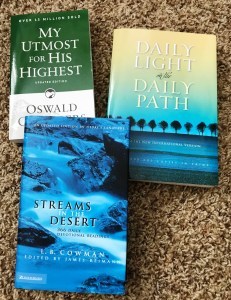 90+ years of daily devotional
 reading can’t be denied!
Consolation, according to Lettie, was “addressed to those whose hearts have been storm-swept . . . after a bereavement.”
Both Cowman devotionals are meaningful for people caught in challenging circumstances.
My friend Rachel Dodge recently published devotionals based on the writings of Jane Austen and one pulling spiritual truths out of Anne of Green Gables.
40-day devotionals often interest readers look at specific ideas or themes.
Devotional books written by author friends
A number of my friends write devotionals, and several write for specific audiences.
Encountering God’s Heart for You by Diane Stortz. The book focuses on 365 devotions that follow the Bible from Genesis through Revelation.
All God’s Creatures: Daily Devotions for Animal Lovers from Guideposts. The book shows how “God uses the beautiful creatures in our world to deepen our connection to Him in astonishing and profound ways.”
My Time with God: 15-Minute Devotions for the Entire Year by Amanda and Stephen Sorenson.
How about one that includes activities?
The One Year Daily Acts of Friendship: 365 Days to Finding, Keeping, and Loving Your Friends by Kristin Demery, Julie Fisk, and Kendra Roehl.
How do I choose a devotional?
I’m still reading, thinking, and writing about My Utmost for His Highest and Streams in the Desert.
I’ll be spending more time in Streams in the Desert this year, learning more about Lettie Cowman.
And, of course, seeing new ways of looking at God–which is the real point.
Happy reading!
Tweetables
How to choose a Bible devotional book for the year. Click to Tweet
Five things to consider when choosing a Bible devotional book. Click to Tweet
The post How to Choose a Devotional appeared first on Michelle Ule, Author.
December 29, 2020
2020 Favorites

Such an odd year, 2020, yet I had favorites.
Here’s my annual list of (mostly) entertainment that made the year better and brought me enjoyment.
2020 Favorite Books
In my free monthly newsletter, I highlight two books I’ve particularly enjoyed in the previous four weeks.
I just looked at the books I gave five-star ratings on my Goodreads list. I don’t give five-stars very often, so here are the books I particularly liked:
Nonfiction
Becoming Elisabeth Elliott by Ellen Vaughn. I loved this biography so much, I wrote a blog post about it.
The Hunt for History by Nathan Raab. A fascinating account of a man who sells American historical items to collectors. Raab is definitely a historian as well!
The Anne of Green Gables Devotional by Rachel Dodge I wrote a blog post about this wonderful devotional as well. It’s written for both children and adult readers alike. I gave copies of it to the girls in my life.
Historical Fiction (My favorite genre)
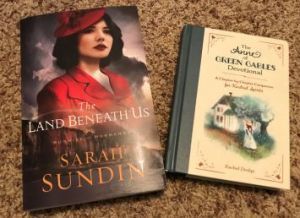
The Land Beneath Us by Sarah Sundin (The whole Sunrise at Normandy series is terrific!) Sarah is a friend and I love how intelligently she writes about WWII military people while melding spiritual truth into tough stories.
Prairie Lotus by Linda Sue Park. A wonderful counterbalance to the Little House Books. What was it like to be a minority girl on the prairie?
Special mention to books written by Amanda Dykes (lyrical, mystical, historical), Roseanna M. White (the WWI series are terrific), and Laurie R. King (Ah, the clever Mary Russell Holmes!).
Straight Fiction
The One-in-a-Million Boy by Monica Wood. A most unusual story of an extraordinary boy who brought together unexpected people.
Afraid of the Light by Cynthia Ruchti. I never really understood what makes people hoard possessions until Ruchti’s insightful novel.
Movies
I didn’t see any new movies in 2020.
 We liked the ones we already own!
We spent the year at home watching all our old favorites.
The entire Monk series–which seems so true to life these days–made us laugh a great deal. 
December 22, 2020
Rossetti & A Christmas Carol

Christina Rossetti wrote a poem many years ago that she called “A Christmas Carol.”
Many know it from the first line: “In the bleak mid-winter.”
It told the story of Jesus’ birth from the point of view of a British woman writing in mid-19th century Britain.
But what is it about?
A Christmas Carol
In the bleak mid-winter
Frosty wind made moan;
Earth stood hard as iron,
Water like a stone;
Snow had fallen, snow on snow,
Snow on snow,
In the bleak mid-winter
Long ago.
In the first verse, Rosetti described the season when Jesus was theoretically born in Bethlehem.
But, it’s also a poetic description of the status of many people’s hearts who aren’t thinking about God.
It’s often physical or spiritual challenges that first send many people to consider who Jesus is.
Their hearts, like snow covered ice, many be hard; their situations bleak.
In my case, that was long ago. But I remember how cold and lonely the world could feel.
Rossetti on Jesus’ Coming–First and Second Times!
Like many orthodox hymn writers, Rossetti didn’t merely write of Jesus’ first coming. She looked forward to His second–and that’s reflected in the next two stanzas:
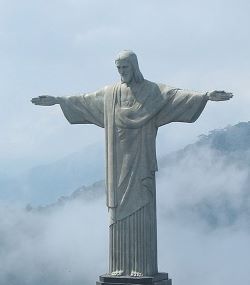 Photo by Jcsalmon
(Wikimedia Commons)
Our God, heaven cannot hold Him
Nor earth sustain,
Heaven and earth shall flee away
When He comes to reign:
In the bleak mid-winter
A stable-place sufficed
The Lord God Almighty —
Jesus Christ.
Enough for Him, whom cherubim
Worship night and day,
A breastful of milk
And a mangerful of hay;
Enough for Him, whom Angels
Fall down before,
The ox and ass and camel
Which adore.
How could heaven not hold God?
He loved them (us) so much, He wanted to come to earth to save His people.
That’s why Jesus came.
As King Solomon prayed at the dedication of the temple:
“But will God indeed dwell on the earth? Behold, heaven and the highest heaven cannot contain you; how much less this house that I have built!
ESV
Imagine! The Creator of the Universe made himself small enough to live in a baby, while at the same time His resurrection from the dead created havoc that day in Jerusalem 33 years later.
Rejoicing in the heavens and earth
While God incarnate lay in a manger of straw surrounded by animals at the end of the second stanza, things changed by the third.
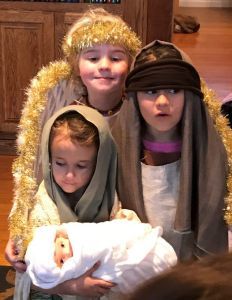
Yet also retained intimacy.
Angels and Archangels
May have gathered there,
Cherubim and seraphim
Thronged the air;
But only His Mother
In her maiden bliss
Worshipped the Beloved
With a kiss.
The heavens outside roared with angelic joy–so many they filled the air.
But in the quiet of the manger, his mother recognized Him and kissed the baby cheek.
Turning the poem back to Rossetti
What did Christina Rossetti–or any of us–have to bring such a Savior?
That’s her question in the final stanza:
What can I give Him,
Poor as I am? —
If I were a Shepherd
I would bring a lamb;
If I were a Wise Man
I would do my part, —
Yet what I can I give Him, —
Give my heart.
The only thing any of us can give God: our heart.
Who was Christina Rossetti?
Long before I heard “A Christmas Carol” sung, I knew Christina Rossetti through English Literature.
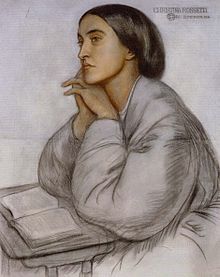 Portrait by Dante Gabriel Rossetti
 (Wikimedia Commons)
Born into an artistic family in 1830, Christina’s education came from her parents with a focus on the Bible, classics, novels, and even fairy tales. Her father Gabriele Rossetti was an Italian poet and political exile living in London.
The sister of artist Dante Gabriel Rossetti, she was associated with the Pre-Raphaelite Brotherhood–a group of artists in London mid-nineteenth-century.
Christina, the youngest in a family of four, was the writer in the group. Her brother illustrated some of her work. He also used her as a handy model for his paintings.
Writer Elizabeth Ludlow recognized the influence of Rossetti’s religious education in her work, citing references to Thomas a Kempis, John Bunyan, George Herbert, and John Donne.
Ludlow also noted in Christina Rossetti and the Bible, that Christina “encouraged her Victorian readers to respond to its [the Bible’s] radical message of grace.”
Christina wrote poetry, devotions, and works for children before dying in 1894.
What about the music?
Two noted composers wrote the music for Rossetti’s “A Christmas Carol” poem.
Gustav Holst’s version is perhaps the most well known, first set to music and published in 1906.
Harold E. Darke wrote an anthem with the same lyrics in 1911.
Corrinne May, December 25, 2007
I like Holst’s version better. That’s what Corrinne May is singing in the video.
Regardless, the soul of many that winter may have been cold–and bleak–but the Savior of the world entered with Good News!
Merry Christmas.
Tweetables
What’s “In the Bleak Midwinter” really about? Click to Tweet
What did Christina Rossetti refer to “In the Bleak Midwinter?” Click to Tweet
The post Rossetti & A Christmas Carol appeared first on Michelle Ule, Author.
December 15, 2020
“Break Forth” Johann Rist on the Nativity
“Break Forth, O Beauteous Heavenly Light,” is the full title. Johann Rist wrote the original hymn, and the English translation comes from John Troutbeck.
It’s full of the nativity excitement–what that day and time would be like–based in the Gospels.
“Break Forth, O Beauteous Heav’nly Light” words
The Christmas carol has two stanzas:
1 Break forth, O beauteous heav’nly light,
and usher in the morning;
O shepherds, shrink not with affright,
but hear the angel’s warning.
This Child, now weak in infancy,
our confidence and joy shall be;
the pow’r of Satan breaking,
our peace eternal making.
2 Break forth, O beauteous heav’nly light,
to herald our salvation;
He stoops to earth–the God of might,
our hope and expectation.
He comes in human flesh to dwell,
our God with us, Immanuel;
the night of darkness ending,
our fallen race befriending.
Both are odes to the Savior. The first stanza focuses on the nativity. The second looks ahead to who that baby is/will become.
What does the first stanza mean?
Obviously, the “break forth” that begins the song is a herald–something’s happening.
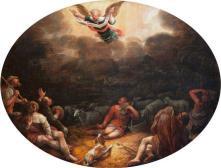
Rist based the first stanza out of Luke 2:8-11:
And there were in the same country shepherds, abiding in the field, and keeping watch by night over their flock.
9 And lo, the Angel of the Lord came upon them, and the glory of the Lord shone about them, and they were sore afraid.
10 Then the Angel said unto them, Be not afraid: for behold, I bring you glad tidings of great joy, that shall be to all the people,
11 That is, that unto you is born this day in the city of David, a Savior, which is Christ the Lord.
Luke 2:8-11 (1599 Geneva Bible–which Rist would have used)
We’re familiar with the story–and I raised my children to understand you knew you were seeing an angel because of those first words: “be not afraid.”
Just seeing the sky filled with angels in the sky singing, would have been enough to floor me!
But there might have been another reason for the great excitement.
According to Rabbi Jason Sobel, those shepherds keeping watch in the fields by night were the men raising sheep for the temple sacrifice.
Can you imagine what it must have meant for those rough men to discover the sheep they were raising would no longer be needed 33 years later?
What does “break forth” mean for stanza 2?
The most thrilling news of all comes from two Bible passages in stanza 2:
And that Word was made flesh, and dwelt among us, (and we saw the glory thereof, as the glory of the only begotten Son of the Father) full of grace and truth.”
1 John 1:14 (1599 Geneva Bible)
and
Behold, a virgin shall be with child and shall bear a son, and they shall call his name Emmanuel, which is by interpretation, God with us.
Matthew 1:23 (1599 Geneva Bible)
It’s the good news of salvation–the reason that baby was born!
Immanuel: God with us.
It’s an interesting way God chose to save His people from their sins.
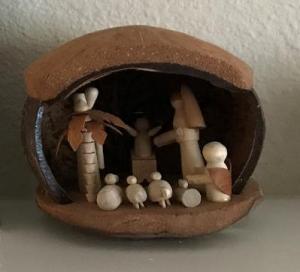
Instead of staying in heaven, Jesus chose to experience the entirety of a human life.
He entered a woman’s womb and was born the normal way in extraordinary circumstances.
“God with us” had to learn how to walk and talk; read and write.
He made himself one of us, so that He could be a perfect Lamb of God for the ultimate sacrifice.
By so doing, Jesus befriended–and saved–our fallen race.
Thanks be to God.
Who was Johann Rist?
Born in Hamburg, Germany in March 1607, Johann Rist was the son of a Lutheran pastor Caspar Rist.
He studied theology, Hebrew, mathematics, and medicine during a time of plagues and the Thirty Years War.
In addition to being a Lutheran pastor in Wedel on the Elbe, Rist was also a playwright and a poet. (Perseus, produced in 1634, was his most famous play).
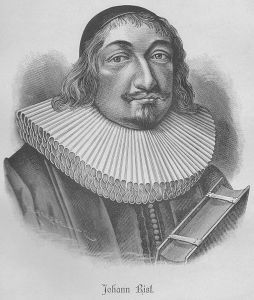 Johann Rist (Wikimedia Commons)
Rist wrote nearly 700 hymn texts between 1641 to 1656.
He was best known at the time for the hymns he wrote. Johann Sebastian Bach composed three cantatas based on his hymns.
“Break Forth, O Beauteous Heavenly Light,” is the most familiar in modern times. It’s used as a liturgical hymn during Advent.
Johann Schop served as musical editor for Rist’s work and composed the music “Ermuntre Dich” for the text in 1641. Bach wrote the melody’s harmonization.
English translator John Troutbeck, an English clergyman, translated oratorios by famous German composers and other German choral texts, in the mid-19th century.
He’s the man responsible for English translations of all of Bach’s major choral works!
Despite that pedigree, “Break Forth, O Beauteous Heavenly Light,” is an obscure Christmas carol with a theologically rich meaning.
Tweetables
Bach loved it, why not you? “Break Forth, O Beauteous Heavenly Light” Click to Tweet
Obscure, yet theologically rich, “Break Forth,” Christmas carol. Click to Tweet
The post “Break Forth” Johann Rist on the Nativity appeared first on Michelle Ule, Author.