Michelle Ule's Blog, page 30
May 12, 2020
Writing in the Middle of the Night
 Why yes, I AM writing this in the middle of the night.
My brain woke up at 2:15 and before I could stop it, was off thinking . . . thinking . . . thinking . . .
I protested. “Go to sleep. Stop this. You’ve only gotten five hours of sleep!”
Of course that didn’t work.
It wanted to remember the literary highlights of the day before and start to pick apart the knots in the book I’m writing.
“Shhh. No. You can do this in three hours at a normal time.”
It ignored me. You need to send an email to this person. That one needs to see what you’ve seen saying about this. Hey, I’ve got an idea for chapter five, but you ought to . . .
“Forget the book. If nothing else, let’s pray. It’s cold outside of these covers. And we have to get back to sleep before . . . you know . . . noise starts again . . . ”
Too late.
Who else is up in the middle of the night?
A gentle noise.
The cat was now on to us with a yowl.
I pushed my husband’s back and the non-gentle rumblings drifted away to quiet bliss.
Come on! Look at this parallel. Hey, did you notice this before?
“I’m going to pray now if you won’t let me sleep.”
That kept the brain quiet, oh, maybe two or three rounds of prayer.
You could be praying about the book . . .
“Great idea! Leave me alone so I can get the rest I need to write well in the morning.”
We argued like this until 3:45. I live in California but we don’t heat our house at night. It was–for us–cold.
When I realized my eyes were no longer clenched shut and I was staring at the ceiling and hearing the trucks on the highway seven blocks away, I realized sleep was not coming back.
Giving Up
So here I am at the keyboard.
I’m wearing slipper socks, exercise pants, my long sleeved warm nightgown, a bulky bathrobe and a wool stocking cap. I’m about to brew hot tea.
I hate to let the brain win, but ideas for how to end chapter five and get a jump on chapter six are stirring.
I think I’ll write that email first . . .
This is the fourth time in the last five days I’ve been up in the middle of the night to write. Frankly, I like it.
I had three emails to read, no one was on Facebook, Twitter was active but dull, my private blog friends were not awake–except Jo in Papua New Guinea, it’s the first time in ages I’ve been able to talk to her on the same day.

Photo by John Tuesday (Unsplash)
Even the cat has given up on demanding food and is curled up next to my warm sleeping husband in that cozy, comfortable bed.
Chapter five will be finished by the time he wakes up and, with any luck, World War I will have started.
There are advantages to writing in the middle of the night.
When I got to the gym at six this week, I’d already written for a couple hours.
When Wednesday got so crazy at work and I just couldn’t go home afterwards and return to the typewriter, I felt better when I remembered I had written for three hours in the middle of the night already.
My friend Robin Jones Gunn used to get up at 3:30 in the morning several days a week when here children were young. She’d brew a pot of tea, belly up to the keyboard and write away. That’s when the Christy Miller series of books were written–very early in the morning.
I used to write in the middle of the night when I had teenagers at home, too. Often, that was the best time to get on our sole computer. The house was quiet–the cat didn’t yowl then–and my brain happily engaged dreaming up stories.
It was a magical time when anything could happen on paper.
Including, I think, good writing in the middle of the night.
Back to the book. How about you? Do much writing really really early in the morning?
Tweetables
Why write in the middle of the night? Click to Tweet
A yowling cat, insomnia and a demanding keyboard Click to Tweet
Well, what do you wear when you write in the middle of the night? Click to Tweet
The post Writing in the Middle of the Night appeared first on Michelle Ule, Author.


May 5, 2020
The Cowman Gravesite: a Pilgrimage
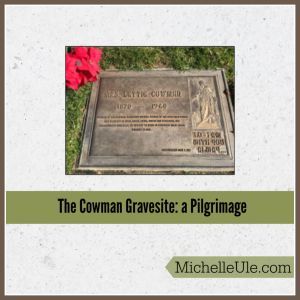
I visited the Cowman gravesite in January 2020.
It felt like a pilgrimage to leave flowers on Lettie’s grave.
Charles and Lettie Cowman lie beside dear friends and colleagues Ernest and Julia Kilbourne. They’re in a row with beautiful plaques marking their final resting spots.
Lettie and Charles Cowman and Ernest and Julia Kilbourne did not always lie in rest at Glendale, California’s Forest Lawn cemetery.
The original Cowman gravesite
Charles Cowman was the first Oriental Missionary Society (OMS) founder to die.
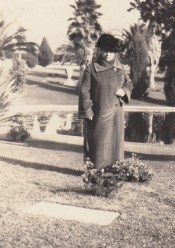 Lettie at Charles’s grave (OMS archives)
He died of heart failure at his Hollywood home on September 25, 1924.
Lettie and friends decided to bury him a mile west at Hollywood Cemetery.
(Established in 1899, the Hollywood Cemetery is now called Hollywood Forever Cemetery. It houses famous movie-makers, including Cecile B. Demille, Judy Garland, and Mickey Rooney.)
Ernest Kilbourne joined him in 1928 and Julia in 1935. The OMS buried Lettie beside her husband and friends in 1960.
Juji Nakada died in Japan in 1939.
Why move the Cowman gravesite?
Problems arose at the cemetery in the 1980s. The buildings deteriorated, weeds grew, and many people became unhappy with the conditions.
That included visitors from Korea.
The Korean Holiness Church traces its founding to 1907. That year two Koreans enrolled at the OMS Tokyo Bible Training Institute.
At their urging, OMS opened the Seoul Bible Training Institute in 1909. The church now has over a million congregants. The church honors its founders.
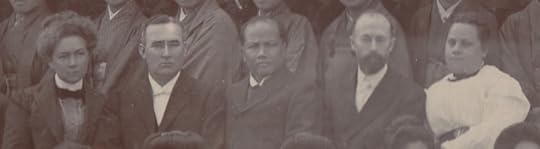 Founders Lettie, Charles, Juji Nakada, Ernest and Julia Kilbourne circa 1902 (OMS archives)
In 1988, the Asia Pacific Federation investigated the Kilbourne and Cowman gravesite. Dismayed by the cemetery’s condition, they asked to reintern the graves.
The OMS and family members agreed to the reinternment and the Korean Evangelical Church of American spearheaded efforts.
They agreed on the need to move the Kilbourne and Cowman gravesite.
Forest Lawn Glendale
On July 2, 1996, members of the Asia Holiness Federation held a replacement and memorial service.
They reestablished the gravesite on a lovely slope at Forest Lawn Glendale.
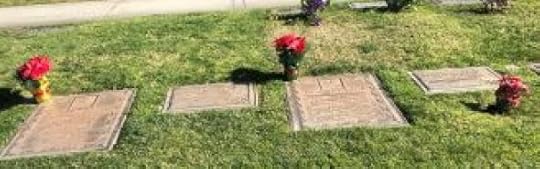 Ernest and Julia Kilbourne; Charles and Lettie Cowman gravesites
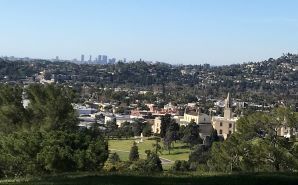
The gravesite looks to the southeast toward downtown Los Angeles.
The metal plaques say the same thing. Only the names and dates differ.
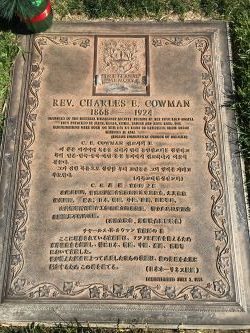
It reads:
Founders of the Oriental Missionary Society. Because of the Four-Fold Gospel, they preached in Japan, Korea, China, Taiwan, and Hong Kong, our denominations were born.
“On this day we pause to remember their great ministry in Asia–Korean Evangelical Church of America.”
The words are translated into Japanese, Korean, and Chinese.
Someone left flowers that January day I visited. I placed carnations at Lettie’s feet. The site felt peaceful.
The real legacy
The founders’ legacy is 119 years of ministering to those who’ve never heard of Jesus.
All four (with Juji Nakada) launched their mission to Japan, thence Korea, and China.
They established Bible schools, led crusades, prayed constantly, and rejoiced over every new believer.
Millions of people are in heaven today because of their work.
Well done, good servants. You earned your rest.
We’ll see you in heaven.
Tweetables
Where are the North American OMS founders buried? Click to Tweet
Why reintern the North American OMS founders? Click to Tweet
The post The Cowman Gravesite: a Pilgrimage appeared first on Michelle Ule, Author.
April 28, 2020
Ezekiel 36 and Modern Israel
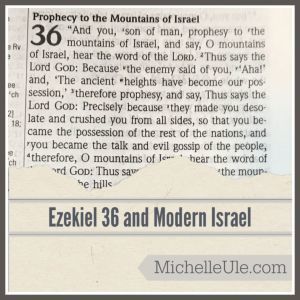
Ezekiel, the Old Testament book, came up in the usual rotation as I read through the Bible.
I read through from Genesis to Revelation in my regular Bible reading. When I finish Revelation 22, I turn to Genesis 1 the next time I sit down with the “Good Book.”
That year I read a Lutheran Study Bible. It’s in the English Standard Version and includes up to half a page of footnotes. I love the footnotes! I always read them because I want to understand the text.
Several years ago, I read Ezekiel 36, checked the notes, and thought, “this sounds exactly like what has happened in modern Israel. I wonder what’s been written about the changes?”
Since God knows my thoughts, He heard my musing.
Two important events happened in my life as a result of that question.
Looking for a commentary on Ezekiel 36
Of course, I googled the question.
For whatever reason, I selected the Enduring Word commentary from a long list of potential hits. I’ve attended Calvary Chapel in the past, so I clicked on a link to Santa Barbara Calvary Chapel’s teaching pastor David Guzik.
This was a revelation! I loved how he put the historic times and the Scriptures into context!
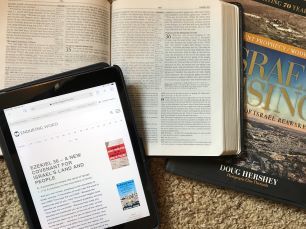
I practically wallowed–intellectually and spiritually–in Guzik’s insightful commentary.
Indeed, I’ve been reading his commentary ever since for my personal Bible reading!
(I can hardly wait to finish Revelation and return to Genesis 1. Between Guzik’s teaching and the Bible Project, Scripture looks far richer to me these days–if that is even possible after a lifetime of teaching the Bible.)
Doug Hershey and Ezekiel 36
But the Lord was not finished with my understanding.
Two days later, I listened to “The Eric Metaxas Show.” His guest that day was Doug Hershey who had just published a book called Israel Rising: The Land of Israel Reawakens.
It came out of Ezekiel 36.
Watch Hershey explain the book and show contrasting photos:
I immediately ordered a copy of Israel Rising and looked through it, enchanted.
My Bible study ladies took my copy home to share with their families. We were all awed by the comparison photos–Israel from the past against what the same landscape looks like today.
It’s stunning to see the change.
God has fulfilled His promise and it’s evident in the land.
Where did the photos come from?
Hershey explains all in his book, but I knew some of those photos were the work of the American Colony in Jerusalem.
Horatio and Anna Spafford founded the American Colony years after Horatio wrote the famous hymn, “It is Well with My Soul.”
You can read about their Jerusalem time in my blog post “Was it Really Well with the Spaffords’s Souls?“
The American Colony took many of the late 19th-century and early 20th-century photos of Jerusalem. Here’s one from Wikimedia Commons:
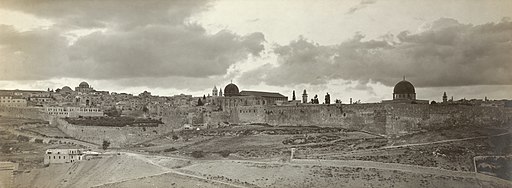 American Colony (Jerusalem). Photo Dept., photographer. / Public domain
Here’s a similar photo from 2008, also via Wikimedia Commons:
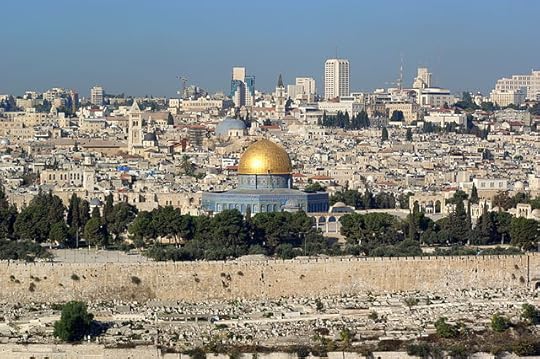 Berthold Werner / Public domain
Marvelous times
Truly, we live in marvelous times where Biblical promises and history turn up in astonishing ways.
My friend Latayne C. Scott wrote a book with archaeologist Dr. Steven Collins about Discovering the City of Sodom, for example.
“The Eric Metaxas Show” often interviews people about their Biblical discoveries.
It’s not just the heavens these days, but also the earth telling of the glories and fulfilled promises of God.
I’m thankful I live in a time and place where I can learn and read about them every single day.
To God be the glory!
(Note: I’m merely a fan without connections to the Lutheran Study Bible, “The Eric Metaxas Show,” Enduring Word Commentary, or even Doug Hershey’s ministry. I’m just grateful for their work.
Here a link to the Doug Hershey audio podcast interview on Metaxas)
Tweetables
Thrilled to learn about Ezekiel 36 through modern teachers! Click to Tweet
Ezekiel 36 & Modern Israel–insight from many wise teachers. Click to Tweet
A contrast in photos: Ezekiel 36 & Israel in the 19th & 21st centuries. Click to Tweet
The post Ezekiel 36 and Modern Israel appeared first on Michelle Ule, Author.
April 21, 2020
A Puzzle and Biography Writing

I dumped out my biography puzzle several weeks into our 2020 sheltering-in-place.
I’d spent three weeks organizing my data, and the time had come to take a deep breath and begin.
The experience reminded me of starting a puzzle.
(We did that, too)
It appears I approach both from a similar mindset.
Here’s how they’re similar.
Start with the puzzle frame
Most puzzlers I know begin with the frame.
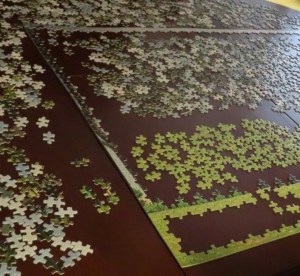
Some may sort their pieces first, but my family prefers to jump in and get started.
We pull out all those edge pieces and start snapping them together.
In writing a biography, I need to know the elements of my subject’s story. In this latest venture (I’ve written three family biographies and Mrs. Oswald Chambers), I put together a timeline of Lettie Cowman’s life.
During the first three weeks of our sheltering-in-place, I reviewed my 8 GB of data and placed the information in what became a 140-page timeline stretching from 1870 to 1960.
My husband taught me how to copy and paste from a PDF, which enabled me to place material I read into the appropriate spot on the timeline.
Theoretically, I just need to write my way through the timeline and will have the biography. Two weeks in, I’m writing the fourth chapter and am able to cite all the references into endnotes, effortlessly.
Sorting the pieces
We generally toss similar jigsaw pieces into piles–usually sorted by color or distinctive features–like flowers.
We do it as we go along building the edge pieces. Mostly, we’re trying to get them out of the way so we can build.
In writing my timeline, I put events into the time when they occurred and included the reference.
Sometimes a story that happened in, say, 1898, appeared in a 1908 magazine article. I copied and pasted the story into 1898. I also included the reference.
The last time I wrote a biography, I put some of the most important notes into a three-ring binder and then used post-it notes on the pages.
It sort of worked, but I spent a lot of time paging through hunting the specific story I remembered. (It would have been helpful to have used color-coded post its, but I wasn’t that organized then!)
This time, I just work through the timeline.
Putting together the easiest parts
Sometimes we don’t even sort the pieces before we start putting them together. That’s particularly true with letters.
It’s a great way of clearing all those pieces from the jumble and restoring order in at least one section of the puzzle.
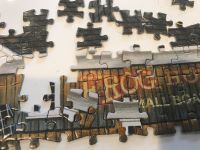
While I usually write a biography in chronological order, sometimes an entire section is so easy to write, I just finish it while the information is at my fingertips. (Or the front of my mind)
I know I’ll need it eventually!
Let’s say I have detailed descriptions of a wedding. Why not write that part into a specific Word document. When I reach the date, I just copy and paste that detailed story right into my manuscript.
The hard parts of a puzzle
I think piles of similar color–like the sky or sea–often are the hardest sections to put together quickly.
A biographer often runs into troubling aspects of their subject’s life. Maybe their actions don’t fit the “frame” you’ve put together for their story. Perhaps ten years of their lives are simply normal living without anything of significance happening.
Dull? Potentially. But if my character, or my puzzle, needs them for background or for contrast, I just work at it.
Sometimes, though, I save those parts for last!
Puzzle pieces that don’t fit
My husband picked up three pieces as I neared the end of the last puzzle.
“How come these are sitting here? Don’t they belong somewhere?”
I laughed. “They should go right here, but I can’t seem to make them fit.”
That can be true of elements in my biographical subject’s life.
Maybe they did something. But maybe they didn’t. What if their actions don’t fit logically into their life story?
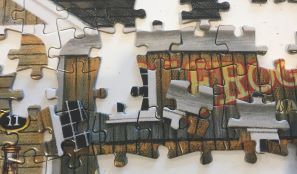 Do you see the problem here?
In the case of the puzzle, a closer examination of the pieces suggested I might not have “read” their shape correctly.
Notice how the lettering doesn’t quite match in the center piece.
When I pulled it out and reorganized the pieces–moved it to the empty spot on the right–all the other pieces went directly into place.
I have to do that sometimes with elements in my biography subject’s life. I ask myself questions or try to see their behavior from a different perspective.
Why did they behave like that?
What else was happening during that time and in their lives–historically, personally, professionally?
Turning the pieces in different directions often solves the puzzle.
Finishing the puzzle
My brothers and I always wanted to be the person to put in the final piece.
It’s so satisfying to snap the final piece into the final hole and see the entire picture spread out before you, completed.
(Some members of my family famously put a piece in their pocket and only returned when the rest of us were crawling around on the floor hunting the missing piece.
(“Finished,” my brother would cry as he slipped the piece from his pocket and tapped it into place. The rest of us hated when that happened.)
In writing a biography, typing in the final words to finish off a life story is also deeply satisfying.
You’ve framed the story, sorted the pieces, turned events around in your mind, written them down and ended with a sense of completion.
No life is ever really fully known–the biographer can only try to write the story clearly and completely.
The truth of how well the author wrote the book lies in the reader’s understanding of another’s life.
Similarly, a puzzle can be a satisfying experience when it’s fully done and the picture completely comes into view.
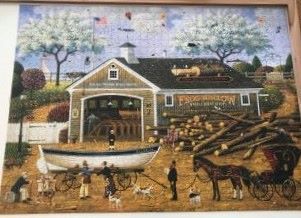
Tweetables
The similarities between puzzle making & biography writing. Click to Tweet
Puzzles and biography writing. Click to Tweet
The post A Puzzle and Biography Writing appeared first on Michelle Ule, Author.
April 14, 2020
The Bible Project: An Appreciation
We’re fans of the Bible Project.
Last night we finished watching all their overviews of the Bible videos.
It took us five nights watching three hours a night to view the sweep of Biblical history from Genesis to Revelation.
I cannot praise The Bible Project enough for the encouraging, enthralling, astonishing, marvelous, witty, wise and insightful experience.
I just wish we had watched them years before.
Oh, wait, I only heard about them two years ago!
What is the Bible Project?
They explain it best on their website, www.Bibleproject.com:
BibleProject is a nonprofit animation studio that produces short-form, fully animated Bible videos and other Bible resources to make the biblical story accessible to everyone, everywhere. We create 100% free Bible videos, podcasts, and Bible resources to help people experience the story of the Bible.
bibleproject.com/about
I first heard about them from a mutual friend who attended Multnomah University with founders Timothy Mackie and Jonathan Collins.
 Collins and Mackie at work (BibleProject photo)
As a Bible study leader since I graduated from college, I’m always looking for new ways to present material. My personal studies also send me scrambling through books, articles and new ways to learn about God, Jesus, and the Holy Spirit.
My life is rich as a result!
I fell in love with the Bible Project the first time I watched a video.
How does my Bible study use the videos?
Every time my group begins a new Bible study– I prefer to teach a straight book of the Bible study, not a subject study–we watch the pertinent video.
I download the video onto a USB stick and plug it into our church’s television. It takes about 10 minutes to view, depending on the video, and then we start the first study.
Here, for example, is the overview of the Old Testament:
A minute and a half in, with Timothy Mackie cleverly explaining all, we’ve watched the following drawing appear on the screen:
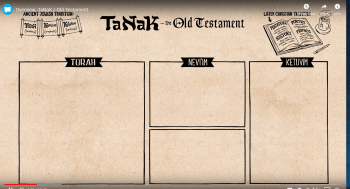
As he talks, pictures are drawn into the blocks. Each video lasts 8-12 minutes, with larger Biblical books broken into two parts.
I love hearing about the book’s organization and then watching the themes and ideas unfold across the screen.
Bible Project explains their motive this way:
From page one to the final word, we believe the Bible is a unified story that leads to Jesus. This diverse collection of ancient books overflows with wisdom for our modern world. As we let the biblical story speak for itself, we believe the message of Jesus will transform individuals and entire communities.
bibleproject.com/about
The videos demonstrate that unified story.
Here’s what the finished Old Testament video story looked like:
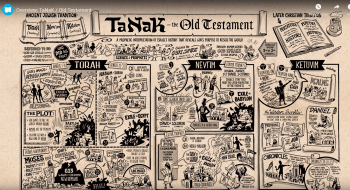
It took Mackie nearly 13 minutes to tell the whole story!
Within this overview, he touched on the major themes running throughout the Old Testament, setting the stage for a more detailed study of the individual books.
But wait! There’s more
Bible Project is supported by gifts and everything is free. The website has a wealth of material any teacher or individual can use to understand the Bible better.
Their free resources include all the video downloads, poster downloads, notes, resources and guidance for churches.
The videos are available in 23 languages, from Afrikaans to Vietnamese.
A missionary friend uses Bible project videos with the people she meets in her country.
What she really appreciates is how many people go on to watch other videos on their own after she’s introduced one.
The Bible project has a podcast and a blog, but I just watch the videos!
Who are these people?
You never want to trust your Bible study to people whose theology may differ from yours.
The team page describes who they are.
Mackie is the writer and creative director. He holds a Ph.D. in Semitic Language and Biblical Studies and is a professor at Western Seminary.
Collins holds a BA in Biblical Studies and is the other writer and creative director. Check out their team before you dive in.
Why do I appreciate them today?
I write this on day 23 of “sheltering in place” during the 2020 COVID-19 pandemic.
We’ve just spent five nights watching the videos. My husband had only seen a few, but we agreed to start at the beginning and go to the end.
Fortunately, the Bible Project Youtube page allowed us to watch them all in order. (If interested, it starts here).
We “cast them” from Youtube to our television and began what became my most significant retreat–time out of life to study the Bible–in years.
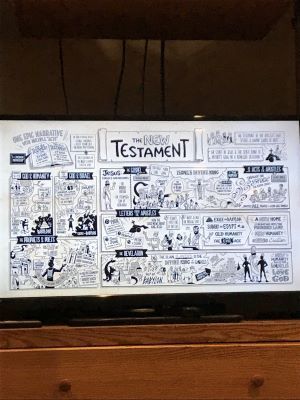 Cast from the computer to the TV!
I normally can’t sit and watch television; I work a puzzle, sew, or clean up the kitchen.
But these videos captured us and kept me enthralled all three hours each night.
The sweep of the Bible story is breathtaking. The initial overview video of the Old Testament sets up the themes and points out the recurring patterns.
I’d never seen them spelled out so clearly before–and then throughout the rest of the Scriptures.
When we finished Revelation last night, I clapped–so awed, humbled and amazed at my God.
I have a degree in English Literature. I know how to look for patterns in the text. Part of studying literature involves watching for repeating ideas and words.
Bible Project, using those boxes, shows those patterns.
And don’t get me started on the clever words matched with clever drawings.
I have read and studied the Bible since I was 15 years old. I’ve studied commentaries and books on the passages I’ve taught.
I had never seen some of these patterns and themes quite this way before.
Truly, it was magnificent and my awe at our Lord expanded in marvelous ways.
Takeaway
Of course, I’ll continue to use the videos in my classes.
Now that we know they also have “theme videos,” we’ll probably watch those, too.
But these overviews! You’re doing a disservice to your Bible knowledge if you don’t view them.
In the meantime, thank you to Timothy Mackie, Jonathan Collins and all the team members at Bible Project, as well as their supporters.
May God continue to bless your work as much as you have blessed me.
(Some of you will want to know my church affiliation. As a military family, we’ve worshipped God in a variety of church settings. You can see the list here. I currently teach at a Lutheran Church– Missouri Synod.)
Tweetables
In praise of the Bible Project videos! Click to Tweet
An astonishing 15-hour sweep of the Bible. Click to Tweet
How to better understand the Bible by video. Click to Tweet
The post The Bible Project: An Appreciation appeared first on Michelle Ule, Author.
April 7, 2020
At the Foot of the Cross
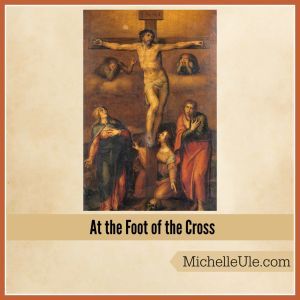
Who stood at the foot of the cross that Good Friday so long ago?
A variety of people: Roman guards, a centurion, bystanders, disciples, people who knew Jesus, his mother, his aunt, women followers, and people Jesus loved.
The Son of God didn’t die alone.
Passersby, as well.
A variety of people went past Golgatha that day, some stopped at the foot of the cross, others jeered from the road.
Their reactions at seeing Jesus were ugly
Those who passed by blasphemed Him, wagging their heads and saying, “You who would destroy the temple and build it in three days, save Yourself! If You are the Son of God, come down from the cross.”
Matthew 27:39-40 (NKJV)
Scripture doesn’t tell us who those people were, but they were not alone in their nastiness.
Jesus spent Holy week reaching out to a specific group of Jews. They were the worst.
The men who claimed to know the Scriptures conspired with the hated Roman government, to have Jesus killed.
Likewise, the chief priests also, mocking with the scribes and elders, said,
“He saved others; Himself He cannot save. If He is the King of Israel, let Him now come down from the cross, and we will believe Him. He trusted in God; let Him deliver Him now if He will have Him; for He said, ‘I am the Son of God.’ ”
Matthew 27:41-44 (NKJV)
Jesus tried tough love on men who spent their lives examining the Scriptures.
They refused to consider how Jesus could be the Messiah.
So they rejected him.
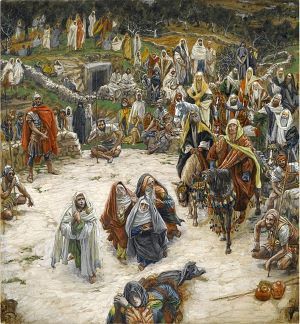 “Jesus’ View from the Cross,”
 by James Tissot
(Brooklyn Museum via Wikimedia Commons)
Men crucified alongside him
Jesus was one of three men crucified on Golgatha that day.
He hung on the cross alongside two robbers.
One shouted: “Why don’t you save us?”
The other replied.
But the other criminal rebuked him. “Don’t you fear God,” he said, “since you are under the same sentence? We are punished justly, for we are getting what our deeds deserve. But this man has done nothing wrong.”
Luke 23:40-41 (NKJV)
The second criminal understood his guilt. That’s the best spot from which to ask Jesus for eternal salvation.
He said, “Jesus, remember me when you come into your kingdom.”
Jesus answered him, “Truly I tell you, today you will be with me in paradise.”
Luke 23:42-43 (NKJV)
Family at the foot of the cross
Now there stood by the cross of Jesus His mother, and His mother’s sister, Mary the wife of Clopas, and Mary Magdalene.
John 19:25 (NKJV)
Commentators note women remained the most loyal. His mother Mary, of course, was the one disciple who knew him from the very beginning and stayed with him to the very end.
His disciple John also waited at the foot of the cross, for Jesus recommended his mother Mary into John’s care.
It’s possible, too, that Joseph of Arimathea also attended the crucifixion. As soon as the Roman centurion pronounced Jesus dead, it appears Joseph went to ruling authorities and asked for permission to bury Jesus.
Technically, not at the foot of the cross
Jesus died nearly two thousand years before my birth.
But as a follower, I gained from his death on the cross.
That came home to me in a startling way when I stood before this painting by James Tissot.
 Do you see my shadow in this photograph of
Jesus’ View from the Cross?
My sins were forgiven that day. Thanks be to God.
Subscribers to my monthly newsletter received an additional gift this week; a copy of my 46-page PDF Thoughts on Holy Week and Easter.
This is a compilation of seven blog posts (including this one) about Holy Week. If you’d like a copy yourself, you can download it here:
Thoughts-on-Holy-Week and-Easter Download
Tweetables
Who was at the foot of the cross when Jesus died? Click to Tweet
Witness to Jesus’ death: those who loved and hated him, and me. Click to Tweet
The post At the Foot of the Cross appeared first on Michelle Ule, Author.
March 31, 2020
Fear: An Antidote

Fear stalks the world these days and leaves many of us uneasy.
But what do we deal with gut-churning agitation? How do you overcome it enough to live a normal life?
Recognize the source of the fear
My childhood caretakers used fear to control my behavior.
I don’t think it was intentional, that’s what made sense to them.
They warned: “If you go under the house, black widow spiders will bite and kill you.”
Since the basement door was right beside my bed, I felt uneasy if I ever saw it open.
What did a black widow spider look like? How big was it? Did they live everywhere in the basement, including beside the door?
When I got old enough to read, a book provided me with a picture–so I knew what to avoid.
It also taught me how to protect myself.
I killed any spider on sight.
My husband finally pointed out that “Daddy longlegs” spiders ate insects, it wouldn’t bite or kill me. “Repeat after me, ‘the spider is my friend.'”
I still didn’t let them stay in the house, but at least I wasn’t so terrified.
I didn’t want my children to grow up fearful. So, we read books about spiders and learned what a black widow and a brown recluse spider looked like.
Knowledge can defeat fear.
I’m just sorry I didn’t learn that tool until adulthood.
Bible verses and fear
The Bible includes many verses on fear.
As my county in northern California introduced “social distancing,” I picked up undercurrents of concern.
We’d already gone through three autumns with catastrophic fires and had survived power outages. The ladies in my Bible study are resilient and I knew they would comply, but that didn’t mean they weren’t disquieted.
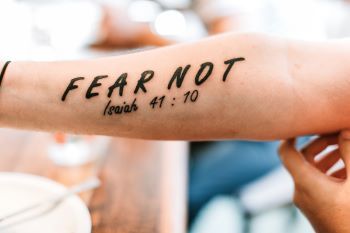 Photo by Melanie Wasser (Unsplash)
The last time we met, I set aside our study of Proverbs and we discussed fear through a Biblical lens.
I found a list of ten Bible verses and we worked our way through the list.
As it happened, we had ten women in the study that day. Each woman read aloud a verse, reacted to it and the group discussed it.
We reflected on what each verse meant to us using examples from our past and what we anticipated for the future.
Some of the ladies survived World War II; we’d all endured the fires.
They are so wise!
But in their pragmaticism, they also understood we needed to apply what we were studying to our current situation.
Our God loves us.
“God is our refuge and strength, an ever-present help in trouble. Therefore, we will not fear, though the earth give way and the mountains fall into the heart of the sea, though its waters roar and foam and the mountains quake with their surging.”
—Psalm 46:1-3
What about the pandemic?
My friend Jerusha Agen addressed the pandemic in a recent blog post.
Called “A Pandemic of Fear,” the post’s subtitle is “4 coronavirus fears and how to beat them.”
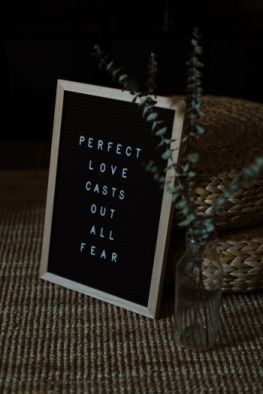 Photo by Priscilla Du Preez (Unsplash)
 In my family, which includes several members involved in planning and on the front lines, we pray.
We make sure we remind family members that we love them.
We try hard not to question them too closely. I listen to what they have to say, ask how they feel about things, and try to keep fear-based questions at bay.
When concern about my own possible death rears its head, I return to a blog post I wrote several years ago.
I overcame my fear of flying years ago when I remembered God knows the plans He has for me and when I will die.
Nothing has changed since then.
I live my life carefully and responsibly, but when I start to feel uneasy about the length of my life, I return to God’s perfect love.
I will die when He so chooses and not before.
Do I fear the virus?
I’m wary of it. I’ve armed myself with knowledge and information–from a trusted source like the CDC.
When my heart races, I take deep breaths and ask myself, “What do you know to be true?”
I pray for truth to be revealed if I’m not sure.
But time and again I return to faith in the God who planned my life for this time and place, for His glory.
In times of stress and fear, Scripture–particularly the Psalms–give me peace.
Tweetables
An antidote for fear–today and into the future. Click to Tweet
What do I know to be true? and handling fear. Click to Tweet
Using Bible verses to overcome fear. Click to Tweet
The post Fear: An Antidote appeared first on Michelle Ule, Author.
March 24, 2020
Census in 2020 & Genealogy

I filled out our 2020 US Census form last night.
It’s the fifth such form I’ve filled out in my life. Once again, I’m not living in any of the same places I lived last time I wrote in my name and birthdate.
Since I’ve already written my family history, subsequent genealogists will understand why they never find me in the same place every ten years.
But they may be disappointed with the information they don’t find on this year’s form.
As the census form explains, results from the census can be used to:
Direct billions of dollars in federal funds to local communities for schools, roads, and other public services.Help your community prepare to meet transportation and emergency readiness needs.Determine the number of seats each state has in the US House of Representatives and your political representation at all levels of government.
So, fill it out when you get it.
Working with Censuses
(I really wanted to use the Latin version, censi, but the plural is censuses).
As a genealogist, I’ve been working with censuses for years.
They’re one of the primary keys to learning and tracing back family members.
In the days before Ancestry.com, investigating census records was a tedious, often futile task.
If you didn’t know where they lived in a given year, you had to guess. That often meant expanding research into auxiliary family members and hoping someone stayed put from zero decade to zero decade.
If, like my current family, they moved often, the task became even more difficult.
These days, you can far more easily and quickly trace individuals with an Ancestry.com membership. My local library provides access for those who can’t afford one.
I’ve written blog posts about creative and biographical research use of Ancestry.com outside of census records here, here, here, and here.
Old Census Records
The fledgling United States government took its first census in 1790.
It was a rudimentary instrument without much detail beyond the simple number of people–both free and slave.
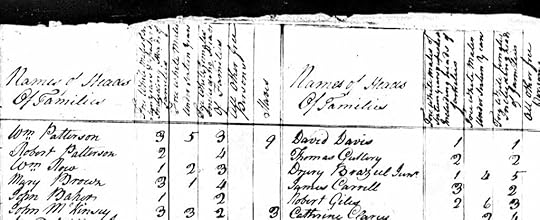 1790 Abbeville, SC census records (National Archives via Ancestry.com)
Here’s an example from 1790.
It lists the names of family members and specific types: 1. White males over a certain age and heads of families. 2. White males under sixteen years. 3. White females. 4. All other free people. 5. Slaves
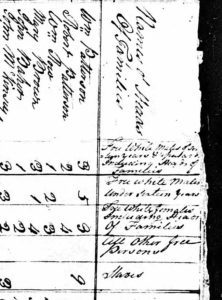
More details
As the nation grew, the census asked more questions, including years of schooling, age, birthplace (very helpful when searching backward in a genealogy hunt), and information about where they lived.
Here’s an example from 1880 Anderson County, Texas:
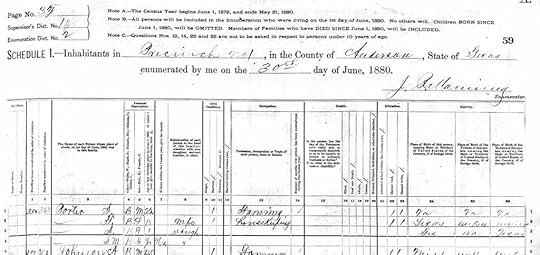
Among other items, the 1880 census asked for occupation, education, birthplace (including that of parents) and age.
It also sought information on handicaps:
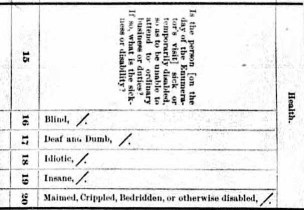
I don’t know what the government did with this information. Certainly, we know schools for the blind opened in the mid-nineteenth century.
The 1870 census, interestingly, did not ask if anyone had fought in the Civil War. It did ask for more details about schooling and whether male citizens over 21 had been denied their right to vote.
Genealogists all miss the 1890 census lost in a 1921 Washington, D.C. Commerce Building fire. Some states and counties had retained copies and pieces can be found.
And we all hate General Sherman for burning the town halls throughout the South during the American Civil War. So many records valuable for genealogists were lost.
The 2020 US Census
My reaction to the 2020 census?
Mixed.
Because I know the information that can be gleaned from the official records, I felt leery about typing it into a computer.
I understand why, once I began I had to finish, but it left me uneasy.
(We received a letter in the mail with a census ID number, asking us to respond by April 1 at my2020census.gov. If people lack computer access, they can request a paper question).
While I know my family facts, we have a non-related college student living with us this year. It wasn’t until I got into the “you cannot stop” census form, that I found I had to provide his birth date and nationality.
I found his birthdate on Facebook, but nationality?
I guessed.
Future genealogists will hate me, but I couldn’t ask him.
They’re going to be disappointed with this form anyway, in terms of mining it for interesting information. I thought it pretty benign.
Except, for the nationality section.
Instead of asking where I or my parents were born, it asked for my nationality.
I left it blank.
It returned me to the spot and would not allow me to go on.
Begrudgingly, I wrote in the three main groups.
Later, I realized that since the paternal side of my family has been in North American since the 17th century, I should have simply written “American.”
I think I’ll type in that answer ten years from now, wherever I’ll be living.
Tweetables
How is the 2020 US census different from past ones? Click to Tweet
Genealogists and past census information. Click to Tweet
What questions does a census ask? Click to Tweet
The post Census in 2020 & Genealogy appeared first on Michelle Ule, Author.
March 17, 2020
Quarantine Activity Ideas

Many are in quarantine these days.
Many have kids at home and maybe wondering how to fill all that time.
Here are a variety of ideas for all ages.
Schedule your quarantine day
What may seem like long hours stretching before you can benefit from a schedule.
Kids follow a schedule at school. Have them work out a schedule for their at-home school time. Pay attention to what they think is important and make sure you include hourly physical activity and a glass of water.If you work from home, consider setting a timer to get up every hour to move and drink a glass of water.If you’re working and managing children, consider flex-time–working your job during kid “off hours.” Consider “done that” advice-givers: Buffer, The Simple Dollar, and Money Crashers.
Encourage spiritual life
While your usual house of worship probably is closed, that doesn’t mean you can’t nurture your spiritual life.
Incorporate prayer, gratitude, positive thoughts and singing into your schedule to set a positive tone. Encourage one another.Keep doing your readings, Bible study classes, listening to teachings, and practice loving each other in practical ways.Consider watching all the Bible Project videos (8-12 minutes each) from Genesis to Revelation! Great for all ages.Reach out to those in need as much as quarantine allows. Call, write, text, email encouragement to those in need and whom you love.
Get exercise and drink water

Of course, I said that before. It’s important.
If you have a fenced yard, make the best of it. Send children outside to play. You may need to provide toys, chalk, balls, Nerf guns, whatever.If quarantine rules allow, take a walk. Consider a photo scavenger hunt with your camera. Walking at night might be an answer to mitigate social distancing.If you have stairs, set the timer and walk up and down them for a given period of time. I usually turn on music or listen to a podcast.Make sure you stretch. No matter your age, stretching is always a good idea. Youtube has plenty of examples and websites.
Be careful with screen time
It’s way too easy to overdo the amount of time we sit in front of a screen and don’t move. Limit your time with the news so as to not feel overwhelmed.
Consider using screen time as a reward and decide how much time you want family members to spend with a screen. (This would not include work or school, of course).Consider listening rather than watching; use audiobooks, podcasts, music to entertain and distract. You can do chores while you’re listening as an added bonus.Several posts about how to do it: Children, Teens, Workers.If they MUST be on a screen, consider having them learn something: present a verbal report on the Youtube video during lunch, make a graphic on Canva, practice typing, make a video and then edit it.
Filling quarantine off-hours
 Photo by Kelly Sikkema (Unsplash)
 Work and school will take up most of your time, along with household chores. But some downtime and off-hours will occur!
Be creative with cooking. Involve the kids.Savor your hobbies–or work on them.Finish your taxes (!), plan your garden, catch up on your laundry, teach the kids how to iron (!), declutter!Engage your kids: Declutter, teach life skills, weed your yard, train the dog, sing together, sew, wash windows, use your imagination!
Converse and work together
If you live with anyone, now’s the time to actually talk with them about subjects beyond everyday life conversations. This is especially true if you have children or older adults in the household.
Sort, scan, label and organize your photos. If they’re all on the phone, download them to your computer and save them in the cloud. You’ll be glad you did.Work on your family tree. Record stories from older family members. Tell your kids about your childhood. Put together a list of family health issues for future use. Make up a family cookbook of all your children’s favorite recipes. You may be surprised at what they like. My children all took a family cookbook to college with them and used it!
Quarantine entertainment
Consider being proactive about entertainment when you’re in quarantine.
 Photo by Hans-Peter Gauster (Unsplash)
 Use news for information but do not dwell there.Read through your “to be read” pile of books. I have three piles . . . Be deliberate in movie choices and then discuss them. Limit them, say, to one Harry Potter movie per night. (Bonus points if you insist the children read the books before they see the movie again!)Work a jigsaw puzzle together, have someone read aloud (you can do it at the same time), sort the Lego, act out stories, sing together, cook, dream, plan, work in your garden. Write letters to folks in nursing homes, call the grandparents, make a video, Facetime, play musical instruments, write a book.
Look for the positive
Focus on what is good, right, and salutary (good = excellent; right = appropriate; salutary = bringing glory to God and not to ourselves).
Many of us live very busy lives; perhaps staying home can help us reconnect with our families, our souls, our dreams and desires.
I plan to use this opportunity–there’s nothing on my calendar–for the good.
Tweetables
Quarantine activities ideas for home. Click to Tweet
What to do while stuck at home. Tips and ideas. Click to Tweet
The post Quarantine Activity Ideas appeared first on Michelle Ule, Author.
March 10, 2020
Rees Howells Intercessor–and Prayer
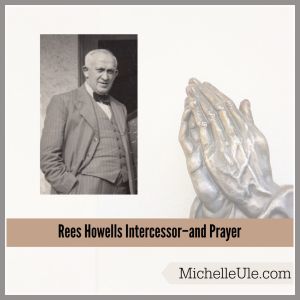
Have you ever heard of Rees Howells?
I had not until I began my most recent project.
I’ve now read Norman Grubb‘s book, Rees Howells, Intercessor, and have a few questions about how Howells–and his friend Lettie Cowman— prayed.
Maybe you can help me?
What is the longest time period you have ever prayed?
My question comes from my study of Lettie Cowman, author of Streams in the Desert and a 21-year president of the Oriental Missionary Society (OMS, now called One Mission Society).
Lettie and her husband Charles (who died in 1924) relied on prayer to understand God’s will for their lives. They were careful to not take any steps of faith without hours of prayer beforehand.
They also fasted and searched their Bibles as they prayed.
Sometimes they prayed for days on end.
On at least two specific occasions it changed their lives–and that of many others.
Why read about Rees Howells?
A friend suggested I read his biography to better understand how he prayed. She thought Lettie’s prayer life resembled Howells’s.
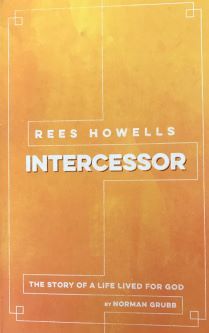
The two were friends and one of the major prayer changes in Lettie’s ministry came at Howells’ suggestion.
The founder and president of The Bible College of Wales, Howells based his life on hours spent listening to God.
Stories abound of God’s activity as a result of prayer from Howells and those at his school.
Did you know that the Bible College of Wales students prayed from 7-11 every night during WWII for their nation?
Why had I never heard that story before?
Some believe Rees Howells’s intercessory prayers, and that of his students helped save England. You’ll have to read Rees Howells, Intercessor to learn how and why!
How did he pray?
First, an intercessor is someone who prays on behalf of another person.
That’s how Howells saw himself.
He had a profound meeting with Jesus and then the Holy Spirit. It changed everything about how he saw his life. He surrendered everything into God’s hands.
And then the miracles began to happen–always as the result of prayer.
As Grubb recounts:
Perhaps believers in general have regarded intercession as just some form of rather intensified prayer.
It is, so long as there is an emphasis on the word “intensified;” for there are three things to be seen in an intercessor which are not necessarily found in the ordinary prayer: identification, agony and authority.
Rees Howells, Intercessor p 100
It means identifying with the person’s need and agony–in essence taking on the person’s agony and praying for them. (See Exodus 17:8-13)
The authority to deal with issues comes as a result of impartially waiting before God with an answer. It often takes intense praying over a longer period of time than most of us spend in prayer.
Prayer warriors vs. intercessors
There’s a difference between the two.
Grubbs:
Prayer warriors can pray for things to be done, without necessarily being willing for the answers to come through themselves. They are not even bound to continue in the prayers until they are answered.
But intercessors are responsible to gain their objectives, and they can never be free until they have gained them. They will go to any lengths for the prayers to be answered through themselves.
But once a position of intercession has been gained, tested and proved, intercessors can claim all the blessings on that grade whenever it is God’s will for them to do so.”
Rees Howells, Intercessor p 121-122
Rees Howells and Lettie Cowman
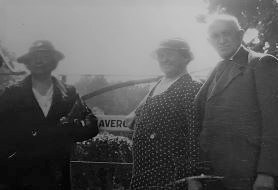 Lettie with Mrs. and Mr. Howells,
 Wales 1936 (OMS photo)
In 1936, Howells invited Lettie Cowman to speak at the “Every Creature Missionary and Intercessory Conference” at the Bible College of Wales.
As the featured speaker, Lettie Cowman spoke the first night, and Howells then asked her to speak nightly for the entire week. Lettie told stories about OMS, from Charles’ original vision to the fulfilments.
Designed for missionaries, the convention featured people from all over the world.
She knows God is flowing through her to these hearts. She seems enveloped in the presence of God.
Strangely–all seems so strange, so wonderful–Mr. Howells has the vision too. God is leading him to evangelize the world. Her heart is gripped, stirred. Her prayers, her admiration are with all who attempt great things for God. She seeks cautiously to feel her way. What is the Lord saying to her?
The Vision Lives (written in the present tense, sorry) p. 134
After the convention, Howells asked Lettie to remain in her room to pray. “God has something to tell you. We will send meals.”
Lettie prayed for three days. The answer surprised her.
Lettie’s prayer experience
Lettie knew she was in Wales because God had directed her steps. The trip came together in a surprising and unexpected way for her.
At 6 am on Sunday morning, August 10, 1936, the Lord speaks: “I sanctified thee and I ordained thee a prophet unto the nations”
She sees that before she was born, God planned her life. She is guided to Psalm 139. Even in her ancestry God had her in mind. She wonders what it means to be ordained, “a prophet unto the nations.” It is too strange to take hold of all at once.”
The Vision Lives by B. H. Pearson p 134
Having prayed as directed, Lettie believed God had a new ministry ahead of her. She left the room and attended the Sunday morning service.
The missionary preacher that day read the first chapter of Jeremiah. Her ears pricked up at one of the early verses:
“Before I formed you in the womb I knew you, and before you were born I consecrated you; I appointed you a prophet to the nations.”
Jeremiah 1, ESV
She’d been thinking about the same passage. Here, it was echoed by someone unknown. For many people, scripture or Biblical concepts that keep coming up usually are a sign God is calling for our attention.
But what does it mean?
Monday she shared with Rees Howells God’s sacred dealings with her soul. Staff members come to her room for prayer. She has a God-planned week in her room. A conference visitor sends her $1000. She seeks God’s will earnestly . . . she joins in the college fast and prayer day.
The Vision lives p 135
Lettie spent three weeks pondering the Bible passages, praying, thinking and examining the circumstances. By the end of that time, she knew she was to launch a ministry to the world–whatever that meant.
And then, while taking a walk in the garden, she met a couple from Finland. They asked her to bring the gospel to their nation.
Which, in an extraordinary way, she did–as an answer to prayer.
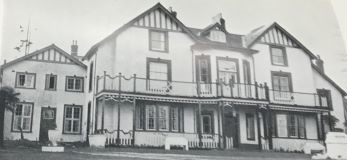 Bible College of Wales, circa 1936
From Lettie’s copy of Rees Howells, Intercessor,
OMS archives
Why does it take so long?
Ah, there’s the question! Can’t we just tell God what we want Him to do and move on?
When someone approaches you and flings a list of demands and then walks away, how do you feel?
How much time do we want to spend with a person we love? What if we’re discussing something large–a change in our lives?
Don’t we talk it through, examine options, discuss implications, wonder if it’s the right decision? Don’t we discuss it together?
Why wouldn’t God feel the same way?
Of course, we know He can do anything, but often praying about an issue, wrestling with it, changes how we look at it.
It can take time, particularly if it’s very big. That’s why it can be called wrestling, right?
Still thinking–and praying
Rees Howells’s life is an example of a man thoroughly wedded to his Creator. I’m still pondering what it means and if his–and Lettie’s –prayer lives should be an example for mine.
Rees Howells, Intercessor helped me understand something of Lettie’s prayer life–and that’s important.
But what about you? What’s the longest you’ve ever prayed?
Tweetables
A fantastic intercessor for God: Rees Howells. Click to Tweet
HOW do you pray for days at a time? Click to Tweet
Days of prayer and fasting with surprising results. Click to Tweet
The post Rees Howells Intercessor–and Prayer appeared first on Michelle Ule, Author.