Michelle Ule's Blog, page 33
October 15, 2019
A Thankful Heart: How to Cultivate

How do you cultivate a thankful heart?
I’ve spent a lot of time this year choosing to be thankful, rather than dwelling on my disappointments.
It took a while.
But I got there.
Here are four ways to cultivate–to nourish–a thankful heart.
Choose to be thankful
A bitter, disappointed person isn’t fun to be around.
I had prayed about my situation, assumed all would be wonderful, and then didn’t like the answer.
I could choose to be miserable and bitter–and I sunk into that from time to time–but I knew I didn’t want to stay there.
Who wants to spend time with someone who is always negative?
Who wants to hear about my sense of entitlement being swiped?
Not me.
So, I determined to find things to be thankful for, even in the midst of my disappointment.
The Bible tells us to do just that:
in everything give thanks; for this is the will of God in Christ Jesus for you.
1 Thessalonians 5:18 NKJV
I practiced. And the more I chose to be thankful, the more thankful I felt.
You can say it became a habit!
Don’t compare yourself to others

So often we become unthankful because we are looking at our circumstances and then at someone else’s. Their situation always seems better–which breeds discontent.
Author Madeleine L’Engle had something to say about that:
I must not worry about comparisons between great and small. I used to irritate my children by frequently quoting [Christopher] Marlowe: “Comparisons are odious.”
Madeleine L’Engle Herself: Reflections on a Writing Life
Jesus agreed.
Speaking to Peter at the end of John’s Gospel:
This He spoke, signifying by what death he [Peter] would glorify God. And when He had spoken this, He said to him, “Follow Me.” . . .
Peter, seeing him [John], said to Jesus, “But Lord, what about this man?”
John 21: 19, 21-22
Jesus said to him, “If I will that he remain till I come, what is that to you? You follow Me.”
God had one plan for Peter, another for John.
The same is true of you and me. I need to cultivate gratitude for what God is doing with my life without comparing it to yours.
Bless other people
As above, comparisons don’t work. God has plans for each of and what works for one person won’t work for another.
But, we can bless other people and, as in Romans 12:15, “rejoice with those who rejoice.”
Rejoicing with others, being thankful for their good fortune, encourages our thankful hearts–as long as we genuinely rejoice.
Celebrating and being thankful for one person’s good fortune can encourage us to be thankful–if we don’t return to those odious comparisons!.
Max Lucado on the September 20 Eric Metaxas Show, in discussing his new book, How Happiness Happens, noted, “we become happier people when we help other people.” (At about 21 minutes in).
The same things work with thankfulness. Be thankful for someone else’s situation and it will cheer you up, too!
Turn a twinge to thankfulness
Because I had determined to not be disappointed or bitter, whenever I had a twinge of negativity, I chose to pray.
I returned to that 1 Thessalonians verse and chose to ignore the envy, thanked God for what He had given me.
Every twinge reminded me to express gratitude to God.
Soon it became enough of a habit, that ingratitude faded.
Cultivating a thankful heart resulted in a lighter attitude, a genuine smile, and a marveling soul.
Such is the will for those who are in Christ Jesus: giving thanks in everything.
Tweetables
How to cultivate a thankful heart. Click to Tweet
4 suggestions for encouraging thankfulness and not bitterness. Click to Tweet
The post A Thankful Heart: How to Cultivate appeared first on Michelle Ule, Author.


October 8, 2019
What is “Imago Dei?”

I’ve used the term “Imago Dei” several times recently and I’m surprised people don’t know what it means.
It’s a Latin term that means “image of God,” or “made in the image of God.”
It means respecting life, human life.
We’re all made in the image of God, as He himself explains in Genesis 1:27:
So God created man in His own image; in the image of God He created him; male and female He created them.
Genesis 1:27 NKJV
Christanity.com expands on this definition:
The term Imago Dei refers most fundamentally to two things: first, God’s own self-actualization through humankind;
and second, God’s care for humankind.
To say that humans are in the image of God is to recognize the special qualities of human nature which allow God to be made manifest in humans. . . .
The moral implications of the doctrine of Imago Dei are apparent in the fact that if humans are to love God, then humans must love other humans, as each is an expression of God.
Is all creation Imago Dei?
God created other living things besides Eve and Adam in the Garden of Eden.
Is everything that lives Imago Dei?
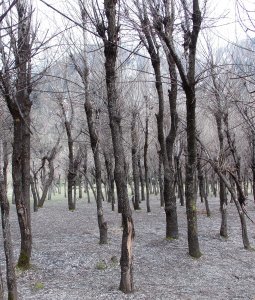
While waiting for the kindergarten bus one day, my daughter explained that “trees were more important than people.”
 Dilip Parikh (Unsplash)
My heart sank and I whispered a prayer under my breath before pointing at some nearby spindly trees. “Are those trees more important than your brothers?”
“Of course not. They’re just trees!”
“What people, then, are less important than trees?” I asked.
“People we don’t know!”
Ah, there’s the rub.
Even as a five-year-old, my daughter learned that Imago Dei refers to all people, whether you know them or not.
Of course, we love trees; but not as much as God calls us to love people–no matter who they are in relationship to us.
Jonah and the plant
In Jonah chapter 4, the prophet who already had spent time inside a whale and admonished the Ninevites to repent, settled down to sulk.
He didn’t like that God had mercy on the hated Ninevite race.
Jonah left the city and sat on a hill to see what would happen next.
But it was hot, so the same merciful God who accepted the Ninevite’s repentance, caused a plant to grow up,
That it might be shade for his head to deliver him from his misery. So Jonah was very grateful for the plant.
Jonah 4:7 NKJV
The Lutheran Study Bible notes, “this is the one time we are told Jonah was truly happy.”
The next morning, God sent a wind to scorch and kill the plant and a furious Jonah felt so sorry for himself, he demanded to die.
God called him on his lack of mercy and care for others. Was that plant of more value to Jonah than the 120,000 people in Ninevah?
They were made in God’s image and had eternal life before them.
The plant was designed to grow, wither, and die in one day.
What/who truly was more important? A plant or the eternal soul of men and women?
John Calvin on the Imago Dei
In Timothy Keller’s The Prodigal Prophet: Jonah and the Mystery of God’s Mercy, he discusses the value of our neighbors–the people we live with and whom we encounter, if only fleetingly, as we go through life.
John Calvin . . . discusses how Christians should regard all their neigbors. He draws remarkable implications from the doctrine of the Imago Dei.
“Remember not to consider men’s evil intentions but to look upon the image of God in them, which cancels and effaces their transgressions, and with its beauty and dignity allures us to love and embrace them.”
The Prodigal Prophet
We are called to love men and women, strangers, neighbors, foreigners, cruel people and all we meet with God’s love. They are all made in God’s image, whether they know it, or even like it, or not.
Dismissing the Imago Dei
It’s easy for many to demonize those who are not like them, or look like them.
“The other” can often seem like a threat.
And yet, Jesus calls us to love one another.
There is no asterisk excluding anyone.
That’s why racism, sexism, nationalism, class and sneering at others not like us has never made any logical sense to me.
Under the skin, we’re all the same.
I recently had a conversation with someone who told me, “I think humans are the biggest cause of climate change. They’re destroying the planet. We need to get rid of half the humans, and then we’ll be fine.”
I didn’t think anyone would suggest such an idea to a living person.
I’d already explained I thought everyone needed to be respected because of the Imago Dei–a concept of which this individual had never heard.
I shook my head. “I can’t agree with you if for no other reason than the Imago Dei.”
Mark 5
 Swine Driven into the Sea by James Tissot
 (Wikimedia Commons)
In his discussion of Jesus encountering the demon-possessed man living in the tombs among the Gadarenes, Enduring Word’s David Guzik commented on why Satan’s demons attack individuals.
Demons . . . attack men because they hate the image of God in man. They attack that image by debasing man and making him grotesque – just as they did to this man in the country of the Gadarenes.
Do Christians need to fear such attacks?
Demons have the same goal in Christians: to wreck the image of God.
But their tactics are restricted toward Christians because demonic spirits were “disarmed” by Jesus’ work on the cross (Colossians 2:15).
Yet demonic spirits certainly can both deceive and intimidate Christians, binding them with fear and unbelief.
Enduring Word, Mark 5: 8
What does it mean to be made in God’s Image?
We are fearfully and wonderfully made.
Each one of us.
We are called to love one another.
Each one of us.
I may not like what you do, what you say, how you behave.
But you are Imago Dei–God’s image–and for that reason, I can choose to love you no matter what.
The real question for me is simple: do I reflect God’s image in my interaction to and with the world?
Tweetables
What is the Imago Dei? Click to Tweet
Are trees more important than the Imago Dei? Click to Tweet
The post What is “Imago Dei?” appeared first on Michelle Ule, Author.
October 1, 2019
Assimilation to a New Community: Welcome Home

Assimilation to a new community is often the most confounding part of a move.
So, how do you assimilate after a move?
While there are things to love about a move, for many it’s daunting.
I’ve only moved fourteen times in adulthood, so my experience may not be as sweeping as others.
Ten suggestions for assimilation to a new community
Read the local papers before you move
Get a feel for the community before you relocate, learn what the main problems are and what people complain about.
You can read the paper online and learn for example, as we did, where NOT to buy a house.
Expect the last six months in the old location and the first six months in the new will be challenging.
Emotionally, physically, organizationally and personally.
During our Navy years, I tried to spend the last six months catching up on my photo albums–to give myself a sense of ending that chapter of our life.
 Photo by Jan Tinneberg on Unsplash
 It also enabled me to assess if we’d missed anything we wanted to do.
It’s important to remember, too, that those last six months and the first six months at the new location are times of grieving.
You’re saying goodbye to people you love and remember the missing relationships in the new spot.
My husband likes to remind people everything is in a different spot in your new residence and so it takes longer to do things.
You have to remember where you keep the hairdryer, say, or what drawer has your first aid kit.
Part of your assimilation may be to different climates–even if it’s sunny, maybe you need a jacket. (A lesson I learned on a sunny Connecticut morning when it turned out to be 32 degrees outside, not 70!)
Yes, you will get disoriented as to where things are and how long it takes to do everything.
Set up beds first, then organize the kitchen.
Sleeping in your own bed is important.
If you can cook a meal or make coffee without having to unpack a box, life will go easier.
Move during the summer if possible
If you can move in the summer, put your kids in fun activities and camps to help them get started and give them something to do.
My older children learned how to sail in Pearl Harbor when we arrived in late June. I happily spent the money to keep them entertained with local kids five afternoons a week for four weeks!
Meanwhile, I unpacked . . .
Give yourself permission not to unpack every box immediately.
 Then again, some unpack themselves. Photo by Erda Estremera on Unsplash
 Life is more important than having your boxes unpacked and pictures hung inside a week. No one is scoring, not even Navy wives.
Group items in the new house near the same items they were grouped with in the old.
I found the tripod the day I asked myself, “Where did we keep the tripod in the last house?”
When I went to the jacket closet, there it was.
When my mother-in-law couldn’t find her daughter’s cookie sheets, I asked her where she kept them in her house.
“Right here where they belong, above the oven.” Mary opened the cupboard door and there they were!
Even though unpacking boxes is physically strenuous, make sure you get exercise away from the house.
Take walks, ride your bike, explore the beach.
Assimilation to your new community means spending time there!
Getting outside can revive your spirits when the boxes never seem to end.
Take fun outings to the local tourist spots
What if the petrified forest seems like a corny idea? You can always learn something about local history and geology.
You can gain insight into your new communities if you experience what they’re famous for.
Now I try to do them in the first months. Too many times, I’ve lived somewhere for years and never made it to local tourist attractions.
Treat everything like an adventure
Who cares if you get lost? It’s a chance to see and learn about a new part of town.
Find your old friends in your new place
Assimilation to a new community goes better if you can find folks who share your interests.
Consider such spots as a church, scouts, music, soccer, gym, or reading groups.
See my post here about finding a new church.
Get a library card
 Photo by Jason Leung on Unsplash
 I always get a library card first thing.
(The apartment manager in Orlando was so shocked I asked the location of the closest library, “No one has ever asked me that before,” that she gave us a discount on our security deposit!)
If you befriend the librarian, you can get a lot of tips about best hiking, museums, local history, and suggestions on things to do, for example.
My current library has both reading groups and a quilting group, not to mention a local park pass you can check out for three weeks!
Ask locals for recommendations
If you know someone in the area, ask them to for suggestions about doctors, dentists, hairdressers, shopping, gym, and restaurants.
It’s also a great way to start a conversation with a stranger.
If the choice is between laughing or crying, laugh.
Assimilation to a new community takes time.
You may make mistakes.
It is absurd. You’ll figure things out eventually, but your emotions are engaging in frustration that has to be worked through.
You might as well laugh.
Tweetables
Assimilation to a new town: 10 pointers. Click to Tweet
How to survive a move: 10 suggestions. Click to Tweet
10 tips for a successful move. Click to Tweet
The post Assimilation to a New Community: Welcome Home appeared first on Michelle Ule, Author.
September 24, 2019
The Gold Rush Christmas Interview

This is a reprise of the original conversation, with updated information!
What made you write about this period?
I remembered my fascination with the 1897 Alaskan gold rush stories when my family traveled to Alaska.
In particular, I thought of that horrific photo of the line of men climbing over Chilkoot Pass.
I imagined a story about a family caught in that line, stepping out on December 25 to celebrate Christmas.
“The Gold Rush Christmas” didn’t quite turn out that way, though Miles and Peter do spend time on White’s Pass out of Skagway.
How is Christmas celebrated in your family and what effect did it have on your writing this story?
My husband is a retired naval officer, and we’ve celebrated Christmas in a number of different cultures.
We like to use aspects of the local customs when we lived in different spots–Christmas in Hawaii, for example, included a crèche made of a coconut shell.
We had a kiwi doll dressed like Santa from our Christmas spent in New Zealand.
While writing “The Gold Rush Christmas,” I sought an element of Alaskan culture readers would recognize that also told the Christmas story.
I found a fantastic one!
What research did you do to authenticate Christmas celebrations in your story?
 David K. Fison’s Christmas Totem Pole, Anchorage, AK
“The Gold Rush Christmas” includes a Christmas totem pole. I explored the Internet for information, and discovered a missionary in Alaska had actually made one!
We corresponded and Rev. David K. Fison asked me to use his description because he’d spent years ensuring it was culturally accurate.
(I no longer have a viable address or website for Rev. Fison).
What was the “germ” of your story idea and how did you flesh it out?
I wanted to write about the gold rush and I liked the idea of a pair of boy-girl twins and the boy next door sailing to Alaska on a ship filled with gold seekers.
I had to come up with a reason why they’d be sailing and turned it into a quest for a missing missionary father.
Would you like to have been there?
No. The conditions were awful, the con men terrible, and many people suffered.
What aspects of your characters are reflected in yours?
My tall, pushy brother likes to order me around and I’ve often resented it. 
September 17, 2019
The Drama of Primary Source Materials

Primary Source Materials are first-hand accounts of events, like this:
“I was too young to remember her. I do not have the faintest recollection of her.
“They told me Aunt Hannah made a white dress for me with lace beading and ran a black ribbon through this beading for the burial services.
“The day of the services Aunt Hannah was holding me in her arms and when they closed my mother’s casket I waved my hand and said, “bye-bye, Mama.”
On the day I copied those words, I stopped and put my head down on the keyboard.
I wept for both Carrie who died following her second childbirth and also for my grandmother who lived 91 more years missing her beautiful, kind and loving mother.
In “The Gold Rush Christmas”
“Primary source materials”sounds staid and boring, but it can make scenes come alive and inspire curiosity:
“Spill it! We’re aching to know where and how you spent the night? Why the Winchester? And for whom the book on etiquette?”
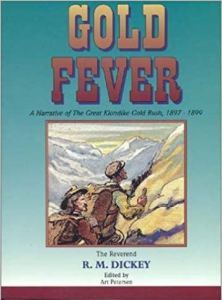
Rev. R. M Dickey; Gold Fever
Newspapers and diaries are excellent sources of information–primary, the first places things were reported.
Historians insist history cannot be understood without them–the eyewitness accounts of people on the ground.
Often, their poignancy speaks much louder than anything an author can imagine.
As he prepared to fix his bayonet for the battle of Cold Harbor during the Civil War, one soldier scribbled the date on the last page of his diary followed by the fateful words:
“I died today.”
Adapting Primary Source Materials
I like to use primary source materials while writing historical fiction because it makes the story feel more real.
I start with basic information about the location, and history, and then scour the Internet and libraries to find actual information written by people during the time frame.
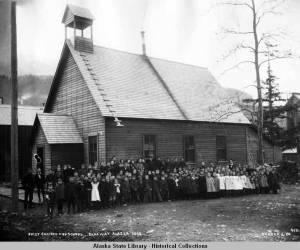 The original Union Church (Alaska State Library Historical Collection)
For my novella The Gold Rush Christmas, my best source was Rev. R. W Dickey who spent the 1897 winter in Skagway, Alaska and wrote about building the Union Church.
He mentioned townspeople, described what he encountered, and quoted unusual events in his book Gold Fever: A Narrative of The Great Klondike Gold Rush, 1897-1899.
He was the primary source of the amazing tale of the Skagway “sporting women,” “soiled doves” and “unfortunates,” as polite society called prostitutes.
A church member makes a request
When church member Mollie Walsh asked him to visit one of these women, the as-yet-to-be-ordained Rev. Dickey hesitated.
But he went, reminded the dying woman about Jesus and “how he came to search for us and bring us home to our loving heavenly Father.”
“The funeral service two days later was held in the church, which scandalized some people. The girls of her own class were in attendance–practically all of them–their painted faces and showy ornaments marking them out from the few women of the other class. Some of the latter sat aloof and looked their disapproval.”
Gold Fever
You can picture them, can’t you?
“It was a strange scene–probably fifty girls on their knees as we carried the coffin down the aisle.”
Rev. Dickey needed to visit the hospital and didn’t go to the cemetery, “but I paused long enough to watch the men reverently carrying the body of their erring sister toward her last early resting place, confident that Jesus to Whom she had looked had brought the wandering lamb home.”
I didn’t have enough extra words in my tightly-written 20,000 novella to include all of Rev. Dickey’s details or lovely turns of phrase.
To condense the storyline, many of his actions were transferred to Miles. A not-ordained seminarian, Miles’ sense of propriety ran into a number of “how can you not?” questions in “The Gold Rush Christmas.”
What happened next?
Rev. Dickey ran into Captain O’Brien of the steamship Hercules, who was curious about local news.
He told the story of the sporting woman’s death and the sobbing unfortunates in his church, mentioning his own sermon. The captain listened with interest and then had a question:
“Do you think any of them do it, leave off, I mean . . . Get word to them that on my return trip . . . I’ll take all who want to go to Vancouver or Seattle. It won’t cost them a cent.”
When the reverend pointed out they’d have no money and would have to return to their trade, a packer standing nearby butted in:
“I’ll give the Captain a check for whatever he thinks he may need. Would a thousand do?”
The town conman, Soapy Smith, wasn’t likely to let his primary source of income go without a fight.
The good men of Union Church, however, led by Rev. Dickey prevailed on the fearful sheriff to help the women.
As the sun set that night, a group of church people escorted 40 prostitutes to the Hercules and waved them south.
An amazing story.
I’ve read a lot about the Alaskan Gold Rush. My family traveled to Skagway, Alaska and saw Mollie Walsh’s statue in the park.
I’ve read countless tales of missionaries but had never heard of this one before.
I had to go to the historical documents to find out.
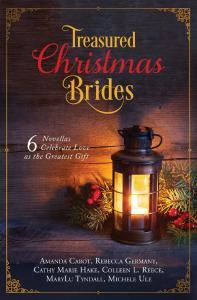
You can read my fictionalized version of this story, “The Gold Rush Christmas,” in Treasured Christmas Brides
Tweetables
How 40 prostitutes escaped 1897 Skagway Alaska. Click to Tweet
Using Primary Source materials for a better story Click to Tweet
Stranger than fiction: 1897 Skagway prostitutes escape. Click to Tweet
The post The Drama of Primary Source Materials appeared first on Michelle Ule, Author.
September 10, 2019
How the Holy Spirit Says No

How do you know if the Holy Spirit is redirecting you from the path you’re on?
Or, saying no?
It depends.
Here are four ways the Holy Spirit says no to a believer’s actions.
Through Scripture
This should be pretty straight-forward.
You decide you want to do something.
But there’s a “check” on your “spirit.”
That means something reminds you there might be a problem with that decision.
So, you look in the Bible to see what it says about your murderous thoughts, say.
You don’t have to go far before you encounter this one:
Thou shalt not kill.”
Exodus 20:13
Or if you prefer the New Testament:
For He who said, “do not commit adultery,” also said, “do not commit murder.” Now if you do not commit adultery, but do commit murder, you have become a transgressor of the law. “
James 2:11
In John 14:26, Jesus specifically said “The Holy Spirit . . . . will bring to remembrance all that I have said.”
 Photo by Lilian Dibbern on Unsplash
 That means a Bible verse pertinent to our situation will pop into our mind.
That’s the main way the Holy Spirit redirects our steps.
Through other people
But they don’t look like the Holy Spirit . . .
Who does?
This one works when you pray about something, say, asking God if you should do a specific thing.
You don’t tell anyone about it–you don’t ask someone what they think.
A friend joins you in a casual conversation but happens to mention the very question you had asked God about–and they provide an answer.
They don’t know you’re wrestling with a subject, but offer an opinion usually not even directed at you!
I’ve written about this here.
I had my answer.
You sense you’re not supposed to do something
It’s important to remember that God will always send a “check” if we’re wandering off the path He has set before us.
 Photo by Nadine Shaabana on Unsplash
 A good example of this is in Acts 16: 6-8, where Paul headed in one direction to share the Gospel and he was “forbidden by the Holy Spirit to preach the word in Asia.”
Enduring Word commentator David Guzik explained what happened this way:
We note with interest that the Holy Spirit actually forbade Paul to do something we normally think of as good – preaching God’s Word to those who need it.
Yet the Spirit of God directed this work, and Paul wasn’t the right person in the right place at the right time to begin bringing the gospel to the Roman Province of Asia Minor.
There was certainly nothing wrong with Paul’s desire to preach the word in Asia; but it wasn’t God’s timing, so this was forbidden by the Holy Spirit.
It is difficult to say exactly how the Holy Spirit said no; it may have been through a word of prophecy, or by an inward speaking of the Holy Spirit, or by circumstances. One way or another, Paul and his company got the message. Ephesus would come later, not now.”
Enduring Word commentary on Acts 16
You’re thwarted
Some will argue that when you’re stopped time and again by circumstances, you just need to move forward.
That’s true if you’re positive God has called you to do something.
But sometimes He uses circumstances to redirect us.
It’s not because we’re doing something wrong, but maybe (as noted above) the timing may be wrong.
Or maybe you have something else to do along the way.
That happened to Paul in the same Acts 16 passage.
As Guzik commented:
Paul was guided by hindrance. The Holy Spirit often guides as much by the closing of doors as He does by the opening of doors.”
Enduring Word commentary on Acts 16
Bonus: Dreams
Think how often in Scripture the Holy Spirit directed God’s people through timely dreams.

Both the Old Testament Joseph and the New Testament Joseph acted on dreams that came at the exact right moment.
I wrote about those dreams here.
A friend of mine raised in an Iranian Muslim home became a Christian after seeing Jesus in a dream.
That’s been happening a lot lately in the Muslim world–she isn’t the only one.
The Holy Spirit can direct us in the best way we can hear.
For some that will be in Scripture–black and white, clear.
Others will need brothers and sisters in Christ to advise them–whether they know it or not!
For some, it’s just a sense–but a testable one–and for others a dream.
Whatever means the Holy Spirit uses to speak to us, our calling is to respond in accordance with His will, not our own.
Thanks be to God
Tweetables
Five ways the Holy Spirit directs–and redirects. Click to Tweet
How best do you hear the Holy Spirit? Five options. Click to Tweet
What does it mean to be thwarted by the Holy Spirit? Click to Tweet
a Rafflecopter giveaway
The post How the Holy Spirit Says No appeared first on Michelle Ule, Author.
September 3, 2019
Treasured Christmas Brides

Treasured Christmas Brides is a collection of six Christmas-related novellas releasing from Barbour Book Publishing in September 2019.
One of my novellas, “The Gold Rush Christmas,” is part of the collection.
Treasured Christmas Brides includes novellas written by experienced writers.
Here’s a rundown on the stories and the writers themselves.
The Christmas Star Bride by Amanda Cabot
Wyoming, 1885

Esther Hathaway lost her one true love at Gettysburg twenty years ago, but she is still willing to celebrate her niece’s wedding by commissioning Jeremy Snyder to paint her portrait. Will Esther’s prayers for God to ease her loneliness be answered by a wounded vet?
Amanda Cabot is the published author of thirty-six works of fiction, “and enough technical articles to cure insomnia in a medium-sized city.”
Whether writing historical or contemporary stories, “the persistent theme is the healing power of love.”
She’s been writing since she was seven-years-old, “because it’s an integral part of who I am.”
Christmas Bounty by MaryLu Tyndall

California, 1855
Caroline is a widowed mother alone in a small California town that is suddenly exploding with gold fever. When she sees the ship’s captain who once saved her and her husband’s lives on a scaffold to be hung, she must do something—even propose marriage.
MaryLu Tyndall is the author of some thirty novels.
“Writing is my escape from life, from the humdrum of reality.”
Growing up in Florida, she’s written her entire life and is a “tall ship enthusiast, friend of pirates and mermaids, hopeless romantic and a sword-wielding princess-warrior of the King of Kings.”
In terms of Treasured Brides Collection, MaryLu thought “it would be cool to write a story about a pirate in California. And yes, they had them, but not the same kind you think of from movies.”
Winterlude by Colleen L. Reece

Alaska, 1930’s
A single out-of-place snowflake in San Diego lures Ariel Dixon home to Ketchikan, Alaska, despite her wealthy fiancé’s protests.
When she encounters Jean Thoreau, a childhood friend presumed dead, a swift rush of events changes the course of Ariel’s life.
Drawn back to the home she loves, Ariel finds peace in the arms of the man who would not break a promise made long ago.
Colleen Reece began writing “as soon as I could print and read, maybe about age 4.”
She grew up traveling all over the western United States and has published 160 books with more than 6 million copies sold.
A voracious reader who writes both contemporary and historical fiction, she believes the important thing as a writer is to tell “a good story that can touch lives.”
The Gold Rush Christmas by Michelle Ule
Alaska, 1897—

When Samantha and her twin Peter book passage to Alaska in search of their missionary-minded father, they never imagined getting caught up in the rush for gold or that their “third musketeer” neighbor would join them.
Dropping out of seminary is the first risk Miles took to protect the girl he loved, but couldn’t have guessed what was to come. Gold-hungry prospectors, “soiled doves,” gangsters and challenges to his faith, grow Miles’ character as a skeptical Samantha looks up.
Soon their youth and inexperience is challenged on all fronts–and they work a wonder in gold rush boomtown Skagway.
And then there’s the totem pole . . . ”
Michelle Ule fell in love with stories as a child and always added herself as a character into the novels she read.
Trained as a newspaper reporter while at UCLA in the Dark Ages, Michelle has traveled the world and loves nothing more than researching and exploring a new place for whatever she happens to be writing.
The Gold Rush Christmas concept first took root during a camping trip to Alaska with her husband, father-in-law and four boys under eleven.
She did all the cooking and they never needed their lantern.
Band of Angel’s by Cathy Marie Hake
Colorado, 1893

The first time Jarrod McLeod dips his pan in the river, he strikes gold—a wedding ring!
Sure the woman who lost it must be beside herself, he goes upriver to his neighbor’s claim. There, he meets hard-working laundress Angel Taylor.
She did lose the ring; however, she refuses to take the ring back. Jarrod’s first impressions of Angel are scandalous, but when he discovers the truth about her stepfather, everything changes.
With the help of a gentle Bible reading, how will Angel learn to trust again?
And what will Jarrod end up doing with that ring?”
Cathy Marie Hake is the author of more than twenty-five novels and novellas. A former oncology nurse and maker of Bible covers, she writes in the inspirational historical fiction categories.
Cathy lives in Southern California and did some of her research for A Band of Angel’s at Knotts Berry Farm!
Band of Angel’s is connected to the next one, A Token of Promise.
A Token of Promise by Rebecca Germany
Alaska, 1897

Promised in marriage to a man she has never met in exchange for a place to call home, Charlotte Vance is headed to the Klondike and struggling not to fall in love with the wrong man.
Gabe Monroe has found a bride perfect for his brother. A wife will help his brother run his supply business and raise his daughter, and Gabe will be freed to seek riches in the Yukon rivers after the spring thaw.
But what will become of Charlotte when both brothers refuse to marry her—even though one’s refusal sounds a little shaky?
Rebecca Germany is senior fiction editor at Barbour Publishing, as well as the author of five novellas and several gift books.
Her affection for historical fiction comes from her love of old-fashioned kinds of romance!
She lives on the old family farm in the Midwest and enjoys reading, singing, gardening, quilting and raises poultry.
Why a Christmas novella collection?
The Christmas season in the United States is a busy one full of things to do.
Each novella in Treasured Christmas Brides takes about an hour to read–a comfortable interlude for quiet entertainment.
I’ll be giving away a copy of Treasured Christmas Brides along with a $20 Starbucks gift card–so you have several drinks for several stories!
To enter, share this blog post somewhere.
Enter the rafflecopter below!
a Rafflecopter giveaway
Merry Christmas!
Treasured ChristmasThe post Treasured Christmas Brides appeared first on Michelle Ule, Author.
August 27, 2019
Aucas, Missionaries, and History
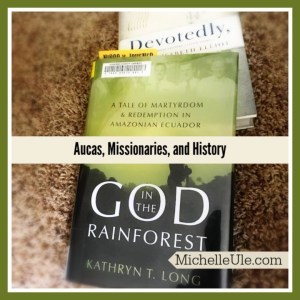
That’s just the first thing I didn’t understand until I picked up Kathryn T. Long’s God in the Rainforest.: A Tale of Martyrdom & Redemption in Amazonian Ecuador.
I first heard the stories long ago. Up until this week, I only knew them through Elisabeth Elliot’s pen or Steven Saint’s movies.
There’s so much I didn’t know.
Long wrote an excellent and thoroughly researched book about the Aucas, missionaries and everyone else in the Ecuador jungle. The book spans 60 years.
Here are four surprises, but they weren’t the only ones I read in God in the Rainforest.
Elisabeth Elliot’s role
Along with Aucas not being the proper name for the indigenous people, I learned Elisabeth Elliot did not do a lot of translation work in the years she and her daughter Valerie lived in the jungle.
Long presented a mostly positive picture of Elliot.
Earlier this year, I read Valerie Elliot Shepard‘s interesting book about her parents’ courtship, Devotedly, The Personal Letters and Love Story of Jim and Elisabeth Elliot.
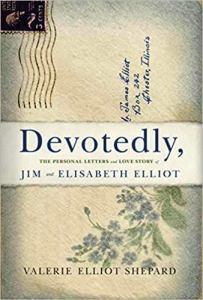
It’s a fine book detailing the deliberate choices, prayers, Scripture reading, and determination to follow God’s will that both Elisabeth and Jim worked through prior to their marriage.
I have no doubt that Elisabeth went to Ecuador determined to do God’s will come what may.
Even if that meant going to live with her husband’s killers in an attempt to reach them for the Gospel of Jesus Christ.
But the focused and determined Elliot (widow of martyr Jim Elliot) and Rachel Saint (sister of martyred Nate Saint), did not see eye-to-eye on their work.
Rather than confuse the Waorani, Elisabeth left the mission field.
God used her in other ways.
Another martyrdom occurred
I think that shocked me the most.
Many years after the five men lost their lives on a beach, Waoranis speared two Catholics to death.
Known as the “Aguarico Martyrs” Catholic Bishop Alejandro Labaca and Sister Inés Arango died, probably on July 21, 1987.
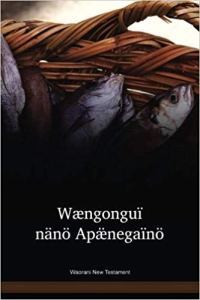 Waorani New Testament
Both had worked among the Waorani for years, though their language skills were limited.
They genuinely loved the Waorani and intervened to protect them from a potentially dangerous scheme.
Looking back, Capuchin missionaries close to the bishop were convinced that Labaca’s actions leading up to his encounter . . . could be understood only in light of his conviction that if Vela [a go-between in an incident between oil workers and Waorani that ended in death] found them [Waorani] first, the results would be tragic.”
God in the Rainforest page 280
The indigenous people ran up against oil and other explorations in the rainforest. Labaca, like the missionaries with SIL (Summer Institute of Linguistics, part of Wycliffe Bible Translators), wanted to protect them from outsiders who did not have the best interests of the Waorani at heart.
Many outsiders wanted to take advantage of them.
Well-wishers have been battling over what’s best for them ever since.
The Waorani’s jungle is a national park
Part of the area in which the Waiorani live is now Yasuni National Park.
Located nearly to the Peruvian border in eastern Ecuador, it appears to be bordered by Waorani Ethnic Reserve and an “intangible zone.”
This area has many oil reserves, not to mention unique species of animal life and the extensive biodiversity of the rain forest.
People have encroached upon the rainforest for more than 60 years. This forced the Waorani into smaller areas, or deeper into the rainforest interior.
The story is more nuanced than past portrayals
Of course, it is.
Whether indigenous rainforest hunters, farmers, oil workers, missionaries or linguists, the Aucas story remains complicated and multi-layered.
Long estimated the percentage of Christian Waorani at about 20-25% of the small population. (out of about 2000 people total).
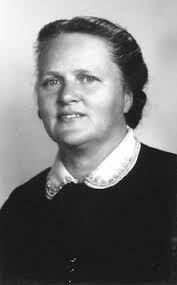 Rachel Saint (Wikipedia Commons)
Their worship services may differ from those in evangelical American churches, in part because they’ve made a Waorani form of Christianity their own.
Most live with some contact with the modern world.
They’re not frozen in jungle attire (or lack thereof) in time. They desire the benefits of modern civilization–particularly the health benefits.
Thanks to the work of teacher Pat Kelley, and linguists Rosi Jung and Catherine Peeke, the Waorani received a New Testament translated into their own tongue.
Long’s epilogue perhaps explains it best.
As far as the missionary-Waorani story, perhaps it is time for critics to concede that SIL workers did help the Waorani end some patterns of internal violence and survive contact with outsiders.
The Waorani are much more than the “supporting” cast for missionary heroism. They are people with a unique language, culture, and geographic location that–in common with all other cultures–reflects both the goodness and the brokenness of the created world.”
God in the Rainforest page 349
A meticulously researched (57 pages of endnotes!) book, God in the Rainforest taught me a great deal and left me with much to ponder.
Tweetables
Aucas, missionaries and a fuller side of the story. Click to Tweet
It’s Waoranis not Aucas and other surprises learned from God in the Rainforest. Click to Tweet
The post Aucas, Missionaries, and History appeared first on Michelle Ule, Author.
August 20, 2019
Novella Writing Reflections

“The Gold Rush Christmas” is part of Treasured Christmas Brides.
I’m pleased to see it again. “The Gold Rush Christmas” was my favorite and most memorable novella to write.
What’s it like to write a novella?
Novellas are popular because they’re short–the stories I wrote were 1500-20,00 words in length.
They’re basically short stories but in the case of the novellas I wrote, they included romance and aspects of American history over a longer period of time than usually covered in a short story.
As with any interesting tale, they encompass emotion, action, and insight.
At least that’s what I strove to include.
It also needed to make sense and resolve in a satisfying way.
Here’s an example of the plot diagram I did for “The Gold Rush Christmas.”
 My writing diagram for A Gold Rush Christmas
Blocking it out like that was the only way to make sure I included a full and rich story in 20,000 words!
Plotting an authentic story
Given that I wrote in the inspirational historical romance genre, I felt a responsibility to put together an authentic story.
That meant I did plenty of research to make sure my tales were historically accurate.
I’m a stickler in that arena.
Because we’d lived in the Seattle area and taken a three-week camping trip to Alaska, I was familiar with the drama of the 1897 gold rush.
I took my children to visit both the Seattle Alaskan Gold Rush Museum and the Alaskan half of the museum.
We took a four-day ferry ride from Puget Sound to Skagway, Alaska. to accomplish that end.
Upon leaving the ship (at 2 am!) in Skagway–the site of my story’s drama–we spent the night in a former brothel.
“Why are the bathtubs so big?” The nine-year-old asked.
“Why are their mirrors everywhere?” My ten-year-old godson asked.
We shrugged.
 We saw the same views as we sailed through the Inland waterway as
The Gold Rush Christmas
‘ Samantha, Miles, and Peter.
We saw the same views as we sailed through the Inland waterway as
The Gold Rush Christmas
‘ Samantha, Miles, and Peter.Out in the wilderness, the six guys I camped with panned for gold while I read stories about the era.
All this, however, took place long before I wrote “The Gold Rush Christmas,” so I had to reread everything!
Two-thirds of the way into the writing, I found a fascinating historical detail begging to be included.
So, I rewrote, reorganized and by editing every word, managed to squeeze in a fascinating tale of the 1897 Skagway prostitutes.
I’m still shaking my head!
What makes a novella inspirational?
To get romance, historical accuracy and inspiration into one novella is a lot for 20,000 words!
And yet, properly honed, inspiration should be organic to a story.
It involves your characters and their dreams.
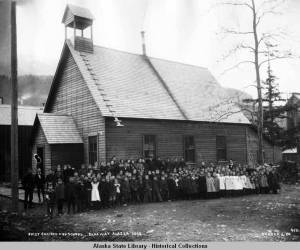 The church Rev. R. N. Dickey built!
 (Alaskan Historical Society)
“The Gold Rush Christmas,” tells the story of a pair of twins and the boy next door–who knows he’s in love with the girl half of the twins.
Actually, all three know.
But Miles wants to prove himself to Samantha and his God.
He learns to takes risks within his character.
Miles confronts people he never would have approached and for that experience learns an important spiritual lesson.
At the same time, Peter and Samantha seek their father.
They didn’t realize they were also looking to find themselves as individuals no longer linked to their twin.
And when the “three musketeers,” finally track down the man, everything turns around.
How?
You’ll have to read “The Gold Rush Christmas” to find out.
And, hopefully, be inspired along the way with this adventurous novella.
My thoughts seven years after writing
I still love this story.
The interaction between the characters makes me laugh.
I remember feeling the way Samantha did about her overbearing brother.
Loving him, yes, but exasperated!
And I love how the Christmas totem pole wraps it all up.
I’m so pleased to see “The Gold Rush Christmas,” back in print.
Thanks, Barbour Publishing, for the Treasured Christmas Brides Collection.
(“The Gold Rush Christmas” also appeared in A Pioneer Christmas Collection.)
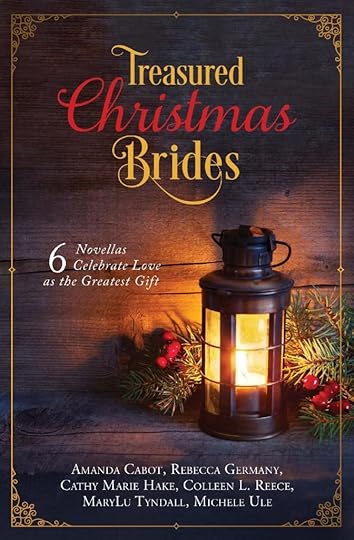 Treasured Christmas
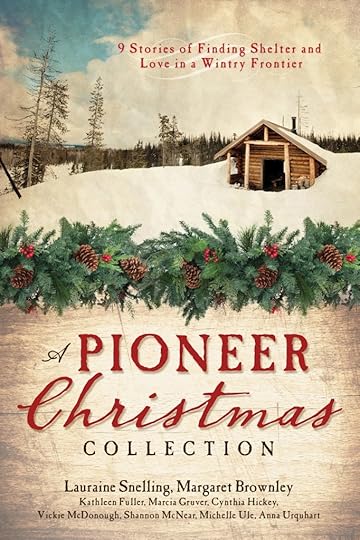 Pioneer Christmas
Tweetables
An author reflects on her favorite novella–and why she still loves it. Click to Tweet
The lengths a writer will go to tell an authentic inspirational and historical story. Click to Tweet
The post Novella Writing Reflections appeared first on Michelle Ule, Author.
August 13, 2019
Why Host Foreign Exchange Students?
Our three Finnish foreign exchange students just left for home.

We miss them.
Two and a half weeks of showing our country to wonderful teenagers ended with tears and kisses.
It’s the third time we’ve hosted foreign exchange students.
Here are four reasons why hosting teenagers from another country is so rewarding.
You see your country through different eyes
What’s normal to you may not be for people from another country.
Our two thirteen-year-old Chinese students were amazed by many things.
Among them:
Mechanical trash truck arms that picked up the garbage cans and dumped them into the garbage section on top. Cars towing things; in our case, it was an ancient catamaran.Redwood trees. They didn’t believe us when we said, “you’ll see really tall trees.”The ocean. They were from inland China. “There are not enough words for beautiful,” their teacher said.
Our Brazilian foreign exchange student arrived in 2010. Among the first items she purchased was a DVD of the movie Twilight.
“If Twilight was your idea of American high school, did you see any pale people with twinkling skin the first day of school?” I asked.
She laughed.
 Look! Hills and palm trees!
The Finnish students were surprised by
All the different varieties of toothpaste.Chocolate chocolate chip pancakes at IHOP.Palm treesHills. (Finland is flat. That surprised us!)
Foreign Exchange Students teach you about their countries
Other than Finland is the only Scandinavian country I’ve not visited, I’d never considered traveling there.
Then Marcus brought us a gift book about his country.
I read it with my map open and was surprised at how beautiful it is.
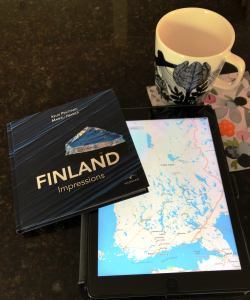
We might visit now–especially with three people to see.
Brazilians are earnest about the quality of their meat.
Once we found the right type of beef (we drove 30 miles to a Brazilian grocery), Giovanna barbequed a superior dinner!
The Chinese boys had a lot of cash and wanted to visit the Apple Store.
“IPhones and IMacs are made in China,” my husband pointed out. “Why do you want to buy one here?”
“It’s the only place we can guarantee they’re not counterfeit,” “Harry” explained.
We insisted the teacher join us for that shopping trip!
It’s fun
While the students attend class during the day, the evenings and weekends were ours.
They all wanted to go shopping–and I visited the grocery store frequently.
But my husband and I are teachers at heart, so we introduced them to other experiences.

Both the Chinese boys and the Finnish trio stayed with us in July.
They were here for the Civil War reenactment held locally at Duncan Mills, California.
What fun that was!
(Though, ask yourself. How would you explain the Civil War to two teenagers from China?)
We took the Finnish students to San Francisco for the day, where we rode cable cars, ate at a Chinese restaurant and walked nearly six miles.
Our Brazilian was here an entire semester. Picture her face when we told her we were headed to Disneyland!
What foreign exchange students can teach you
We learned a lot from our students.
I can now count, sort-of, in Finnish.
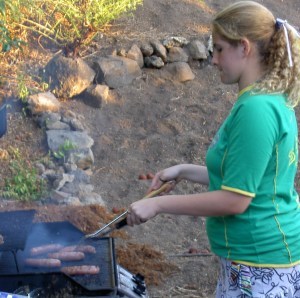 Fantastic barbeque!
Giovanna taught me about perseverance. She wanted to read Harry Potter novels.
So, with an English Harry Potter book in one hand and her dictionary in the other, she began.
By the time she reached the final book and visited us, she was fluent in English.
The Chinese boys reminded us of the delight of seeing Star Wars for the first time.
That pizza isn’t always what a teenager wants to eat.
American food is sweeter than any of them prefer.
There’s more to Chinese culture than we see in the newspapers.
And of course, what you think you know about their countries, particularly in their view of the United States, isn’t necessarily correct.
Indeed, it can be surprisingly refreshing.
What do you need to host foreign exchange students?
An open heart, curiosity, time and a nearby grocery store.
They will need their own bed, but your house doesn’t have to be large.
The students’ programs all asked us to involve the young people in our normal, every day lives.
They attended church with us, shopped, went sailing, enjoyed our greater family, met our friends, and listened politely to our stories.

We didn’t have any children at home, except during the Brazilian’s stay.
In turn, we listened to their stories, laughed, taught them how to do laundry in America and sought ways to enlarge their American experience.
Each time we sent them home, we cried.
We’d be happy to host foreign exchange students again.
Tweetables
Why host foreign exchange students? Click to Tweet
4 reasons for hosting foreign exchange students. Click to Tweet
What’s it like to host foreign exchange students? Click to Tweet
The post Why Host Foreign Exchange Students? appeared first on Michelle Ule, Author.