Michelle Ule's Blog, page 29
July 21, 2020
The Headhunter’s Bride

The Headhunter’s Bride is a book of narrative nonfiction, published in 1952, by Dr. B. H. Pearson.
I picked up this book because of the provocative title, but also because it’s directly related to Lettie Cowman.
I’ve even got a photo of Lettie with a headhunter.
According to Pearson, he first heard the story from Lettie. He found it so astonishing, he interviewed the bride for the whole story.
It’s a wild one.
Headhunter facts
No, we’re not talking about recruiters.
We’re talking about a man who grew up in a Formosan/Taiwanese village in the first half of the 20th century. Pearson called him “Zumba.” (Which has nothing to do with exercise dance).
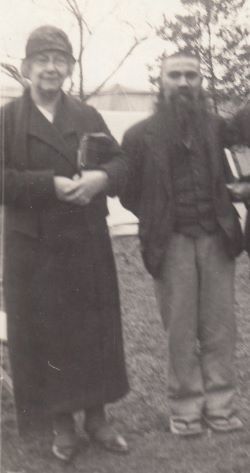 Mrs. Cowman and “Blackbeard,” 1929
(OMS Archives)
The villagers really did kill people, often with poison darts, and then cut off their heads.
The hunters wore netting around their necks and carried the heads in those nets back to the village following a raid. (As late as the 1930s)
It was a triumphant time of religious ritual when they returned. The women and children whooped and screamed, gathering around the men to inspect their “trophies of war.”
The villagers set the severed heads on logs and brought them bowls filled with rice liquor to “make the spirits happy,” so they would help the villagers rather than their enemies.
Honestly, you have to read it to believe/understand it.
The story was grisly.
Fortunately, the book has no photos.
Who was the headhunter?
Zumba was the son of Chief Zu, who had ruled the native Taiyals/Amis people for many years.
Chief Zu, his father, had ruled the Taiyals for years when his oldest son left the Formosan mountains to attend school in Taipei. He learned to speak Japanese and trained to become a Japanese police officer.
One day, he heard OMS founder Juji Nakada share the Gospel, and Zumba became a Christian. He returned to his village to teach and tell them the Good News.
Zumba also had to tell his father he would not participate in headhunting any more.
As a result of this decision, no women in the village would marry him.
He asked the Taipei pastor for help in finding a bride.
Who would become a Headhunter’s Bride?
A very unusual woman indeed.
O-Chan, as Pearson calls her, was born in Japan about 1905, of near-royalty, a member of Shogun Keihi’s family. (He was the supreme ruler before the Meiji dynasty).
She grew up entering the Japanese palace, at home in conversing with the Emperor and Empress. The family arranged for O-Chan to marry a wealthy and prestigious man.
But a Christian serving girl gave O-Chan a New Testament. She became convinced it was true and left home for the Oriental Missionary Society’s Bible Training Institute in Tokyo.
Her family disowned her.
She didn’t mind.
“I saw there was some purpose in living. Now I had Life and something to live for.”
The Headhunter’s Bride, p 220
When a Taiwanese pastor visited the Bible Training Institute one day in 1926, he told of the Christian headhunter who wanted a wife but was shunned because he’d given up headhunting.
Would any woman in the school be willing to accept this man and live in the village to share the Gospel?
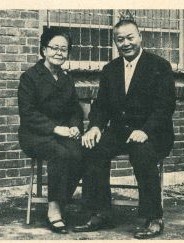
She would leave behind a city life of order, electricity, piped-in water, telephones, and clean orderly streets. Her new home would be in a village of bamboo huts over dugouts two feet deep and communal pots for dining.
Only one woman came forward: O-Chan.
This was my chance. At times before I became a Christian, I thought of suicide, because life was so empty. Here was something worth dying for–these headhunters for whom no one cared.”
The Headhunter’s Bride, p. 221
But her instructors were aghast. Given her imperial connections, they had hoped she would work among her friends and family. Surely someone else would volunteer for this life-long task?
They waited, but no one did.
At last I said, ‘If God is calling me I must go.’ I dropped to my knees and promised God that if He would go with me, I would never turn back.”
Ibid.
And so she went.
Formosa/Taiwan in 1926
The eastern half of the island of Formosa is a rugged mountainous country, almost impregnable. The southern tip is 500 miles due west across the South China Sea from Hong Kong.
In the early 20th century, the Taiyal/Ami people had been driven off the rice-growing plains into the high eastern mountains by the Japanese. They managed, living off the land, trading with people in coastal towns for their needed salt and other staples.
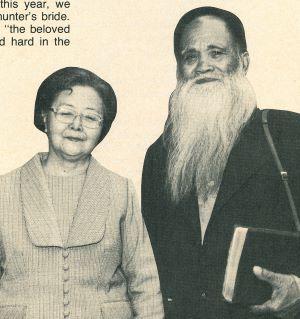 O-Chan with one of her first converts–Blackbeard, aka Pastor Wu. (Missionary Standard Magazine, 1976; OMS Archives)
People were afraid of them, for good reason, and they lived isolated in the hills. The men hunted, the women planted, gathered, made cloth, cooked, and did all the usual work of aboriginal women everywhere.
Following directions sent from Zumba, O-Chan, her pastor and a Chrisitan couple set off to find Zumba’s village high above the jungles.
She married Zumba that night.
Two nights later, after her friends left for Japan, O-Chan witnessed the return of a headhunting party, complete with three severed heads.
Terrified by the screams and dancing, she turned to her new husband who explained the ways of the people.
She had never dreamed that all this commotion had any reference to placating and honoring the spirits of those whose heads she saw there before her . . . she saw that all of this had a religious significance . . . It was all so crude, so savage, so uncouth, so dark, so without the knowledge of God.”
The Headhunter’s Bride, p. 79
The Results of the Headhunter’s Bride’s life?
Chief Zu welcomed O-Chan into the clan in their primitive village. She soon grew to love Zumba and eventually gave birth to three sons.
Her willingness to serve and adapt to the village life endeared her to the tribe, despite her and Zumba’s unwillingness to participate in headhunting rituals.
Gradually, many asked to know about her God.
That included the man known as “Blackbeard,” who founded the OMS work among the tribal people in Formosa.
She used her limited skills to help with midwifery and hygiene, ministered to the sick, and prayed for all. Her youngest son eventually traveled to Japan where he became a doctor.
They called him Juji.
The Japanese Army in the mid-1940s martyred Zumba for refusing to deny Christ. O-Chan died in the 1970s.
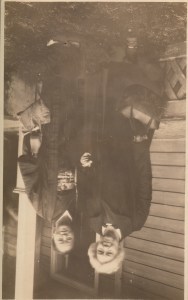 Mrs. Cowman and O-Chan 1929 (OMS Archives)
She’d told her story to Lettie Cowman when they met in 1929. By 1975, 14 tribal churches had been established in eastern Taiwan.
They were no longer headhunters.
O-Chan may have forsaken the riches of the Japanese aristocracy, but she’s rejoicing in heaven today with the saints–including many Taiyal tribe members.
Tweetables
The life of a Headhunter’s Bride, for Christ. Click to Tweet
What would cause a Japanese noblewoman to marry a headhunter? Click to Tweet
The post The Headhunter’s Bride appeared first on Michelle Ule, Author.


July 14, 2020
Good People and the Bible
Is the Bible about good people?
Isn’t it a book full of dos and don’ts featuring sweet-tempered boring angels playing harps and never doing anything wrong?
Or, is it one long drag of lecturing readers about improving their behavior or else?
Did the writers just put together words to make people feel guilty?
The answer to all those questions is no.
Don’t believe it?
I didn’t either–until I actually read the book.
Indeed, other than Jesus, I’m not sure you can find many good people in the Bible
And that’s the point.
Who IS the Bible about?
It’s about all of us, no matter our race, gender, ancestry, behavior, hopes, dreams, sins.
It’s the story of God reaching out, time and again, to call the people He created back to Him.
We read it as truth, but also with nuance. Particularly in the Old Testament, we need to read for more than the simple facts.
 Sigh. It’s always the attitude.
 Photo by Eirik Skarstein (Unsplash )
God is showing us the consequences of lives lived apart from Him.
I may not have much in common with a prophet named Jonah in terms of gender, nationality, clothing choices, or even hairstyles.
I’m also not a prophet.
BUT, I do know what it means to resist God when He directs me to do something.
I know what it’s like to be afraid.
I’ve been resentful.
My attitude has needed God–or one of His children–to straighten me out.
By reading beyond the simple facts, who, what, when, where, why, how, I can recognize the attitudes in my heart.
Then, I recognize, yet again, that I’m not a good person.
What’s the difference between good people and bad?
The New Testament, in particular, carries good news for people like me.
That would be folks who recognize they sin. Often.
Remember those Ten Commandments?
We call that “the Law.”
The purpose of the Law is to show us the “rules.” It draws the line so we can understand what is “bad.”
Not who is bad.
What is bad.
Without those Ten Commandments, how would we know?
The Definitions
Good= morally excellent; virtuous; righteous; pious. (Good is mentioned 743 times in the New King James Version [NKJV]of the Bible)
Bad= not good in any manner or degree. (Bad is only mentioned 51 times in the NKJV!)
The Bible= “All have sinned and fallen short of the glory of God.”
It’s to act contrary to God’s law–see the Ten Commandments.
To be blameless, obedient, kind. Here’s a whole list.
Since, however, the Bible has said all have sinned, none of us are good.
The Bible is full of people who are NOT good. On pretty much every single page. (The Bible on my lap is 1500 pages long)
Except, of course, for those whose sins are forgiven because of Jesus’ death on the cross.
So, what’s the point?
I’ve been listening to the Old Testament’s book 1 Samuel at Enduring Word for the last few months.
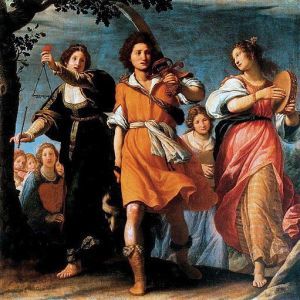 David: flawed but forgiven
Triumph of David by Matteo Rosselli (Wikimedia Commons)
Hearing the story of King David, the man after God’s own heart, has not shown me a saint without flaws.
It’s been one story after another about a man living in dangerous circumstances, trying his best to honor and love God.
He fails time and time again.
Some of his choices are good.
Some of his choices are horrific.
But the point of reading or listening to 1 Samuel–and then on into 2 Samuel–is not to hear about a good person.
It’s to hear about someone like me.
I’m not a king, a shepherd, or the youngest of eight brothers.
I’ve never been to Israel, I can’t use a sling, and I’ve no interest in a bunch of husbands.
But I am a woman who makes mistakes. I make bad choices. I disappoint people.
Failure, sin, behaving badly, is common in my life, thoughts, and too often my words.
The Bible, in depicting David’s failures, encourages me that despite my choices, I’m still loved by God.
I can still come to Him and ask for forgiveness.
Good people or bad people–does God care?
You bet God cares.
It’s not our behavior He watches, however. It’s our hearts.
By reading the Bible we learn how God deals with the people He loves.
In reading Scripture, we learn how to discern the state of our hearts–toward God.
Studying Jesus’ life in the Gospels shows us how to put the two together to make us whole before God.
 Alas, this is not me.
 Photo by Ravi Roshan (Unsplash )
All those “bad” people, who stumble and fall, cry out to God for help and forgiveness, show me how.
I didn’t know anything about loving God, following Jesus, recognizing the Holy Spirit, until I began to read and study the Bible.
I’m one of the many people in there–both the good and the bad.
And so are you.
The question, however, is will I end up in heaven with God eternally?
Well, yes. I will. Jesus died on my behalf.
But, not because I’m good.
Tweetables
Is the Bible only about good people and being good? Click to Tweet
Isn’t the Bible about boring goodie-two-shoes who never do anything wrong? Click to Tweet
The post Good People and the Bible appeared first on Michelle Ule, Author.
July 7, 2020
900 Blog Posts

I’ve written 900 blog posts for this website.
Since I’ve been writing here since December 2010, that probably isn’t surprising.
That’s roughly 700,000 words.
I hope they were good ones!
Most Read of the 900 blog posts
The top ten, most-read of those 900 posts are these:
Bagpipes in the WWI Trenches (#1 on Google)
Whatever Happened to Kathleen Chambers? (#1 on Google)
Was it Really Well with the Spafford’s Souls? (#3 on Google)
 One of my favorite photos Photo by Andrew Smith
 Who was Biddy (Mrs. Oswald) Chambers Part I (#1 on Google)
Why Did God Let Oswald Chambers Die So Young? (#1 on Google)
Kathleen Chambers: Little Girl in a WWI Camp (#2 on Google)
What Belongs in a Modern Hope Chest? (#4 on Google)
An Angel and the Apostle Paul (#1 on Google)
Six Keys to Writing Christian Devotionals (#1 on Google)
What to do with Self-Pity (#1 on Google if you add “Elisabeth Elliot.”).
Roughly analyzing 900 blog posts
What do you make of these posts?
Obviously, I write often about Oswald, Biddy and Kathleen Chambers.
I’ve done so 100+ times. You can see the list here.
Since A Poppy in Remembrance included the Chambers family and World War I, I wrote a number of posts about the war.
I was writing a book, or three, and I used my research to tell the stories that may or may not have made it into the books.
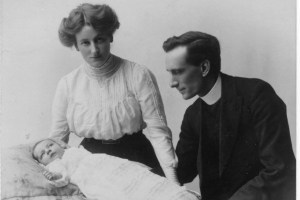 The Chambers trio
The Spafford’s blog post is also a World War I story, based on a fascinating book, American Priestess.
Books I read and appreciate often prompt blog posts.
The hymn, of course, “It is Well with My Soul,” is what brings many people to the post. I think it’s a sad and surprising story, myself.
But I still love the hymn, as evidenced in this post about a visit to the Brooklyn Tabernacle in New York.
A favorite post about a hymn, also shares history, a story, and music. I only wrote it a year ago, so it hasn’t had time to climb this chart! Who Wrote “Jesus Loves Me?”
Travel Influences on the posts
The Modern Hope Chest post was the result of visiting Venice, Italy where we saw a 500-year-old hope chest. It prompted a discussion with family members about what people would want to learn in their childhood for their adult life.
My children acquired most of those skills (Though one called home recently to complain I hadn’t taught him how to iron!).
On the same trip that we visited Oswald Chambers’ Bible Training College, as well as St. Paul’s Cathedral where he and Biddy became engaged, we also went to the trenches.
The trench visit inspired several posts, but I’d already fallen in love with bagpipes–when I wrote about them in my novella, The Yuletide Bride.
Everything I do becomes fodder for writing a blog!
Other Themes in the Top Ten
I write about spiritual issues often. As a long-time Bible study leader, I’ve thought about spiritual growth and the challenges I’ve faced in my Christian walk. I’m thankful when I can share things I’ve learned.
I’ve written a number of posts on Biblical themes–often taken from what I’m teaching or reading. A list of them can be found here.
As a professional writer for ten years, I’ve written frequently about the writing life. Many people want to write Christian devotionals, which is why that post and several others on the subject are so popular.
I wrote it, though, as part of my research in My Utmost for His Highest and Streams in the Desert. I love sharing information I know others are interested in.
Comments and emails from readers are treasures!
But, what does it mean to have written 900?
Nothing in particular, though some people believe you should write books on what your readers like.
Given that injunction, what should I write the next book about?
How about a story set during WWI when a group of bagpipe players in a trench discuss how to write a devotional, or argue about whether the Apostle Paul ever saw an angel, or if Oswald Chambers’ daughter was a Christian, before getting the call to go “over the top,” while playing “It is well with my soul?”
No, I don’t think that would work either. 
June 30, 2020
Bookshelves, Books & Voyeurs

When bookshelves and books appear in photo or video backgrounds, do you zero in on them?
Oh, sure, you’re listening to the person being interviewed, or at least you make note of them, but are your eyes sirened in another direction?
A friend asked the question the other day and three of us immediately admitted we scanned the book titles.
Judgment may have been involved, but mostly it’s curiosity.
What can you learn about a person based on the books they like to read?
Or, perhaps better yet, the books represented on their bookshelves?
Books and Bookshelves at home
What appears in a Zoom background?
I like to sit beside my desk with a painting on one side and bookshelves on the other. My personally written books are on the top shelf. (Perfectly situated for admiration).
That particular seat meets all the video “best practices.”
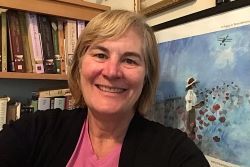 Obviously staged
Natural light shines on my face, the background represents my interests, and everything I need is in reach.
Perfect for interviews. (I sit at my desk for Zoom meetings).
The Twitter site Bookcase Credibility also notices bookshelves and frequently releases a commentary on what a shelf says about the usually famous person.
The elevated language and assessment often make me laugh.
But it’s an interesting exercise.
What do your bookshelves say about you?
Assessing the bookshelves
I turned the phone on myself and went sleuthing in my own house this morning.
(Other than the photo above, the only things I changed were photos to protect the innocent).
Let’s start in the kitchen.
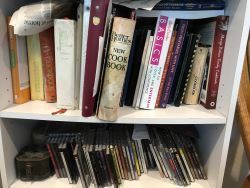 What do you make of this reader?
I’d say this person likes tried and true recipes, is optimistic about recipes found in the newspaper or magazines but never tries them.
The curator of this bookshelf probably prefers old music to cooking–but perhaps combines the two?
Let’s hope the cookbook weightiness is not reflective of the cook.
June 23, 2020
Making a Family Recipe Cookbook
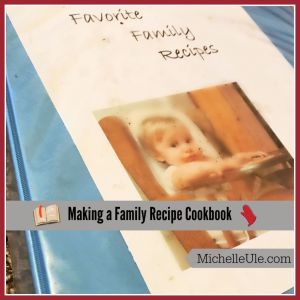
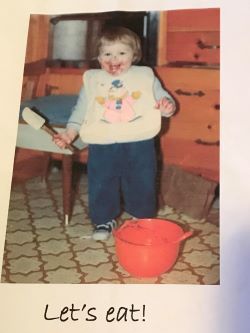
I made a family recipe cookbook when my first child left for college.
He asked for it.
But, I saw no point in providing a plain, ordinary list of recipes.
Instead, I included photos and a few stories along the way.
Here’s how and why.
The importance of a family recipe
We often talked about our distant (as in location) relatives while eating food we’d shared with them.
That was particularly important on holidays, of course, but it also enabled us to tell family stories year-round.
We come from a multi-cultural family, and our food tastes reflected that.
(Along with family recipes picked up along the way after living all over the United States.)
The only time the kids ever ate sweet potatoes, for example, was at Christmas when their paternal grandmother’s recipe hit the frying pan.
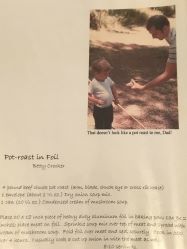 It’s your family’s cookbook; be as silly as you like!
None of the kids particularly liked that family recipe, but they all nibbled a piece in honor of the grandmother half of them never knew.
It also gives children continuity.
My family’s been eating pasta on Sundays for more than 160 years.
That’s not surprising since we’re Sicilians, but I asked my grandfather once and he agreed his family always ate pasta on Sundays.
(They probably ate it every day of the week, but we focused on Sundays).
It put rhythm into our week–spaghetti sauce was brewing. It was Sunday.
Which family recipe to include?
I asked the kids which ones they wanted.
They had a list: spaghetti sauce, enchilada pie, chocolate mousse, apple crisp, hamburger stroganoff, and so forth.
 I remember what they were doing!
Somehow in all that note-taking, I forgot to write down the most requested recipe: Mrs. Ule’s Chocolate Chip Cookies.
(A man who regularly visited our house in high school asked me for the recipe just the other day!)
Some of the favorites came from Betty Crocker or the Better Homes and Gardens Cookbooks. I included the reference, but also my substitutions. (I always use plain Greek yogurt in lieu of sour cream to save a few calories, for example)
I also threw in stories and explanations of where the food ideas came from and pictures.
Why include photos in a family recipe book?
My children grew up far from loved ones. I wanted them to connect recipes with their family.
So, my mother-in-law’s photo is at the top of the candied sweet potato page.
My son’s godparents (and their children who are my godsons) smile at us from Bob’s Pizza Dough recipe.
Hungarian relatives pose with the notation, “our favorite Hungarians,” on the goulash page,
Every time I open the cookbook and see them, I smile back.
Why not include a few stories?
The stories don’t have to be lengthy, just a sentence or two to put the food into context.
For “Auntie Arly’s Incredible Potatoes,” I merely wrote, “everyone wants this recipe!”
It was true. My aunt used to carry around the recipe on cards to hand out when she took her casserole to potlucks.
Everyone wanted it.
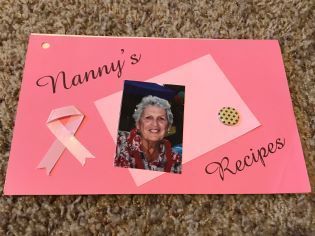 My cousins made their own book–but shared it!
For the pumpkin bread recipe, I added a photo of the boys carving a pumpkin we grew in the garden–the only time we succeeded!
Any picture of the kids with food the family loves is fair game.
Putting it together
Simple.
I typed all the recipes into Word, added whatever commentary I felt like, and inserted photos.
For my family, I divided the recipes into two sections: Main Dishes or Desserts.
I had the family recipe book put into comb binding at a local printer for the children.
For me, I slipped the pages into clear plastic sleeves and set up a three-ring binder.
That was a better strategy. Over the years, dirty fingers have left their marks and I’ve added a bunch of additional recipes.
I have a section on Christmas Cookies now, in honor of the annual decorating party, for example.
Whatever works for your family is the best choice.
I’m going to redo the family recipe book this year in time for Christmas.
I’ll add all the recipes I forgot the first time and which they’ve asked for ever since.
(Though, wait. They call me when cooking to ask about the ingredients and the recipe. Maybe I should leave our a few strategic points?
(Or, perhaps, include, “This step involves a phone call home for further directions?)
The cookbook has served its most important function.
The recipes bring us together.
They remind us of the people and the tastes we love.
They’re a bit of home–whatever home means for my moving family–because a family recipe doesn’t require anything besides ingredients, love, and memories.
I can hardly wait to get started on the update.
Why not make one for your family?
Tweetables
The satisfaction of a family recipe cookbook. Click to Tweet
How to put together a family cookbook. Click to Tweet
The post Making a Family Recipe Cookbook appeared first on Michelle Ule, Author.
June 16, 2020
What Do You Do? & Other Minefields

“What do you do?” used to be a challenging question for me.
When speaking with strangers, it was difficult for me to gauge what they were really asking.
Did they want to know how I spent my time? Curious about my personal interests or dreams?
Of course not. Here in the United States, they were trying to assess whether I had anything of interest to say.
I always felt like I was being judged on whether I had a job or not.
Is that still true?
Changing Times?
The question came up this week in my small book club.
The other five members are professional women, most of whom, if not all, have worked their entire adult lives.
We’re reading a much-needed book called Do Nothing: How to Break Away from Overworking, Overdoing, and Underliving by Celeste Headlee.
Because I’m taking the title seriously (and trying to meet a few deadlines), I’ve only read the introduction and the first chapter.
But, the beginning of the book struck a chord in the lives of all six of us very busy women (see the previous sentence).
We’re all in agreement on the importance of finding a work-life balance.
While that’s true in my life now, I’ve also been on the receiving end of judgment by busy people who, without knowing me, assumed I had no value because I didn’t have a job.
I know many were just trying to “break the ice,” but if the conversation turned into the Titanic’s encounter with an iceberg, no one had any fun.
The Definition of “Do”
We live in a society that values results and evaluates people on the basis of what they do for a living.
 Photo by emrecan arık (Unsplash)
“Society” may say something different, but when someone asks you “what do you do,” what do you think they’re asking?
In a social setting, that question feels like “sorting.” Are you worth talking to? Can you have anything to say that is meaningful to me or that can help?”
Maybe I have a chip on my shoulder because I’ve spent a lot of time in social situations meeting people. More times than I could count, people would turn and walk away from me when I said I was a stay at home mother.
Was that my definition of who I was and what I did?
Of course not. But I knew they wanted to know about my job, or they were asking my professional achievements.
When I didn’t have any they valued–in the answer to one question–people judged me as inadequate and not worth talking to.
Or, at least that’s what it felt like to me.
The Defensive Answer
It got so irritating, that when asked that question at a social gathering (for a variety of reasons we regularly attended parties with high achievers), I started taking a moment to evaluate the person asking.
Did I want to impress them? Puncture their ego? Start a friendly conversation? Antagonize? Laugh?
Irony is my favorite form of humor.
(Oh, and did I mention I trained as a newspaper reporter and can talk to anyone?)
On an airport shuttle one night while I sat behind the bus driver, a friendly man took the next seat.
The chatty young engineer worked for a solar company.
So, I interviewed him about solar power. I knew enough about the subject to keep his and the bus driver’s attention engaged for 45-minutes.
When he finally wound down, the young man asked me, “So, what do you do?”
“I raise children.”
His jaw dropped.
The bus driver burst out laughing. “Is it very lucrative?”
I laughed back. “Depends on the day. I’m looking forward to future benefits.”
My seat companion was a friendly man, but I saw no reason to share my award-winning chocolate chip cookie recipe.
So I had mercy on his intellect and described my writing projects, travel plans, and the books I read. (It may have been the history of the Ottoman empire that month, or possibly Siberia).
He relaxed and we happily chatted–on a variety of subjects– the rest of the trip.
A Better Question
 Waiting for an answer
Having spent so many years feeling defensive about “that” question, I’ve adapted it when meeting others.
I don’t ask the provocative, “so, what do you do?”
Instead, I lengthen it to match the situation: “So, what do you do when you’re not attending _________________.”
(Fill in the blank: wedding, 10-year-old birthday party, choir performance, church welcome party, writer’s conference–whatever).
Most of the time people laugh, before answering.
I prefer this question because it enables a person to define themselves. “I’m with the band,” or “this is my favorite niece.” Maybe, “I’m a waitress at a home for the disabled,” or “I drove my father.”
The answers open the conversation and put us on the equal footing of learning about what’s important to us.
So, what DO you do?
I don’t know where Do Nothing is going. (I’ll find out when I get around to reading it!)
But, I have learned that what I do needs to be the result of who I am.
My actions should come out of my life and my interests–not necessarily what society judges to be valuable.
As for others, I just need to observe and ask questions that enable them to reveal who they are.
For where your treasure is, there your heart will be also.
Matthew 6:21
And then I’ll know who they really are.
So, what do you do when you’re not reading my blog?
Tweetables
How to ask “What do you do?” with genuine interest. Click to Tweet
What does the question “What do you do?” say about you? Click to Tweet
The post What Do You Do? & Other Minefields appeared first on Michelle Ule, Author.
June 9, 2020
What is Soli Deo Gloria?
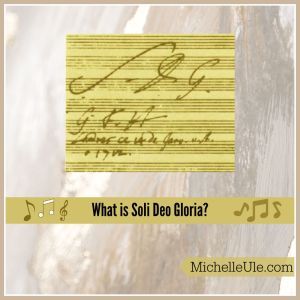
Soli Deo Gloria–what does that term mean?
It’s Latin, so no worries if you can’t quite grasp it.
But it turns up often enough among Christians, that it might be worth taking a look at it.
Soli Deo Gloria–the definition
“Glory to God alone.”
Simple. To the point. Definitive.
For people who worship God, it means that any praise belongs to Him, not to us.
It’s a humble, yet usually honest, response to work–whether artistic, musical, literary, or anyone’s task.
Since it’s Latin, the term obviously came into usage long ago.
Bach and music
Johann Sebastian Bach left us the best-known examples.
As a church organist and musician, Bach believed his musical talent came from God alone.
As a result, he signed all 1000+ compositions “soli deo gloria,” and finally just initialed them “SDG!”
RC Sproul believed the concept came out of the Protestant tradition, so Bach wrote
SDG at the bottom of each manuscript to communicate the idea that it is God and God alone who is to receive the glory for the wonders of His work of creation and of redemption. [This happened] at the heart of the sixteenth-century controversy over salvation was the issue of grace.
To God Alone Be the Glory
Bach, of course, worked for a Lutheran Church.
It bears mentioning Georg Frideric Handel often noted “Soli Deo Gloria,” on his manuscripts as well.
Isn’t The Messiah just an oratorio call to give God glory?
SoliDeoGloria8555 sponsors a YouTube Channel that plays Bach’s works.
Others use it, too.
Why should God get all the glory?
Other than the fact He’s the Creator of the Universe?
The Bible records verse upon verse calling believers to give God glory.
Here’s just a few:
“Now to our God and Father be the glory forever and ever, Amen.” Philippians 4:20 “To him [Jesus] who loves us and has freed us from our sins by his blood; and made us a kingdom, priests to His God and Father, to him be glory and dominion forever and ever. Amen.” Revelation 1:5-6” Blessed be his glorious name forever; may the whole earth be filled with his glory! Amen and Amen!” Psalm 72:19” I am the Lord; that is my name; my glory I give to no other, nor my praise to carved idols.”
In three of the four verses, God receiving glory is followed by “Amen.” There’s no need to say anything else!
Composed by Larry Bryant Arranged by Mark Hayes
The University of Pelita Harapan in Indonesia choir
In writing
I may be partial to this concept because I’ve ended two biographies with the words “Soli Deo Gloria.”
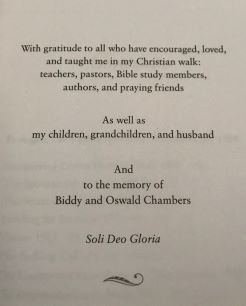 Mrs. Oswald Chambers dedication
 In both cases, I wrote biographies of women devoted to God.
I got a lot of help writing the book–whether from people who knew the women, archivists, other authors, or friends.
I felt, very much, that the writing of the books was a personal gift from God–to me and from me to Him.
How could I not recommend the glory to Him?
Tweetables
What does soli deo gloria mean? Click to Tweet
Bach, Handel, choirs, and me celebrate soli deo gloria! Click to Tweet
The post What is Soli Deo Gloria? appeared first on Michelle Ule, Author.
June 2, 2020
On Being the Mother of Three Sons
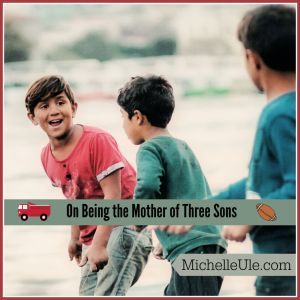 “They” say there’s a special place in heaven for the mother of three sons.
Which is what we wrote on the third boy’s birth announcement.
It’s been a great life and I love everything about them.
Raising those boys changed how I looked at the world.
Even now when my friends give birth to a third son, I like to pull out one of my first articles published in a Navy magazine during the last century and send them a copy.
Enjoy!
On Being the Mother of Three Sons
After our third son was born I spent several days in the hospital thinking about life with a family of boys.
I contemplated camping trips and ball games, more Tonka trucks, and Matchbox cars.
I knew I was in for a life of action and activities with a decidedly masculine twist.

Medieval Lego guy. (Wikipedia)
Other women I knew had three boys. I thought of Marty Hills, Queen Elizabeth, and even Mamie EIsenhower.
But when I got to Steve Dietz’s mom, I paused and my blood ran cold.
Mrs. Dietz raised three fine sons and they are a credit to her. But all three are in the military and two are pilots.
Queen Elizabeth and Mamie Eisenhower also saw their sons in uniform.
It was while thinking of them that I fully contemplated the risks of raising only sons.
War as a possibility–or play?
My sons probably won’t fight in a war like WWII. But as you all know, there are risks involved in being in the military, and 20 years from now my boys, all three of them, could be on the front lines somewhere.
And my heart would be breaking with fear.
Of course, the idea doesn’t bother them.
They play outside with makeshift guns, shooting and charging, building forts, and tossing water balloon grenades.
Among friends and brothers, they move plastic Army men through the dust, setting up mock battles, and crying when too many of their “guys” die.
They argue about who will be the good guys and who will be the bad guys, and often make up imaginary enemies just to be on the safe (and same) side.
Construx snap into swords, the boys build amazing bomber aircraft, and delight in the helicopters they construct.
We have a Lego castle and a host of Lego men with all sorts of medieval artillery designed to attack.
They lay siege for hours, plastic bows and arrows taking aim with the small bricks tumbling down.
Sidestepping the explanations
I, the coward, am amazed by all this. I’ve only seen a gun up close once in my life.
I didn’t even want my children to own play guns, much less spend their hours in war games.
My husband (every boy needs a father to protect him from his mother) fashioned a compromise: they could have guns but the weapons had to stay outside.
I will, however, allow squirt guns in the bathtub.
For them, of course, war is just a game.
We don’t allow our children to watch much television, but over the years they have seen almost every submarine movie ever made.
With a submariner father, they are well versed in torpedoes, conning towers, reactors, and diving.
They saw it as a marvelous machine and never thought to wonder about a submarine’s real purpose.
And so our oldest son was shocked the day he finally thought to ask his father what a torpedo actually did.
He couldn’t believe they blew up ships and then made the connection: “Do they kill people?”
I’m glad to report the thought made him uncomfortable.
The results?
I began to think we may have overexposed them to WWII when, during the Olympics, our five-year-old watched a Japanese skier going down the slopes.
“Look, Mom,” he said pointing at the rising sun flag. “There are the Japanese. They are the enemy. You have to watch out for them.”
I chose my words carefully, trying to explain the war ended many years ago and the Japanese are now our friends.
He seemed to understand, but lately he’s been questioning me again about war. “It’s a terrible thing. I hope we never have to live through a war.”

Photo by Diego Gavilanez (Unsplash)
I hope so, too.
And so we raise our boys with hopes and dreams, take them camping, and watch them play ball.
We teach them history and how to play chess. We read Bible stories and practice diplomacy.
Our family visits other nations and discusses foreign customs.
And I pray that 20 years from now our nation will be at peace.
Today
All these years later none of my sons have gone to war, but plenty of our friends’ sons have.
My heart seizes some days in concern and I pray for them.
All three sons understand history and diplomacy, have traveled the world, and seldom shot anything other than a paintball gun.
They play international games across the dining room table and know far more than I ever will about submarines, history, and war.
But like every parent–of sons and daughters– I wish the world was at peace.
Tweetables
On being the mother of three sons. Click to Tweet
Raising boys with war games and toys. Click to Tweet
The post On Being the Mother of Three Sons appeared first on Michelle Ule, Author.
May 26, 2020
Honeymoon Dictation & Oswald Chambers
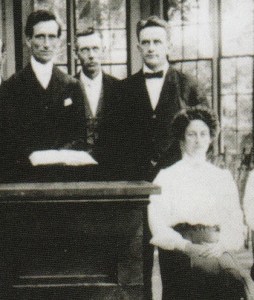 They spent their honeymoon in America at camp meetings with others!
Honeymoon dictation? Really Oswald?
While researching the lives of Oswald and Biddy Chambers, I turned up the story of honeymoon dictation more than once.
Oswald and Biddy sailed from Liverpool to North America almost immediately following their May 25, 1910 wedding.
They had a lovely 10-day cruise on the S.S. Coronia across the Atlantic before Oswald began speaking at camp meetings.
Biddy did not travel with him at first. She spent June staying and catching up with her friend Marion Leman Moore in Brooklyn, New York.
Oswald at God’s Bible School
Once he established his bride with her friend, Oswald took off for God’s Bible School in Cincinnati, Ohio.
He’d taught at the school in 1907 and had many friends there.
He brought a suitcase full of homework to grade while at GBS. Oswald taught a Bible correspondence course that summer.
Indeed, Chambers biographer David McCasland estimated he read and graded 4000 student’s papers between June and August!
(How many people do you know graded papers on their honeymoon?)
Honeymoon dictation in the Catskills
At some point that August, a friend sent them to “Meadow Lawn,” a hotel in the Plaaterkill Valley, southwest of Poughkeepsie for a week.
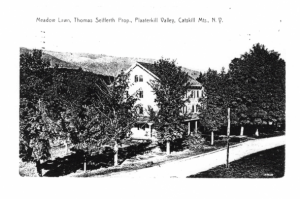 Photo courtesy Wheaton College Special Collections
The two nature-lovers hiked the hills and dales–much like Oswald’s beloved Yorkshire mountains.
They loitered beside splashing streams. Oswald may have had an opportunity to fish!
Of that week, Biddy wrote:
We spent a little while in the exceedingly grand and beautiful Catskill Mountains, amidst scenery which left us with the sense of worship expressed by Isaiah, ‘The whole earth is full of His glory.'”
The Place of Helps
Oswald Chambers was a romantic man.
He loved poetry, particularly that of Robert Browning.
He had not expected God to provide a wife.
Throughout their short seven years of marriage, he wrote romantic letters and sent poetry to his wife.
Would he really have spent his few scant days on honeymoon dictation?
Yes, but it wasn’t an entire book.
A pamphlet is perhaps a better description of the four pages.
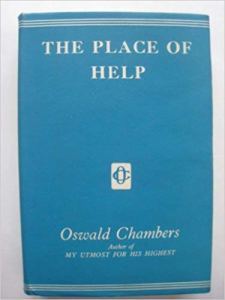 1959 edition
A New Ministry
McCasland noted The Place of Help is based on Psalm 121, “I will lift mine eyes to the hills. Whence should my help come? My help cometh from the Lord.”
It marked the beginning of a new ministry that occurred to Oswald shortly after falling in love with Biddy.
In one letter to her, he wrote
I want us to write and preach; if I could talk to you and you shorthand it down and then type it, what ground we would get over? I wonder if it kindles you as it does me!”
Mrs. Oswald Chambers, p 37
Biddy saw her dictation as a way of advancing Oswald’s ministry beyond the students to whom we spoke.
That day in 1910, she heard his thoughts in a beautiful place that reflected the Scripture passage.
She never forgot it.
The rest of the Honeymoon
“Mr. Romance” escorted his bride to camp meetings up and down the eastern seaboard of the United States for the rest of the summer.
He continued marking papers.
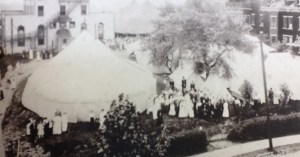 1910 God’s Bible School Camp Meeting
He introduced her to camp meeting folk:
“They are not the clever, the glittering or the worldly, but just the common folk who have gone through much uncommon sacrifice to belong to God.
“I am sure you will find some royal, heroic souls.”
Abandoned to God p. 177
Biddy traveled with him to camp meetings in Ohio, Massachusetts, Maryland, and Maine.
She corresponded for the rest of her life with several persons.
One of them was Lettie Cowman, who eventually wrote the devotional Streams in the Desert.
In later years, Biddy admired Lettie’s devotional and donated money through the sales of books to Lettie’s ministry, The Oriental Missionary Society.
The honeymoon dictation’s legacy
Following Oswald’s 1917 death in Egypt, his close friend Jimmy Hanson suggested printing pamphlets of his teaching.
Biddy made arrangements and freely gave away copies of The Place of Help to WWI soldiers.
She lacked Oswald, but Biddy continued his ministry.
Ultimately, her transcriptions of his talks resulted in 30 books; the most famous was 1927’s My Utmost for His Highest.
Here’s a Revived Thoughts podcast, featuring Pastor Chase Replogle reading The Place of Helps as a sermon Oswald may have delivered.
Tweetables
Oswald Chambers on his honeymoon. Why not dictate a book? Click to Tweet
Romance & ministry: Oswald Chambers’ honeymoon. Click to Tweet
The post Honeymoon Dictation & Oswald Chambers appeared first on Michelle Ule, Author.
May 19, 2020
Laura and Lettie; Little House and Streams Authors
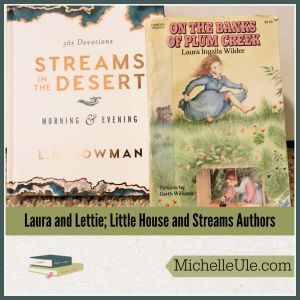
What do Laura Ingalls Wilder and Lettie Burd Cowman have in common?
More than you might expect.
The authors of the Little House books and Streams in the Desert share a few similarities which might surprise fans of both works.
Births
They were children of the post-Civil War years in the United States.
Laura Ingalls was born on February 7, 1867, outside of Pepin, Wisconsin.
Lettie Burd arrived on March 3, 1870, near Afton, Iowa.
The two towns are 320 miles apart. Wisconsin, of course, was full of big woods while Afton was in the rolling plains.
Both fathers were farmers; both mothers were hard-working farm wives who cared about appearances and proprieties.
Charles Ingalls was poor; Isaac Burd was wealthy. Both fathers doted on Laura and Lettie.
Schooling
Both girls attended school in their small towns.
On The Banks of Plum Creek clued me into how they might be connected.
The Ingalls family resided in a dugout along Plum Creek near Walnut Grove, Minnesota when Laura finally could attend school.
The Burds lived on a large “estate” just south of town.
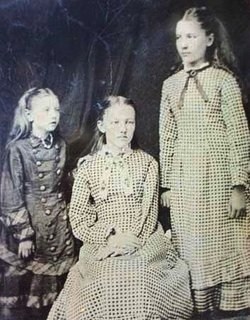 The Ingalls girls; Mary and Laura in homespun (Public Domain)
The girls grew up attending their small local schools, where they excelled.
But Laura and Mary Ingalls were poor girls in homespun dresses. Neat and clean as Ma could make them, they seldom wore shoes except in the winter.
Laura felt her poverty keenly.
Lettie, on the other hand, was the surprise baby–born eight years after her closest sibling when her mother was 49-years-old.
The youngest of eight in a relatively wealthy family, Lettie wore much more elaborate clothing.
If Laura’s straight hair was ever curled it was because of rag curls tied into her hair at bedtime.
Lettie, with naturally curly hair, wore her hair in beribboned sausage curls on a regular basis.
Indeed, had she lived near Plum Creek, Lettie–in appearance at least–would have fit the Nellie Olsen character.
Isaac Burd, after all, eventually became the president of the Afton Citizen’s Bank.
Education for Laura and Lettie
They both learned reading, writing, and arithmetic from the McGuffey Readers.
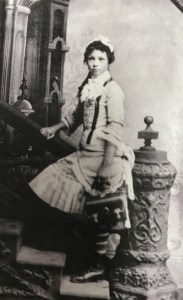 Lettie Burd (OMS Archives)
(Free downloads of all the McGuffey Readers are available here).
In a paper about the readers, Professor Samuel J. Smith of Liberty University wrote:
With over 122 million copies sold since 1838, the McGuffey Eclectic Readers taught more Americans to read than any other textbook. Initial publication coincided with a unique period in United States history as the West was settled, newly arrived immigrants assimilated, and the common school movement gained momentum.
At this time, the nation was at a critical point of forming a distinct identity. These phenomena created a demand for textbooks that would not only meet the practical need for curriculum in developing schools but would also extend prevailing American values to both children new to the frontier and those new to the nation.
McGuffey Readers
The first primer began quite simply: it listed the ABCs, with a pronunciation guide and simple words. Children learned to read using phonics.
The books taught reading and penmanship (“slate work”). Students learned literature that included patriotic works, lots of poetry, and moral sayings.
Readers used excerpts from great literature, eventually working up to selections from Lord Byron, John Milton, and Daniel Webster. Bible lessons and morality stories figured in McGuffey Readers as well.
While Laura and Lettie learned ciphering–arithmetic–both preferred literature and elocution.
Similarities in writing style
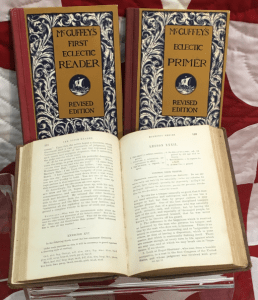 Tpdwkouaa / CC BY-SA
(Wikimedia Commons)
The influence of McGuffey Readers can be seen in books written by Laura and Lettie.
They both loved poetry and quoted it in their books.
Lettie wrote Streams in the Desert as a compilation of poetry and wise sayings from people she’d read over the years.
Laura included excerpts from the poetry she loved, usually in the context of her schooling or speaking. Like Lettie, she included words from the songs she sang while accompanying Pa’s fiddle.
Lettie, too, loved to sing–she had a trained voice and accompanied herself on the piano. She derived a great deal of encouragement and satisfaction from hymns.
Their choice of loved poems and songs came from the same readers they grew up with. The McGuffey Readers set their “taste” for what they liked.
Writing Life for Laura and Lettie
Both Laura and Lettie were busy adults.
Lettie’s early married life was far easier than Laura’s on a tree farm. But both embraced their husband’s vocations as their own and used their writing skills.
Both women wrote magazine columns for many years. Laura for farming magazines; Lettie for God’s Revivalist and the Oriental Missionary Society magazines.
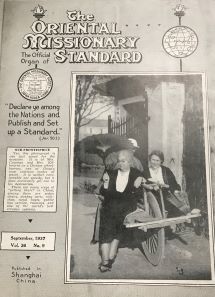 Cover girl Lettie in 1937
(OMS Archives)
They wrote about their lives, occasionally included poetry, and honed their skills. Their style may seem simple by modern standards, but it was very good.
The small town schools of the late 19th century taught them both well. Their grammar skills were excellent and they both had an ear for how a sentence should sound.
Music, literature, family life, and their intellect served them well.
If you love one author’s works, maybe you’ll like the others?
Tweetables
What do Laura Ingalls Wilder and Lettie Cowman have in common? Click to Tweet
How are the authors of the Little House books and Streams in the Desert similar? Click to Tweet
The McGuffey Reader’s influence on Little House books and Streams in the Desert. Click to Tweet
The post Laura and Lettie; Little House and Streams Authors appeared first on Michelle Ule, Author.