Michelle Ule's Blog, page 118
March 4, 2011
Hurry Up and Wait!
 In the traditional Evangelical thought on prayer, you can receive one of three answers from God: Yes, no, or wait.
We all love the answer "yes," because that means God agrees with us.
We may not be so keen on the answer, "no," but we can, sort of, live with the disappointment. Hey, it's a straight answer right?
But that "wait." I didn't use to like it at all.
I mean, what does "wait," really say? Has God not made up His mind yet? Is He still pondering, like a parent, if we've been good enough to get the "yes," we're looking for? And if I jump up and down a few more times with enthusiasm and wave my hand higher, will He decide "yes?"
I don't think so.
As I thought about the irritation of "wait," it occurred to me some of the problem may be my American impatience. Really, "wait," often seems like I'm just marking time.
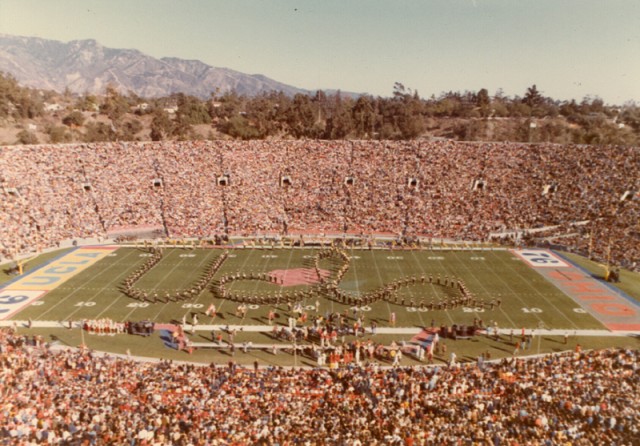
And that's when I got caught. "Marking time" took me back to when I played the clarinet in the UCLA Marching Band.
To "mark time," in band parlance means to stop moving forward, you march in place. You don't usually do it for long, because it's a temporary spot. Soon enough the drum major will whistle and the drummers will either wind down, or they'll pick up their cadence, three short whistles will blow and you'll step off once more. But a lot of times "mark time," is a prelude to three long whistles and silence.
"Parade rest," the drum major will bark, and our instruments will come down from our mouths into a relaxed spot in our arms. We've given a reprieve and a chance to catch our breath, look around, think about where we've been and contemplate where we're going. It can be a long wait, or a short one.
And isn't that what God does with His "wait" answer? "Waiting on the Lord," doesn't mean He's not up to something. It means things aren't in place yet. The answer may be a no, but it's not clear to move forward, yet, or perhaps you're not in the right place–spiritually, physically, financially, socially, musically–for what comes next. The next phase can be just as exciting as what has come, we just need to wait a minute for things to fall into place.
I now think God's answer, "wait," is an exciting one. I use that time to review where I've been, what has happened, and where I want to go. I take deep breaths and savor what's around me, resting in the current situation. I chat (in the band through the corner of my mouth) with my compatriots and reflect on what we've done together. Sometimes I gather information, other times I admire the landscape. Because soon enough, three sharp whistles are going to zing through the air, and I want to be ready, set, and prepared to go toward what God has called me to do–or not do.
So, hurry up . . . and rejoice in the answer: "wait."





March 1, 2011
A seeing eye person

Our dog Suzie is blind.
It apparently came on relatively quickly and now she cannot see a thing.
I say apparently, because while I certainly noticed things were not normal, I hadn't a clue Suzie couldn't see me until she started knocking her snout into the wall and bumping into the furniture.
When I took her to the kind vet for the third time in as many months, he tossed cotton balls at her face and she didn't blink. He sent us to a brusque canine opthamologist who did the same thing, followed up by a series of other procedures involving more complicated instruments.
Nothing. Suzie's eyes don't work.
But how could I not notice? That's what troubled me after the horror of her diagnosis. What sort of owner am I that my dog, literally under my nose, could have such a catastrophic event and I didn't, well, see?
When I call her, Suzie looks in my direction and cocks her head. When I open the door, Suzie pushes outside. I attributed her stumbling on the steps to her weight gain, not blindness. How can she suddenly not see?
The brusque opthamologist diagnosed her as having Sudden Acquired Retinal Degeneration Syndrome (SARDS)–an incurable sudden blindness that comes on within days. The Internet (now that I've been allowed back into legal cyberspace to check), tells me a blind dog can live a full and rich life. Sight is the #3 sense for a dog; smell and hearing are more important. She certainly smells very well.
Watching her navigate, I'm reminded of 1 Corinthians 12 that talks about being part of the body. When Suzie's sight failed, her nose and ears went into overdrive–so much so, we barely noticed a problem.
Corinthians also talks about the stronger making allowances for the weaker, and that's what I'm trying to remember to do. I stamp my foot on the top of the stairs so she knows we're at the edge. I call "down" or "up" or 'wait," when we walk outside. I drag her continually next to me as we stroll through the park. Suzie may see only blackness, but she's not afraid to tug me headlong along the paths she knows so well.
Yesterday I called out, "stop," just before she plowed into a pillar on a friend's porch. I'd so admired her running with abandon, I failed to notice danger until it was too late. I can't imagine what she was thinking, hurtling into darkness.
All around me people walk in spiritual blindness, oblivious to the danger teetering within inches of their souls. How often have I called out to friends, "wait," or "be careful," only to watch them ignore me and get hurt? How many times have I wondered when their other spiritual senses will step in to save them from trouble? How can I be a seeing eye person to not only the dog, but also the people in my life?
The kennel owner told us not to worry about Suzie. "As long as she has food, water, a warm place to sleep, and people to love her, she's perfectly content."
I wish I could be as well. In the meantime, I'll be a seeing eye person–looking out for Suzie, and all the others God sends my way.





February 24, 2011
A little cyber-criminal behavior?
 The Scriptures tell us a good name is to be desired. They talk about the importance of a good reputation, and we're warned in the epistles that we will be judged by our fruit.
I've been pondering these ideas all week as I've grappled with a thwarted reputation. My Facebook account was hacked by an Imposter who went to all the trouble of setting up a fake yahoo e-mail address in my name. The Imposter, presenting himself as me on my Facebook page, then approached my friends and begged them to send money as, Imposter me explained, I had been held up by gunpoint in London and lost all my cash.
In one of those ironies you cannot plan for, earlier that day I had posted a comment on World Magazine's Whirled Views in which I warned that if you run into problems in a foreign land, you should contact the US Embassy! (See comment # 52 here: http://online.worldmag.com/2011/02/19...)
With the help of several friends, I straightened it out, reclaimed my Facebook page and excised an ap placed by the Imposter that would enable said Imposter to continue manipulating my account.
The next day, Facebook declared my account had shown "cyber-criminal behavior," and was frozen. As of today, Thursday, I've still not cleared my name with Facebook.
I'm not important in the Facebook world, except to my friends. But what if I were important and my account was hacked? What then?
Keep watch on Books & Such's blog. I'll be discussing this situation and others in March. 
In the meantime, take my advice. Change your e-mail password frequently. Monitor your accounts. Check your security on Facebook. Guard your reputation.
A good name is easy to lose and hard to regain.





February 17, 2011
Unto the Next Generation
 My adorable grandchildren are here for a visit and while it's certainly a privilege to have them, it's also sobering me during a curious time in my life.
I'm teaching in the book of Psalms this quarter and I've noticed how often generations, descendants, and other references to family lines, turn up. The immediacy of King David's emotions make it hard to believe he expressed his thoughts to God 3,000 years ago. And yet Psalm 90:4 tells us "A thousand years in your [God's] sight are like a day that has just gone by, or like a watch in the night." The sweep of time to God is a blink of an eye, while my personal eyes tremble at the enormity of the universe.
The adorable grandchildren love the 120-year-old reed pump organ in our living room and today it, too, reminded me poignantly of the span of time. My great-great-grandmother gave the organ to my grandmother in 1914. My grandmother gave the organ to me. Today as I pointed out the two women in the photo above the organ, I realized my granddaughter was pushing the keys. The stretch of time from a blond blue-eyed Danish woman born in 1848 to a blond blue-eyed American girl born a year ago today, felt very short.
The Psalms tell us that eternity awaits those who believe, those who have faith in God, those who accept Jesus' resurrection from the dead as the cornerstone of truth. Jesus tells us in John 14 that He goes ahead of us to heaven where there is room for all who believe in Him, "and if it were not so, I would have told you so." I cling to those verses when my life seems so flimsy and fleeting.
I'm not sure I'll ever see my granddaughter's daughter and certainly not her granddaughter, but the cycle of life will push forward. As I rocked her this morning, I prayed that her life would be full of trust and faith in the One who has loved her from before the dawn of time.
It's the only really valuable thing I can give her.
Other than an old organ and my love.





February 13, 2011
My Bible study valentine
I spend Tuesday mornings with a select group of women. One is younger than me, but the rest are my elders by a considerable number of years. They are friendly, devout and wise. I love them.
I'm the leader of the Bible study. We use the Lutheran Church Missouri Synod's Lifelight studies and we have a terrific time together. We pray for each other, laugh together, go out to lunch and they're quite vocal about my life. "Don't clean your house. You've got better things to do, hire a housekeeper." Or, my favorite, "Don't cook dinner. Have your husband take you out."
When I report this advice to my husband, he sketches a salute and says, "Yes, ladies."
Six years ago, Valentine's Day fell on a Tuesday morning. I wanted to celebrate the love these women have for the Lord, for each other, and for me. But how? Isn't Valentine's Day really designed for young lovers? Half the women have outlived their husbands.
My scheming prayer partner and I put together a surprise. Before we got down to the brass tacks of study–or at least the prayer list–I passed around a Starbucks menu. "Since everyone knows Valentine's Day is for teenagers like Romeo and Juliet, I thought we'd celebrate like girls. The drinks are on my husband, choose one!"
None had ever been to Starbucks before. "What is a 'La-tay?" cackled Bea–87 at the time and still going strong.
"Coffee with a foamy milk on top and a sprinkling of nutmeg," I explained. "You can get it with soy, non-fat milk, or decaf."
"Decaf? Why waste the coffee? And what's foamy milk?"
Several twisted their tongues trying to pronounce cappuccino. "Don't they sell a simple cup of coffee?"
"Sure," I said. "But try something new. Giggle when you drink it and pretend you're a flirting 13."
Ginnie looked down her nose and through her specs at me. "I was never that young."
Eventually we got the order sorted, my prayer partner went to the coffee shop, and we read through the Bible study. It was sweet.
And so was the coffee once it arrived. "Ooh, who can drink this?"
"How do you say this name? Frappuccino? Never again." Justine shuddered.
My mocha was just fine, thank you very much. I like that combination of bitter with the sweet. No whipped cream.
We were studying the book of Acts that year–focusing on how the believers took the good news of Jesus' resurrection throughout the world. We marveled at how the followers of Jesus wanted to stay huddled together in Jerusalem, praying safely behind closed doors, clinging to what they knew. But events forced them out of their comfort zone and they spread throughout the countryside taking the good news with them. Buoyed on by the joy of Jesus' resurrection, the disciples had to sample a new way of life. Paul's life in particular was one of bitter challenges, sweetened and buoyed by the Jesus he met on the road to Damascus.
Just like the lives of my fellow students.
We had fun on Valentine's Day six years ago, because of the love bestowed on us by a benevolent God. His love brought the Bible study ladies together to learn about him. And because we've studied His word together so long, my wise ladies– who have seen and done so much– trusted me with strange sounding drinks of curiously doctored coffee.
"Too sweet," they giggled as they gathered up their Bibles. "But happy Valentine's Day to you."
And you, too.





February 6, 2011
Waiting for Snow in Havana and other cheekiness
 Alas, this is not my title, but that of my favorite memoir, Carlos Eire's Waiting for Snow in Havana, which won the National Book Award in 2005. A rollicking Latin story of growing up prior to Castro taking power in Cuba, this memoir made me laugh, despair, rejoice and savor my own freedom here in the good ole USA.
I've been waiting ever since for the sequel, to find out what happened to Eire after he and his brother arrived without relatives in Miami on the "Peter Pan Airlift" in 1962. Sent as a ten-year old with his 14 year-old brother, Eire carried a parting gift from his parents, Thomas à Kempis' The Imitation of Christ, which Carlos indicated made all the difference to his life.
In 2005, I wrote to Carlos Eire (who is a professor of history and religion at Yale) and expressed my appreciation for Waiting for Snow in Havana, but asked about The Imitation of Christ–since he never explained why it was so important. Just as cheeky in 2005 as he was in his youth, Eire suggested I read the book myself and form my own conclusions.
Once a professor, always a professor.
I read it, didn't see anything that made sense to me, and so I let it go, hoping a sequel would enlighten me.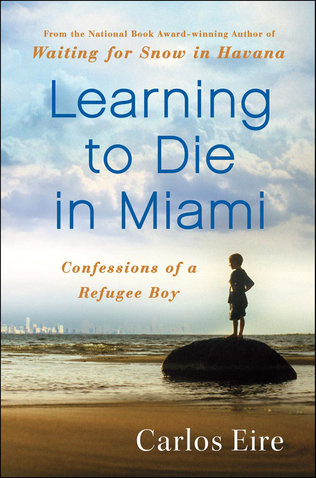
I've spent all weekend pouring through Learning to Die in Miami. It didn't grab me as completely and with as much a salsa hush as Waiting for Snow in Havana, but it moved me on a deeper level as Thomas à Kempis' influence (not mentioned until nearly the end, but obviously there in hindsight) worked its way through young Carlos Eire's life. His description of "the Void," alone, is worth the price of the book:
"Bonk. I leave my body and float over it. I'm looking at myself, and at the doctors and nurses . . . My body doesn't look too good without me in it. I look dead, or hungover, or both at the same time . . .
"Bonk. I'm out of there, going down a spiral tunnel very, very fast, headfirst. It's a long way down, down, down. It seems to take hours, maybe days, or some timeless measure, and as I plummet it gets darker and darker, and I can't see anything, and my falling speeds up.
"Bonk. I'm out of the tunnel, and there's nothing there. Nothing but me, without my body. Nothing but utter darkness and me, whatever I am: mind, soul, whatever, but certainly not a body. I left that behind on the operating table, looking poorly. No motion, no sound, no cold, no heart; nothing to see, nothing to touch, nothing to feel, nothing to taste. Not even wormwood, or my own salty tears. I have no eyes, anyway, no tongue. Nothing but pure thought and the awareness of my own existence and my own eternal loneliness.
"Never, ever, have I felt such pain and terror; such pure panic. I pray for annihilation, but there is no one or nothing to pray to. All I can do is to wish for my extinction, and to know that I'll be eternally unable to annihilate my lonely rotten self."
I gasped when I read those words–that to me is life apart from God–and Carlos put it into words that seared with a cold knife blade into my soul.
According to Eire, Thomas à Kempis' book talks of dying to self, of giving away everything to gain it all, and other concepts well-known to a follower of Christ.
Maybe I'm old enough now to read The Imitation of Christ, and understand things just a little better. You can try it yourself right here: http://www.ccel.org/ccel/kempis/imitation.all.html





February 2, 2011
Here's to you, Punxsutawney Phil
 Why no, it's not snowing in Sonoma County. We've got a beautiful blue sky and 65 degrees. The windows are open and the house is flooded with light and warmth. I feel sorry for all of you romping in the freshly fallen snow back east.
Which brings me to Puxatony Phil, a critter I've never met, but whom I've talked about and laughed at often over the years–more than 54 times to be inexact.
The reason is the Bill Murray movie, Groundhog Day. We watch the film every time we stumble on it while mindlessly flipping through channels. And every time, I'm reminded of a column written when the movie came out, by The Boston Globe now-retired columnist, Ellen Goodman. She thought the film memorable for one simple reason: it reflects adult life. Some of us have new adventures every day. Like children, we open our eyes to new places with exciting opportunities to learn and savor something we've never done before. But for most adults, it's the daily round of behaviors: shower, shave, breakfast, coffee, paper (at least for me) and off to work. Same commute, same job, same people, same life. Just like Phil went through on that immortal Groundhog Day that didn't end until . . .
My take is, Phil didn't break out of an interminable groundhog day until he learned how to love and how to think of someone other than himself. From that love and attempt to put himself into someone else's shoes, he began to see needs and respond to them. He changed and became lovable himself. And when the winter of his miserable self-centered life ended and bloomed into the joy of someone else, well, he walked out into freshly fallen snow hand-in-hand with his future. But he had to look, recognize, respond and change.
I think God often does the same thing to us; puts us into a state where we have no choice but to question the point of our experiences/life/day. He then invites us to look at our life and circumstances from His point of view.
And you know what? It looks different.
There's a lot more love, a lot less selfishness, and a lot more willingness to make snow angels for pure joy , along with reaching out a helping hand to those in need.
February 2 rolls around like clockwork each year and asks me to reconsider my own life. How does it look through God's eyes?
And if there isn't any joy, or child-like excitement over something new, well, maybe I ought to just throw a snowball and get something started? Particularly with someone I love–or whom God sends across my path.
Here's to you, Phil.





January 30, 2011
Slash Marks the Very Good Trail
 Several years ago we enjoyed the movie End of the Spear, the story of the infamous murder of five missionaries in Ecuador in 1955. The movie was made by Steven Saint, son of one of the murdered missionaries, who spent time living in the jungle with those same Waodani (Aucas) many years after the death of his father.
Much about this film commends it to viewers, but what captured my imagination was the way the missionaries presented the gospel–the cultural way they explained God and Jesus. Saint told this story in a 2006 interview with Decision Magazine, about how the Waodani view sin:
"An actor came to me and said, "Steve, what is sin?" I told him that the Waodani say that sin is those things that God sees well that we don't do and those things that God does not see well that we do do. He was one of the actors who wanted to meet the Waodani in their own territory. He said to me, "I want you to tell the Waodani that I, too, have lived badly, badly. But now I want to live well. Would you ask the Waodani to pray that I will live well now?"
"The Waodani were so excited. They said, "Oh yes, that's what we say, too. We say, 'God, You helping us, we'll walk Your very good trail.'" So, the Waodani got around and prayed for the actor, that he would walk God's trail and that God would clean his heart so that he could see the trail and that once starting, he would not veer off one way or the other."
I like the concept that when we are following Jesus, we're walking his very good trail. In the movie, a young Waodani woman points at the slash marks on a tree signifying the trail. She tells the person with her you have to watch for the marks to follow God.
That's what He asks of us, too. He wants us to watch for the trail markers showing how to follow Him. Fortunately in 21st century America, we merely have to read a Bible to understand God, and see where His trail leads–to the forgiveness of sin.
I try to remember the need to explain on a person's own terms, when I talk about who God is. Steve Saint lived with the Waodani for years, he understood how they saw things. I've lived among a different tribe of people my whole life, while maintaining relationships with a lot of peculiar people. Sometimes we don't seem to speak the same language at all. The trail that looks clearly marked to me is a jumble of thick vines to them. It's my creative task to figure out how to explain the good trail in a way others can see.
How about you? Can you describe different-cultural ways of telling the gospel? And how do you get your mind to think outside of the box of your own experience to reach out to someone else?





January 23, 2011
Four memorials, three illnesses, death and a choice
 Our church has seen four memorial services in the last nine days. Three people I know have been in the hospital with life-threatening ailments in the same time-period. We've recently come through sobering anniversaries of family deaths.
A friend's book is on the top of the New York Times' bestseller list. The title: Heaven is Real.
I've been thinking about death quite a bit lately.
I don't like it.
I'm not concerned about the afterlife—what happens after I die. The Psalms we've been studying this month in Bible study indicate even the ancient Israelites knew the God they worshipped expected to see them after death. (See Job 19:25-27; 2 Samuel 12:23; Psalm 139:8)
I'm uneasy about the physical and emotional exhaustion of the dying process. And as I struggle with aches and pains and physical limitations at the relatively young age of 54, I wonder how I can go on another 25 or 30 years in an optimistic manner. How can I be a blessing in my aging process rather than a curse to my family and friends?
I used to be terrified of flying, or rather of being on a plane when it crashed. I'd have to steel myself before I got on a plane, and I'd spend most of the take off praying. That's not a bad idea even on the safest flight, but fear was taking control and it got harder and harder to fly.
One day while praying about my fear of flying, it occurred to me that if God knew the number of hairs on my head, and if He knew the time and place of my death, being afraid of flying was pointless. I was either going to survive, or die. And if God ordained the length of my life, I could just as easily be killed crossing the street as crashing in an airplane.
No matter what I did at any moment of the day, I was going to either live or die. The question was not how or why, but when.
And the only one who knows the answer to that question is God.
I'm still not crazy about flying, but I no longer spend the minutes prior to and during take off in a frenzy of prayer. Sure, I pray, but then I leave my life in God's hands.
He's got it anyway.
Remembering those thoughts has helped me wrestle through the twinges of anxiety as mortality brushes its icy fingers along the back of my neck.
Do I trust God to use my life for His purposes for however long I have on earth?
Do I have a choice?
I still don't like the thought of dying, but I'm choosing to hope in God, so that I can yet praise Him while I remain on this side of the great chasm.





January 10, 2011
The blessing of showing up
According to the Internet (and why would it lie?), filmmaker Woody Allen once said, "80% of success is just showing up."
I thought about his statistic the other day when just showing up turned into a blessing for my husband, Bob.
Bob had spent a number of months two years ago mentoring a man, we'll call Jay. Jobless, family-less, hope-less and discouraged, Jay couldn't understand why his attempts to follow God had landed him in such a grim spot.
Bob didn't have any quick answers either, but they spent weeks reading through and discussing Watchman Nee's Sit, Walk, Stand before touching on truth Bob had read in The Spiritual Man.
What wisdom would an early 20th century Chinese man have to share with 21st century Americans? Plenty, because it's rooted in the book of Ephesians and focused on our individual relationships to God.
We prayed for Jay at home, had him in for dinner. His desire to know what God had for him drove him back to Bob, where he picked his spiritual insight for understanding. Bob had never done anything like this before and had to listen closely to what the Holy Spirit directed him to say and do.
Both men flourished in the spiritual discipline. One day it was over. Jay had learned enough and like many we've prayed and studied with over the years, we lost track of him.
Until Saturday at the pharmacy when Bob chose to run a menial task of the type he'd seldom done before. And there he ran into Jay. A different man.
Bob's face shone as he described the blessing of showing up and hearing a wonderful story. Jay's joyous tale of reconciliation and remarriage to his wife, their children pleased at his return home, and a church ministry that astonished them both made us all rejoice.
Sure, Bob's real work was done two years ago when he struggled to hear God's direction in prayer and Bible study. But the blessing came, unexpectedly, when he just showed up and got to hear the rest of the story.
How often we forget that while God certainly can do enormous things like hold back the Red Sea or raise a man from that dead, for most of us, He works in the small, quiet voice, touching us with a blessing when we're not really looking.
Thanks be to God.