Michelle Ule's Blog, page 112
September 29, 2011
The Shock of Landing on The New York Times Bestseller List
 This is Wanda Brunstetter. A well-known Amish fiction writer, she currently has several books on The New York Times Bestseller List. One of those books is a novella collection written with eight other writers called A Log Cabin Christmas Collection. The novella collection is on the bestseller list at #34.
I am one of the other novella writers.
Technically, that means I am a New York Times bestselling author, albeit on Wanda's coattails. :-)
My story is called The Dogtrot Christmas, based on a family history story from 1836 Texas. It's the story of love across cultures that features screaming Native Americans, panthers stalking in the woods and my real-life great-great-great-grandfather, the Reverend Thomas Hanks. Given the title of the collection, you won't be surprised to learn the story revolves around a log cabin and also includes Christmas celebrations–in this case a mixture of the Mexican posada and frontier Scottish traditions. It's also a romance.
I've written about how I came to write this novella here, here, and here.
It's a beautiful book with ragged-edge pages that hint at a pine log's rough bark. When I held it in my hands, I felt like a plain woman who had given birth to Elizabeth Taylor. I held this gorgeous, tactile delight and wondered, "where did it come from and how am I involved?" :-)
We've had trouble getting copies of this book way out here on the west coast, and I puzzled over that. Amazon didn't deliver the books I ordered until three weeks after the release. No explanation and I shrugged. It's my first published work and what did I know?
I spent last weekend at the American Christian Fiction Writer's convention in St. Louis, MO. A wonderful conference with inspirational speakers and workshops, ACFW had 700 writers in attendance. I saw many friends, mentors and luminaries in the Christian fiction world, including two of my collaborators on this project, Liz Johnson and Erica Vetsch.
While boarding the elevator Saturday morning, Cindy Herron greeted me with surprising words: "I'm so excited about your book making the New York Times bestseller list!"
I laughed. "Right."
Cindy looked puzzled. "I don't want to start a rumor, but I thought I heard that."
I shrugged and smiled. When I saw the project's editor Becky Germany, she confirmed the book really was on the best seller's list. We laughed together, shaking our heads.
My agent's jaw dropped when I told her, as did our work colleague. What a fun day! Everyone was surprised, but they congratulated me when I showed them the picture on my I-touch.

 The teasing went on and I just laughed. I knew it had nothing to do with me and everything to do with Becky including me in this collection. Still, it was awfully fun.
Upon my return home, I continued to savor the feeling and tried not to gloat even though my husband claimed we needed a larger door so I could fit my head through to get into the house . . .
At Safeway the next morning, I blurted out my news to the checker who picked up the mike to announce, "over here in aisle three we have the newest New York Times best selling author . . . " At the library, I told the librarian–thanking him for all the help I got researching the book. "You should have a party and address the local writers. Go tell the reference librarian!" He shook my hand.
And through it all, I've laughed with joy. The incongruity of my name–in very tiny print, or "et al" as it appears on the list–linked to a best seller. Hallmark movie, maybe, but the real list? The list I've scrutinized, examined and checked off for 35 years?
Simply shocking.
And joyously fun.





September 23, 2011
Since I'll be in the Neighborhood, Shouldn't I Stop By?
 I'm married to a logical, reasonable man who grew up in a nuclear family with plenty of older sisters but not many other relatives. He likes quiet and order and is perfectly happy to spend time thinking and reading by himself.
He had the (mis?)fortune to marry me–a woman who grew up in an Italian family devoted to relationships. We don't mind being alone, but if we have a choice we're happy to include everyone in to whatever we're doing. We share two traits on the Myers-Briggs scale, but in the E and I department we're polar opposites.
Or, as I like to say, he'd have led a really dull life without me around to complicate matters.
This frequently comes to a head when planning vacations or other travel opportunities. He names a place and I think of all the people I can visit along the way.
He's very patient. "What about just us?"
"Oh, sure, it'll be us, but if we're in the neighborhood, don't you think we should stop by?"
Twenty years in the Navy only complicated this for him. If we had stayed in one place all those years, perhaps I would be bored of all the usual people in my life and would gladly flee to another spot without anyone but him.
But our life hasn't been like that. My dear friends, kindred spirits, Navy wife pals, and even relatives are slung all across the United States. Or, as my sister-in-law has observed, "You know somebody everywhere."
Not exactly. I don't know anyone in Fargo, ND, but I do have a friend whose sister lives there . . .
One year in desperation, my husband suggested a trip to New Zealand, "because you don't know anyone there."
I didn't have to think long. "Dave (our brother-in-law) has all those relatives there."
"But you don't know them. What's their last name?"
I didn't know and he wouldn't let me ask. We actually visited a continent where I didn't know a soul. We had a great time camping from the North Island to the South, but I really enjoyed Christmas Eve and day at a Bed and Breakfast near Queenstown–where the owner and I gabbed for hours about everything I had wanted to ask on the entire trip. Curiosity. Research. Friendliness. A new friend . . . .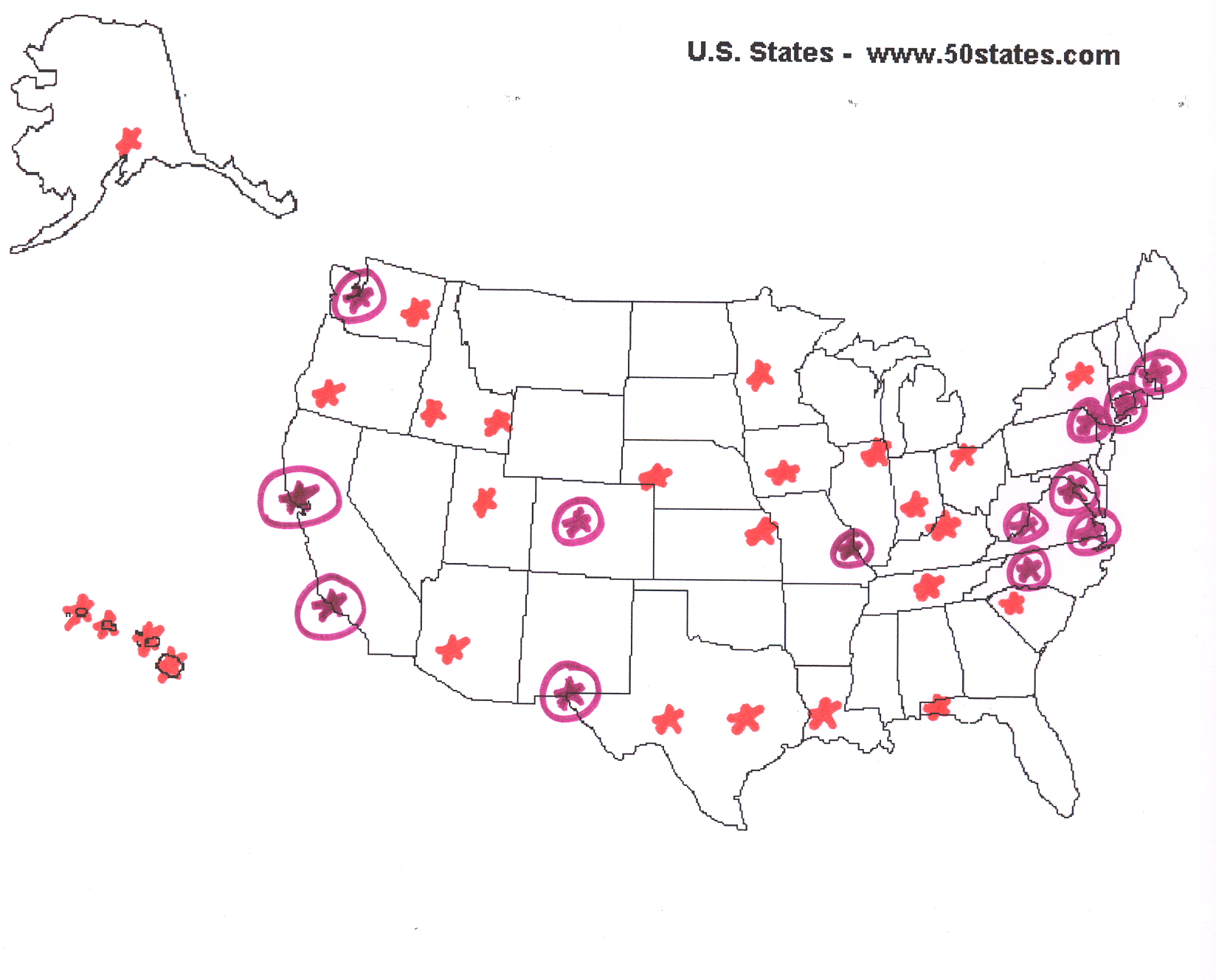
Because of all our moving, when it came time for our children to choose a college far from home, I circled on the map all the places where we knew someone, "just in case you ran into trouble, I could call for help."
First son went to college in Los Angeles, where three sets of aunts and uncles and a grandfather lived nearby. Piece of cake.
Second son went up to Davis where an outlaw (in-law of a family member) lived, indeed, taught at the college. No problem.
Third son matriculated at a university in Seattle; an uncle lived just a few blocks away not to mention a host of Navy friends. He now attends grad school 35 miles from where one of my bridesmaids lives in Texas.
Fourth child is in Santa Barbara. A little trickier and harder to get to, but the same LA relatives are only 90 minutes away.
That all makes it easy. If there's a crisis and they need help, I can call someone I trust.
It also gives me someone to either stay with or visit when I take the kids to school. 
We live in such unusual times, where friends follow each other's activities on a computer screen. Where cell phones enables us to reach out to our friends from anywhere in the world. But there's something about sitting beside and listening to the voices of loved ones, particularly friends in the midst of interesting times, that calls to my soul and says, "stop in. Touch their hand. Let them see your tears. Laugh with them."
Skype is helping, but it's still not quite the same.
I've abandoned my husband and house guests this week to attend the ACFW Conference in St. Louis. One of the main reasons I signed up to go? One of the sets of godparents lives in St. Louis and I haven't seen them in 10 years.
And since I'm in the neighborhood, I'll be stopping to visit child #3. It's practically on the way!





September 20, 2011
Where with World am I?
 My father-in-law gave us a subscription to American Spectator magazine some 30 years ago. I ying and yang on my opinion of the magazine; it often seems way too harsh to me. But about 20 years ago it began a feature wherein people could send in photos of themselves reading American Spectator. My favorite was the Army officer sitting in one of Saddam Hussein's thrones following the Gulf War I and reading the magazine.
Laughing that one of my fellow subscribers lived in such opulence, I thought it would be handy to include a home front picture. So I arranged to have my son take my photo reading American Spectator magazine while standing in front of two very long clotheslines. Even housewives read the magazine! (And alas, I can't find that photo now . . . )
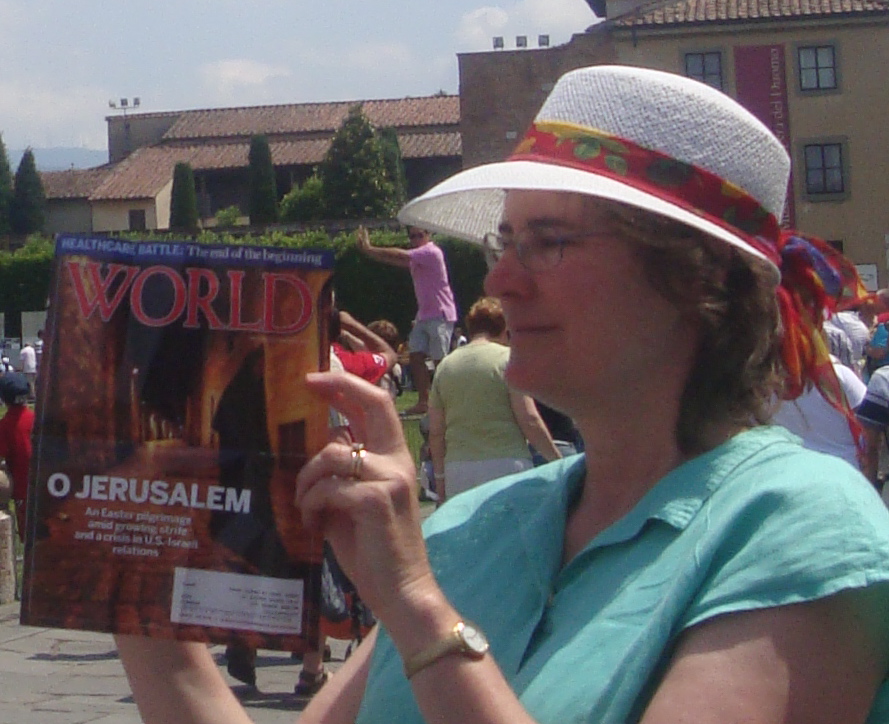
The fun, however, of finding an incongruous photo returned when World Magazine began to include a photo of readers with the magazine in unusual spots. I was on it in a flash and have hauled World Magazine to four different continents. It's become a joke in the family: "Where's Mom and her magazine?"
Fellow WorldMagBlog poster Mark Roth and I have commiserated over the years as our photos did not appear. Oh, lots of great ones turned up, but never mine.
I'm about to take another trip and a new edition of the magazine arrived in the mail today. I'll stick it in my carry-on and read through the articles while I fly, but this time I'm NOT going to have my photo taken with it. I already have too many pictures of me and the magazine in far more interesting spots than St. Louis, MO.
I couldn't find them all, but here are a number for your enjoyment: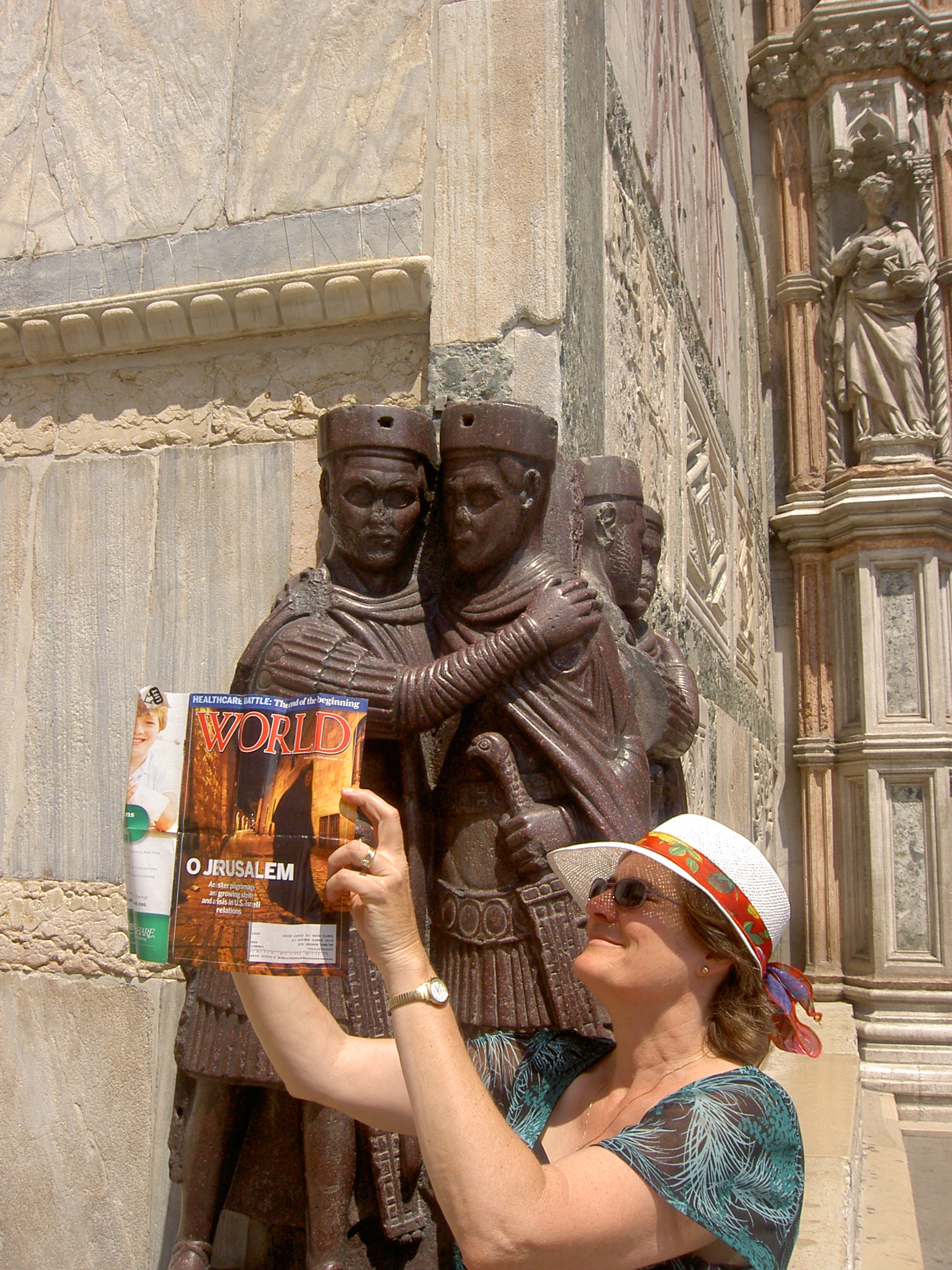
Here I am trying to show recent events to these guys on the corner of St. Marco's Cathedral in Venice.
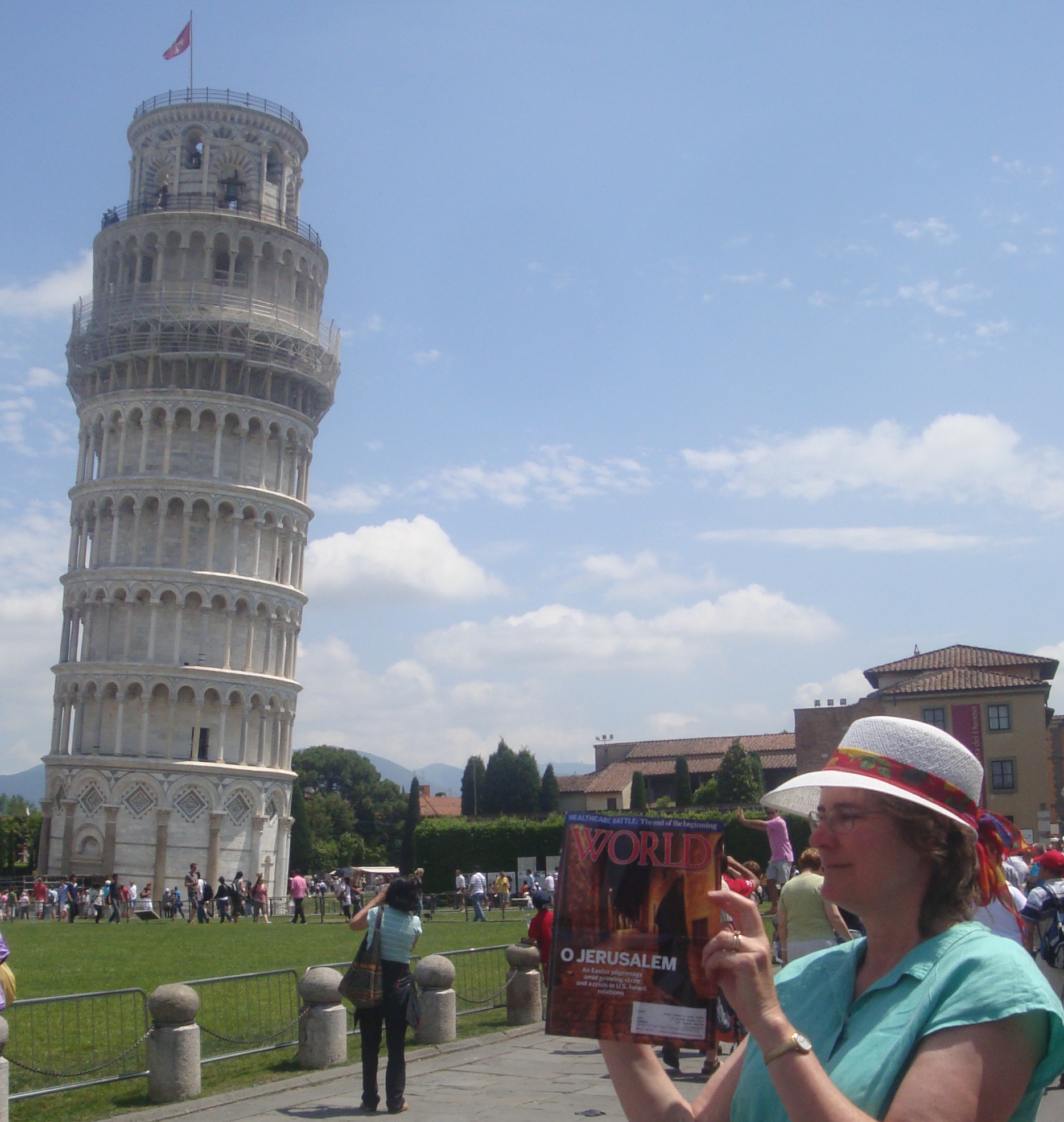 I read the magazine while viewing the leaning tower of Pisa.
I also pulled out the magazine to think in Paris.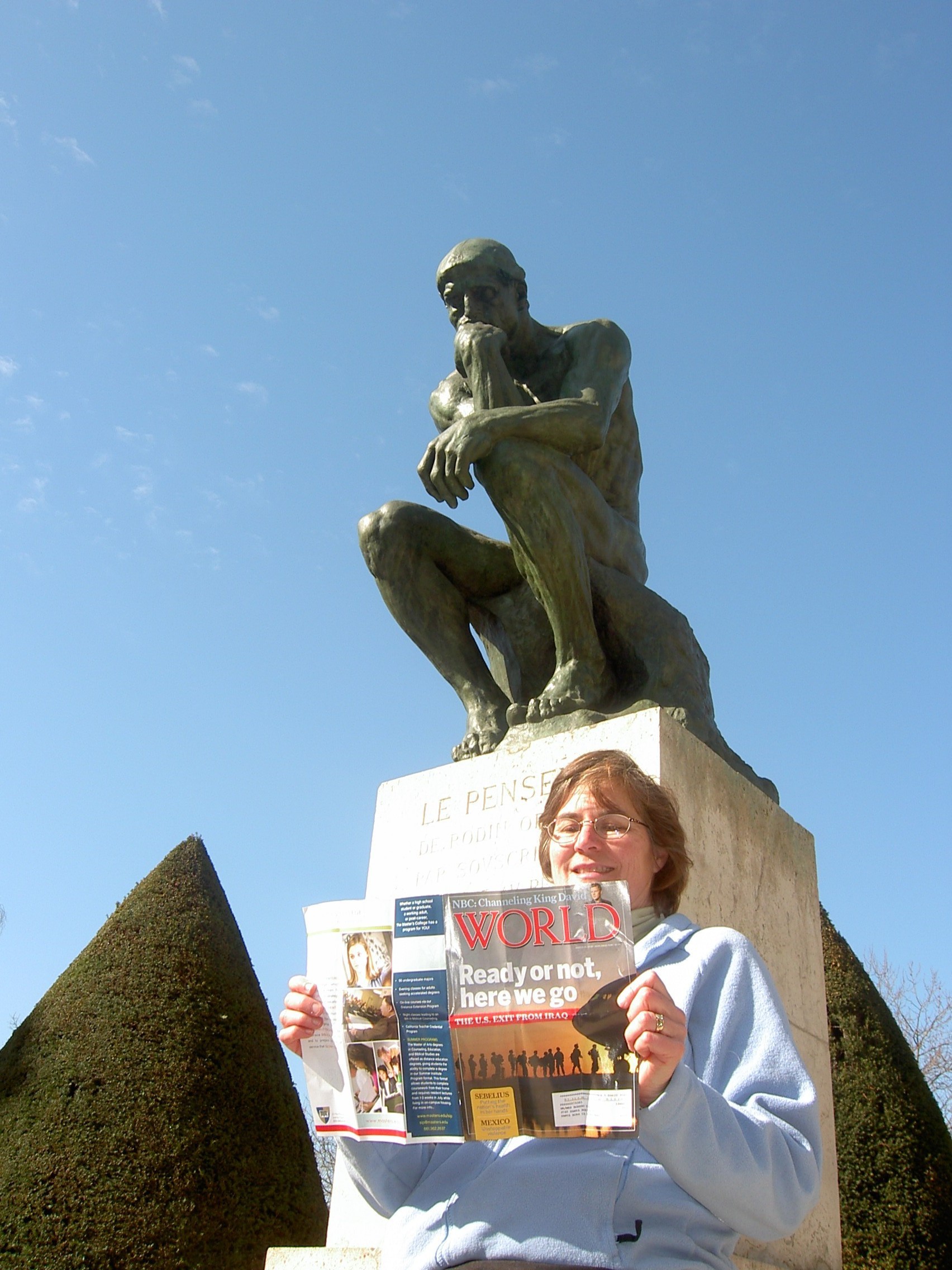
I can't find the picture of me sitting on the Great Wall of China NOT looking at the view, but perusing the magazine. There's also a missing shot of me standing in Tiannamen Square with Mao looking over my shoulder into an edition from May, 2008
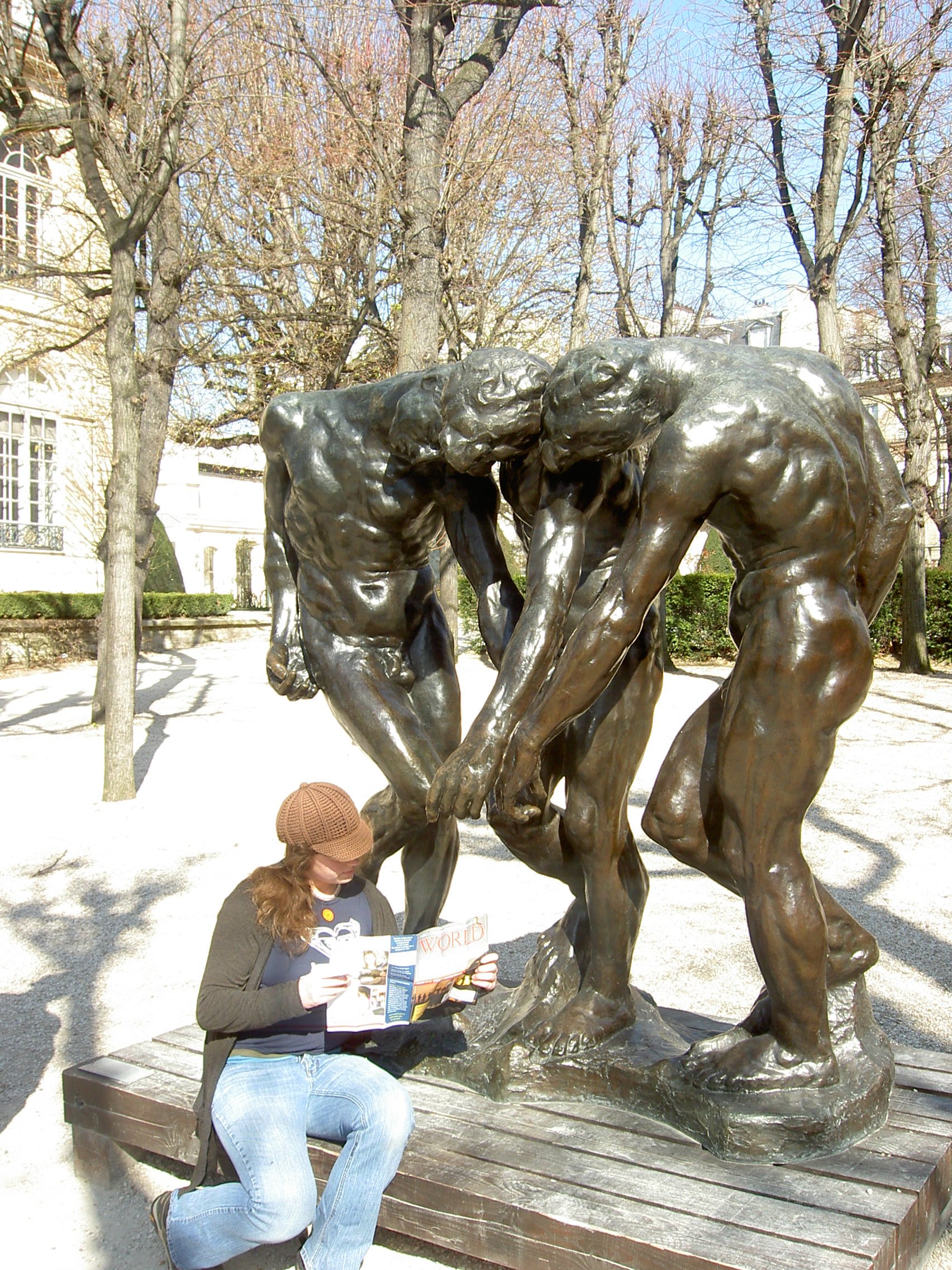 My daughter got into the act at the Rodin Museum. We're missing the fun shot of her giving a statue a close-up, but we do have her in the fits of despair out in the garden, fortunately with something to read . . .
We're also missing the picture of me looking through the magazine on top of Notre Dame, nor do we have a picture of me with it at Loch Ness. We took a picture of me at the Louve showing recent events to a statue of Sargon. I wonder if that photo is in my son's camera?
I was able to find the shot of our stop for Sherlock Holmes and Watson's query at Baker Street's tube station in London.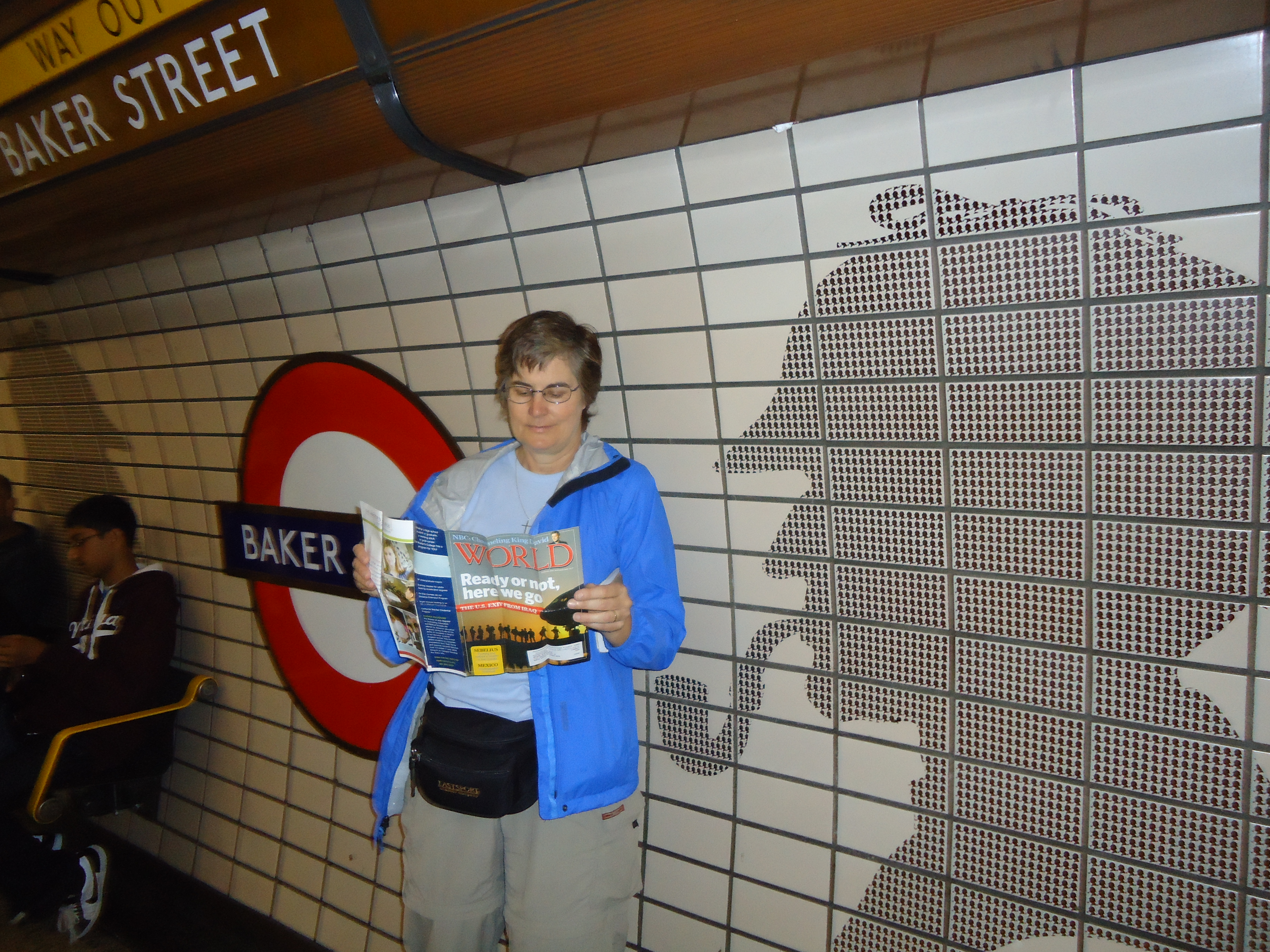
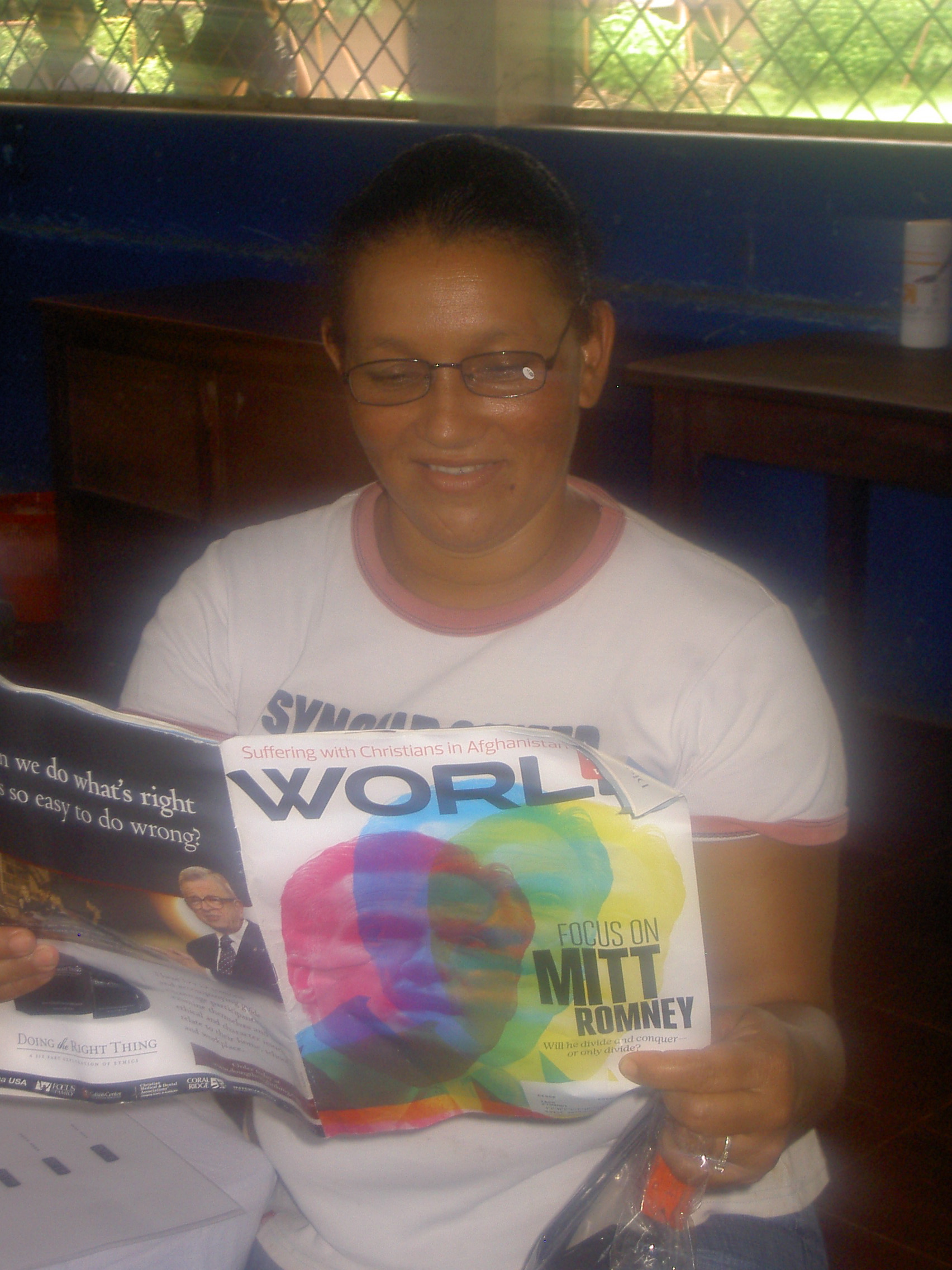
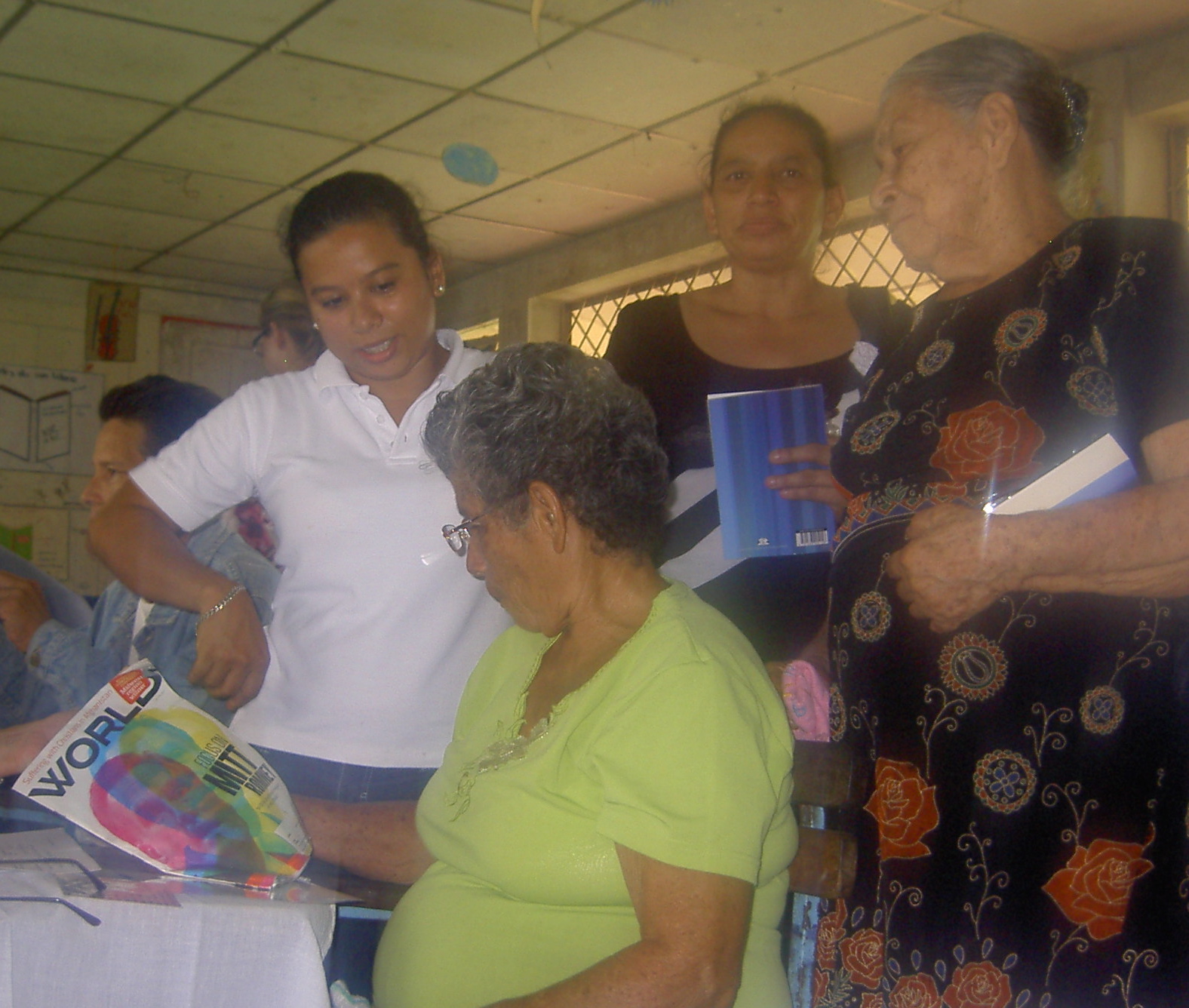
But perhaps the best two are not of me at all, but show women in Nicaragua, wearing glasses for the first time and getting a taste of the world outside of the Rio San Juan region. Laughing and smiling, but more important, seeing the World through new eyes.





September 16, 2011
On Keeping My Options Open–Because You Never Know
 I grew up in a household with a mercurial, creative, option-loving parent. He meant well, but his word simply wasn't good–at least in the plans he made for us. (His word was a bond in business and he paid dearly for his loyal ethics). That meant for me, things often felt out of control. I didn't know what would happen next and so I learned to keep my options open and to hold on to things–because you never knew when you might need to produce something he suddenly thought he wanted.
Twenty years in the military meant I worked hard to keep my options open in terms of possessions–because you never knew when those curtains might fit into a new house. For that reason I carried curtains from our third set of quarters, material I bought for 67 cents a yard because I knew we would only live in the house a year, all over the country for 17 years. I might find a place for them.
I never did.
Over the years, we collected my husband's parents' furniture and my parents' furniture. We had a big house, but too many things as the children peeled away to their own lives. When we moved to our last house, I suggested throwing away all the furniture and starting over again. Or at least throwing away the old beat up furniture.
Closer scrutiny revealed that while my children had grown up unattached to a given house–owing to all the moves–they had transfered their allegiance to what went with them everywhere: the beat up furniture, the scarred piano, the lamps my husband made as a teenager.
Everything moved with us.
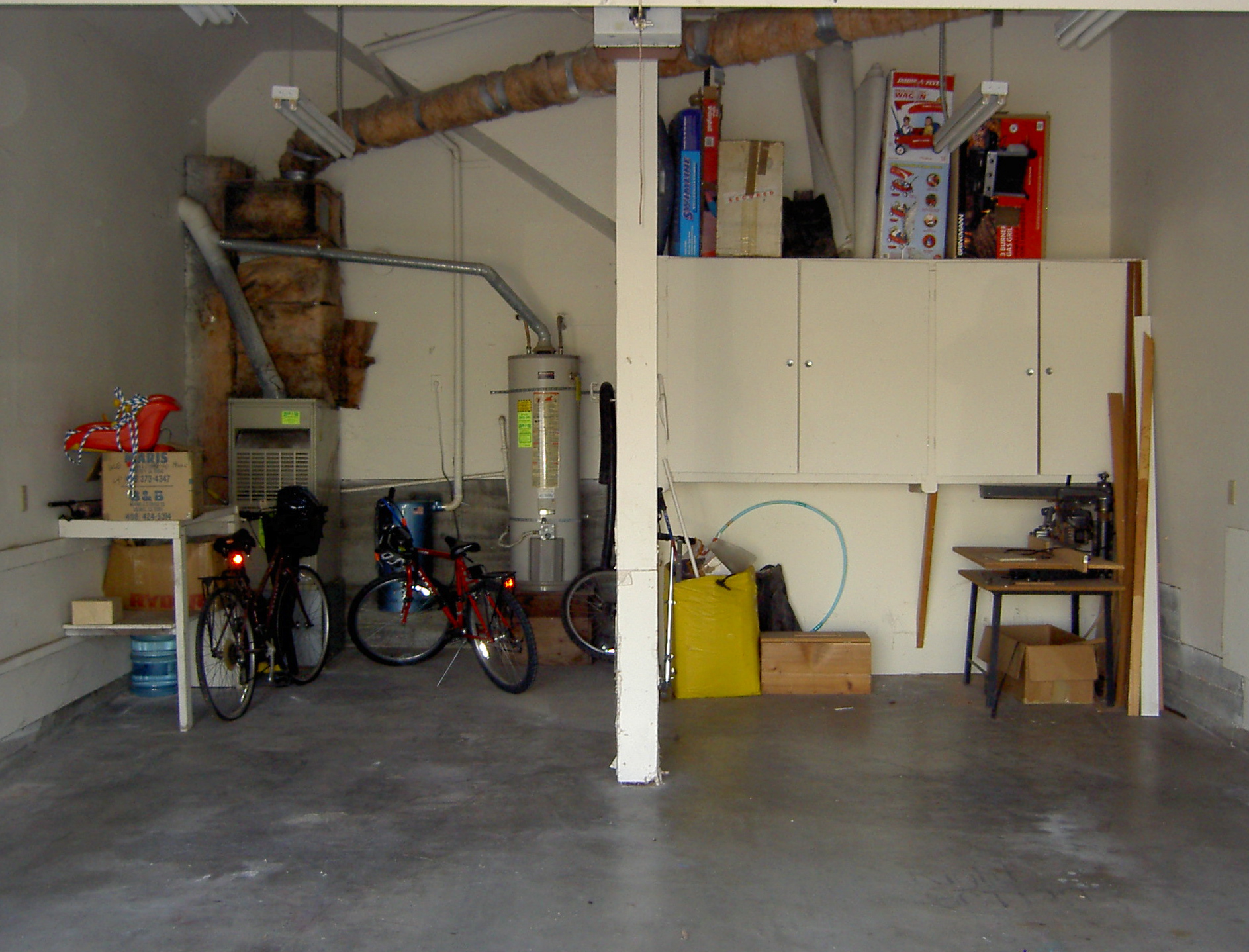
This morning we hauled away to the dump the old speaker, a pioneer Cerwin-Vega, my father-in-law built 50+ years ago. It anchored my husband's childhood from a corner of the living room. It's taken up a corner of our garage for 10 years. We'll never hook up an ipod to a speaker measuring 3x3x4 feet.
But even harder to give up was the old baby backpack someone gave me thirty years ago and which I used to haul my children around for a long time. I can't carry my grandchildren in it, it truly is worn out, but something has kept it hanging on the wall in the garage for three moves where it was never used.
You know. Memories.
Sentiment trumping logic yet again.
The late author Larry Burkett used to talk about hoarding, not in the over-the-top sense we see on TV these days, but how our reluctance to trust God makes us cling to things we no longer need. He pointed out we have plenty of clothing in America; no one should ever be in want. The problem is, too many people leave their excess clothes hanging in the closet when they really need to be shared with others.
I'm going to the closet next.
But his idea about a lack of faith reverberates in my soul. I cling to things because I might need them some day, not because they're being used today. That may be sensible in some arenas–we've got extra tiles for the foyer which we'll need to replace broken ones this week. But do I really need the dress I wore to the Navy ball fifteen years ago? The jeans that are too big? The jacket I never wore? If I cleared them out, I could have more order in my closet and possibly more options.
How could I have more options if I get rid of something?
Clearing out the excess enables me to see the root–the primary, the most important. Old clothes, old furniture, old memories can get in the way of today–what I need to think about and deal with in the present.
Ultimately, the children didn't care what happened to the old sofas–several went to college with them after all. But they did care about the important: what they did with that furniture while growing up–built forts, read books together and laughed. While they occasionally wax nostalgic for something they owned once, they really prefer to share the memory between them.
My garage is emptier with that speaker gone–less weighty, too. Without a useless item, I have more options and I can trust God will fill that empty space, or leave it open. After all, I still have options–they're just different.





September 13, 2011
The Unceasing Hunt for Order
 My colleague Wendy Lawton and I share a major belief. We both think if we can find an orderly system of management, our life will become simpler, more controllable and efficient.
I'm not sure why Wendy is so convinced, but my past as a military wife bears some responsibility for my dream. Thirteen times we moved. Thirteen times I stood in a house surrounded by my possessions all neatly boxed up and stackable. Life was in total order and not even a surly two-year-old could throw anything around.
Similarly, I loved marrying an engineer who, I thought, had a place for everything and everything should go in its place. I rejoiced with Adrian Monk when he fell in love with a woman because her garage was totally organized. While Natalie, the Captain and Randy passed incredulous looks, I sighed with contentment. Everything in it's place.
Where did this desire for order come from? Why are some "messies" and others obsessive compulsives? And what about the rest of us in between? Why am I looking for order and management to gain control over my life?
Ah, maybe that's the real crux: control?
We worship an orderly God. He tells us "come now, let us reason together," in Isaiah 1:18. That reference is in conjunction with our sin, but can't you make a case that sinning is getting out of order? That when we sin, some of us are allowing a base need or desire to control our Godly sense?
God created order out of chaos when he divided the dark from the light in the opening chapter of Genesis. He put continents in their places (somewhat flexibly as earthquakes demonstrate) to give a boundary to the sea. He set up his laws so we could understand the difference between sin and not-sinning.
An old friend asked me last summer why I would base my life on the Bible. I told her I saw the Scriptures as a framework. God gave us boundaries and limits and then we are free to live our lives within that order. Knowing what's sin enables me to avoid it, and thus to keep the chaos of guilt at bay.
We live in a world of variables and most of it is out of our control. But Wendy and I optimistically believe that if we could set up systems to keep the variables exceptional rather than the norm, we could get our work done more effectively. The exceptions should the exceptions, not the rule.
But how do you even put the systems into play to keep the chaos at bay?
You start by examining the entire situation–what causes things to get out of order. Those that can be contained, should be contained. Those that can't, like a two-year-old, need boundaries erected and a recognition that dealing with them is, by nature, uncontrollable. If you can anticipate what you can't control, you're halfway to figuring out how to deal with it in an orderly fashion.
Similarly, I'm going to sin today. In fact, I've already sinned today in several orners of my life. That's not surprising to God and alas, not surprising to me either. It will probably happen tomorrow as well.
They key, though, is how I deal with that sin, that lack of control, that choice to be disorderly?
Come now, let us reason together. God has given us a way.
The third book of Lamentations reminds us of what it feels like to fall out of order, and it gives us hope.
20 My soul still remembers
And sinks within me.
21 This I recall to my mind,
Therefore I have hope.
22 Through the LORD's mercies we are not consumed,
Because His compassions fail not.
23 They are new every morning;
Great is Your faithfulness.
God created the night and the day; he put order into the world. The sun comes up in the east and it goes down in the west. Every day is a new day, full of his mercies and forgiveness.
Which means every day I can wake up knowing order is in the world–somewhere–and that even when things fall apart, His mercy and faithfulness remains secure and we'll get through this, perhaps not efficiently, but under God's control.
At least Wendy and I can bank on that.
Thanks be to God.





September 8, 2011
The Theology of a Rumpled Bed
 While praying over the issues in friends' lives recently, I found myself wishing I could take their lives, fling them out like bedsheets and smooth them out again as when making a bed.
Silly, of course, so I settled down and prayed for the peace that passes all understanding and that the Lord would make their way clear.
But I kept thinking about a well-made bed and wondered if there may be some spiritual applications.
A bed becomes rumpled when you sleep in it–actually use it for the purpose for which it's intended. It's not meant to remain pristine and neatly arrayed if it's being properly slept in. Some people, apparently, can lie down like a log and never move all night long and wake up to a bed that takes seconds to restore to order.
Others, however, thrash and carry on (perhaps alone, perhaps with another) and arise from a disordered heap of tumbled linens.
Likewise, some live practical lives of spiritual piety: ordered, straight, narrow and complete.
Others . . . not so much.
Some live in the chaotic give and take of a Holy Spirit-following mess–responding where we believe God leads us even if it doesn't make sense and frequently when it involves others.
The majority probably float back and forth– living in perfect obedience to God and marveling how easily things flow together when you walk with Jesus; other days wondering if the will of God means an out of control cacophony of activities and events.
Much like beds in the morning.
I don't know about you, but I can't stand to sleep in a tangled mass of unmade bed sheets. Even if I'm about to climb in, I stop and pull everything straight, smooth out the blankets and plump up the pillows. It doesn't have to be hospital corners and military taut bounce-a-coin-off-the top, but it needs the wrinkles brushed out.
Just like my soul.
Some days I sit down to pray and my emotions and life feel bunched up and out of sorts. Perhaps I've kicked my attitude toward God into a pile at the foot of my bed. Possibly I've slung the pillow of my anger at the headboard and missed. Maybe I've tried to cover my shame with a blanket pulled out of its tucked security.
Often when I pause to examine the unmade aspects of my spiritual life, I don't even want to climb in there because I know I'll have no rest until it's all straightened out.
How do you get rid of the wrinkles in your soul?
You start by throw off all the covers–expose all the hidden crevices of your soul to God. Let His cleansing forgiveness air out the darkness and clear the covers of deceit.
You then smooth out those scrunched sheets by telling God about them and asking Him to forgive you. It's like straightening the bottom sheet.
Sometimes you have to restore relationships back to where they belong, like tugging the top sheet neat and matching it to the fitted bottom. Part of forgiveness can involve the person you've wronged, or who has wronged you. Too many times, I have to write humble letters of apology and ask someone to overlook my sin.
In colder months we need blankets. I fold them in with the top sheet. On desperate days, I use the hospital corners to tug the bedding taut. Sometimes we need to help ourselves avoid a disheveled mess by erecting boundaries–if we can't control our behavior an external force may be necessary to keep us tucked into the straight and narrow . . . bed.
And then I toss over it all a polished bedspread of grace–perhaps quilted with experiences. I brush out the creases–overlook the flaws–and plump up the pillows of love to match.
And then, once the bed of my soul is straightened, I can climb in again–able to relax into the restful life God has created for me.
And you.
It's a messy life full of complications, tumbles, scuffles, mussing and joy.
But every night I return to the Master bed maker and He restores my soul.
Thanks be to God.





September 6, 2011
Humility in the Face of Their Courage
 I've been writing about my story, The Dogtrot Christmas, and what went into making it. I started with historical facts and then built a fictional tale
Writing it caused me to revisit my family history, Pioneer Stock, and remember the difficulties my ancestors faced as they carved out a life for themselves in hostile territory. I'm still awed at their courage and embarrassed by my comparative cowardice. I stand on the heroic shoulders of moral and courageous giants, and I feel way too small.
What did it take to leave behind the relatively settled communities of southeastern Virginia, to push through the Cumberland Gap not long after Daniel Boone and head to a land teaming with angry native Americans, vicious bears and panthers, enormous rivers and mountains, rapacious reptiles and insects, and the ever present danger of getting injured in a time before antibiotics?
I have no idea. It's unthinkable to 21st century me.
The depth of their courage became apparent while reading Harriette Simpson Arnow's Seedtime on the Cumberland, in which she tells the story of a mother in a wilderness clearing sending her 11-year-old son out to milk the cow. The next time she saw her child, his severed head was impaled on a pole being shaken at her by a Native American howling as he rode his horse around her log cabin.
Absolutely chilling.
I ran to hug my own 11 year-old son after reading that passage; harmlessly playing ball in the Hawaiian sunshine, he pushed me off with a shake of his head.
But the horror.
I've never even contemplated moving to a dangerous place where people wanted to kill me.
And yet my ancestors counted the cost and made the journeys across a cold ocean in wooden vessels that didn't even have a traditional steering wheel–ship captains used a pole connected to the rudder– a tiller–to steer the ship. On the Mayflower, the tiller didn't even reach to the top deck–the sailor manning the tiller responded to orders from the captain on deck, shouting through a hole. The mortality rates on those sailing ships were high.
I can't handle a modern cruise liner without heaving over the side.
Obviously, conditions in the old world or on the exhausted farm in Virginia, must have been so poor than an uncertain future in a dangerous place was preferable. Or, perhaps their husband insisted. Who can say?
Many of my ancestors were Primitive Baptists and thus motivated by religious issues. The Reverend Thomas Hanks was one of the first evangelists in Texas, crossing the Brazos River to provide Christian influences and hope to settlers living in Catholic Mexico. He didn't get caught, but slipped in and out of what became Texas for 15 years before moving his family into the land. They prayed and believed, then moved forward.
We moved thirteen times in twenty years following my husband's military career. The hardest move was from Washington to Hawai'i, but only because we had to leave the cat and washing machine behind. The natives were friendly when we got there, and the 747 we flew had all the latest navigational devices.
But the example revealed to me by those who have gone before, has given me plenty to think about over the years. I've weighed the true danger of relatively minor events, in light of their undaunted courage. I've wondered where the strength came from to propel them into an uncertain future, and I've prayed to the same God for wisdom and strength.
I remain humble, however, in the face of their courage and can only hope I someday will live up to the sacrifices they made for their own children, grandchildren and so on, all the way down to me.
It's the least I can do.
What about you? Where do you go to derive courage for the future? Got any ideas for the rest of us?





September 2, 2011
Traveler's Tales: The European Family Connection
 My mother's Sicilian cousin died last Thursday, five days before the big celebration of his 90th birthday. When my cousin wrote to tell of the news he sadly noted, "this is the end of a connection to the past. Nino waved goodbye as our family left for America," in 1931.
That's his grandson in the photo; Nino came to marriage, fatherhood and grandfatherhood late. We knew him because he admired his uncle, my grandfather, another man who lived a long time: to 103 in Grandpa's case.
This means my uncle is the final member of his generation. He's only 82, but we certainly hope he'll live to match the old ages of his relatives.
Nino's branch of the family did well in Sicily, even as my side moved west. He served in the Army during World War II, but the family survived into prosperity when, after the Allies finish bombing the island, theirs was the only major building standing in Milazzo on the northeastern coast. They opened a successful Ford dealership.
Nino left the army and became a police officer–eventually rising in rank to become the police chief of Palermo, the main city in Sicily.
I have no idea what his politics were.
For all of us, family was key. My grandparents kept the correspondence going and in later years would speak to Nino on the phone. They visited him and his brothers when my step-great-grandmother died and my grandfather had to spend all his inherited lire in Italy, circa 1955.
 Nino retired to Milazzo and became a defacto tour guide for our American branch of the family whenever we landed in the home country. He had the route down: the house where my mother and her siblings were born. In the sun-kissed air of an April afternoon, he showed my husband, children and I the seafront promenade he wandered every evening–after we saw the house, the cave where my grandfather acted as a goat herder and my grandmother's village.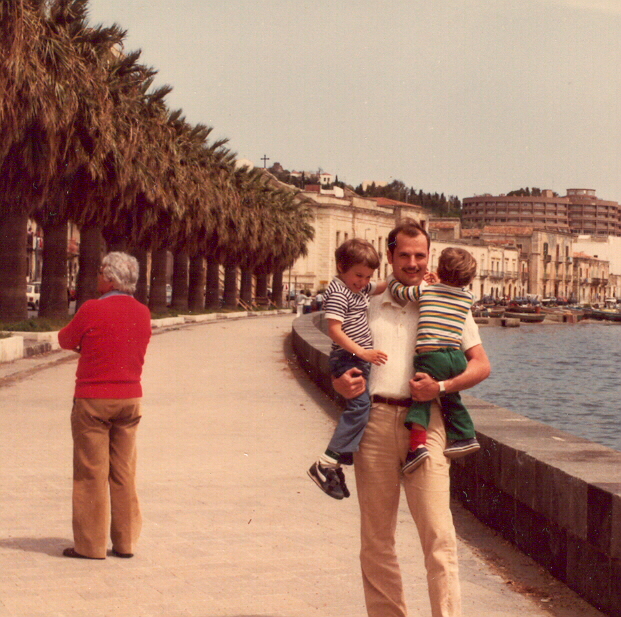
Having a family connection in a foreign country is a privilege. I've stayed with relatives in Switzerland, Lake Como and last summer, with my husband's family in Slovenia. It all looks so different when a cousin can take you to the grocery store, or explain how things are different between the countries. In Slovenia, a cousin took my daughter to the doctor and in translating, saved our sanity.
 The Slovenia relatives also have a family tourist route which includes, now, the stump of the tree my husband's grandfather planted the day he left for America nearly 100 years ago. We didn't see it on our trip, but apparently there's a valley somewhere in the country where everyone shares our surname.
I grew up in San Pedro, a community of immigrants, and knew countless people with close family connections to Europe. Foreign tongues flew with ease and stories of broken-English hardship and traveling across the Atlantic Ocean were familiar.
My mother took us to Europe the summer I was 14. We saw a number of countries but the real excitement was reserved for her return to the motherland she had left as a six-week old baby. She, of course, had no memories, but she had language skills from her childhood and was anxious to use them in her emotional homecoming.
We crossed the border from Austria, and in those days had to show our passports. The border guard raised his eyebrows when he saw my mother's American passport listed Italy as her birthplace. At his nod of welcome, she dropped to her knees and kissed the ground: she had returned.
Italians are like that.
She then gallantly tried to explain to the guard why she was so excited.
He shook his head. He didn't understand the dialect, it came from further south.
We all were surprised. He was right.
The Italian language is flowing and demonstrative; it rolls off the tongue with a rhythm and melody hard to explain to the uninitiated. Just say the word, "mozarella," and you can feel the thrill. (Make sure to put a tiny trill on that 'r").
We laughed watching my mother use her hands and rolling tongue through the north. She delighted when people understood, and then dropped her mouth with surprise when they told her she must be from southern Italy.
"Do I look like I'm from southern Italy?" she asked us.
How would we know?
When we got to Rome and ate in a restaurant (my father insisted on pasta and red wine everywhere), she did all the ordering and translating. The waiter smiled. "You must be from Sicily."
She put her hand over the napkin covering her heart. "How can you tell?"
"Your accent."
When we got to the toe of the Italian boot, Mom bought ferry tickets. "Ah," the ticket seller said (in Italian), "You are from Milazzo."
Totally charmed, and the "r" trilled even better.
The final thrill, however, was reserved for the restaurant in Milazzo. The waiter congratulated her on her Sicilian dialect, noting it was old fashioned. "You must be related to the Foti family."
Her dialect could indicate that? We were amazed.
He laughed and pointed to Nino's brothers. "You're with the Foti family."
We were, and are, proud to be connected to such fine Sicilians and we're going to miss that special family connection.
Fortunately, we know the next generation, too.
Arrivederci alla mia famiglia siciliana. Lo mancheremo, Nino.





August 30, 2011
On Writing: Getting a Novella Out of Real Life
 My first book releases on Thursday, September 1. If, for some reason, you haven't heard about The Dogtrot Christmas novella as part of A Log Cabin Christmas Collection, you can read about it here.
But where did I get the story and how?
I was given two parameters when I wrote The Dogtrot Christmas. Because it's part of a Christmas collection, something in the story needed to touch on that holiday. In addition, a log cabin needed to play a major role.
Go.
Fortunately for me, I'm a genealogist and I merely had to reach into my family history to find an accessible log cabin story. Keziah (Kizzie) Hanks Colwell (or Caldwell?) wrote a diary as her family traveled from Maury County, Tennessee to eastern Texas in 1835. The wagon train was led by her father and my great-great-great-grandfather, the Reverend Thomas Hanks, a Primitive Baptist Circuit Riding minister.
Gladys Hanks Johnson, a researcher, saw Kizzie's diary and took notes. Someone allegedly wrote a Master's thesis on it.
(If anyone knows where I can find that diary, PLEASE contact me. I've been seeking it for years!)
Kizzie had quite a task ahead of her. Her sister died in childbirth shortly before they left Tennessee, meaning she had to nurse a newborn along with one of her own four children, manage the wagon, encourage her husband and follow her Dad. Not to mention write up her diary notes.
Once they got to east Texas, the family threw together a log cabin and they worked the land. Kizzie did the cooking, chinking, teaching, child tending and of course, tried to keep her nephew alive. One day she returned to the cabin to find the baby restless on the straw tick. When she looked a little closer, she saw a Native American's hand reaching between the unchinked logs, patting the baby on the back.
That scene made it into my story. :-)
Another time, she was down at the creek, washing clothing. She looked up when the baby cried, to see him being swung by the foot. A Native American chattered at her in his unknown tongue and indicated a nearby tree. Laughing, he swung the baby's head in the direction of the trunk. Kizzie threw down the clothes, shrieked and grabbed for the baby.
The Native American handed him back and then slunk away.
Of course that scene made into into my novella.
Those were the stories I had, along with the worried threat of panthers in the woods. How to make that into a log cabin Christmas story?
Rev. Thomas Hanks "had the first conversion" on the west side of the Brazos River. He had begun sneaking into Texas when it was still a Mexican state, baptizing, marrying and preaching to the English-speakers in the neighborhood, possibly as early as 1820. Another family story told of Hanks riding back to remarry all those illegal couples once Texas became a Republic.
One woman, ten hard years into a challenging marriage heard him out when he stopped by their claim and offered to marry them again, legally this time. She frowned and looked into the distance, finally saying, "Well, okay, Daddy Hanks. I'll do it just because it's you that's doing the asking. But if I'd known then what I know now, I'd never have married him."
Do you see how that gave me insight into my ancestor? An adventurer, not afraid to share the Gospel in an illegal situation, and probably with a sense of humor.
Because The Dogtrot Christmas is a romance, I needed to find some hooks to link in the history with the story. Cynthia "Syntha" Hanks Faires is the woman who died in childbirth. Her husband, James, raised the baby to adulthood, marrying and having other children by his second wife. Even though Kizzie is a heroic figure to that branch of the family (I descend from the shopkeeper son who stayed behind in Tennessee), I wanted to set my romance during the more dramatic historic time–the beginning of the Republic of Texas, immediately following the Battle of Goliad that ended the Mexican rule.
So, I invented a character: Molly Faires, a sister for Jamie. In my story, she raises the baby nephew, meets the Native American, and chinks the cabin. Easy.
She also enjoys Rev. Thomas Hanks' preaching at a camp revival meeting and along the way falls in love with a native Tejano–fourth generation Spaniard on a land grant–who just happened to be tutored by the Rev. Hanks during those spying-out-the-land-for-the-Gospel visits.
What did it take to be a pioneer in that time and place? How did these people live out their spiritual lives on the frontier?
I took what I knew about Hanks' faith and tailored it to the circumstances and beliefs of the people during that time. It had to be true to the early 19th century, but the Word of God is eternal and profitable no matter when in history a believer lives. Figuring out how people of faith related to their God was straight forward–and even easier when I found hymns sung at camp meetings!
How did it all turn out?
You'll just have to read the story. But I'm proud to be a member of the Hanks family of Texas.
Oh, and how did I work in Christmas?
It's Jesus' birthday and he's the center of the holiday and the hope the Hanks family took to Texas. Also, with a Mexican flair, I incorporated the posada tradition of looking for a home for Mary, Joseph and the baby. Since a dogtrot cabin sits at the heart of my story and our hero Luis is looking for a home . . . well . . . use your imagination.
What interesting stories does your family tell? Could you weave them into a novel with just a little push?





August 24, 2011
The Bittersweet Humility of a Published Book
 Several years ago I sat in my rocking chair to "have it out with God." I was tired of talking about writing and trying to write. I needed to know if this desire to write was from God, or was something I only wished was from God.
I was willing to set it aside and do something else–getting a Ph.D. in American history has always been the fallback–if this wasn't something God wanted me to pursue.
I'd been reading about prayer and one book exhorted us to "dream big," and "ask for the impossible." We also were advised to scrub our hearts and desires to determine what we really wanted.
While I'm not a "name it and claim it," Christian, I decided to ask for the one desire of my heart.
"Okay, Lord, I want to write a book."
Ping. The light went on in my brain. I'd already written several books.
"Okay, Lord, I need to revise that. I want to publish a book that makes a difference in someone else's life."
I don't think God said this, but I laughed at myself–was that my second request?
I don't worship a genie God who waves His hands and gives me the desires of my heart. I worship a God who gave me gifts that He might be glorified through them. The honor and acclaim needs to be His, not mine.
That's easy to say, but what does it really mean? I needed to confront my reasons for wanting to write.
So what is the real state of my heart? Why do I want to write a book?
I hate to admit it, but the real, honest truth hidden deep in the recesses of my soul is, I want to prove a point.
Unfortunately, the people I most want to impress are dead. Long dead and will never know I actually wrote a book that was published.
My mother always expected me to amount to something–she put up with a lot to make sure I had a secure and happy childhood filled with opportunities. If I wanted to be a writer, she wanted to make sure I had the opportunity. I'm sorry she'll never know my name appears on the cover of A Log Cabin Christmas Collection.
She lived long enough to see my name on the masthead of the UCLA Daily Bruin and to get a copy of Military Lifestyles Magazine when I won the grand prize short story contest. She saw the biography I wrote about my grandmother and of her parents. She knew I was writing Pioneer Stock, but never learned it ended up in the Library of Congress, much less in genealogical libraries around the country.
I'm sorry, Mom, it took me so long.
My Aunt Rosie gave me a Webster's Dictionary for my tenth birthday. She probably got it on sale, but was surprised at how it pleased me. I loved words and still have the volume, the pages brown and spotted with age. She asked me one day when I was in college what I planned to do. "I want to write," I said.
"Really? What do you have to write about?"
"Oh, my thoughts and stories."
She sniffed.
Auntie Rosie lived long enough to read Travels with Jeanette, a story I wrote about touring Europe with my mother. Not published, but complete. She liked it, as did her brother, because it brought my mother alive again for them.
My uncle's wife, Auntie Arly, read Travels with Jeanette as well, and liked the parts about my mother but wanted me to write a mystery next.
She never understood that it didn't quite work that way. :-)
They're all gone now, and won't hold this book with my name on the cover in their hands.
So, what else was I trying to prove?
I spent twenty years following my naval officer husband around the world, raising our children in a variety of locales, teaching Bible study and doing almost anything but writing. Unlike most of my close friends–or at least most of the godmothers of my children–I did not work a job. To be able to publish a novel would demonstrate all my fine IQ points were not wasted on raising children. That's the other point I needed to prove.
Except I know, as many of you know, that I didn't waste all those years raising children, making a home and teaching Bible study–not to mention working at pregnancy counseling centers, volunteering as a Navy Relief budget counselor and all the hours at eleven different school districts.
I know. You know. But I didn't feel accomplished.
After that day praying, I knew there was no point in God answering the desire of my heart to be published if I thought being published would be the pinnacle of my life. I needed to recognize I have worth in God's eyes beyond what I can produce.
Intellectually, I understand completely. Emotionally, I struggle.
A Log Cabin Christmas arrived yesterday. I held the book in my hands and looked at the green embossed title, my own name in small letters on the bottom line. I hefted it in my hand, flipped through the pages and marveled at seeing words I typed on this very computer, printed into a book. It felt humbling and marvelous.
It reminded me of holding a new baby: the joy, the awe, the wonder.
But you know what? A baby is more valuable than a book.
I am humbled to have a book with my name on the cover. I wish my parents and my aunts had lived to see it.
But more importantly, I know my parents and my aunts lived to see my four children and my happy marriage.
They died knowing I am a success.
Thanks be to God.