Michelle Ule's Blog, page 25
April 27, 2021
What was an Anchorite?
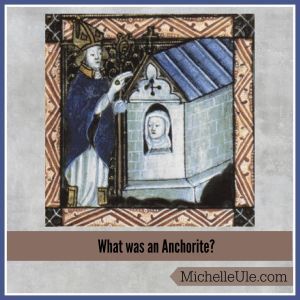
Anchorite?
What kind of word is that, much less what was it?
Long ago, I heard stories of women who voluntarily had themselves sealed up into the walls of a church.
Their holiness was so profound, they wanted to be hidden away into a life of prayer.
Similarly, I heard stories of the “church fathers” who lived in the desert. (Some were called “desert fathers.”)
These included impossible-seeming tales of men who isolated themselves on the tops of tall platforms, removed from the world.
Both types of people could be called “anchorites.”
Anchorite and anchor?Anchorite comes from the word anchor.
As in, staying anchored to one place.
Unlike hermits who could wander, and usually did, anchorites took a vow of “stability of place.”
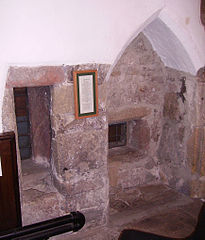 View of an Anchorite’s cell
 (Immanuel_Giel at
Wikimedia Commons)
They devoted themselves for prayer in the general sense but also for the particular church community in which they “dropped anchor.”
In doing so, they “attached” themselves to a church and the local bishop performed a service akin to a funeral.
Thus they became “dead to the world,” a type of living saint.
They may or may not have been nuns or priests, but obviously were devoted to God. Becoming an anchorite was considered a form of “Christian monasticism.“
The first anchorites were recorded in the third century. After Henry VIII of England’s Dissolution of the Monasteries circa 1540, the tradition ended for the most part.
How did it work?As a child, I couldn’t imagine how a woman lived as such a holy person.
Wouldn’t she die from lack of food? How big was her hole? What about waste products? What happened when she died?
It wasn’t as confusing as I thought.
A devout person who wanted to be isolated from the world for prayer and meditation needed a sponsor.
A sponsor, usually a wealthy landowner, agreed to pay the anchorite’s expenses in return for prayers.
(During that period before the Protestant Reformation, requested prayers were not only for the present but also for family members locked in purgatory.)
They sought a church community willing to have them attached to the church building.
Once the local bishop agreed, the sponsor paid to have a small room or “cell,” generally about 10 feet by 12 feet, attached to the church.
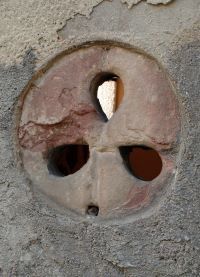 Squint Hole
(Wikimedia Commons)
The cell had three windows. A small “squint hole” (or hagioscope) looked into the church, focused on the altar, and was large enough for the anchorite to receive the sacraments.
(The anchorite couldn’t see anyone except the priest. No one in the congregation could see her).
A window large enough to afford personal needs–a bucket for waste, food, laundry, the occasional book–opened into an attached room or cottage where attendants lived.
The last window, probably not large, had shutters or thick curtains for local residents to speak with the (unseen) anchorite.
She heard their prayer requests and perhaps answered spiritual questions. It was not a social opportunity. The anchorite hid from the world for a purpose: devotion to God.
What were these holy people good for?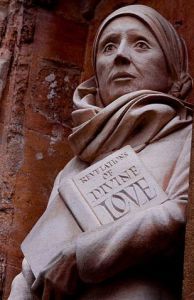 Julian of Norwich
 (Wikimedia Commons)
Attached to a village, listening to prayer requests, and praying meant the anchorite understood the local community.
Visiting priests might stop by to ask about the village’s needs. (One teacher said John Wesley’s evangelism success was due to visiting the local anchorite when he arrived to learn of needs).
They meditated on the Bible, catechism, or prayer books. Some, like Julian of Norwich, had visions and wrote them down.
According to Veronica Rolf in An Explorer’s Guide to Julian of Norwich:
Julian called her mystical experiences shewings, an older English word that meant “manifestations.”
These came to her as bodily sights of Christ on the cross; in locutions or words that she heard spoken directly by Christ; and in intellectual and spiritual understandings that continued to develop throughout the rest of her long life.
Julian considered all her mystical experiences to be direct shewings from God.
An Explorer’s Guide to Julian of Norwich, p. 7
People still read Julian of Norwich’s writings in the 21st century.
Julian, who lived in the 14th century, was the first woman to write in English. Attached to the parish church in Norwich, England, she was Geoffrey Chaucer’s contemporary.
She lived during a plague and her prayers brought solace to many.
Why did they seek to be locked away?
‘all shall be well, all shall be well, and all manner of things shall be well,’
Julian of Norwich, Revelations of Divine Love
Obviously, they felt they had a prayer vocation.
In her novel The Anchoress, scholar Robyn Cadwallader agreed prayer was the first reason.
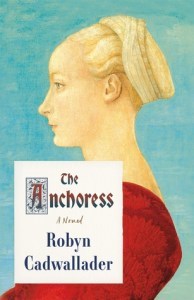
But the novel also pointed out the few choices women had during the middle ages.
Cadwallader’s heroine prayed, read, and meditated, but she also sought escape from an arranged marriage.
Many nuns over the centuries ended up in a nunnery not because they had a vocation, but because their fathers or brothers didn’t want to pay their dowry.
Probably a widow, Julian of Norwich’s vocation came from a devout love of God. Money, at least to her, was immaterial.
Many of us love God, Jesus, and the Holy Spirit.
But, how many of us would be willing to live in a small cell for the rest of our lives praying, meditating, and listening to prayer requests?
Tweetables
What was an anchorite? Click to Tweet
Would you be willing to be walled into a church? Click to Tweet
The post What was an Anchorite? appeared first on Michelle Ule, Author.


April 20, 2021
How to Tithe Time

After a friend retired he chose to tithe time to his church.
That meant he spent a year in a church office organizing paperwork, clearing out a lot of junk, helping sort through accumulated information, and set up a new computer system.
It’s amazing to see the changes his tithe time wrought in the organization!
What does it mean to tithe time?He donated ten percent of his normal work hours the year after he retired to the church.
He kept regular office hours.
If questions arose he could answer, he did so.
When people asked him to get rid of junk from closets, he made the arrangements.
Our friend organized plumbing jobs and worked with the various people in charge of activities at his church.
His presence was invaluable when the secretary got injured and was out for two months.
As a responsible (former) business executive, none of this was hard. Indeed, he enjoyed himself immeasurably.
Why bother to tithe time?Obviously, our friend had skills his church needed. He already volunteered for other tasks, but this was in addition.
 Photo by Ray sangga Kusuma
 (Unsplash)
He used it as a gift to God, in thankfulness for his success in the working world.
(And his wife didn’t mind having him out of the house that first year of adjustment.)
We know other people who have given time to their church rather than money.
They may not have much money they can give. Perhaps their spouse doesn’t approve of them donating money to their church.
Maybe they, too, want to give back to God in gratitude for what He has done in their lives.
Why ten percent?Ten percent is the traditional tithe many people advise.
Another concept is giving back the first fruits of your profit to God.
(This is not the same thing as tithing. See an explanation here.)
Throughout the Old Testament, God asks His people to give the best, the first fruits, of whatever they receive, earn, or grow.
Verses abound. Here are two:
Honor the Lord with your wealth and with the first fruits of all your produce.
Proverbs 3:9 ESV
and
The best of the first fruits of your ground you shall bring into the house of the Lord your God.
Exodus 23:19 ESV
Does God need our money or our time?
Of course not.
But, like anyone, He appreciates being recognized for all the good He has done in our lives.
Giving Him 10% of our earnings, time, or even produced goods, honors Him.
It also demonstrates we trust our entire life to Him.
David’s exampleBefore David became King of Israel, he spent years evading King Saul’s rage.
While hiding in a cave one night, he mentioned how much he would love to have a sip of water from a favorite spring.
13 And three of the thirty chief men went down and came about harvest time to David at the cave of Adullam, . . . 15 And David said longingly, “Oh, that someone would give me water to drink from the well of Bethlehem that is by the gate!”
16 Then the three mighty men broke through the camp of the Philistines and drew water out of the well of Bethlehem that was by the gate and carried and brought it to David. But he would not drink of it. He poured it out to the Lord
17 and said, “Far be it from me, O Lord, that I should do this. Shall I drink the blood of the men who went at the risk of their lives?” Therefore he would not drink it. These things the three mighty men did.
2 Samuel 23:13-17 ESV
 Photo by Diego PH (Unsplash)
David recognized where his safety and that of his men came from.
It came from God. David was not “too important” that his men should risk their lives for something he fancied.
So, he poured it out, gave it back to God, as a sacrifice.
It wasn’t time or something David produced. It was a gift and he used it to honor God, not himself.
Time tithing and volunteersMany churches have members who volunteer their time. Most also donate money to their church.
COVID, of course, has cut down on many of those hours people can volunteer.
But, they can take papers home to sort, say, or items to cut out for Sunday School.
Our church put on an entire “COVID-friendly” VBS using volunteers who did their tasks and planning at home, alone. (The telephone and Zoom helped).
Another church member cooks for elderly members–five days a week!
We’re so grateful for her time tithe, and her willingness to check in on our friends–every day!
If you volunteer at your church, you may be tithing your time as well!
Thank you.
Tweetables
What does it mean to tithe time in a church setting? Click to Tweet
If you can’t afford to tithe financially, can you give your time? Click to Tweet
The post How to Tithe Time appeared first on Michelle Ule, Author.
April 13, 2021
Friendship: Lettie & Biddy
“Did a friendship exist between Lettie Cowman and Biddy Chambers?” a writer asked me recently.

“Sometimes when I read Streams in the Desert and My Utmost for His Highest, they seem to have similar themes. I wondered if the women knew each other.”
The short answer is yes.
Initial friendship: Oswald ChambersThey would have first heard of each through the Cowman’s friendship with Oswald Chambers.
Juji Nakada introduced Chambers to the Cowmans when they first met in Japan. You can read the post explaining that here.
Chambers sailed with Lettie and Charles back to England in 1907. They spent weeks together on a steamship, toured Hong Kong and Canton together, and enjoyed each other’s company.
While Oswald and Biddy married in 1910 and honeymooned in America, it’s not clear if Biddy met the Cowmans at that time.
Oswald spoke at the God’s Bible School camp meeting which the Cowmans also attended that year. I don’t know if Biddy was with him at that time.
(She made a lasting friend in Ohio with whom she corresponded for years. She supposedly met the woman through God’s Bible School. My guess they probably met at this camp meeting.)
We have this photo. No one can tell if that is Oswald and Biddy in the far back left row. (OC had a hat like the one the man is wearing).
Given Oswald would have been a featured speaker, it’s unlikely he would have stood in the back row.
But, why would he not have been in the photo? The camp meeting only lasted one week.
(Your guess is as good as mine.)
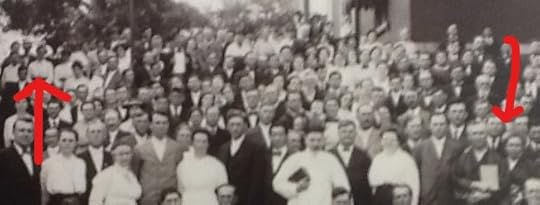 Follow the arrows. Is that Biddy and Oswald in the back left? The Cowmans are in the front right, dressed in kimonos, as was their custom.
 A reread of Mrs. Oswald Chambers explains Biddy met Lettie at the National Holiness Camp Meeting at Denton, Delaware, if nowhere else!
Later friendship: WidowhoodWhile no correspondence between the two women remains, we know some letters were shared.
It seems likely one or both women would have sent condolences on the deaths of Oswald Chambers (1917) and/or Charles Cowman (1924).
Biddy began compiling the readings that make up My Utmost for His Highest in 1924. Lettie first published Streams in the Desert in January 1924.
It’s possible Lettie mailed Biddy a copy. They only printed 3,000 copies at first because they doubted the devotional would sell.
Perhaps Biddy examined the devotional (She always used The Daily Light for her devotional) and realized the potential for creating a devotional herself.
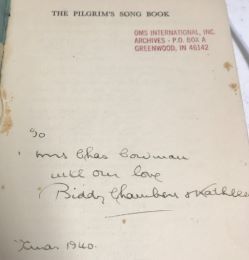 OMS Archives
Biddy already had been editing and releasing versions of Oswald’s talks. If she could edit them even “tighter” into 250-300 word devotionals, she could turn them into a book.
It took her three years, but she did so. My Utmost for His Highest came out in January 1927.
I’m sure she sent a copy to Lettie.
Lettie had several personally inscribed books in her what remains of her library, houses at One Mission Society headquarters.
Meeting each otherWhile I don’t know the exact date Lettie and Biddy met, I know it was in England in the mid-1930s.
If not before.
Among Lettie’s papers, I found Biddy’s address and that of two of her friends.
Miss Ashe and George Swan both lived in Cairo at the time. Lettie sailed with her friend Elizabeth Howells to Egypt in 1937.
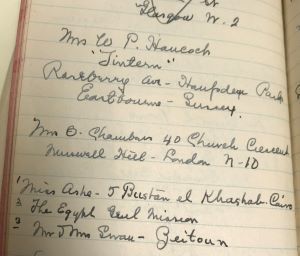
It makes sense the two middle-aged women would have carried letters of introduction to missionaries on the field in Egypt.
In addition, the Oswald Chambers Publications Association made at least one donation (five pounds?) to The Oriental Missionary Society during these years.
Oswald always liked the Cowmans. Lettie and Biddy had a lot in common–the Holiness Movement, ministry, Jesus, widowhood, book writing.
No photo of the two women together, but plenty of indication they had a long friendship.
Those who love My Utmost for His Highest and Streams in the Desert are among the many beneficiaries of two God-led women.
Tweetables
Did Lettie Cowman and Biddy Chambers know each other? Click to Tweet
Did the authors of Streams in the Desert and My Utmost for His Highest know each other? Click to Tweet
The post Friendship: Lettie & Biddy appeared first on Michelle Ule, Author.
April 6, 2021
The Temple Veil and Easter

The tearing of the temple veil has long has been a source of joy for me.
It’s the veil that tore from top to bottom on Good Friday.
Breathtaking news–for all of us.
Women and men can now face God without anything in between.
(Unless there’s sin involved–God can’t look on sin.)
What was the temple veil?The original veil ordered by God was not in a temple.
It was in the desert Tabernacle.
Made of cloth and moveable, the Tabernacle was where the Levitical priests offered sacrifices to God.
 Model of the Tabernacle
(Wikimedia Commons)
There, under God’s directions to Moses, the Levitical priests set the Ark of the Covenant into an area called “the Holy of Holies” or “the Most Holy Place.”
The veil separated the Holy of Holies from the rest of the Tabernacle.
It hid a holy God, who dwelt above the mercy seat on the ark of the covenant, from sinful people on the outside.”
Learn Religions
Sacrifices went on every day before the Tabernacle, but no one could enter the Holy of Holies except the High Priest once a year on the Day of Atonement. (See Leviticus 16).
But this was the Temple VeilWhen Solomon built his temple, he followed the same plan as the Tabernacle–only he built a building.
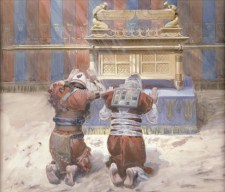 Moses and Aaron before the
 Ark of the Covenant by James Tissot
(Wikimedia Commons)
He used a thick curtain, called the temple veil, to separate that same Holy of Holies from the rest of the temple.
Sacrifices went on, just as at the Tabernacle, only in an elaborate stone building. Solomon spared no expense in building the house of God, using enormous amounts of gold and Lebanese cedarwood.
It sat on the highest point in Jerusalem and its gleaming white walls could be seen for miles.
With the Ark of the Covenant in place, God settled in.
Unfortunately, He didn’t stay.
Owing to the Israelite’s apostasy as described in Ezekiel 10:18, God departed the temple.
The Babylonians destroyed that temple circa 586 BC.
Herod’s TempleBut in Jesus’ day, Herod’s Temple, the second temple, stood on the Temple Mount. Not as glorious as Solomon’s, but still a magnificent building.
Scholars debate the thickness of the veil in Herod’s Temple–some believe it was more like a carpet, the width of a man’s hand.
It must have been thick–no one would have been able to see inside the most Holy Place.
We know it was beautiful.
At Easter dinner, my family got into a discussion about the temple, the Holy of Holies, and the veil.
“The problem was,” one family member said, “there wasn’t anything in the Holy of Holies. God had never come back.”
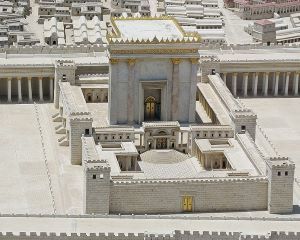 Model of Herod’s temple in Israel Museum
(Wikimedia Commons, Aierly)
God hadn’t returned, despite their many prayers.
Before that temple veil, however, was the altar of incense. That’s where John the Baptist’s father Zacharias, a priest, made an offering when an angel arrived to bring him good news.
Only three priests a day were allowed into that section, and only one priest, alone, could offer the incense on an altar before the temple veil.
But, as my relative observed,
A temple veil description
“The tragedy was they burnt incense every day as their prayers rising up to God. They were begging him to return to the temple–for hundreds of years.
“And when Jesus did come into the temple, first as a baby, then as a twelve-year-old to confound the priests, they didn’t recognize him.
“The very people who had been asking God to return, rejected Him when He did.”
First century Jewish historian Josephus described the Temple veil this way:
What happened on Good Friday?“The Temple had…golden doors of fifty-five cubits altitude and sixteen in breadth; but before these doors there was a veil of equal largeness with the doors.
It was a Babylonian curtain, embroidered with blue, and fine linen, and scarlet, and purple, and of a contexture that was truly wonderful.
Nor was this mixture of colors without its mystical interpretation, but was a kind of image of the universe; for by the scarlet there seemed to be enigmatically signified fire, by the fine flax the earth, by the blue the air, and by the purple the sea….
This curtain had also embroidered upon it all that was mystical in the heavens, excepting that of the twelve signs of the Zodiac, representing living creatures.”
Josephus.org
The Gospel of Mark tells us that sometime after the ninth hour (about 3 o’clock in the afternoon),
Jesus uttered a loud cry and breathed his last.
And the curtain of the temple was torn in two, from top to bottom.”
Mark 15:37-38
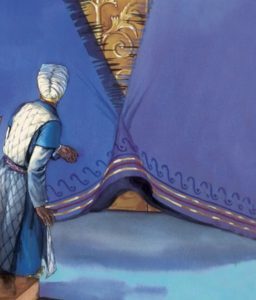 Good News Productions International
 and College Press Publishing.
I don’t know where the Chief Priest was on that day, but imagine his horror when he learned the Temple Veil separating God from the rest of us was torn asunder.
And note the tear direction: from top to bottom.
The temple’s height was 60 feet.
Who do you think?
But what does it really mean?Jesus was the lamb of God, the pascal lamb (it was Passover), the lamb who was slain for all.
He took all the sins of the world upon Himself when he willingly went to the cross that Friday.
As Charles Spurgeon explained many years ago (from Hebrews 6:19-20):
The rending of the veil chiefly meant that the way into the holiest, which was not before made manifest, was now laid open to all believers.
Once in the year the high priest solemnly lifted a corner of this veil with fear and trembling, and with blood and holy incense he passed into the immediate presence of Jehovah; but the tearing of the veil laid open the secret place.
The rent from top to bottom gives ample space for all to enter who are called of God’s grace, to approach the throne, and to commune with the Eternal One.
The Spurgeon Library, “The Rent Veil.”
The excitement of the Temple Veil torn in two, from top to bottom, in a way no mere mortal could do, means I can come to God–when my heart is clean-and know Him.
We don’t need a priest to translate or serve as our go-between.
Jesus accomplished that task.
Jesus, the greatest High Priest, died on my behalf–and yours, too.
A blessed redemption to all.
Tweetables
What happened at Herod’s temple when Jesus died? Click to Tweet
What caused Herod’s temple veil to rip from top to bottom? Click to Tweet
The post The Temple Veil and Easter appeared first on Michelle Ule, Author.
March 30, 2021
A Holy Week Walk

I participated in a Holy Week Walk this year.
In the same spirit as a “Living Nativity” (which we did at Christmas), our church designed a half-hour walk to show four key scenes from Jesus’s life.
Jesus ministered to people during that last week of his life.
We wanted to demonstrate what that looked like–by using four short sketches of key scenes.
We were all amateur actors, but telling the story meant a lot to us–and the people who watched.
Palm SundayWe didn’t bring a donkey or mobs of people.

Instead, at the check-in booth, volunteers gave each visitor a palm branch.
A photo booth, decorated with palms provided a place to get into the rejoicing spirit.
Led by a Biblical-scene-costumed guide carrying a bluetooth speaker, guests began their Holy Week Walk to the first scene: the Last Supper.
Last SupperOurs is a small church and no families had 13 men to volunteer for the dinner.
So, we made do with a three-generation family of five men to represent the dozen who joined Jesus on that night.
A maidservant narrated the five-minute scene, observing what she’d seen:
I’d brought the water and towels, the leader Jesus, used to wash the feet of this dirty band of a dozen men. It surprised me the man they all seemed to honor would get on his knees to remove their sandals and scrub their filthy feet.
Yet, he did that.

As she moved among the men, filling cups, passing food platters, the narration recorded what went through her mind.
She heard the men muttering, saw Judas bolt, and stopped in surprise to hear Jesus talk about the Kingdom of God.
Guests saw all the main action–bread, wine, and prayer.
The maidservant reflected:
Garden of Gethsemane
Jesus didn’t answer any questions I might have asked. He nodded toward his friends, “Come, let us go.”
As I watched them go into the cool night, I felt sad to see them go, but also hopeful. Who could overcome such a man, and at Passover no less?
Was he another Moses?”
Told from St. Peter’s point of view, this scene found Jesus in the Garden of Gethsemane, asking his disciples to pray with him.
When Andrew yawned, a big noisy yawn, Jesus opened his eyes to look at us. “Can you not pray with me for one hour?”
“Of course, we can,” I insisted. But then I yawned and swayed on my knees.
The next thing I knew, Jesus touched my shoulder. We heard a noisy crowd coming our way.
Among that mob, the High Priest’s servant grabbed Jesus.
Peter rose to the occasion and sliced off the servant’s ear.
Jesus healed it and was led away.
Just like people on the Holy Week Walk.
At the CrossThere, a Roman soldier watched a white shrouded body carried off on a stretcher, before addressing the crowd.
Even my hardened soldiers couldn’t imagine what this man had done to justify such torture, and then they ordered us to escort him up to this monstrous place, Golgotha—the Place of a Skull.”
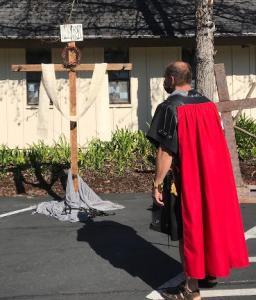
He described the events that dreadful day at Calvary, reflecting on the horror for Jesus’ mother, Mary, watching her son die.
He gestured to the cross as he spoke, and then turned to leave.
Oh, one more thing. The thief on the left heckled that Jesus, shouting and making fun of him. The other one drew himself up and shouted back, ‘We deserve what we get, but this man doesn’t.”
He asked Jesus to remember him when Jesus got to heaven. Jesus told him he’d be with him in heaven tonight.
Tonight. I guess they’re both in heaven right now.
Then the soldier remembered the earthquake right after Jesus said “it is finished.”
“Yeah. That Jesus. Truly, he was the Son of God.”
Holy Week Walk ends at the empty tomb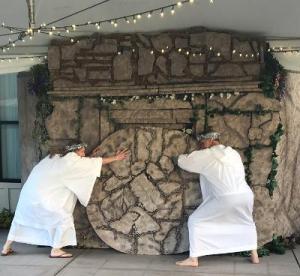
Empty tomb.
My favorite scene involved the two angels at Jesus’s tomb.
Told from the Archangel Michael’s point of view, it described the angels’ joy.
The scene also put the whole story into context:
The entire angelic choir had waited for centuries for this great moment, ever since that dreadful day the first man and the first woman decided they wanted to be like God, rather than to know and love God.
A quick description of how the angels watched God send angels to protect, guide, and lead men and women.
They reminded viewers of that night they rode chariots against the Syrian army and only Elisha saw them.
And the triumphant joy of Jesus’ birth in Bethelehem.
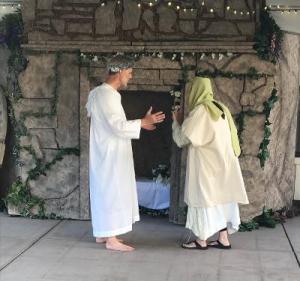
They also sniggered remembering the look on the High Priest’s face when they tore the temple curtain in two.
The rest of the story unfolded as all know: the women came to the tomb and Jesus greeted them.
Honestly, I got choked up every time I watched this scene..
Peter rushed in to look in the empty tomb and shout “hallelujah, He’s alive!”
And then the angels swaggered off to catch the last bit of action: Jesus on the road to Emmaus, explaining all.
What else happened during Holy Week?I’ve written a number of posts on this subject.
Why Raise Lazarus from the Dead?
Jesus’ Ministry During Holy Week
What does it take to Kill Jesus?
Tweetables
How a small church acted a Holy Week Walk. Click to Tweet
What were the main scenes of Jesus’ Holy Week? Click to Tweet
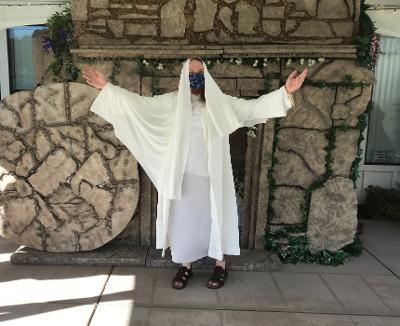 Risen indeed!
St.-Mark-Lutheran-Church-Holy-Week-2021-The-Redemption
Download
Risen indeed!
St.-Mark-Lutheran-Church-Holy-Week-2021-The-Redemption
DownloadThe post A Holy Week Walk appeared first on Michelle Ule, Author.
March 23, 2021
Cities of Refuge and Fiction
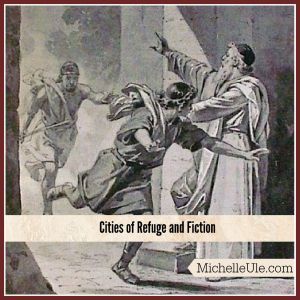
I’ve just finished reading a series of novels called The Cities of Refuge by Connilyn Cossette.
As often happens in my life, I chanced upon these novels just as I began my systematic reading of the Old Testament book of Joshua.
It’s the story of the Israelites crossing the Jordan into the Promised Land after Moses died.
The Old Testament passages describe how the Israelites honored God and then conquered the land God promised them.
Cossette’s novels gave “flesh” to the biblical stories.
What are Cities of Refuge?While I’ve read about them in past readings of Joshua, I didn’t quite understand how they worked.
The biblical God is a God of justice and mercy.
God included a provision for unintentional crimes in the Law he gave Moses.
Particularly for murder verses manslaughter.
In Numbers 35: 9-12:
And the Lord spoke to Moses, saying, “Speak to the people of Israel and say to them, When you cross the Jordan into the land of Canaan, then you shall select cities to be cities of refuge for you, that the manslayer who kills any person without intent may flee there.
“The cities shall be for you a refuge from the avenger, that the manslayer may not die until he stands before the congregation for judgment.”
Numbers 35: 9-12 ESV
God ordered Joshua to set up six cities of refuge, specifically located throughout the country. This way, any “manslayer” could run to the city for justice.
Levitical priests lived in the cities. (The tribe of Levi was the only one of the twelve tribes not to receive land. Instead, they received the tribe’s tithes to live on).
They were responsible to enact justice in Kedesh, Golan, Ramoth, Shechem, Bezer, and Hebron.
Fleeing to a City of RefgueWhen someone killed another person, the dead persons’ relatives could exact revenge, according to Genesis 9:6.
“Whoever sheds the blood of man, by man shall his blood be shed, for God made man in his own image.
Genesis 9:6 ESV
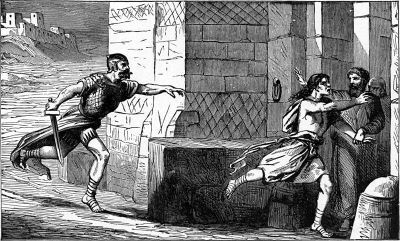 Blood avenger after a manslayer (Wikimedia Commons)
Bible Pictures and What They Teach Us by Charles Foster, 1897
If the opportunity arose, a victim’s kin could kill the victim’s slayer on the spot, no questions asked. (They called the relative intending to slay the killer an “avenger of the blood.”)
But, that was not merciful or just. Sometimes the death was an accident.
The killer could run to a city of refuge, where the Levites kept them safe until they held a trial.
Once he heard all the evidence, the Levite judge determined the manslayer’s guilt and if execution should take place.
An innocent manslayer would recognize their culpability in the death and ask for forgiveness.
If the judge ruled the death an accident, the unintentional killer lived out his/her life in the city of refuge.
The forgiven person, however, lived with consequences.
They could never live anywhere but in the city of refuge. They could not pass beyond a designated distance outside the city walls.
The “Mishkan” Tabernacle also plays a role in these stories. Model in Israel’s Timna Park
(Wikimedia Commons)
If they left the safety “zone,” the family member could kill them without fear of judgment.
What I didn’t realize until I read Cossette’s novels, was another way for the refugee to be released.
If the High Priest of Israel dies, all sentences are commuted and the forgiven person can return to normal life in his hometown. The avenger of blood had no legal right to harm him.
According to the Lutheran Study Bible discussing Joshua 20:6:
What did that actually look like?
The death of the high priest, intercessor for all Israel, evidently restored harmony and signaled the safe release of the manslayer to his former hometown.
Death of the Old Testament high priest anticipated the death of the great High Priest, Jesus Christ, whose blood makes full atonement for all.
One of the reasons we read historical fiction is to get a sense of social life in the past.
This is where Connilyn Cossette’s four excellent novels provide insight.
Her Cities of Refuge series follows a family dynasty through different variations on the manslayer and blood avenger themes.
(The novels are historical romance, too).
The first novel, A Light on the Hill, tells the story of a woman who accidentally poisoned twin teenagers.
With the help of her family, she immediately begins running to the nearest city of refuge, with the “blood avenger” and companions on her heels.
The story helps us understand the desperation of someone who never intended harm.
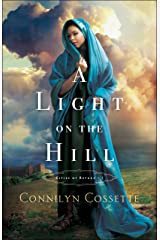
Shelter of the Most High provides insight into what it means to live out a life sentence, along with your family, in a city.
Until the Mountains Fall is an Old Testament version of the Prodigal Son when a Levite’s daughter rejects a Levirate marriage with her late husband’s brother.
(The story also examines the implications of God’s provision for a childless widow).
Like Flames in the Night continues following the book of Joshua to describe what happened later. It also enables us to see life after the family can leave the city.
(I’ll add that her three novels about leaving Egypt, and the series she’s now writing about the end of Judges, are also excellent).
How do we know to trust the author?That is always the question when reading historical fiction about events you know, or that are close to your heart.
It’s particularly true with biblical fiction.
Several times in the course of reading Cossette’s books, I checked Bible commentaries and passages to ensure what I read is what happened.
They are, however, works of fiction.
In this context, Cossette provided imagination to tell an authentic (and often heart-pounding) story. But, it all seemed to fit well into what I’ve read in the Bible.
Is it Gospel truth?
Of course not.
But, Cossette’s novels provided a widening of my understanding–and that, for me, is valuable.
We should all do our own research, anyway.
What do the cities of refuge foreshadow?We always should be looking for the foreshadowing and parallels in the Bible.
I liked what Compelling Truth said:
Cities of refuge foreshadowed God’s plan of salvation in Jesus Christ. As we recognize our guilt, we flee to Jesus as a refuge.
As Psalm 34:22 says, “The LORD redeems the life of His servants; none of those who take refuge in Him will be condemned.”
Turning to God and taking refuge in Him for forgiveness of our sins is what gives us freedom from the threat of eternal death.
Second Corinthians 5:19 and 21 say, “In Christ God was reconciling the world to himself, not counting their trespasses against them… so that in him we might become the righteousness of God.”
Jesus’s work on the cross allows us to be protected from the threat of eternal death if we take refuge in Him.
The cities of refuge in the Old Testament are a beautiful illustration of God’s desire to save those who recognize their own sin.
Compelling Truth
In the end, our city of refuge, always, is Jesus.
Thanks be to God!
Tweetables
Cities of refuge and fiction. A wonderful tool! Click to Tweet
God’s mercy: refuges in the Old Testament & New Click to Tweet
Reading Connilyn Cossette’s fiction for biblical insight. Click to Tweet
The post Cities of Refuge and Fiction appeared first on Michelle Ule, Author.
March 16, 2021
Nakada’s Ministry in the 21st Century (Part 3)
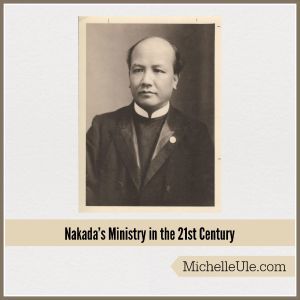
Juji Nakada’s ministry reaches, even now, into the 21st Century.
Even I have a personal Juji Nakada story.
It took place just a few years ago while I sat at this very computer terminal, typing away.
“John,” sent an email asking for information about Nakada.
What a random question out of nowhere, I thought.
But as I read deeper, my eyes widened.
A book he purchased at a British thrift store (charity shop), opened the door to a conversation.
Nakada and John
Hello Michelle,
Sorry for the out of the blue message. I was looking up a name on the internet and came across a page you had written about O. Chambers…and it had tagged the name I was looking for…which was ‘JUJI NAKADA’.
I often receive random messages from people through my website.
Many of them are friendly and interesting, or they have information I seek. (Keep those emails coming!)
This was the first time, however, anyone contacted me about Juji Nakada.
“John” explained he’d purchased a small pocket Bible, “over 100 years old.”
Inside the cover, was written a strange scribble in Ink…which I think is Japanese
…and next to it says Juji Nakada, Holiness Bible School, Yodobashi, Tokio..(spelt like that), Japan.”
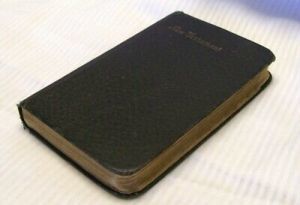 A pocket Bible fits in a pocket.
He wondered who this Japanese man was, and turned to Google.
There, he learned Juji was in the UK around 1900, but along with Nakada’s scribbling, he found:
What did I know about Juji Nakada?
Another name inside the cover…a page in from this name, as if written later.. is the name of a young girl…saying the gift is to her from her parents…with Love dated March 22nd 1903.
I just thought you may know a bit about this man and wondered if you could give me any info?”
This email came while I wrote my books about Oswald and Biddy Chambers. I knew about OC and Nakada’s ministry and friendship, so I wrote back with what information I had.
(You can learn a lot about their friendship in David McCasland’s wonderful biography, Oswald Chambers: Abandoned to God.)
But as you saw in the previous posts, here and here, Nakada was a force to be reckoned within the Kingdom of God!
“John” wrote back to thank me and share something of his personal spiritual story. He had endured a number of challenges and was trying to find a way to God.
That’s why he picked up that old Bible.
But, like many, he started reading at the beginning and without context, those early books of the Bible can challenge people’s ability to see the God many of us know.
We exchanged a few more emails and I suggested he read, instead, John’s Gospel in the New Testament
Nakada’s Ministry to JohnGod gave John a sign!
As soon as you told me about John’s Gospel, I saw it as a sign that I should read it right away.
My local church is open each morning, so I went down and sat alone and began to read ‘John’… (Not 1John)…and having seen a film recently called ‘the son of God’, I began to realize that this was what the film was based around. Jesus’s journey to Jerusalem and the miracles…The last supper and crucifixion.”
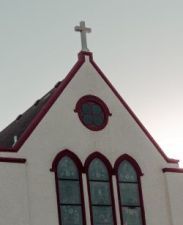
He read all the way to John 17:9 before he became restless.
He got up to wander around the neighborhood church.
I was looking at some writing in huge gold-colored carving that was high in the eaves of the ceiling and wondered what book in the Bible it came from, as it didn’t say.
I went back and sat down…and would you believe it, it was John 17 VERSE 10!!!! Is that crazy or what? ‘All mine are thine, and thine are mine; and I am glorified in them’. The opposite side of the ceiling was John 17:24.”
I love stories like these.
Seeing God, almost teasing him, encouraged John’s fledgling faith.
The OMS connectionI suggested John send an email to the (now) One Mission Society, which he did.
The person he contacted provided more information about Nakada’s ministry and sent him to another man who had more stories about Nakada.
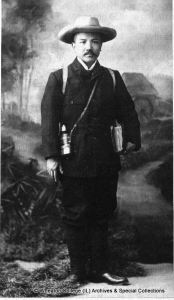 Juji Nakada
(Wheaton College Special Collections)
John marveled at the exchanges.
“Such amazing stories all from one man, one book. I would love to have met him.”
I lost track of John after that, but I love to think of how Juji Nakada’s ministry continued for 80 years after his death.
The D. L. Moody of Japan, the founder of The Oriental Missionary Society, Bishop of the Japan Holiness Church, and the editor and primary writer for Tongues of Fire, was still preaching with words.
It reminds me of a quote from the British League of Prayer founder Reader Harris. Oswald Chambers loved this quote and it fits well with this story.
“The most lasting of all preaching is with the pen.”
Thanks be to God for Juji Nakada’s ministry and evangelistic reach into the 21st century!
Tweetables
A thrift shop Bible and a Juji Nakada connection. Click to Tweet
100 years of preaching through Juji Nakada’s Bible. Click to Tweet
The post Nakada’s Ministry in the 21st Century (Part 3) appeared first on Michelle Ule, Author.
March 9, 2021
Juji Nakada and the OMS (Part 2)
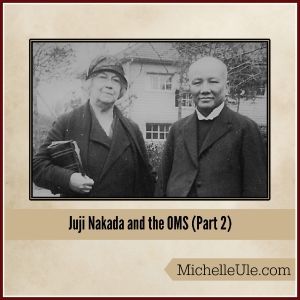
Juji Nakada was one of the founders of the Oriental Missionary Society (OMS).
Indeed, he probably could be described as the instigator.
Friendship with the other foundersEven as he attended the Moody Bible Institute in 1897, Juji dreamed of setting up an evangelistic ministry in Japan.
He, Ernest Kilbourne, and Charles Cowman discussed and prayed about the idea together.
It excited them all and a few years later the Cowmans both “got a Word from God,” they should go to Japan as missionaries. Kilbourne and his family followed a year later.
Juji’s role in beginning the Tokyo ministryA beaming Juji met the boat when the Cowmans arrived on Thursday, February 21, 1901!
Three days later, they gathered at the First Methodist Episcopal Church in Tokyo, where Juji preached the sermon.
The westerners met the entire Nakada family that weekend as well.
Monday morning, they began the search for a suitable building for a Gospel Hall and a Bible school.
The school began as soon as possible with both men and women studying the Bible.
Nakada gave up a salary and trusted God for his family’s financial support. The ministry had begun.
Preaching at the Central Gospel Mission Hall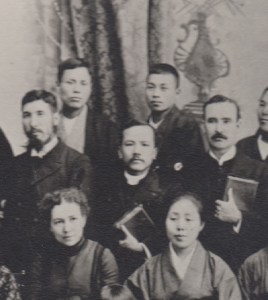 Tetsusaburo Saso, Nakada,
 Cowman, center.
Lettie & Katusko in front (OMS Archives)
This was an evangelizing organization. Central to it all was Nakada’s dynamic preaching at the Central Gospel Mission Hall.
The Bible Training Institute students studied the Scriptures every morning and fanned out into the community to evangelize every afternoon.
Along with the Cowmans, they handed out tracts everywhere, inviting people to the mission hall every night at 7.
Juji Nakada’s dynamic preaching inspired many. Afterward, the students and Cowman remained to the end of the evenings to answer questions.
The first time Juji found an English-speaking Japanese man in the crowd, he directed him to Charles Cowman. An hour later, the man gave his life to Christ.
The Central Gospel Mission Hall sponsored an evangelist, frequently Juji, for 3000 straight nights.
Juji Nakada: Preaching and travelingOnce the ministry was established as the Oriental Missionary Society (OMS), Nakada continued as an evangelist.
During the Russo-Sino War in 1904-1905, Japanese soldiers fought the Russians in both Manchuria and on the Korean peninsula.
Juji Nakada traveled through Korea during the war to encourage Japanese soldiers and to preach the Gospel.
While riding on horseback one day, Nakada heard a Japanese workman shout, “Aren’t you from the Central Gospel Mission in Tokyo?”
The man had attended services when he lived in Tokyo. Juji stopped to fellowship with him.
But while in Korea, he preached to local groups as well. The result?
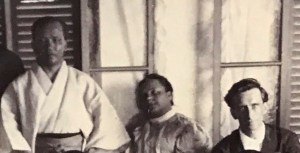 Nakada, Julia Kilbourne, OC (OMS Archives)
In 1905, three Korean students arrived to study at the Bible Training Institute–and from them ultimately came the Korea Holiness Church. (One of the largest denominations in 2021 Korea).
Nakada traveled to Great Britain and the United States to raise funds in 1906. In England, he met Oswald Chambers. The two enjoyed each other’s company, and Juji Nakada invited him to visit the US and then Japan.
I wrote about their trip here.
He had plenty of evangelizing and preaching to do!
The Great Village CampaignThis fit right up Juji Nakada’s alley–sharing the gospel all over Japan.
Between 1912 and 1919, the OMS sponsored a massive Gospel literature campaign. Students, evangelists, and eventually Americans, visited every home in Japan to leave a tract and Gospel excerpts.
It took everyone to engage in the effort, and Nakada certainly helped train the men.
As the result of the campaign, the number of OMS-sponsored churches grew. By the the early-1920s, OMS declared the the Japan Holiness Church independent of the ministry.
The OMS shifted their ministry’s focus to Korea and China.
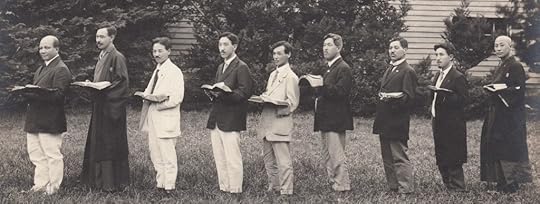 Juji Nakada and student evangelists during the Great Village campaign. (OMS Archives)Bishop of the Japan Holiness Church
Juji Nakada’s heart remained in Japan and he became the first and head bishop of the Japan Holiness Church.
(The organization’s first name was the Oriental Missionary Holiness Church.)
Nakada wrote,
as the name indicates, a missionary society. Our purpose is simple: to propagate the complete Gospel, that is, the Foursquare Gospel (salvation, holiness, the Second Coming of Christ, and healing) all over Japan”
Jews in the Japanese Mind: The History and Uses of a Cultural Stereotype
The church remained affiliated with the OMS, though it was now self-supporting. (In the beginning, the church consisted of forty-six churches and fifty ministers.)
[image error]That’s Juji on the right (OMS archives)Nakada continued to write and edit his Tongues of Fire magazine, continued speaking in evangelization meetings whenever they occurred and kept in touch with his former colleagues.
During this time, Juji Nakada became passionate about Jesus’ second coming (particularly after reading W. E. Blackstone‘s Jesus is Coming).
His evangelism efforts, already profound, increased.
He also lost his first wife and remarried. His oldest child, Ugo, wrote hymns in Japanese.
Heartbreak at the endCharles and Lettie Cowman returned to the United States for good in 1918. While Ernest Kilbourne remained, he was very much involved in the practical aspects of the OMS.
Juji Nakada had a new church body to oversee. He continued preaching and saw large growth in the Japanese Holiness churches.
The 1924 Tokyo earthquake, which leveled most of the city, became in Nakada’s mind,
“a judgement on the nation like Sodom and Gomorrah. He proclaimed this message boldly and called upon people to repent of their sins. He also felt that the earthquake signaled the beginning of the end of the world.”
John Merwin dissertation, The History of the Oriental Missionary Society
This added even more impetus to the need to evangelize Japan. The Bishop focused his church organization to encourage evangelists. He also began to preach on the radio–a new concept for Japan.
Merwin observed much of the church growth during these years came from the inspiring Juji Nakada.
But during the heightened political events in his country, he also became engaged in an effort to marry Christianity with Japanese culture. According to David Goodman, that led Juji to see “Japan’s national salvation as inextricably intertwined with the national redemption of the Jewish people.”
Juji Nakada’s focus
Became his obsession with Japan Israelism–a strange teaching which held that the sole task of the church was to hasten the return of Christ by praying for the Jews’ restoration to their homeland.”
No Guarantee But God by Edward and Esther Erny
This caused a divide between the Oriental Missionary Society proper with Juji Nakada.
Despite many attempts to bridge the gap in their understanding, the OMS relationship with Nakada was never resolved. It broke Lettie Cowman’s heart.
Juji Nakada and Lettie Cowman: the final visitLettie Cowman traveled to Japan to see Juji Nakada twice in the last ten years of his life. Despite their love and friendship, they could never resolve their differences.
She made one last effort in 1939.
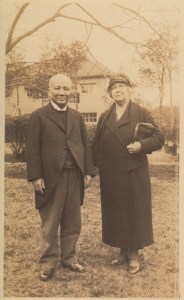 Juji and Lettie 1939 Tokyo
 (OMS Archives)
They spent a lovely evening together on the OMS compound, remembering old times and all the good God did through them and OMS. As she got up to leave, Juji asked her to return and spend time in her old home.
Lettie agreed. She was headed to Korea for an OMS board of trustees meeting.
Two weeks later, only a few days after the death of Juji’s second wife, Lettie received a wire.
On the fifteen anniversary of Charles Cowman’s death, the sixty-nine year old Juji Nakada died.
A sobered Lettie wrote:
How strange it is that these two, the founder and co-founder, of The Oriental Missionary Society should have gone to the glory land on the exact date.
It seemed to me as if dear Brother Nakada went to spend the anniversary of Mr. Cowman’s translation with him and the heavenly city was so beautiful and attractive that he never wished to return again into the land of pain and suffering.
The Oriental Missionary Standard, December 1939, p. 12
In the events leading up to World War II in Japan, many Christian pastors were arrested and tortured.
Those of the Japan Holiness Church sustained a great deal of pain and suffering, but they never broke.
Juji Nakada had taught them well to love their Savior.
Nakada’s Ministry in the 21st Century Part 3
Tweetables
The Japanese founder of the Oriental Missionary Society. Click to Tweet
The D L Moody of Japan’s ministry in his home country. Click to Tweet
The post Juji Nakada and the OMS (Part 2) appeared first on Michelle Ule, Author.
March 2, 2021
Who was Juji Nakada? Part 1

Juji Nakada served as an influential missionary in Japan and Korea during the first half of the twentieth century.
I first learned of him while researching Oswald and Biddy Chambers.
I’ve written about his friendship with Chambers here.
He turns up in several of my posts because he was an extraordinary man, used by God.
But who was he?
Part 1 describes his younger years serving God.
Part 2 (next week) describes his role as a founder of the Oriental Missionary Society.
Park 3 (the following week) describes his influence into the 21st century–through a surprised me.
Where did Juji come from?The son of a minor samurai, Juji Nakada was born October 27, 1870, in Hirosaki, Japan. The small town is in a not-densely populated part of the island nation.
As he wrote:
I was born in a Samurai family, I confess I loved my country more than God.
The Samurai are the ancient military class of Japan. . . . Their object was to live and die for their country.
Electric Messages April 1904
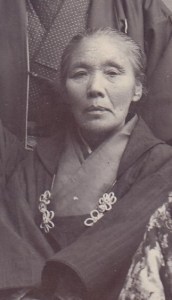 Chiya Nakada,
 (OMS Archives)
More significantly, Juji’s mother Chiya was an early Methodist convert in nineteenth-century Japan.
After her difficult husband’s early death when Juji was four years old, Mrs. Nakada raised her two sons in the Methodist Church.
Her younger son was particularly good at getting into mischief. As he grew into a strong stocky teenager, he focused on judo expertise.
Her older son Kyukichi became a Methodist minister.
Juji admired his older brother and eventually his heart changed.
When I was sanctified, God delivered me from all things, even from patriotism, and I have always felt that to love Him [God] supremely and even die for His sake is a great privilege.
I feel that the spirit in the blood of the Samurai is the kind of a spirit we ought to have for God . . . having but one object in life, to live and die for our Lord.
Electric Messages April 1904
Baptized at seventeen, Juji had a deep, jolly laugh which drew people, despite his sometimes austere appearance. He loved his mother and brother and often helped with church work.
EducationEncouraged by the family’s pastor, Juji began studying English literature at the age of 18, but then switched to theology. He didn’t like the higher criticism he heard in the classes and eventually dropped out.
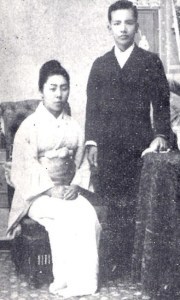 Juji & Katusko wedding 1894
(Wikimedia commons)
But the family pastor recognized Juji’s skills as an evangelist and arranged a probationary preacher’s license in the Methodist Church.
Juji preached the Gospel in northern Japanese islands with great success.
He married a lovely young woman named Katusko and fathered a child.
One day he heard of American D. L. Moody‘s skills and spiritual power. The young Japanese evangelist wrote to Moody asking how to receive such power.
Moody invited him to Chicago to study at the Moody Bible Institute. Off he went, “in search of the baptism of the Holy Spirit and more effective evangelism methods,” according to historian John Merwin.
He arrived in Chicago in early 1897 where he met several important people who changed his life.
FriendshipsThe most significant meeting occurred within days of Nakada’s arrival in Chicago.
Charles and Lettie Cowman noticed the Japanese man with a large black Bible in the pew before them at Moody’s Grace Memorial Church.
Part-time students themselves at the Moody Bible Institute, the Cowmans befriended the cheerful man.
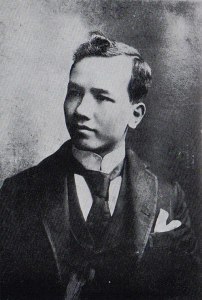 Headed to America 1897
(Wikimedia Commons)
They introduced Nakada to Charles’ telegraphy colleague, Ernest Kilbourne. Together, the men brought Nakada to meet with the men’s Telegraphers’ Mission Band.
The Cowmans loaned Nakada books, eventually paid some of his expenses, and encouraged him during his time in America.
Nakada left Chicago in April 1898 as a member of the Pentecostal Holiness League.
Wanting to visit other churches associated with the Holiness Movement, he arranged to travel home by way of the eastern United States and England.
He had little, if any, money so he worked his way across the ocean on a cattle boat.
In England he met League of Prayer President Reader Harris. As a result of their acquaintance, Nakada befriended Oswald Chambers.
The young Juji in JapanAfter a nearly two year absence, Juji Nakada returned to his impoverished family and ministry in Japan.
Once home, he began preaching the Gospel. His words now contained the power of the Holy Spirit. Many listeners became Christians as a result.
Within months, Nakada founded a Holiness magazine, Tongues of Fire. With friendly Holiness evangelists and ministers, he also formed the Holiness Friends Society.
Nakada’s fame spread as the magazine became popular throughout Japan. He received invitations to speak at large rallies and churches. Many began referring to him as the “D.L. Moody of Japan.”
Nakada corresponded with his friends around the world and received financial backing from the Cowmans, Kilbournes,, and the Telegrapher’s Mission Band.
They were all interested in beginning a Bible school and preaching ministry in Japan. As the turn of the century arrived, they recognized God was on the move.
Juji Nakada was in the middle of it all.
Tweetables
Who was Juji Nakada? Click to Tweet
Where did the D. L. Moody of Japan come from? Click to Tweet
The post Who was Juji Nakada? Part 1 appeared first on Michelle Ule, Author.
February 23, 2021
A Year in the Old Testament
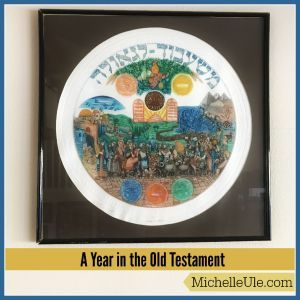
I spent much of last year in the Old Testament.
Other than checking on things, and listening to the entire Gospel of Luke (perfect for Advent), I’ve wallowed in the pre-Jesus part of the Bible.
I’ve taught Bible study for many years.
Somehow, though, I’d missed a lot of important truths in the Old Testament.
And the parallelism between the Old and New Testaments?
I see it everywhere now!
Why did I miss Old Testament facts?An excellent question for someone who has been reading the Bible diligently since she was 15.
Some of it had to do with the Bibles I’ve read over the years.
I generally change translations every decade or so, and read the Scriptures paying attention to nuanced differences, particularly in language.
For the last 20 years, I’ve been reading either a Life Application Bible (NKJV) or a Lutheran Study Bible (ESV translation).
I’ve loved those editions because of all the footnotes (BOB notes–“bottom of the Bible” notes) that explain everything.
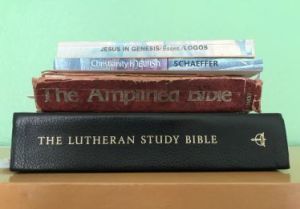
Cross-references abound.
But, apparently, I still had trouble grasping the fullness of the Old Testament stories and/or the pointing to the past, as well as the future in Scripture.
But last year that all changed.
How did I read the Old Testament differently?I listened instead.
You can read about my appreciation for the Bible Project. When COVID shelter-in-place began, we watched the entire drawing/explanation of the Bible over five nights.
Somehow, this Bachelor of Arts in English Literature had not seen all those parallelisms before.
The Scriptures came alive in a new way. I’m looking for the parallels, now. In the past, I’d apparently only registered them and moved along.
Better, though, were the many insomnia-inspired nights when I listened to Calvary Chapel Santa Barbara Teaching Pastor David Guzik teach through books of the Bible.
(Calvary Chapel pastors traditionally start at Genesis and preach chapter by chapter all the way through the Bible. When they finish Revelation, they return to Genesis).
A lot of Guzik’s teachings are recordings of his Wednesday night Bible classes. I usually could listen to one before I fell asleep.
The teacher takes classes.After nearly 30 straight years of Bible study teaching/ leading/ facilitating, I took classes this year.
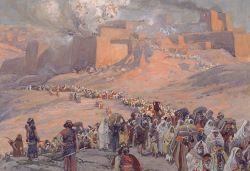 In reality, the prisoners were naked
 and led by hooks in their lips.
Painting by James Tissot
ORBIS Ministries started class in all their teaching modules by examining Scripture passages. (They explained what they taught came out of Scripture, rather than being read into Scripture).
Since many points came out of the Old Testament, particularly about prophets, I reacquainted myself with the books of Samuel and Kings.
It soon became clear, however, that Guzik’s teaching and Ken Fish’s exegesis explained the Scriptures in a way I hadn’t seen before.
Fascinating.
The scriptures come alive!All Bible students know the 2 Timothy 3:16-17 passage:
All Scripture is breathed out by God and profitable for teaching, for reproof, for correction, and for training in righteousness, that the man [and woman] of God may be complete, equipped for every good work.”
2 Timothy 3:16-17 (ESV)
Most of us who read the Bible have experienced the shock of what is seemingly a “new verse we’ve never seen before,” spring up to surprise us with biblical truth.
That’s because the Scriptures are alive. Each time we open the Bible we’re new–we bring our current life into the eternal book.
When we read verses pertinent to our experience at that moment, the verses shout their truth.
The Bible doesn’t change. Our experiences and lives cause us to approach the Scriptures with different ideas.
Last year, I listened and read the Old Testament with different ears.
God awarded me keener insight and understanding as a result.
Why the Old Testament and not the new?It’s always easier to read the New Testament because it revolves around Jesus.
The Gospels are stories. The Epistles explain how to live as a Christ-follower.
Jesus lived in our historic time–our Western calendar begins at His birth. We can grasp the history and events better. They’re more approachable time-wise. Many of us in the west learned something about Roman history in school.
But the Bible is a Middle Eastern book and can be tricky to fully comprehend when we read it with western eyes.
The Old Testament can seem confusing, particularly the books of the prophets, when we try to understand what happened all those years ago. Not to mention why.
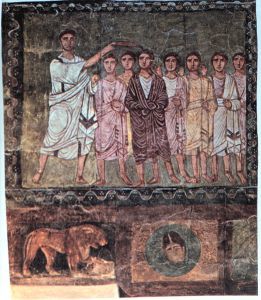 Samuel annoints David (Wikimedia Commons)
But the Old Testament, like the New, is about the Messiah.
You cannot fully understand who Jesus is/was and why He came without a grounding in the Old Testament.
I’ve known that since I read Jesus in Genesis, decades ago.
Edith Schaeffer pointed back to the same ideas in Christianity is Jewish.
You can’t adequately understand much of the New Testament, particularly the symbolism, without a grounding in the Old.
I’ve read the Bible for years (Like Calvary Chapel teaches, Genesis to Revelation). But I didn’t always catch some of the nuances–and thus missed important parallelisms and their implications to my faith.
Cross-referencing two teachersIsaiah 1:18 reminds us, “Come now, let us reason together, says the Lord.”
We can’t simply take passages of Scripture at random. They need to be cross-checked to other passages of the Bible so we can ensure we’re understanding it correctly.
Since I was studying new ideas with Ken Fish of ORBIS, and hearing new teaching from David Guzik of Enduring Word, I cross-referenced them.
Did they agree with each other?
Guzik’s explanation of the book of Jeremiah, helped me put Fish’s teaching on prophecy into context.
It was very helpful.
They may not have agreed with their interpretation of specific passages, but they were close enough to give me confidence in both teachers.
And then, of course, I always had the benefit of the Lutheran Study Bible’s bottom of the Bible notes (BOB).
Why does everything return to Exodus?Isn’t it interesting when many spiritual elements in your life point to the same Bible passages?
(See “How I Recognize God’s Voice.”)
 St. Mark Lutheran Church VBS 2020 logo
That happened in the summer.
While I listened to Guzik’s Exodus teaching, Fish talked about Moses, and then the VBS director asked me to write a play about Escaping from Egypt.
Scripture came alive–I saw the story differently. My audio VBS play was richer because of what I had learned from my teachers about the Old Testament.
The value of the Old Testament for guidance.While researching the life of Lettie Cowman, long-time president of the Oriental Missionary Society (1928-1949), I learned of her love for the Old Testament and how it affected the ministry.
When Lettie felt God suggesting a change in the ministry, according to long-time friend and associate, Esther Erny,
She would go away, spend time in prayer, and she’d come out with some isolated portion of scripture, often somewhere in the Old Testament, feeling God had given her that word for that advance. And then, having had that, she had faith to believe God was calling, and she would accept and make plans to go forth.
OMS Archives, “Who was Mrs. Cowman?” by Esther Erny
Lettie Cowman knew the Bible backward and forwards, spent long hours studying it, and often found her guidance in the pages of the Old Testament.
It was the Word of God, and she went with it.
Those words Lettie read in the Old Testament changed the lives of many people, for the good. They directed people to Jesus.
That’s why reading and learning and wallowing in the Old Testament for a year is so valuable.
Try it.
Tweetables
The value of a year in the Old Testament. Click to Tweet
Why should Christians study the Old Testament and how? Click to Tweet
The importance of studying the Old Testament. Click to Tweet
The post A Year in the Old Testament appeared first on Michelle Ule, Author.