Michelle Ule's Blog, page 23
September 14, 2021
Alert! And How Not to Live that Way
Alert!
Warning!

Screams from the phone: Be prepared!
What’s the smoke index today?
Red flag warning!
Was that an earthquake?
Alert!
That’s how many of us in Northern California live these days.
And if all that wasn’t bad enough, while traveling to New England recently, both my husband’s phone and mine went wild.
The reason?
Hurricane coming. Prepare! You have 36 hours. Leave now if you can!
How’s a person supposed to live while on high alert at all times?
Six tips on how to live when living on high alert.1. Prepare as best as you canYou can only do what you can do.
(See How to Prepare Your Life for a Fire).
Since we live in a high fire area, we’ve followed all the preparation directions sent from our county.
This summer we even took out our lawn because of the drought.
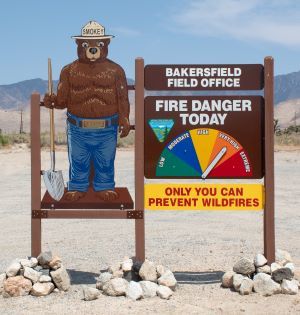 Photo by Brian Wangenheim (Unsplash)
When we returned from last September’s week-long evacuation (fire), I dumped the boxes of photo albums in the living room.
“I’m not putting any of these away until they’re scanned. I can’t keep hauling photo albums everywhere.”
They sat there until June when my Adorable granddaughters learned how to scan.
We’re almost done now.
We’ve done the best we can and the photos, finances, writing, and copies of all important documents now survive in the cloud.
I, personally, don’t let my car get lower than a half-tank of gas. We just never know.
2. Put alert technology to work–and then let it do its job.My area in Northern California lost 5200 homes in one dreadful 2017 night.
The technology that night was primitive. I scoured the Internet hunting for information and found little.
Friends’ Facebook posts are what convinced us to flee.
Government, fire, police, and county resources are much improved, now.
So, we’ve signed up for Nixle alerts, phone alerts, text alerts, and I don’t fret about getting an alert anymore.
They’ll sound.
Besides, my children and friends call and text me when they see a fire near. 
We also now own a small generator (that can run the refrigerator and two electrical outlets)–and I have a video on my phone of my husband explaining the simple way to set it up and run.
When the air quality deteriorates, I close the windows and turn on the air filter.
We have plenty of batteries, flashlights, a local radio, a backup battery recharger, lantern, and even a small solar recharger (which doesn’t work well). Fortunately, we have natural gas so we can cook and take hot showers.
Oh, and plenty of friends and relatives who will take us in during an emergency.
3. Don’t live on the InternetI do keep track of issues on the local Firestorm Update Facebook page, but not obsessively.
Once a day is fine.
 Smoke across the street!
We do monitor air quality (on the phone’s weather page, or on an app), and if we feel threatened, check out the ALERT Wildfire live cameras now available.
But that’s it. I don’t need to feed on others’ agitated alert!
4. Examine your values and declutterWhen you have to flee in the night (twice), possessions can weigh you down.
I’ve spent the last four years contemplating what is really important for me to have (photos, writing), and what isn’t all that important (furniture, CDs, books).
While I’d hate to lose artwork and my grandmother’s 120-year-old organ, I can’t carry it all in the car.
(I know which small art items I’ll pack).
After watching our friends deal with the grief of losing so much, we’ve been decluttering now.
(If you need help, see my friend Kathi Lipp’s work).
When you get rid of things that don’t “spark joy,” it’s easier to see what’s really important to you.
Decluttering and personal value assessment make it easier to decide what to take or what to leave.
Making that decision before you have to, relieves anxiety when you find yourself in an emergency situation.
(By the way, take photos of every room in your house, inside the closets, cupboards, and drawers. Photograph everything in your yard and in your garage. Post those photos in the cloud, but also copy them onto a memory stick. If the worst happens, you’ll need to document all your possessions.)
5. Make a backup plan and/or consider movingDuring my 20 years as a Navy wife, we always had “a plan.” Like many military families, we needed to know what we would do if the worst things happened.
Knowing ahead of time, meant that while none of our worries ever came to pass, I didn’t have to fret about it.
We’ve already discussed what will happen if our house burns down. We know what we will do.
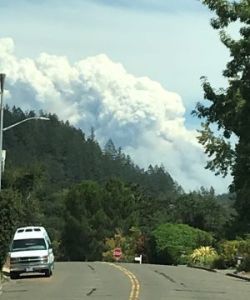 Sobering to see just up the street!
We even have an idea of where we would move–if that became something we should do.
Our family talks freely about these ideas–should we move?
So far, the answer is no.
But, we have a backup plan, just in case.
Besides, where would we move? Every place has challenges and we’ve gotten used to wildfires, drought, electrical outages, earthquakes, and smoke.
(In 2017, we got three of those in one night!)
While we may not want to deal with those issues, we know what to do.
(Evacuation plans in place, water conservation in place, alas, a generator, and an air filter).
6. Choose peace with God–aka, prayWe believe that this home in this part of the world is where God wants us to be–right now.
Since we know that the only real peace comes from being in the center of God’s will for our lives, we’re okay.
That doesn’t mean I don’t feel my heart scramble to hysteria when an alert sounds on the phone.
I still grieve for those who I’ve lost because of fires.
The fires many endured have induced trauma. Christian inner healing helped.
Finding peace with God and praying, help center my soul on what is important.
Prayer calms my heart and reminds my mind that we have a plan and know how to execute it if needed.
Thanks be to God.
Final–and Important–NoteThere’s nothing wrong with being afraid.
But, when fear dominates your life and it’s hard to control your anxiety, it’s time to find help.
As a Christian, I recommend a Christian counselor.
If that doesn’t work for you, find someone qualified to work with your greatest need–especially trauma.
Where I live, counselors are readily available, many of whom have gone through the same fire-riddled trauma.
Don’t wait too long. There’s help available. You’re not alone. You don’t need to suffer alone. Get help.
Tweetables
How not to remain on high alert in fire country. Click to Tweet
6 steps to help calm anxiety when living in fire country. Click to Tweet
The post Alert! And How Not to Live that Way appeared first on Michelle Ule, Author.


September 7, 2021
An Unexpected Intercessor in Action

An intercessor doesn’t always expect to get involved.
There they are, going about their business, perhaps merely reading a book, when they are called into action.
But it can be surprising, all the same.
When prayer is part of your life, it’s not a big deal.
How about an example?I recently caught a flight in a surprising set of circumstances.
My original plans had me flying out of one city, but a hurricane sent me elsewhere.
The airline kindly accommodated my change of plans, and I boarded a new flight 400 miles away.
As always, I asked God to go before me and I looked forward to what would come.
You never know how He will answer a prayer like that.
But, it’s always interesting.
Fly away.
The first twistI learned a long time ago not to be worried about flying.
That doesn’t mean I’m not paying attention.
I’m just not worrying about a sudden crash and instant death, anymore.
Certainly, I pray when we take off–and sometimes when we land.
But, I’d never been on a flight that left the gate and then was forced to return.
An individual from the back of the plane was marched off by the two largest flight attendants.
 Photo by Gabrielle Claire Marino (Unsplash)
No explanation.
But one flight attendant was visibly shaken. “In 37 years of working for the government, I’ve never had that happen before.”
(Rumor among the passengers was the person seated in an emergency row refused to help in an emergency situation. That made no sense, but that’s a rumor for you.)
Intercessor steps in #1 and #2So, I prayed–particularly for the upset flight attendant, who continued on in a professional manner.
The plane took off, beverages came down the aisle, then the airplane captain called everyone into their seats.
“This includes the flight attendants. We’ve got rough turbulence ahead.”
So, I prayed, #2, for the plane, safety, etc. The flight attendant I could see, sitting with his back to the cockpit door staring down the aisle, looked okay.
Frankly, the whole episode finished much faster than I expected, and the beverage cart soon came down the aisle again.
I returned to my book, Deliverance from Evil Spirits by Francis McNutt.
With all the excitement onboard, I was still reading on my phone. There was no reason, by that point, to pull out the Ipad, so I stayed on the phone.
The man sitting beside me pulled his hat over his eyes and went to sleep.
Intercessor called toAs we neared our destination, I read about the need for prayer.
Our flight attendant moved down the narrow aisle claiming trash for her black bag.
As she paused beside me, I heard her muttering, “We need an intercessor. We need an intercessor.”
I glanced back at my book.
The header–in bold black–read Intercessors.

“Excuse me,” I said. “Did you say, Intercessor?”
I held up my phone. “Look what it says right here.”
She peered closer and her eyes went wide as she gasped.
“Would you like me to pray for you?”
“Yes!”
So, I did.
It was a routine prayer for peace, safety, clarity of mind, confidence, and assurance that God loved her.
Maybe a minute? Perhaps 90 seconds?
“Thank you, Jesus,” she whispered.
At the amen, I handed her my empty glass for the trash bag, and she carried on down the aisle.
But, I heard her joyful, quiet, exclamation.
“We had an intercessor! We had an intercessor!”
But, why the need?Who knows?
I wasn’t supposed to be on that airplane.
We landed on time, no problems, and I laughed as I walked off the plane.
When I see that flight attendant in heaven, I’ll ask her.
Many intercessors pray every day around the world for the needs of people they’ll never know.
As I walk through my day, I often pray for people I pass on the street, in the airport, standing in line hither and yon.
The words spring to mind, the ideas, the wonder. I seldom know the reason, but I can pray blessings.
And, frankly, it’s a lot of fun.
Especially when you get to see or receive unexpected joy in the most unlikely of spots.
Join me, won’t you? See what happens when you say a prayer for someone you don’t even know.
Tweetables
An unexpected need for an intercessor–and one was there! Click to Tweet
Prayer needs show up at the most surprising times! Pray away! Click to Tweet
The post An Unexpected Intercessor in Action appeared first on Michelle Ule, Author.
August 31, 2021
Checkpoint Charlie as a Historic Site?

Checkpoint Charlie in Berlin gave us a choice.
We could treat it like a bonafide museum, or even a historic site.
Or we could nod our heads, laugh, and wish for better things.
We did both.
What IS Checkpoint Charlie?When we took our 2018 vacation, we thought we were following Martin Luther’s Reformation trail.
We did that (learning far more than we expected along the way).
But, we also discovered our daughter didn’t know much about the Cold War.
Which means she’d never heard of Checkpoint Charlie. “What is it?”
It was the most well-known border crossing site between East and West Berlin between 1947 and 1991.
According to Wikipedia, it:
became a symbol of the Cold War, representing the separation of East and West.
Soviet and American tanks briefly faced each other at the location during the Berlin Crisis of 1961.
On June 26, 1963, U.S. President John F. Kennedy visited Checkpoint Charlie and looked from a platform onto the Berlin Wall and into East Berlin.
Why the name?
Espionage
The name Checkpoint Charlie comes from the NATO phonetic alphabet (Alpha, Bravo, Charlie).
After the border crossings at Helmstedt-Marienborn (Alpha) and Dreilinden-Drewitz (Bravo), Checkpoint Charlie was the third checkpoint opened by the Allies in and around Berlin.
Visit Berlin
The site of many escape attempts (usually in a car), the crossing served as the crucial setting in many Cold War stories, including The Spy Who Came in from the Cold. (It’s in the opening scene of the movie).
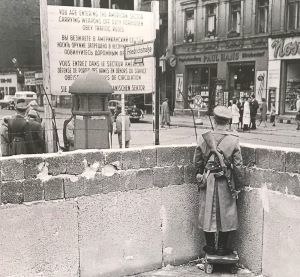 Circa 1962–note barbed wire
No one from Eastern Bloc countries was allowed to cross there. In addition, western officials, military personnel, and even my (then) teenage brother could only cross into East Berlin at the checkpoint.
The DDR had their own checkpoint a few yards away in East Berlin. On their side, they employed mirrors and listening devices to check under cars going into the west. They often searched trucks and emptied the contents lest someone escape.
American soldiers who stood at Checkpoint Charlie were forbidden from helping anyone escaping. Too often, they stood by, helpless, while the East German police, the Stasi, arrested people seeking to escape.
A restaurant on the corner served as a spot for Allied authorities to keep an eye on the crossing.
What’s it like now?When the Berlin Wall blockade ended on November 9, 1989, Checkpoint Charlie’s value became moot.
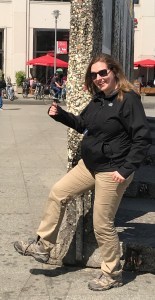 Crossing East to West
It remained the major crossing for about a year, until German reunification.
The original guard shack came down in 1990, and the area was remade into a tourist attraction.
Which is what we visited in 2018.
We had not realized until we reached the open-air exhibit that we’d spent our entire vacation in the eastern sector.
So, our daughter demonstrated what happened when we walked through the checkpoint.
The rebuilt guard shack is now manned by actors in army uniforms.
An American flag flies.
People walk back and forth.
Typical of a border crossing.
Checkpoint Charlie ExplanationsI’m not sure it really was a museum, but in the block leading up to the crossing, large posters lined a wooden fence explaining the story (and showing photos, like the one above).
We learned quite a bit as we walked along, glancing up from time to time at the jaunty American flag flying over the shack in the middle of the street.
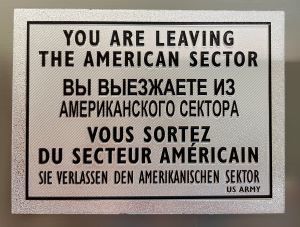
Crowds wandered around, stopping to buy trinkets (like the one on the left that now graces our refrigerator), and think about what used to happen at this spot.
The area is one of the most visited tourist spots in Berlin!
And right beside the checkpoint is a Museum of the Wall at Checkpoint Charlie.
But there’s a sober side, as well.
Far too many people died trying to escape to freedom at the guard shack or over the Berlin Wall.
The haunting photos were more important than the photo opp and I stood looking across the guard shack for a long time, just thinking of the lost lives.
What was Berlin like?I know two stories about the capital of Germany from the years when the wall and checkpoint kept the west at bay.
One friend attended elementary school the day her mother went shopping in East Berlin, against her husband’s advice.
He knew the East German government suspected him. “If you get arrested, I can’t do anything about it.”
“Oh, who would arrest me?” the mom laughed.
The DDR’s Stasi.
She spent the night in jail before US diplomatic officials could get her released.
Her husband shrugged. “I told you so.”
Another friend lived in West Berlin in the mid-1980s. “The air was always black and nasty in the wintertime,” she told me not long after the wall came down. “They only had soft coal to burn, and when everyone lit their heaters, the air pollution was terrible.”
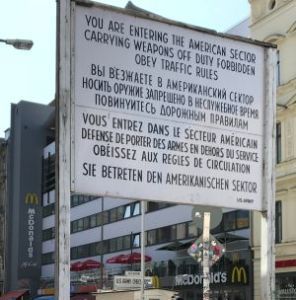
I remember the stories after the wall came down. People flooded across the border from East Berlin, amazed at the items anyone could purchase in a store.
Some people drove their Trabis into the west and hoisted them into trash dumpsters.
They sang Beethoven’s 5th Symphony song, “Ode to Joy.”
It was a wonderful, liberating fall.
And the world no longer needed a Checkpoint Charlie.
Today, there’s a McDonald’s restaurant overlooking the site.
Tweetables
A fun, yet poignant, visit to Berlin’s Checkpoint Charlie. Click to Tweet
A reminder of the Cold War, with McDonald’s in the background. Click to Tweet
The post Checkpoint Charlie as a Historic Site? appeared first on Michelle Ule, Author.
August 24, 2021
The Berlin Wall: A Sobering & Enlightening Walk

We visited the Berlin wall several years ago.
As recounted here, our adult daughter knew little about the Cold War which ended before her birth.
To stand beside such a barrier to freedom surprised all three of us.
It felt like a memorial to the past, which seemed far away but so very close time-wise.
What is the Berlin Wall?During my childhood but before my memory, the German Democratic Republic (DDR) built the Berlin wall over several days in 1961.
Then divided into “zones,” Berlin sat in the middle of territory seized by the Soviet Union following Germany’s collapse at the end of World War II.
The DDR kept their sector of Berlin isolated from the west.
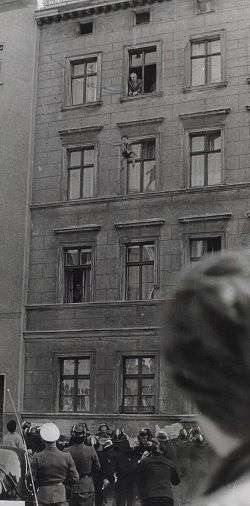 The father tossed his child from East Berlin into West. Police caught the boy, then the father jumped.
 (Wikimedia Commons)
For the sectors held by the US, Britain, and France, supplies only came via airdrops or specific routes allowed by the Soviets.
But so many people slipping through the sealed border from East Berlin to West Berlin angered the Communists in control.
(See any Cold War spy novel).
As traveler Rick Steves wrote:
West Berlin was a 185-square-mile island of capitalism surround by East Germany. Between . . . 1949 and 1961, an estimated three million East Germans emigrated (fled) to freedom.
To staunch their population loss, the DDR erected the 96-mile-long “Anti-Facist Protective Rampart” almost overnight.”
Rick Steves’ Germany p. 767
At midnight on August 13, 1961, the DDR began building a high wall to separate the city and slow the escapees.
It dived families and neighborhoods, even as it went up between apartment buildings.
Hated then and still hated now
By the time the DDR built the wall, many Berliners and Germans hated the Communist life.
They dashed across or past the wall, desperate to escape before the DDR completely sealed them in the Communist prison.
Too many people jumped over the wall from apartment buildings on the Eastern side.
More than one parent tossed a child.
Others tunneled underground. Two men flew gliders over the wall.
Some of this I knew.
The rest (with photos), we learned at the splendid Berlin Wall Memorial.
Such an interesting walkBerlin has more than its share of fantastic museums.
However, this particular one is a self-paced open air and you can walk the Berlin Wall during daylight.
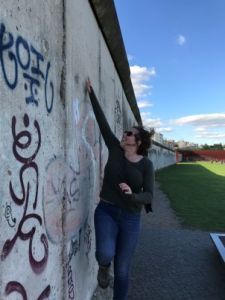
We read through the exhibit boards, marveled at the very wall, right there.
(And yes, you can touch it!)
Below are examples of three open-air exhibits (Placards explain what happened in English and German).
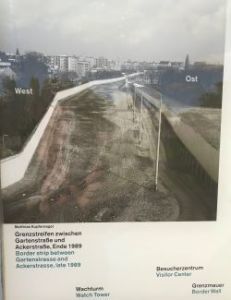 Photo showing how wide “no-man’s land” got.
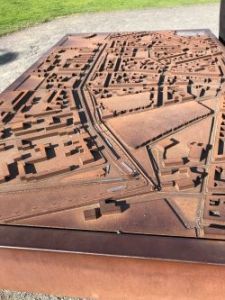 Bais-relief exhibit
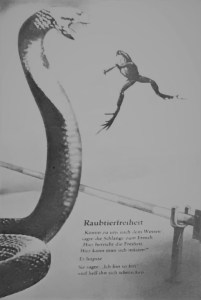 DDR propaganda for fleeing GermansMemories?
The memorial park skirts the remaining intact section of the wall. A lovely grassy parkland stretches to the east of the wall. Chronologically, it worked best for us to walk from the south to the north.
We stopped to read the exhibits all along the way, so thankful horrifying concertina wire no longer stars the top.
Our daughter knew nothing–somehow I’d forgotten to describe this part of history.
I told her of President John F. Kennedy’s famous response, “I am a Berliner.”
And also, President Ronald Reagan’s admonition to General Secretary Mikhail Gorbachev:
It all came down on November 9, 1989.
Friends were out to sea on a submarine that day. The Commanding Officer entered the wardroom and paused to meet the eyes of each man.
He walked around the table, shook their hands, and said, “Congratulations, gentlemen, on winning the Cold War.”
After the Berlin Wall came down.In 2010-2011, I traveled to three countries that spent 40 years mired behind the Iron Curtain.
I asked the people I visited, relatives of my friends, how things changed in 1989.
A Slovenian shrugged. “My son came home from the army.”
Attila, a Hungarian lawyer, gave me a long answer which basically boiled down to, “We expected to become like Americans overnight. It did not happen. Hungary is a small nation, we had to adapt to the larger ones.”
A Romanian woman nodded her head, defining that 1989 change as “when Capitalism came.”
I’ve pondered her answer ever since.
Before capitalism, we did not know who we could trust and so we focused on our family. You spoke truth to your family and they were the center of your life. You worked your job and then you came home to your family. We grew much of our own food.
Now under capitalism, we work all the time and we have little time for our family. We are not so close anymore.
And the tomatoes have no flavor, either.
(The tomatoes lost their flavor because families no longer had time to grow them. Store purchased tomatoes, as many in the west also know, seldom taste as good as those grown at home.)
Undivided BerlinWe learned a lot walking the Berlin Wall our first night in that marvelous city.
It helped shape the five days we spent there and gave us a glimpse of a different world.
That’s why we travel, of course.
On our final day, we visited a somewhat cheesy but also poignant spot.
(The next post!)
Tweetables
A fascinating walk along the Berlin Wall. Click to Tweet
Where 1961 Berlin split East and West, today. Click to Tweet
The post The Berlin Wall: A Sobering & Enlightening Walk appeared first on Michelle Ule, Author.
August 17, 2021
The Good News and Charles Cowman (Part 2)

God’s Good News caught Charles Cowman by surprise the second time, but he seized it for good in 1892.
His wife Lettie’s determination to follow God might have been the catalyst, but Cowman quickly caught up.
If he knew nothing else, he knew the gospel needed to be shared.
Charles Cowman went right to work.
Literally.
Sharing the Good News at Western UnionThe first morning after Cowman gave his life, for good, to Christ, he told his colleague Ernest A. Kilbourne about his decision.
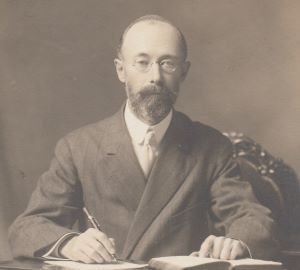 Ernest Kilbourne (OMS Archives)
Kilbourne listened to Cowman’s story, nodded, and didn’t say anything else.
Crestfallen, Cowman went home to Lettie to describe his failure.
However, the next morning, Kilbourne reported he’d thought, prayed, and decided he, too, needed to apply Jesus’ good news to his life.
Kilbourne became a Christian–and eventually joined the Cowmans and Juji Nakada in founding the Oriental Missionary Society.
The two fast friends prayed together and began sharing with the telegraphers in their office. Within six months, Cowman led 75 fellow workers to the Lord.
There were some 500 men working in the office and he [Cowman] tried to see and talk with everyone of them about his soul’s welfare. He was always buying up opportunities, redeeming the time. He was a good salesman who did not leave the case with closed doors, but always with a way to return and talk about it some more.”
No Guarantee But God p. 5
Cowman rented a room in a nearby hotel on Sunday afternoons for an hour so telegraphers could attend service. They called the group, “the Telegraphers Mission Band.”
Soon, their ministry spread down the telegraph lines and similar bands grew up in other cities.
“Little Hell” and the Good News.Cowman didn’t remain solely with his peers. One Sunday afternoon, he scouted a vile area called “Little Hell,” to observe ministry there.
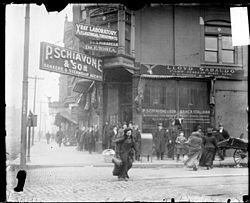 Little Hell circa 1909
 (Wikimedia Commons)
When he stopped to visit one small chapel, the person in charge assumed Cowman had come to preach.
He began a week later, often staying late into the night ministering to local denizens.
“That was my missionary training college,” Cowman later told a friend.
Eventually, Cowman rented a storeroom with a basement, outfitted it with benches and beds, and “invited drunks and gamblers to spend the night there on the condition they attend his preaching service.”
His technique seemed to work.
TrainingWhile Cowman learned many of his techniques from trial and error, he also recognized he needed to study the Bible to be effective.
According to his wife Lettie,
He followed a unique method of Bible study. He would read through one book of the Bible at a sitting.
The next day, he would reread it. This was often continued for a week at a time, or longer, until the contents were thoroughly mastered.
He likened this method to that of a landscape painter who first draws an outline, then adds a tree, a flower, and a brook.”
Missionary Warrier condensed, p. 37
The disciplined man poured over his Bible, took some courses at a Bible school, and spent some time (though how long is not clear) at the Moody Bible Institute.
When asked about his credentials, he told one woman his “college of missions had been the telegraph office in Chicago and his credentials–all that he possessed–were found in 2 Corinthians 6:4-10.”
(Verse 7: “By the word of truth, by the power of God, by the armor of righteousness on the right hand and on the left.” KJV)
He read a great deal in his free time. When opportunities arose, Charles and Lettie attended conferences by learned men. They befriended A. M. Hills, Dwight L Moody, A. B. Simpson, and Arthur T. Pierson, along with denizens of the Holiness Movement.
The Life of David Brainerd left him yearning for more opportunities to share the good news.
Beyond ChicagoPart of the Holiness Movement’s theology incorporated a desire to share the good news with everyone. They believed Jesus would return soon and evangelism should reach everyone.
Despite his busy job as a Western Union manager and his hours spent in ministry, Cowman found time to pray.
“A world map became a sort of prayer book of intercession,” Lettie wrote.
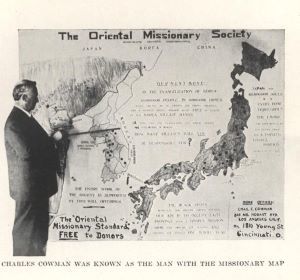 (OMS Archives)
It wasn’t too long before the world beckoned. Within eight years, Charles and Lettie traveled to Japan to share the good news.
Tweetables
Sharing the good news in the 1890s Chicago. Click to Tweet
When God gets hold of a man, he must share the good news–with everyone! Click to Tweet
The post The Good News and Charles Cowman (Part 2) appeared first on Michelle Ule, Author.
August 10, 2021
Charles Cowman & God’s Prepatory Work in A Life(Part 1)
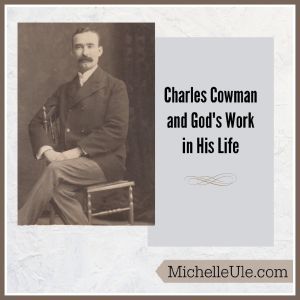
Charles Cowman was a dedicated businessman, prayer warrior, innovative missionary, and one of the founders of the Oriental Missionary Society.
A writer and a champion fund-raiser, his most important role outside of serving his God, was loving and encouraging his wife Lettie Burd Cowman.
The two needed each other and built a profound partnership for the Kingdom of God.
But, he didn’t start there.
God needed to mold him, first.
Charles Cowman as a childTwo notable events marked Charles Cowman’s youth.
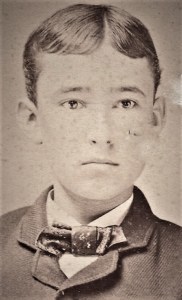 About the time of that altar visit. (OMS Archives)
The first came during toddlerhood when his family traveled in a covered wagon from Indiana to Iowa and stopped at a friendly farmhouse along the way.
Neither had a memory, but their parents later realized two-year-old Charles and his future wife Lettie, an infant, met that day for the first time. The Cowman family settled a county away and they didn’t see each other for many years.
But the other notable event occurred when, as a broken-hearted nine-year-old boy, Charles knelt at the altar of a simple church.
With the revival deemed a failure by some because only one boy responded to the circuit rider’s call, God proved otherwise.
It took Charles Cowman another 18 years, but he eventually recognized God’s claim on his life. Nothing stopped him after that.
Charles Cowman as a youthA small farm in Iowa didn’t hold a future in the ambitious Charles’ estimation. When, as a teenager, he met a telegrapher, Charles wanted to learn more.
Like many other young men interested in the latest 1870s technology, Charles spent the summer at the telegraph office.
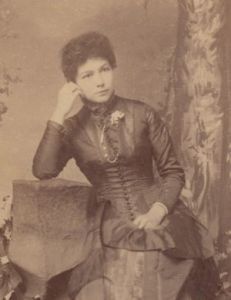 Can you blame him? (OMS Archives)
Cowman practiced hard, won a job, and became known as a “brass pounder,” a telegrapher so fast others had trouble keeping up with him!
Charles Cowman loved the work. At fifteen, he dropped out of school and soon earned a position running a telegraphy office in the town near the Burd’s farm.
A chance meeting with Lettie Burd’s mother brought the two young people together again. They fell in love that 1883 summer. The determined Lettie, who never changed her mind once she made a decision, was only 13.
Charles moved on in the telegraphy world, quickly advancing through the Western Union company ranks. He worked in the Chicago hub and when he returned to claim a bride in 1889, Charles Cowman managed the Glenwood, Colorado office.
An up and coming businessmanPopular in the Colorado mining town, Charles didn’t want to be apart from his bride anymore than necessary.
So, he taught that piano-playing Lettie how to send and transcribe telegrams.
(Since she couldn’t cook, it probably was a better use of her abilities.)
There in the late-19th century western town a mile high, Charles Cowman learned how to talk with rough-hewn men, manage a budget, and negotiate.
When his wife fell ill, Charles asked Western Union management to move him to a lower altitude.
Western Union brought the Cowmans to the Chicago main office where Charles continued winning managerial promotions.
The Cowmans cut a fashionable swath through Chicago society.
Finally, Charles could impress his in-laws by providing his wife with a glamorous life.
The future looked bright.
Who needed the God he had agreed to follow all those years before, anyway?
Well, Charles Cowman needed God.
He just didn’t know it yet.
The Challenge of a Determined WifeCharles Cowman should have remembered how a determined Lettie Burd stood up to her parents to marry him.
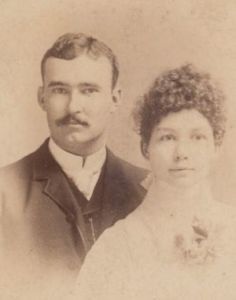 He got the girl! (OMS archives)
He should have recalled how she took to telegraphy, once she made up her mind to do so.
A beautiful wife and a beautiful apartment in a beautiful part of a busy city fulfilled his dreams.
Attending the opera, going to plays, reading fashionable books–and visiting the Chicago World’s Fair charmed the man who grew up on a small Iowa farm.
He wanted nothing more.
But one day his adored wife came home with a shining face. Her quiet voice told him she’s made another decision.
Charles Cowman felt uneasy. He showed her tickets to the opera.
Lettie refused to go; Jesus beckoned.
“What are you telling me?” Charles demanded. “I have worked all these years to come up to the top, and now you’ll ruin my life? From tonight my life is ruined.”
Religious men weren’t welcome in the industry where he managed 600 telegraphers.
But Lettie had made a commitment.
Her decision would change many people’s lives.
Starting with Charles Cowman.
(Part 2 next week)
Tweetables
The early life of a missionary pioneer. Click to Tweet
How early can God begin to work in a missionary’s life? Click to Tweet
The post Charles Cowman & God’s Prepatory Work in A Life(Part 1) appeared first on Michelle Ule, Author.
August 3, 2021
The DDR Museum and a Very Different World

So help us, we loved Berlin’s DDR Museum.
Okay, we traveled with a Cold War warrior, so our interest obviously was personal, but still, what a surprise!
Rick Steves warned the DDR museum is “overpriced, crammed with school groups, and frustrating to local historians.”
Rick Steves Germany only gave the museum two stars, but we laughed more there than in any other of Berlin’s many terrific museums.
Except when I paused and considered the enormity of it all.
Then it wasn’t quite so much fun.
What’s to see in a DDR Museum?We traveled with our daughter, born after the Berlin Wall came down.
She didn’t know most of this history.
I’d forgotten quite a bit, but every turn brought back something I’d vaguely known about life in the Deutsche Demokratische Republik.
 The door didn’t sound like it was made of cardboard when we slammed it–carefully.
Who could forget a Trabant car, (“Trabi”), so poorly made people threw them away after 1989?
(The exhibit called them “cardboard on wheels.”)
I’d never seen one before, but we got to climb through and around one–inspecting it.
It made me sad to imagine people wanting any sort of personal transportation that they waited for years for one of these.
The exhibits featured everyday life in Eastern Germany. highlighting both the good and the bad.
We walked through a mock-up of a home, saw the types of food people could purchase in a store, and even viewed television programs.
Historic and poignantI love museums and learning about life in a different place–the DDR Museum served me well.
But I also saw sadness and poignancy in the exhibits.
All children started into kindergarten (child garden) at a young age. The exhibit looked charming and the museum presented a lovely room for children.
But then I looked more closely at one example of what they learned in school.

“Why do schoolchildren practise throwing balls?
In the GDR (German Democratic Republic), they did so in preparation for war. Under the heading, ‘I love and protect my homeland,’ schoolchildren were instructed in the use of deadly weapons.
Wooden hand grenades replaced a ball.”
Elsewhere I read “social activities were noted on a schoolchild’s school report and were important to advancement.”
The determining factor for their futures was membership in the correct political party. Once at a university, every student, no matter their planned careers, had to take courses in Marxist Leninism.
Home? Fashionably simple? (Wikimedia Commons)
As the exhibit demonstrated, most families lived in a two-bedroom high-rise apartment with modest kitchens and bathrooms.
“Why is the washing machine in the bathroom?” my daughter asked.
“It’s either there or the kitchen,” I explained. “Those were the only sources of water in the simple apartments.”
The DDR Museum set up the exhibits so visitors had the freedom to open closets, look in drawers, and cupboards.
We did so, as did everyone else.
I thought about the need to purge my possessions when I went home!
What about Shopping?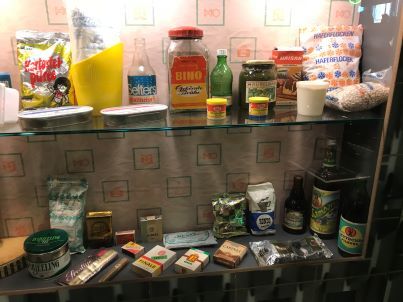 Rice, instant mashed potatoes, cigarettes, and all sorts of drinks!
Stores always carried a limited supply–I’d heard that forever.
Since countries behind the Iron Curtain often couldn’t trade with western stores, their supplies were limited to Communist nations.
Shoppers famously lined up for hours to purchase, often poor quality, food.
Here is one exhibit of the typical products available.
Stores tended to have few items for children compared to an American toy store.
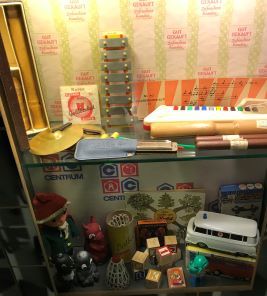
We always heard about specialty shops available for the elite, often members of the local Communist Party.
Products available in those stores, which required payment in “hard currency,” usually from the west, tended to be of better quality.
Or, available only outside of Eastern Bloc countries.

As the museum caption explained:
Sobering Sights
The GDR provided too few goods and the people had too much money. Economists speak of a glut of money.
Under normal circumstances, prices would rise. However, price stability of basic goods was one of the holy cows of the GDR political settlement.
The solution was to create special shops which provided luxury goods at exorbiatant prices.
The people may have complained, but still went shopping where they could luxuries such as tinned sausages, coffee cream, and instant milk.”
In a section about the military–in which all young men took part–merriment faded.
The DDR museum showed us the type of training soldiers endured.

We also learned the western targets–which included where we lived.
I flinched realizing the east Germany army thought my country wanted to destroy theirs.
I’d seen Kalishnikovs before–in Italy during the Red Brigade attacks of the 1980s. Italian soldiers stood on guard everywhere holding them.
We read about the nuclear drills, the plans to bomb western nations.
One wall explained their plans.
I turned away.
ReflectionsMy historian father ensured we grew up with a knowledge of what was happening in other parts of the world, including behind the Iron Curtain.
I read many memoirs of life in Eastern Europe both before and after the Iron Curtain came down.
I followed the news in 1989 when the Berlin Wall fell–and I cheered.
So many people lived a harsh existence for 40 years. I’m glad that limited time has ended.
The DDR, GDR, East Germany, may have called itself a democratic republic, but it wasn’t.
That’s the reason we travel and visit museums–to learn about life different from what we think is normal.
With COVID-19 restrictions ending–though not in Germany as I write this–visiting the DDR Museum and others like it, can be illuminating, interesting, and important.
You have to buy your tickets online these days–it can be busy–but this museum and the Pergamon, are the ones we still talk about three years later.
Tweetables
A funky Berlin Museum spotlights a sobering period in history. Click to Tweet
Where else can you sit in a Trabant and learn about a very different life? Click to Tweet
The post The DDR Museum and a Very Different World appeared first on Michelle Ule, Author.
July 27, 2021
4 Engrossing Books for a Summer Plane Flight

I like to read on a plane flight.
The more engrossing and interesting the book, the better.
I don’t care if it’s fiction or nonfiction as long as it captures my attention and makes that in-flight time pass quickly.
That’s particularly important as COVID recedes but we still have to wear a mask.
It can be tricky to find the right book for any trip. Here are a few suggestions to get you started.
4 perfect books for a summer plane flight Into Thin AirI started Jon Krakauer’s blockbuster book Into Thin Air on a plane flight from Los Angeles to Oakland, California.
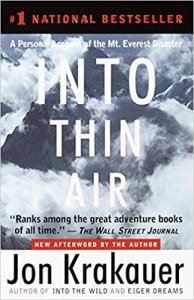
A personal account of Krakauer’s experiences on Mt. Everest in 1996, Into Thin Air describes the chaos, confusion, and heroics of so many on Mt. Everest during a disastrous climbing year.
On assignment for a magazine, Krakauer documented his own hike and told a harrowing story.
Really, the heroes were the Sherpas hauling all those westerners and their gear to the summit of the world’s highest mountain.
I’m not a mountaineer and I’m leery of heights, but Krakauer’s writing and the story itself, kept me riveted.
Unfortunately for me, the plane flight for once wasn’t long enough.
Haunted because I didn’t know the ending, I stayed up way too late once I returned home to finish the book!
The Boys in the BoatI read The Boys in the Boat by Daniel James Brown on a plane flight from San Francisco to El Paso, Texas.

With two relatives rowing crew at UC Berkeley, I wanted to learn more about their world. This nonfiction story of the 1936 US Olympic crew team kept me riveted the entire trip.
Engrossing personalities, dramatic events, and showing up Hitler all resulted in a story I couldn’t stop reading.
I normally walk during a layover, but not this time. I sat glued to my airport seat taking in all the details and drama.
As we landed in El Paso, I reached the last page and closed the book with a sigh.
What a splendid story!
Code Name VerityI picked up by Elizabeth Wein at the library for a plane flight from San Francisco to Chicago.
A total innocent as I opened the cover, I didn’t know what to expect of this “fiendishly plotted,” WWII story.

I didn’t really like the first four chapters and considered forgetting the whole thing, except I didn’t have anything else to read.
So, somewhere over Nevada, I sighed and continued reading.
Except, events didn’t quite make sense.
Somewhere over northeastern Colorado, my eyes widened and I gasped.
As we landed in O’Hare, I reached the shocking, satisfying, enlightening conclusion.
Returning to the first pages, I started over again.
And finished a reread way too late that night at our hotel.
Unreliable narrator, anyone?
(For a similar shocking, satisfying, let’s start all over again novel, try Amor Towles’ A Gentleman in Moscow. Unfortunately, to finish that book in one flight, you’d probably have to fly all the way around the world!)
Blind DescentNevada Barr’s books tell the stories of Anna Pigeon, a national park ranger.

On another flight, this time home from El Paso to San Francisco, I reread this novel after hiking in Carlsbad Caverns, New Mexico.
Barr, of course, set Blind Descent in Carlsbad Caverns, more particularly a “wild” cavern without lights or other amenities.
Since we had hiked a “wild” cavern the day before–led by a guide and wearing trusty headlamps with new batteries–I’d survived the experience.
But “experiencing it again,” through Anna Pigeon’s life proved almost more than I could stomach.
Riveting and exciting, I’m glad I read it coming home rather than flying to!
Other notable plane flight booksCuba— was the title of a fat history of the island my father read on a Los Angeles to Miami flight in the early 1960s. The nervous flight attendant finally approached him to ask if he was planning to hijack the plane–other travelers were nervous.
The Witch of Blackberry Pond by Elizabeth George Speare. This wonderful story of colonial Connecticut caught my 10-year-old’s imagination and she read the whole book on our flight to New Zealand. (When she wasn’t watching Lilo and Stitch seven times.)
The four children spent the rest of the trip reading all the Harry Potter books–which were practically the only books for sale in 2002 New Zealand.
This summer’s flight reads?For a May flight, San Francisco to Seattle, I read most of Patricia Raybon’s upcoming All That is Secret. An unusual tale of a Black theology woman professor solving a murder in 1920s Denver, it kept me guessing!
For a flight later this summer across the country, I already have my chosen novel: Amanda Dykes’ newest Yours is the Night. Five hours should fly by with Dykes’ splendid writing and storytelling. I can hardly wait to fly!


What are some great books you’ve read while traveling through the air?
Tweetables
4 great reads for a plane flight! Click to Tweet
Flying with boats, caves, Mt. Everest, and an unreliable narrator. Click to Tweet
The post 4 Engrossing Books for a Summer Plane Flight appeared first on Michelle Ule, Author.
July 20, 2021
Why Not Ask a Question and Learn Something?

Asking a question is not a problem for me when I’m interviewing people.
In a personal situation, I’m sometimes hesitant.
But, I live in a society that often makes assumptions about what other people think.
Somehow, just asking a question doesn’t seem to cross their minds.
But, if we don’t know, we can make poor decisions–for ourselves, for others, and for society as a whole.
Remembering the risk of a poor reaction, however, pushes me to ask sometimes uncomfortable questions.
How about you?
Why don’t people ask a question?Sometimes it has to do with authority.
To ask a question is to imply you don’t know an answer–and for some people, it feels too big a risk.
But, in a cooperative situation, the freedom to question can lead to stronger outcomes.
Hearing several answers and ideas can prompt consensus and happier people.
And it also can promote a better community.
What about asking for a child’s opinion?While preparing for a house-hunting trip years ago, my husband and I made a list of things we sought in a new home.
(It started, of course, with something in our price range.)
 Photo by Rohit Farmer (Unsplash)
At breakfast one morning, I looked at our children and decided to ask their opinion.
“What would you like for a new house?”
The imaginative eight-year-old was off!
“I want a big lawn, and a creek, and a place to shoot arrows. I want a horse. We need more blueberry bushes and apple trees!” His face shone with animation as he expressed dream after dream.
I had no idea he desired so much.
The six-year-old sat beside me chewing his cereal. After a long, thoughtful pause, he delivered his simple request.
“I would like a house with a kitchen and a garage.”
It was so hard to keep a straight face, but I nodded. “I can assure you, you’ll get what you want.”
And, as it turned out, except for the horse, our oldest son got his dream house, too.
Taking care to form the right question“Why bother to ask if you’ve already made up your mind?”
I’d frustrated someone close to me.
Surely my question was open-ended enough. Wasn’t it?
But if he didn’t think so, then I was wrong.
Time to rephrase.
 Photo by Jon Tyson (Unsplash)
In rephrasing, I recognized my presumption and his point.
That opened the door for further conversation and an important meeting of minds.
We reached a constructive, and much better, answer as a result.
But, if I hadn’t asked and then been called on the question, we wouldn’t have reached a healthy understanding.
It can be a risk to backtrack and it requires humility.
Maybe that’s why some people don’t ask?
“How do you feel about that?”My husband rolls his eyes but stops to ponder.
“How many questions do you need to ask me?” He might respond.
Sigh. Sometimes he’s right.
“When you’re married to a reporter,” he explained to a waiter yesterday. “The questions can go on forever.”
Okay, so sometimes he’s right.
Maybe frequently right.
But we know each other well now, and that’s important.
If you’re hunting the formula it’s “5 Ws and an H.”
Or, who, what, when, where, why, and how.
Once I get the answers to those questions, like a good reporter, I feel like I have a complete understanding.
Try it!
“What do you want to know?” Cheerios for the win, again!
 Photo by Annie Spratt (Unsplash)
Several years after our move, I asked the same boys what they wanted to learn before they grew up and left home.
“I require you to learn how to swim, type, and cook. But what would you like to learn?”
The oldest was off, “Oh, I want to learn to sail, and to fence, and to learn to ski,” and he continued with a long list
He had many dreams I hadn’t anticipated.
The second one was still eating cereal for breakfast. He pondered the question, nodded, and smiled.
“I would like to learn how to drive and count money.”
You know what? Other than fencing (though maybe he learned that in college), my boys can all do those things.
I’m so glad I asked.
Tweetables
The importance–and value–of asking questions. Click to Tweet
Five Ws and an H–the secret to asking a good question. Click to Tweet
The post Why Not Ask a Question and Learn Something? appeared first on Michelle Ule, Author.
July 13, 2021
View of God: Is Yours High or Low?

What is your view of God?
Is it like this:
I saw the Lord sitting upon a throne, high and lifted up; and the train of his robe filled the temple. Above him stood the seraphim. Each had six wings: with two he covered his face, and with two he covered his feet, and with two he flew. And one called to another and said:
“Holy, holy, holy is the Lord of hosts;
the whole earth is full of his glory!”
And the foundations of the thresholds shook at the voice of him who called, and the house was filled with smoke. And I said: “Woe is me! For I am lost; I am a man of unclean lips, and I dwell in the midst of a people of unclean lips; for my eyes have seen the King, the Lord of hosts!”
Then one of the seraphim flew to me, having in his hand a burning coal that he had taken with tongs from the altar.
Isaiah 6:1-6 ESV
Or, when you think of God and Jesus, is it more like this:
What difference does our view of God make?“Left to ourselves we tend immediately to reduce God to manageable terms. We want to get Him where we can use Him, or at least know where He is when we need Him.
. . . a God we can in some measure control.
We need the feeling of security that comes from knowing what God is like, and what He is like is of course a composite of all the religious pictures we have seen, all the best people we have known or heard about, and all the sublime ideas we have entertained.”
A.W. Tozer in The Knowledge of the Holy
Quite a bit.
I was praying one day, and distractions kept cropping up.
 Westminster Abbey headed to the throne. (Cornell University Library;
 Wikimedia Commons)
Did I pull out meat from the freezer for dinner?
Was that the dryer pinging?
Did I put that letter out for the mail?
I forgot to answer that email!
With each reminder, I bounded out of my prayer chair and took care of it.
The mere two minutes, maybe five, the chore took wouldn’t matter.
I knew God would wait.
Wouldn’t He?
Leaning back in my chair, I thought a little bit more about the Creator of the Universe.
If I viewed Him as a real King, would I treat Him like this?
(Time to start squirming).
This is what came to mind:
 Am I likely to run off for my sweater if she’s waiting for me? (Wikimedia Commons)
Let’s say I was being presented to Queen Elizabeth II. She was waiting for me on her throne as I made my way up a long aisle wearing my best clothes and focused on the queen.
But what if, out of the corner of my eye, I saw a beautiful hat. Would I stop and admire it, congratulating the wearer on such style?
If I caught myself–remembering why I was there– and continued up that long aisle on a red carpet, would I pause and ask a gentleman on the right to suggest a restaurant for dinner?
If I suddenly felt chilly, would I run back to grab my sweater out of the car?
How would my behavior honor the queen?
Perhaps she would call for my head instead of waiting for me to kneel before her?
Why do I treat God like that?
How does my view of God determine who I worship?He was before all time. He flung the stars across the open universe and called light into being.
God looked across the expanse of history 13.7 or so billion years ago and began the work of creation.
He created Black Holes and dwarf stars, muskrats, and dinosaurs.
He stared across human history and put together your genes and mine, setting us into a time and place where our gifts, talents, and abilities could best be used for His glory.
But at the same time, He knew us to the marrow of our bodies and souls.
That’s a pretty big God–and one so glorious that the prophet Isaiah fell at his face when he caught a glimpse.
The angels cried, “holy.”
Who can disagree?
 God looked across the universe of time and created you for right now.
 (Photo by Josh Gordon on Unsplash)What’s a low view?
Jesus is my buddy. He’s my friend. The gentle Jesus meek and mild so often portrayed to make God palatable for children often seep into adult faith.
A low view of God, as Tozer pointed out, usually focuses on Jesus–the human form of God.
The problem is, too many of us don’t spend as much time studying the Old Testament God as the Gospels.
The Old Testament is too hard to understand–God too often seems capricious and not loving like Jesus.
Is the fault God?
Or our concept of God?
Isn’t it easier for us to worship a God who, as Tozer pointed out above, is more like me than I am like Him?
That’s what the Greeks did–their gods were just “bigger” humans with the same appetites and temptations.
But God is not like us. Before Him, we should feel undone.
Before Jesus, too, which should bow in gratitude and humility.
And that Holy Spirit? He may be the comforter, but he’s part of that trinity Godhead. He was there at the beginning and will be there orchestrating events at the end.
We’re not dealing with a god of wood or stone whom we can move around and manipulate for our own ends.
Yes, because Jesus died on the cross, we can approach God without an intermediary.
Who, then, can approach God?
My personal view of God makes a difference
Who may ascend into the hill of the Lord?
Or who may stand in His holy place?
He who has clean hands and a pure heart,
Who has not lifted up his soul to an idol,
Nor sworn deceitfully.
He shall receive blessing from the Lord,
And righteousness from the God of his salvation.
Psalm 24:3-5 NKJV
Why?
Who really cares but God and me?
How I approach God, how I think about Him, how I speak about Him does matter.
It reflects if I honor Him or not.
My words shout of my reverence or lack of reverence for Him.
My attitudes turn into my theology which affects everything in my life.
I aim for a high view of God and begin my prayers by remembering just who I’m speaking to.
It shows how much He values you, too.
Yes, He does love us. Yes, Jesus died that our sins might be forgiven forever. The Holy Spirit came when Jesus returned to the Father so we could always have Him with us.
But God is holy, and we are not.
Let us fall on our knees before our Lord, God, our Maker, and our Creator, our Redeemer, and the Lover of our Souls.
He’s listening. He’s waiting.
And His love never ends.
Thanks be to God.
Tweetables
Do you have a high view or a low view of God? Click to Tweet
Does your view of God affect your personal theology? Click to Tweet
The post View of God: Is Yours High or Low? appeared first on Michelle Ule, Author.