Michelle Ule's Blog, page 19
June 21, 2022
What’s the Deal with Stupid Sheep?

Does God simply love stupid sheep?
Baaaa. Do you really want to know?
Obviously, God believes people are a lot like wooly, inept, four-legged creatures who prefer their ignorance and would run from safety rather than trust the one who loves them.
His description in Isaiah 53:6, alas, sums it up: “All we like sheep have gone astray; we all have turned to his own way.”
Yet, even knowing and describing people that way, God still sent Jesus to redeem us from, well, you know.
What can we learn from them?
Facts about sheep you may not know.If they fall over, they have no way of getting up. If they lay on their backs too long, their lungs can collapse from the weight of their wool.For that reason, shepherds routinely graze them on hillsides. The thought is, that if they fall over, they’ll keep rolling down the hill until they pile up against the fence.A shepherd has to roll his sheep over onto their feet every twelve hours.While staying at a farmer’s B&B in Cornwall, my husband and son helped find the farmer’s flock pilled up on a fence and helped roll them back onto their feet. They trotted away.Lambs and ewes all have poor depth perception and often stumble into dangerous places.They have good peripheral vision, however, especially needful when the wool grows over their eyes. (Do you better understand “pulling the wool over their eyes” now?).They have no way to protect themselves and thus become victimized by eye-pecking birds.Many sheep, therefore, are blind and only know which way to go when they hear their shepherd’s voice.Actually, they’re not all that stupid–nearly as clever as pigs–but they are headstrong. (Think Maa in Babe ).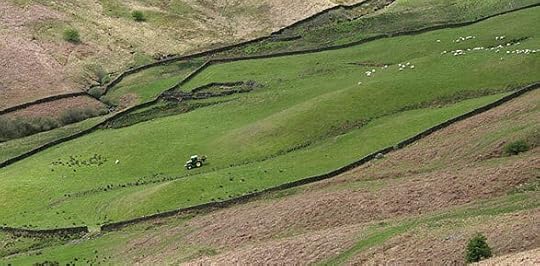 Note sheep at the top of the hill. The black lines are fences. (Wikimedia Commons; hill farming)Shepherds and their flocks
I thought about shepherds and their flocks recently while writing a post about King David.
He was a shepherd, and Scripture calls Jesus the Good Shepherd.
The Bible is ripe with references to shepherds and their flocks.
(Check out Strong’s Concordance on the subject here).
Sheep are challenging.
They’re stupid, unruly, ungrateful, unable to protect themselves, and vulnerable to death by simply rolling over.
Does that remind you of anyone you know?
Yet, anyone who can control, or at least keep alive, such creatures must be a special individual.
Hence, the need for a shepherd.
John 10:3-5 tells us why:
The sheep hear his voice, and he calls his own sheep by name and leads them out. When he has brought out all his own, he goes before them, and the sheep follow him, for they know his voice. A stranger they will not follow, but they will flee from him, for they do not know the voice of strangers.
John 10:3-5 ESV
According to Pastor David Guzik:
During World War I, some soldiers tried to steal a flock of sheep from a hillside near Jerusalem. The sleeping shepherd awoke to find his flock being driven off.
He couldn’t recapture them by force, so he called out to his flock with his distinctive call. The sheep listened and returned to their rightful owner. The soldiers couldn’t stop the sheep from returning to their shepherd’s voice.
Enduring Word.com, John 10:6
The hapless animals both need and want their shepherd.
Two fine books on the subject of sheep and shepherdsSheep are a common topic in New Testament literature.
 Photo by Héctor Achautla (Unsplash)
Two fine books have been written about them:
Suzanne Tietjen’s The Sheep of His Hand:
The book is a walk through the Psalms with stories are full of deep lessons.
Sheep are individuals who differ from each other and benefit from individualized care. Shepherds have always dealt with primal concerns – birth, death, love, rejection. Technology has changed much in the last millennium but the mud and the blood of shepherding are timeless – and sheep are still sheep.
Suzanne Tietjen’s website.
W. Phillip Keller’s A Shepherd Looks at Psalm 23:
Baa Humbug? Or Baa, Relief?Keller pointed out that sheep cannot just take care of themselves. They need a shepherd who knows every inch of the land, every pit fall, and every hide out where predatory creatures hide as they wait for the unsuspecting wooly prey.
He compares their intelligence and knowledge to the shepherd’s, then draws the parallel between our limited abilities and God’s Divine Intelligence.
Ben: “Learning from a Real Shepherd,” accessed June 13,2022; not available June 20.
I’m going with relief that my Shepherd, Jesus, looks at me, His sheep, with love–and I’d like to think a smile of exasperated affection.
After all, God created me this way.
Tweetables
What did God have in mind when he created people to act like sheep? Click to Tweet
If sheep are so stupid–and God likens us to sheep–DOES He really love us? Click to Tweet
The post What’s the Deal with Stupid Sheep? appeared first on Michelle Ule, Author.


June 14, 2022
A Man After God’s Own Heart? WHY?
 David by Michelangelo Florence Galleria dell’Accademia
“David was a man after God’s own heart,” we’ve heard for years.
But why?
What made such a notorious man so dear to God’s own heart?
I’ve pondered this question for a recent talk.
Here are some ideas.
Does God love a shepherd’s heart?Born Jesse’s seventh and final son, David grew up in Bethlehem of Judea.
With one heir and five spare sons ahead of David, Jesse assigned him a task that kept him away from home.
The youngest son guarded the family’s sheep.
David learned what it meant to care for a flock of unruly, self-indulgent, stupid sheep.
A sheep has no way of protecting itself except by stumbling back to its shepherd.
If they’re blind, or even if they’re not, they can’t find their shepherd unless he calls for them in a voice they recognize.
Being a shepherd requires attention, but also provides plenty of time to think.
God’s own heart communed with a young man on a hillside.David spent most of his time outdoors with no one to talk with except God.
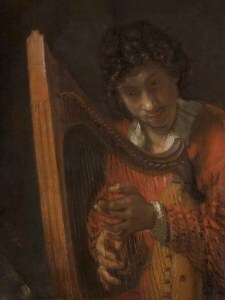 Detail: David and his harp. Rembrandt (Wikimedia Commons)
But out in the Judean hills, David cultivated a relationship with the Creator of the Universe.
He poured out his heart to God—sharing with God his delight in living outdoors, guarding the sheep, honing his sling skills, and playing the small harp he toted on his back.
While talking to God, singing psalms, and praising his Creator, David came into his own as a man after God’s own heart.
His older brothers ignored and dismissed him.
Some might wonder if his father even knew his name—since he didn’t mention David the day the prophet Samuel stopped in Bethlehem to sacrifice to God
Samuel recognized David as the next king of Israel to whom God specifically sent Samuel to anoint.
Scripture doesn’t tell us, but it’s possible that David only discovered God had created him for something significant when Samuel anointed him.
Knowing God had plans for him, what did David do with that information?
He returned to guarding the sheep.
Humility always touches God’s heart.
Did he look like someone after God’s own heart?Yes and no.
David’s life after Samuel’s anointing boils down to bullet points:
 The triumphant David by Rosselli Triufo
(Wikimedia Commons)Personal praise leader for King Saul.Slayer of GoliathPhilistine killer extraordinaireThe subject of “hit song” throughout the region: “Saul has struck down his thousands, and David his ten thousands.” (Per Pastor David Guzik)Son-in-law of King Saul.A close friend of Crown Prince Jonathan.Husband of a disgruntled wife, MichalThe object of King Saul’s hate, thus an expert spear dodger.Fugitive in Israel.Leader of a large band of disgruntled menWould-be murderer of the fool Nabal.Husband of three women at the same time: Ahinoam, Michal, and Abigail.Fugitive who lived and worked among the same Philistines–who were Israel’s greatest enemy at the time.Bandit, murderer, and raider—with 600 followers plus their wives and children—on Israel’s southern borders.Successor in exile of King Saul.Regretful fighter against King Ishbosheth (Saul’s only remaining son)Crowned king of IsraelContinual fighter against Israel’s enemies.Husband of more wives, had many concubines, fathered many children—and head of an unruly household.Adulterer with Bathsheba; the murderer of her husband—one of his mighty menA broken-hearted, chastened, humble sinnerRelieved recipient of God’s forgiveness.Lover of GodA thrilled dancer before the ark of the covenant.Temple plannerPoor and indulgent fatherOutraged father at daughter’s rape by her half-brotherThe focus of son Absalom’s attempt to usurp David’s throneDesperate father fleeing his throne.Thankful for God’s mercyRests with his GodThe ancestor of the “Son of David,” the Messiah.Why did God love such a man?
David’s life wasn’t perfect.
He frequently fell short of the glory of God throughout his life.
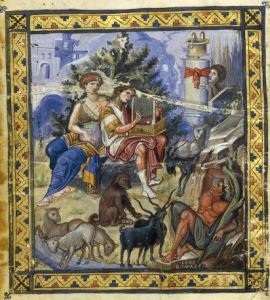 David pouring out his heart in the Psalms (Paris Psalter; Wikimedia Commons)
With such checkered behavior, what made David so special?
He knew the deep love of God, his salvation. David knew that confessing his sins, asking for forgiveness, and worshipping God would refresh his soul.
And God met him in those moments of deep humility and regret.
David let God see his soul–God knew what was in it anyway.
He never stop talking with God; David told God exactly what he thought and felt.
He knew his God from all those years of freely communicating with Him.
Can we be people after God’s own heart?God loves us just as much as He loved David.
His salvation, His Yeshua, is found, over and over again in the Bible.
We can be honest and pour out our hearts to God.
We can tell him everything about the soreness of our souls, about our disappointments, about our fears.
He already knows them.
When we confess our sin, He forgives us.
And He loves us.
Our Kingdom is coming– a place with a mansion for us, no more sorrows, no more pain.
All we have to do is ask.
Jesus, our Yeshua, our salvation, has gone ahead to prepare a place.
The key is humbling our souls before God and recognizing His forgiveness.
Thanks be to God.
(From a talk given at The Lutheran Women Missionary League Convention; June 11, 2022)
Tweetables
WHY was King David a man after God’s own heart? Click to Tweet
How can we become people after God’s heart? Click to Tweet
The post A Man After God’s Own Heart? WHY? appeared first on Michelle Ule, Author.
June 7, 2022
Post-Easter Weeks with Jesus’ Disciples

What happened to Jesus’s disciples post-Easter–in the weeks following Jesus’ resurrection?
It was an exciting time.
“Unusual” activity began that Easter Sunday when Jesus appeared to his disciples.
Joy quickly followed their initial disbelief.
And why wouldn’t it?
Wouldn’t you be excited if a loved one died and then appeared three days later whole, hearty, and with an appetite?
Post-Easter events to AscensionJesus spent forty days with his disciples after his resurrection.
He walked to Emmaus with two disciples.
Held a post-fishing barbeque on the shores of Lake Galilee for most of them.
Jesus appeared to all eleven, including the suspicious Thomas.
Without Thomas saying a thing, Jesus held out his hand and invited Thomas to put his finger there.
He suggested Thomas put his hand in his side–where the Roman spear left a wound.
Thomas was astonished, “My Lord and my God!”
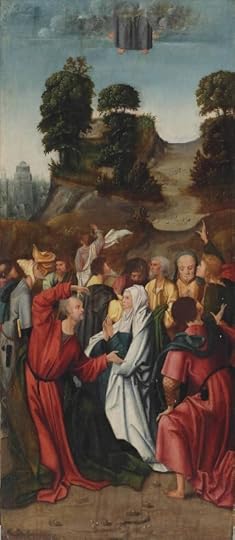 See Jesus’ feet ascending?
 (Adriaen van Overbeke; Wikimedia Commons)
Jesus: “Have you believed because you have seen me? Blessed are those who have not seen and yet believed.” (John 20: 24-29; ESV)
During that post-Easter time until Jesus’s ascension in bodily form to Heaven, Jesus continued teaching his disciples–who numbered about 120.
Over 500 people saw Jesus during this time. They would have recognized him.
None of the Gospels detail what Jesus taught them. The physician Luke in Acts 1 mentioned Jesus spoke to his disciples about the Kingdom of God.
Given they’d seen him raised from the dead, it’s likely they reviewed what Jesus told them before his crucifixion.
They asked if Jesus now would restore the kingdom of Israel.
“It is not for you to know times or seasons that the Father has fixed by his own authority. 8 But you will receive power when the Holy Spirit has come upon you, and you will be my witnesses in Jerusalem and in all Judea and Samaria, and to the end of the earth.”
Acts 1:6-8 (ESV)
And then a cloud appeared and took Jesus out of their sight.
Now what?How would the Holy Spirit baptize them?
No one knew, so they headed to a building on the Mount of Olives where they gathered in an upper room.
Mary, Jesus’ mother went with them, along with other women and Jesus’ relatives.
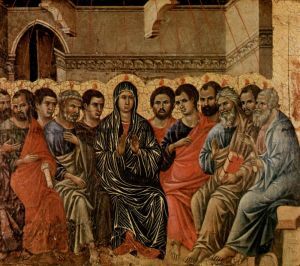 Can you see the flames? (Ducio di Buoninsegna 1308; Wikimedia Commons)
There, they prayed and celebrated the Feast of Weeks, bringing them to the 50th day after Passover, or Pentecost.
The Holy Spirit came down upon those praying folks in the upper room, “like a rushing wind,” and filled the entire house.
The Holy Spirit bestowed spiritual power and gifts on all present that day. Suddenly, they spoke with authority and confidence. The preaching began! People changed!
The fledgling church grew to 5000 people.
The same unhappy pre-Easter characters were unhappy post-EasterThe book of Acts describes one exciting event after another. With the Holy Spirit filling and directing them, the disciples began to speak in tongues, preach, heal, and set the captives to sin free–in Jesus’ name.
Pre-Easter the Temple priests, Sadducees, captains, and the Pharisees were irate.
Lazarus being raised from the dead, Jesus being raised from the dead; they couldn’t control God’s work.
Peter didn’t help by pointing out Jesus being raised from the dead was responsible for all this excitement.
The priests and the scribes knew the Law–that was their job.
Seeing all the activity post-Easter, some began to reread the Messianic prophecies.
The respected teacher Gamaliel, a Pharisee, reminded the council to be careful what they did next.
It was too late.
The word of God continued to increase, and the number of the disciples multiplied greatly in Jerusalem, and a great many of the priests became obedient to the faith. Acts 6:7 ESV
They must have watched as Jesus performed miracles on the Temple mount prior to his crucifixion.
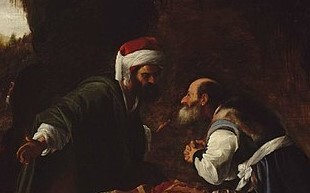 Gamaliel and Nicodemus
 Carlo Saraceni circa 1615 (Wikimedia Commons)
Surely, they scratched their heads and compared Jesus’s actions to what the Scriptures taught about the Messiah?
What other conclusion could they reach?
The Messiah had come. They recognized the Messiah’s description from Isaiah 53.
Eventually, one particular Pharisee saw the light: Saul.
And so the church began.
The Bible Project also takes a look at Pentecost and what happened next.
Tweetables
What happened in Jerusalem after Jesus’s ascension? Click to Tweet
Post-Easter events in Jerusalem, & the conversion of some Temple priests. Click to Tweet
The post Post-Easter Weeks with Jesus’ Disciples appeared first on Michelle Ule, Author.
May 31, 2022
Why Not Play in Adult Bible Study?

Note: That’s why not PLAY in Adult Bible study not PRAY.

I’ve been teaching adult Bible study since I graduated from college in the Dark Ages.
I taught classes in six different states with many different women.
Some weeks we studied difficult subjects (marriage, parenthood, submission, the book of Revelation).
We cried together, argued with each other, and struggled to make sense of the text.
All good.
God himself said, “Come now, let us reason together.”
So we have.
It’s been terrific–no matter who studied with me.
But Play in Adult Bible study?Why not?
God has a sense of humor.
For the last twenty years, I’ve taught a group of women older than I am.
Many have followed the Lord longer than I’ve been alive.
 Photo by ABHISHEK HAJARE (Unsplash)
What I could possibly share or point out they haven’t read or learned about before?
Well, the Word of God is new every morning, and as a living document, enables us to see new truths every time we read it.
My motto? Why not enjoy the experience?
So, while I’ve remained true to the Gospel, from time to time I’ve incorporated fun.
Sometimes to underscore my point, other times just to celebrate them.
(We’re Lutherans, we always enjoy a good potluck).
One Valentine’s Day, I announced my husband was buying everyone a drink from Starbucks.
My reasoning?
Valentine’s Day really is for teenagers, but why not enjoy it with women who were once teenagers?
You can read about their reactions–from 2002–here.
Why not start with a fun–but true– video?I love Bible Project videos for their ability to provide an easy-to-enjoy overview of Biblical books, ideas, and principles.
I show overviews of the book on the first day of a new Bible study.
We laugh at some of their points, but also begin to grasp what’s really going on from a new perspective.
Why remain seated if you can play in adult Bible study?We read about the walls of Jericho tumbling down one Tuesday morning.
I saw this as a prime opportunity to play in adult Bible study and teach from a different angle.
You can read details of the story here in Joshua 6:9-16.
Basically, after crossing into the Promised Land, the Israelites caused the walls of Jericho to “come a tumblin’ down.”
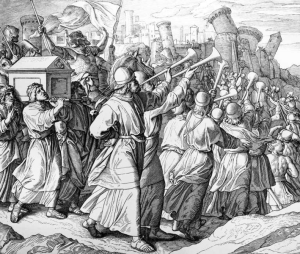 We didn’t look like this.
 (Julius Schnorr von Carlsfeld Wikimedia Commons)
Several women in the study that year used walkers.
“Okay,” I said. “Everyone up. Grab your walkers. We’re going to march around our tables seven times.”
I led the way, pretending to play the trumpet.
They laughed, but followed after, silent for the first six times.
On trip seven, everyone marched until the last woman finished her lap.
Then we all shouted, “The Lord has given us the city!”
And laughed, and laughed, and laughed.
I’ve never forgotten the story–and neither have they!
Playing, or is that praying, the Armor of God?Several weeks ago, we reached the Ephesians 6:10-17 passage about the Armor of God.
I have been praying that passage over myself daily for months, and I talked about it.
But also wanted to make it fun. Who hasn’t heard about this?
I suggested dressing up in pieces of armor if you had them.
(And promptly forgot about it).
I searched Pinterest, hunting for a female wearing the armor of God.
(Do you know how hard that was? With one exception, it’s all men in armor with the correct notations!)
I put together a coloring page to pass out. (But forgot to get the Sunday school crayons!).
It was a day full of distractions, I forgot to bring our sword, but I’ve got fun women in my class.
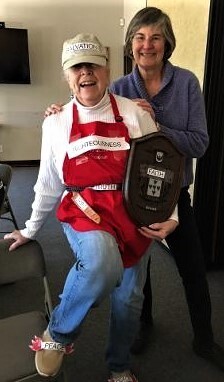
One of my students dressed up.
How does she look to you?
Would you like to play in adult Bible study?
What would work on whatever you’re currently studying?
We’ve moved on to Haggai, Zechariah, and Malachi.
Dreams, flying scrolls, olive trees?
I’m putting on my helmet of salvation and thinking about how to make the study fun.
Tweetables
Creating ways to play in adult Bible study. Click to Tweet
Why not incorporate laughter and fun in adult Bible study? Click to Tweet
The post Why Not Play in Adult Bible Study? appeared first on Michelle Ule, Author.
May 24, 2022
The Puzzle of a Child’s Mind
A child’s mind is such a puzzle at times!
Years ago I read about learning styles–the ways people learn best.
We’re each created differently with strengths, weaknesses, inclinations, and talents. The way you learn is singular to you.
I was interested in figuring out how my particular group of children learned best–so I knew how to engage them with their education.
That exercise proved very helpful over the years. I discovered that just because I learn things best a certain way doesn’t mean that will work for them–or you.
It also explains why I may prefer a certain type of music, book, or movie.
It’s not right or wrong, it’s just my preference.
How a child’s mind tried to work a puzzle.I recently remembered learning styles while working on a 100-piece puzzle with a three-year-old girl.
I always start by sorting the pieces–edge pieces there, and particular colored or type of pieces in a different pile.
Once sorted, I put the frame together and then fill in the middle.
Working on a puzzle with a small child, younger than five, can be an adventure.
The three-year-old tried any piece, not noticing if it was an edge or not.
All she seemed to see was indentation and tabs/knobs that might fit.
Working with her resulted in a lot of bent pieces and a frustrated child.
We switched to a smaller puzzle–20 pieces–and that went a lot easier. (Most of the pieces were edges!)
She smashed them together, “there,” and we were done.
Lego and a child’s mind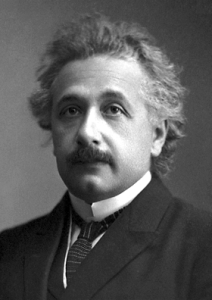 Einstein’s official Nobel Prize photo (Wikimedia Commons)
One of my children has a mind that can visualize in both three and four dimensions.
Albert Einstein could do that, too. Hence, he was able to figure out the General Theory of Relativity.
His brain simply worked differently.
Our son got his start with Lego, moved on to Construx, and thence to three-dimensional puzzles.
He also walked through a New Zealand labyrinth in about 20 minutes.
After two hours spent waving at me as I vainly tried to get out of the same maze (he was having a drink in the center and could see me walking around), he pointed me toward an exit.
We’re well-matched, however, on regular jigsaw puzzles.
As a proud mother today, I can’t imagine how he does his job.
He’s a metal fabricator. He writes computer programs to maneuver huge metal pieces through the air to build things I cannot describe.
My child’s mind–his adult mind–imagines where cuts and holes need to be placed, and then writes a computer program that does it.
Amazing.
But what about the state of their bedrooms?As they grew up and I learned more about learning styles, I realized we didn’t think alike.
I needed things organized, the floor picked up, and the books on the shelves.
(Okay, I do stack papers all over the place. But they’re STACKED.)
 Well?
Well?Their rooms–whether shared or not–drove me crazy.
But, if one of them was constructing something, who was I to tell them to take it apart and put the pieces away?
If one of them wanted to study while listening to music, wasn’t that their business?
(Just because I wouldn’t remember anything that way, didn’t mean they wouldn’t.)
If they did fine in school without me having to remind them to do their homework, why not leave them alone?
I finally came up with one rule, well three.
Make your bed every day.Put away your clean clothes.Pick up the floor once a month so it could be vacuumedI also learned to close their bedroom doors when I thought it was too messy.
They lived there.
They needed to figure out what worked for them.
Training a child’s mindI saw my parental role as being a facilitator and a trainer.
(Pretty grand descriptions for “mom,” aren’t they?)
I started giving them puzzles early–18 months.
They built with blocks, spent as much time outside in the dirt as possible, and visited the library regularly.
Cooking, of course, is simplified chemistry–all that pouring and measuring.
(They’re all good cooks now).
I tried to remember to ask them leading questions, rather than demand they explain why.
 Someone’s got to cut the metal!
 (Photo by Ant Rozetsky on Unsplash)
Try it:
“Can you tell me why you chose to do it that way? “What do you plan to do next?”“I don’t quite understand. Can you show me what you’re doing here?”It was fun to catch them by surprise and watch their brains suddenly realize they needed a next step!
Unpuzzling the kids?Where’s the fun in that?
While it’s certainly easier if you can predict and/or control a child’s imagination or behavior, we’re all made differently.
If we all thought and acted the same, most of us would be superfluous.
Once I learned to appreciate how different the children thought, the easier it was to sit back and watch them soar.
God created each of us with gifts, talents, and abilities to use.
My job as a mother was to give the children the tools they needed to become the people God created them to be.
Even if I can’t picture what they do with my puzzled mind.
Click to Tweet
Is raising a child with a puzzling mind fun or frustrating? Click to Tweet
How to give your child’s mind freedom to solve whatever they dream up next! Click to Tweet
The post The Puzzle of a Child’s Mind appeared first on Michelle Ule, Author.
May 17, 2022
The Best Yoke? Over Easy with a Light Burden

I could not resist throwing yoke, easy, best, and light, into a scrambled headline.
I apologize. This post was meant to be serious!
2013 was an extraordinary year with high temptation to falter.I launched four books in 2013 and we moved unexpectedly.
While writing a new book requiring a lot of research, I sorted possessions.
We added a family member, lost a loved dog, and traveled. I’m sure there was more (well, two writer’s conferences), but many of you have struggles. There’s no need to compare or compete.
In January 2013, an opportunity arose for me to write a novel that included Oswald Chambers. Had the publisher bought the book, meeting the deadline might have destroyed me!
On the other hand, sharing the yoke of writing pressure with the author of My Utmost for His Highest, helped. It also started years of joyous research and correspondence!
“If I have to spend a concentrated time writing a book quickly, I can think of no one better to spend it with than Oswald Chambers,” I told my agent.
My words turned out to be more prescient than I knew. Who knows how well I would have fared without his words from the May 25 My Utmost for His Highest?
The best yoke?The great enemy of the life of faith in God is not sin, but the good which is not good enough. The good is always the enemy of the best.
Faith in God includes concepts like, “everything works together for the good for those who are in Christ Jesus.”(Romans 8:28)
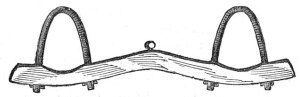 Western Yoke (Wikimedia Commons)
Verses like that help when everything else feels crazy!
In his above comment about the life of faith, Chambers was discussing sin and the natural life.
In 2013, particularly during our ten-week hunt for a new home, I quoted OC continually.
I needed to remind myself not to settle for something that was simply good–I needed to wait for the best.
The whole devotional is worth reading because it teaches us to treat our lives lightly–my plans, my hopes, my dreams.
Everything needed to be given over to God. Once I accepted He and I worked together, living like oxen and a yoke, then I could watch with expectation.
We looked at many terrific houses. We explored many options.
God laughed and tugged me elsewhere.
We ended up in a spot we did not expect, in a type of house we were not looking to buy, and which was larger than we thought we wanted.
But it’s wonderful.
In the last nine years, four different people lived with us. We’ve been able to offer the house as a haven to some, a temporary place of rest for others.
Pure joy.
An easy yoke.The other passage that encouraged me during that insane year came from an even better source: Jesus.
I still had plenty going on. The whirlwind of writing, marketing, packing, and sharing our home with 10 family members while househunting that summer meant I got discouraged by all the work.
Come unto me, all you that labor and are heavy laden, and I will give you rest.
Take my yoke upon you, and learn of me; for I am meek and lowly in heart: and you shall find rest unto your souls.
For my yoke is easy, and my burden is light.
The yoke referred to by Jesus, of course, is the wooden tool that goes over the shoulders of a team of oxen.
For such a team to work in harmony, the two need to plod together in the same direction. If one ox decided to veer off the path, the wooden yoke hurt.
The pair might stumble and forward progression would stop. Calamity could occur.
Yokes, of course, are carved for specific animals.
The yoke is fitted to the shoulder blades so there is no rubbing. The oxen owner is concerned about his animals. They can’t work well together if their yoke is ill-fitting.
Similarly, I believe God has set a path for me to walk in. I share the yoke, the tool, to perform the job he has ordained with Him. I need to walk in harmony with Jesus to accomplish what he has sent in my heart to do.
The best yoke.My prayer for several months was a combination of the two ideas.
 Yep. A yoke is much easier! Photo by Adli Wahid (Unsplash)
I prayed for wisdom to walk in the path God called me to walk. To do that, I needed to ignore the siren call of the good on my way to accomplish His best for the task He ordained for us.
It took me much longer to finish the novel than I expected, thanks be to God.
A Poppy in Remembrance didn’t appear until November 11, 2018. The date marked the 100th anniversary of the end of the Great War.
Like you, I’ve been given gifts, talents, abilities, and opportunities. My job is to use those in the way God directs for His glory.
When we yoke ourselves to the Creator of the Universe, who knows what we can accomplish?
Particularly when it’s easy.
Tweetable
The Best Yoke? Over Easy with a Light Burden! Click to Tweet
First 3 chapters free on a week of reduced price: A Poppy in Remembrance. Click to Tweet
 Click here to download first three chapters of A Poppy in Remembrance
The post The Best Yoke? Over Easy with a Light Burden appeared first on Michelle Ule, Author.
May 10, 2022
European Evangelism and Lettie Cowman

Lettie Cowman led a European evangelism effort in the years leading up to World War II.
It appears to have been the last effort to share the Gospel before the Iron Curtain came down in 1949.
The story of how and why she became involved, spearheaded, participated in, and prayed for European evangelism happened in a surprising way.
It wasn’t even her idea.
Or, at least, not at first.
You can read in previous posts how God spoke to her, at the encouragement of Rees Howells of the Bible College of Wales: Part 1: “How to Wait on God.”
A New Mission, a Storm, and Glory is here in Part 2.
European Evangelism effort in EstoniaAfter Lettie spent several glorious months traveling through Finland, she was ready to head home.
Except, God wasn’t done with her yet.
Estonians invited her to visit their country across the Gulf of Finland.
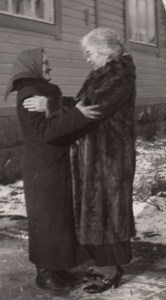 Greeting a woman in the Baltic States
 (OMS Archives)
Lettie had never met an Estonian before her wild voyage to Finland on the SS Kadir.
As one of the few people not overwhelmed by seasickness, she spent time in the kitchen. There, she befriended the Estonian cook and shared the gospel.
When an invitation came to visit the cook’s homeland, Lettie prayed and agreed to go.
As it turned out, Lettie met church members delighted to meet her. They believed God sent her in answer to years of prayer for revival.
She may not have understood the Estonian language, but Lettie recognized a thirst and hunger for the word of God in the eyes of the people she met.
The only answer was to order 100,000 copies of the gospel of John printed in Estonian.
And then given away.
As Lettie wrote later:
Where to next?Old men and women, tears streaming down their faces, took my hand in theirs and kissed it saying, ‘You have come to bring Jesus to us.’ I became theirs for the moment—an American Estonian.
Once Lettie began, how could she stop?
God called her to the nations, to speak to Every Creature.
While in Estonia, she traveled east to the border with the Soviet Union.
There, Lettie met 80,000 Russian natives who fled to Estonia to escape Communism.
Thousands died along the way from starvation.
Once again, Lettie shared a salvation message–and listened to weeping fill the hall.
With winter bearing down, Lettie made plans to provide the Gospel of John in Russian to the people she met in Estonia.
And then a large church in Stockholm invited her to speak.
Requests followed from Christians in Latvia, Poland, Romania, and Czechoslovakia.
Scriptures for European EvangelismWhere did Lettie find a publisher who could publish even a small portion of the Bible in so many different languages?
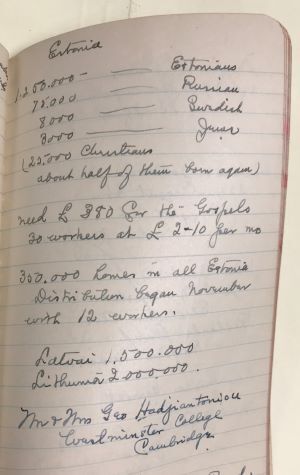 Lettie counted the costs (OMS Archives)
She turned to the Scripture Gift Mission in London.
(Now called Lifewords, the nonprofit organization was founded in 1888 and has produced Bible portions in over 1000 languages.)
After Lettie described her experience, the mission agreed to help. As one member said,
I see the hand of God outstretched to the Baltic States. You have been definitely sent there by Him. It sounds like the Acts of the Apostles.
The Vision Lives p. 160
A Baltic States Committee formed around her work. The Bible College of Wales assigned her a student secretary to take dictation, and Lettie embraced this new ministry.
While war clouds formed over East Asia and Hitler’s troops began to march, Lettie scurried to share the gospel.
Before she finally returned to the United States, Lettie Cowman instigated European evangelism efforts across the continent.
Several, like the Greek crusade, didn’t take place until after World War II.
But it all began . . . and this was only a beginning. . . from a God-inspired invitation from extraordinary intercessor Rees Howells.
Tweetables
A gospel distribution campaign in the Baltic states right ahead of Hitler. Click to Tweet
What motivated missionary Lettie Cowman in Europe prior to WWII? Click to Tweet
The post European Evangelism and Lettie Cowman appeared first on Michelle Ule, Author.
May 3, 2022
A New Mission, a Storm, and Glory!

Lettie Cowman launched a new mission in September 1936.
As noted in the previous post, directions for this new mission came from God.
But that does not mean it was easy.
Indeed, Lettie nearly lost her life following God’s lead.
You have to have provisions to launch a new missionLettie traveled to the Bible College of Wales during the summer of 1936 summer to speak at a conference.
Afterward, the president of the Swansea school, Rees Howells, directed her to pray “about something new” God wanted her to do.
She prayed for ten days and discovered God wanted her to bring the gospel to “every creature.”
When she met Sanfrid and Anna Matteson in the garden and they poured out their desire for her to come to Finland, Lettie agreed.
She might as well travel back to Finland with them–a week later.
But when she left her southern California home, Lettie hadn’t planned to spend the winter in Scandinavia.
In my life, I’ve learned that when God decrees you do something, He moves. If you don’t go with Him, you’ll be left behind.
The cargo ship SS Kadir captain gave her his cabin for the trip–the only free bed on the boat the Mattesons planned to take home.
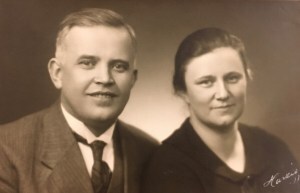 The Mattesons
 (OMS Archives)
Someone gave Lettie twenty pounds, then sufficient funds for her to purchase a wool coat with a cape, a hat, warm gloves, and leggings.
An old friend provided three woolen suits. A wealthy woman loaned Lettie a fur coat.
Rees and Elizabeth Howells drove Lettie, Anna, and Sanfrid to the Cardiff docks. The trio boarded the Finnish ship SS Kadir on September 23, 1936, and they sailed for Jackobstad, Finland.
At their going-away party a few nights before, Lettie sat at the piano to play and sing:
But you have to get to there before you can beginHow Sweet the thought that comes to me,
On mountain or on stormy sea,
There is no land or clime or zone
Where Jesus leaves His sheep alone.”
The Vision Lives p. 143
Cardiff to Jackobstad, by air, is 1100 nautical miles.
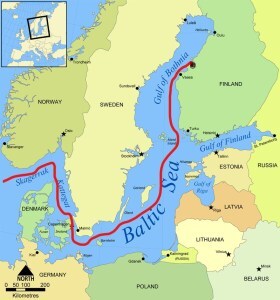 Expected route to Jacobstadt, Finland.
 (Map from Wikimedia Commons)
Even on an old cargo ship traveling around Scotland to the North Sea, thence the Baltic Sea for the Gulf of Bothnia, it should take eight days.
The trip through the North Sea caused seasickness in just about everyone except Lettie. Even the Estonian cook had trouble, but Lettie spent time praying for her.
Six hours before they arrived at Jackobstadt, a sudden storm blew up in the Gulf of Bothnia.
Huge winds and waves roared and raged.
Once again, the passengers and crews could scarcely control their seasickness.
Lettie, alone, handled it well and this time she sang hymns all on the ship.
No one on board had ever seen such a storm before.
As it turned out, many ships went down and the SS Kadir received many SOS messages.
The captain and crew didn’t leave the bridge for three days and nights.
Lettie and the Mattesons both wired simple prayer requests to the Bible College of Wales and the Matteson’s Finnish church: “Storm. Ship endangered. Pray.”
They did.
Unsure of what else to do, the captain finally anchored the ship and let it toss for two days and two nights.
Eventually, the storm blew away, the sun came out, and they limped to Jackobstadt.
Everyone agreed God had saved the ship–and their lives.
The new mission, or an Every Creature Campaign to FinlandTwo weeks after leaving Cardiff, Lettie arrived in Finland. She and the Mattesons went right to work.
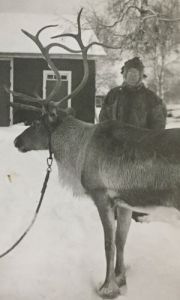 Lettie and a reindeer in Lapland (OMS Archives)
She spoke at her first gathering the evening after her arrival.
During the tranquil parts of their voyage, Lettie and the Mattesons mapped out a plan for Lettie to visit Finnish churches and speak whenever possible about Jesus.
She traveled all over the country, even as far north as Lapland.
Everywhere she went, Lettie described the Great Village Campaign her husband spearheaded twenty years before in Japan.
Enthusiastic groups of people met her everywhere, hungry to hear the gospel.
Setting out on a new mission was pure joy for an old missionary campaigner like Lettie Cowman.
And her photos showed why.
(For more pictures of the Lapland trip, see my Pinterest board about Lettie Cowman)
The time in Finland ended in Helsinki, where Lettie spoke at the Parliament Hall.
But, it was just the beginning of her ministry to Europe at a crucial time.
The third post will explain how important Lettie Cowman’s Eastern Europe Evangelism campaign really was.
Tweetables
The challenges and danger of setting up a new mission. Click to Tweet
Not even a massive storm could stop Lettie Cowman’s new mission. Click to Tweet
The post A New Mission, a Storm, and Glory! appeared first on Michelle Ule, Author.
April 26, 2022
How to Wait on God: a Cowman Case Study

What does it mean to wait on God?
How do you hear God’s voice and follow God’s direction?
Lettie Cowman provided a 1936 case study that touches Eastern Europe even today.
Rees Howells intervenesIn 1936, Lettie Cowman toured Oriental Missionary Society (OMS) ministries in Japan, Korea, and China.
She returned to her Hollywood, California base exhausted. Her doctor told her to end her traveling.
Except a letter awaited her from Bible College of Wales president Rees Howells. He asked her to be the keynote speaker that summer at his first Every Creature Missionary and Intercessory Conference.
She’d never met Howells before. She knew nothing of him.
But, as was her custom, Lettie decided to wait on the Lord for direction. She prayed about the invitation until she had peace that God wanted her to go.
Over her doctor’s objections, Lettie caught a train across the United States to New York where she boarded a ship to Wales.
Rees and Elizabeth Howells met her at the dock and took her to the school.
She told the OMS story of the Great Village Campaign over five nights to great interest.
But then Lettie’s story got interesting.
“Wait on God” until He tells you what to do.After the convention, Howells asked Lettie to remain in her room to pray. “We will send meals. God has something to tell you. ”
What does that mean? How do you wait on God?
Early in her Christian life, she’d learned the secret.
 Rees Howells
 (OMS archives)
Lettie spent hours reading her Bible and searching for answers to her questions. Her time of prayer and searching the Bible lay at the heart of her faith and confidence.
Lettie trusted that God would answer her question, but the answer had to “line up” with the truth of Scripture.
Asking questions and seeking answers—with plenty of verses in between—helped Lettie wrestle through a subject with the Bible on her lap and her heart open to hear God.”
The Visionary Behind Streams in the Desert (to be published in 2022)
Rees Howells presented her with an opportunity to step out of time for as long as she needed.
As Professor George P. Pardington explained:
Our hearts are like a sensitive photographer’s plate; and in order to have God revealed there, we must sit at His feet a long time. . . . Our lives must be quiet and restful if we would see God. The vision of God always transforms human life.”
Streams in the Desert, September 18
The answer surprised her.
Wait on God, yes, but how about a confirmation?At 6:00 am on Sunday morning, August 10, 1936, the Lord speaks:
“I sanctified thee a prophet unto the nations.” She sees that before she was born, God planned her life.
She is guided to Psalm 139. She is awed. Even in her ancestry God had her in mind. She wonders what it means to be ordained, “a prophet unto the nation.” It is too strange to take hold of all at once.”
The Vision Lives p. 134
But, when you wait on God and believe He’s given an answer, you need confirmation.
At six o’clock Sunday morning, August 10, 1936, she read in Jeremiah 1:5: “I sanctified thee, and I ordained thee a prophet unto the nations.”
The Vision Lives p. 135
Why that verse?
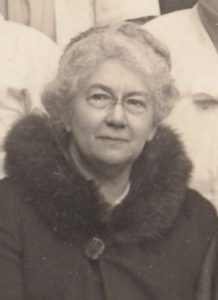 Lettie Cowman 1936
 (OMS archives)
Something about it jumped out to her.
Lettie finally left her room to attend the chapel service that morning.
A missionary took the pulpit and read from the Bible: Jeremiah 1.
The passage gave Lettie an inkling, but she didn’t know for sure. She asked the Bible college community to pray for her.
Lettie returned to her room with her Bible and her prayers.
Three days later, she told a physician, “God has been telling her she was to live now, not just for China, but for every creature.”
Lacking a clear path of how or what, Lettie continued praying and scouring her Bible.
An opportunity arisesThe following Sunday, after ten days in her room, Lettie took a stroll.
There in the beautiful gardens, she met a Finnish couple, Sanfrid and Anna Matteson.
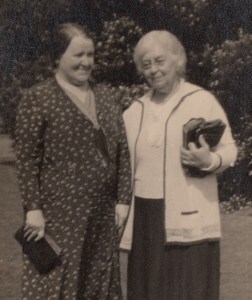 Anna Matheson and Lettie at the Bible College of Wales (OMS Archives)
They’d been praying, too.
They sat on a bench together for three hours as the couple poured out their burden for Finland after hearing about the Great Village Campaign.
The couple published and aided with Scripture distribution in Finland, and they worked with prisoners and the poor. They wanted to make sure every Finnish household had a copy of the gospel.
Could Lettie help make that happen?”
The Visionary Behind Streams in the Desert
As Lettie explained that night, her wait on God produced an amazing new commission: the evangelization of the world.
And the “glory of God came down on us all and we had a time of rejoicing.”
But when would she travel?
Just because you wait on God and accept the answer, doesn’t mean the way will be easy.
This is the first post of three.
Next post: Satan’s reaction to God’s new work.
Tweetables
What does it look like to “wait on God?” Click to Tweet
Practically speaking, how do you wait on God? Click to Tweet
Lettie Cowman demonstrates how to wait on God and get answers. Click to Tweet
The post How to Wait on God: a Cowman Case Study appeared first on Michelle Ule, Author.
April 19, 2022
Foot Washing, Humility, Betrayal, and Faith
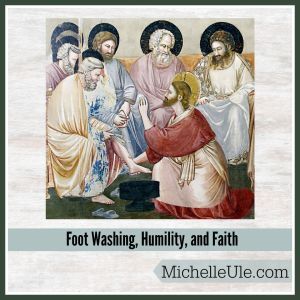
Foot washing and humility as elements of faith go together in my mind.
Along with Maundy Thursday’s remembrance of the Last Supper.
It also makes me think about forgiveness and choosing to do what is right–to love–over pragmatic personal concerns.
But where did the idea come from?
Foot washing, historically
Foot washing began as a practical gesture in Middle Eastern homes long ago.
According to the Encyclopedia Brittanica:
The practice of foot washing was originally an act of hospitality in Palestinian homes, performed for guests (who wore sandals and walked on dusty roads) by a servant or the wife of the host.
Britannica.com
People had dirty feet. Their feet may have hurt. Why not wash them off before hosting them in your house?
Offering water, whether to wash or to drink, symbolized proper hosting or greeting.
Think how lovely it feels to wash your feet after a long hard day.
When we lived in Hawai’i, people seldom wore shoes or sandals in the house. Many times we’d visit friends to find a pile of footwear outside the door.
(No one ever volunteered to wash our feet!)
Biblical examples of humilityThe first mention of foot washing is in 1 Samuel 25:41 when Abigail approached David.
 Maundy; Mosaic Icon ca 1100
(Wikimedia Commons)
He’d come to kill her foolish husband Nabal who refused to pay David and his men for their work.
When Abigail heard the news, she quickly rounded up servants and food, then rode to meet the angry men. As soon as she reached David, she slipped off her mount.
Richly dressed, she “bowed with her face to the ground and said, “Behold, your handmaid is a servant to wash the feet of the servants of my lord.”
It worked. First her her humility, humble offer, and then her gifts.
Many will remember Luke 7:37-40:
A woman . . . brought an alabaster flask of ointment, and weeping, she began to wet his [Jesus’s] feet with her tears and wiped them with the hair of her head and kissed his feet and anointed them with the ointment.
Luke 7:37-40 ESV
Humility and honor again.
And, of course, Jesus’ example prior to eating the Last Supper.
Did Jesus wash Judas’ feet?Yes.
When we read John 13 on Maundy Thursday, we usually pay attention to Jesus’s exchange with a reluctant Simon Peter.
Jesus told him, “If I do not wash you, you have no share with me.”
Peter immediately suggested Jesus pour water all over him!
But to get there, we read past this:
having loved his own who were in the world, he loved them to the end. During supper, when the devil had already put it into the heart of Judas Iscariot, Simon’s son, to betray him, Jesus, knowing that the Father had given all things into his hands, and that he had come from God and was going back to God, rose from supper. He laid aside his outer garments, and taking a towel, tied it around his waist.
John 13:1-6 ESV
Jesus knew Judas would report his location to Jerusalem’s Sanhedrin.
Judas left to do so shortly before dinner ended.
I thought about this exchange during Holy Week, enlightened by Dr. Eugenia Constantinou’s The Crucifixion and the King of Glory.
Jesus knew Judas was working with those who planned to have him crucified, yet, Jesus “loved him to the end.”
Even when Jesus handed Judas the dipped bread at dinner, he still loved him.
When Jesus saw Judas’s greed overcome his love, Jesus bid him go quickly.
Judas did.
In examining the Scriptures, we can see that while Judas has always received the bad press, the real “villains” were the Sanhedrin who had determined “it is better for you that one man should die for the people, not that the whole nation should perish.” (John 11:30, ESV).
Judas simply made it easier for them to arrest Jesus far from the Passover crowds.
I kept thinking about how Jesus knew and yet loved Judas anyway.
Parenthood often has similar mixed emotions.
Humility and faith in Romania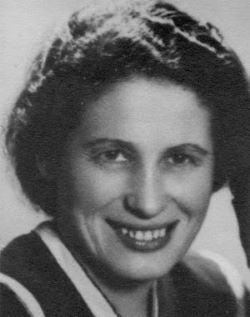 Sabina Wurmbrand
 (Voice of the Martyrs photo)
Which reminded me of a different setting–without foot washing.
In her memoir The Pastor’s Wife, Sabina Wurmbrand recounted how Jesus’s treatment of Judas applied to her small Bucharest home church.
“The clergy of the official church were under constant pressure to inform on congregations,” she wrote.
It soon became clear informers infiltrated the small group who met at her home.
I saw that there was spiritual significance even in this. Informers taught us that while we live we are constantly surveyed. Angels watch all we do and say; but they are invisible, so we do not care.
These informers reminded us that our every action counts.
The Pastor’s Wife, p 199.
So, how did she live knowing she might be turned in at any moment–and by people she tried to help?
Long before he went to prison, Richard Wurmbrand taught his wife a simple truth:
You can’t accept Jesus without accepting His disciples. He would not leave them to come to you. And you can’t accept the disciples without calling even Judas a friend, as Jesus did.
The Pastor’s Wife, p. 76.
Sabina Wurmbrand struggled with bitterness toward those who betrayed others in Romania and in particular those who betrayed her husband.
Peace about how to treat those who would betray her didn’t make sense until she remembered betrayers later thirsted for forgiveness.
Which I would not give them, which in my bitterness I witheld.
And with that thought something changed in me. I knew that even for saints a time may come when self-love is stronger than love of God . . . I resolved to give love and expect nothing in return.
The Pastor’s Wife, p. 222-223
Elsewhere, she commented,
I saw that in the original Greek of the gospel, Christ is “Christos,” which is almost identical with the word chrestos, meaning gracious. We cannot think of Him in any other way. Grace and forgiveness are in His very title.
The Pastor’s Wife, p. 114.
Sabrina Wurmbrand washed feet with her mind, not her hands.
Washing feet, forgiving, choosing not to be offended Photo by Michael Held (Upsplash)
It’s hard to follow Jesus in all things.
It’s hard to forgive.
Washing feet, choosing to be humble, deciding not to be offended, forgiving–all are hallmarks of Jesus’s followers.
He showed us how when he loved Judas.
It’s humbling to realize Jesus knows our souls to their depths and loves us the same way he loved Judas.
And we don’t even have to hand him a towel.
Tweetables
Foot Washing, Humility, and Faith; Jesus in the past, the rest of us today. Click to Tweet
How faithful and humble do you need to be to wash feet? Click to Tweet
The post Foot Washing, Humility, Betrayal, and Faith appeared first on Michelle Ule, Author.