Michelle Ule's Blog, page 15
March 28, 2023
Visiting an Antiquities Dealer in 2022

What’s it like to visit an Antiquities dealer?
Shades of Amelia Peabody! I was curious, but also suspicious.
And what a surprising turn of events that visit in fall 2022 proved to be.
At the Antiquities DealerWe walked a few blocks from Jerusalem’s Garden Tomb, turned down a pretty lane, and knocked on an ancient door.
The antiquities dealer (Dealer) smiled and invited us in.
I’d tagged along for curiosity’s sake. When I think of antiquities dealers, particularly in the Middle East, my mind flashes to Elizabeth Peter’s archaeology novels straddling the 19th and 20th centuries in Egypt.
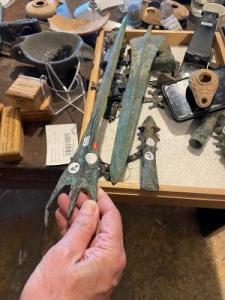 First-century Roman knife blade
(all photos by author)
Written as a parody of Rider Haggard’s novels, Amelia Peabody and her dashing husband Emerson Radcliffe constantly foiled “bad guy” antiquities dealers.
I was a journalist on this outing–as I told our host. He said I could ask all the questions I liked.
While I took my seat, the three men with me (husband, friend, guide) accepted glasses of whiskey, and we settled in to talk.
What were we seeking?I’m not sure how this outing occurred. Dealer (I didn’t write down his name) was a friend of our guide’s and M. thought several of us would find this an interesting experience.
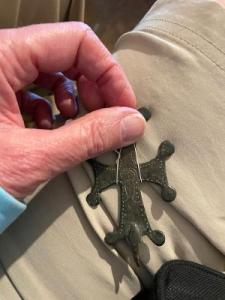 13th century Byzantine century cross.
Perhaps S. sought an item. I didn’t know. R and I were not looking.
At least I didn’t think so.
Still, I marveled at chatting in a dusty room full of items the like of which I’d never seen outside of museum displays.
While I’m not exactly a stranger to historic items, I usually wear white curator gloves in a library. I’ve never touched an object more than 200 years old.
Here, though, the dealer casually handed me an 11-13th-century Byzantine cross.
What is an antiquities dealer?While the men sipped their whiskey, I asked questions.
(For the record, I identified myself as a journalist. He gave me permission to ask questions and quote him.)
Born and raised in Scotland, the dealer studied archaeology and history. I smiled at his Scottish-accented English with an Arabic lilt.
After he graduated 40 years ago, the dealer moved to the Middle East where he’s been ever since.
Why?
“The game’s the thing and if you enjoy the game, that is everything. I’m a hunter,” he shrugged. “I enjoy the hunt. I make a little money.”
He kept handing us ancient items to inspect, commenting, “That’s from the Iron Age first temple period; there’s been some restoration.”
First temple period? That makes it at least, at least, 2500 years old.
The dealer buys the antiquities from bona fide dealers he knows throughout the world. His reputation is wide—he brokered the sale of important archaeological items to libraries and museums.
After he inspects an item and buys it, he doesn’t clean it. “I leave them the way they are. That enables the buyer to see exactly what they are purchasing.”
“Do you have anything younger?”I worried about holding something so old and dropping it.
R suggested we sought something “younger.”
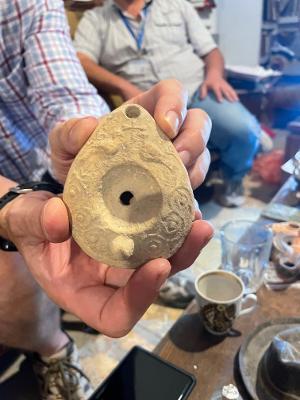
The dealer brought out clay “slipper lamps” for our inspection. Israeli, Syrian, and Jordanian-made 1500-or so years before, they’re still usable with a cotton wick and olive oil.
Called “slipper lamps” because of their shape, the dealer explained their only true value is for education. He bought the one on the left (below) north of Jerusalem in Ramallah.
He pointed out the unique cross signified “the light of Christ shines to all.”
The decoration indicated it was made in the Holy Land, probably during the fourth or fifth century. (Or after Roman Emperor Constantine became a Christian circa 312).
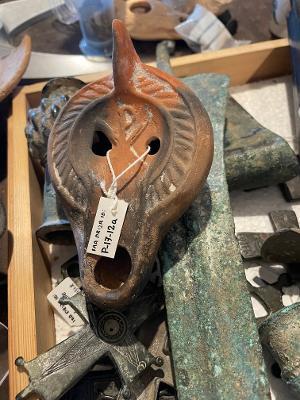
“After that time, people were able to display Christian symbols openly,” the dealer explained.
Previous to that, Christian symbols invited persecution.
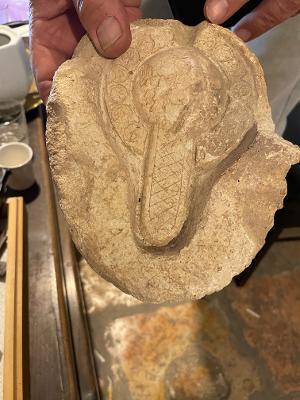
The middle item is a clay lamp mold made about the fourth century BC in North Africa. He called it “red slip wear.”
The slipper lamp on the right, casually sitting on ancient metal crosses and an eighth-century bronze blade, came from Tunisia, and sports a Christogram (a mark that forms an abbreviation for Jesus Christ).
“Inscriptions are the most important item in aging things,” Dealer laughed. “Nothing comes with a sign attached saying, ‘made in 784 BC.'”
“What about forgeries?”
He gazed at me, weighing his words. “I never sell a forgery, but I give them away.”
The Antiquities Dealer makes some deals.S. made a few purchases, and then to my surprise, R picked up a clay lamp. “How much is this?”
I looked at him over the top of my glasses.
“It’s an open-mouth pinch lamp from the first Temple. It would have been made 500-1000 BCE.” He shrugged. “$150.”
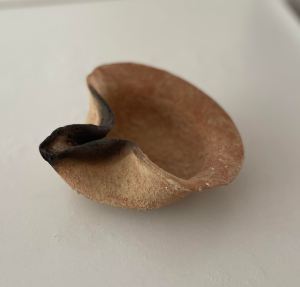 Basically, a light bulb
Hmm. The dealer and I were the only people not drinking whiskey.
R bought it. “A housewarming gift. And you’ll get a story,” my husband added.
He’s used it at church ever since as an object lesson and a wonder to Sunday school kids and adults alike.
He refers to it as an “ancient light bulb,” and lights it using olive oil and a piece of cotton shirt.
The final item sobered me.Archaeologists digging through through the rubble of the 586 BC destruction of Jerusalem by the Babylonians, made an interesting discovery.
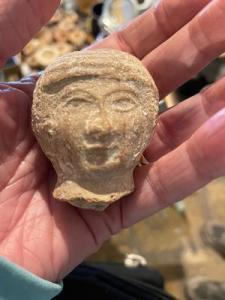 Ashtoreh head from Jerusalem rubble
 According to the antiquities dealer, every household owned one of these idols: Sidonian goddess Ashtoreth.
I have no way of proving his comment, but it’s troubled me ever since.
Every household? All the Jews practiced syncretism?
What we leave behind can define us.
Visting an antiquities dealer left me examining my own household items more critically.
Other than the pinch lamp, however, I don’t think anything else we own will last 2700 years.
Tweetables
What’s it like to visit a Middle East antiquities dealer? Click to Tweet
What if I dropped a lamp made 2700 years ago? Click to Tweet
The post Visiting an Antiquities Dealer in 2022 appeared first on Michelle Ule, Author.


March 21, 2023
The Value of a Mystery Novel

What’s the value of a mystery novel?
I understand entertainment, but why a mystery?
What makes such a book satisfying?
I think I know the answer. Let’s see if you agree.
The Best Mystery Novel of the 20th Century–-Who dunnit?Bookbub and Goodreads agree: Agatha Christie’s And Then There Were None.
(This book was called Ten Little Indians when I read it as a teenager in the Dark Ages).
The style has been copied often over the years–a group of people locked up somewhere together (or on an island, or a snowbound train, or a ship on the Nile). One by one, they are killed off with the heroic detective (male or female), figuring out the case by the end.
Arthur Conan Doyle’s The Hound of the Baskervilles holds second place.
(Frankly, I prefer my Sherlock Holmes stories as told by Laurie R. King in her Mary Russell [or Mrs. S. Holmes] series.
Notice what happens in these stories. You have a mystery wrapped in a death and solved by one super-wise detective.
While we, the readers, travel along pages in time watching a story unfold, our stomaches clench, and our brains struggle to guess, we turn a corner and . . . it all resolves.
And when we review the story, we can see how it all makes sense.
Congratulate yourself.



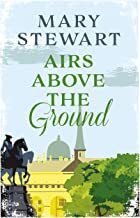 Comfort novel mysteries
I’ve written before about a terrible accident when my husband was out to sea.
I had no one to comfort me. The toddlers who went to the hospital in an ambulance needed me to comfort them.
My husband didn’t learn about the horror until three weeks later.
In trying to process that time, I read and reread one Mary Stewart mystery novel after another.
I hadn’t read them since my teens, and yet a dozen years later, they comforted me, particularly Airs Above the Ground.
The hero was just as maddeningly logical as my husband.
It felt very familiar–and helpful to read–as the analytical husband comforted the semi-hysterical wife.
And the resolution? The bad guys were revealed, the family restored, and they all lived happily ever after.
Entertaining History?Reviewing a list of mysteries I’ve enjoyed over the years, I see an interesting correlation.
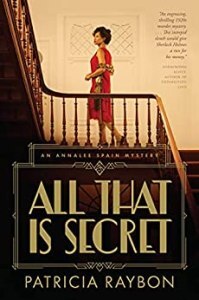
Patricia Raybon’s All that is Secret involves an African American female seminary professor in 1923 Denver.
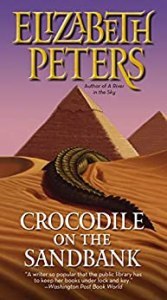
Elizabeth Peter’s Amelia Peabody takes on antiquities dealers in Egypt 1890-1915.
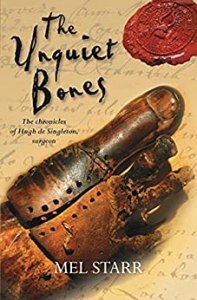
In far-too-busy February and March 2023, I read all fifteen books in the Hugh de Singleton Chronicles by Mel Starr.
This satisfying series takes place in a 14th century village not far from Oxford. I learned a lot about Medieval life, including food dress, health customs, influence of the Catholic Church and pre-Reformation ways of murdering people.
From these books–I’ve read all the Amelia Peabody and Mary Russell novels, also– I not only enjoyed a satsifying mystery, but I learned a great about the times, culture, and historic events.
Painlessly.
Unless you were the victim, of course.
 Learning about new places through another’s eyes?
I liked Nevada Barr’s mysteries set in national parks–many of which I’d visited.
A strong clever woman using forensic skills in nature provided a new twist on a classic tale.
(I was shocked to learn how firefighters save themselves when overrun by a wildfire, for example).
But, I decided never again to read one while actually traveling to that national park.
It was one thing to read about exploring a “wild” cave in Carlsbad Caverns, but then to hike through one and have the guide turn out the lights?
Sitting in the dark that day and terrified to move, I’m glad I knew Blind Descent resolved with our favorite park ranger battered but alive.
We got out safely, too, of course.
So what IS the value of reading a mystery novel?
A mystery novel can teach us about times long ago. We can learn police procedures and about unique cultures. The step by step logic so many detectives employ demonstrates how to think in orderly ways to reach conclusions.
They can entertain us, comfort us, expose up to clever humor.
But good, satisfying mysteries have one thing in common.
The good ones, the ones worth reading, all resolve with a surprising, but satisfying way.
And when you close the book, all looks right in at least one (fictional) world.
Suggest another book series I should read.
Life is still a little crazy around here.
But, thanks be to God, I know how it ends.
Tweetables
What’s the value of a mystery novel? Click to Tweet
Comfort novels, Who dunnits, & historical fiction mysteries. Why read them? Click to Tweet
The post The Value of a Mystery Novel appeared first on Michelle Ule, Author.
March 14, 2023
Darkness and the People Who Walked in It.

Who were “the people who walked in darkness,” according to Isaiah?
And when, specifically, did they live?
Isaiah referred to a time between Malachi and Matthew–and perhaps beyond.
But who were they?
Generally speaking, those who lived in Judea–those who had no shepherd.
But during those 500 silent years between Malachi and Matthew, the high priest and Sanhedrin ruled in Jerusalem at the Temple. Surely, they were the shepherds of Israel?
Technically, yes. Spiritually, in terms of the attitudes of their hearts, probably not.
And as a result, everyone–Jews and Gentiles– walked in darkness.
Many still do.
What is darkness?Biblical concept:
Apart from its literal meaning, darkness often has a figurative meaning in the Bible. Its most common figurative usage is as a symbol for evil.
This symbolic usage is natural, for wrongdoers prefer darkness to light. It enables them to carry out their wrongdoing more easily.
Bridgeway Bible Dictionary
 The way is dark if you don’t know how to see or you lack a light. Photo by James Kovin (Unsplash)
“And God saw that the light was good. And God separated the light from the darkness.” (Genesis 1:4 ESV)
“He will guard the feet of his faithful ones, but the wicked shall be cut off in darkness.” (1 Samuel 2:9 ESV)
Here’s the basic English definition:
Sightless.Without knowledge of certain facts that could serve for guidance or cause bias.Strong’s Concordance provides a Hebrew definition:
חֹשֶׁךְ chôshek, kho-shek’; from H2821; the dark; hence (literally) darkness; figuratively, misery, destruction, death, ignorance, sorrow, wickedness:—dark(-ness), night, obscurity.
But the Bible is also full of good news:
The Lord opens the eyes of the blind. He lifts up those who are bowed down; the Lord loves the righteous. (Psalm 146:8 ESV).
(Strong’s Concordance translates this as the physically blind.)
Jesus arrives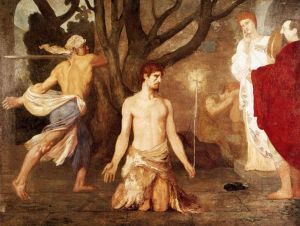 The Beheading of St John the Baptist by Pierre Puvis de Chavannes (Wikimedia Commons)
John the Baptist was the forerunner to the Messiah–whether the residents of Judea realized it at the time or not.
He, of course, baptized Jesus.
John also criticized those in power who preferred the darkness of their sins and personal life to redemption by the Messiah.
For pointing out that fact, John died in Herod’s prison on the east side of the Dead Sea.
When happened after that?
[Jesus] departed to Galilee . . . and dwelt in Capernaum . . . that it might be fulfilled which was spoken by Isaiah the prophet, saying:
“The land of Zebulun and the land of Naphtali, By the way of the sea, beyond the Jordan, Galilee of the Gentiles: The people who sat in darkness have seen a great light, And upon those who sat in the region and shadow of death Light has dawned.”
Matthew 4: 12-17; NKJV
In this context, the Isaiah passage indicated the “great light”–seen by people who had been in darkness–was Jesus.
So what does it matter?If people do not know they live in the dark, they cannot “see” what they lack.
(That does not mean they cannot sense they lack something, but if they don’t know the light exists, what are they to do?)
Many people in Judea of the first century knew they had no Messiah. They knew their nation and even their religion was dominated by Gentiles–who by definition did not know the light of their Jewish faith.
Unfortunately, their Jewish leaders–the Sanhedrin in particular–did not, either.
When Jesus arrived in Capernaum and began to preach throughout the area, people could see the contrast between a faith that had no affect on their lives, and one that healed them.
Everything changed. (Especially if you could walk again, or even SEE again).
They didn’t live in darkness, apart from their God, anymore.
Darkness and Religious Leaders Read the post here
Like any devout Jewish man of the first century, Jesus visited Jerusalem and the Temple at least three times a year.
In year 12 AD or so, Jesus (perhaps having recently celebrated his bar mitzvah) dazzled the scholars in the Temple with his insight and wisdom. (See Luke 2:41).
Does it make sense that the Temple scholars that year would forget the boy from Nazareth?
If it were you, wouldn’t you have noticed him, and perhaps watched for his return visits?
Scripture doesn’t tell us, so it’s not important, but I’ve always wondered about those scholars. Surely they saw something unusual about the young Jesus.
Regardless, they must not have been in leadership positions that final Passover week when Jesus returned to Jerusalem on a donkey and eventually went to the cross.
But, what did Jesus do during that holy week? Didn’t he reach out to people locked into their personal and/or political darkness?
As you can read in this post, Jesus spent the last week of his life trying to removed the spiritual blinders from those Pharisees, Sadducees, and others in authority in Jerusalem.
He loved all the Jews that much. He wanted them to be with Him in Paradise.
Do people still walk in darkness today?Unfortunately, yes, but do they have to?
Remember?
 Christ the Redeemer
 Photo by Joshua Woroniecki (Unsplash)
On that Good Friday in AD 33, or so, darkness fell all over the land from the sixth to the ninth hour.
Then Jesus died.
And the temple veil–separating the Holy of Holies from everyone else–tore in two.
Remember what He said?
“I am the light of the world. He who follows Me shall not walk in darkness, but have the light of life.” (John 8:12; NKJV)
No one has to walk in darkness any more.
Thanks be to God.
Tweetables
According to the Bible, who walked in darkness? Click to Tweet
The people who walked in darkness and Jesus. Who were they? Click to Tweet
The post Darkness and the People Who Walked in It. appeared first on Michelle Ule, Author.
March 7, 2023
Juji Nakada’s Ministry to One=Eternal Results
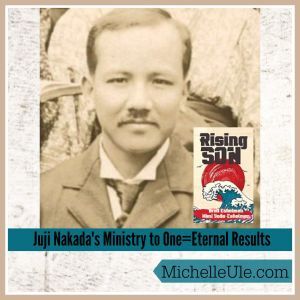
Juji Nakada’s ministry to one man led to eternal results.
It wasn’t just one man, of course, and many are in heaven today.
Others still minister on earth 85 years after Nakada’s death.
But, I recently read Rising Son by Brett and Mimi Yoda Eshelman, describing Nakada’s ministry to one man and how that affected the man’s son (and his granddaughter, Mimi).
The book also provides insight into how Nakada and the Oriental Missionary Society’s (OMS) Bible Training Institute (BTI) in Tokyo worked, circa 1915.
A poor man in Tokyo: Toyoshichi YodaRising Son opens with a Japanese man standing on a tower waiting for American planes to bomb Japan in 1942.
A lone watchman, Toyoshichi Yoda was a Christian pastor pressed into service throughout the war.
 Yoda family 1930s (Son Terry on right). (Eshelman family)
He spent his 12-hour shifts praying for his country, his people, as well as the men in the planes attacking his country.
He also prayed for his son, a fighter pilot against his will in the Japanese air force.
Yoda had good reason to pray. Fire bombing Japan would destroy many homes and buildings; many people would die.
How did Yoda become a Christian pastor?
Through Juji Nakada’s ministry 27 years earlier.
It began when a Christian man fed a hungry boy.
1912 Japan (Kofu)The Oriental Missionary Society began in Tokyo in 1901. Co-founder Juji Nakada’s ministry focused on local evangelism. Without his “fiery evangelism,” the OMS efforts would not have reached so many Japanese nationals.
Eleven years later, a starving orphaned Toyoshichi Yoda met a street evangelist handing out tracts while others stood nearby singing.
The evangelist saw the teenage boy needed food and purchased three bread rolls for him.
As Yoda devoured the food, the evangelist explained,
I will give you another, but first I want to tell you about a man that offers you, ‘bread of life.’ . . . there is the one I spoke of who wants to give you a different kind of food, so you will never hunger again.”
Rising Son p 12
He handed Yoda a pamphlet as well as more bread, explaining, “If you want to know more about this bread of life, come to the place on this paper and we’ll tell you much more about a new life for you.”
Yoda took both and watched the “crazy singing people,” walk away.
He shook his head and walked in the opposite direction as it began to rain.
Finding a dry and secure spot under the stairs of a small house, he fell asleep.
Yoda woke to the sound of “crazy people,” singing. He’d sheltered at a small meeting house.
“So you found us,” the man said . . . “You were supposed to go up the stairs, rather than go under them.” (Rising Son p. 15)
They invited him in and fed him. When he tried to slip away, an old lady stopped him, and gave him more food.
He never returned and never saw them again, but their generosity and the love in their eyes remained in his memory. Yoda had not felt wanted in a long time.
Nakada’s ministry to Yoda in 1915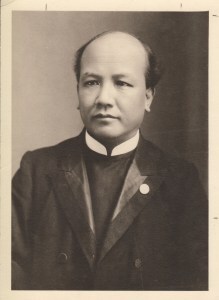 Juji Nakada (OMS Archives)
Yoda’s life improved after meeting the Christians.
Three years later, while strolling through Tokyo streets after work, he saw “crazy singing people” again.
This time he followed them and their band all the way to a tent meeting where a handsome short man in a western suit greeted them.
Yoda sat beside a kind man he knew from his job. The crowd sang a song he didn’t know, that included the words, “Praise God from whom all blessings flow.”
Then the handsome man spoke, “A special thanks to you who have come for the first time. We trust that this will be a life-changing moment for you. For those who do not know me I am Juji Nakada, and I have a message for you.”
Rising Son p. 38
He talked about Jesus, who died and then rose from the dead.
Yoda shook his head, not understanding why people were crying and coming to the altar at Nakada’s invitation. They were “crazing singing people.”
But Nakada’s words captured Yoda’s imagination. The young man returned after work night after night, until the final evening of the revival meeting.
That night, Nakada told the story of Nicodemus meeting Jesus and learning he needed to be born again.
Nakada gave an invitation, “Is there anyone here who has heard the voice of the Savior and would like to be born again?”
Before he knew it, Yoda stood and went directly to the altar.
There, he met the bread of life as his Savior.
Afterward, “Nakada-Sensei,” invited Yoda and several others to dinner.
Yoda soon found his way to the Bible Training Institute and a life in the Nazarene Church of Japan.
Rising Son and the Yoda Family Toyoshichi Yoda
While Rising Son provides a glimpse into Christianity and Juji Nakada’s ministry in Japan during the first two decades of the 20th century, it’s really the story of Toyoshichi’s son Terry–an earnest Christian caught in the Japanese Imperial Army.
Terry Yoda’s story is fraught with danger, surprises, hardship, and coincidences that saved his life throughout WWII. After the war’s end, Terry attended university and seminary in the US and eventually served as a Nazarene pastor in Japan until his early death in 1973.
His father’s prayers spoken on that watchtower for four years made a difference for Terry and for those who loved him and Terry’s ministry.
But all would have been for naught without Toyoshichi Yoda hearing salvation proclaimed through Juji Nakada’s ministry so many years before.
As Lettie Cowman’s biographer (a co-founder of the Oriental Missionary Society), I read about Nakada’s evangelism skills in many books and articles.
Rising Son, however, first gave me a glimpse of the man in action.
Though, of course, many others were changed as a result of hearing Nakada’s ministry over 35 years.
Take Korea, for example.
Ah, that’s a blog post for another day.
Tweetables
A Japanese man hears Juji Nakada–and lives change. Click to Tweet
Juji Nakada and an altar call’s result. Click to Tweet
The post Juji Nakada’s Ministry to One=Eternal Results appeared first on Michelle Ule, Author.
February 28, 2023
Jesus’ Ministry North of Galilee
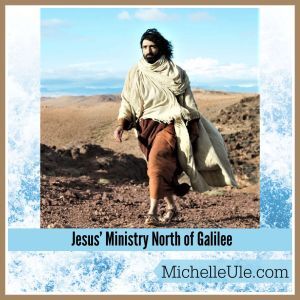
Did you know Jesus spent time ministering north of Galilee in Israel?
We all know about Jesus preaching and healing around the Sea of Galilee.
That’s where most of his ministry took place outside of Jerusalem and the Judean hills.
But when we think of Jesus walking the earth, do we picture him in the mountains north of Galilee?
I was surprised to discover during a recent visit to Israel that it never occurred to me Jesus would have walked away from the seashore up into the hills.
(I know it’s obvious in hindsight, but until last fall I thought he stayed near the water!)
But where did he go?
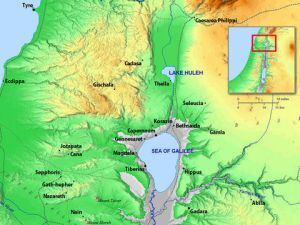 Map courtesy of Biblos.com (Bible Hub)Visiting all the villages north of Galilee
Take a look at these verses in the Gospel of Mark:
Jesus went on with his disciples to the villages of Caesarea Philippi. And on the way he asked his disciples, “Who do people say that I am?” They told him, “John the Baptist; and others say, Elijah; and others, one of the prophets.”
He asked them, “But who do you say that I am?” Peter answered him, “You are the Christ.” He strictly charged them to tell no one about him.
Mark 8: 27-30
You can read the passage, as well, in Matthew 16:13-20.
Generally speaking, Caesarea Philippi, is now the area called Banias.
(Known as Caesarea Philippi during Jesus’ lifetime because Philip the Tetrarch founded his administrative capital there).
There, Jesus stood in front of “the cave of Pan,” or “the gates of hell,” and asked his disciples who people said he was.
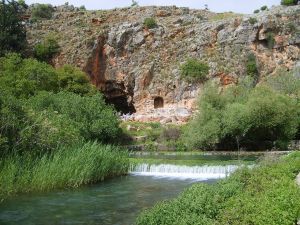 The Cave of Pan–or the Gates of Hell; Banias Park (Photo by gugganij, Wikimedia Commons)
The headwaters of the Jordan River flowed down from Mt. Hermon and came out of the cave to flow south (ultimately to the Dead Sea).
But note the text refers to villages in the area.
(Historian Josephus estimated the Galilee region boasted about 200 villages during the years Jesus lived there).
Caesarea Philippi is a hilly region about 25 miles north of the Sea of Galilee, home to many Greeks and Romans.
ALL the villages?We can assume he visited mostly Jewish villages since Jesus usually began his visits in the synagogues.
(To have a synagogue, a village needed at least 10 Jewish men).
While traveling toward Mt. Hermon in 2022, the furthest area north of Galilee, our guide pointed out Jesus and his disciples moved among the villages tucked into the valleys and on the hills.
Jesus went throughout all the cities and villages, teaching in their synagogues and proclaiming the gospel of the kingdom, and healing every disease and every affliction. When he saw the crowds, he had compassion for them, because they were harassed and helpless, like sheep without a shepherd.
Matthew 9:34-36 ESV
We looked over the ruins of the Gamla (or Gamala) fortress and could make out the ruins of a synagogue just inside the gate.
If there was a synagogue, Jesus came here.
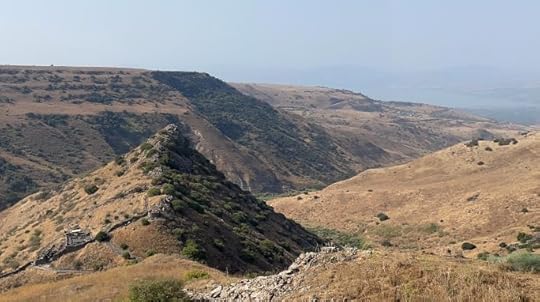 You can just make out the gate in the bottom left where a synagogue once stood. We’re on the far northeastern end of the Sea of Galilee. (Author photo)
Gamla, as it happens, is on the road to the most northeastern corner of Israel–Mt. Hermon.
As the highest mountain in Israel, Mt. Hermon is one of the two possible sites of the Transfiguration.
From the Gamla region, it’s possible, “after six days Jesus took with him Peter and James, and John his brother, and led them up a high mountain by themselves.” (Matthew 17:1; ESV)
It’s about 40 miles between the two and it could take that long to walk so far and up so many hillsides.(Mt. Hermon would be in the top right corner–or off the corner–of the above map.)
What about the seaside north of Galilee?Jesus and the disciples worked hard during their ministry north of Galilee.
They climbed mountains (Mt. Hermon is about 9200 feet), hillsides, and crossed wide valleys.
People flocked to hear Jesus–many seeking healing or other ministry.
With just a few exceptions, Jesus healed them all.
One day, Jesus and his men visited Tyre.
From there He arose and went to the region of Tyre and Sidon. When He entered a house, he wanted no one to know it, but He could not be hidden. For a woman whose young daughter had an unclean spirit heard about Him, and she came and fell at His feet.
Mark 7:24-25
Tyre is up on the Mediterranean Sea, now in Lebanon, about 40 miles northwest of the Sea of Galilee. Sidon is 40 miles further north, also along the coast.
Jesus’ fame spread to that region, and many came from the area, later, to receive ministry from him.
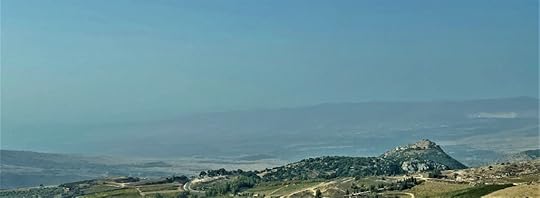 That’s Nimrod’s Castle, 3/4 up Mt. Hermon. The Mediterranean Sea is on the other side of those mountains to the west. (Author photo)How far did Jesus travel?
Two thousand years ago during their ministry years, Jesus and his disciples walked everywhere. (Well, except for when Jesus rode a donkey into Jerusalem during Holy Week.)
Fit men in their prime, they still dealt with heat and dust, pebbles in their sandals, and thirst.
We know they traveled as far north Sidon and as far south as Jerusalem, about a 150 mile stretch.
It’s probably seventy miles as the crow flies between Sidon and Mount Hermon.
Jesus’ travels were not about visiting and touring. He came to set the people free.
That includes you and me.
Some things never change–despite the distance in place and time.
Israel turned out to be much smaller than my husband and I thought–in 2022.
Tweetables
How much territory did Jesus cover when he walked the earth? Click to Tweet
Did Jesus only minister around the Sea of Galilee region? Click to Tweet
(Top photo courtesy of www.LumoProject.com)
Thanks to all who entered the “For the Love of Books” Giveaway two weeks ago.
The winners were:
Becky L. of Michigan (All the books)
Gift card: Penny L. of Georgia
Book-related gifts; Kim R.
The post Jesus’ Ministry North of Galilee appeared first on Michelle Ule, Author.
February 21, 2023
What is the Purpose of Lent?
 He’s risen–the purpose for Lent
What is the purpose of Lent?
You know, the Lenten season that runs from Ash Wednesday (February 22 in 2023) to Easter Sunday’s glory six weeks later (April 9)?
Basically, it’s for Christians to prepare their hearts and minds for the celebration of Jesus rising from the dead.
I’ve written a number of posts about Lent, Holy Week, and Easter over the years.
This post will provide overviews.
The purpose of Lent in the Christian churchMany liturgical churches use the Lenten season to prepare our hearts and remember just what we celebrate on Easter Sunday.
Many denominations use it as a time of repentance and preparation.
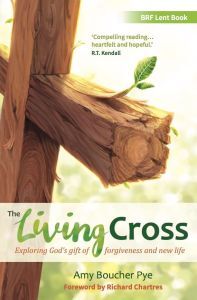
Traditions evolved over the years and generally use these forty days as times of fasting, contemplation, or specific devotions focused on Jesus and his ministry.
We honor Good Friday with a Tenebrae service at our church.
Author Amy Boucher Pye wrote a devotional and uses an object lesson to help families honor the Lenten period.
Some church traditions involve “giving up items” for Lent.
“Fasting” from meat, or choosing not to do something, or eat something on specific days, can serve as a reminder of Jesus’ sacrifice on our behalf.
Of course, we can always give up sin for Lent.
Or at least try to.
The idea is that when you want to eat a specific food, or do a specific item, you use the time instead to meditate on Jesus’ suffering, or to contemplate his sacrifice on our behalf.
It can also be a time of unification as churches hold Lenten services or, in our Lutheran Church, potluck dinners.
Some Christians spend their time viewing and praying through the Stations of the Cross.
During the COVID shutdown year, my church presented A Holy Week Walk–outside.
What does the word Lent mean?The 40-day period called Lent comes from an old English word meaning ‘lengthen.’
First recorded before 900; Middle English leynte, Old English læncte “spring, springtime, Lent,” literally, “lengthening (of daylight hours)”; cognate to Dutch and German meaning “spring” (only English has the ecclesiastical sense).
Dictionary.com
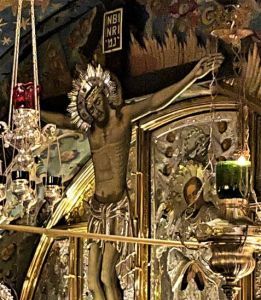 Jesus at Church of the Holy Sepulcher (Author photo)Holy Week and as the real purpose for Lent
The first five weeks of Lent are preparation for the final Holy Week.
Jesus spent his last days in a human body walking through Jerusalem and ministering to the populace.
You can read the specific daily events of Holy Week here.
I’ve written about the following topics:
Why Raise Lazarus From the Dead?
What Did it Take to Kill Jesus?
Post-Easter Weeks with Jesus’ Disciples
Time to consider other ways of thinking about Lent and Holy Week?The week before Holy Week in 2022, I heard Dr. Jeanie Constantinou interviewed on the Eric Metaxas Show. Before the show even concluded, I ordered her book.
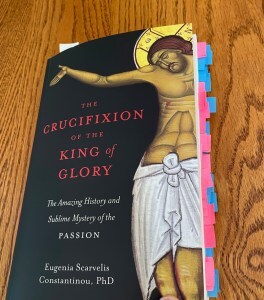 It’s like confetti!
When it arrived three days later, I read it immediately. (See all the tabs?)
I then jettisoned my planned Bible study, copied all the pertinent parts from my tabs, and put together a 23-page paper full of notes.
I presented that to my study in 90 minutes three days later.
It changed how I view the week, awed–yet again–by Jesus’ death on the cross, and left me marveling at what a gracious God we serve.
I’m teaching adult Sunday School this week out of those same notes.
My post describing the book: The Crucifixion in all Jesus’ Glory
We have to trust what the Holy Spirit guides us as we prepare for Lent, Holy Week, and Easter each year.
This book, and other devotionals and writings–not to mention the Scriptures–presents us with the enormity and purpose of Holy Week.
But not just Holy Week.
Jesus, himself.
Blessings to all readers as we contemplate just who the Messiah is and what he did on our behalf.
Tweetables
What is the purpose of Lent? A list of posts and books to contemplate. Click to Tweet
How to think about Lent, Holy Week, and Easter. Click to Tweet
The post What is the Purpose of Lent? appeared first on Michelle Ule, Author.
February 14, 2023
Book Romance? One Woman’s Favorites

Do I like book romance stories?
Yes and no.
I’d like to think my taste has improved over the years as I’ve lived through lots of personal romance.
And books.
Since the post goes live on Valentine’s Day in 2023 and I’m part of a related giveaway, I’m highlighting several of my favorites in the book romance category.
Book romance connected to life experiencesLong ago my husband was out to sea (of course) when a terrifying accident occurred.
Our two toddler sons, me, and his mother were in a terrible head-on crash–at our driveway’s mailbox.
It happened to be New Year’s Eve–and we had not seen him in over a month.
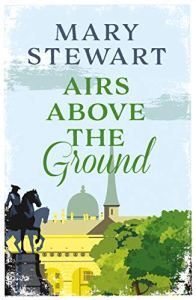 A modern cover!
I did not know when he would return.
After the rides to the hospital, my mother-in-law returning home in pain for the rest of her life, and our car destroyed, life returned to a new “normal.”
I had no husband to hug me and tell me everything would be okay.
Instead, I had Mary Stewart novels to comfort me.
Airs Above the Ground provided the book romance and comfort I needed during that time.
The dialogue reminded me of the banter I missed and needed so much.
So, I reread the pages over and over again.
Romantic?
Maybe not to others, but it helped me.
Sharing Books with your Romantic Interest is even more fun!Of course, sharing a romantic book with my engineer husband is even more fun.
We love Nevil Shute novels.
 Our copy
And why not?
The heroes are always engineers–with perfectly capable love interests who meet them half-way.
That would be us.
“Pure romance,” I always say. He laughs.
(Who can forget A Town Like Alice?)
We also read all the Poldark stories a very long time ago–vying over who would finish one so the next could start it.
Book romance–and a movie, too?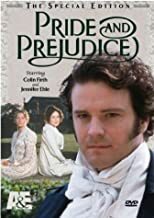 Doesn’t everyone own a copy?
Hand’s down–the obvious choice.
A&E’s Pride and Prejudice for the movie (1995).
I love it, too, but I also really like Persuasion–after all, the hero is a naval officer . . .
My husband loves Jane Austen and has read her books far more times than I have!
What’s a guy romance?Years ago, he explained the concept of a “guy romance,” and even wrote a blog post about it here.

To his credit, my Engineer wrote the post as an explanation of why he loved my Navy-SEAL novel, Bridging Two Hearts.
He likes to point out a guy romance is a book wherein our hero runs into a damsel in distress–who is distressing.
(Okay, I wrote the book, so it probably isn’t fair to include it. In fact, see A Poppy in Remembrance, for a more mature male romantic lead. BTW, my guy’s a far better man than the heroes in those novels!)
Other book romances–nonfiction?I love nonfiction and memoir, and of course, romances that actually occurred are memorable as well.
One of my favorites, which I read as a new Navy wife, was James and Sybil Stockdale’s In Love and War.
I didn’t realize then, but it was preparing me for the next 20 years. Sybil Stockdale left me a tale of dedication I needed to remember time and again.
And you know? After all these years, a long marriage is more romantic to me than any book romance.
Happy Valentine’s Day
Tweetables
Book romances that never grow old. Click to Tweet
Guy romances, comfort novels, Pride and Prejudice, and other romance stories. Click to Tweet
A one-week Book Romance Giveaway opportunity, February 14-February 19, 2023 Enter Here
 Enter Here
 Enter Here
CALLING ALL BOOK LOVERS!
Are you ready for the FOR THE LOVE OF BOOKS GIVEAWAY?! It’s Valentine’s Day week, and we’ve teamed up to celebrate the love of books and their authors by blessing 3 WINNERS with incredible prizes!
As writers, we want to build up and champion other authors and let our readers know we are grateful for their faithful support. We are so thankful for YOU and for God, who is the ultimate Author of our stories. ♡
** ENTERING THE GIVEAWAY IS SIMPLE – Sign up with your email for a chance to win one of THREE fantastic prizes:
Prize 1: $400 Amazon Gift Card!
Prize 2: Bookie Bundle featuring 17 books for hours of reading! (worth $200+)
Prize 3: Book Lover Accessory Bundle featuring various book lover necessities including a $15 Starbucks card, blanket, pens, highlighters, journal, reading light, candle, tea, mug, socks, and more… all for creating a comfortable and cozy reading time! (worth $200+)
Enter the Giveaway by Clicking Here** Want to increase your chances of winning?? Come back daily for more entries and MAKE SURE TO FOLLOW, LIKE AND SUBSCRIBE TO THE PARTICIPATING AUTHORS FOR ADDITIONAL ENTRIES. The more you do, the more your chances go up. And please share with your book-loving friends! 
Here’s to the Love of Books and hours of reading fun...
DetailsIMPORTANT! The For the Love of Books Giveaway runs 2/13-2/19/2023. Random winners will be selected via KingSumo on 2/20 and notified within 48 hours.
This giveaway is not sponsored or endorsed by anyone except the writers involved in supply prizes.
By entering the giveaway you agree to receive emails from the contributing authors as part of their email list, but feel free to unsubscribe at any time.
No purchase necessary. Void where prohibited. US Residents only. Must be 18+ years of age to participate. Thank you for entering!
The post Book Romance? One Woman’s Favorites appeared first on Michelle Ule, Author.
February 7, 2023
Why the World Needs English Majors

Does the world need English majors?
Technology folks, jokingly, may not think so.
Or, relatives with their hearts set on having a doctor in the family, may be discouraging.
After all, the argument goes, with Grammarly and other artificial intelligence tools, isn’t studying English a waste of time?
You’d be surprised.
Here are my thoughts on why the world needs English majors.
Someone has to make sure words are spelled correctly. (Especially in the wild).Who else knows how to write clearly?Not all writing needs to be simply the facts, ma’am, to be valuable.Who else studies the difference between utility communication and beauty?I polled friends with English majors and they came up with other ideas.
Join me.
(Points awarded if you find errors–and this post is bound to have them.)
Spelling, Grammar, and English MajorsWhy are we needed?
“So we can correct everyone’s grammar!” My writer friend joked.
But, was she really joking?
A literary agent weighed in with another observation. “We [English majors] know how to spell and construct sentences. A lost art in my opinion.”
Once upon a time with my spanking-new degree in hand, I entered a bank.
 Misspelled as a technicality–this was overseas.
 Standing in the lobby wondering whom [!] to approach, I smiled when a middle-aged manager asked if I needed help
“Actually, I think I can help you,” I said with a twenty-three year-old’s confidence. “You have a misspelled word outside on your sign.”
He froze. “Uh, which one?”
I politely told him and left, proud to have demonstrated the value of my degree.
Ah, but, what about Spellcheck?
AppleSpell often “translates” my correctly spelled words (like, say, Ule,) into something that makes zero sense. (Why would I type “tule” when spelling my name?)
(I do, alas, make spelling errors–usually typos. Which is why I run Grammarly and Spellcheck on my computer–even though I often have to correct their too-often misguided “corrections.”)
Clear writing and English Majors.Here’s a list of 100 famous people who share my degree. Some write/wrote more clearly than others.
For example, do you know what James Joyce wrote about in Ulysses? (Personal nemesis).
My first day of English 1A, the instructor began with a lecture about “Clearing out the dead wood,” in our writing.
She spent the rest of the quarter using a red pen to slash her way through our word thickets.
Thanks to her, I learned to communicate more effectively.
Another friend pointed out a similar idea. “The world needs English majors to translate the communication of engineers.”
My husband is an engineer . . . let me explain. (He loves Jane Austen, by the way).
“Clarity and precision in writing,” said a homeschooling friend.
She’s correct. You people need us.
But, what are the English majors majoring in? Somebody’s got to do it.
 (Darwin Vegher on Unsplash)
As a student who graduated a dozen years ago recounted:
One of my college literature professors half-jokingly, half-seriously referred to us as “arbiters for the dead” and “paleontologists of the mind.”
He said we give new life to the fossilized voices (preserved in books, journals, novels, etc.) of past writers/thinkers and help prevent their knowledge from being lost or distorted by actively discussing it and bringing it into the current cultural consciousness.
So, part of our mission is to keep stories and ideas alive to share with later generations.
She continued.
Another, more pragmatic professor, simply said that English majors are taught essential critical thinking, analytic, and communication skills that society needs to function smoothly, and so we enrich whatever job or social sphere we are in.
(As you can see, the question of “what good is an English degree if you don’t want to teach?” came up fairly often throughout the getting of said degree!)
Ah, yes, a bestselling author agreed. “We are critical thinkers. Thinking requires WORDS and perspective. Literature provides opportunity for both.”
A teacher pointed out her university differentiated English majors’ programs.
Ah, reading and loving literature!
“My university had two tracks: One was geared toward writing and one was for literature. Mine was the literature track because I was going to be a teacher specializing in reading.”
The English majors I know–and I’m on this list–love to read.
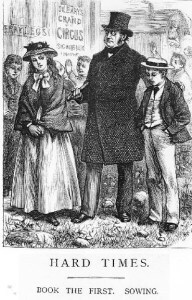 Professor Gradgrind grabbing children who need more facts. (Wikimedia Commons)
Stories are important.
Literature teaches you about rhythm and rhyme–which can be how children first gain a love of words and thus reading.
My post about The Five Little Monkeys and Learning to Read explains the connection.
The point should be to love reading, not to be subjected all the time to facts, deciphering facts, and thinking only about facts–per Professor Gradgrind in Charles Dickens’ Hard Times.
Gradgrind reminds me of a problem I see as a Bible teacher in 21st century America.
The absence and lack of understanding of metaphor and its cousins.
What is nuance? What are metaphors? How about similes? Are words just words spilled across the page without anything bigger than individually interpreting the (preferably) short little words?
 Photo by Brett Jordan (Unsplash)
The Bible often uses metaphors when talking about Jesus or spiritual concepts.
If you are “decoding” words only for the most absolutist meaning, you’ll miss the joy and pleasure of what the text actually says.
That’s particularly true in understanding the Bible.
Part of the problem is too many children are being taught just to read for facts–not for beauty, understanding, or simply joy.
I believe a continual emphasis on facts alone stunts literature, thinking, and imagination.
Why spend time reading and studying literature?At heart an English major loves words and ideas.
We’re not machines.
We’re people with hearts and clever tongues who love stories.
As my niece’s friend said, “Well, if I’m going deep, we have hope for a better world because we’ve read” about it in great books.
That’s why the world needs English majors.
Tweetables
Why does the world need English majors? Click to Tweet
The value of an English degree in 21st century life. Click to Tweet
The post Why the World Needs English Majors appeared first on Michelle Ule, Author.
January 31, 2023
A Geographer’s Daughter in Israel

I’m a geographer’s daughter.
As such, I grew up with maps, and can find north, south, east, and west.
Like my siblings, I inherited the family’s “sense of direction,” and rarely get lost.
I carry a map in my head, no matter where I go, and usually can find my way back to where I started.
(The one exception is in Boston. I could see the Old North Church tower. I just couldn’t direct my husband there. When we finally gave up, parked, and walked, we learned you can’t drive to the Old North Church. So, yes, Boston defeated me, but only on a technicality!)
As a Bible study leader, I’ve spent countless hours staring at maps of Israel. I tried to understand where Jesus traveled and how he got between places.
I knew the nation had many hills, a few tall mountains, and the Jordan River.
Jerusalem is on a hill, but I couldn’t quite grasp what it looked like.
That’s when I realized it was time for this geographer’s daughter to visit Israel.
So we went.
What did the geographer’s daughter learn about Israel?I live in a nation that spans a continent. I’ve driven across it nine times.
Israel is much smaller than even I imagined.
 Looking from the west to the east side of the Sea of Galilee. (Author photo)
When teaching about the Biblical Israel, I often try to give my students a sense of the size of the country.
“To compare Israel to where we live, imagine it stretches from the Golden Gate Bridge north to Eureka.
It’s about as wide as the distance between Bodega Bay (on the Northern California coast), to Davis (near Sacramento). That’s the whole country.
The part of the country where Jesus mostly ministered really isn’t much farther than an 1-2 hour drive from Jerusalem.
We were surprised.
The Sea of Galilee, in particular, is only about 13 miles long and 8 miles across at the widest spot.
People on the shore could watch Jesus sail away and see where he landed. It would take a while to run from spot to spot–but you didn’t lose sight of him. (See Mark 5).
What about the Wilderness?I’d always wondered about the Wilderness described in both the Old and New Testaments.
How far away from things was it?
Not that far.
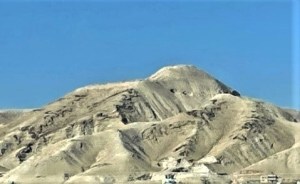 Wilderness and Temptation area west of Jericho? (Author photo)
Which was perplexing.
Why couldn’t King Saul find David?
(It helped to realize King Saul didn’t live in Jerusalem–David conquered the Jebusite stronghold and built the city. God, of course, also played a hand in shielding David and his men’s seven years on the run.)
Remember? Jesus was baptized in the Jordan River and then went into the Wilderness for 40 days to talk with God. (Matthew 4)
Our guide believed that the site of his temptation by Satan is just west of Jericho (which is only 13 miles, downhill, from Jerusalem).
This geographer’s daughter loved standing on the hillside at Qumran looking east over the Dead Sea.
From there, our guide pointed out other places germane to Jesus’ trips to Jerusalem. (John the Baptist is believed by some to be an Essene who lived at Qumran–where a boy found the Dead Sea Scrolls in 1948).
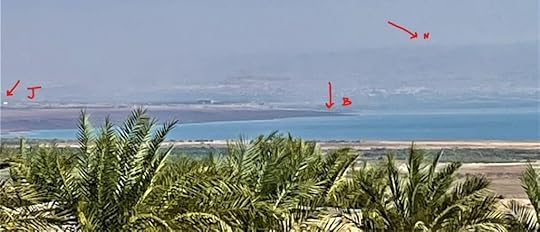 Herod Antipas ordered John the Baptist beheaded at Machaerus (foot of Mt. Nebo west side, near Dead Sea shores).
In photo taken at Qumran, J= Jericho; B= baptism site area; N= Mt. Nebo area. (Author photo)
 Does a geographer’s daughter need maps?
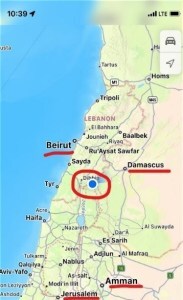
Of course I do. I carried three–and I consulted the map on my phone. I always need a sense of where I am in the world.
Especially if it feels intimidating.
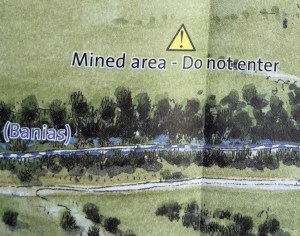
At each park or nature reserve we visited, we picked up folders and I consulted those maps, too.
The one from the Banias Nature Reserve sobered me. I’d never seen such a notation on a map before.
Dad would have loved it.
We traveled from as far north as the top of Mount Hermon (9200 feet; circled in red to the right), to the Dead Sea (1400 feet below sea level).
I’ve been higher than Mount Hermon many times, but I’ve never been as low as the Dead Sea. (For the record, I wouldn’t have realized how deep we were save for the signs telling us).
How about in Jerusalem?The winding corridors and narrow alleys of Jerusalem can be a puzzle in the Old City.
Fortunately, they post maps on the walls, signs indicate which way to go, and the Old City is only about 1 kilometer square.
So, even if you get lost, you’ll eventually turn up where you started!
(And the phone map worked inside the thick walls, so that helped).
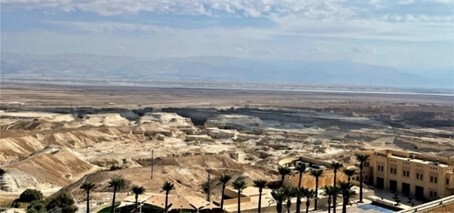 The view while going up to Masada (Author photo)Surveying the land
We loved our trip to Israel and learned so very much.
I enjoyed looking out the window watching the fabulous scenery.
Climbing to the top of Mount Hermon, it felt like the world did spread out before us. (Some believe Jesus’ Transfiguration took place on Mount Hermon; Others Mount Tabor).
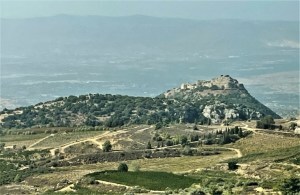 Nimrod’s Castle from the road to Mount Hermon (Author photo)
Standing at Meggido looking across the Jezreel Valley, we thought of the armies who have marched from the northwest to the southeast many times in history.
It was odd to think Jesus’ arrival to Mary’s womb took place at Nazareth (the site of the annunciation)–a village overlooking the valley where he’ll return some day (for Armageddon?)
The geographer’s daughter came home with a greater appreciation for Biblical history and awe that God chose that corner of the world in which to write the Bible.
I’m so glad we got to go.
I’m a better Bible teacher now that I’ve seen where so much took place.
Dad was right. Seeing the places make history come alive.
Thanks be to God.
Tweetables
A geographers daughter tours Israel–in amazement. Click to Tweet
Maps and the Bible tell the story–but seeing Israel is believing. Click to Tweet
The post A Geographer’s Daughter in Israel appeared first on Michelle Ule, Author.
January 24, 2023
What is Streams in the Desert?

Streams in the Desert is one of the most beloved devotionals published in the last 100 years.
I used to hear about it but never picked up a copy until I began a deeper review of My Utmost for His Highest.
First published in 1924 in a limited edition (only 3000 copies), Streams in the Desert will celebrate its publishing centenary in 2024.
But what is it?
Why has it stood the test of time?
What? A devotional for the agesLettie Cowman wrote Streams in the Desert over a relatively short period of time–several months.
Lettie and her husband Charles had returned to Hollywood, California from their overseas missionary life in Japan because of his health.
They believed God could heal physical illness.
But, for some reason, Charles wasn’t healed–despite years of pleading.
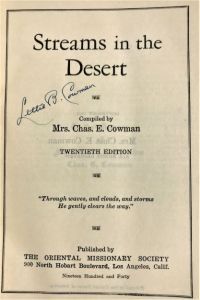 1940 20th edition titled page signed by author (OMS Archives)
Because of her emotional state, Lettie leaned toward reading material (sermons, poetry, hymns, teachings) that would encourage her faith, and Charles’, too.
A sensitive poetry lover in the best of times, Lettie was grieving as she put together Streams in the Desert.
In it, Lettie Cowman poured out the emotions she struggled with by using quotes she’d clipped out of magazines and newsletters for many years.
(I laughed when I opened a manila envelope while doing research and scores of paper scraps flew into the air–all wise sayings Lettie had clipped).
For that reason, the devotional is timeless.
Everyone goes through grief in life. Many people see their anguish and uncertainty recognized, in the daily devotional.
But Lettie also provides hope–isn’t that what we need when times look dire?
Why do people read it–over and over again?What is the devotion’s power that people keep returning to read it?
People asked Lettie and she had an answer:
“Streams was born. My other books were written.”
Was that mean?
God birthed the idea in her heart and mind to write the devotional . (Lettie already had a regular column in God’s Revivalist Magazine called “Streams in the Desert”).
She and Charles worked together to produce it.
Streams in the Desert’s message continually points back to God, the creator and sustainer of all.
Lettie Cowman compiled her readings from words, teachings, and poetry that already had sustained people seeking meaning for their suffering for centuries.
She knew to choose because she, too, suffered.
How has it ministered to people?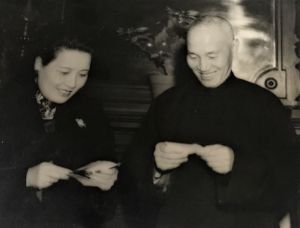 General and Mrs. Chiang Kai-Shek (OMS Archives)
In The Story Behind Streams in the Desert (and, frankly, in my own upcoming biography of Lettie Cowman), author Ed Erny recounted several instances of the devotional’s value.
It opened doors to Gospel ministry through Europe, and the world.
The devotional inspired Chinese Nationalist Army General Chiang Kai-shek so much, he ordered copies distributed to his armed forces. He worked closely with the with the translator and publisher of Streams in the Desert. Chiang asked to be buried with a copy in his arms. (which he was).
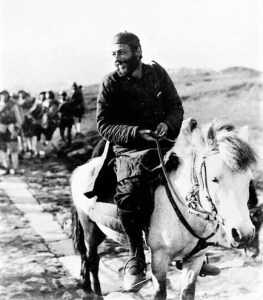 R. A. Bosshardt upon release in 1936
 (Wikimedia Commons)
China Inland Mission’s missionary Rudolf A. Bosshardt served in China during the 1930s. In 1934, bandits seized him and other missionaries, eventually marching him and another man 2500 miles across the country during their 18-month captivity.
The Chinese took away his Bible, but did leave him with a “battered book,” called Streams in the Desert.
Deprived of human support, Alfred could only depend on God. Though he had no Bible, years of reading and studying the book and memorizing verses had left him with the stored wealth of much of its teaching and stories . . . Some of these were contained also in the one devotional book which he still had. Living up to its title, Streams in the Desert refreshed him again, and again.”
Bosshardt: A Biography by Jean Watson p. 122
(You can hear his recollections of that time through the Imperial War Museum’s audio recordings.)
To Whom does Streams in the Desert minister?People around the world.
It’s been translated into at least fifteen languages, and probably more. No one knows the number of copies sold.
 A. B. Simpson has 20 quotes in Streams in the Desert! This is the Chinese version. (OMS Archives)
As Lettie Cowman traveled the world, people often approached her offering to translate the book.
She herself authorized translations into Chinese, Korean, Greek, Russian, Japanese, Spanish, Swedish, French, German, Armenian, Romanian, Amharic, Finnish, and even Braille.
It obviously ministers to a general human condition spanning cultures, time, and nations.
What is Streams in the Desert?
A time-honored devotional born out of suffering, speaking to suffering and Biblical truth, plus a book of encouragement and often joy.
You can read it daily at Crosswalk.com or on an app.
Tweetables
What is Streams in the Desert? Click to Tweet
A century later, what is Streams in the Desert‘s staying power? Click to Tweet
The post What is Streams in the Desert? appeared first on Michelle Ule, Author.