Michelle Ule's Blog, page 11
December 26, 2023
Goodbye, 2023; Hello to a New Year for All
 [image error] [image error]
 It’s time to say “goodbye, 2023,” and “hello, 2024.”
It happens every December 31–with the year changed, of course.
But, the end of a year is a good time for reflection, which is what Oswald Chambers did while serving in Egypt.
A New Year’s Eve nightwatch to say goodbye.It was the Chambers family custom to hold a prayer service, or a “nightwatch,” on New Year’s Eve.
We’ve only got records of the final nightwatch Oswald Chambers led in 1916. It went like this:
He spoke on “Finish 1916,” writing on his ubiquitous blackboard: “The Irreparable Past–Sleep On Now. The Irresistible Future–Arise Let Us be Going. Matthew 26:45-46.”
At the stroke of midnight, he turned over the blackboard to his printed words: “1917, A great New Year to you all ‘And God shall wipe away all tears,’ Revelation 21:4.”
I love his words–which Biddy used for the final reading in My Utmost for His Highest:
“As we go forth into the coming year, let it not be in the haste of impetuous, unremembering delight, nor with the flight of impulsive thoughtlessness, but with the patient power of knowing that the God of Israel will go before us.
OC, circa 1907 (Wikimedia) [image error]OC, circa 1907 (Wikimedia) [image error]OC, circa 1907 (Wikimedia)
Our yesterdays present irreparable things to us; it is true that we have lost opportunities which will never return, but God can transform this destructive anxiety into a constructive thoughtfulness for the future. Let the past sleep, but let it sleep on the bosom of Christ.
My Utmost for His Highest; December 31
It’s always such a good reminder–to release events of the past year (and seek forgiveness, as needed).
Whatever issues came up, we seek forgiveness, receive it, and then say, “Goodbye, 2023.”
Goodbye, 2023, yes. But what about 2024?Technically, it’s just another day on the calendar of life.
But, it also can be a time to consider new options, perhaps turn over some new leaves, in the new year.
Many people like to start with resolutions–how they plan to change in 2024.
Often, that includes beginning a new hobby, or discipline.
For many, that means reading a devotional–perhaps a familiar one, or perhaps a new one.
(Streams in the Desert will celebrate 100 consecutive years in print starting January 1, 2024. Why not try it?)
 Buy one here
I have many suggestions here, here, and here.
I say “Goodbye, 2023,” with satisfaction this year.
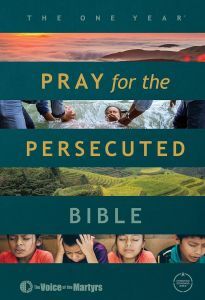
Joining other members of my church, I read through Voice of the Martyr’s One-Year Devotional Bible in 2023.
I did it.
And was so inspired, I’m picking up a one-year chronological Bible in 2024. I’ll read the Bible yet again, but this time in chronological order! LOL (Lots of options here, including audio versions.)
I can hardly wait to wade through the Old Testament prophets in 2024!
(If you don’t want to buy yet another Bible, consider reading it online here).
Prayer is always the key–for OC and me!Over at our house, we’ve been talking a lot lately about Jesus’ explanation for his behaviors:
Then Jesus answered them, “Most assuredly, I say to you, the Son can do nothing of Himself, but what He sees the Father do; for whatever He does, the Son also does in like manner. For the Father loves the Son, and shows Him all things that He Himself does; and He will show Him greater works than these, that you may marvel.
John 5:19-20 NKJV
A blessed goodbye to a complicated year, 2023, and a welcome hello to 2024.
I pray for your year will be one of joy and grace as we walk with God the Father, God the Son, and God the Holy Spirit, into a new year.
Tweeables
Goodbye, 2023; hello, 2024, with tips on how from Oswald Chambers. Click to Tweet
The post Goodbye, 2023; Hello to a New Year for All appeared first on Michelle Ule, Author.


December 19, 2023
Nazareth’s Influence on Jesus’ Life
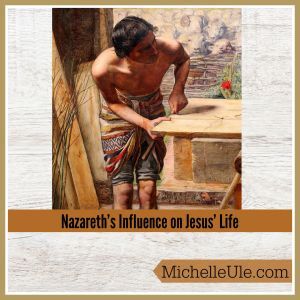
Nazareth’ s influence on Jesus’ life is interesting to consider.
A small town at the time of Jesus’ . . . conception, Nazareth probably housed between 200-400 people, according to archaelogists.
Nestled on a hill above the south end of the Jezreel Valley, the town looks over the future site of Armaggedon.
(Interesting that the Savior’s life in the womb began so close to the valley that will see his final return.)
But no one thought of that in AD 1, give or take a few years.
For whatever reason, when Herod died, an angel directed Joseph and his family back to Nazareth, not to Bethlehem.
What was everyday life like during Jesus’ boyhood?Dating is imprecise around Jesus’ life. All we know is when Herod the Great died, Joseph felt it was safe for his family to return to Israel.
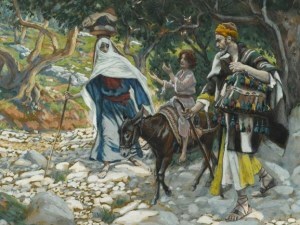 Headed to Nazareth by James Tissot
(Wikimedia Commons)
He and Mary may have thought they should raise Jesus near the religious center of Israel: Jerusalem. But, an angel warned Joseph in a dream not to return to Bethlehem.
So they turned north instead.
No one in Nazareth had seen them since they left prior to Jesus’ birth (so no one knew the exact date when the baby was born–much less Jesus’ sex).
One assumes Jesus was five or so years old when the family returned from Egypt. He must have grown up and remained in the town working with his family.
Nazareth’s water source up on the hillside was one spring–so the town could only support 400 people or less.
The people spoke Aramaic, farmed, and raised livestock.
Joseph, of course, was a carpenter–though that may have meant a stone mason.
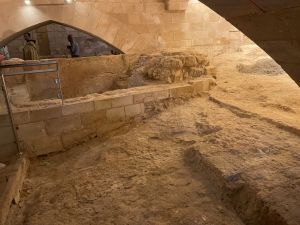 Joseph’s workshop (Author photo)
Sepporis, the capital of the Galilean region was several miles away and had many beautiful stone structures. Joseph, and later his sons, may very well have worked there.
Historian Howard Clarke supports this idea:
Sepphoris had been largely destroyed in the violence following the death of Herod the Great, and was being rebuilt by Herod Antipas. Clarke speculated that this could have been seen as a good source of employment by Joseph, a carpenter.
The Gospel of Matthew and its Readers: A Historical Introduction to the First Gospel, quoted here
Some believe that Catholic nuns found the actual family home. (Eric Metaxas describes the story in Is Atheism Dead?)
The Church of the Annunciation features a crypt where they believe Mary met the Angel Gabriel.
A church now sits over what Nazarites believe was the site of Joseph’s workshop.
Jewish influencesWhile Nazareth today is one of the largest Palestinian towns in Israel, at that time only Jewish families lived there.
God chose Joseph and Mary to raise his son. Given their experiences with angels and God working in unusual ways, they knew their God well.
No surprise, their children studied the Hebrew Scriptures and worshipped the one true God.
All Jewish boys learned to read and write in their synagogue school. (The Jewish Queen Salome Alexandra made it compulsory 100 years before!). Jewish tradition required boys to read the Torah to celebrate their bar mitvah at age 12-13.
Note that age. That’s how old Jesus was when, on his family’s annual visit to Jerusalem, he spent several days in the Temple impressing the priests.
His synagogue obviously prepared him well.
(Then again, Jesus was the Word of God himself!)
Nazareth’s influence–a negative one?Remember Nathanael’s response to Philip about hearing of Jesus for the first time?
“Nathanael said to him, “Can anything good come out of Nazareth?”
“Philip said, “Come and see.”
John 1:46 NKJV
Nathanael was from the area. So, what was the problem?
Nazareth is not mentioned in the Hebrew Scriptures (the Old Testament).
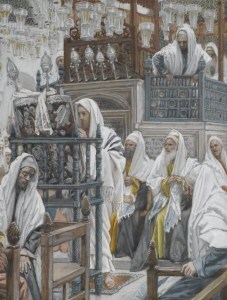 Jesus in the Nazareth Synagogue (Tissot)
800 years before, however, the prophet Jonah came from the nearby “inconsiderable village” of Gittah-hepher (It’s 5 kms north).
Jonah prophetic abilities were such that he ended up in the court of King Jeroboam I of Samaria.
Some from that area might have considered Jonah a traitor.
Nazareth’s influence would not have impressed people looking for the Messiah.
Scripture said the Messiah would come from Bethlehem.
That’s why Nathanael dismissed Jesus–until he went to see.
God wanted Jesus to grow up far from the corruption of religious power in Jerusalem at the time.
A small town tucked 70 miles away, turned out to be the right place for Jesus to grow up.
But they who knew him well, did not recognize him as their Messiah when he returned to read the Torah as an adult.
When he reached adulthood and left his home village, he settled in Capernaum 43 miles east on the north shore of the Sea of Galilee.
And then everyone in Israel learned about the Son of God.
Tweetables
What was Nazareth like during Jesus’ boyhood? Click to Tweet
How did Jesus learn to read in a small village far from Jerusalem? Click to Tweet
The post Nazareth’s Influence on Jesus’ Life appeared first on Michelle Ule, Author.
December 12, 2023
Jesus’ Toddler Years in Egypt
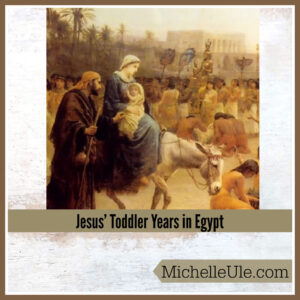 [image error] [image error]
 Were Jesus’ toddler years really spent in Egypt?
The Bible seems to say so, as do ancient traditions.
But why would Mary and Joseph take their firstborn to Egypt?
An angel appeared in Joseph’s dream and told him to take his family out of Bethlehem to Egypt, specifically.
Basically, because King Herod felt threated by this unknown baby king and so he wanted to kill Jesus.
Why Egypt?Going to Egypt was God’s idea. He obviously wanted Jesus’ toddler years to be spent outside of Israel.
Many believe Joseph used the magi’s gifts to pay for their flight to Egypt.
(And why not? We worship an orderly and efficient God.)
The Bible does not give us any information about the family’s life in that country. That’s because we don’t need to know.
History and traditions, however, have provided a few ideas as to why.
At the time Jesus was born, many Jews already thrived in settlements in Egypt. One of the first synagogues in the world, and certainly the largest, was in Alexandria.Indeed, historians estimate a million Jews lived in Alexandria at the time.Egypt was outside Herod’s jurisdiction.Rome had built a well-traveled and well-maintained road, the Via Maris, along the Mediterranean Sea into Egypt.It was prophesied: Hosea 11:1: “Out of Egypt I called my Son.Throughout the Old Testament, Hebrew people traveled to Egypt for help, food, security–even if God warned them not to do so.
Any historical evidence for Jesus’ toddler years in Egypt?No.
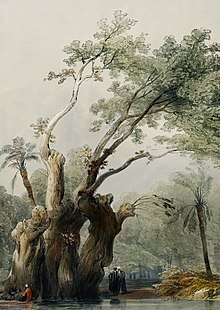 Holy tree of Metereah; c. 1840 (David Roberts; Wikimedia).
There’s only tradition, particularly from Coptic Christians in Egypt.
Indeed, their traditions include 25 different places the “Holy Family” stopped in Egypt. Churches were built at those sites.
You can read more details about Coptic Christians’ thoughts on the journey through Egypt here.
I first came across this concept while studying Oswald and Biddy’s Chambers’ life in Egypt.
Legend has it that Mary and Joseph stopped with baby Jesus near Heliopolis–otherwise known in the early 20th century as Zeitoun, and now El Matareya.
Claiming they always stopped near a stream, Egypt Today, explained the reason for the stop.
How long did the family stay in Egypt?
“The Virgin Mary washed her garments, sprinkling the used water on the ground, from which a balsam tree, now known as Virgin’s Tree, sprouted and continues to receive visitors to this day.”
Egypt Today, November 26, 1917
It’s not clear in which year Jesus was born: sometime between AD 1 and AD 6!
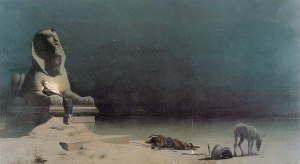 Resting on the way to Egypt
 Luc-Olivier Merson (Wikimedia) [image error]Resting on the way to Egypt
Luc-Olivier Merson (Wikimedia) [image error]Resting on the way to Egypt
Luc-Olivier Merson (Wikimedia)
We know the family returned to their original home in Nazareth after Herod the Great died in 6 AD.
We don’t know how long it took for news of the King’s death to find them–wherever they were in Egypt.
I’ve always liked the song “My Deliverer,” by Rich Mullins depicting what Jesus’ time there might have been like:
Joseph took his wife and her child
And they went to Africa
To escape the rage of a deadly King
There along the banks of the Nile
Jesus listened to the song
That the captive children used to sing
They were singin’
My deliverer is comin’, my deliverer is standin’ by.”
https://www.youtube.com/watch?v=K8-NxI_IWd0
Don’t you love the image of Jesus’ toddler years spent listening to people plead for their redemption?
What differences does it make where Jesus grew from a baby to a child?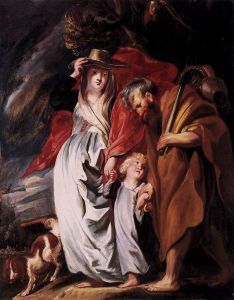 The Return of the Holy Family from Egypt
by Jacob Jordaens (Wikimedia) [image error]
The Return of the Holy Family from Egypt
by Jacob Jordaens (Wikimedia) [image error]
The Return of the Holy Family from Egypt
by Jacob Jordaens (Wikimedia)
The Return of the Holy Family from Egypt
by Jacob Jordaens (Wikimedia) [image error]
The Return of the Holy Family from Egypt
by Jacob Jordaens (Wikimedia) [image error]
The Return of the Holy Family from Egypt
by Jacob Jordaens (Wikimedia) I don’t know.
Abraham went to Egypt. Moses was born in Egypt. Israel’s son Joseph wound up in prison there before becoming the vizier of the entire nation.
Somehow, it was important the Savior of the World, too, spend time there.
I like to think about how human Jesus was. He could feel a pebble in his sandal. He knew sweat on his brown from heat.
As a baby, he learned to walk–perhaps along the banks of the Nile.
He and his parents were refugees from a brutal regime. They found safety in Egypt before returning home.
And in Nazareth–the toddler grew up (see next week’s post), and from there went on to become the Redeemer of the world.
Tweetables
Were Jesus’ toddler years really spent in Egypt? Where? Click to Tweet
Where’s the proof Jesus went to Egypt as a baby? Click to Tweet
The post Jesus’ Toddler Years in Egypt appeared first on Michelle Ule, Author.
December 5, 2023
Walking in Darkness: AD 1.

In AD 1, give or take a few years, the people of Israel were described as “walking in darkness.”
What did that mean?
What were the conditions when Jesus was born?
Why would His arrival–the Messiah is here–have made a difference?
I’m going to abbreviate it!
Life in AD 1 under King Herod’s ruleAntipater the Idumaen, who came to power by unscrupulous methods (including sailing to Roman to convince the Roman Senate to make him the leader), ruled with an iron fist. Somewhere in his background, he had a Jewish mother.
 King Herod (Schwabach – City church. 1495; Wikimedia Commons) [image error]King Herod (Schwabach – City church. 1495; Wikimedia Commons) [image error]King Herod (Schwabach – City church. 1495; Wikimedia Commons)
 A friend of Caesar’s and Mark Antony (of Cleopatra fame), upon his death, his son Herod 1 took control of Judea.
Raised as a Jew, King Herod curried favor with the Romans and instituted massive building projects.
These included a total expansion and restoration of the Jewish temple on the Temple Mount.
He did not, however, display a lot of personal religious belief. He dumped his first wife to marry another, and eventually executed several members of his family–including the second wife.
Named the King of Judea by the Roman Senate, he worked to accomplish their goals.
During our visit to Israel in 2022, our guide refered to Herod as “Bob the Builder,” because of his ambitious building schemes.
He was very jealous of retaining power–as demonstrated in his interview with the Magi looking for the newborn King Jesus circa AD 1.
In addition to the Jewish Temple, Herod directed the building of forts and lavish homes for himself around Israel.
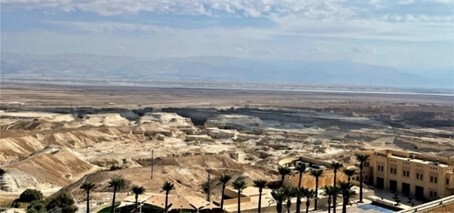 Current view from Herod’s Masada. (Author photo)
This included Caesarea Maritima, Masada and Herodium in Bethlehem (Site of Herod’s burial in a glorious castle that could see to the Temple in Jerusalem).
Circa AD 6, Emperor Augustus of Roman deposed Herod and turned the territory into the Roman province of Judea. (Which it remained until 132).
Bethlehem itself at Jesus’ birthKnown as the city of David, because King David grew up in Bethlehem, it was still an agricultural center at the time of Jesus’ birth circa AD 1.
Shepherds raised the lambs for the Temple sacrifice on the hillsides in Bethlehem.
The city itself is built on a hill riddled with caverns–which often houses sheep during inclimate weather.
Indeed, people themselves often lived in the comfortable caves, as late as 100 years ago.
Farmers grew grain, just as they had when Naomi and Ruth returned hundreds of years before.
Some of the Temple grain offerings may very well have been grown in Bethlehem–which was only a small town.
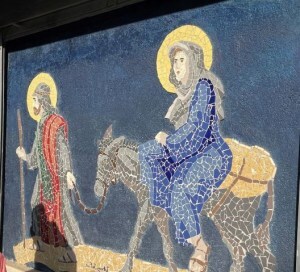 [image error] [image error] It’s always about the taxes–even in AD 1!
Actually, the taxes were the reason for the census.
Roman records recount the census called by Caesar August actually took place in AD 6.
Matthew 2:1-12 recounts the story of Mary and Joseph traveling to Bethlehem where Mary gave birth.
The couple came down from Nazareth for the census because their families were from the line of King David, which made Bethlehem their ancestral home.
While they may have sheltered in one of Bethlehem’s caves that first night, the experience may not have been as forlorn as depicted. They had family in Bethlehem. I doubt Joseph needed to serve as a midwife very long.
But what darkness did people walk in circa AD 1?The quote comes from the Prophet Isaiah, describing the coming Messiah:
Nevertheless the gloom will not be upon her who is distressed,
As when at first He lightly esteemed
The land of Zebulun and the land of Naphtali,
And afterward more heavily oppressed her,
By the way of the sea, beyond the Jordan,
In Galilee of the Gentiles.
2 The people who walked in darkness
Have seen a great light;
Those who dwelt in the land of the shadow of death,
Upon them a light has shined.
Isaiah 9:1-2 (NKJV)
The Roman oppression, the troops stationed throughout Galilee and further north, the brutal demand for taxes and shake downs.
The Roman government did like the Jews. The people of Israel begged God for their Messiah.
And one glorious night full of angels, he was born.
Whether recognized or not.
A blessed Advent to you all. The Messiah came.
Tweetables
What was Israel like circa 1 AD, or so, when Jesus was born? Click to Tweet
What sort of world was Jesus born into? Click to Tweet
The post Walking in Darkness: AD 1. appeared first on Michelle Ule, Author.
November 28, 2023
A Jerusalem Night Touched with Wonder

A Jerusalem night in 2022 seemed touched with wonder.
We had only the one night to ourselves during a busy 16-day tour.
Indeed, that very day, we’d walked on the Temple Mount, visited Lion’s Gate, saw the pools of Bethseda, hiked Hezekiah’s Tunnel, and still had another tour at nine o’clock.
I’d altered my clothing three different times (out of one backpack), and we ended up walking nine miles.
But then, there was the Jerusalem night.
Before Jerusalem Night fell, we retraced our stepsWe started at the Church of the Holy Sepulchre, where I’d been distracted on a visit the day before.
I wanted to walk through the huge vaulting spot where Jesus allgedly was crucified and then buried.
It was just as crowded on a Jerusalem night as it was during the day.
It probably didn’t matter since, yet again, I began to cry as soon as I entered the church.
Seeing the stones where Jesus’ blood may have spilled was very emotional and I felt nearly undone.
Such a sobering, yet uplifting, place.
Always shopping, of course.The northern side of old Jerusalem is lined with shops.
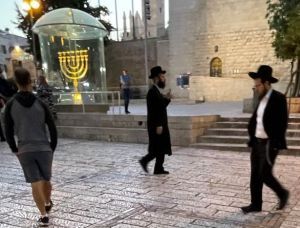 An American, the Golden Menorah, and two Orthodox men on a Jerusalem night.
COVID policies had closed many for too long, and the sellers were eager to engage in conversation and, hopefully, sell us something.
This was our shopping opportunity, and we sought small, only-from-Jerusalem gifts for our family.
We had plenty of options–as well as encouragement.
(We also had to buy another suitcase the next day to get everything home).
As night fell, crowds thinned and a hush filled the narrow streets. Voices sounded muted as all the different people who live in the ancient city headed home.
Incongruous travelers and citizens passed each other and I had to snap a picture.
Beautiful lighted walls on a Jerusalem night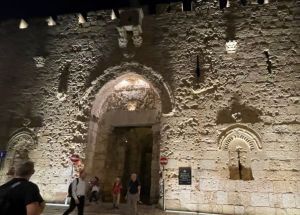 Zion Gate [image error]Zion Gate [image error]Zion Gate
 The lights against the ancient stones made them seem even more romantic.
Zion Gate, which we exited to visit the Upper Room, felt dramatic and historical as we walked through.
A window from the Upper Room (which was built during the Byzantine era, so obviously wasn’t where Jesus and the disciples dined on Maudy Thursday), also shone in the night.
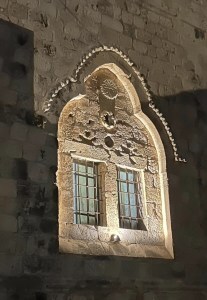 This “Upper Room” window is Byzantine.
 In early November 2022, the night felt warm and comfortable. I wore a light jacket over a short-sleeved shirt and Keen sandals. (I wore those sandals earlier in the day through Hezekiah’s Tunnel. The cool water felt terrific!)
Eventually, we stopped in a coffee shop to ease our feet and prepare for the final event–a walk along the Western Wall.
The Wailing Wall on a Jerusalem NightOur group gathered at what is known as “the Wailing Wall,” the only spot along the western wall of the Temple Mount where Jews are allowed to pray.
We’d walked past it earlier in the day, and it looks just like all the photos.
The wall is open 24-hours a day for people to pray; women on the south side, men along the north side.
I joined several women in our party, and prayed in the women’s section.
I put up my hand on the still warm bricks, listened a moment, then prayed for the women around me.
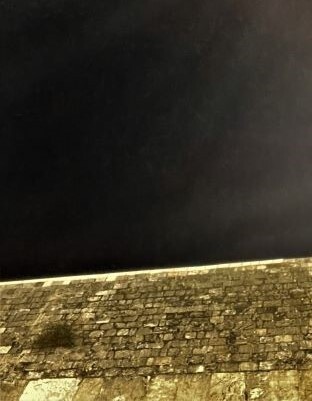
Then I sat down to wait for everyone else to finish their prayers.
Gazing up at the wall on that warm night, I saw a demarcation between the golden wall itself and the black night above.
Surprised, I took a picture.
That Jerusalem night felt timeless in early November, 2022.
God seemed so close.
Pray for the peace.
Tweetables
A timeless 2022 Jerusalem night–with photos. Click to Tweet
Golden walls, ancient skies; photos of Jerusalem in 2022. Click to Tweet
The post A Jerusalem Night Touched with Wonder appeared first on Michelle Ule, Author.
November 21, 2023
Disappointment that Led to Thankfulness

Have you ever had a disappointment that led to thankfulness?
I did.
It was humbling and humiliating, but resulted in a better me.
I’m so thankful where I ended up.
But it was hard.
Let me explain.
Giving thanks even when you know disappointment is comingThe idea to write this post came from several converging events.
My friend Barb Roose wrote a newsletter post relating to 1 Thessalonians 5:18.
You know, “in everything give thanks; for this is the will of God in Christ Jesus for you.” (NKJV)
In her post, Barb referenced Mark 14:22-23 where Jesus blessed the bread at the Last Supper.
Here’s her observation:
Notice Jesus’ actions here: He blessed the bread before he tore it. He gave thanks to God before sharing the wine. The bread and wine symbolized the brokenness and suffering that was to come in Jesus’ life. Yet, he still gave thanks anyway.
Jesus even gave thanks while his future betrayer Judas was sitting right at the table with him. Some of you have felt the sharp stab of betrayal or difficult people. Jesus gave thanks right in the middle of it, not waiting until later.
The Blessing of the “Hard” Giving Thanks, Barb Roose Newsletter
Jesus expected disappointment to come. He knew the disciples would betray him.
But He gave thanks anyway, because He knew the outcome of the price He would pay: salvation for all.
Had I known the disappointment that was to come to me those years ago, would I have been thankful?
Uh, no.
When did God disappoint you?While listening to a talk on Psalm 73 by Ken Fish, his question struck me.
He described how Asaph, a composer of psalms described the agony of disappointment.
A close associate of King David’s, he led worship in the Shiloh Tabernacle.
He’d worshipped God faithfully for years, but when he looked around, he saw the wicked people prospering in ways Asaph was not.
“All in vain have I kept my heart clean,” he said, “and washed my hands in innocence.” (Psalm 73:13)

He carried on in this vein, complaining and with envy eating at his soul. As the Psalm continued, we watch as he processes the disappointment.
Fish described all this and then asked the pertinent question, “where did God disappoint you in your life?”
How often does resentment about not getting what we worked hard for, turn our faith and attitude to ashes?
I knew that pang, oh so very well.
Making everyone miserable in my disappointmentYears of hard work turned up nothing. Expenses mounted, nothing improved.
Eventually, I gave myself a month to mourn.
I needed to mourn.
But, then that month turned into a second month, headed toward a third.
I railed at God, much like Asaph, until I realized, “When my soul was embittered, when I was pricked in heart, I was brutish and ignorant; I was like a beast toward you.” (Psalm 73:21-22 NKJV)
Acid tipped my tongue.
 It took me awhile to go from left to right! (Mohamed Nohassi; Unsplash)
The people in my life–the ones who received the bitterness from my tongue–said little, but listened and loved.
But one day, I raised my head, remembering the1Thessalonian passage.
The people I love didn’t deserve my disappointment. I could see how with each pointed remark, I didn’t hurt them as much as I savaged my own heart. I was pushing the seed root of bitterness deep into my soul.
But what to do with this disappointment?
In everything give thanks–or, just be grateful.How often have I written on this subject?
While disappointment remained, I needed to let God change my heart.
 Thankful to be here, now. (Bob Scirpo Unsplash)
The only was to choose to be grateful for what I had, to be thankful, rather than bitter.
I started that day. I chose gratitude.
It was hard that first day. And the day after, and the day after.
But in choosing gratitude moment after moment, day after day, my heart lifted.
I meditated on the names and attributes of God.
Years later, because I am years away from that terrible time, I’m so grateful for so much.
Disappointment turned to gratitude. I can now see how the will of God took me in a different direction.
Gratitude became a habit.
This Thanksgiving week, I remember that time, and I’m thankful.
Thankful I didn’t remain stuck–because, of course, the Word of God placed deep in my heart years ago, returns good.
And my friends and family seem to be happier with me!
Thanks be to God.
Tweetables
How to turn disappointment into gratitude. Click to Tweet
In everything give thanks . . . why? Click to Tweet
The post Disappointment that Led to Thankfulness appeared first on Michelle Ule, Author.
November 14, 2023
Jesus Spit, Spitters, and a Strange Gospel Story.

Do you remember when Jesus spit into a man’s eyes?
It’s a strange Gospel story that appears twice in the Gospel of Mark at 8:22-26 and in 7:31-37.
Jesus Heals a Blind Man at BethsaidaJesus spit in a John Gospel story
He[Jesus] took the blind man by the hand and led him out of the village, and when he had spit on his eyes and laid his hands on him, he asked him, “Do you see anything?”
And he looked up and said, “I see people, but they look like trees, walking.” Then Jesus laid his hands on his eyes again; and he opened his eyes, his sight was restored, and he saw everything clearly.
Mark 8:22-26 (ESV)
As he passed by, he saw a man blind from birth . . . As long as I am in the world, I am the light of the world.”
Having said these things, he spit on the ground and made mud with the saliva. Then he anointed the man’s eyes with the mud and said to him, “Go, wash in the pool of Siloam” (which means Sent). So he went and washed and came back seeing.
John 9: 1-7 (ESV)
 What happened when Jesus spit?
What’s with the spitting, Jesus?
What happened when Jesus spit?
What’s with the spitting, Jesus?The love of God.
How could that possibly be? The idea of spitting on someone–even to heal them–is repugnant to most people
It always seemed a curious and inexplicable thing for Jesus to do–even if it did result in three men being healed.
Many scholars have tried to explain these incidents and I’m not going to belabor them here.
Jesus spit. Men were healed. That’s what happened. Did it matter what method Jesus used?
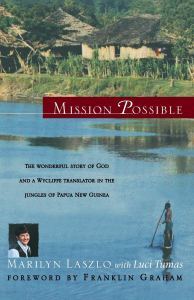
1900+ years after Jesus spit, Spitters hear the story.In her wonderful memoir of life as a pioneer missionary with Wycliffe Bible translators, Marilyn Laszlo shared a story about the effects of Jesus’ curious healing methods.
In Mission Possible, Laszlo described the challenges she faced with the Sepik Iwam people who lived deep in the New Guinea tropical rain forest. (500 miles up the Sepik River from the ocean).
Laszlo and a colleague arrived in the village in 1967. Over the first seven years, a series of miraculous healings led most of the villagers into a relationship with Jesus, but one group remained skeptical.
 Life on the Sepik River (Wikimedia Commons)
Four traditional medicine man cared for the village’s health using traditional methods which often worked well. They were called “Spitters.”
You can watch a Spitter in action in Laszlo’s film Come By Here, part two.
In one case, family members brought an ailing child to the Spitter.
He chewed on gingerroot and “with ritualistic precision and genuine compassion.” Marilyn watched in horror “as he cut tiny slits in the child’s chest, then spat gingerroot juice into the bleeding cuts.”
Sometimes spitting into the wounds worked.
Too often it did not.
Surprised to learn Jesus spit, too.Seven years and plenty of adventures later, Marilyn was busy translating the Gospels into the Iwam language.
Among her translators on one particular day was a group of Spitters–the only members of the community who had not become Christians.
As Laszlo explained the John 9 passage, the men became excited.
“What is it?” she asked.
“He’s just like we are, only he has much more power.”
You can see the story here, at 7 minutes into the film.
“I believe God put that story into the Bible just to touch the hearts of the Sepik people,” Laszlo said.
How much does God love each of the people He created?
 Marilyn Laszlo (Laszlo Mission Leauge)
Enough to have Jesus spit into the mud, or onto a tongue, to heal someone.
The story puzzles most of us.
But, the Spitters finally saw in those stories that Jesus was like them.
Jesus knew their lives and understood their traditions, and thus became knowable to them.
Isn’t it wonderful how God meets each of us in a way we can understand and thus shows He knows who we are?
Then what?Wikipedia reports 95% of people in Papua New Guinea claim to be Christians.
Hauna Village, where Marilyn Laszlo served the Sepik Iwam people for 24 years, is a vibrant Christian community today.
Thanks to Laszlo and her sister, along with many other helpers and translators, the Hauna people have a Bible and many walk with God.
For more information about the Laszlo Mission League in Hauna, Papua New Guinea, see their website here.
I first heard Marilyn Laszlo story on the Women Worth Knowing podcast.
Tweetables
Why did Jesus spit into the mud and put it on the man’s eyes? Click to Tweet
How Jesus spitting on a man’s tongue led men to the Lord. Click to Tweet
The post Jesus Spit, Spitters, and a Strange Gospel Story. appeared first on Michelle Ule, Author.
November 7, 2023
Why Write Bible Notes in your Bible?

Do you write Bible notes?
As in, marking passages, or dating them, or simply writinga note.
Why?
Why not?
It’s a long-standing tradition and has valuable results.
Two of my favorite writers did it all the time and it’s interesting to see what they said.
Lettie Cowman’s Bible notesLettie Cowman notoriously read through many copies of the Bible in her 90 years. She wore them out as she turned the pages and engulfed herself in the truth of Scripture.
It was fun to page through some tired copies and see how often she wrote Bible notes.
As in, frequently.
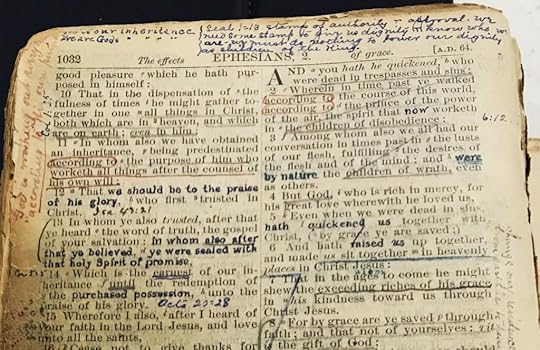
In the above, she’s commenting on Ephesians 2 and wrote herself a note:
“We are God’s inheritance. Seal 1=13 stamp of authority or approval. We need some stamp to give us dignity (to know who we are as children of the King.”
The note in a reddish color explains “God is making out everything ‘according to’ His own purposes.”
The Bibles were coming apart at the seams!
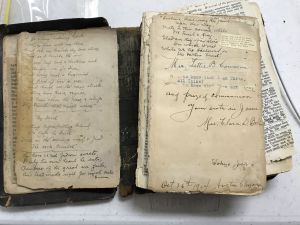 1904 gift from a Chicago friend. (OMS Archives)
She particularly liked to write hymns or poems on any empty pages she found. Opposite the title page of her 1904 Bible, she wrote “A Missionary’s Son.”
Lettie may have used it as a personal anthem:
I go among unloving hearts,
Poem by Lettie Burd Cowman
Lord, go though with me there,
Andlet me breath Thy love always
Just as I breathe the air;
Let each day’s hands of thankless risk
Be temple words for Thee,
And every meal a Eucharist.
Lettie’s Bible notes were meaningful to her–and a way of exploring how her faith played out in different times of her life. (Or, perhaps, when she needed to use a verse for Streams in the Desert!)
What about Biddy and Oswald Chambers’ Bible notes?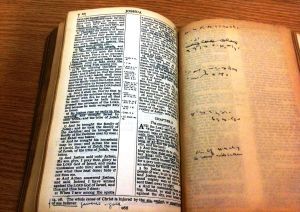 That’s shorthand on the right! (Wheaton College Special Collections Library)
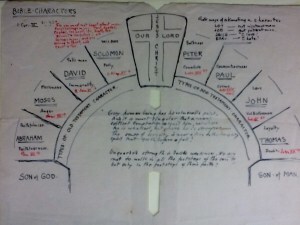 Notes drawn and written by OC in his Bible (Wheaton College Special Collections library)
Always a private person, Biddy Chambers wrote few notes in her Bible.
If you can tell me what the one on the left says, I’ll be happy to hear it:
Yep. She wrote them in shorthand.
(Though not all. See this post.)
Oswald Chambers, however, wrote, drew, and even seemed to decorate his Bible with information.
Bible notes like the above were interesting to me as a biographer.
What about in modern times?My friend Janet McHenry buys a new Bible each year with wide margins.
She reads through it in a year, decorating the pages, offering prayers for her grandchildren, commenting with Bible notes, and pointing out information she believes is pertinent to that particular child.
“I’d been reading the Bible from Genesis to Revelation for more than ten years when I joined the Bible Girls Facebook group ten years ago. A couple years into reading with that group I decided to journal through a Bible.
When I was partway through, I decided I wanted to do that again but with a fresh Bible. So it occurred to me then that I could journal one of those Bibles for each of my grandkids. I’m finishing up number eight this year and have two more to go.”
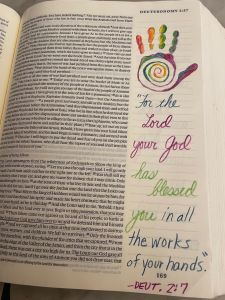
“I’m not an artist, and sometimes I’ll Google search for images that I can copy. I keep it simple, so that I can keep up from day to day.”
When she “finishes” personalizing the Bible for her grandchild, she wraps it up and hands it over.
Impressive.
As Janet continued:
“What’s thrilling is that my grandkids tell me they read all the scriptures I journal for them, as well as any personal notes I also write to them. I pray God’s Word will always stay in their hearts.”
Do you write personal Bible notes?Raised to never write in a book, I felt uncomfortable marking special verses in my first Bible all those years ago.
Apparently, however, I’m in the minority who feels that way.
When I asked the question on my Facebook page, 24 people responded.
Almost all of them doodle, take notes, date significant verses, and even include prayers in response to passages.
We all greet God with the creativity He gave us and what works for one person may not for another.
Another friend explained that coloring and decorating her Bible, “helps the Word to stick and makes me smile when I see it!”
I understand another friend’s motivation: “When the same key word or phrase is repeated in the book, I highlight it in the same color with colored pencils.
This reminds me of the Kay Arthur’s Precepts method of studying Scripture. It’s how I prepare to teach my Bible studies (but on a piece of paper).
Reading through my friends’ thoughts, I’m torn, now, at all the “dark nights of the soul,” I didn’t detail in my Bible. (But hey, which one? I change versions every ten years, whether the Bible is worn out or not).
I look at Janet’s wide-margined Bible and wonder.
How about you?
Tweetables
Do you write notes in your Bible? Why? Why not? Click to Tweet
Oswald and Biddy Chambers, and Lettie Cowman, all wrote notes in their Bibles. Do you? Click to Tweet
The post Why Write Bible Notes in your Bible? appeared first on Michelle Ule, Author.
October 31, 2023
Which Transfiguration Mount was It?

Which Transfiguration Mount did I visit in Israel?
Since no one is sure on which mountain Jesus visited with Moses and Elijah, who knows?
But, we did see the two best choices: one because of tradition, the other because of description.
Very different, but both very interesting.
(Transfiguration, by the way, means “a marked change in form, or appearance that glorifies or exalts.”)
What was the Mount of Transfiguration?At the end of Matthew 16, Jesus and his disciples were in Caesarea Philippi (modern day Banias).
After six days Jesus took with him Peter and James, and John his brother, and led them up a high mountain by themselves. And he was transfigured before them, and his face shone like the sun, and his clothes became white as light. And behold, there appeared to them Moses and Elijah, talking with him. And Peter said to Jesus, “Lord, it is good that we are here. If you wish, I will make three tents here, one for you and one for Moses and one for Elijah.”
He was still speaking when, behold, a bright cloud overshadowed them, and a voice from the cloud said, “This is my beloved Son, with whom I am well pleased; listen to him.”
When the disciples heard this, they fell on their faces and were terrified. But Jesus came and touched them, saying, “Rise, and have no fear.” And when they lifted up their eyes, they saw no one but Jesus only.
Matthew 17:1-8 ESV
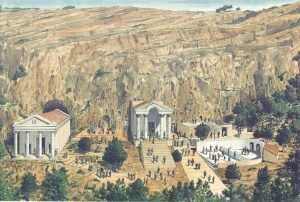 Berthold Werner rendition of Caesarea Philippi (Wikimedia Commons)
Note: it took them six days to walk to the top of the high mountain.
Luke 9 tells a similar story, but places the group in Bethsaida–which is inland northeast of the Sea of Galilee (in the lower Golan Heights).
In this gospel version, Jesus taught his disciples and then, “Now about eight days after these sayings he took with him Peter and John and James and went up on the mountain to pray.” (Luke 9:28-36; ESV)
Was the real one on Mt. Tabor?The first prospect we visited was Mount Tabor, just east of the Jezreel Valley–where Armaggedon is expected.
We’d been to Meggido, ate lunch in Nazareth, and then proceeded down the road about half-an-hour.
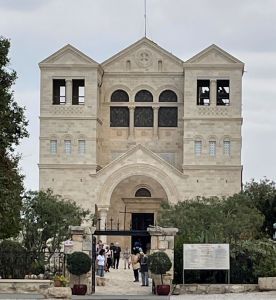
Then we began to climb a steep hill/low mountain (depending on what part of the world you’re from).
As we wound higher, a song from children’s choir came back and I began to hum: Three Tents.
After parking the van, we walked down a lovely walkway to the church.
The beautiful church, designed circa 1915 by Antonio Barluzzi, sits on the site of a 5th century Byzantine church.
It watches over the countryside from a heady 1900 foot elevation with views all around.
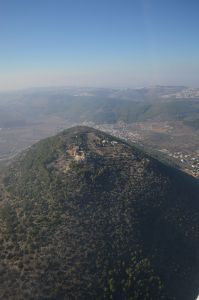 Aeriel view; Amos Meron (Wikimedia Commons)
Jesus and three disciples easily could have hiked up it in two days. (Bethsaida to Mt. Tabor is 33 miles on mostly flat land until you reach the mountain).
We could see the Sea of Galilee for the first time from the top. Until I traveled to Israel, I thought Jesus spent most of his time–when not in Jerusalem–around the Sea of Galilee.
But that turned out not to be true.
The Son of God traveled to the Mediterranean at Sidon and Tyre, but he also visited all the villages in North Galilee.
Which brings us to what I’ve come to think was the real Mount of Transfiguration: Mount Hermon.
Why not the highest mountain in the area?Sometimes you just have to get out a map and go climbing!
Mount Hermon is significantly higher than Mt. Tabor.
The sweeping view from its top outshone Mt. Tabor’s. We could see all the way to the coastal mountains. Had we been allowed higher, we could have looked over the side into Lebanon and Syria as well.
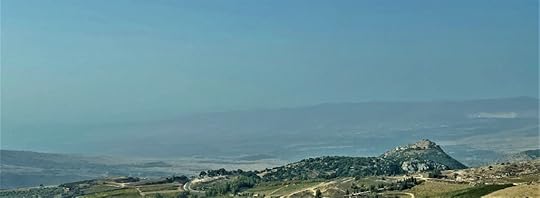 Mt. Hermon’s view with Nimrod’s Fortress in the foreground and the costal mountains beyond.
In terms of being closer to heaven, well, Mount Hermon makes the most sense.
Distance, of course, wouldn’t have meant anything to Elijah and Moses.
It probably would have taken the men several days to walk from Bethsaida to Caesarea Philippi, and then a good six days to climb the high mountain top. (Mt. Hermon stands at 9200 feet.)
(It’s 29 miles from Bethsaida to Caesarea Philippi, and then 13 miles straight up to Mount Hermon).
Next stop off the mountain?Peter, James, and John suggested they stay on top of the Transfiguration Mount and build tents to house Jesus, Elijah, and Moses.
Biblical teaching suggests the prophet of the Law (Moses) and the prophet himself (Elijah) met with God in person (Jesus) on that mountain that day to encourage him.
Jerusalem loomed.
He could not stay.
Down they went into the valleys below–where at the first stop the rest of the disciples struggled to cast out a demon.
Jesus finished the task, the boy was healed into his right mind, and Jesus continued preaching and healing.
All the way to his crucifixion in Jerusalem.
Does it matter where Jesus’ transfiguration took place?Other than to mark another spot where Biblical events really happened, no.
Still, standing on top of Mt. Hermon, it felt like we really were looking out over the world.
And glory felt close at hand.
Tweetables
Which is the real Mount of Transfiguration in Israel? Click to Tweet
Was Mt. Hermon in Israel the site of Jesus’ transfiguration? Or was it Mt. Tabor? Click to Tweet
The post Which Transfiguration Mount was It? appeared first on Michelle Ule, Author.
October 24, 2023
A Gold Star as a Gift of Grace

“You deserve a gold star,” I said.
Using my index finger, I traced a star on her forearm.
She laughed.
I smiled.
Grace extended.
Mission accomplished.
What does a gold star mean?As a child in school, I loved receiving a returned assignment with a gold star sticker at the top of the first page.
Some teachers handed them out as encouragement, others to indicate they’d recorded the grade.
Other teachers used them to score tests.
Whatever.
It acknowledged work well done (or at least finished!).
Many have used gold star stickers on a chart to keep our kids on track for their goals.
We put them on Christmas trees to sparkle with excitement.
A star of unknown color, of course, announced Jesus’ birth.
They make people smile–especially if they’re unexpected.
But why?Everyone needs encouragement.
Years ago, I felt God telling me I needed to be thankful–for all the people who help me all the time.
 Military gold service star. (Wikimedia)
In that particular case, I was traveling and I knew I needed to acknowledge the grace given me.
Someone would hand me a receipt, I’d wait, and when they looked up, I met their eyes and thanked them.
I’ve long been surprised at how grateful people are when someone acknowledges them, their work, or their effort.
It’s important.
I give out a metaphorical gold star when I can see someone trying to do well by their customers, strangers, or anyone else.
People always seem surprised to be recognized.
Which is why I do it.
Encouraging anyway?Anyone who needs encouragement, or who has done something out of character for the good of another, deserves a gold star.
In my opinion.
Over the weekend, I stood on a beautiful patio, dressed in my elegant clothes, talking to a casual acquaintance dressed in a tuxedo.
He’s had a difficult couple of years, had too many disappointments, yet continues to wear a cheerful, encouraging countenance.
As he described his efforts to put a meaningful life back together after so many drastic changes, my heart melted in compassion.
From high-flying society, he’s now managing young children in a small town far, far, from his origins.
I nodded, marveling, and then stretched out my hand. “You deserve a gold star,” and scratched one out quickly on his expensive suit arm.

His face completely changed, startled into a wide grin.
“I’ll take it.”
Little children, adult men, tired mothers, harried teachers, hardworking clerks, my good husband.
All gold star receipients know they’re being acknowledged for doing something hard–who deserve thanks, but mostly grace.
I’m having a lot of fun metaphorically handing them out!
How to draw a gold starUsing my index finger, I reach out and draw the shape of a star on the forearm, just below the shoulder.
Here’s a description how (in this case, using a paper and pencil, but you can figure out the strategy!)
Since it’s invisible, no one can see how sloppy or accurate it is, anyway. (!)
It’s the thought that counts.
We live in a world that seldom seems to reward the small victories–whether of character, choice, action, or words.
I suppose you could bestow happy faces, but I find the star works better.
Easy. Simple, Full of grace and laughter. Unexpected.
Yet every “gold star” I’ve bestowed has caught folks off guard, but made them smile.
Someone noticed.
Someone acknowledged–whatever needed acknowledging about them.
A gold star always encourages.
Why not try handing a few out yourself?
Oh, why stop at a few?
Be generous!
 Photo by Tengyart (Unsplash)
Tweetables
Handing out metaphorical gold stars–for grace and encouragement. Click to Tweet
Why hand out a gold star to a stranger? Click to Tweet
In a slightly different vein:
Retail outlets encourage customers to rate their products the same way.
(Please, if you like a writer’s work, rate their books on sites like Amazon, Goodreads, the book publisher’s sites, or anywhere else you buy them. It really does make a difference in their ability to be published again! Anything, including a negative review, helps!)
The post A Gold Star as a Gift of Grace appeared first on Michelle Ule, Author.