Michelle Ule's Blog, page 8
July 23, 2024
Marys in the Bible: Why So Many?

Why are there so many Marys in the Bible?
We’re going to look at some Scriptures as we ponder it, but I’d like to make one comment.
As an English major in college, and a professional writer for the last 14 years, the fact we run into the same names often in the Bible is a telling feature.
A good novelist knows you don’t give everyone the same name–it’s too confusing for the reader.
But, the Bible is not fiction. It’s true.
And, apparently, all these women had the same name: Mary.
Or some variation.
Wikipedia pointed out some surprising (to me) statistics:
Marys: different meanings of the name.Mary was the single most popular female name among Jews of the Roman province of Judaea at the time, borne by about one in four women.
The most complete research on the frequency of names is provided by scholar Tal Ilan, who in 1989 and 2002 compiled lists of all known names of Jewish women living in Israel/Judaea between 330 BCE and 135 CE and what was then known as Palestine from 135 CE to 200 CE.
According to her 1989 data, 58 or 59 out of all 247 female names she found were Mary, accounting for 23.5% of all known names
.
Mary’s entomology comes from ancient Hebrew, as well as from Greek–which was the language spoken in the Middle East in the centuries before Jesus’ birth.
The name original came from Miriam or Maryam.
The first Miriam, of course, was Moses’ sister.
According to Strong’s Concordance, the name has a few meanings: rebellion, bitterness (as in Ruth when Naomi changes her name), and obstinate!
All of those choices don’t really seem to fit the Marys who loved Jesus, particularly his mother!
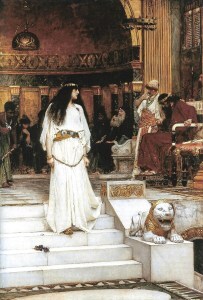 Mariamne being led to death (Wikimedia)
St. Jerome had another suggestion: “Drop of the sea,” from the Hebrew nouns mar (sea) and yam (drop). (When he translated the Bible into Latin, he translated the name into stilla maris, which morphed into stella maris, star of the sea–which is what Jesus’ mother is called in some churches.)
Some believe the name may have an entymological root out of Egypt: mr, which has the meaning “beloved.”
Another source suggests Mary’s popularity may come from King Herod the Great’s wife Queen Mariamne.
But since the king had Mariamne killed because he thought her treasonous, at that time, I’m not so sure people would have named their daughters after her.
The name Mary has been one of the most popular ever since Jesus walked the earth–holding his mother’s hand.
What did the Marys do in the New Testament?One gave birth to Jesus.
 Mary of Clopas by Rogier van der Weyden (Wikimedia Commons)
Mary Magdalene was a dedicated semi-disciple. She and “the other Mary” were the first to go to Jesus’ tomb Easter morning.
One sat at Jesus’ feet as he taught, earning his praise, annointed his feet with perfume, and dried them with her hair. She was Lazarus’ sister and ran to meet Jesus at her brother’s tomb.
Mary, the wife of Clopas, witnessed Jesus’ crucifixion. (Some believe she was Joseph of Nazareth’s sister-in-law).
According to Acts 12: 12, John Mark’s mother Mary appears to have sponsored the prayer meeting where Peter found the disciples after his miraculous release from prison.
So what?Are there any parallels between the Old Testament Miriam and the New Testament Marys?
One significant one.
In Exodus 15, Miriam led the Hebrews in song after the miracle of the Red Sea’s parting.
Among her words:
“I will sing unto the Lord for He has triumphed gloriously!”“The Lord . . . has become my salvation.”“Who is like You, glorious in holiness, Fearful in praises, doing wonders?”“The Lord shall reign forever and ever.”Mary’s praise of God–who had worked a shocking miracle in her life–mirrors some of Miriam’s concepts.
“My soul magnifies the Lord.”“He who is mighty has done great things for me, And holy is His name.” “He has helped His servant Israel, In remembrance of His mercy.”“As He spoke to our fathers, To Abraham and to his seed forever.”While Mary Magdalene may have been morally compromised, she changed her life when she began to follow Jesus.
God’s imprint is on all the Marys (and their variations) in the Old Testament and the New.
It’s a good name and God obviously likes it.
Which is why there are so many of them!
Tweetables
All the Marys in the Bible. What does the name mean? Click to Tweet
Parallels between Miriam and Mary singing God’s praises. Click to Tweet
The post Marys in the Bible: Why So Many? appeared first on Michelle Ule, Author.


July 16, 2024
Bible Study Preparation: A How-To for Learners

Bible Study preparation has been part of my life since my teens.
I didn’t become a Bible study leader until I graduated from college in the Dark Ages.
It was hit or miss–depending on where the Navy sent us–for a few years.
But I’ve been a leader almost every year since 1993.
More than thirty years.
This is how I prepare to lead a Bible study.
Bible Study Preparation: Begin with the textWhile I almost always use a prepared study–I like those put together by Concordia Publishing House, or Intervarsity Press–I need to understand the text before I can lead the discussion.
 Completed study, ready to lead!
I have a degree in English Literature from UCLA–which was basically textual analysis.
That means my professors taught me how to analyze a text–English literature in their case.
I knew how to take apart Shakespeare, Milton, and the romantic poets. I wrote papers on what I understand from examining it.
But, I used those same skills in Bible study, even in college. (It was my initial reaction after seeing Star Wars for the first time!)
My small group Bible study friends–including history, engineering, and poli-sci majors–often watched, amazed, as I tore about the Scriptures.
I wanted to know the why, the how, what the words meant, and how it all fit together.
Sometimes I may have become a little . . . over-zealous, shall we say?
Tearing apart the verses and examining the wordsHow do you do that?
Piece by piece.
Here’s how Kay Arthur’s Precepts classes taught me to examine the words closely. (I didn’t start this way, but I loved it when I took a Precepts class).
This is how I scribbled on the opening to Romans 8 (ESV) as my first pass:
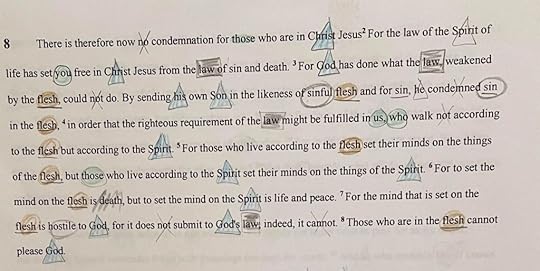
Note how I marked the repeated words in symbols and colors.
God, Jesus, and the Holy Spirit are blue triangles. “You” is circled and greenish. To my surprise, Paul used “flesh” nine times in the first paragraph.
Do you think it might be an important word/concept for this passage of Scripture?
If I hadn’t marked it, I’m not sure I would have noticed how often it appeared–though you’ll note God, Jesus, and the Holy Spirit appeared 13 times.
I then asked myself several questions–I usually scribble them into the margins.
What is this passage about?What are the themes?How many times are specific words used?Why?And so forth.
I usually apply the famous 5 Ws and an H–who, what, when, where, why, and how.
Once I’ve grasped what the passages is talking about, I move along.
Sometimes I answer the questions in my Bible study book.
But sometimes I don’t–particularly if my word study produces questions.
Bible study preparation, for me, always includes the commentaries.I try to match my Bible to what my churches uses, to keep things easier.
My Lutheran Study Bible is perfect for the Lutheran church.
After I do my overview, I read through the passage in the Bible, again, and then examine the notes at the bottom of the Bible.
On tricky topics, I move along to another commentary.
Over the last few years, I’ve used the Enduring Word commentary put together by Pastor David Guzik of Calvary Chapel, Santa Barbara.
I also like Concordia Publishing House’s The People’s Bible Commentary–which is mostly out of print now.
Beyond all these, Bible study tools abound. We have an entire shelf of them at our house!
Greek or Hebrew word explanations
When I’m leading a study that doesn’t include a workbook (as I did when I led a woman’s retreat last summer), I need to look at the actual Greek or Hebrew word meanings.
Fortunately, the Blue Letter Bible provides all the Bible study preparation I need to understand what the words mean in their original languages.
We used to own a Strong’s Concordance, but using online tools is much easier and faster than paging through a thick book, at least for me.
Logos provides many materials as well, including books.
I often use a straight dictionary, and frequently compare different translations/versions to more fully grasp a word’s meaning.
Auxiliary Books and VideosDepending on what I’m teaching, I like to look beyond the Bible itself for background material.
As a researcher/historian, I’ve taken notes from books, done indepth research of my own (turned into blog posts), and often just take my ladies through the Scriptures themselves, line by line.
I’ve even used novels to get a better sense of what “normal” life might have been like during the Biblical period. (See novels by Lynn Austin, Connilyn Cossette, and Tessa Afshar).
I read books by friends like Latayne Scott or even biographies set in Israel. There’s always the Bible Project videos, too.
I’ve written a lot of posts about Bible studies. You can examine them starting here.
Tweetables
How a seasoned Bible study leader prepares to teach. Click to Tweet
Where do you begin to prepare a Bible study teaching? Click to Tweet
The post Bible Study Preparation: A How-To for Learners appeared first on Michelle Ule, Author.
July 9, 2024
Joab and Abner: Seas of Blood on Their Hands

I’ve been reading about Joab and Abner recently, fascinated by their parallel lives.
Old Testament generals, they led King David’s and King Saul’s armies.
Blood poured from both mens’ hands–including that of each others’ relatives.
But who were they and how did God use them?
Relatives of Saul and DavidThe son of Ner, Abner was King Saul’s cousin. Grandsons of Abiel, the men grew up in the Benjamite lands north of Jerusalem. They obviously descended from the line of Benjamin–the youngest of the twelve tribes of Israel.
We don’t know why the tallest man in Israel at the time, Saul, chose his cousin to command his armies. Perhaps Abner also stood head and shoulders above most Israelites?
Meanwhile King David chose Joab, the son of his sister Zeruiah, to lead his army.
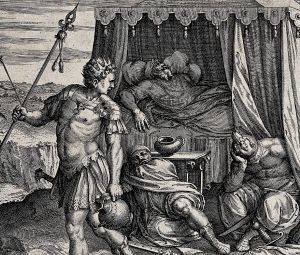 David steals Saul’s sword while
 Abner sleeps. (Wikimedia Commons)
It’s interesting to note the text does not mention Joab’s father, causing some to speculate Zeruiah held a special place in King David’s heart.
Joab’s two brothers also played important roles in King David’s army. Joab first appears in 1 Samuel 26, where he’s mentioned as the younger brother of Abishai.
(In 1 Samuel 26, Abishai, not Joab, is the brave nephew who travels with David into Saul’s camp at night. David and Abishai both stepped over the guards surrounding King Saul, including a sleeping Abner.)
Given the two generals’ courage and willingness to spill blood, perhaps it’s not surprising the two kings chose to keep Joab and Abner close and easily commandable!
Joab and Abner, David and Saul; they all knew each otherArguably the four most important men of their time, they all knew each other.
When Saul asked who killed Goliath, General Abner presented David.
Abner also attended the dinner when Saul first noticed David missing–because David knew King Saul sought his death.
As general of King David’s armies, Joab spent years hiding with David in the desert while King Saul sought to kill his rival.
 Abner in Medieval garb (Wikimedia Commons)
He’s first mentioned in connection with Abner in 2 Samuel 2 when Abner killed Joab’s younger brother Asahel.
It’s a curious passage. Asahel pursued Abner–to kill him–and Abner killed Asahel in self-defense. Abner kept telling Asahel to leave off, “because how will I face your brother Joab?”
Indeed.
Joab and Abner: blood thirsty menTwo strong, able, talented, devoted men rivaled each other in blood thirst.
Countless men fell at their swords, as well as under their command.
Joab and his brother Abishai pursued Abner after he killed Asahel. Arguing the murder was in self-defense, Abner urged the men to leave off.
Abner called to Joab and said, “Shall the sword devour forever? Do you not know that it will be bitter in the latter end? How long will it be then until you tell the people to return from pursuing their brethren?”
2 Samuel 2:25-27 NKJV
The avenging brothers stopped at Abner’s words, thought about it, and left off.
Perhaps they could live in peace?
Peace might have been possible after King Saul’s death on Mt. Gilboa, but generals are proud.
How did it all end?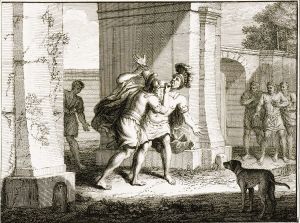 Joab and Abner outside Hebron for the kill. (Wikimedia Commons)
Abner backed King Saul’s son Ishbosheth rather than David. War continued between the two kings for control of Israel. Joab and Abner led the armies.
In his attempt to consolidate power in Ishbosheth’s kingdom, Abner took the late King Saul’s concubine as his own.
Perceiving this action as a threat to his power, Ishbosheth challenged him.
That was enough for Abner. He “quit” his job and went over to King David’s side.
David welcomed him.
Joab did not.
Perhaps Joab perceived a threat in his leadership, but the Scriptures indicate Joab sought revenge for Asahael’s death many years before.
Hebron was a city of refuge. Abner was safe inside the walls from blood-guilt by Jewish law.
Besides, King David had welcomed Abner.
One day, Joab and Abner met just outside Hebron’s gates, and Joab murdered him.
In his anger with Joab and his grief at Abner’s death, King David arranged for Abner’s burial in Hebron. You can still visit Abner’s grave today.
In one of his last pieces of advice to Solomon, King David told him to kill Joab following David’s death.
The two generals fought and left behind many bodies. Ultimately, they killed each other both directly and indirectly.
It’s hard to be the relative of a king.
Tweetables
Joab and Abner; blood shedders for Kings David and Saul. Click to Tweet
The parallel lives of Joab and Abner in the Old Testament. Click to Tweet
The post Joab and Abner: Seas of Blood on Their Hands appeared first on Michelle Ule, Author.
July 2, 2024
Lipizanner Horses: Beauty, Grace, and History
What is it about Lipizanner horses?

Their grace? Beauty? Fantastic history?
All I know is, they caught my imagination and fancy when I was a young girl–and I’ve been fascinated ever since.
The books did it first.
But then, I saw some “dance” in person. One magical afternoon, a few trotted to a fence to meet me.
Smitten, as only a girl can be.
(Even when she’s an adult).
What is a Lipizanner?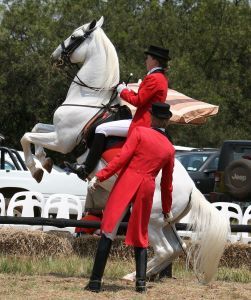 South African Lippizanner (Wikimedia Commons)
My interest probably began when I saw Miracle of the White Stallions. A 1963 Disney movie, it was based on a book written by Alois Podhajsky, a director of the Spanish Riding School in Austria.
I loved the story and seeing how the impeccable white stallions “danced” in the air in marvelous ways. How could such a horse “leap” as in a ballet?
Airs Above the Ground by Mary Stewart captured my imagination in my teen years. This story, a comfort novel to me, also features a spy . . . but describes action at the Lipizzaner stud farm in Slovenia
Unique European Horse Breeds in Books
I’ve been thinking about not just the Lipizanner horses, but also the other unique horsebreeds lately because I recently read my friend Nicole M. Miller’s debut novel which features them.
Based on a true story, Until Our Times Comes describes the desperate scramble to save the Polish breed during World War II.
With those unfamiliar with the Nazis . . . they were interested in perfecting not just the “human race,” but also in selective breeding for a “perfect horse” during WWII.
(See Elizabeth Lett’s The Perfect Horse).
Miller’s historical novel portrays a different “front” in this attempt–the Janów Podlaski Arabian Horses.
The action for Miller’s novel begins at the Janów Podlaski Stud Farm, not too far from Warsaw, in 1939.
The farm has raised Arabian horses for the last 200 years, despite being plundered by the Russians armies in both WWI and WWII.
 Janów Podlaski Stud Farm (Wikimedia Commons)
In her novel, Miller describes the risk of losing the pure breed through the eyes of an American working at the farm and her love interest: a British spy.
From the novel, I learned a lot about the care needed for thoroughbreds, and the desperation so many felt during WWII to escape the Nazi clutches.
The book reaches a satisfying conclusion when, as history recounts, General George C. Patton (an Olympic equestrian medal winner) sent in his troops to rescue the horses.
Visiting the Slovenia Stud FarmYears ago, my family visited Slovenia and when I looked at the map, I realized the Lipizanner stud farm wasn’t far away (Indeed, for those with a car in Venice, you’re not far away either).
“Can we go?” I asked my husband.
Of course.
Unfortunately, we arrived too late for the tour, but as we drove up the long driveway between beautiful lush green pastures, we spied a small herd.
He pulled over, I got out of the car, and my heart melted yet again.
I stood at the rails, shooting photos, and then they came over to greet me.
How my heart sang! Lipizanners greeting me!
I was a little girl again, a teenager, and then a grinning, charmed middle-aged woman.
 The Slovenia stud farm
 A herd at a distance
 Then they came to visit
Obviously, beautiful horses will do that to you.
Tweetables
What is it about Lipizanner horses? Click to Tweet
A new novel reminds us of the Nazi plan for a super horse breed. Click to Tweet
The post Lipizanner Horses: Beauty, Grace, and History appeared first on Michelle Ule, Author.
June 25, 2024
Hamlette the Pig Takes a Walk

Hamlette the pig took a walk one day, followed by me and her owner.
I’d planned to sit in the Southern California sun and enjoy the weather, but the thought of ambling down the street following Hamlette the pig seemed like fun.
So, off we went.
Through a gate and down a wide street.
My friend, me, his cat, and Hamlette.
Quite a little procession we made.
Hamlette the pig and the catThe cat was hilarious.
She’d taken this walk before.
She watched from a tree.
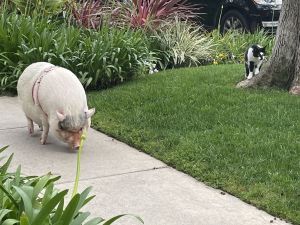
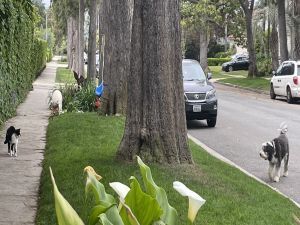
Rolled, bored, she waited as the swine took her time.
Peered around a corner, and called off a dog, and sprinted home–long before us.
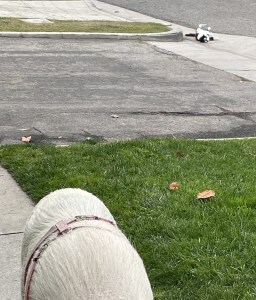
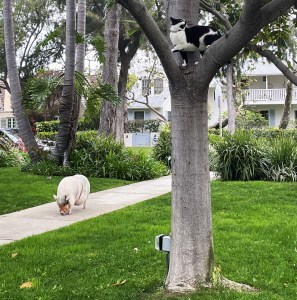
At least the cat knew how to defend Hamlette the pig from a friendly dog!
The pig, however, never looked up. Hamlette kept trudging, diligently, down the street!
Dinner was waiting–somewhere!
What do the neighbors think?Everyone in the neighborhood knows Hamlette the pig.
Including the local dogs.
They don’t even look up anymore. (The dog above reacted to the cat!)
Hamlette enjoyed resting in the fenced-in front yard.
Children and their parents, the mail carriers, neighbors, and friend delivery people, all knew her.
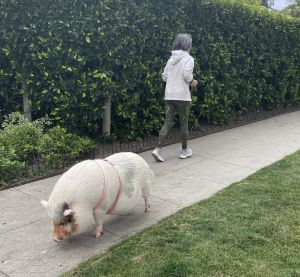
They’d stop to say hello, or even toss a piece of fruit, whether the owners were home or not!
On our walk, a neighborhood runner, not moving very fast, lapped us twice!
Cars slowed down and drivers peered at the ambling porcine.
Her owner waved and they returned the salute!
You can read about the popularity of a neighborhood pig in the book The Good Good Pig: The Extraordinary Life of Christopher Hogwood by Sy Montgomery.
Why does Hamlette the pig live with a family?Once upon a time, Hamlette the pig belonged to her current owner’s daughter.
Purchased as a teacup pig nine years, ago, the first owner’s roommates didn’t like living with a pig, no matter how cute she was.
 Hamlette the pig as a piglet
 Like many pigs, she liked to eat.
And eat. And eat.
One day, the young woman brought Hamlette the pig home.
Her parents fell in love.
And Hamlette has been a happy pig ever since.
She started out at only a few pounds, big enough to hold in your hand.
Hamlette the pig weighs 250 pounds now.
Her family still loves her.
And every day, or even twice a day, she goes for a walk.
How does the walk end?
The cat keeps track of her.
And waits for her piggy friend to catch up.
Then, the two of them go through the gate.
Hamlette knows it’s time to eat once she’s home.
And then, she does her job.
Relaxing.
Everyone knows to let sleeping pigs lie.
 Hamlette Goes on a Walk
Hamlette’s story releases on June 25 as a child’s picture book.
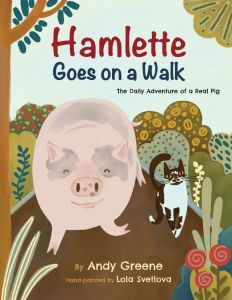
Written by Andy Greene–and based on the walk above–you can find the book at Amazon and at Green River Books.
Andy met Hamlette several years ago when he “began walking her as a side hustle to his artisitic endeavors. And he still enjoys walking Hamlette to this day.”
Portions of the book’s profits will be donated to the Hammy Fund, to help pigs and other animals in need.
Tweetables
Taking a neighborhood walk with a 250-pound pig. Click to Tweet
A pig, a cat, and two adults take a walk on a city street. Click to Tweet
The post Hamlette the Pig Takes a Walk appeared first on Michelle Ule, Author.
June 18, 2024
On Being a Student Journalist

Once upon a time, I was a student journalist.
My stint as a reporter for the UCLA Daily Bruin and eventually as a city editor, took place in the last milenium.
I’m not going to say “covering the story” was different in “my day,” but it sure feels like it.
I’m not sure why. It’s just the usual Who, What, When, Where, Why, and How?
Isn’t it?
Who wanted to be a student journalist?I did not go to college planning to be a journalist.
I sort of fell into it.
UCLA still does not have a journalism school, but it always has had a student-run and student-edited newspaper, The UCLA Daily Bruin.
(My father wrote for the sports section during his time at UCLA, a generation before me.)
Even all those years ago, I dreamed of being an author. I wanted to write books that would change how people viewed God and life in general. (I explain all that on my website here.)
I thought a degree in English Literature would prepare me for a literary, book-penning world.
Actually, in my time, a degree in English Literature means I got a degree in textual analysis.
It could be helpful for studying literature, yes, but it was extremely helpful for what I’ve done ever since I graduated from college: examine the Biblical texts and lead Bible studies!
Who knew?
Not me.
(Isn’t it interesting how God so often organizes our lives in ways we don’t even realize at the time! I’ve written a lot of blog posts about studying the Bible. You can see them starting here.)
Being a student journalist often means making mistakesBut during my first year, I never seemed to get around to writing the great American novel. I was too busy with the band, Bible studies (ripping apart the text just as I was taught), and figuring out life.
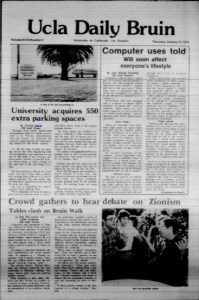 Front page! I remember writing that story! Internet Archives
One day, I saw an ad in the UCLA Daily Bruin looking for student journalists.
I figured if I had a job, I’d have to write, so I went down and applied.
That turned out to be true. Typing words on paper was the job.
I also learned to edit and since being a student journalist often means making mistakes, I also learned how to accept responsibility for my words.
That’s an important skill to learn when you’re 18 years-old.
I learned to be very careful about taking down accurate notes during interviews.
Several times I learned how to apologize for misrepresenting people’s words.
How to make appointments and keep them, how to face down angry readers, how to not flinch over letters to the editor, and how to accept correction from my editor.
Important skills I took with me into adult life.
Most importantly, I learned how to respectfully ask questions and really listen to the answers–particularly of people I didn’t agree with.
And, of course, I learned how to write to a deadline.
(Back in those Dark Ages, we were taught if you could not respectfully present both sides of a story–particularly if you didn’t agree with one side–you were not ready to write the article.
(Do you see that attitude in the news today?)
Facing hostility as a writerHey, I didn’t write the editorial that caused all the trouble!
But I was one of the editors the day an angry mob–maybe 25 people–marched on the Daily Bruin office and burned a copy of our paper “in effigy.” (We were students, dramatic, remember?)
The campus police evacuated the offices. We locked up, grabbed our notebooks, and fled–to the top of Kerkoff Hall where we could watch events!
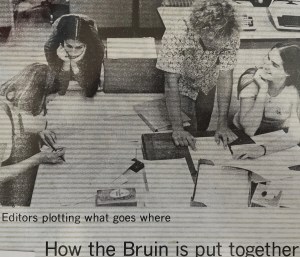 That’s me on the right talking to an editor. (Daily Bruin 1976)
Nothing more happened–but we got great photos and a story for the next day’s front page.
In hindsight, I was not a particularly good student journalist. I’m sorry for that.
But I learned a lot about life, asking questions, and taking down answers. I showed up every day, supported the rest of the staff, and then graduated a year early.
My experiences as a student journalist helped form my novel A Poppy in Remembrance.
Even a former student journalist follows the action.Years later, we woke up to words shouted outside our bedroom window: “Police! Stop or we’ll shoot!”
“What are you doing?” my husband whisper-shouted as I bounded out of bed to look out the window.
I raced down the hallway, listening as the police chased someone down the east side of our thin-walled Hawaiian bungalow.
What a surprise! The long-defunct reporter instinct was ressurected!
I dashed through the galley kitchen to the lana’i, where I saw the flashlights following a suspect.
(Using my sleep-addled brain, I did crouch beside the refrigerator lest any bullets come through the screened windows or one-board thick wall).
They ran around the back of our house, and then through the carport on the west side!
Hustling back down the hallway, I stood watching in my sleeping children’s bedroom as the police knocked the assailant onto the driveway not ten feet away, and arrested him.
After the police cars drove off, I climbed back into bed.
“What were you doing?!” demanded my Navy guy. “Are you crazy? They had guns!”
I shook my head and smiled. I’d felt that familiar adrenaline surging and the dormant journalist sprang back to action
“Once a reporter, always a reporter,” I laughed and kissed him goodnight.
Did I really major in textual analysis?
Yes . . . but I’ve always been interested in getting the story, too!
Thanks be to God.
Tweetables
On being a student journalist–do the reporter instincts ever die? Click to Tweet
Student reports can make mistakes but if they’re good–grow up to tell the accurate story. Click to Tweet
The post On Being a Student Journalist appeared first on Michelle Ule, Author.
June 11, 2024
A Wonderful Life: Have You Got One?

I first saw the classic movie It’s a Wonderful Life my freshman year of college.
I remember watching the black and white movie late one night at Christmas time.
In those long ago years, we only saw a movie when a television station manager could program it onto his station.
Movies were rationed. They’d air on television then disappear for years. When enough time passed, someone released them from movie vaults and program managers scheduled them on TV.
It’s a Wonderful Life had not played in my lifetime before that night.
How wonderful, really, to watch it for the first time.
It’s always fun to get sucked into a story and see something about life.
It changed me.
How to define a wonderful life.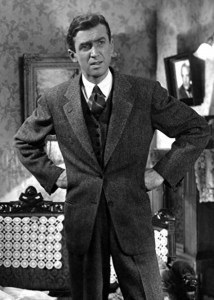
As usual, we start with a definition for wonderful:
Admirable or very good; excellent or splendid.Capable of eliciting wonder; astonishing.Adapted to excite wonder or admiration; surprising; strange; astonishing.Wouldn’t you love to have a life like that?
Does any of it depend on us or how we feel?
Gratitude is the key. Doesn’t choosing to be thankful make a difference?
So, when I greet the day with expectation (after putting on the armor of God), my eyes are opened to what may be, not just what is supposed to happen.
Holding my calendar lightly is helpful–because I never know when my day will get upended.
That happened to George Bailey in It’s a Wonderful Life, didn’t it?
Life was hard, but filled with simple blessings.
The night they potentially were taken away, an angel enabled George to look at the past–through different eyes–and recognized the glory, wonder, and joy.
How can a movie help you assess your life circumstances?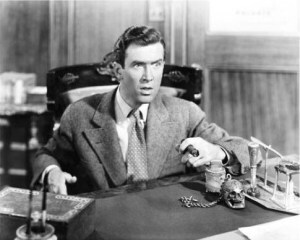 How can THIS be a wonderful life? (James Stewart as George in It’s a Wonderful Life. Wikimedia)
In It’s a Wonderful Life, George Bailey lives a normal life–full of disappointments, work, but also busy with love and laughter.
Small town America in the 1930s was both a safe place, but also a potentially dangerous place to live.
People tended to be simpler, poorer, and needed to depend on each other.
George Bailey had to work at a young age.
He also had to take an important step into maturity–when he corrected the pharmacist for making a mistake.
George got his ears boxed that day–felt pain–but it was the right thing to do.
How often does that happen to us in “real life?”
George’s dreams got dashed by reality.
He “settled” for marrying the girl he’d known from childhood.
Instead of becoming an engineer and touring the world as he’d dreamed, his life narrowed.
George took over his father’s failing savings and loan company instead of going on his honeymoon. (How many women would be as charitable as Mary Bailey?)
From there he invested in the people around him–whether they deserved it or not.
And when push came to shove–Mr. Potter pulled a shady scheme–George Bailey found out the truth about his life.
How to recognize you have a wonderful lifePonder the idea.
Turn the prism and examine your life and circumstances from a different angle.
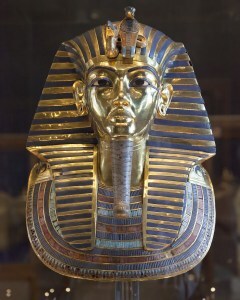 King Tut funerary mask. Roland Unger (Wikimedia)
He was the pharoah of Egypt–how could my life be better than a potentate?
Those who’ve visited museum exhibits of his tomb know the truth.
He had terrible teeth.
Mine are much better–and they don’t even hurt. (The dental hygenists laugh every time I point that out!)
I also can drink out of a glass. He only had clay or golden goblets.
(I wouldn’t want to drink out of a golden goblet. Who has time to polish water spots out of a gold goblet?)
Taking George Bailey’s wonderful life philosophy homeIf you haven’t seen the movie, you can watch it here.
Know that by the end, the yearning for a glorified future George desired required him to possibly lose it.
Then he could count his blessings and recognize how God had led him through difficulties upon difficulties.
From a distance, where he thought he’d lost it all, he recognized what really makes a life wonderful: the love of people who cared about him.
Nature helped with a snowflake on his tongue.
When he could look up from the pain (with the help of an angel), he saw with joy that he truly had a wonderful life.
Many people in this time and place don’t seem to have the same opportunities for love that George Bailey had.
It’s important to remember he received love from so many others because he chose to love them first.
Even when it required a sacrifice from him.
Just like it says in 1 John 4: 19: “We love Him because He first loved us.”
Look around you. Turn the prism of today’s circumstances. Count your blessings. Try to see things with gratitude instead of judgement.
You may be surprised. You could have a wonderful life.
It just depends on how you look at things, doesn’t it?
Tweetables
The secret to having a wonderful life. Click to Tweet
It’s a Wonderful Life: fiction or can you make it a fact? Click to Tweet
The post A Wonderful Life: Have You Got One? appeared first on Michelle Ule, Author.
June 4, 2024
Reading Chad Bird–and Listening, too–in 2024

I’ve been reading Chad Bird’s words every day, so far, in 2024.
Who is he?
He describes himself this way: “Chad Bird is a speaker, scholar, writer, and truck driver who weds biblical truth to life experience to help broken people like himself.”
He’s also the scholar in residence at 1517: “Christ for You.”
I listen to his 90-second explanation of an Old Testament passage every morning on “X-Twitter,” and then read a short commentary he wrote on another Biblical passage.
He’s going through a Bible-in-a-year plan on “X-Twitter,” but that’s not what I’m reading.
I’ve got his excellent 365-daily devotional, Unveiling Mercy: Based on Insights from Old Testament Hebrew.
Everyday I learn at least one new thing.
I’m amazed at the parallels, meanings, and concepts I learn from the Bible every single day. Bird’s explanations just enhance the other places God is taking me these days.
Where did I hear of Chad Bird?I can’t quite remember, but I know it was during the 2023 summer. My former prayer partner may have suggested him.
After visiting her, I flew home and read his memoir on the plane.
Night Driving: Notes from a Prodigal Soul caught my attention on Hoopla from the title alone.
Not a long story, I read the entire book on my flight from Idaho to California.
As soon as I got off the plane, I ordered a paper copy of my own.
I wanted to mark up a book!
What am I learning from Chad Bird? Chad Bird photo off X-Twitter.
 As a Bible teacher for most of the last 30 years, I’m constantly gaining new insights.
I’ve been reading the Bible almost daily for most of my life–but there’s always something more.
In the last five years, I’ve spent a lot of time in the Old Testament. I’m now on my second reading the Bible-in-a-year.
I’ve long been fascinated by what the Hebrew words really mean. (So, while preparing to teach, I spend a lot of time with Strong’s Concordance trying to fully grasp the Hebrew word meanings).
Every morning, Bird supplies a new Hebrew word–with a fuller explanation of how the word is used, often in both the Old and New Testaments.
Fascinating! (But I’d still like an index in the back, guys, so I wouldn’t always have to hunt up Strong’s!)
A former Hebrew professor at the Lutheran Church Missiouri Synod’s Concordia Theological Seminary in Fort Wayne, Chad Bird brings the theological, Hebrew, and spiritual implications into his word explanations.
So rich. So wonderful.
I appreciate, however, how humble he is as well about his life. As I write this, he posted yesterday:
“I always knew that Jesus died for vile and deeply flawed sinners. It was only later in life that I realized I was in that group.”
Same here. Amen.
Making Jesus realWhat I liked about Night Driving was how he reminded me that Jesus understands brokenness–and how how real He is.
 Photo by Alice Godoy (Unsplash)
Look at this quote:
What I’ve learned to appreciate most about our God of skin and bone is how underwhelming he is. Jesus didn’t walk the streets of Nazareth with his face aglow.
He looked like the guy at Walmart you push your cart past on the way to get milk. He was no head turner . . . [see Isaiah 53:2]. Maybe Jesus was ugly, or fat, or had bad teeth. He wasn’t GQ material.
He was the kind of God you could miss, because he hid in plain sight, as a regular Joe–finally even as a convicted criminal sentenced to die.”
Night Driving p 47.
That’s the Jesus I worship.
Amen, again.
But always pointing me back to the God I worshipI suggest you look up Chad Bird on “X-Twitter” and find out for yourself.
See how he makes God and Jesus and the Holy Spirit feel closer and more wonderful to understand.
Hopefully, Bird’s insights will increase and encourage your faith, just as he’s done mine in 2024.
Thanks, Chad Bird.
Tweetables
Reading Chad Bird–and Listening, too–in 2024. Click to Tweet
Intriguing insights into the Hebrew God of the Bible from a guy on X-Twitter. Click to Tweet
The post Reading Chad Bird–and Listening, too–in 2024 appeared first on Michelle Ule, Author.
May 28, 2024
Putting on the Armor of God: A How-To
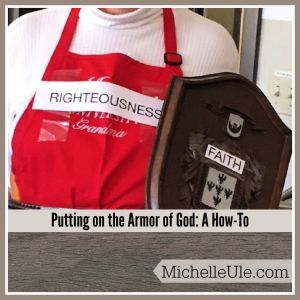
We’ve been putting on the armor of God at our house for quite some time.
It’s the first thing I do every morning.
I‘ve written about the armor of God before, I just didn’t explain how I use it.
I’ve been asked now, to do so.
This is my description, which also includes commentary from a military officer I know well.
Why putting on God’s armor is importantThe concept comes from the Ephesians 6 passage that explains the importance of putting on the armor of God.
The key verse explains:
Put on the whole armor of God, that you may be able to stand against the wiles of the devil. For we do not wrestle against flesh and blood, but against principalities, against powers, against the rulers of the darkness of this age, against spiritual hosts of wickedness in the heavenly places.Therefore take up the whole armor of God, that you may be able to withstand in the evil day, and having done all, to stand.
Ephesians 6: 10-13
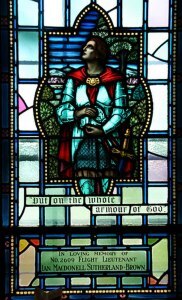 Putting on the armor of God stained glass. (Wikimedia)
We live in a challenging time when Christians can feel vulnerable.
The best way to stand against the forces of evil–the spiritual ones–is by being prepared and therefore not being surprised when “attacks” of one type or another come.
Scripture warns Christians to “be sober-minded; be watchful. Your adversary the devil prowls around like a roaring lion, seeking someone to devour.” (1 Peter 5:8)
It’s harder for a lion to sneak up on you if you’re listening for his roar, and you’re prepared to defend yourself.
Spiritually, of course.
A step-by-step guide to putting on the armor of God; Ephesians 6: 14-15Therefore take up the whole armor of God, that you may be able to withstand in the evil day, and having done all, to stand firm.
14. Stand therefore, having fastened on the belt of truth, and having put on the breastplate of righteousness.The belt of truth is a symbol of authority–and, of course, refers to the Bible.
After I mentally put on the belt, I ask God to govern my words so that I may correctly speak Biblical concepts. My words need to speak truth by matching what God says in the Bible.
In addition, I ask God that I might bless people with my truthful words and not curse them.
You may have different concerns about how you speak and what you say. Since God already knows your weaknesses, ask Him to protect you and others. Metaphorically, that belt of truth is a reminder to speak only truth.
The military guy had a fuller explanation: “The belt is not to protect you. It’s a sign of authority, trust, and personal confidence I’ve been given the authority for what I need to do for the Kingdom of God.”
“When I put on the belt, I’m doning the Lord’s authority.”
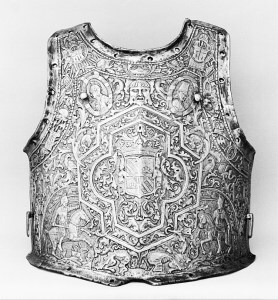 A breastplate fastens on the side. (Wikimedia Commons)Breastplate of Righteousness
A breastplate guards our heart, soul, and spirit. It goes over our head and we fasten it on both sides, secure in place.
Lately, I’ve been thinking about the ephod the Temple high priest wore to determine the will of God.
Christians have the Holy Spirit living in them. I always picture him in my heart.
In reflecting on the breastplate, I think about how it’s the Holy Spirit who tells me to go this way or that way.
So, when I mentally secure the breastplate across my chest, I’m protecting the most important and eternal part of who I am.
And I try hard to follow where the Holy Spirit wants me to go.
15. As shoes for your feet, having put on the readiness given by the gospel of peace.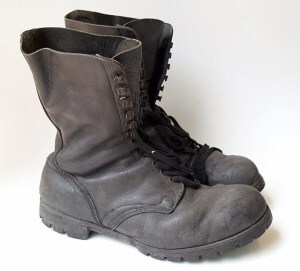 Hikers know the value of boots; soldiers, too. (Wikimedia)
As I mentally pull on my boots, I always think of the Isaiah 52:7 verse: “How beautiful upon the mountains are the feet of him/her who brings good news.”
The verse reminds me that my words, thoughts, and actions should present the Gospel to people with grace, humility, and peace.
I think of Romans 12:18, “If it is possible, as much as depends on you, live peaceably with all men.”
I ask God to help me walk in His peace and bring His peace wherever His shoes take me that day.
The military guy commented, “in wearing the shoes of peace, remember to take time to rest.”
Putting on the shield and helmet; Ephesians 6:16-1716. In all circumstances take up the shield of faith, with which you can extinguish all the flaming darts of the evil one.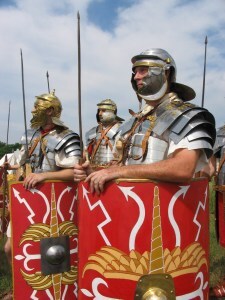 Roman shields could be locked together to form a wall. (Wikimedia Commons)
“Flaming darts” also appear in Job 41:21 and refer to attacks by Leviathan (whom some Biblical scholars believe to have been Satan).
This shield–which is small enough to be placed above the head if need be, or linked to shields held by other soldiers–is designed to protect us.
In putting on a shield of armor, we’re asking God and His angels to step between us and Satan’s evil.
A surrounding shield is not to be hid but to be deployed. It’s not static, flexible, and mobile. We shouldn’t be afraid to use it offensibly.
It’s the first line of our defense. We can duck down and hide behind a shield.
17. Take the helmet of salvation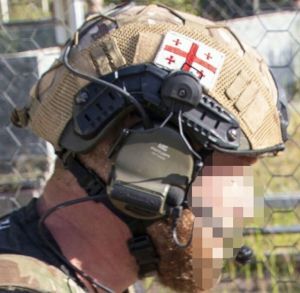 Not the helmet Paul pictured, but it works for us! (Wikimedia Commons)
I remind myself that “God has not given us a spirit of fear, but of power and of love and of a sound mind.”
Jesus told us not to worry when we go before authorities, “for the Holy Spirit will teach you in that very hour what you ought to say.”
Wearing my helmet of salvation, I can trust Jesus will put the words into my mind.
(I picture a modern helmet with earphones that keep me in contact with my authority!)
I also ask God to “govern my thoughts, words, actions, that I might see with Your eyes, hear with Your ears, understand with Your heart, and speak only words that are consistent with Scripture.”
17b. And the sword of the Spirit which is the word of GodBefore I “pick up” the shield of faith, I thank God for the sword of the spirit.
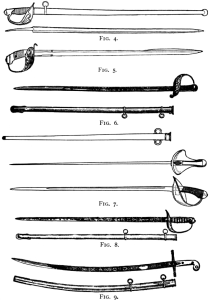
Swords come in different forms. Some are hacking swords–wide blades that can do a lot of damage
Some are thin, almost scapel-like blades that can go deep without doing as much damage–as between the bone and sinews.
Depending on the day and the planned activities, I usually ask that I would wield God’s sword without bludgeoning someone. I want to speak words of life, not death.
Don’t we all want truthful affirming Biblical words to come from our lips?
18. Pray at all times in the Spirit, with all prayer and supplicationWho can argue with that?
It doesn’t do us any good, spending time putting on the armor of God, if we aren’t convinced God is with us.
As Oswald Chambers always said, “prayer is the greater work.“
If we haven’t prepared ourselves with prayer before we “go into the fight” of life in the world, we’ll find it more difficult to come out unscathed.
Prayer, basically, is God’s “battle plan.”
A military officer expands on why putting on the armor, as well as taking it off, is important.He commented about the use of the spiritual armor of God in a prayer session, providing these points:
No warrior expects to be unscathed when s/he fights.Expect to come out with bruising, broken bones, and blood.Preparation can minimize the hurts.The armor protects from major injuries.Rest is a weapon (don’t be afraid to take off your armor and rest).If the enemy convinces you to fear injuries, he wins, because you’re not as effective.A soldier never goes into battle alone. Don’t try to be a “lone ranger.”Scars are marks of honor (The enemy whispers you’ve failed if you get injured. He lies.)Rotating out for a time is not failure. It’s rebuilding to re-enter the battle.Don’t be afraidHe who began a good work in you will bring it to completion.
If God is for us, who can be against us?
Put on the armor of God and stand.
He’s with you.
Thanks be to God.
Tweetables
HOW, exactly, do you put on the armor of God? Click to Tweet
What, practically speaking, does it mean to put on the armor of God? Click to Tweet
The post Putting on the Armor of God: A How-To appeared first on Michelle Ule, Author.
May 21, 2024
Vacation Planning with Teenagers

We’re vacation planning with two teenagers these days.
Along with their very experienced adult aunt.
They’ll be meeting us in a long way from home after we finish a ministry trip this summer.
The aunt has traveled with us since birth.
The teenage girls?
Never.
Their fathers, also experienced in traveling with us since birth, are laughing. “You’ll love it. Go!”
How do you do vacation planning with teenagers?Once upon a time, a friend and I took our teenage daughters (see the above aunt) to New York City over spring break.
Before we left, I took a poll with two questions:
What do you HAVE to see on this trip?List three other places you’d like to visit in order of preference.From there, and in consultation with J, the other mom, I arranged an itinerary for our five days in the city.
Fortunately, three of us agreed on our number one: The Metropolitan Museum of Art.
The rest of the lists lined up to the classics: Statue of Liberty, a play, MOMA, Central Park, Chinatown, Empire State Building, New York Public Library (that was me!), and the 911-site.
We stayed in a hotel near Times Square, so that was a given.
 Which would you choose? (Wikimedia)Did vacation planning include the theater?
J and I purchased tickets in advance to see The Phantom of the Opera as our splurge event.
That was fine with the girls (14 and 15), but they really wanted to see Wicked.
J and I had never heard of it.
Which is why vacation planning ahead of time was important.
Fortunately, during those years, you could line up at the Wicked box office at five o’clock, and enter a lottery. Each person wrote their name on a ticket.
You returned at seven o’clock to hear them select twenty-five people who could buy two tickets for that night’s performance.
We did that every day we were in New York. (Which made a mess of dinner plans!)
Vacation Planning and IndependenceSince this trip was about me demonstrating to my daughter that I could be a really fun go-with-the-flow mom (it had been a long winter), I decided to give her a very long leash.
I still held the leash, but she had plenty of leeway.
It started with the subway.
We bought passes and handed them out. “Okay, girls, you’re in charge of the subway.”
 The teenagers managed just fine!
The California girls looked at me. “What do you mean?”
“You’re going to figure out how to get to wherever we’re going on the subway. Examine the map, plot the subway, and we’ll follow you.”
J laughed with me at the surprise on their faces. They were both conscientious girls.
“What if we don’t get off at the right place?” my teenager asked.
“We’ll just catch the subway back to wherever. We aren’t going to care if we get lost. You’re in charge.”
Working together, they figured it out. We never got lost. We never got off at the wrong place. They were very proud of themselves.
And they never missed returning us to the Wicked theater in time for the lottery.
Visiting an Art MuseumFirst day, though, we set out for the two art museums on our lists: the Museum of Modern Art, and then the Met.
Since MoMA was on the way, we stopped there first.
None of us really liked it (“What’s the point of appreciating a work of art if the artist can’t figure out what to name it?” asked one).
We breezed through the exhibits very quickly.
The Met, though. Ah, a great success.
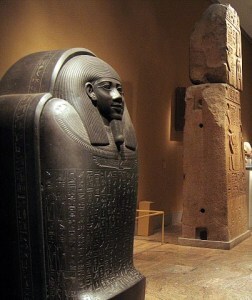 They loved the Met’s Egyptian wing! (Wikimedia Commons)
We started in the Egyptian wing–which the girls loved.
It was crowded, has many paintings, and can be overwhelming.
So, I went into traditional “visiting an art museum” mode and we walked quickly through the exhibits.
At each new gallery, I glanced around, found the most famous painting, and led them to it for a hurried description.
They needed to know why this painting was significant.
We chatted about it and then and headed to the next exhibit.
Total fun.
Do teenagers want to visit museums?My children think visiting museums IS the purpose of the vacation.
No problems with our friends.
But we spent a lot of time just walking the streets, discussing how different New York was from our homes on the west coast.
We visited Chinatown, walked through Greenwich Village and the 911-site on our way to catch the ferry to see the Statue of Liberty.
The girls enjoyed going to the top of the Empire State Building and admiring the astonishing view.
 The view is always amazing from the top! (Wikimedia Commons)
Central Park was beautiful and we had an ice cream cone.
But each night on time, we returned to the Wicked theater to sign up for and then learn if we’d won the lottery.
Tantalizying: would we see Wicked?The girls sang songs from Wicked the entire trip.
Why I had never heard this music before?
Three nights in a row, we didn’t win the seat lottery.
On Thursday, we stopped by one last time.
 We stopped by every night! (Wikimedia Commons)
The man taking my lottery ticket looked at me. “Have you been here all week?”
“Yes. We’ve come all the way from San Francisco, and this is what the girls really want to do.”
He nodded and read my name. “Mrs. Ule, right?”
I looked him in the eye. “Yes.”
“Good luck.”
Surely you heard the screams two hours later when they picked my daughter’s lottery ticket? (Okay, she has the same last name, maybe that was it?)
She and her friend sat front row, center, for $25 each. They could practically touch the orchestra conductor.
J and I bought our own tickets, far from the girls, and enjoyed the show.
it wasn’t part of my vacation planning with teenagers, but for all of us, winning the lottery to see Wicked was the highlight of a great trip.
It also started the restoration of our relationship, which was important.
But, all of that was possible because I left planning the vacation in the hands of two capable teenage girls.
In 2024?Both girls have travel guides. I gave them post-it notes and a deadline: “tell me what you want to see more than anything.”
The fourteen-year-old handed me a full book fulled marked.
The thirteen-year-old squealed, “I just want to go!”
So the aunt and I are planning (with the teenager’s notes).
And my husband? He just laughs.
It should be a great trip.
Vacation planning with teenagers is an opportunity to:
Teach them some independence.Learn about their interests.Encourage their enthusiasm for a trip.Bond as a family.Try it!
Tweetables
Vacation planning with teenagers–let them do it! Click to Tweet
Tips for vacationing with teenagers. Click to Tweet
The post Vacation Planning with Teenagers appeared first on Michelle Ule, Author.