
Michelle Ule's Blog, page 6
December 10, 2024
Jesus’ Father Joseph in Nazareth

We saw references to Jesus’ Father Joseph in 2022 Israel.
Mary, Jesus, and God the Father were all over the place.
Joseph, as usual, remained in the background.
Walking through the family’s Nazareth hometown, however, we saw that Joseph had not been forgotten in his hometown.
Signs of Jesus’ father Joseph and Mary in present-day NazarethThe major tourist site in Nazareth is the Church of the Annunciation.
In the 18th century, the Catholic Church built an altar over what is believed to be where Gabriel appeared to Mary–or her family home.
But why there?
The Emperor Constantine’s mother, Helena, converted to Christianity and, in 326 AD, traveled to Palestine to find significant sites.
Constantine gave her funds, and she sought to commemorate the place where Jesus and his family lived. While there, she built basilicas–or shrines–on the sites.
One of those places was in Nazareth–the Basilica of the Annunciation of Mary.
The residents of Nazareth, 300 years after Jesus lived there, told her where the events happened.
What was their logic?
Jesus’ family’s life in Nazareth before his birth2033 years ago, Nazareth was not a large town.
Sitting on a hill overlooking the southern end of the Jezreel Valley (aka, the site of Armageddon), Nazareth was a small town whose residents probably were related to each other.
(Which is why some people believe Mary and Joseph probably were cousins).
Everyone would have known each other.
When visitors began arriving to seek information, folks would have known where Mary lived.
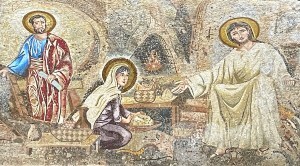 Mosaic inside the Church of St. Joseph (author photo)
Hence, they would have pointed to the “likely” spot of Mary’s family home and Joseph’s workshop.
(“Likely” means give or take 100 yards!)
Hence, the specific spots pointed out at Nazareth’s Church of the Annunciation.
Joseph’s WorkshopAfter stepping out of the Church of the Annunciation, we followed a path up the hill.
To my surprise, we arrived at a much smaller church: the Church of St. Joseph. The plaque out front identified it as the site of Jesus’ father Joseph’s workshop.
Who knew?
In the photo at the top, you can see how shiny Joseph’s knees are on the statue. People touched them as they knelt to pray.
We walked down a narrow set of stairs to an area under the church. There, we viewed what was supposedly Joseph’s workshop.
The mosaic above helped us picture what the workshop might have been like 2000 years ago.
 Joseph’s workshop circa today?
Today, it looks like this:
(You get used to seeing dirt and stones pronounced something significant!)
Was this spot really Joseph’s workshop?
Who knows?
It’s close to Mary’s family’s home–or at least according to what Nazarites told Helena 1700 years ago.
Jesus’ father Joseph– the man himselfWhat do we know from the Scriptures about Jesus’ father?
Joseph never spoke a word in the Gospel stories.
The Bible tells us about Mary talking.
But Joseph?
We only see his actions.
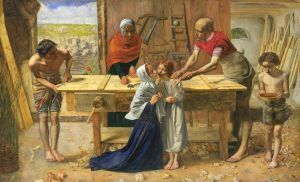 The family at home. By John Everett Millais (Wikimedia Commons)
Despite Mary’s curious story, he accepted the angel’s direction, and his Nazareth life turned extraordinary.
He acted immediately when another angel told him to leave Bethlehem for Egypt.
Another angel in a dream shook him awake and sent the family back to Israel–but not Bethlehem.
Joseph took Mary and Jesus back to Nazareth, where he lived for the rest of his life.
What happened to the boy he raised?
Jesus loved his mother and cared for her. He put up with frustrating brothers and went on to save the world.
Who can doubt but that his father, Joseph, the man, would have been proud?
Tweetables
Jesus’ father, Joseph of Nazareth: actions spoke louder than words. Click to Tweet
Interested in Another Look at the Advent Stories? Available in the Free Resources.
Joseph’s Lullaby–by Mercy Me–is a Christmas carol about him.
The post Jesus’ Father Joseph in Nazareth appeared first on Michelle Ule, Author.


December 3, 2024
Mary after the Nativity

What happened to Jesus’ mother, Mary, after the Nativity?
Many people don’t know.
We get glimpses of her further in the New Testament, but nothing beyond.
Here’s what we do know from the Bible.
Mary, after the Nativity, lived in several locationsWe don’t know if she was born in Nazareth, but the lineage in Luke 3:23 suggests Mary was a descendant of King David. (Got Questions explains why scholars believe this).
In addition, scholars believe Luke interviewed Mary about Jesus, which is why his gospel has details the other three lack.
King David’s hometown, of course, was Bethlehem–where Mary gave birth to Jesus.
Joseph and Mary, after the Nativity, “when the days of her purification according to the law of Moses were completed, brought Jesus to Jerusalem to present Him to the Lord.” Luke 2:22 NKJV.
At that point, the family had a choice: return to Nazareth or Bethlehem.
They chose Bethlehem–what better place to raise the “Son of God?”
It also may have been a good spot because Zechariah and Elizabeth, who knew the baby’s real identity, lived in the nearby Judean hill country.
Who knows what the Nazareth family thought?
The young family’s first moveJoseph had a second dream (the first told him to wed Mary), with an angel telling him to get up and leave that night.
They moved to Egypt until King Herod’s death.
We have apocryphal stories about the Holy Family in Egypt, including 25 places they stopped.
Mary, after the Nativity, probably saw the pyramids.
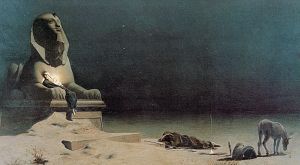 Fanciful. . . but still. By Luc-Olivier Merson – Wikimedia Commons.
Some believe the family stopped in Heliopolis–where a spring bubbled from the ground.
(Oswald Chambers fans will be interested in knowing Heliopolis is a neighbor of Zeitoun–where he and Biddy lived in a YMCA camp during WWI.)
History tells us a substantial Jewish community lived in present-day Alexandria–one of the first synagogues stood there.
I think it’s interesting that, once again, Egypt figured in the Biblical account as a refuge. (Here’s one explanation for why).
(See Chad Bird’s Unveiling Mercy on December 8 for another thought of why Jesus lived in Egypt).
On to Nazareth, finally.Why did Joseph and Mary, after the nativity’s glory, return to their obscure town in the Galilean foothills?
That’s where the angel sent them.
But, it also may have had to do with a parallel Jesus himself referred to: that of Jesus and Jonah.
Jesus, as the son of David, “fled to Egypt” and then lived in obscurity before arriving “on the scene.” He needed to wait “until his time had come.”
Other Mary sightingsMary, after the nativity, traveled back to Jerusalem several times a year with her family to celebrate the feasts.
The year Jesus turned twelve, the family went up together.
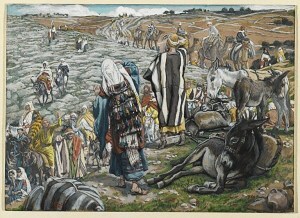 On return from Jerusalem. By James Tissot (Wikimedia Commons)
During the journey home, she and Joseph went three days without noticing Jesus was missing.
Once they realized their bar mitzvahed son wasn’t with the party, they returned to Jerusalem.
When questioned why he was in the Temple, Jesus asked: “Why did you seek Me? Did you not know that I must be about My Father’s business?” (Luke 2:49-50 NKJV)
Interesting answer, isn’t it?
During Jesus’ adulthoodTwenty years later, the proud Jewish mother–who knew her son’s true identity–encouraged him to display it at a wedding in the town of Cana.
A fully grown man by this time, he could admonish mother–“not yet”–while answering her request.
We also know Mary stood at the foot of the cross with her sister (name unknown), watching her son die.
Now there stood by the cross of Jesus His mother, and His mother’s sister, Mary the wife of Clopas, and Mary Magdalene. When Jesus therefore saw His mother, and the disciple whom He loved standing by, He said to His mother, “Woman, behold your son!”
He gave his mother to the beloved apostle John–who also, it should be added, was one of the younger disciples.
We also know she waited with the disciples and her other sons in the Upper Room until the Holy Spirit came. (Acts 1:14, NKJV)
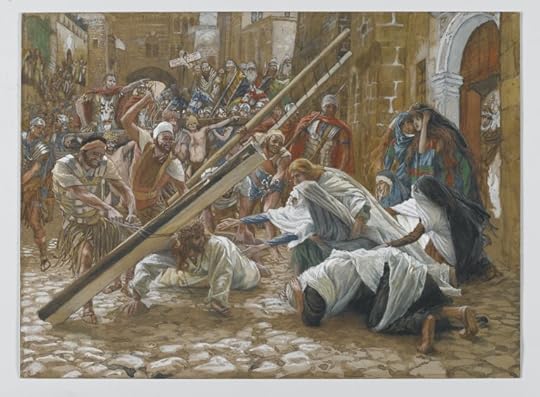 In this painting by James Tissot, Jesus looks at his mother on the via Dolorosa.
(Wikimedia Commons)Apocryphal stories about Mary after the Nativity
Because the Bible does not tell us when or where Mary died, it’s not important to our faith.
We know Jesus left her in the care of his disciple John–not in the care of his brothers.
At that time, the brothers were not sure about Jesus’s divinity. That changed after the crucifixion. His brother James ultimately became a church leader in Jerusalem.
Mary disappeared from the Bible after the Holy Spirit came on Pentecost.
 Photo by Robert Helvie (Wikimedia Commons)
Scholars believe that John took her into his household, and when he became the bishop of Ephesus, she moved with him to Western Asia Minor (now Turkey).
A scholar friend visited the house near Ephesus, where tradition claims she died between 43-48 AD.
Was it?
Who knows?
Tweetables
What happened to Jesus’ mother Mary after the nativity story? Click to Tweet
Biblical facts and apocryphal stories: Mary, after the Nativity story. Click to Tweet
The post Mary after the Nativity appeared first on Michelle Ule, Author.
November 26, 2024
Koalas and Kangaroos: Curing Kids from Jet Lag

It took koalas and kangaroos to cure our kids from jet lag.
Not that we gave them much choice.
We picked them up in Brisbane, Australia following their 15-hour flight from San Francisco.
The teenagers bounced off the plane–full of candy and snacks consumed on their trip over the Pacific Ocean.
Their aunt just asked for coffee.
We took them to the hotel, fed them lunch, and then headed out.
We had koalas and kangaroos to see–and they needed to stay awake until nightfall!
Lone Pine Sanctuary for Koalas and KangaroosThey all napped in the car–once they got over being on the “wrong side of the road,” but roused when we arrived.
Once through the gate, we were all eyes.
There were so many strange birds and animals to see!
The colorful birds and their “calls” first reminded us we were on a new continent.
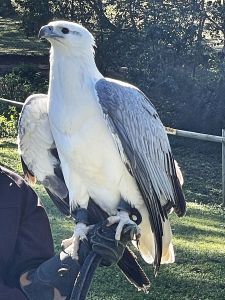
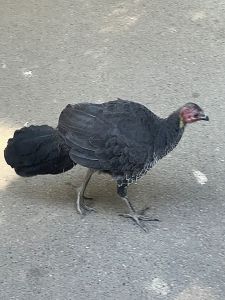
 But what about the koalas and kangaroos?
They don’t live together.
We saw the koalas almost immediately.

Most of the time, they look like the photo: asleep.
For this reason, you can purchase a stuffed koala and stick it high in a corner of a room.
You’d pretty much have the same experience we had.
We learned they only eat a particular type of eucalyptus leaf. That’s their only food.
For that reason, they generally don’t have a lot of energy–except for eating more leaves.
We did see them come alive, briefly, to dine.
What about Kangaroos?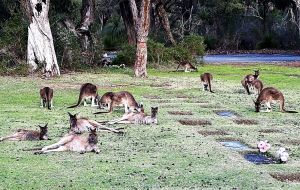
Lots of places have kangaroos. A friend in Perth took us to view them in a cemetery.
“Cemeteries and golf courses are the easiest places to find them,” she explained.
We found them lounging at the sanctuary in a large fenced-in area (the same was true at the Australia Zoo).
The girls could walk up to them, pet the lounging ‘roos, and even feed them.
The relaxed marsupials didn’t seem to care.
 See the baby in her pouch?
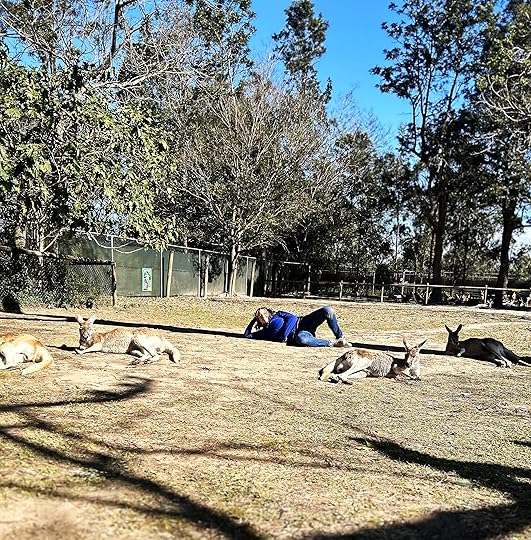 Our daughter is outstanding in her field.
 Red kangaroos are TALL!Other interesting animals in the park–other than Koalas and Kangaroos.
The Lone Pine Koala Sanctuary is much smaller than the Australia Zoo.
It was an easy and fun visit to keep the girls up and moving and thus help them recover more quickly from jet lag.
As in any zoo far from home, this one boasted creatures we’d never seen before. Here are three more:
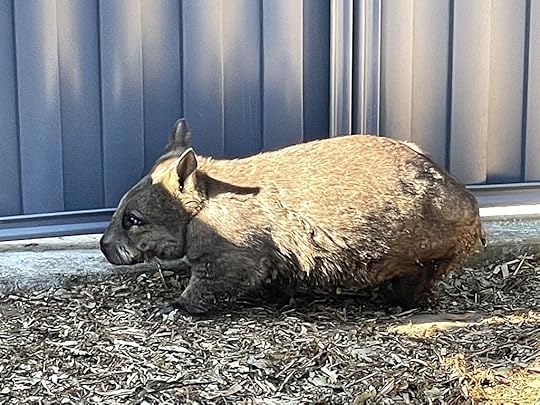 A wombat
 Dingo Dog
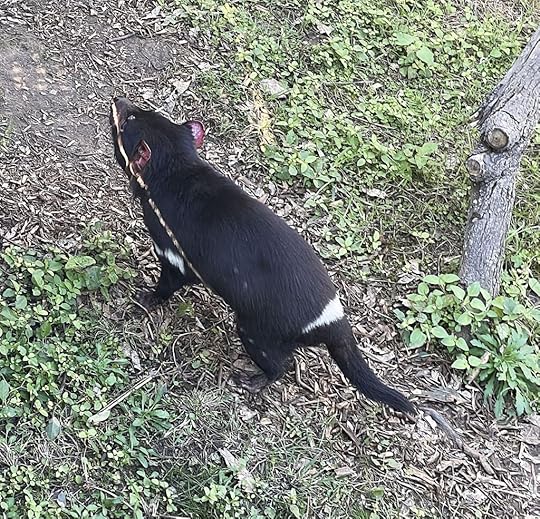 Tasmanian Devil
The final “animal,” or is it a marsupial?
We fell in love with a platypus.
Who has seen a platypus swim?Certainly not us!
All in all, our visit to see koalas and kangaroos–plus many other animals–at the Lone Pine Sanctuary helped our girls overcome their jet lag.
They returned to the hotel, ate dinner, and crashed for a full 12 hours.
The next day?
Off to the Australia zoo!
Tweetables
How we used koalas and kangaroos to cure jet lag. Click to Tweet
Lone Pine Sanctuary: a great Australian spot to see animals. Click to Tweet
The post Koalas and Kangaroos: Curing Kids from Jet Lag appeared first on Michelle Ule, Author.
November 19, 2024
Thanksgiving Holiday Ideas and Being Thankful

The Thanksgiving holiday takes place next week in the United States.
I’ve written about being thankful and the Thanksgiving holiday often.
Here’s a roundup and some additional thoughts for 2024.
The Thanksgiving HolidayMy family splits Thanksgiving and Christmas each year with the in-laws.
We’ve been doing this for many years and are grateful to our in-laws, who have accepted the idea.
We get our children, daughters-in-law, and grandchildren this year for Thanksgiving.
The in-laws get their daughters, our sons, and our grandchildren for Christmas.
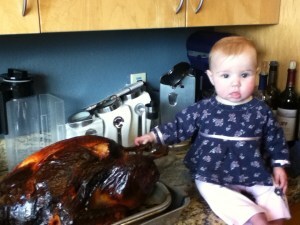 The turkey did weigh more than she did!
Next year, we’ll swap. Our family will go to our daughters-in-law’s parents’ home, and we’ll find somewhere else to go.
Fortunately, my extended family always invites us, so we always have a place to go.
Long ago, when my husband went to sea over the holidays, the children and I had nowhere to go.
I told the pastor, and he made our needs known at church.
Three families invited us.
The children and I didn’t feel so lonely that year, and we had a wonderful time.
Thanksgiving traditionsWe’ve celebrated the Thanksgiving holiday in unique ways over the years.
One year, we took our dinner to Moloka’i on an airplane, including the turkey and fixing, and ate our dinner on the beach.
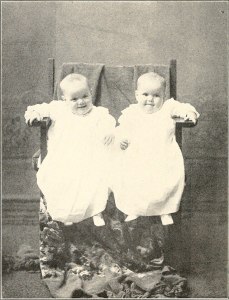 Wouldn’t you like to know their story? (Wikimedia Commons)
Our vegetarian relatives came one year. What to cook?
We’ve often joined my extended family and shared genealogy stories.
One memorable genealogy-focused Thanksgiving, we wore nametags noting our spot on the wall chart.
We had several new family members that year, and they could look at our name tags, refer to the chart, and then figure out how we were related to each other!
(We have a fiancee coming this year. I’ve already sent her a family chart!)
Here’s a link to free family tree templates.
Thanksgiving Holiday Ideas Activities–that don’t involve footballConsider taking a family tree to your gathering. You’ll have better success–and more conversation–if you ask your relatives to bring what they’ve got.
Beg your family to bring old photos–and then scan them all!
(If you don’t have a portable scanner, take photos with your phone. You will never regret it!)
Here’s another genealogy-related post with suggested questions to prompt stories.
Ideas of things to do for all ages.
One year, I brought an empty picture frame to dinner and took pictures of all my family members, individually or in silly groups, framing themselves. We had a lot of fun.
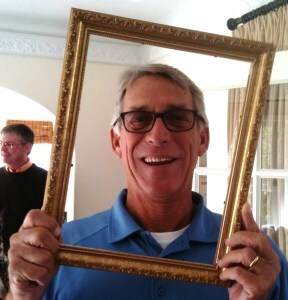
You never know what can happen when you choose to be thankful and act on “bringing together” the people you love.
At every opportunity, give thanks.While the Thanksgiving holiday is a good reminder to be thankful, the Bible reminds us, “In everything give thanks for such is the will of God in Christ Jesus for you.” (1 Thessalonians 5:18; NKJV)
Aside from a hearty meal in November (in the US), being thankful is a habit to cultivate year-round.
I work hard to find reasons to be thankful.
Maybe it’s my hands? It could be something silly like Cary Grant movies.
I learned this lesson from my UCLA band director, Kelly James!
I’ve written blog posts about authors I’m thankful for: Laura Ingalls Wilder, the Massie family, Edith Schaeffer, and Elisabeth Elliot.
Years ago, God impressed upon me that many people never get thanked for doing their jobs. I now make a point to thank the people who help me–no matter how small.
You’d be surprised how seldom people hear a genuine “thank you.”
Thanks for reading!
If you’re American, enjoy your Thanksgiving holiday. If you’re Canadian, I hope you had a lovely time last month.
And for the rest of the world, I wish you blessings every day.
As always, thanks be to God.
The post Thanksgiving Holiday Ideas and Being Thankful appeared first on Michelle Ule, Author.
November 12, 2024
An Amateur Providence: How to Avoid Being One

What is an amateur providence, according to Oswald Chambers?
Biddy defined an amateur providence in the November 15 reading from My Utmost for His Highest:
One of our severest lessons comes from the stubborn refusal to see that we must not interfere in other people’s lives. It takes a long time to realize the danger of being an amateur providence, that is, interfering with God’s order for others.
You see a certain person suffering, and you say—‘He shall not suffer, and I will see that he does not.’ You put your hand straight in front of God’s permissive will to prevent it, and God says—“What is that to thee?”
An amateur providence is when we do what we think is right in someone else’s life rather than wait to see what God wants to do.
Or–we think we know more than God does about what He’s doing in someone else’s life.
What does it mean to be an amateur providence–practically speaking?It means that when you see something happening (usually something uncomfortable) in someone’s life, you intervene.
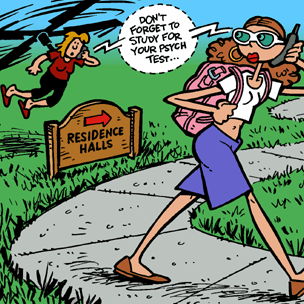
Parents often do this–rather than allow a child to experience the consequences of their choice, we step in and “make it better.”
We want to guard the people we love and protect them from a difficult result.
It’s understandable but often wrong.
 Greg Williams, CC BY-SA 3.0, (Wikimedia Commons)
We usually learn better from bad experiences than good or fortunate ones.
Right?
Wrong?
What do you think?
What happened to meI usually shudder when I read one of the ten times OC uses “amateur providence” in My Utmost for His Highest.
I know what OC and Biddy are talking about.
God plans the experiences of our lives in a certain way. He uses both the good and the bad to teach us about Himself.
He often uses such experiences to help us examine the attitudes of our hearts.
One day, someone asked me for help. The person needed a ride, “only 20 minutes.”
I was on deadline with a long list of things to do. I felt pressured by the demanding tone–surely I could help?
However, I knew 20-minutes with this person always extended much longer. The caller knew how to make others feel guilty.
 The post is here.
I waffled. What should I do?
God spoke to me sternly.
“You have commitments today you already told me you wanted and needed to meet. If you go off to help this person–who I have not asked you to help–it will take longer than 20 minutes.
Indeed, it probably will take the full day. You’ll be frustrated and angry with yourself. Tonight you’ll complain to your husband about how you never get the work done you know you need to do.
I did NOT ask you to help this person. You know very well you are not to be an amateur providence.”
It was that reference to “amateur providence” that convicted me.
I declined to help, met my deadline, cooked dinner, and went to bed content I’d listened to and obeyed God.
If God calls us to do something, we need to do it.
My weakness to feel guilty–whether justified or not–nearly undid what I wanted to do.
But what about God?This is the real issue with acting like an amateur providence–whether we know it or not.
We assume we know more than God does about a person’s situation.
In my situation, God made it clear to me that if I acted out of misplaced sympathy and against my own will to help someone, I would get in the way of what God was doing in this person’s life.
He could have spoken to me in any way, maybe even saying, “Stop it, Michelle!”
But, He caught my attention by using Chambers’ phrase.
I felt the reprimand immediately.
And I felt peace at not guilting my way into helping someone God did not want me to help that day.
 Trying to listen. Photo by Anastasiya Badun (Unsplash)How do you avoid being one?
We need to pay attention when others make claims about our time and attention.
It doesn’t mean we don’t help or are unwilling to help.
Instead of immediately saying “yes” or “no,” we simply ask God what we should do.
“Do you want me to do this, Lord?”
If He says, “Yes,” I act.
But if He says, “No,” I demur.
Is this simply a pious way of getting out of doing something I don’t want to do–listening to my feelings rather than God’s?
It depends on your heart’s attitude and your relationship to God, doesn’t it?
The significance of “amateur providence” in the November 15 readingOswald Chambers died November 15, 1917, in Cairo, Egypt.
Biddy compiled My Utmost for His Highest ten years later.
How many times in the intervening years do you imagine people asked her, “How could God have let Oswald die so young?”
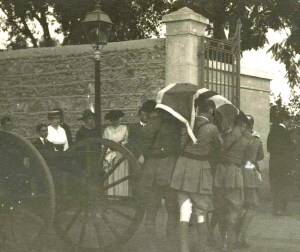 Cadbury Research Library Special Collections, The University of Birmingham, UK
I believe she answered the question in that November 15 reading.
Biddy wasn’t heartless. She was determined to remain right in the center of God’s will.
Losing her husband in Egypt during World War I with a four-year-old and no financial resources was a hardship.
She did not want to be an amateur providence–suggesting God made a mistake–about Oswald’s death.
But, she focused on what was true, right, and perfect: doing what God called her, specifically Biddy, to do no matter the circumstances.
Biddy Chambers knew God’s voice well. So did Oswald Chambers.
A yes means yes. A no means no.
I’m trying to make sure I remember that same lesson every day.
How about you?
Tweetables
What is an amateur providence in My Utmost for His Highest? Click to Tweet
How can you avoid being an amateur provider in someone else’s life? Click to Tweet
The post An Amateur Providence: How to Avoid Being One appeared first on Michelle Ule, Author.
November 5, 2024
How to and When to Talk to Strangers

Do you know how to talk to strangers?
You know, begin a conversation with someone you’re interacting with, usually in a casual setting?
How do you do at “get-togethers” or “meet-ups” when you know only a few people?
Are you friendly and kind to people with whom you transact business?
Do friends tell you to speak up more and act “more friendly?”
That never happens to me.
Why?
Well, I suspect “talking to strangers” may be one of my (unofficial) spiritual gifts.
Here are some suggestions for how to talk to strangers–without getting in trouble.
Why should you talk to strangers?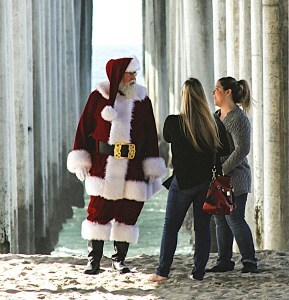 Santa has no trouble talking to strangers. Why not? Photo by Jeremy Bishop (Unsplash)
That’s a legitimate question, particularly at a time when we regularly warn children to be careful.
As a woman (now far out of the cute zone), I pick my opportunity to talk to strangers carefully.
If a person is serving me from behind a counter in a public spot, I like to get a conversation going while they help me. (That assumes they don’t scowl and indicate they want to be left alone).
If I’m standing in line, I often strike up conversations. (Why not make the time pass pleasureably?)
When asking questions of friendly-looking people, I often turn it into a brief conversation.
I like to thank people for their work–particularly if it moves me. (Thank you to the young worship leader at our church. I gave him a gold star while I was at it.).
I watch for people who look like they need encouragement and make sure to look them in the eye and say something. (What? Anything works, even a simple, “Isn’t the sky beautiful today?”)
Homeless people sometimes want to talk. I watch their body language when I strike up a (usually limited) conversation.
I’m generally not afraid to talk to strangers in a public setting.
And if I’m at a party where everyone is a guest, I assume these strangers are suitable for me to speak with. (Headed to a wedding tomorrow).
What do you talk about?Anything that comes to mind.
Generally speaking, people like to talk about themselves in social settings like parties or church.
So I ask questions pertinent to where we are or who they seem to be.
The (mostly impertinent) questions I ask folks who look like they’re bored or interested in a conversation are variations on these:
So, what do you do when you’re not attending parties?How do you like to spend Sunday afternoons after church?Do you have any children? Any particular sex?Do you spend a lot of time at __________ (wherever we are)?What’s your favorite part about _____________ (this conference, visiting the library, going out to dinner, standing in line)?Isn’t the sky beautiful today?If they glare at you, take a stiff jolt of their drink, or turn their back and walk away, well, you don’t have to talk to them! LOL
(When that happened to me–when I was a cute young thing, I just looked for another person to talk to.)
Potential complications of not talking to strangers.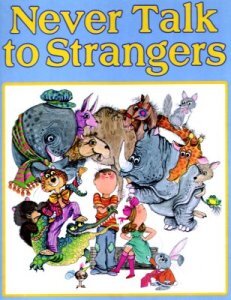
The following is a horrible and true story.
My kids grew up with a book called Never Talk to Strangers, which we read frequently when they were young.
It provided a problem, however, when an EMT asked my toddler–tied to a stretcher–his name. The two-year-old didn’t say anything.
“Ma’am,” the EMT turned to me. “We’re losing the little guy. We need you to talk to him.”
Terrified, I ran to my son. “Are you okay? Why won’t you talk to the man?” His eyes went big. “Strangers,” he whispered.
I have tears in my eyes, right now, remembering that awful automobile accident. “It’s okay,” I told him. “You can talk to an ambulance driver.”
“Oh,” he said. “Okay.”
My son was fine.
Reasons why you might consider talking to strangers–and “not me,” is a fine answer, too.Obviously, children standing alone on a sidewalk shouldn’t talk to strangers.
A dark alley in a big city full of drama and fear is not a good spot to strike up a conversation with someone you’ve never met before–let alone don’t trust.
Obviously.
If you feel like you’re in danger. If a stranger gives off uncomfortable vibes. When the conversation takes a turn that feels troubling, let it go.
You should never put yourself into a situation that feels physically or spiritually dangerous.
 I avoid talking to people who make me feel uncomfortable, too. Photo by Peter Forster (Unsplash)
Never feel ashamed to create a scene if someone makes you feel uncomfortable.
Don’t feel that you have to put yourself in danger to chat with someone–which is why I only talk to strangers when there are other people around.
Never talk to a stranger where others cannot see you.
Decline any invitation from a stranger to carry on a conversation in a private place.
Be smart. Protect yourself.
Other thoughtsSome of us are extroverts; some are not. It’s just the way God made us.
Many people don’t know how to begin a conversation (see list above).
I’ve attended social gatherings where people determined to overcome their reluctance to talk to an unknown person, write out questions on cards.
They study the questions–which they’ve practiced in a safe place–take a big sigh and look for a friendly person.
(Look for me. I’ll help keep a conversation going).
Or, look at the classic questions I always ask people: the 5 Ws and an H.
But what about where danger doesn’t lurk?
Take a deep breath and try to talk to just one stranger.
How else can people learn about the living God, get directions, take a drink order, or get through a slow day when you’re the only customer?
Asking a question, smiling, offering an observation (“Isn’t the sky beautiful today?”), could make all the difference in the world to someone.
And, it might even find you a spouse.
Who knows?
All of us married folk one day stepped forward to talk to a stranger.
Worked for me . . .
Tweetables
Why not take a risk and talk to (friendly) strangers? Click to Tweet
Tips on how to talk to strangers. Click to Tweet
The post How to and When to Talk to Strangers appeared first on Michelle Ule, Author.
October 29, 2024
An Australia Zoo Visit in 2024

We visited the Australia Zoo in July 2024 and had a terrific time.
There were five of us: two old people, one young woman, and two teenage girls.
At the end of our trip, other than seeing friends, the Australia Zoo visit was our favorite experience.
(Closely followed by the Great Barrier Reef trip!)
Why?
The young woman loved the Crocodile Hunter TV show as a child. (“It was the only show you let me watch,” she said. Not true. But close.)My husband and I liked the show, too.The teenagers didn’t care where they went in Australia but loved learning about crocodiles.We all felt -a little–better prepared before visiting Queensland’s “Croc Country.”What made the Australia Zoo visit so good?It’s a superb zoo.
We’ve visited several classic zoos: San Diego, San Francisco, the Bronx, and London.
We’ve also visited lesser zoos that showed us native animals, or wild beasts in a more “natural” environment.
That included a stop at the Lone Pine Koala Sanctuary in Brisbane the day before. (Also worth a trip).
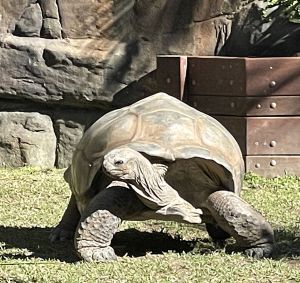 This tortoise is IN action! (Ule photo)
With the Australia Zoo, the Irwin family apparently took the money the TV show earned and turned it into an organized, efficient, well-laid-out experience.
Animal “docents” willingly answer any questions. They’re easy to find through the park.
There we stood beside a cage looking at a giant tortoise. While this was not the same tortoise owned by both Steve Irwin and Charles Darwin (the tortoise lived that long), it was still really big!
The colorful zoo map made it simple to find ourselves and follow the daily guide to whatever was happening that day.
Then there’s the “Crocoseum.”No surprise, crocodiles are big at this zoo.
We arrived early for the day’s big event–which was Robert Irwin feeding crocodiles.
But it wasn’t just an exhibition of a giant crocodile leaping out of the water to eat a chicken carcass.
The Australia Zoo used the time before “lunch” to teach us lessons about crocodiles.
Who knew?
Certainly not us Californians.
A croc feed in action (That’s not Robert Irwin).For the rest of the trip, the teenagers watched for creeks and streams which, “might have crocodiles in them.”
(Since we left two days later for “croc country” Queensland, this information turned out to be important).
Most fascinating to me is that crocodiles make no ripples on the water surface as they cruise underwater.
That’s why they can sneak up on folks standing beside even the smallest creeks.
Too often, people never knew what was coming.
More animals at the Australia Zoo
While it calls itself the Australia Zoo, it doesn’t limit itself to animals from down under.
The cheetah exhibit is large enough that we watched the big spotted cat run!
The meerkats were adorable, practically posing on top of rocks!
We glimpsed zebras, giraffes, and two rhinoceros in a large field, not to mention tiger and elephant exhibits.
The zoo also had interactive events for kids. We laughed as the teenagers attempted to “beat the clock” against a cheetah.
The cheetah’s time always won.
Here are several highlights:
 Giraffe
 Rhinos
 Wary Cheetah!
Engaging tigers behind a thick glass!
Two tired elephants.
And a last-minute laugh on our way out.
 Go ahead and admire me
 Time to knock off for the day
 So thankful this is a model!
Click to Tweet
Tigers, elephants, & crocs–oh my–at the Australia Zoo. Click to Tweet
More than just Down Under animals at the Australia Zoo. Click to Tweet
The post An Australia Zoo Visit in 2024 appeared first on Michelle Ule, Author.
October 22, 2024
Giant Pumpkins in the Front Yard

We’ve got giant pumpkins growing in the front yard this year.
Okay, not giant pumpkins, as if we tried to win a contest. (A neighbor several blocks away grew the second-largest pumpkin in California this year–2,741 pounds!)
I grew my pumpkins in an innocent attempt to provide fall decorations.
When I didn’t have room in my “normal” backyard food garden, I stuck ONE SEEDLING into the front yard.
We plan to plant a tree there this fall, but the spot was empty in April. Why not?
And then we watered it.
That’s all.
How it all began Photo by Teal Tardigrade (Wikimedia Commons)
I’ve grown pumpkins before.
I usually get a few on the vine and harvest them for fall.
They sit on the porch in October as cheerful and colorful decorations.
Once I give out all the Halloween candy, I recycle them.
I stuck the seedling into the ground (purchased at a local nursery), and our watering system watered it three times a week for ten minutes.
(Someone asked me today for that detail).
Voila.
It grew. We went traveling.I read this exchange between our housesitter and mutual friends in July.
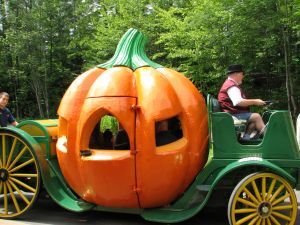 By EgorovaSvetlana, Storyland, New Hampshire (Wikimedia Commons)
“Help! I’m being held hostage by giant pumpkins growing in the front yard.”
Another friend: “Watch out for singing mice.”
A fatherly type: “Just make sure you’re home by midnight.”
After reading this exchange, I sent an email. “What?”
“It’s giant! All the neighbors are stopping by to discuss it! I may have to call the police to hack their way to the front door so I can get out!”
(Okay, that was all a joke, but still . . . )
Who knew?
The seedling wasn’t a giant pumpkin seedling, at least as far as I knew!
 AUGUST 2024
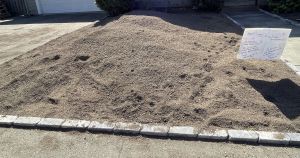 MARCH 2024–Bare Earth
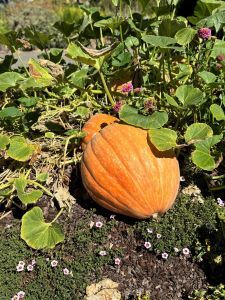 OH MY!
 You can see the difference in the photos above: we got new soil in the front yard in March.
By August, after we traveled for six weeks, the plant took up the yard.
The giant pumpkin surprised me when we returned.
Then, I lifted the large plant leaves and discovered two large, healthy green pepper plants covered in peppers.
And two more pumpkins.
Giant pumpkins, even larger than the one pictured on the right above.
How big did the giant pumpkins grow?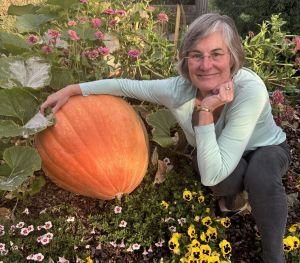
Using a measuring tape, I estimated the first pumpkin’s circumference as 69 inches or 1.7 meters by early October.
That’s me hugging the giant pumpkin.
I’m 69 inches tall!
Every time I returned home from traveling, my neighbors found me in the front yard cutting back the giant pumpkin leaves, harvesting green peppers, and trying to restore the unruly garden to order.
Everyone stopped to comment and ask questions. (I met a lot of neighbors).
I’d laugh. “You think THIS one is big? Look what’s under the pumpkin leaves!”
More questions.Today, I cut back all the giant pumpkins’ foliage. It’s time for my fall decorations to stand out–on the front yard.
How could I possibly carry these mammoths onto the porch?
(We had four but donated one to the church harvest festival. The men who picked it up estimated the weight as 100 pounds.)
I shook my head as I examined the last two pumpkins to appear, freed from the giant pumpkin leaf canopy.
“Look what I found!” I laughed when a neighbor stopped to shake his head.
“How could you have lost it?” He laughed back.
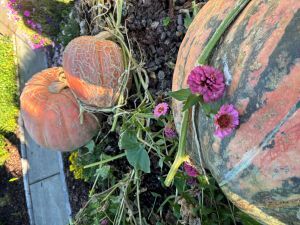 The far one is 69″ in circumference
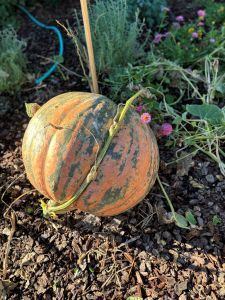 The true giant pumpkin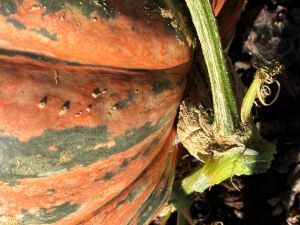
The final measurement on that big one (in the center photo above) is 75 inches in circumference.
It’s big enough for me to sit on quite comfortably.
A lovely fall (or spring, down under) to you all.
Pumpkin seeds, anyone?
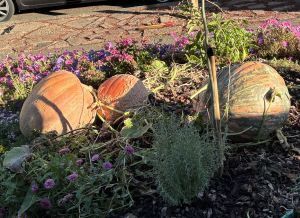 And the yard grew them itself!Tweetables
Giant pumpkins in the front yard? Now what? Click to Tweet
How ONE seedling produced three pumpkins more than 5 feet in circumference. Click to Tweet
The post Giant Pumpkins in the Front Yard appeared first on Michelle Ule, Author.
October 15, 2024
Butte and the Big Pit: EV, Anyone?

We visited Butte and the Big Pit last month. It’s a must-see for folks who believe EVs–electric vehicles–should be the future.
I first visited Butte and the Big Pit 30 years ago with my parents and children.
My father read about the Anaconda Copper Mine and wanted to get a feel for how big it really was.
Huge then, smaller now–but only because the water has risen in the last 30 years.
It’s called the Berkeley Pit.
What is this Big Pit?An “open pit copper mine,” the Berkeley Pit is one mile long, by one-half mile wide, with an approximate depth of 1,780 feet.
It sits in the hillside above Butte, Montana–where extensive mining began after the American Civil War.
The Anaconda Copper Mining Company opened the pit in 1955. Purchased by ARCO, it closed in 1982. At that time, Arco turned off nearby water pumps, 3800 feet below the surface, which enabled groundwater to fill the pit.
Unfortunately, as the pit filled–about a foot a month for many years–heavy metals and dissolved metals leached from the rock.
Among the metals are traces of copper, arsenic, cadmium, zinc, and sulfuric acid.
When the water’s acid pH level reached between 4.1 and 4.5 pH, the US federal government declared it a Superfund site in 1987.
Butte’s Big Pit boasts a viewing platform. Just as my family stood on the platform in 1993, my husband and I walked through a tunnel and took in the site.
Staring at Butte’s Big Pit 31 years later, I wondered if we Americans realize the amount of digging required to build EVs and batteries.
My husband, an energy expert, didn’t say a word. He just stared.
 Big Pit in 1984 (Wikimedia Commons)
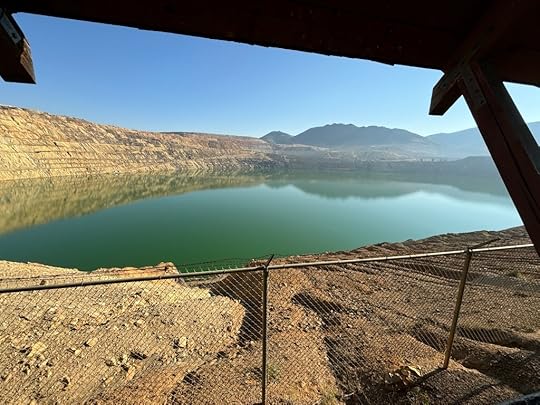 Butte’s Big Pit in 2024 (author photo)What do Butte’s Big Pit and other mines have to do with EVs?
Journalists remind Americans that if they want an electric vehicle, someone needs to dig the necessary ore.
It’s in the ground, yes, but it requires a lot of energy to get the minerals out of the ground.
Most of that intensive mining work is done far from typical American towns.
A great deal of mining is done in other nations. In some parts of the world, children dig up ore with their bare hands.
Visiting a mineAfter viewing Butte’s Big Pit on the surface, we wandered over to the “>Montana School of Mines and toured the World Museum of Mining.
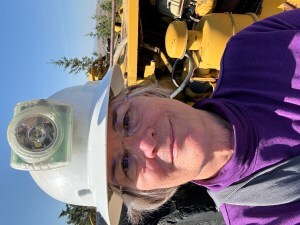
The Orphan Girl Mine is all underground.
We descended with a small group, 100 feet into the Orphan Girl Mine to see the original shaft station.
It’s always curious to travel deep into the ground, trying not to think about how much rock is above my head!
Using lights on our helmets, we saw one of the few exposed veins in America that visitors can approach.
We saw physical and cardboard signs indicating where the miners dug during the years Butte’s big pit mining areas were open.
Men from around the world flocked to Butte to work in the Orphan Girl Mine. They spoke 30 languages and dug copper.
Later, silver ore veins paid the bills.

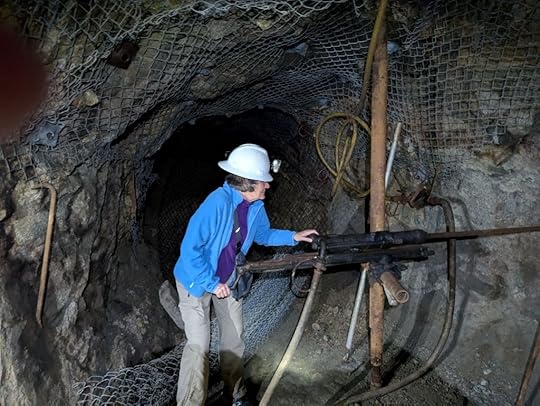 I would not have liked this job.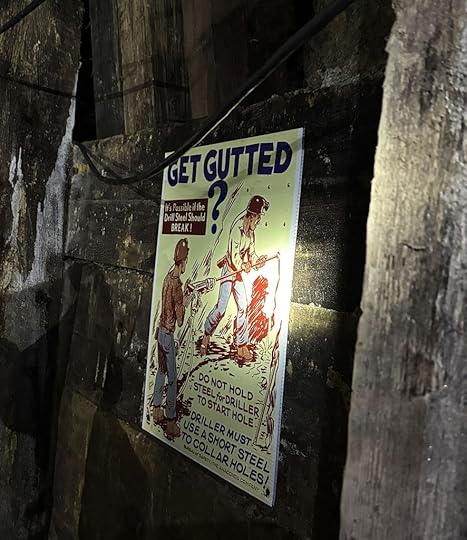
The Orphan Girl Mine closed in 1955.
But mining operations continue in a small way. Students from Montana Tech University still go down the mine to dig.
Thoughts on Butte’s Big Pit and MiningI honor and appreciate the courage and strength it took for so many men–few, if any, women worked as miners–to dig minerals out of the mines.
Watching the movie October Sky brings home the danger and filth such work requires.
The pictures I see, and stories I read about copper mining in other parts of the world trouble me.


I took the above photo at a natural history museum in Australia. The number of different metals needed to create an iPhone shocked us.
(I took the photo with an iPhone).
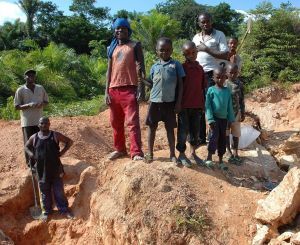 Child labor artisan mining in Kailo, Congo. (Wikimedia Commons)
The Smithsonian National Museum of Natural History in Washington, D. C. currently has a similar exhibit.
They call it “Cellphone: Unseen Connections.“
I don’t have answers for any of this.
Photos of child miners like the one on the right, however, trouble me.
Tweetables
Where is the copper ore coming from for modern life? Click to Tweet
Visiting a mine in Butte, Montana–and a Big Pit. Click to Tweet
The post Butte and the Big Pit: EV, Anyone? appeared first on Michelle Ule, Author.
October 8, 2024
Social Duties and How to Split Them

Social duties turn up all the time. Do you and your spouse ever split them?
We all know about carpooling and getting the kids here or there.
Some of us have elderly family members that need help. Or neighbors.
Churches often ask us to help–such as bringing a meal, setting up tables, or organizing events.
We don’t all have spouses.
But if you do, have you ever considered “splitting the duty,” as my husband and I do?
What does it mean to split social duties?We first coined this term while hunting for a new church in a new community.
It was too confusing for the children to be hauled from one setting to another.
To that end, one attended a church service early, and the other went late to a different church.
We then debriefed, thereby cutting the church hunt time in half.
As a result, it usually took only a month to find a new church home in our fourteen moves.
But what about actual social duties, like parties?“You two never sit next to each other at parties,” a friend observed recently. “Why not?”
My husband laughed. “By splitting the social duties, we cover twice as much territory.”
Puzzled, the friend asked, “What does that mean?”
 Who would you want to talk with first? Painting by Marcellus Laroon the Younger (Wikimedia Commons)
“We each talk to different people so that at the end of the night, we share the stories we heard.”
“We get to hear twice as many stories that way. And everyone knows Michelle loves stories.”
Well, yes. I love to hear the stories from our friends. By dividing our social duties during the party, we hear twice as many stories.
I’m fortunate that my husband is well-trained after all these years.
Does that mean we never sit together?Of course not. I’m married to a very interesting man with fascinating ideas and experiences.
(Fortunately, he feels the same way about me!)
When I do find myself standing next to him, or sitting beside him, or across the table, I’m usually egging him on.
Don’t you love it when someone urges you to tell a fascinating story?
We generally touch base during a social event, especially if we don’t know anyone.
But, most of the time, we listen to other people. I’m interested in learning about new things and hearing about new adventures.
If all else fails, we know how to ask questions to encourage more stories.
And then we share them.
(What questions to ask? Try the list here.)
Splitting social duties in everyday life.When we had children at home, one of us usually drove someone somewhere.
Between all the children, we rarely attended the same events for years. It got easier as they peeled off into real life.
Indeed, only our last child regularly played on a sports team that we could attend together.

We usually divided the tasks by whomever was most comfortable with the event or knew the most people.
Nowadays we travel more together, but still don’t always sit next to each other.
Now that you have to pay to sit next to each other on airplanes (whose idea was that?), I rarely sit next to him when we fly.
Last month, I spent two hours talking to the guy sitting beside me.
My husband napped eight rows back.
And then listened to the fascinating stories all the way to our destination.
Totally fun.
Personality differences?Of course, they make a difference.
I’m an extrovert. I can talk to anyone.
My husband does well, too.
But, if in doubt about what to talk about, we can always fall back on the five Ws and an H for conversation.
As long as you get someone to talk about themself–and many people are happy to do so–the stories will come.
Whether you’ve split the social duties or not.
Enjoy!
Tweetables
Too many social duties? Why not split them? Click to Tweet
How to make a party twice as fun: split the social duties. Click to Tweet
The post Social Duties and How to Split Them appeared first on Michelle Ule, Author.



.png)