
Michelle Ule's Blog, page 4
April 29, 2025
Who Deserves Mercy Most?
 Who deserves mercy most?
I asked myself the question after a ship capsized off the California coast last week.
The Coast Guard arrived in time to save all seven people–which included three children under ten. It was a miracle in our frigid waters because no one wore a life jacket.
Like many writers to the editor of the paper, I was indignant.
What were those parents thinking not putting the children into life jackets?
How could they be so foolish?
Did I have any business asking that question?But then the Holy Spirit checked me on that concept: mercy.
Who deserved God’s mercy most? Them or me?
Well, neither.
We’re all culpable in one way or another for the mistakes we make raising our children.
Or even the errors we make while living our lives.
Who hasn’t done something stupid in traffic?
Several people close to me left children behind in airports, a relative’s home, and even sleeping in their cribs when they assumed the spouse had the baby.

Or what about the shock of pulling a toddler out of the car seat and realizing they never buckled him in?
We were fortunate that we didn’t have to face charges of dereliction of duty due to absent-mindedness, at the least.
So, who was I to judge those families reeling from horror?
Does anyone deserve mercy?The New King James Bible lists 276 verses for mercy.
My favorite verse, of all, is out of Micah 6:8 (NKJV):
He has shown you, O man, what is good;
And what does the Lord require of you?
But to do justly,
To love mercy,
And to walk humbly with your God?
This is an excellent reminder that God asks me to show mercy to those who have erred, including myself.
It’s also helpful for me to remember another essential verse from Romans 3:22b-24 (NKJV):
“There is no difference. All have sinned and fall short of the glory of God, being justified freely by His grace.”
Mercy, forgiveness for our mistakes–no matter how lethal–falls into God’s grace.
All we have to do is ask God to forgive whatever sin we’re confessing.
He will.
He always does.
And then I have to accept that forgiveness as once done, and completed.
Why are forgiveness and mercy so hard for us to accept?Satan is an accuser. He wants everyone to feel weighted down by shame and guilt.
If he can distract us into focusing on our sins, we miss the good works God gave us.
It’s a distraction technique mired in guilt and shame–or judging others.
There’s no life or joy in that.
At a recent Bible study, someone asked why we struggle so much with accepting forgiveness.
I reminded her of Corrie ten Boom’s insight: “God takes our sins—past, present, and future—and dumps them in the sea. He puts up a sign that says “No Fishing Allowed.”
A friend pointed out that when we confess the same sin repeatedly, God doesn’t know what we’re talking about.
Once confessed and forgiven, God forgets it.
Why should we?
Forgetting confessed sin is mercy, isn’t it?
Thanks be to God.
The post Who Deserves Mercy Most? appeared first on Michelle Ule, Author.


April 22, 2025
Jerusalem in Uproar: AD 33

Jerusalem in uproar best defines the month after Jesus rose from the dead.
As conquerors, the Roman army was always on guard in the ancient city.
But now, despite the best efforts of the ineffectual and corrupt Sanhedrin, everything had changed.
The rabble-rouser risen from the dead?
Who thought that?
And what was up with the High Priest screaming in the temple?
The post-Easter weeks were busy and teeming with the unexpected.
Uproar, “a state of commotion, excitement, or violent disturbance, described it best.
Where was Jesus amid the uproar? Wikimedia Commons
It started on the Road to Emmaus Easter afternoon.
He appeared to over 500 people during the 40 days after Easter.
Here’s a list:
Mary Magdalene, Salome, and “Mary the mother of James” (Mark 16:1).Cleopas and a friend (Mark 16:12-13).Simon Peter (Luke 24:34).Eleven other apostles and friends (Luke 24:36-43).Thomas (John 20:28).Eleven disciples on a Galilean mountain (Matthew 28:16-20).A gathering of about 500 on a Galilean mountain (1 Corinthians 15:6).His brother James (1 Corinthians 15:7).A group as Jesus ascends into heaven. (Acts 1:9).What were the disciples up to?Traveling to Galilee and going fishing. (John 21)Waiting for the Holy Spirit, and then being filled with his power, praise, and direction at Pentecost. (Acts 2).Testifying as to who Jesus was and what he did.Healing a crippled man and preaching in Solomon’s porch in the Temple area. (Acts 3).With all of Jerusalem in uproar, they caught the attention of the Jewish religious leaders and the Romans. (Because they kept preaching, even when told not to).
(Definition of the Sadducees and Pharisees).
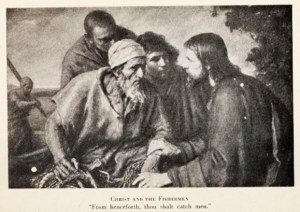 (Wikimedia Commons)
Then John and Peter were arrested:
What was the Sanhedrin’s reaction to Jerusalem in uproar?
As they spoke to the people, the priests, the captain of the temple, and the Sadducees came upon them.
[The Sadducees were] greatly disturbed that they taught the people and preached in Jesus the resurrection from the dead. 3
[As a result, the Sadducees] laid hands on John and Peter. [The Sadducees] put them in custody until the next day, for it was already evening. However, many of those who heard the word believed. The number of men came to be about five thousand.
(The Sanhedrin was the Jewish ruling council.)
The High Priest was aghast–how did the temple veil rip into two pieces?
 By Nikolai Ge (Wikimedia Commons)
And how would it be repaired?
Even worse, from their point of view, many priests who worked in the temple became Christians! (Acts 6:7)
(The priests and scribes should have recognized Jesus’ identity because they memorized the Scriptures. They recognized the acts, particularly after Jesus’ death, were prophesied in the Old Testament.)
Their wisest teacher, Gamaliel (Saul/Paul’s instructor), advised them to be careful:
Then what happened?
34 A Pharisee named Gamaliel, a teacher of the law held in respect by all the people stood up. He commanded the Council to put the apostles outside for a little while. 35 He said: “Men of Israel, take heed to yourselves what you intend to do regarding these men. . . .38 I say to you, keep away from these men and let them alone. If this work is of men, it will come to nothing. 39 But if it is of God, you cannot overthrow it—lest you even be found to fight against God.”
The Christian diaspora began.
Believers in Jesus’ words acted in the 40 years after his death as events grew more difficult in Jerusalem.
“When you see Jerusalem surrounded by armies, then know that its desolation is near. 21 Then let those who are in Judea flee to the mountains. Let those who are in the midst of her depart. Let not those who are in the country enter her. 22 For these are the days of vengeance, that all things which are written may be fulfilled.”
Luke 21:20-22 (NKJV)
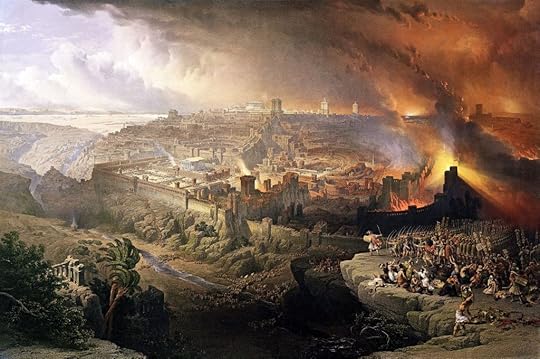 The Destruction of Jerusalem Painting by Francesco Hayez (Public Domain; Wikimedia Commons)
By the time of Jerusalem’s destruction in AD 70, most of the Christians had left the city.
The Jews and the Romans oversaw the scorched-earth horror that destroyed the city.
Jerusalem in uproar, yes.
But those who believed Jesus had already left.
Tweetables
What happened during the time of Jerusalem in uproar after Jesus’ death? Click to Tweet
The post Jerusalem in Uproar: AD 33 appeared first on Michelle Ule, Author.
April 15, 2025
Where was Jesus’ Crucifixion and Burial?

Where did Jesus’ crucifixion and burial take place?
Well, we know from the Gospels that the Holy Week events took place in Jerusalem.
But that’s not the question.
Where, exactly, did Jesus die on the cross?
And where did Joseph of Arimathea take his body for burial?
It’s complicated.
Maybe.
One traditional site for Jesus’ crucifixion and burialThe Gospel of Matthew tells us the Romans crucified Jesus on Golgotha (place of a skull).
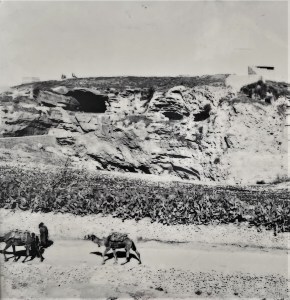 Circa 1900 photo of Golgotha from the Garden Tomb displays.
 During our 2022 visit to Israel, we visited two possible sites.
The Garden Tomb is north of the “old” city of Jerusalem. Old Jerusalem is an ancient town surrounded by walls and punctured with gates.
The Garden Tomb sits at the base of a hillside that some believe resembles a skull, hence Golgotha.
Our guide produced photos, like the one to the right, of a hillside resembling a skull.
That, and the fact it’s located outside of Old Jerusalem, seems to be why people believe this spot a possibility.
What do you think?
The more likely spot for Jesus’ crucifixion and burialIn 326 AD, Emperor Constantine’s mother, Helena, traveled to the Holy Land looking for sites related to Jesus.
 Helena (Wikimedia Commons)
The residents brought her to spots known as the traditional locations of Jesus’ life events. (As they’d lived there for centuries, they had historical knowledge of where important events happened. Eric Metaxas explains this concept in Is Atheism Dead?).
Helena ordered a church or basilica constructed on the site of Biblical events throughout Palestine.
As to the sites of Jesus’ crucifixion and burial, she concluded a spot in Old Jerusalem made the most sense.
It’s the Church of the Holy Sepulchre.
But it’s inside the walls of Old Jerusalem.
How does that work?
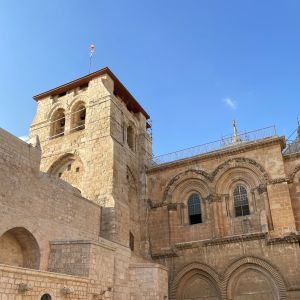
First-century Christians revered the spot now housing the Church of the Holy Sepulchre, as a holy site.
Emperor Hadrian ordered the area destroyed when he rebuilt Jerusalem as Aelia Caitolina in 135 AD.
On the site of what tradition claimed to be Jesus’ tomb, he ordered the construction of a temple to Venus.
A later governor of the city extended the city walls outside of the present church.
Nearly two hundred years later, Macarius, the Bishop of Jerusalem, asked Emperor Constantine to look into the issue.
With his mother in the area identifying the same place as the site of Jesus’ Crucifixion and Burial, Constantine went to work.
He ordered a new church built on the site.
Was Jesus crucified and buried at the Church of the Holy Sepulchre?I visited the enormous church, more than a thousand years old, twice during our time in Jerusalem.
When I walked through the ancient doors on the south side, I broke into inexplicable tears both times.
I felt overwhelmed by the grandeur, the history, and the enormous building.
Following the crowds, I climbed the narrow stairs inside the door and found myself in a mobbed area.
Magnificent frescoes and paintings covered the walls.
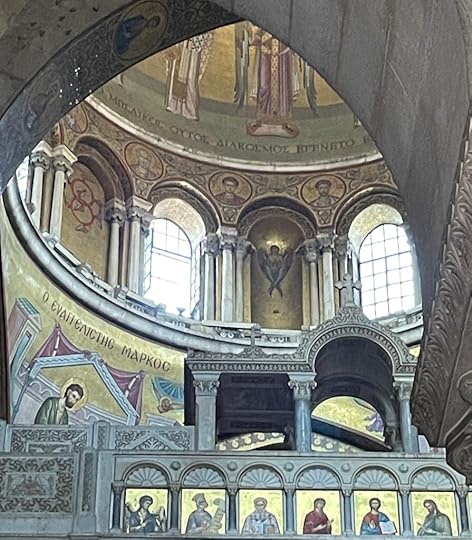
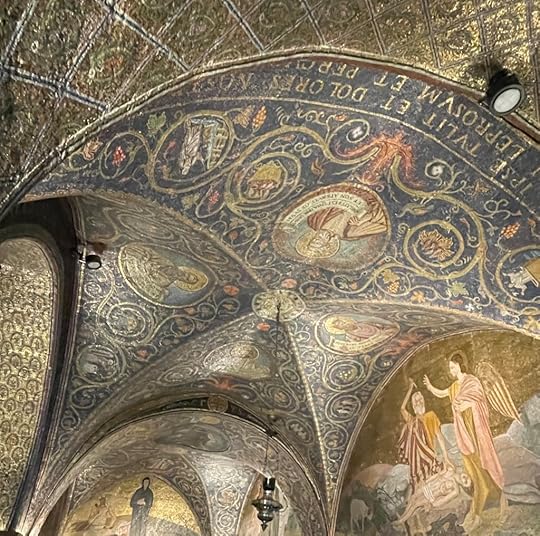

What were all these people doing? Why were they standing in lines and then falling to their knees?
They were touching the rock under the altar.
It’s allegedly the rock in which the Romans stuck Jesus’ crucifixion cross.
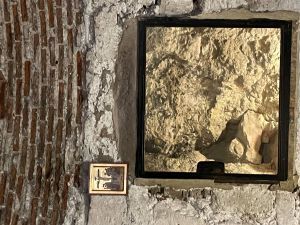
His blood, therefore, would have dripped onto that rock.
Did I believe it?
Intellectually–really?
Emotionally? I felt overwhelmed.
I had to sit down to take it in.
The burial tombsWe peered into a tomb cut into the rock at the Garden Tomb site.
It was empty, just as you would expect for the site of Jesus’ crucifixion and burial.
The line to enter the aedicule–tomb of Christ–at the Church of the Holy Sepulchre was very long.
We did not have time to wait two hours to walk through it. But it’s claimed to be the site where Joseph of Arimathea laid Jesus to rest on Good Friday.
It’s also the site of where he got up and left the grave on Easter Sunday morning.
Does it matter?No.
The important thing is Jesus did die on the cross and did rise again from the dead three days later.
Thanks be to God.
A blessed Holy Week to all.
The post Where was Jesus’ Crucifixion and Burial? appeared first on Michelle Ule, Author.
April 8, 2025
The Beersheba Charge and Australia

The Beersheba charge–the last successful cavalry charge in world history–thrilled Australians.
During my 2024 travels on the continent, I watched for elements or remembrances of the charge.
I found them and even heard them.
When I brought up the historical World War I event, people were surprised I knew about the Battle for Beersheba.
They were intrigued as to why.
It had to do with Oswald Chambers, of course.
Oswald Chambers and the Beersheba chargeI wrote about the WWI Charge of a Light Brigade here.
Many years ago, a reader wrote asking me to look into how Oswald Chambers ended WWI.
Skeptical, I asked questions.
According to her, the Chambers-led revival among the ANZAC troops at Zeitoun, Egypt, resulted in many ANZAC soldiers becoming believers.
As a result, when they were ordered to charge on Beersheba, they were not afraid to die.
That’s why the Beersheba charge was a success.
“Because they took Beersheba, and then Jerusalem, they knocked out the German southeastern flank during the war,” she explained.
“As a result, the Allies consolidated their efforts in other parts of the world–like France.”
The war ended a year later.
(I think other considerations were in order. The horses were dying of thirst; the men were following orders. Was their ultimate salvation an element?
(Who can know? Chambers-influenced men were there, including Philip Hancock and Peter Kay.)
Historical observations?The charge is considered the last successful cavalry charge in history.
You can watch a video version of it here:
I do not know if my correspondent had read 800 Horsemen: Riders of Destiny by Col Stringer.
The book is out of print now and unavailable in the US. I found it in Australia, and in reading it, I discovered where her idea came from.
Stringer’s popular book linked religious events in Palestine to Biblical prophecies, in particular as related to the ANZAC troops.
It’s an interesting read of firsthand accounts.
One story about the ride up to Jerusalem after the Beersheba charge recounted a night sky full of angels and unusual sights:
Why was the Beersheba charge important to Australians?
“From General Chauvel down to the officers and troopers, visions of ancient buildings, lighted villages and angelic being were being witnessed enmasse. . . . Reports of angelic beings appeared during the fighting occurred up to the cessation of hostilities in 1918 . . . Statements were taken from captured enemy officers who had witnessed this manifestations. Gen. Allenby called for detailed reports and interviewed witnesses himself.”
The AIF in Sinai and Palestine, page 155.
1.3% of the entire Australian population (about 60,000 people) died while fighting in WWI.
They were a quiet nation far from the headlines. Often overlooked by other countries, Australia’s army saw a large percentage of death in their able-bodied men.
Yet, those men led a brave charge that helped change history.
If the ANZAC horsemen had not taken Beersheba, they would have fought a bloody, desperate battle.
And General Allenby would not have peacefully walked through Jerusalem’s gates a month later.
The nation felt proud to have participated in such an undertaking.
It’s part of their history.
Newcastle Memorial WalkKnowing of my interest in this story, my friend Anna took me to see a remembrance.
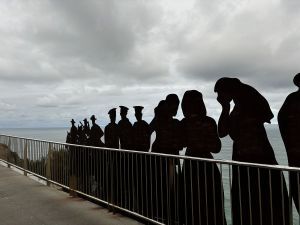 Horsemen in the lead; nurses behind.
The Newcastle Memorial Walk features steel silhouettes of ANZAC triumphs.
This line-up is on the east side of the walkway. The horsemen are facing east.
During a trip to New Zealand many years ago, I noted ANZAC memorials stood in every small town.
They were WWI ANZAC soldiers in full kit, facing east.
Why east?
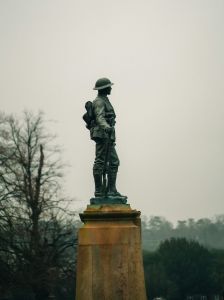 Photo: Joshua Lawrence Unsplash
Because that’s where they left their hearts and their lives, fighting far from home.
When a nation loses so many men fighting a battle few understand, it leaves a mark.
Whether Oswald Chambers influenced the men to fight their way to Jerusalem or not, the charge was significant.
And many people have never forgotten.
Including me.
Tweetable
Was Oswald Chambers really responsible for the end of WWI? Click to Tweet
The post The Beersheba Charge and Australia appeared first on Michelle Ule, Author.
April 1, 2025
What NOT to Say After a Fire

Here are some thoughts about what not to say after a fire to people who lost their homes.
Yes, they need encouragement.
Yes, they may need comfort.
But no, you don’t have to say anything.
Most of the time a hug–or a gift card–will do.
Feel free to say, “I love you.”
That often will cheer up people.
What not to say to homeownersWe want to comfort and encourage, but people who are in shock after such a significant loss don’t need much.
They may still be in shock if they’ve fled their homes in the middle of the night.
They probably have no idea what they’re going to do next.
If your house burns down, you’re in a crisis–on multiple fronts.
Avoid giving advice unless someone who survives a fire specifically asks, “What do you think I should do?”
“Unless it’s really solicited, opinions and advice are not helpful in this situation,” one woman explained. “That’s not the type of support we need.”
“People always had ideas they want to share with us,” her husband said. “I’d listen but think, ‘How do you know this will work? Have you been through this situation before?'”
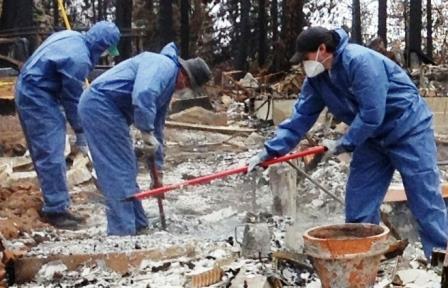
If you have information–something you know is true–consider passing it along to whomever your friend trusts.
In one case, I sent the pertinent information to the homeowner’s father. He decided whether the family needed the insight.
On the day FEMA cleared the property, his son was there. My advice was heeded–without me ever saying a word to the homeowner.
Another friend knew he couldn’t make sensible decisions because everything felt overwhelming. He had a list of trusted advisors who helped him make decisions.
The elders at our church made themselves available for consultations–and even sifting.
What not to say with the kids listeningAnother friend discussed the fire events with her relative. The relative teared up as she related events, and my friend grieved with her.
But then the friend noticed her relative’s daughter.
The little girl’s eyes widened, and my friend saw fear. Every time the mom described something that happened, the child heard her fear and grew anxious.

“Let’s change the topic,” my friend wisely said. She’d talk to the child’s mother later.
This story reminded me of September 12, 2001. After the 9/11 crisis, child psychologists asked news stations to stop running videos of the World Trade Towers falling.
They had discovered that children watching television thought it was a new scene each time.
Psychologists observed tension and fear in the children who didn’t understand reruns were not more airplanes flying into skyscrapers.
What to say?In a crisis, people need hope, not necessarily helpful advice. (Especially from people who had not lost their homes in a fire).
“It’s always much longer and much more painful than you ever think it will be,” one fire survivor said.
My friend laughed as she described something I said to her years ago.
“I’d remember in some situation in the past that was hard to figure out, you’d say, “Okay, God. Let’s just see what you’re going to do with this.”
She smiled. “I thought of it so often and then said it myself.”
(I refer to it as “pulling a Biddy.“)
Be careful with giftsIf you’ve lost your home, you have no place to store anything.
“The best gifts were gift cards,” one man said. “We spent them on what we needed when we needed things. “We knew people meant well. But it was hard trying to figure out where to store anything.”

What to say?
“Here, spend this when and where you need it.”
Of course, one of the best gifts is a dinner invitation, where you listen silently while they speak.
If you have space, offer a room or storage.
Some friends stayed in a guest room for nine months until they knew they should rent an apartment.
I lent a Lazy-Boy chair to several couples when they rented a place to live while rebuilding.
Avoid criticizing inconsequential decisionsDoes it really matter what your now-homeless friends buy?
They’re walking in grief and shock.
Just because something isn’t important to you doesn’t mean it doesn’t help your friend.
If they use funds to buy a big TV for their temporary home, so what?
Just because you think it’s frivolous doesn’t mean it won’t comfort them.
If you see too much shopping–speak to someone whom they trust, about your concern. They probably have insight you lack.
What’s really important, rather than what not to say?When you go through a crisis–of whatever kind–you need hope.
Speak words of encouragement to friends:
I’m here if you need me, but I’ll leave it up to you.
We’re here for the long run. We’ll help.You can do this.You’re wise. You best know what you need.I can see you love your kids.I’ll be praying for you.Here in Sonoma County, we’ve gone through too many fires.
The experience has made us less proud, more comforting, and more compassionate. Also grateful.
We know how people are struggling–we know.
Tweetable
What NOT to say to people after a fire. Click to Tweet
Beware fearful children overhearing a fire discussion. Click to Tweet
The post What NOT to Say After a Fire appeared first on Michelle Ule, Author.
March 25, 2025
Fire Grief, and Helping Kids

Fire grief, and helping kids were on our minds in both 2017 and 2020.
All of us were affected–and we didn’t even lose our homes.
My own family, as described here, felt fire grief and worried about our kids.
For those who did lose their homes profound fire grief settled–and lasted a long time.
And then there were the kids.
Very tough.
Yes, I’m thinking about Southern California.
How did people handle fire grief, and helping kids?As best they could.
As I wrote here, our school district did a fine job using the arts to help children sort out their emotions and what happened to them and their families.
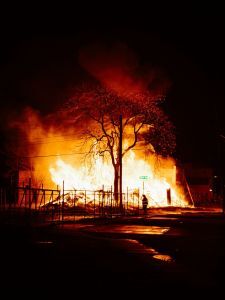 Photo by Hayley Murray Unsplash
In our case, my granddaughters (ages seven, six, five, and four) acted out a play.
The oldest entered first wearing a hat. “I’m the fireman!”
#2 came in waving a piece of red cloth. “I’m the fire!”
The four-year-old crawled in barking. “I’m the fireman’s dog!”
Our third granddaughter carried a set of pom-poms: “I’m the water putting out the fire!”
They laughed, acted and when it was done (the red cloth fire stamped onto the floor) they grabbed hands.
“Thank you first responders!”
And then those four little evacuees bowed. “All done.”
What about seven years after the home burned down?I spoke with friends recently about their experiences in 2017 when their house burned down.
The couple were united in their focus on their children even as they worked through the hard decision: rebuild or move?
Mom: “It was one of the biggest concerns we had. We tried to keep as many things as normal for them as possible.” They lived in several places, often with friends, as they worked through insurance and rebuilding issues.
Over eighteen months, they got plans to rebuild and cleared their property of fire debris. But road blocks kept coming up. When the children’s school closed, the decision became simple.
“That was the a-ha moment for us,” Mom recounted. “We chose stability for our children.”
They relocated to an area near close friends, found an excellent school, built a house, and are content.
For the moment.
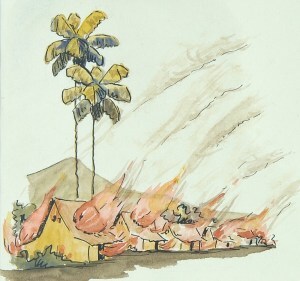
Things for parents to considerEveryone in the family processes fire grief a different way. The decision to rebuild or to move is a personal one for a family.
 Wikimedia Commons
Moving away from a former community can be hard on everyone.
“But, you know, it’s the age of technology,” Mom said. The now-teenaged daughter talks to friends “back home” frequently.
When the family moved, “we said to people, we’re not going to be the ones that leave and cut ties. And we’ve made good on that,” Mom explained.
I can attest to their success. We’re always happy to see them, surprised at the childrens’ growth, and fall right back into conversation.
But we miss them.
And they miss us.
Fire grief and heavenEven though our home survived two fires (the last reached 1/2 block from our house), I’m changed by living through the experiences of my friends and relatives.
I’m reluctant, for example, to replace the carpeting. My emotional reaction is, “why bother? It’s just going to burn.”
A friend has the same feeling–to the shock of his wife.
We both know that’s an irrational thought, but there it is.
For our friends, life divides into “before the fire” and “after the fire.”
 Photo by Dieny Portinanni (Unsplash)
“At the end of the day,” Mom said, “I think the biggest thing I’ve learned is that this is not my home.”
Sitting in her new home, she reflected, “My home is in heaven, and this is the house that I get to live in until I get there.”
She smiled ruefully. “That’s really what it is, and that’s what it was before. But I think we forget that idea because we become so comfortable.
“I feel like I’ve learned that lesson more deeply than I ever have before.”
As for the kids?
They know the love of their parents, they’re in a wonderful school, and close friends live nearby.
They even know me–and danced through the interview, showed me artwork, and answered a few questions.
The kids are all right.
And we’re all grateful.
Tweetables
How to help kids when fire consumes their home. Click to Tweet
“Heaven is our home,” and fire grief. Click to Tweet
The post Fire Grief, and Helping Kids appeared first on Michelle Ule, Author.
March 18, 2025
Exploring the Australian Rainforest: A Family Adventure
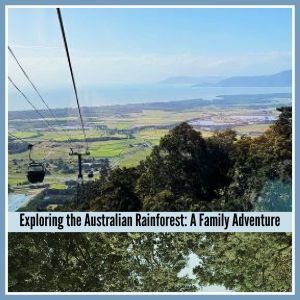
We visited a massive Australian Rainforest, both above it and in it, during 2024.
Leaving from Cairns, we rode a Skyrail to a World Heritage rainforest in Queensland.
The view from above was mighty with breath-taking views–and a few gasps.
Inside the rainforest, we walked about reading signs with our eyes wide-opened in surprise.
There was a lot going on!
The Australia Rainforest from aboveThe skyrail comfortably fit all five of us as we rode high above the green canopy.
This northeastern corner of Australia felt unpenetrable for a long time. Many aboriginies lived beneath the canopy and birds and animals enjoyed it as well.
We stopped several times along the way as we traveled 7.5 kilometers (about 4.5 miles) through the sky.
Here are some of the views:
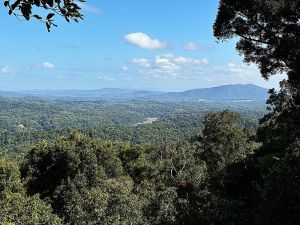 Headed north to Kuranda
 Cable wires as we come into a stop midway
 Nearing Kuranda
We’d look down occasionally, but only rarely saw the rainforest floor.
There was lots of greenery and we learned about the rainforest’s value at the informative tours and small museum along the way.
Hiking–sort of–high off the ground.The first of two stops on the trip was at Red Peak where we walked high above the ground on a boardwalk.
We missed the ranger tour, but augmented our ignorance by reading signs along the way and in the station.
Since we traveled with two teenagers, this was both a curiosity trip but also a learning one.
From that hike, the fourteen-year-old recounted the following in an email home that night:
The first stop we hopped out and walked on the trails. It was interesting to learn that most vines grow counter clockwise up the trees because of the natural gravitational pull. We also learned that some types of vines actually grow down. The seeds get left on the tops of the trees and the vine grows down and slowly strangles the tree. There were also what looked like nests up in the treetops. We learned that they were actually a type of vine/bush that grows onto the trees. It doesn’t hurt the tree because it relies on itself for food and energy and not the tree.
It is a great home for baby pythons, and many other species. The rainforest floor was almost empty, which makes sense when you think about it. The tree canopy blocks out much of the sun so the ground is not covered in grasses because they don’t have enough sun.
Apparently, the Cassowary is extremely important to the rainforests here in Cairns. 70-100 rainforest plant species rely on the Cassowary to spread its seeds. It eats an average of 5 tons of fruit a day. They are very important to the rainforest health and are one of the main reasons the rainforest can thrive the way it does.
She loves science and wants to be a veterinarian someday.
 Growing around trunk
 Looking way way up to the tree canopy!
 Cassowary modelWater is important in the Australian rainforest–waterfalls, too.
Our second stop was Barron Falls.
There we learned more than half the animal species that live on earth are found in the rainforest.
In the Australian rainforest, scientists found 58 frog species, 64 fish varieties, 110 mammal species, 162 reptiles, 327 bird varieties and more than 40,000 insects species. Impressive–and we saw few of them!
Our correspondent:
It took about 10 minutes of more spectacular views to reach the stop. This stop offered a amazing view of a waterfall. Grandpa was very excited about how the bridge/skywalk was framed.
We also explored a conservation information center. There were learned more about the forests and the wildlife behind it.
As we got onto our last gondola we saw another spectacular view of the waterfall.
As we passed over the river we spotted two crocs laying in wait for an unsuspecting animal (or tourist for that matter) to wander too close to the water. We landed into the cute village of Kuranda
We later took a boat trip down the river.
 Barron Falls
 The engineer was impressed by the cantalevered walk near the falls.
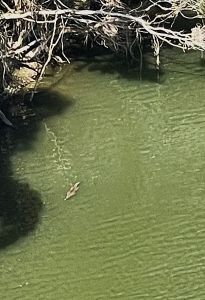 That’s a croc on the left in the water.Traveling with teenagers
We’ve always made a point of visiting museums and interesting sites when traveling with our children.
Our grandchildren, of course, were just an extension of that learning–both for them but also for us.
The three adults on this trip learned a lot which often provoked interesting conversations.
Having them write home each night provided their parents with reassurance they were still alive (!), but also gave them an opportunity to reflect on what they’d seen.
It wasn’t enough simply to travel to a foreign country.
Visiting a new place on the other side of the globe was designed to expand their sense of the world, of their ability to walk in a strange place, see new sites, and really think about what they meant.
The girls had never seen a rainforest before, only ridden a gondola in the snow or at Disneyland, and on this day, used the information they learned at the Australia zoo when looking down on a crocodile.
Kuranda provided even more fun–like butterflies!
And, of course, I, too, was astounded by what I learned–and certainly enjoyed the walk–through an Australian rainforest!
The post Exploring the Australian Rainforest: A Family Adventure appeared first on Michelle Ule, Author.
March 11, 2025
Lamprey Eels and a Natural History Museum

What are Lamprey eels?
I’d heard about them because I’ve read British history, but had no idea what they looked like.
I focused on that word, eel, and imagined a slimy, slow snake-like eel that, for some reason, clogged the streams of Merry Olde England.
They were in such abundance, people just dipped a net, brought them home, dumped them in a pot and, voila! Dinner was served.
(As an eel, of course, you’d need to watch for bones–right?)
Well, after my recent visit to the Burke Museum of Natural History and Culture on the University of Washing campus, I’m not so sure.
I’m afraid, you’d be watching out for TEETH!
The horror of lamprey eels Identifying itself. Surely, I was misunderstanding?
Two of my adult children, scientists both, and I recently visited the museum.
We saw the usual wonderful dinosaurs and many fine exhibits about the Northwest Native American cultures.
Then we turned to aquatic life, and my mouth dropped open in surprise.
“What’s that?” I asked, before peering at the identifying tag.
It didn’t look like an eel to me. Oh, wait, the head was cut off.
They shrugged.
I googled. It was a lamprey!
But they don’t have a head?
“They don’t need a head,” my son laughed. “They’re all teeth.”
I shook my head. I didn’t understand. At all.
Yes, lamprey eels are all teeth, no head. By Fernando Losada Rodríguez (Wikimedia Commons)
A . . . face? Head? Row of teeth only a mother lamprey could love?
Wikipedia consoles with the assurance lamprey eels only bite humans when they’re starving.
(But how can you tell?)
They’re only one of two species of “jawless fish” in the world. The other is called a “hagfish.”
The name means “stone sucker” in Latin.
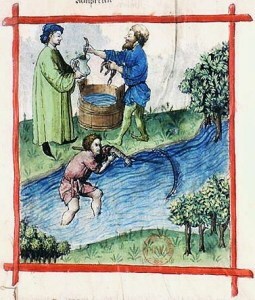 Wikimedia Commons
Lamprey eels allegedly have four eyes–but all I saw were the rows of teeth.
They can grow up to six feet long.
Half the species leaves saltwater to migrate up rivers and spawn in fresh water.
It’s during migration that many were caught and eaten during Tudor times.
According to Wikipedia:
Ogden Nash thoughts
During the Middle Ages they were widely eaten by the upper classes throughout Europe, especially during Lent, when eating meat was prohibited, due to their meaty taste and texture.
King Henry I of England is claimed to have been so fond of lamprey eels that he often ate them, late into life and poor health, against the advice of his physician concerning their richness, and is said to have died from eating “a surfeit of lampreys.”
Poet Ogden Nash wrote a short ditty:
“Lampreys are hagfish. In that one word I’ve said it.
I only know one item to their credit.
The early English had good cause to love them:
Wicked King John died from a surfeit of them.
Underwater with Ogden Nash, page 48.
Amusing, but is it true?
Take a look.
 From
Underwater with Ogden Nash
(Internet Archive photo)
From
Underwater with Ogden Nash
(Internet Archive photo)Tweetables
What on earth/sea are lamprey eels? Click to Tweet
The oddest looking creature in a natural history museum! Click to Tweet
The post Lamprey Eels and a Natural History Museum appeared first on Michelle Ule, Author.
March 4, 2025
Embracing a Gray-Haired Lady Ministry

I’m embracing a gray-haired lady ministry these days.
It’s not an actual club you join. You simply, grow into it–shall we say?
I don’t like to think I’m old enough to qualify, yet, alas, when I look in the mirror a woman with gray hair looks back.
I’ve got a husband with a white beard, a bunch of Adorable grandchildren, and a surprising number of candles on my birthday cake.
But this year I’m embracing what I’m calling “the gray-haired lady ministry.”
Do you know why?
Because it lets me get away with all sorts of activities in public–particularly while standing in line looking innocent. (And not staring at my phone.)
I’m harmless, right?
What is this a ministry to gray-haired ladies?Excellent question.
But the wrong one.
This isn’t a ministry, necessarily, to every gray-haired lady you meet on the street.
No.
It’s a surprise ministry all of us who look like the title can get away with.
 Ah, if you saw her from behind, you might not see how pretty she is! Photo by John Haldezos on Unsplash
Because many younger people (90% of the population) don’t pay attention to us.
We’re considered harmless. (No point in looking at my adult children. They know better!)
Easy to ignore.
People don’t mind sitting next to us on airplanes–especially if we’re only carrying a book and a purse.
(Oh the years I longed to do this!)
Nope. They think we’re harmless.
It’s insulting, but there’s no point in trying to prove our point.
We just act on it now.
So, it’s not a ministry to a gray-haired lady?No.
We’re ministering to anyone because no one expects us to be dangerous.
After the 9-11 incident in the United States, airplane travel became full of hassles. Walking through TSA was one of them.
But many countries wisely checked the people entering their nations–paperwork, inspections, luggage checks.
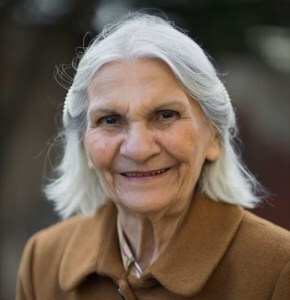 She couldn’t possibly cause trouble! But what if she prayed? Photo by Hosein Sediqi (Unsplash)
(A sniffing dog at passport control in New Zealand stopped my college son one year. It turned out, the dog wanted a bite of his ham sandwich. But still).
Women I knew from our local crisis pregnancy center entered a small nation to lead training.
The guards looked at the gray haired lady leading them, and waved them through without inspection. “They can’t possibly be here to cause trouble.”
No indeed. They came to change the attitude toward pregnant women and give them hope.
Missionaries do similar work, of course. But not all of them are gray-haired women.
Though I do have several friends . . .
They can get away with a lot more than othersLast year, I was standing in front of the tooth paste aisle in my local grocery store.
A younger man–say forty–was looking at the same thing.
We sort-of do-saw-doed around each other until we both started laughing.
He stepped back and declared, “I have to go. You have a good day.”
I grinned back. “Why thank you. Can I give you a blessing?”
“Sure!” (What trouble could this gray-haired lady cause?)
I raised my hand in the direction of his forehead–I did not touch him. “Lord, God, I pray you would be with this man today. I call down the Holy Spirit to fill him with joy and blessings. Amen.”
To my surprise and his shock, he fell backward about a foot.
Wide-eyed, he exclaimed. “What was that?!”
I shrugged. “It was a blessing.”
 What could she possibly be praying? Unsplash photo by Gaspar Zaldo
“No, no. I’m not religious, but something was in that. You’ve got some sort of power!”
I laughed and waved him on. “God’s got his eyes on you. Have a joy-filled day.”
He nodded, staring at me. “Thanks.”
And then he went on his way and I returned to the toothpaste.
He obviously wasn’t expecting anything from a harmless gray-haired lady.
Yes, a gray-haired lady can pray in public–and more.Back at the toothpaste aisle, I looked up when this younger man came around the endcap.
“You’ve got some sort of power.” His arms were wide opened. “My name is Ed. Can I hug you?”
I’m harmless, right?
“Sure. I’m Michelle.”
And that’s why this gray-haired lady was in the local grocery store hugging a strange man.
He ran off again to my laugh, “God’s got his eye on you Ed!”
Indeed, God sees all the rest of you youngsters, too.
Amen.
Hey! What does the Bible say about gray hair? Here are 35 verses!
Tweetables
What kind of a ministry could a gray-haired lady conduct in the world? Click to Tweet
Surely you know not to underestimate a gray-haired lady? Click to Tweet
The post Embracing a Gray-Haired Lady Ministry appeared first on Michelle Ule, Author.
February 25, 2025
Daily Christian History: Lessons from the Past

Christian history nuggests reach my email every morning.
The Christian History Institute (CHI) daily sends me a story out of Christianity’s past plus a review of significant dates that happened on that day.
The fascinating emails often humble me–and they’re free.
CHI also mail me a physical magazine focused on a specific topic out of Christianity’s past. Those come each quarter.
The March 2025 edition features Oswald Chambers.
What type of history are the magazine and daily emails reviewing?Christian. (See title).
On the day I’m writing this post, February 24, the daily email featured the story of Emperor Diocletians’ persecution of Christians, beginning on Feburary 24, 303 AD.
Whereas I knew of the Roman government’s determination to kill Christians, I didn’t know the why of the story.
(For fascinating insight, consider reading Jamie Ogle’s novel Of Love and Treason. It tells a fictionalized account of St. Valentine. Ogle did an excellent job of describing life for Christians in Rome at the time).
In 477 words, author Dan Graves provided me with a full explanation and story. Engaging, horrifying, and true.

As I reflected on his words and remembered how Ogle told her story set during that time, I felt humbled in my faith.
Once more.
Readers, we need people to tell these stories–of our faith’s history, of the missionaries who sacrificed so much for the sake of the Gospel, and of what it really meant to be a follower of Jesus.
When I read the missionary stories, talk to missionaries, and recall history, I’m humbled over and over again.
With this daily reminder, I can start my day in a better spot than, “where’s the coffee?”
What other reminders does the Christian History Institute provide?Significant events and deaths that occured on that particular date in history.
Of personal interest to me on February 24: “1873. A longstanding edict against Christianity is revoked in Japan.”
I happen to be researching 19th and 20th century Christianity in Japan, so this was a date I marked in my research!
I’ve been fascinated by the obscure corners of the world reported by the Christian History staff.
It’s not European or American-centric, which is important at a time where there soon will be more Christian in China than in the United States.
 One assumes the Luthers liked these paintings by Cranach!
 (Author photo)
Graves often writes the articles and he routine describes missionaries landing in far off places. He shares information about the deaths of notable Christians (too often in prison!).
Did you know Martin Luther and Michelangelo died on the same day? February 18–different years but such an interesting juxtaposition!
(Might one argue that Luther’s 1510 visit to Rome–where indulgences and extravagant art works like Michelangelo’s later work, infuriated him–played a part in the Protestant reformation?
(Can you recognize how just reading that fact sent me pondering broader ideas? Here’s one not necessarily pertinent to the men who died on February 18).
Christian History MagazineAs the website explains: “Christian History is a non-profit organization that provides Christian history resources and self-study material at low or no cost. Based out of Worcester, PA, CHI was founded in 1982 by Dr. A. Kenneth Curtis to share the lively history of the faith.”
From the first edition published in 1982 about Zinzendorf and the Moravians, the magazine looks at one particular subject or individual.
You can see the list of all their magazines here.
At about 48-pages long, the magazines cover a specific subject–articles, pictures, bibliographies.
A magazine format can be an easier way to learn about specific subjects in Christian history.
I bought a dozen of these magazines at $6 each, or in inexpensive bundles on subjects.

As a non-denominational magazine, CHI “adheres to the Apostles’ Creed. We seek to present the history of the global church and to see the best in each Christian tradition.”
Is this blog post an ad?Of course not.
I’m simply sharing about a magazine and daily emails that are enriching my spiritual life.
They’re touching my love of history and faith stories. They’re also sending my mind all over the, literal, map thinking of Christianity’s past.
I’m, again, impressed by the faith of missionaries going places I’ll never see.
So much Christian history needs to be told.
The daily emails are so much more inspiring than my Twitter feed!
CHI also provides material for homeschooling and a variety of videos.
And the information through CHI is either free or affordable.
Enjoy.

The post Daily Christian History: Lessons from the Past appeared first on Michelle Ule, Author.



.jpg)