Michelle Ule's Blog, page 9
May 14, 2024
“Sky Pilot,” Oswald Chambers’ Personal Colphon

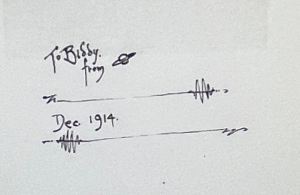
Oswald Chambers called himself the “Sky Pilot” in one book inscribed to his wife Biddy.
But why?
The man was an artist.
It matched his brand–or the colophon he used in personal books.
What is a colophon?His OC, Saturn-like, colophon is a type of branding tool publishers use on the spines of their books.

You can see them in the photo at the bottom of the book’s spine.
Sometimes publishers just use their names, but a symbol of their publishing house works well.
DHP has a feather like bird, Baker has a stack of books, Knopf a running dog, Tyndale has a feathered pen, Harper Collins its name, and Barbour sports an opening book.
They’re easily recognizable brands.
Oswald Chambers wrote many letters and graded a lot of tests in his life.
The Saturn-looking colophon made it easy to sign his personal correspondence, or at least, book gifts.
(For grading papers, he had a rubber stamp and the man used it!)
 Where did Sky Pilot come from?
 Can you see the OC?
Oswald wasn’t thinking about being called a “Sky Pilot” when he drew that Saturn signature.
He was an artist and whimsical. Why not use something that looked like his signature–if you looked at it the right way?
Can you see why it might be considered an OC?
One thing led to another, he was a consummate nick-namer. (Note: he called Gertrude, his wife, Biddy, for Beloved Disciple, B. D.)
Those who knew and loved him, came to expect something fun—as well as an appropriate book gift.
Where else did he use the Sky Pilot colophon? Wedding Gift to Jimmy Hanson.
(Hansen family)
Wedding Gift to Jimmy Hanson.
(Hansen family)When his close friend Jimmy Hanson left Egypt on leave in August 1917, OC knew he would return with his bride..
As a parting gift to the bridegroom, he handed him an inscribed copy of a popular marriage book at the time, Don’ts for Husbands. Jimmy, finally, was on his way to marry Florence Gudgin.
104 years later, their grandson found the book on a nephew’s shelf!
It may have been the last book Oswald Chambers gave to a friend–presented three months before he died.
You’ll note: he used his colophon.
What about the sky?Chambers didn’t talk much about the sky, though in the January 5 reading (in Macy Halford‘s new “Modern Classic” My Utmost for His HIghest), he points to what is truly important.

As a Sky Pilot for the Kingdom of God, he had only one fixed point:
What’s a Sky Pilot?We never did have any power of our own. That’s why all our vows and resolutions ended in failure.
Now, on the other side of that failure, we see clearly. Only one star shines in our sky—our lodestar, Jesus Christ.
My Utmost for His Highest, January 5, Modern Classic Edition
Along with “padre,” Sky Pilot is one of several nicknames miltary members use when referring to their chaplains.
As a chaplain at Zeitoun YMCA camp alongside the ANZAC Light Horse companies north of Cairo during WWI, Chambers relished his new life.
He turned things upside down in the YMCA “hut” his first day in theater, but soon troops came to his talks in hordes.
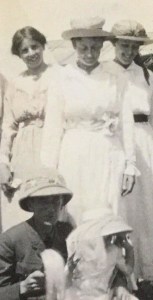 Final family photo before OC’s death.
The first one? What’s the Good of Prayer?
When his wife Biddy arrived a few months later with their two-year old daughter Kathleen and their friend Mary Riley (serving as nursemaid), the full Zeitoun ministry began.
They all knew the soldier’s lives teetered on eternity. Those in the camp were headed either up the line to take Jerusalem, or would go to the trenches of WWI France.
Chambers preached the gospel, always.
You can read more about YMCA work in Egypt here.
Suffice it to say, the Sky Pilot from England, or, in his mind, from God did a wonderful work in the desert for two and a half years.
As one soldier said: “It may very well have been worth coming to war to hear Oswald Chambers preach.”
If that’s what got him into the Kingdom of God, the Sky Pilot would have laughed.
Tweetables
What’s a Sky Pilot and how did the name apply to Oswald Chambers? Click to Tweet
Why did Oswald Chambers see himself as a sky pilot? Click to Tweet
The post “Sky Pilot,” Oswald Chambers’ Personal Colphon appeared first on Michelle Ule, Author.


May 7, 2024
Naval Undersea Museum: Seeing Friends

So, we visited the US Naval Undersea Museum in Fall 2023.
It was another spot for me to see old friends (in the exhibits) and make a new friend.
Because I spent 20 years of my life at the beck and call of submarines, I enjoy reflecting on those years.
(I’ve written about visiting subs and their museums before: here and here.)
We once lived in Washington State and visited the museum was it was brand new.
It’s much more sophisticated now and full of wonderful exhibits.
And plenty of familiar items.
Getting a taste for submarine life
With a naval undersea focus, the Keyport, Washington Naval Underseas Museum provides insight into life on board a submarine.
It has walls of patches–some of which also hang on the walls at our house.
Exhibits show the type of life men and women experience while living underwater in a warship.
I, personally, appreciated the nod toward family sacrifices when a sailor disappears for months at a time.
 Command centers are not this spacious.
The museum contained exhibits about the ocean environment, torpedo technology, mine warfare, and a discussion of the strategic deterrence program.
(Which reminded me of a conversation I had many years ago in Romania).
I could take a spin with a “one eyed lady”– or look through a periscope–and examine a much more spacious command center than I’ve ever seen on an actual submarine.
I learned about how submariners were trained to escape boats in an accident, including seeing a Steinke hood for the first time.
Seldom used (because while submarines sink, they almost always return to the surface), I’d long heard about how sailors put them on, escaped through a tank and puffed “ho-ho-ho” as they swam to the surface.
The most surprising element at the Naval Undersea Museum?The docent outside with two DSRVs. (Deep sea rescue vehicles, see The Hunt for Red October).
I like to chat with museum docents, volunteers, and curators.
 Dive Tower (Wikimedia Commons)
Many visitors don’t stop to chat with docents, but I know they’re the source of great insights.
They usually can point you to interesting items people often overlook.
In this case, the docent stood outside, waiting for a tour when we walked up.
My husband went to examine the undersea submersibles parked in front of the Naval Underseas Museum.
I stopped to chat.
Oh, fun. He was a Master Chief diver and full of stories.
He showed me his folder full of photos and regaled me with some of his, um, unpublicized exploits.
Older than me, he described some of the unusual places the Navy sent him in his 30-year career.
“One of them,” he explained, turning to a photo,”was here.”
“That’s the dive tower in Groton,” I said.
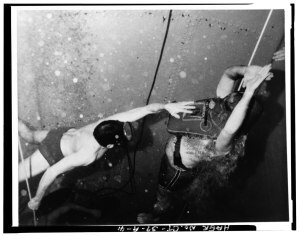 Inside the dive tower; Navy diver checking on man in a Steinke hood. (Wikimedia)
“You know it?”
I nodded. “My husband swam it many years ago. What year were you there?”
We compared notes, timelines, and I put out my hand to shake his. “Thank you for training my husband on how to escape from a submarine.”
A young diver all those years ago, the docent would have been in the dive tank the day my young Navy guy had to get from the bottom to the top wearing only a Steinke hood.
Or, swim 100 feet up.
This is why I love to visit submarine museums.
I never know what “friends” I’ll see there.
Tweetables
A visit to the US Naval Undersea Museum, & hearing a personal story. Click to Tweet
A unique submarine museum in Washington State. Click to Tweet
 I’ve always loved swinging through sub hatches!
The post Naval Undersea Museum: Seeing Friends appeared first on Michelle Ule, Author.
April 30, 2024
Jesus’ Three Cs: Don’t Condemn, Condone; Commend.

What were Jesus’ three Cs?
Do not condemn.
Do not condone.
Commend.
Why are Jesus’ three Cs important?
They tell important lessons about Jesus and about us.
Where does the concept of Jesus’ three Cs come from?The concept is taken from Jesus’ interaction with the Samaritan woman at the well in John 4.
Jesus and the disciples were traveling home to the Galilee region and the shortest route took them through Samaria.
Samaria was the homeland of a mixed-tribe people. They did not associate with Jews because the Jews believed them to be in error about their theology.
Nevertheless, the band traveled through the area and stopped at a well (believed to be a gift to the patriarch Jacob centuries before) outside the town of Sychar.
Jesus sent the disciples into town to get food. He sat down to wait until a woman carrying a bucket arrived around noon.
You can read the gospel story here.
What do Jesus’ three Cs mean?After Jesus asked the woman for a drink of water, she asked him a pointed question:
“How is it that You, being a Jew, ask a drink from me, a Samaritan woman?” For Jews have no dealings with Samaritans.
10 Jesus answered and said to her, “If you knew the gift of God, and who it is who says to you, ‘Give Me a drink,’ you would have asked Him, and He would have given you living water.
John 4: 9-10 NKJV
Jesus didn’t condemn her for her nationality. He was looking at her soul.
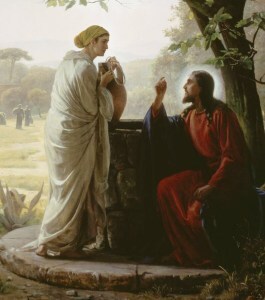 By Carl Bloch
 (Wikimedia Commons)
(Condemn means to declare evil, to pronounce guilty, to denounce as a reprobate.)
After her amazement when Jesus offered her water that will never run dry, He encouraged her to bring back her husband to talk with him.
17 The woman answered and said, “I have no husband.”
Jesus said to her, “You have well said, ‘I have no husband,’ 18 for you have had five husbands, and the one whom you now have is not your husband; in that you spoke truly.”
John 4: 16-18 NKJV
See what Jesus did there? He did not condone her relationships with the “non-husband.”
Instead, Jesus commended her, he praised her, for telling the truth. She didn’t try to whitewash, rename, or hide the fact of her living situation. She acknowledged the truth–thus demonstrating she recognized her behavior for what it was.
So what?Jesus knew the truth about the Samaritan woman. He saw an outcast, a lonely woman separated from her community.
He knew her hurt–five previous husbands gone, in one way or another.
Jesus recognized her soul needed encouragement and certainly redemption.
He spoke to what He knew, and what she needed to hear. Jesus had answers to her problem, or the one main answer: eternal life.
He didn’t condemn the woman for not being Jewish or coming to the well alone in the heat of the day (the women of the town would have come earlier in the day).
Jesus didn’t condone her illicit relationship.
He commended her for telling Him the truth.
No fire. No brimstone. Jesus didn’t pick up a rock to throw at her.
He saw her for what she was–but more importantly, that she needed the living water of salvation only Jesus could/and currently can provide.
Why are the three Cs important?We live in a hostile world that delights in insulting and harming one another.
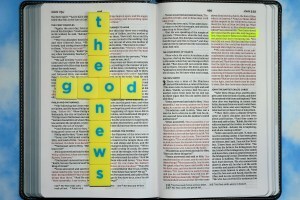 Photo by David Clode (Unsplash)
Jesus brought good news to the Samaritan woman–and he does the same for us.
How can we tell if the voice in our mind that always criticizes us comes from God or from somewhere else?
What is that voice saying to us?
Is it condemning us and trying to reassure us that what we know is wrong really isn’t wrong?
How does that make you feel?
If it’s negative and condemning, it’s not coming from the God who created you and who loves you.
But, you have to be honest with Him.
Jesus offered the Samaritan woman eternal life and assured her that her status didn’t matter to him.
What mattered was her honesty.
Her response?
“Sir, I perceive that You are a prophet . . .
God is Spirit, and those who worship Him must worship in spirit and truth.”
The woman said to Him, “I know that Messiah is coming” (who is called Christ). “When He comes, He will tell us all things.”
Jesus said to her, “I who speak to you am He.”
John 4: 19-26 NKJV
 Jesus’ three Cs assurance remains true today.
Listen to the voices. Are they condemning?
They’re not from God.
Are they calling you back to Him?
Jesus is waiting and happy to provide living water.
Thanks be to God.
Tweetables
Jesus’s three Cs to the Samaritan: what are they today? Click to Tweet
The Biblical model: Jesus doesn’t condemn, condone, but commend. Click to Tweet
The post Jesus’ Three Cs: Don’t Condemn, Condone; Commend. appeared first on Michelle Ule, Author.
April 23, 2024
A Land Flowing with Milk and Honey? Where?
“It was a land flowing with milk and honey,” the Bible often says in describing Israel.

(See Exodus 3:8; Numbers 14:8; Deuteronomy 31:20; Ezekiel 20:15).
What does that word picture suggest to you?
I think of lush gardens, flowers in bloom, wholesome food everywhere, fat cows, busy bees.
God’s promise to the Jews who’d so recently crossed the red sea: “I have come down to deliver them out of the hand of the Egyptians, and to bring them up from that land to a good and large land, to a land flowing with milk and honey.” (Exodus 3:8; NKJV)
You can picture the green hillsides, trees, fruits, and vegetables all waiting to be picked.
It’s a refreshing and encouraging vision until you reflect on that particular land today.
From knowing current geography, my mind sees barren hillsides and rocks.
Having now visited Israel, I saw relatively few trees and many barren hills.
So, what is the Bible talking about?
Is any land flowing with milk and honey these days?Planet earth has many beautiful places. Some are lush, some are not.
Many people don’t realize northern Africa, today the barren Sahara desert, once was covered with vegetation.
The world has suffered through constant change (climate and otherwise) since Moses first wrote about a land flowing with milk and honey in the Bible.
Indeed, as we drove down the eastern side of Israel 18 months ago, we saw little lush landscape.
All along the Israeli side of the Jordan River, the hillsides looked barren as we traveled the main highway.
What greenery we did see, was on small farms.
To my surprise, farmers cultivated banana trees beneath mesh screens–to keep out the insects and birds?
We saw many plantations growing foodstuffs, including date palms, but not many trees.
Indeed, the hillsides were more likely to be covered in windmills, than trees.
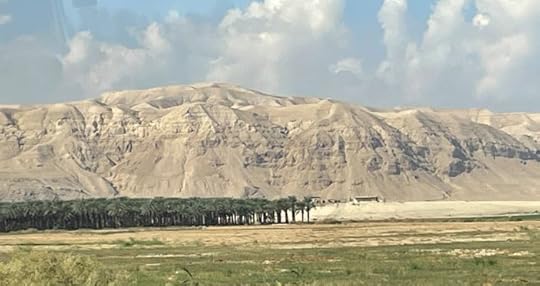 Date palm crops
 Bananas under mesh
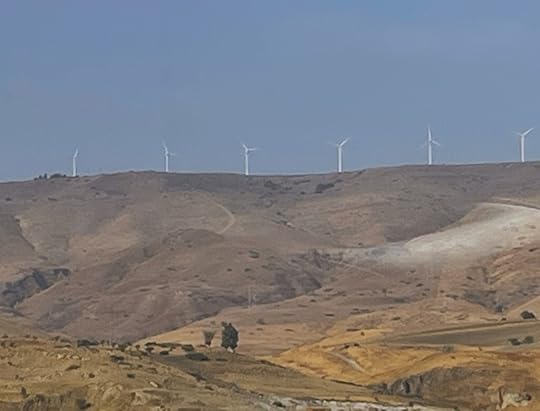 Hillside windmill farmsHow to read the Bible and “see” land flowing with milk and honey?
I’m reading the Bible in a year again this year, and as I stumble through Judges and into the histories, it’s difficult to picture just what the Hebrews were so excited about.
Fortunately, we live in a time where Biblical fiction can help us picture–and thus understand–what the land may have looked like.
Yes, we always read the Bible first, and I spend a lot of time examining maps. (Why would Scripture give us placenames if they weren’t important? They are to me.)
But, sometimes, allowing a trusted author to describe a place we’re having trouble imagining (especially if you’re a concrete thinker), can be very helpful.
An honest novelist is very careful not to break the trust for readers, usually being careful to provide Biblical safeguards.
For these early Bible books, I turn to Conilynn Cossette, who first provided me with descriptions that would match “a land flowing with milk and honey.”
An accomplished writer can help me begin to see, and thus better understand, what’s really going on in the Bible passage.
God gave us imagination. I believe we can use our imagination–but, our imagination has to line up with the absolute truth of the Bible.
And if something about the description bothers us, set aside the book.
(A friend recently wrote a novel set in Genesis 1. I trust her, and I tried, but I couldn’t read it. It messed too much with all the recent study I’ve done about the creation story. I felt uncomfortable and the Holy Spirit basically told me to close the book.)
What else can help us understand as we read the Bible?We live in wonderful times with plenty of resources. Scholars have made great strides in understanding Israel in the past.
They can describe the “land of milk and honey,” based on historical evidence.
Doug Hershey provides insight, as well, with his photos of the Holy Land 175 years ago set against modern shots.
Visiting the land, of course, can help.
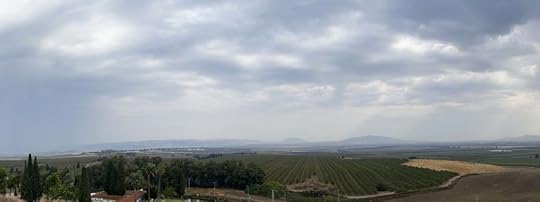
The Land of Caanan which the spies described to Moses runs along the Jordan River, yes, but it also spreads west once it hits the Jezreel Valley.
There’s plenty of land flowing with milk and honey there! (That’s Mt. Tabor in the center distance).
Tweetables
Does the Promised Land still flow with milk and honey? Click to Tweet
Seeing the Promised Land with real eyes, but also real imagination. Click to Tweet
The post A Land Flowing with Milk and Honey? Where? appeared first on Michelle Ule, Author.
April 16, 2024
God’s Point of View or Yours? Whose to Use?

Do you see God’s point of view as you walk through life?
Or is your own more important?
My question comes out of the Bible’s Judges 17:6:
“In those days there was no king in Israel. Everyone did what was right in his own eyes.” (NKJV)
It was a lawless time long ago and the ruler of Israel was God.
Samuel was their prophet and led the people, ultimately making his sons judges.
But those sons were evil, and the leaders decided they’d be better off with a real king, rather than a prophet and his corrupt sons.
Tired of Samuel, they wanted someone they could see, “like the other countries.”
Samuel appealed to the Lord, who replied:
“Obey the voice of the people in all that they say to you, for they have not rejected you, but they have rejected me from being king over them.” (1 Samuel 8)
They didn’t care about God’s point of view. They wanted to use their own wisdom to control their nation, and themselves.
So God let them.
It didn’t turn out well.
Why ask this question today?I’m revisiting this post because everywhere I look, people are valuing their opinion over God’s opinion and point of view.
You know how it goes, “Well, that’s just your opinion. I feel differently.”
That’s fine.
But you can’t play games with what God said in the Bible.
That’s his opinion and that’s what rules the universe.
You can tell us there’s no such thing as gravity, but drop your phone.
A phone doesn’t “know” what you think you “know.” So, it falls to the ground–just as God set up the universe to do.
What is a point of view?In literature, the point of view is the person through whose eyes the story is told.
One of the first lessons a writer learns is writing in one point of view.
“Head-hopping,” or jumping from point of view as is often done in movies, is called “omniscient point of view,” and can confuse readers.
It makes more sense to hear the story from one person’s perception, rather than several. You can follow the story and understand better.
(Think how maddening, or completing, it is to hear the same story told by a group of people interrupting each other).
Everyone brings their own understanding of their past, their fears, their biases when it comes to assessing what happened in a given situation.
That’s why justice requires the testimony of several people.
If several people agree on the same story, chances improve it is true.
So, what is God’s point of view?How God sees something.
His vision can best be figured out by reading the Bible.
God never contradicts Himself, or Jesus or the Holy Spirit.
His character remains consistent through eternity.
We can count on it not changing.

Photo by Luca Baggio (Unsplash)
God sees believers through the lens of Jesus’ death and resurrection.
Since He cannot otherwise look upon sin, God can only see us through that “Jesus lens.”
He gives us his point of view frequently in Scripture. Here are four examples.
“For I know the plans I have for you, declares the Lord, plans for welfare and not for evil, to give you a future and a hope.” Jeremiah 29:11 (ESV)“And we know that for those who love God all things work together for good, for those who are called according to his purpose.” Romans 8:28 (ESV)“Keep your life free from love of money, and be content with what you have, for he has said, “I will never leave you nor forsake you.”” Hebrews 13:5 (ESV)“God is not human, that he should lie, not a human being, that he should change his mind. Does he speak and then not act? Does he promise and not fulfill?” Numbers 23:19 (NIV)
If you need more reminders, Officers’ Christian Fellowship provides a PDF on the Character of God.
What difference does it make?When we run into a problem, trouble, heartache, or trial, the overriding point of view can make a big difference in our response.
Do we rely on our own understanding of the situation, or do we acknowledge God may be doing something we don’t know about?
Our reaction to the situation can determine how well we come through it.
The key is deciding whose reaction we will trust–our own opinions or God’s point of view.
That involves our faith, of course, along with spiritual discipline.
In the February 8 My Utmost for His Highest reading, Oswald Chambers warns:
“Sanctification [the process of becoming holy] means to be intensely focused on God’s point of view.

God sees each of us within the sweep of eternity. (Photo by adrian on Unsplash)
“It means to secure and to keep all the strength of our body, soul, and spirit for God’s purpose alone.”
As Christians, our desires should be to please God alone, no matter the cost to ourselves.
Rather than a stiff-upper-lip/gut-it-out response to difficulties, choosing to believe in God’s point of view can be a relief.
We just have to turn the prism of our expectations and try to see how God may be looking at the same circumstances.
Or not even that.
Practical stepsWhen distressed, worried, upset, afraid, I can wallow in those emotions.
(And the Lord knows we have emotions!)
But after a while, even I get tired of tears and, too often, anger.
I can then (or if you’re better than me, start here), tell God what I’m feeling and why.
He can take it–because He sees me through His point of view, not mine.
He sees beyond eternity to the purposes He has in a given situation.
I then choose–will I trust Him or depend on myself?
It works best if I choose to trust God with the circumstances of my life.
Sometimes, He even gives me a glimpse of what He’s up to.
But I don’t count on it.
Because I worship the God who spans time, and who knows what He is doing.
He also will never leave me nor forsake me. He holds my hand, as it were, as He presses into the future.
Thanks be to God.
Do you seek God’s point of view when you look at your problems?
Tweetables
Whose point of view do you prefer–God’s or your own? Click to Tweet
If God can create the world, can you trust Him with your circumstances? Click to Tweet
What is God’s point of view about our circumstances? Click to Tweet
The post God’s Point of View or Yours? Whose to Use? appeared first on Michelle Ule, Author.
April 9, 2024
A Cal Visit: Bears and Buildings

We went on a Cal visit– a trip to the University of California, Berkeley–recently and saw lots of bears and many beautiful buildings.
It was quite an afternoon.
We had a high school basketball player with us checking out the school, and watching, well, the Cal-UCLA basketball game.
I hadn’t been on the campus in years.
(The last time I visited was for a UCLA-Cal football game. I got so excited when I heard a marching band, I ran up to Sather Square to see it.
(It was the “wrong” band for me, but I felt the music and bounce in my knees and marched up the hill with them, anyway. It was just like old times!)
But on that recent spring day, I felt older and more detached.
That may be the reason why I was amused to see all the bears–who, of course, are Cal’s mascot.
Why bears and lions at the Cal visit?The California grizzly bear is the state of California’s mascot–it appears on the California state flag.
We don’t run into bears in the wild here anymore, they’ve pretty much been extinct for years in the state.
But grizzly bears once roamed freely through the Northern California mountains, and presented challenges for gold miners following the 1849 Gold Rush.

Once farmers and ranchers moved in, the bears became too dangerous for people and livestock alike. (The largest one killed weighed 2200 pounds–or more than a ton).
But their feistiness and power remained a draw and the grizzly bear became the state mascot in 1953.
A grizzly bear (you can tell it’s a grizzly by the hump behind the ears) appears on the California State flag.
What kind of bears do you see on a Cal visit?Metal, plastic, stained glass, t-shirts, everywhere!
 Gate to the President’s mansion
Why?
The University of California, Berkeley, was the first state-sponsored university in California.
Founded in 1868 as the state’s first land-grant university, it’s long been considered the premier college in California.
(Though this University of California, Los Angeles alum might beg to differ. Established in 1931, UCLA was the #2 California university, hence our mascot is a baby bear, or a bruin!)
You can’t spend much time with Cal graduates (we have eight in our extended family) without hearing their favorite chant, “Go, Bears!”

(We recently attended a wedding between two Cal athletes. “Go, Bears” was a frequent toast. It may even have been part of the ceremony . . . )
Anyway, during our Cal visit, I amused myself by looking for the bears.
(The prospective student wanted to see the engineering buildings.)
They were everywhere and it was a fun version of “Where’s Waldo?” on a pretty afternoon.
What else besides bears?The beautiful campus contains stunning views, beautiful buildings, and a creek running down the middle.


Built on an eastern hill overlooking San Francisco’s bay, the views from the top were spectacular on a gorgeous day.
Construction continues all over campus, and fencing students regaled watchers on the lawn near the student center.
Our youngster fit right in.

Just before we entered Haas Pavillion for the game, we paused, one last time, to admire the view while our guide discussed the university’s many famous and accomplished graduates. (The list included her and five of her children!)
I’ve visited the campus a few times over the years to do research in their libraries.
Frankly, just walking around campus made me feel young again.
(Especially when UCLA won the game!)
Whether you’re looking to attend, wanting to do research, or curious about the views, a Cal visit on a beautiful spring day is a lovely way to spend an afternoon.
 Photo by Cal alum Janet McHenry.
Tweetables
A Cal visit on a beautiful spring day (with lots of photos!) Click to Tweet
What does UC Berkeley look like in the spring? Click to Tweet
The post A Cal Visit: Bears and Buildings appeared first on Michelle Ule, Author.
April 2, 2024
How to Overcome Intercessory Prayer Challenges

How do you overcome intercessory prayer challenges?
What is a challenge for the intercessor?
(An intercessor is someone who prays for another person).
Let’s let Moses count the ways.
How Moses learned to overcome intercessory prayer challenges.Everyone who reads the Old Testament can clearly see Moses dealt with a lot of grief from the folks he led out of Egypt.
As a people, the Israelites had been in Egypt for 400 years.
Sure, they had their traditions, but they lacked a temple and by the time of Moses, they were enslaved workers.
It’s hard to know what they remembered about their past.
We certainly don’t know if they had the time, energy, or opportunity to worship the one true God.
As theologian Chad Bird points out in Unveiling Mercy: 365 Daily Devotions, the very concept “Pharoah” means a god.
The word Par’oh (“Pharoah”) is an Egyptian loanword meaning “great house.” . . . In Egyptian theology, Par’oh was the incarnation of a god. Thus when Pharoah scoffs at God and acts like a first-rate uppity deity, he’s thrown down the auntlet: this will be a theomachy, a God-fight.”
Unveiling Mercy p. 63.
After Moses took them through a “baptism” passage of the Red Sea, they spent two years in the desert learning to trust in Yaweh–or “I am who I said I am.”
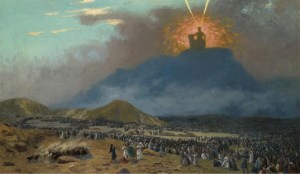 Moses on Mt. Sinai (Jean Leon Gerome; Wikimedia)
Their Hebrew God-worshipping experience had been truncated. They needed to (re)learn what it meant to worship the one true God.
Moses’ intercessory prayer challenges began in the desert when the people who escaped Pharoah suddenly weren’t sure they liked the idea.
Ten: plagues and challengesYou’ll remember that Moses’ prayed for God to intervene when he approached Pharoah.
Moses and Aaron demonstrated how the One True God was more powerful that the Egypian king-god ten times.
But, once past the Red Sea, the Israelites demonstrated ten intercessory prayer challenges.
Here’s the list from Got Questions:
Lack of faith before crossing the Red Sea (Exodus 14:11–12) Bitter water complaints at Marah (Exodus 15:24)Food complaints (no meat or vegetables!) in the Desert of Sin (Exodus 16:3)Greedy manna overcollection (Exodus 16:20)Sabbath breaking to collect manna (Exodus 16:27–29)Rephidim lack of water complaints (Exodus 17:2–3)The golden calf incident (Exodus 32:7–10)General complaining attitude at Taberah (Numbers 11:1–2)Complaints about the food menu (looking back to Egypt). (Numbers 11:4)Afraid to trust God and enter the Promised Land (Numbers 14:1–4)In each of the above incidents, God was unhappy with the Israelites and their attitude. He threatened to wipe them off the face of the earth each time.
Well, how would you have responded to the irate Creator of the Universe?
Interecessory prayer is talking to GodIntercessory prayer is about establishing an intimate relationship with God that enables you to discuss anything with Him.
When we recognize God wants to communicate with us–through the Bible and through the Holy Spirit’s guidance–it becomes easier to prayer.
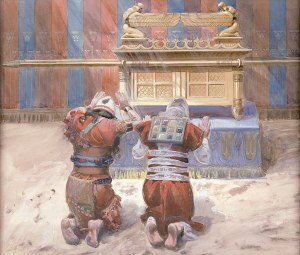 Moses and Joshua at the tabernacle (James Tissot; Wikimedia)
When we learn about God through Biblical stories and words, we learn to trust Him.
And out of that trust, an intimacy that grows, we can ask God for things with confidence He’ll answer.
Why?
Because we know what God values. We know what his Law declares true. We’re looking to please Him.
And that’s why Moses was such an exemplery intercessor.
He walked with God, trusted God, and knew God’s heart.
In Numbers 14, twelve spies returned from Caanan and ten insisted conquering the land couldn’t be done.
God got angry at that assault on His character (after all He had done, suddenly they chose not to believe He would help them?).
In fact, He “came down there.” His cloud appeared in the tabernacle of meeting.
Moses hustled in to talk with Him.
How did God respond to Moses’ intercessory prayer challenges?
Then the Lord said to Moses: “How long will these people reject Me? And how long will they not believe Me, with all the signs which I have performed among them? I will strike them with the pestilence and disinherit them, and I will make of you a nation greater and mightier than they.”
Numbers 14: 11-12 (NKJV)
Moses stood before a very angry God.
But He knew God’s character, and pointed out some basic facts the Lord told Moses:
“The Lord, the Lord God, merciful and gracious, longsuffering, and abounding in goodness and truth, keeping mercy for thousands, forgiving iniquity and transgression and sin, by no means clearing the guilty, visiting the iniquity of the fathers upon the children and the children’s children to the third and the fourth generation.
Exodus 34:6-8 (NKJV)
Moses also pointed out that if God destroyed the Israelites, “the Egyptians will say you brought the people out into the desert to kill them.”
In addition, “other nations will claim you did not have the power to keep your people alive in the desert.”
Elsewhere, God says, “Come now let us reason together.” (Isaiah 1:18).
On that day, He listened to Moses and stayed His hand.
But there was a price.
What price did Moses pay to overcome the intercessory prayer challenges?Both Moses and the Israelites paid a high price for this incident.
Despite God telling them to go into the Promised Land, the Israelites requested the 40-day spy hunt.
Obviously, that was a poor request–though God honored it.
The result: 38 more years in the desert (they’d already been out there two years)
Moses?
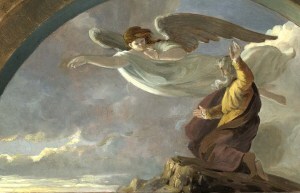 Moses sees the promised land (Robert Walter Weir, Wikimedia Commons)
He was undoubtedly tired of these unruly, ungrateful Israelites.
But Moses was the intercessor. He was the go-between God and the Israelites.
After this incident, he had to lead the people for 38 more years.
In his impatience, weariness, exhaustion, irritation with them, Moses disobeyed God.
God told Moses to strike the stone at Meribah Kadesh once for water (in Exodus 17). He struck the stone twice.
The Israelites got all the water they wanted, but God punished Moses for his disobedience and pride.
God showed Moses the promised land just before his death.
But, like the Israelites over the age of twenty on that day in Numbers, Moses never entered the Promised Land.
How do we overcome intercessory prayer challenges?Spend our prayer time listening and learning from the Bible, the Holy Spirit, and Jesus’ prayer examples.Keep our eyes, ideas, and prayers nestled in the character of God.Don’t be afraid to ask anything in His name that corresponds to His character as demonstrated in Scripture.You can’t ask in faith if you don’t know the Giver.
Nor, can you ask if you don’t believe what He says.
Hebrews 3:18-19 deserves the last word for the weary prayers battling intercessory prayer challenges:
“So we see that they were not able to enter [into His rest—the promised land] because of unbelief and an unwillingness to trust in God.” Hebrews 3:19 (Amplified)
Tweetables
Overcoming Intercessory prayer challenges–like Moses. Click to Tweet
The key to intercessory prayer challenges? Click to Tweet
The post How to Overcome Intercessory Prayer Challenges appeared first on Michelle Ule, Author.
March 26, 2024
Jesus and the Pharisees: Another Look
 [image error] [image error]
 Everyone knows Jesus and the Pharisees had a complicated relationship.
If you could even call it a relationship!
Jesus loved them, absolutely.
The Pharisees–well, did they hate Jesus, fear him, wonder about him, or come to believe?
Let’s take another look at the scriptures pertinent to Jesus’ last week–also known as Holy Week.
(I wrote a blog post on this topic here.)
(You can view a timeline of events for that final week here).
(Dr. Eugenia Constantinou wrote a powerful book, The Cruxifiction of the King of Glory, which I discuss here.)
The teenage Jesus and the PhariseesAt the age of 12 as recounted in Luke 2:41-48, Jesus remained behind in Jerusalem at the Temple when his family returned to Nazareth.
On the second day of their walk home, Mary and Joseph couldn’t find their oldest son. They hurried back to Jerusalem for a feverish search.
 By Heinrich HofmannGeorg Hahn (Wikimedia Commons) [image error]By Heinrich HofmannGeorg Hahn (Wikimedia Commons) [image error]By Heinrich HofmannGeorg Hahn (Wikimedia Commons)
Now so it was that after three days they found Him in the temple, sitting in the midst of the teachers, both listening to them and asking them questions. And all who heard Him were astonished at His understanding and answers. So when they saw Him, they were amazed; and His mother said to Him, “Son, why have You done this to us? Look, Your father and I have sought You anxiously.”
And He said to them, “Why did you seek Me? Did you not know that I must be about My Father’s business?” But they did not understand the statement which He spoke to them.
Luke 2: 41-48 NKJV
As I’ve thought about these verses over the years, it always seems to me that if I had been one of those teachers at the Temple, wouldn’t I have “kept tabs” on that kid from Nazareth?
He regularly visited Jerusalem with his family for the feasts. Wouldn’t you have made inquiries over the years and watched to see what would happen to him?
Generally speaking, the “teachers of the Law” were scribes. Their jobs were to study the Law and interpret it for the Jews. They were experts on the Law.
Some may have been Pharisees, but they generally were a lower “rank” of expert in the Temple during these years. They were not rulers.
None the less, surely they talked about this kid from Galilee–who grew up to become a rabbi–and some may have followed him.
Lazarus’ death and it’s affect on Jesus and the PhariseesWhile the Pharisees had been suspicious and angry with Jesus for a long time, Lazarus’ death raised the stakes.
They’d not been happy with Jesus’ disruptions (in their opinion) on the Temple Mount.
They were angry that “everyday” Jews flocked to see and hear him.
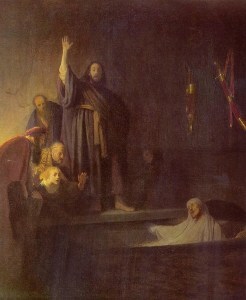 Rembrandt on Lazarus (Wikimedia Commons) [image error]Rembrandt on Lazarus (Wikimedia Commons) [image error]Rembrandt on Lazarus (Wikimedia Commons)
 And the Romans threatened trouble for the Jews if any sort of disorder happened at Passover.
The Romans really controlled events in Jerusalem in AD 33 (give or take a few years).
Enough people, which would have included scribes and Pharisees, saw Lazarus’ resurrection, that the tide began to turn. Who? What kind of teacher could conquer death like that?
Worse, it appeared that some of the scribes/teachers who visited the Bethany household and witnessed Lazarus’ resurrection, became convinced Jesus was the long-awaited Messiah.
Witnessing that event is what sparked Palm Sunday in Jerusalem.
What about the fragrance of expensive perfume?Six days before Passover (Passover was Good Friday–thus this event probaby took place on the eve of Palm Sunday), Jesus dined in Bethany at Simon the (former?) Leper’s home.
There they made Him a supper; and Martha served, but Lazarus was one of those who sat at the table with Him. Then Mary took a pound of very costly oil of spikenard, anointed the feet of Jesus, and wiped His feet with her hair. And the house was filled with the fragrance of the oil.
John 12:1-7 NKJV
Mary used “spikenard oil.” Jesus further explained the extremely expensive oil annointed him for his burial.
The oil’s scent would have clung to Jesus for days. “Spikenard had a strong, distinctive aroma, similar to an essential oil, that clings to skin and hair and continues to give off its heady perfume.”
It would have been on his clothes that week in Jerusalem.
Would the Pharisees and the Sanhedrin, not to mention the crowds of people, not have noticed the scent?
Wouldn’t it have been another irritant between Jesus and the Pharisees, Sadduces, and the Sanhedrin?
Were the Pharisees simply clueless? Or defiant? And of whom?Constantinou’s book well describes the political and religious events in Jerusalem that year.
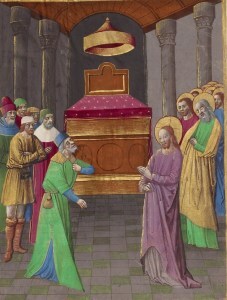 Jesus and the Pharisees in the Temple (Guillaume Lambert workshop; 1475; Getty Museum ) [image error]Jesus and the Pharisees in the Temple (Guillaume Lambert workshop; 1475; Getty Museum ) [image error]Jesus and the Pharisees in the Temple (Guillaume Lambert workshop; 1475; Getty Museum )
 The Pharisees were under a great deal of pressure as the people began to turn against them.
(The High Priest had been robbing the priests of their due “payment” for leading the Temple sacrifice. Some accounts even mention priests starving to death because they were not paid).
Note in John 12:10: “The chief priests plotted to put Lazarus to death also, because on account of him many of the Jews went away and believed in Jesus.”
John 12 describes how Jesus fulfilled Old Testament prophecies, and then comes to this fateful line in verses 42-43:
“Even among the rulers many believed in Him, but because of the Pharisees they did not confess Him, lest they should be put out of the synagogue; for they loved the praise of men more than the praise of God.”
They may not have defied the Pharisees as Jesus did, but even the “rulers” saw the truth. Jesus was the Messiah.
All this was borne out later. Many scribes/teachers who knew the law became Christians following Jesus’ resurrection.
Acts 6:7: “Then the word of God spread, and the number of the disciples multiplied greatly in Jerusalem, and a great many of the priests were obedient to the faith.”
Obviously, the Pharisees feared losing power more than they feared the Creator of the Universe.
What about love that last week?Jesus and the Pharisees didn’t have to have such a difficult relationship.
He loved them.
He recognized their determination to be true to the Law. But Jesus also saw their fear of losing power.
Power. Control. Position. Money.
That’s what motivated the Pharisees, not to mention the High Priest.
But Jesus’ motivation was love. He didn’t want any of them to perish.
Jesus’ ministry during Holy Week was about reaching for those lost Pharisees day by day.
It’s the very same ministry Jesus is conducting this Holy Week as well.
Jesus loved the Pharisees, he loves them still–and that includes those still hectoring him today.
A blessed Holy Week and triumphant Easter Sunday coming soon.
Thanks be to God.
Tweetables
What was going on between Jesus and the Pharisees during Holy Week? Click to Tweet
Jesus and the Pharisees: Was it about power and control? Or simply love? Click to Tweet
The post Jesus and the Pharisees: Another Look appeared first on Michelle Ule, Author.
March 19, 2024
The Value of Just Saying “No.”

“No.”
“Say it again,” he urged. “This time with feeling.”
I laughed. “No!”
“Better. Keep practicing, you’ll improve and soon it even may feel natural.”
I doubt it.
But I’m trying.
Why can’t I say “no?”Oh, who knows?
I want to be agreeable, helpful, and considered valuable.
Sometimes I’m so busy guessing at someone else’s feelings, that I can’t decline to do something.
That’s been true for too long.
But, I was so busy last year, I needed help.
After the umpteenth (well-meaning) phone call asking me to do something, I had to take steps to stop it.
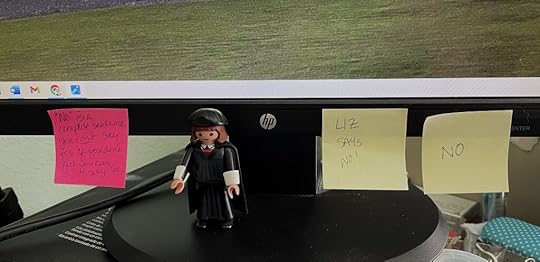
So, I wrote a post-it note and stuck it on my computer.
I don’t think that admonision went a week before I broke it.
How about if Liz says, “no?”
I was whining, er, describing my predicament to a wise friend on the telephone. (I think all my friends named Liz are wise).
She took me firmly in hand. “Michelle, you have a lot of things to do, important things to do. You cannot keep saying yes. You need to say no.”
“I know, I know, but . . . “
“No buts,” she interupted in her wonderful school marm voice. “I tell you. You have to say ‘no.'”
I nodded–even though she couldn’t see my response–and wrote another post-it note.
I put it next to the first one.
That helped.
A little.
And the friends who know Liz agreed. I needed to listen to Liz.
And yet . . .
Feeling trapped Photo by ennif pendahl (Unsplash) [image error]Photo by ennif pendahl (Unsplash) [image error]Photo by ennif pendahl (Unsplash)
 Again, this only may be me, but I feel my heart sinking as I mentally rearrange what I’d planned to do with that particular time.
Most of the time I manage a weak smile before going home to berate myself in private.
I’m hyper-aware of these feelings and often when I ask someone to do something for me, I hedge it.
I’ll say something like, “Would you like to _________________? No is a fine answer.”
No one makes that offer to me.
Perhaps it’s because they know my boundaries are weak?
Now, at least, I take a breath and say, “I’ll need to check my calendar.”
I then go home and shore up my defenses for my true answer–even if it’s “no.”
A philosophical explanation for “stop.”Someone, somewhere, had brilliant insight one day and I managed to scribble it on a post-it note.
Whoever you are, I thank you.
“‘No’ is a complete sentence. You can’t say ‘yes’ if you don’t feel you can say ‘no.'”
It’s that word feel that caught my eye.
Too often I don’t feel like I can say decline.
It doesn’t usually have anything to do with whether I want to say “no” or not.
It’s an emotional reaction to the person asking.
But if that person loves me, they want the best for me, right?
The people who love me–and whom I love back–are the ones who will accept me, no matter what I say.
Right?
And often–my husband looks at me–my family are the ones who suffer when I don’t say “no” often enough.
Recovering, but still not quite there, yet.I am doing better.
My life also has slowed down.
I’ve found places to explain how to say “no.”
In addition, I’ve added Martin Luther to my admonition bar. 
He was good at saying “no.”
How about you?
Tweetables
Why is saying “no” such a conundrum to some of us? Click to Tweet
The value of just saying no. Click to Tweet
The post The Value of Just Saying “No.” appeared first on Michelle Ule, Author.
March 12, 2024
UCLA Basketball, Coach Wooden, and My Family

UCLA Basketball was part of my life for many years; in particular with a focus on Coach John Wooden.
My father’s last year at UCLA was John Wooden’s first year as the head coach.
My first year at UCLA was John Wooden’s final year as head coach of the UCLA Basketball team.
We liked to think that our family bracketed him.
And for many years, members of our family seldom missed a game.
It all came back recently when I read Kareem Abdu-Jabbar’s book: Coach Wooden and Me: Our 50-Year Friendship On and Off the Court.
The memoir released in 2017.
UCLA Basketball and Coach WoodenMy father tried out for the UCLA basketball team when he matriculated at UCLA 75 years ago.
(What? My dad was a freshman 3/4 of a century ago????)
A scrappy six-footer who was always excellent at free-throws, he was a walk-on who didn’t make the team.

(No surprise).
But in the 1960s, my parents bought season tickets to the UCLA basketball games in the newly-built Pauley Pavillion.
I was just a kid and more interested in books and the piano than my sports-loving parents.
But you couldn’t live in our house and daily read the LA Times, without hearing the names “Wooden” and “Alcindor” frequently mentioned.
Again, not paying much attention, I actually thought the superb 7’2″ UCLA basketball center’s name was Al Cindor.
It was only when my dad took me to a game that I realized Lewis was his first name and Alcindor his last.
(And, of course, he’s now Kareem Abdul-Jabbar).
My parents and my brothers loved the two men, along with Bill Walton, Lynn Shackelford, and other names I can’t believe I remember all these years later!
It all came back to me while reading Coach Wooden and Me–which is a delightful book.
My Experience with UCLA BasketballThrough a series of the usual unusual events which often describe my life, I became a rabid UCLA basketball fan my freshman year of college.
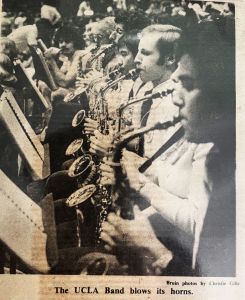 I’m probably sitting in front of my friends the sax players. (UCLA Daily Bruin photo)
I didn’t start that way. It’s because I was a member of the band.
The UCLA marching band–which was my social life during college–became the varsity band for the basketball season.
Well, since those were my only friends, if I wanted a social life to continue, all I had to do was sign up and play my clarinet.
Free tickets! Something to do on the weekend! I was in.
And UCLA won big that year–as in taking the national championship for Coach John Wooden’s final year.
Sitting on the stands near the floor and playing in the band is a really fun way to attend basketball games!
(Note: my trumpeter son also was a member of the UCLA marching and varsity bands.. “It’s the only time I was served a meal in the middle of a final,” he said about the band’s plane trip across the country years later, when he supported the basketball team during finals week!)
But what about Coach John Wooden?My first published article in the UCLA Daily Bruin was about Coach John Wooden.
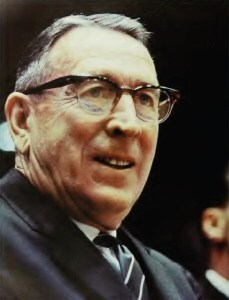 Coach Wooden (ASUCLA via Wikimedia Commons)
A devout Christian, he talked about the small silver cross he carried in his pocket at every UCLA basketball game.
Abdul-Jabbar commented in his book that Wooden carried that cross to match one his wife, Nell Wooden, wore around her neck.
They were a basketball couple for many, many years.
My Daily Bruin article quoted his love for God.
I liked that.
A more recent UCLA Basketball game.Meanwhile, life took us all over the world and I paid little attention to UCLA basketball–or any other type of basketball–until 2023 when my Adorable grandchildren made they way into basketball games.
In February 2024, I attended a Cal verses UCLA basketball game. I went with my “fellow” band alumnus son, his basketball playing teenager, and several other relatives.
(It’s only the second UCLA basketball game I’ve seen in person since I graduated from college in the Dark Ages.)
The last time I attended a basketball game in Cal’s Haas Pavillion, I was in the UCLA varsity band.
Things are different now.
No UCLA band on this out-of-town trip (always the highlight of the season for “the”my” band).
Few cheerleaders.
But worse, to me, the college players didn’t seem to be having fun.
I’ve never seen such lengthy time outs; they actually brought out chairs for the players to sit on.
College basketball in my day was always emotional and noisy, full of shouts and music.
Joyous.
The players last month looked like muscular working men, all wearing different fancy shoes.
While I appreciated seeing a UCLA basketball game again (and the 6’8″ teenager with us was very excited), the play felt unemotional and job-like.
Not as fun.
Time moves on, athletes change, and my fingers will never forget how to play the UCLA fight son, Sons of Westwood.
But fine books like Coach Wooden and Me, will always be able to bring back the excitement and the joy of youth–and my family’s long-ago fun watching and talking about UCLA basketball.
Thanks, Kareem.
Here’s the UCLA Magazine article that sent me to read the book: A Man to Be Thankful For.
Tweetables
Thoughts on UCLA basketball and four generations of fans. Click to Tweet
How UCLA basketball and Coach Wooden touched a family. Click to Tweet
The post UCLA Basketball, Coach Wooden, and My Family appeared first on Michelle Ule, Author.