Michelle Ule's Blog, page 18
August 30, 2022
Hours in Prayer and Lettie Cowman

How did Lettie Cowman spend hours in prayer at a time?
What did she find to pray about?
What can “regular” people learn from her example?
Lettie Cowman’s need to spend hours in prayerThe conviction she needed to spend long hours in prayer began with Lettie Cowman’s walk with God.
Whenever Lettie made a promise, she kept it as much as possible. Once she gave her word, she was good for it.
She poured herself into relationships–particularly with her God.
All she wanted to do was spend time with the people she loved–her husband, God, and the people God sent her to love.
Long before she helped found the Oriental Missionary Society with her husband Charles and others, she regularly knelt for hours talking with God.
Especially after she became the president of the Oriental Missionary Society, Lettie knew God’s wisdom and direction were all that could keep the ministry going
Prayer was how she loved, how she communed with her Creator, and how she learned what He wanted her to do.
How do you spend hours in prayer?Desperation sends you there, first.
Lettie knew nothing about God or the Bible when she gave her heart to God.
She wanted to know Him and, correctly, figured the best way to do that was to read what He said and talk to Him about it.
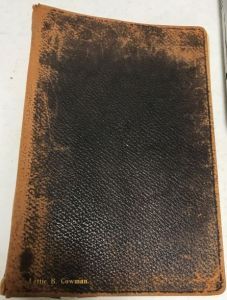
 One of her worn Bibles filled with markings shows how engaged
 Lettie was in understanding God. (OMS Archives)
Lettie trusted the God who loved her would answer her questions. She could could ask Him anything, and He would answer.
To confirm she “heard” Him correctly, Lettie knew she had to “match” the “words” with Scripture.
So, perhaps it is more accurate to say Lettie spent hours communing with God. She praised Him, asked Him things, confirmed what she heard with the Bible, and thanked Him.
Even if she had to swallow more than once to obey!
I spelled it out in this blog post: Devotions.
What did it feel like to spend so many hours in prayer?Lettie often felt God’s presence during the morning hours she spent with God.
She described her experiences this way:
One morning, I arose at four o’clock to pray and to do some searching. Just as I knelt, I felt an Unseen Presence so near me that I looked up to see who was there. I could not utter one word but just felt hushed in that glorious Presence.
A sweet rest filled my very being, and I knew the Holy Spirit had come to abide in me forever. The witness still is in my heart that ‘the blood of Jesus cleanseth me from all sin.’ His will is the sweetest thing on earth.
The Vision Lives, p. 49
Lettie agreed with Martin Luther, the busier the day, the more necessary it was she rise early to join God for hours in prayer and preparation.
When Lettie assumed the role as president of the Oriental Missionary Society (now called One Mission Society), the staff spent Wednesday mornings, nine to noon in prayer. (They still pray on Wednesdays).
The needs were many. The only way to know what was important, and to find unity among workers around the world, was to ask God.
Was it just talking to God?Worship and devotions, prayer and listening, often involve more than silence before a page.
As a trained soprano and pianist, Lettie Cowman loved music and hymns. She incorporated them into her worship of God in her listening hours in prayer.
 Lettie’s worn hymnal (OMS Archives)
Hymns fed her artistic interests. Lyrics provided a greater appreciation for what it meant to worship God in spirit and truth. The age-old and doctrinally sound hymns augmented Biblical concepts.
Immersing herself in worship also helped Lettie “work out” the challenges she later faced in the workplace.
When the complicated decisions she faced while heading the OMS became too many, Lettie prayed, of course, but then turned to a small piano in her office.
She’d thunder the music out of the keyboard and sing at the top of her voice.
As she explained to fellow missionary Florence Munroe, “I just have to do it, otherwise I’d never be able to keep on top of the load.”
The results from Lettie’s hours in prayer?Innumerable people around the globe are in heaven because of Lettie’s hours in prayer.
Encouraged by Rees Howells, another profound praying person, Lettie followed God’s directions in a highly unusual way.
As a result, millions of people had Scriptures in hand when Hitler’s troops marched through, and later when the Iron Curtain fell.
No one but God could have foreseen that.
If we want to see such results to our prayers, perhaps we should follow Lettie’s example.
To be able to hear God, respond to Him, worship Him, and love Him–requires time.
Maybe even hours early in the morning.
Tweetables
How did Lettie Cowman spend hours in prayer every day? And why? Click to Tweet
Secrets to hearing God’s directions and savoring His love. Click to Tweet
The post Hours in Prayer and Lettie Cowman appeared first on Michelle Ule, Author.


August 23, 2022
A Surprising Comfort Cat

What is a comfort cat?
How did my cat Tasha become one?
Why didn’t we find out until long after it happened?
It’s a mystery to us.
But, when we finally heard the story, we felt so proud.
Here’s what happened–in those long ago days of early COVID-19 lockdown.
Had anyone seen our cat?Tasha went out every morning, checked the yard, and then jumped the back fence to disappear into our neighbor’s overgrown vegetation on the other side.
She generally returned for “cat curfew” around 6, when we let her in and locked the door.
Tasha glared when we wouldn’t let her out for a night prowl, but so what?
We’re the ones who fed her, etc.
 One jump and she was over.
Her nightly agitation, however, made me suspect another family claimed her heart.
My husband laughed. “Why?”
“Because she doesn’t gulp down her food.”
He scratched her ears. She nestled beside him on the recliner and glared at me.
One day, I walked up the street behind ours. I came across her lounging in the front bushes of the house behind our back fence.
As I questioned her (Tasha licked her paw), the mother and son whom I’d not met before, came out of the house.
“Is that your cat?” they asked.
I explained.
Then they told me a poignant story of Tasha as a comfort cat.
What did a comfort cat do?Husband and father Chris, whom I’d met, recently died.
Tasha was his comfort cat throughout a long illness.
I glanced down. She washed her paw.
“She’d hop the fence every morning,” the wife explained.
 This is what she likes to do at our house when locked in.
“If I took Chris outside, she sat beside his wheelchair, and put her paw on his foot. It was so comforting.”
Our cat?
“Sometimes she let him pet her.”
The woman’s voice broke. “One day Chris had a stroke. She kneaded his leg, as if for comfort.”
At my feet that day, Tasha rolled over and yawned.
“We meant no disrespect. We sent her home at night. But . . . “
“I’m so happy she could help,” I broke in that humbling day. “Had I known, I would have sent her with treats.”
They laughed and told me more about Chris.
I went home thankful that while I didn’t know about the tragedy across my back fence, my cat did–and she helped.
A comfort dog, yes, but a cat?I’d heard about comfort dogs–they were very helpful for children during our Sonoma County fires.
But I’d never considered an aloof cat like ours might have a sensitivity towards others she never showed at home.
Indeed, she reaches out and swats at me all the time.
But history is replete with stories about animals with an uncanny sense of how to help.
 This, of course, is NOT helping.
It may be a lonely child who needs comfort. Nursing homes have found the presence of animals perk up their patients. Several widow friends adopted dogs to keep them company.
I got one myself when we lived alone in the woods and I wanted an animal who would alert me of danger at night.
A friend has a dog who senses her diabetes numbers–and has saved her life more than once.
And the purr of a contented cat on your lap can lower your blood pressure.
Tasha loves my husband–maybe she prefers males–but rarely sits on my life and purrs.
Still, during one season of a dying man’s life, she served as a surprising sensitive comfort cat.
We marvel when we think of it.
But we still think she needs to be in for curfew.
Right?
This post originally ran in a slightly different format in my October 2021 newsletter.
For other stories like this, or about other adventures, consider signing up for my newsletter. It’s easy, free, and designed to be reading in about a minute on the 15th of the month.
Tweetables
The poignant story of a comfort cat for a dying man. Click to Tweet
The surprising ministry of an aloof feline. Click to Tweet
The post A Surprising Comfort Cat appeared first on Michelle Ule, Author.
August 16, 2022
Clearing an Overgrown Garden and Life

I’ve been clearing an overgrown garden lately, which has forced me to consider the same about my life.
Interesting how dealing with nature can affect you, isn’t it?
Or age, possessions, and the possibility of wildfire.
Regardless, my musings began outside.
Where to start with an overgrown garden?A family member recently purchased an old house needing updating.
Our family went right to work: tearing down walls, patching, painting, and refurbishing floors.
With so many busy inside and my inability to manage tools a liability, I went outside to the garden.
(The preschoolers followed me and, another time, a family dog.)
Both the house and yard have “good bones,” and promised joy once order returned.
The previous owner, obviously a gardener, died after a lengthy illness.
Her trees, flowers, roses, fences, arbor were overgrown.
Wisteria snatched at the magnificent fig tree–and probably would take down the house given a chance.
I soon bought sharp new tools and went to work.
“The garden’s all yours,” laughed my relatives.
Culling the overgrowth Wisteria is brutal! You can practically watch it tear down the fence!
Two houses ago, I approached a similar overgrown garden. It reminded me of the scene in The Secret Garden when Mary Lennox pushed open the gate and walked into a riotous green jungle.
(That time I took a class on pruning to figure out how to deal with so many overgrown trees and bushes.)
I know what to do now–start by figuring out just what’s out here.
As I hacked away at wisteria (honestly, it’s as bad as what I’ve read about kudzu!), surprises turned up.
Miniature rose bushes, an abalone shell, a tiny pond.
A deadwood-infested plum bush displayed several plums. We found small peaches and apples and way too many blackberry bushes.
Each slice of the sharp loppers brought something new to light.
The redwood fence, agapanthus, and a blue ball for the dog.
It just required tools and determination to cut through the dense overgrown bushes to find treasures.
What is an overgrown life?Many of us have lives too overgrown with activities and possessions to stop and enjoy them.
 Alas, I still speak from TBR-pile experience.
 If we can’t appreciate–or even experience–our friendships, time, family, or possessions, what’s the point of having them?
Every room in my house is stuffed with books–but have I read them all? Do I continue to read them?
Several summers ago, I “culled” my books and gave away 400. (But I still have no problem keeping my Little Library in business!)
Digging through them unearthed treasures I forgot I owned (much less had read or, worse, not read!).
I needed to clear out the excess to appreciate the books I loved.
When wildfires roared through our town five and three years ago, we replayed the same lesson. Many friends and I asked ourselves–what have we outgrown? What do we really need?
My relative hasn’t had any trouble furnishing her house. Many friends happily donated furniture, rugs, appliances, and kitchenware they no longer need.
But it’s not just possessions in an overgrown lifePossessions may be one of the easier things to prune–because you can see them.
What about activities?
Years ago, I realized without my husband available to help drive, I physically could not get my sons to all their sports practices.
 Yeah, you get sweetness from the blackberries, but are they worth the pain?
Two boys, four weekly practices at the same time, fields at different ends of the rural county, mostly at dinner time.
Sports are great for team building exercises. Boys need to run around and make friends.
But we had younger children–who would spend hours in the car.
We wouldn’t have a set dinnertime. The children also needed to attend or enjoy band, scouts, youth group, or simple playing.
I couldn’t count on my husband–despite his best intentions– to help.
We had no neighbors.
I soon realized their activities had overgrown their mother’s organizational capabilities.
We had to weigh a hard choice: what was best for our family?
When my husband and I pushed aside all the time-filling choices, we found a soul-building treasure.
Dinner together as a family won.
How to find overlooked treasures?My relative waffled on wielding the sharp loppers through the overgrown garden. “What if I make a mistake and chop down one of the rose bushes?”

I waved at the yard. “If it’s healthy, it will grow back. Otherwise, since you don’t know what’s there now, you’ll never miss it.”
Agreed.
We’re all given 24-hours per day. You know this.
The number of years God determined for our lives is fixed–whether we remember that fact or not.
If we cannot use, see, or appreciate what’s already in our lives–whether activity, possession, or plant–why not remove it?
In clearing out an overgrown life–or garden–we may better appreciate what we have.
Or, even find a surprising treasure hidden where we couldn’t see it before.
Tweetables

What to do with an overgrown garden or an overgrown life. Click to Tweet
Culling the books, garden, life–to find what’s really important. Click to Tweet
The post Clearing an Overgrown Garden and Life appeared first on Michelle Ule, Author.
August 9, 2022
Why Not Walk Around the Block?

“Let’s take a walk around the block,” I called to the three-year-olds.
“Yes!” Boy and Girl cried. They already wore their shoes in anticipation.
For some reason, this is an exciting adventure when they visit.
It’s also perfect for after dinner when they need to move and their parents won’t return for a few hours.
So, I slipped into my sandals and we moseyed (me) and scrambled (them) out the front door.
What’s so interesting about a walk around the block?When you’re three years old, everything is novel and interesting. Every activity is an opportunity to learn or do something new.
I’m not sure how many times we’ve walked around my block, but they’re always ready to go, and it gives Grandpa a break.
The Mother’s Almanac inspired me to take children on walks many years ago with this little story about Halloween:
“It took our Nell to teach us that the dark is as magical to babies and first graders as it is to other romantics, for she was the one who said she hardly could wait to trick or treat on Halloween.
“Daddy takes me, ” she said, “and a walk in the dark with my daddy is the best sort of walk there is.”
The Mother’s Almanac p. 150
 Frankly, I wore out my copy.
We first took our older grandchildren on a walk in the dark–with flashlights!–several years ago.
They loved it!
I’m not ready to release the younger two into the dark with a flashlight, yet, but that time will come.
Meeting the neighborsOur first stop was across the street, which is not technically part of a walk around the block, but we needed the warm up.
I introduced them to/reminded them of “Mr. Pete.”
Girl mumbled out all the syllables of her beautiful name. Boy stuck to the basics–though he usually provides all three of his names.
Mr. Pete was thrilled, and I reminded them of the clever birdhouses he makes. The three-year-olds know about birdhouses.
When he waved us away to continue our stroll, he muttered, “I’ve got to speak to my daughters about grandchildren.”
Boy stopped to admire Mr. Dave’s boat and the amiable fisherman invited us in to pick up a piece of fresh salmon for dinner tonight (Look at the advantages of taking Adorables on a walk around the block!).
He also showed the toddlers pictures of our slab’s origin–an ocean salmon bigger than they are!
A walk around the block with nature Plumbago. Who knew?
One advantage to living in a tract housing neighborhood is all sorts of plants and vegetation flourish, or at least grow.
“Who sees a plumbago?” I called as we crossed the street.
Boy immediately pointed at the blue-flowered bush.
(That impressed me–I only learned the plant’s name a few years ago, myself).
This toddling duo–though they are running now–can identify all sorts of flowers as a result of our occasional rambles around one square block. (And across the streets to Mr. Dave and Mr. Pete).
Agapantus?
Nailed it. (Then I made them repeat the name. Some stuttering occurred).
Teaching them to observe Bonus! Agapanthus behind the naked ladies and their fence!
In addition to the exotic thrill of walking around the block, I use these times as an opportunity to teach them how to observe.
As we walked–or they ran ahead of me–I asked them to look around.
“Where’s the flag?”
Easy after so much practice.
Boy struck a superhero pose as fast as possible to point. His female cousin often beats him to it.
(Typical female, she shrugged the first time Boy “won.”)
They both sniggered when I asked about naked ladies, but then look perplexed.
(I figured Amaryllis Belladonna sounded too complicated, even if I could pronounce it properly!).

Per Mr. Pete’s suggestion, they kept their eyes open watching for dogs (1) and kitties (0).
Nestled behind the plumbago, they found a water bowl for visiting dogs (with me wondering if coyotes also used it), and a now empty bowl that earlier offered dog treats.
Boy loved the idea of leaving dog treats for visiting pups. “This is a nice house.”
Girl loved the decorated stones.
Exercise opportunities–for brain and bodyWhat is that white contraption on the corner with the blue top?
They had no idea.
 Why were they glued on top? I’ve no idea.
So, I got to explain a fire hydrant and how important it is–particularly in my neighborhood.
Both children and their families had experienced evacuation several years ago, and everyone in my community loves firefighters and first responders.
Even preschoolers understood too well.
“But why are these coins here?” asked Boy.
Girl tried to collect them–but they didn’t move.
That perplexed both children.
I couldn’t pick them up either. Who would glue coins to a fire hydrant? And why?
 Stepping stones. Watch out for pebbles!
The children walk closer to the ground and even though they’ve traveled around my block before, they always spy something new.
When I pointed to the stepping stones in the median, they wanted to know what a stepping stone was.
I demonstrated how you walked between them, one foot on each stone all the way across.
We spent more time there than I expected. Girl hopped between them, too–except she kept pausing to clear the excess pebbles off the stones.
They also walked on brick walls, usually holding my hand.
Closing the circleAs they sprinted up my street ten minutes later, they stopped to greet Mr. Pete again, this time on our side of the street talking to my new neighbor.
“Look, Grammy!” Boy called. “There’s your house!”
Girl stopped at my Little Library out front, wanting me to open the door.
No children’s books, alas, that day.
(My Little Library gets a lot of action. The neighbors enjoy seeing people stopping by.)
Boy, meanwhile, was thinking. “Did we walk in a circle?”
I laughed. “Yep. Twenty houses and we’re home again. Shall we go see Grandpa?”
“Yes!”
Girl almost beat him to the door.
Tweetables
The importance of a walk around the block with preschoolers. Click to Tweet
Bored toddlers? How about a walk around the block? Click to Tweet
The post Why Not Walk Around the Block? appeared first on Michelle Ule, Author.
August 2, 2022
Sarcasm and Cynicism in the Christian Life

Do you use sarcasm in your Christian life?
Do you see it around you?
Why do I ask?
I think it’s a major problem for several reasons.
Definitions: Sarcasm and CynicismSarcasm definition:
A cutting, often ironic remark intended to express contempt or ridicule.
A form of wit characterized by the use of such remarks.
Biting taunt or gibe, or the use of such a taunt; a bitter, cutting expression; a satirical remark or expression, uttered with scorn or contempt; in rhetoric, a form of irony; bitter irony.
American Heritage Dictionary, 5th edition
And, while I’m at it, cynicism:
An attitude of scornful or jaded negativity, especially a general distrust of the integrity or professed motives of others.
A scornfully or jadedly negative comment or act.
American Heritage Dictionary, 5th edition
Should the above definitions reflect the heart attitude of a person who purports to love God?
Fruits of the spirit anyone?The Bible is clear on what our heart attitudes should be:
 Photo by Xnatedawgx
(Wikimedia Commons)Love JoyPeacePatienceKindnessGoodnessLong-sufferingGentlenessMeeknessFaithModestySelf-controlPatience
As a friend recently commented, “sarcasm is not a fruit of the spirit.”
What can sarcasm lead to?Belittling of an individual.
Is that acceptable for people who should be studying this verse:
“Be kind to one another, tenderhearted, forgiving one another, as God in Christ forgave you.” (Ephesians 4:32 ESV)?
Years ago while attending a “welcome picnic” at our new church, I told an outrageously ridiculous story to our new pastor.
He smiled politely at my brilliant comment–which had a question mark full of sarcasm at the end asking for agreement.
After a moment he said, “I don’t know you well enough. Are you joking or being serious?”
 What’s wrong? Can’t take a joke?
 Photo by Charl Durand (Unsplash)
Mortified at that moment.
(I then explained the joke and he laughed.)
I have tried to be careful with my speech ever since.
The Open Bible lists 42 verses about speaking the truth to one another, loving one another, and watching what comes out of your mouth–particularly, “I am only joking.” (Proverbs 26:18-19)
It’s particularly a problem with children–who don’t have any world experience to inoculate them against personal humor at their expense.
I watched an eight-year-old deflate before my eyes as her brothers, father, and mother teased her about an, admittedly, obvious question.
It was the pile-on that disturbed me, and which finally led to her bursting into tears. “But what is the answer?”
Her confusion haunts me. I try to gently answer all questions asked by children, now, as a result.
Are sarcasm or cynicism ever warranted?Look, my favorite form of humor is irony.
I get it–how funny it is when someone says something and then does the opposite.
I laugh all the time.
But, while I appreciate humor sites like The Babylon Bee, I simply can’t read them.
I never felt good when I laughed at their irony, it felt too personal.
Afterwards, my laughter clawed at my soul–no matter how deserving the story.
Here’s the issue for me:
While I can laugh at a situation–assuming no one gets hurt–I can’t laugh at a person.
People, even ones we don’t like or disagree with, are made in the imago dei, the image of God.
 This would be irony.
 Photo by Stefan Cosma (Unsplash)
He loves them. He wants the best for all His children.
God doesn’t want people being made fun of if it shreds or could destroy their souls.
Look at those definitions again: “to express contempt or ridicule.” “Jaded negativity.”
(Contempt=despising, disrespect. Ridicule=mock, make fun of. Jaded=dull, cynical. Negativity=disagreeable, negative).
Did you see that in Jesus’ interactions?
Well, yes, a few times, particularly in Matthew 23.
As writer Jayson D. Bradley notes, however,
But this wasn’t really about individual Pharisees, this was a problem with the pharisaical system. And any sincerely religious Pharisee would have had to agree with Him.
Speaking in generalities is another polemic that’s frowned upon, but let’s be honest; it’s an extremely effective rhetorical device—especially for people trapped within a broken system.
Relevant Magazine; 4 Times Jesus Used Sarcasm to Make a Point
NOT geared at the individual. Jesus’ points were at a system.
Besides (contrary to popular belief–wait, is that sarcastic?), I cannot read people’s hearts like Jesus can.
What are the results in others’ lives if we use sarcasm against them?Look at your own life. How does it make you feel when you are the butt of someone’s joke?
Sometimes we make mistakes. Do we really want people to laugh at us with a mean, vindictive spirit?
I suspect the line between sarcasm, cynicism, and humor lies somewhere in each person’s heart.
The Holy Spirit knows.
I trust the Holy Spirit, more than myself, to know when to laugh, apologize, or turn away.
Lately, I’ve been turning away a lot more than in the past.
Everyone else will have to deal with their own heart before their Creator.
Thanks be to God.
Tweetables
Sarcasm, cynicism, and the Christian. Where’s the line? Click to Tweet
What’s at the heart of sarcasm for a Christian? Click to Tweet
The post Sarcasm and Cynicism in the Christian Life appeared first on Michelle Ule, Author.
July 26, 2022
Thanks for Everything, Cary Grant.

Cary Grant saved the day several times in my life.
That suave, well-dressed, and elegant man slid into my life and made all the difference.
While I grew up in Los Angeles and attended college there, I’m not talking about the man in person.
I’m talking about the same Cary Grant you know–the one on the silver screen.
Watching his films and laughing–or thinking–has been a pleasure.
I’m thankful for the entertainment–and lessons learned.
Thanking Cary Grant for exactly what?Many years ago, my husband was out to sea for, literally, months on end and the toddlers and I lived in a house in the woods without neighbors.
It snowed constantly one February week. Our heating system was primitive: a wood stove.
No one could get up our lengthy hilly driveaway.
It was just the children and me.
 Hunting the leopard with Katharine Hepburn in Bringing up Baby (Wikimedia Commons)
Did I mention one of those children turned two that week?
He meant it.
And I fell sick.
The existential dread of military wives is being the sole parent and alone without neighbors during a difficult time.
That was me.
While I could drag in enough firewood to feed the stove, the children were on their own hustling cereal, crackers, cheese, yogurt, and bananas.
I occasionally could warm up chicken noodle soup on the wood stove.
Then there was that suddenly determined two-year-old.
A recipe for disaster.
But, thanks be to God for the reprieve.
We couldn’t raise many television stations on our flimsy antenna, but that week the New York City independent station beamed a savior: Cary Grant.
 Confusing to the children (Wikimedia Commons)
Every day, the impeccably dressed, debonair, funny and charming leading man appeared at our house.
Even the boys liked him–especially with the leopard in Bringing Up Baby and the monkeys in Monkey Business. (The links are from the IMDb and include clips).
They weren’t exactly sure why, but they also giggled at Father Goose.
And look! Operation Petticoat featured a pink submarine!
(That confused the five-year-old who looked at me with anxious eyes. “Aren’t boats supposed to be black?”)
Fond memories of watching movies with my own fatherMy dad first introduced me to all the great movies, including those starring Cary Grant.
(He, however, preferred Charles Boyer in the well-dressed suave department).
Dad’s preference was World War II movies–because he wanted to reexperience his own youth, but also because he wanted his children to understand history.
Even cinematic history.
To that end, even my children can tell you Dad’s favorite movie was The Best Years of Our Lives.
But with that theme running, Dad introduced us to Destination Tokyo (another submarine film! One of the top five sub movies, by the way, in our family’s opinion).
Cary Grant played the cool, calm submarine CO when, inside Tokyo Bay, he nestled the boat on the bottom of the bay for an emergency appendectomy!
I doubt Dad ever sat through An Affair to Remember (but my mom did and cried). He didn’t like Alfred Hitchcock movies all that much, so probably missed all those.
But Gunga Din! You bet!
Dad preferred other movies stars, but when Cary Grant wandered into one of his favorite genres, Dad was all in.
Learning lessons as a young adultPeople pick up ideas about life from the media they enjoy.
 Why change a thing?
(Wikimedia Commons)
I always loved Cary Grant movies.
These are the warnings I took away from his movies:
Don’t change the plans when remodeling a house ( Mr. Blandings Builds His Dream House )Don’t trust a man just because he’s handsome and suave. (Notorious; Suspicion; His Girl Friday; North by Northwest; To Catch a Thief–-wait, are most of these Alfred Hitchcock movies?).Be careful when you choose one guy over another–are you sure you haven’t misunderstood? (The Philadelphia Story; Bringing Up Baby).But I also learned
Laughter in the face of absurdity is fine–no matter how well you’re dressed. (Too numerous to mention).Sometimes it’s hard to keep a straight face. (To Catch a Thief; Charade; Arsenic and Old Lace).Seemingly intelligent men make stupid decisions because of a beautiful face or figure–be more intelligent and avoid foolish men. (Houseboat; Operation Petticoat; My Favorite Wife).Watching Cary Grant movies with my husband–while sick!How often life turns in a circle–which happened last week.
My husband and I spent evenings, half-sick, watching movies streamed (much simpler now–and more choices) of a favorite actor.
We’ve enjoyed his films before–my husband likes them more than his sons did–and, as mentioned above, Destination Tokyo is one of our favorite submarine movies.
 I can see how this would have been a tough choice in The Philadelphia Story. (Wikimedia Commons)
We watched it again, along with Operation Petticoat–which makes me roll my eyes (at the ridiculous stupidity of the beautiful woman his character married) and him laugh. (“You were a far better Navy wife, but I’ve always wondered how the Tony Curtis character got into the Navy!”)
We’d not seen the classic Holiday before–which left us shaking our head at the ethical/moral decision. (We weren’t surprised it bombed at the box office–not the best message about “following your heart” away from a good job during the Depression).
With so many movies to choose from, we skipped all the Alfred Hitchcock films, as well as my two favorites: Bringing Up Baby and The Philadelphia Story.
Since we’re also helping a family member with a house refurbishment, we passed on Mr. Blandings Builds His Dreamhouse as well. (I recommend this movie and book to anyone thinking of a remodeling project, BTW).
All fun.
Which is your favorite Cary Grant movie? Haven’t we all got one?
Tweetables
Cary Grant: Comfort movies–for sickness and health! Click to Tweet
What lessons can we learn from Cary Grant films? Share your favorite. Click to Tweet
The post Thanks for Everything, Cary Grant. appeared first on Michelle Ule, Author.
July 19, 2022
5 Ws and an H: Their Importance in Real Life

“The 5 Ws and an H” is shorthand for a reporting convenience helpful for all of us.
The 5 Ws are who, what, when, where, and why.
H stands for how.
In the Dark Ages when I trained as a newspaper reporter, I used them all the time to make sure I covered my stories completely.
They work equally well in any writing.
Before I finish, I review my work to make sure I’ve answered all six questions.
How do “5 Ws and an H” work?Ideally, when a reporter (or even a “mere” writer) composes a story, the object is to get all the facts.
How do you know for sure if you answered all the questions your reader might have?
By examining your notes to make sure you, the interviewer, asked all the questions.
 Did everything get answered?
 Photo by Adolfo Félix on Unsplash
Obviously, a good reporter would have other questions (I usually write in advance).
But the answers to some questions are so interesting, and invite so many more questions, that a writer can get lost in the rabbit trail.
That’s usually not a bad thing, unless you miss a basic fact like, “what time did this happen or when will it take place?”
Or maybe, “who did this?”
I’m always surprised at what I forget to ask.
5Ws and an H in real life.I use them in real life even more than I do in my writing life.
They’ve been especially important in stressful situations.
If I’ve visited the doctor with my list of “complaints,” I ask the 5 Ws and an H questions.
Sometimes, though, the doctor provides directions or information that surprises me.
Maybe some sort of a blood test?
Especially if I wasn’t expecting the situation, I need to ask questions and write down what the doctor says.
[image error]You might as well be friendly asking questions.(Photo by Christina@wocintechchat.com Unsplash)Example:
Who: who is this for? An obvious answer–me.
But wait, maybe I need to know who needs the results.
Why do I need this test?
What do I do when I get the results? (See how you can follow a rabbit trail asking questions?)
When should I expect answers?
Where do I get the test? Or, perhaps where do the test results go?
How? Are the tests reported (liters, ounces, numbers, etc.)
Unexpected situations in which the questions can helpIt’s not just medical. It’s any time there’s a lot riding on knowing answers.
More examples:
Taking out a loan.Responding to a marriage proposal.Dealing with travel complications.Finding out what your teenager is up to.Divvying up work or volunteer responsibilities.Signing a contract.What does Rudyard Kipling have to do with it? Rudyard Kipling by Phillip Burne-Jones (Wikimedia Commons)
In some odd corners of the world, the concept is called, The Kipling Method, in honor of the opening lines to his poem, I Keep Six Honest Serving Men.
I keep six honest serving-men
They taught me all I know;
Their names are What and Why and When
And How and Where and Who.
I Keep Six Honest Serving Men,
Kipling, of course, was not only a poet and a writer, but also a newspaper reporter.
(Here’s a great explanation of how to use the Six Honest Serving Men in writing).
Working the questions into general conversationWith enough practice, you can learn how to work these questions into a conversation without the person you’re talking with realizing it.
(My husband, after all these years, recognizes my technique too well.)
Many people like to talk about themselves. Many of us find ourselves in social situations where conversation is in order.
I often just interview people, not because I’m writing about them, but because it helps pass the time.
I’m also genuinely curious about people.
And merely asking comprehensive questions can make parties . . . far more entertaining.
Why not try it yourself? Who knows what you’ll learn?
Sometimes I get so engrossed in what we’re talking about, I don’t know when to leave . . . much less how to extricate myself from where am.
Those 5 Ws and an H can–and do–turn up everywhere.
Tweetables
How to use the 5Ws and an H in real life. Click to Tweet
5Ws and an H — the Kipling Method? Click to Tweet
The post 5 Ws and an H: Their Importance in Real Life appeared first on Michelle Ule, Author.
July 12, 2022
Streams in the Desert and How to Open Doors

How does a daily devotional open doors for ministry?
By God at work, of course, but also by “going before” the author and establishing a Holy Spirit connection.
At least, that seems to be what happened with Streams in the Desert for many years.
The story is extraordinary and demonstrates how often God uses the simple to confound the wise.
Or, perhaps better, the Holy Spirit flows where it may and hearts are opened.
In this case, doors of opportunity.
Open doors for Lettie CowmanA woman doesn’t start out to compile a devotional that will change people’s lives, and yet that happened to both Lettie Cowman and her friend Biddy Chambers.
Both women dealt with their husband’s mortal illnesses and death by penning devotionals.
In Biddy Chambers’ case, she launched My Utmost for His Highest into the world and let it go.
Lettie Cowman did the same with Streams in the Desert in 1924–except it kept tugging her along after it.
Lettie Cowman reentered the world of ministry when she became president of the Oriental Mission Society (OMS) in 1928.
In the first 17 years of OMS, she and Charles had traveled around the world raising funds.
Charles generally handled the business end while Lettie painted the pictures with her words and music.
Their stories moved people, but the communities they visited tended to be camp meetings, organizations, and churches familiar with the ministry.
While that remained true after Lettie assumed the presidency, something else began to happen wherever she went.
Carrying Streams in the Desert all over the world.Lettie carried copies of her devotional to give away when she traveled, but when she arrived in Europe in 1936 to speak at Rees Howell’s Bible College of Wales, the book was already there.
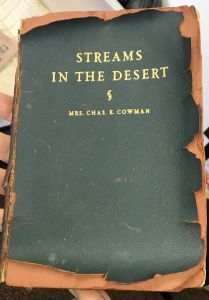 And original copy (OMS Archives)
Folks recognized the title, particularly when learning Lettie wrote it.
Open doors for ministry appeared because readers felt they knew Lettie–and thus could trust her.
After traveling through the Baltic countries beginning her Every Creature evangelism tours, Lettie continued throughout Europe.
That’s when she discovered how wide the devotional had traveled.
Seemingly everywhere she went in 1936 and 1937, at the mention of Streams in the Desert, conversations vividly came to life.
Rudolph Alfred Bosshardt, a missionary to China with the China Inland Mission, lay in a hospital bed in Switzerland that winter. Chinese bandits captured him and a colleague the year before and marched them 6000 miles over 18 months.
The two men begged to keep their Bibles, but the bandits refused.
They did, however, allow the two men to keep “an old English book as if it was something harmless,” Bosshardt wrote.
The two men kept their copy of Streams in the Desert until it fell apart. It helped feed their spiritual lives.
When Lettie visited him that winter, the two cried together in joy.
Open doors with unusual groupsAmong the open doors Lettie encountered during those years were conversations with Indian missionaries from the subcontinent, whom she met in Jerusalem.
Throughout the Middle East, she met people who loved the devotional.
Prince Farouk of Egypt asked to meet her–and she presented a copy of Streams in the Desert.
When he learned Prince Farouk met Lettie, Ethiopian Emperor Haille Selassie requested a meeting.
One of the Ethiopian princesses volunteered to translated Streams in the Desert into the Amharic language.


A group of Russian women in a prayer group in Paris read the devotional and prayed for Lettie.
Everyone was astounded when she walked into their next prayer meeting–they didn’t know she was in Europe and she’d just learned about them that day.
A year later, Lettie met Cuban readers of the devotional.
When they heard of her plans to blanket Cuban with gospel tracts, they signed up to help.
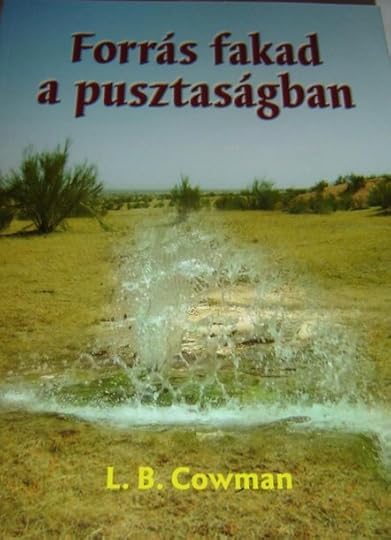
Before Lettie returned to the United States, she authorized various people to translate Streams in the Desert into Swedish, Spanish, French, and German.
Later a woman translated it into Greek. Others followed in Armenian and Romanian.
Many engaged in evangelism efforts as well–the result of the devotional and meeting Lettie.
Who am I? Holding a copy (OMS Archives)
Lettie wrote Streams in the Desert during the agony of her beloved husband’s fatal illness.
(Some believe the devotional’s power came from Lettie’s emotions poured on the pages).
Nearly beside herself with grief during those years, she actually asked God to take her life if Charles died.
But, after discovering the doors opened by the words God gave her, Lettie shook her head in awe.
As Dr. Ben Pearson wrote in The Vision Lives:
“Who is she that God should have given her Streams? Oh, those Calvary hours [at Charles’s bedside]! But what a harvest now!”
The Vision Lives p. 175
The travels in Europe in the 1930s helped Lettie Cowman came to terms with her husband’s death.
Even she recognized the beauty coming from the ashes of her loss.
The royalties from the book undergirded missionary efforts around the world for many years.
As Lettie always insisted she was a missionary not a writer, that was fine with her.
Later effectsStreams in the Desert‘s influenced lasted a long time–even to today.
Lettie used the devotional herself for personal comfort toward the end of her own life.
It was even “translated” into Braille.
Today, when I mention the book Lettie Cowman wrote, I usually get enthusiastic responses.
“I love it,” readers often tell me. “It’s my favorite devotional alongside My Utmost for His Highest!“
It makes me laugh every time.
Tweetables
Can one book open doors to ministry around the world? Click to Tweet
How Streams in the Desert affected people around the world. Click to Tweet
The post Streams in the Desert and How to Open Doors appeared first on Michelle Ule, Author.
July 5, 2022
Jonah and the Ninevites (Post-Whale)

Jonah finally met the Ninevites after a long and lengthy journey.
He’d set off from Samaria, the capital of the Northern Kingdom, headed to Tarshish.
Along the way, 2500 miles from Nineveh, he spent time thinking inside the belly of a whale.
He didn’t like it. (Who would?)
That’s the part of the story most people know.
Somehow, we forget what happened after the whale spat Jonah onto a Mediterranean beach.
Jonah inside the whaleGod loved the Ninevites so much, He used extreme measures to catch their attention.
He loved Jonah just as much.
We can debate whether or not this really happened. Just because a man surviving inside a whale for three days seems fantastic to our modern sensibilities doesn’t mean it didn’t happen.
You choose.
What’s of more interest, and what was more important to God, is what happened to Jonah’s soul during the three days.
 Not the best way to reach a Mediterranean beach
(Wikimedia Commons)
The prophet had a lot to think about. Sometimes God moves us into extreme situations to capture our attention.
Focused on survival, Jonah knew only one place to turn.
He also knew he had offended his Creator.
Pastor David Guzik, in his commentary on Jonah 2, noted the prophet knew the Bible.
Jonah pulled up three pertinent verses:
In my distress, I called upon the LORD, and cried out to my God; He heard my voice from His temple. (Psalm 18:6)Deep calls unto deep at the noise of Your waterfalls; all Your waves and billows have gone over me. (Psalm 42:7)For I said in my haste, “I am cut off from before Your eyes”; nevertheless You heard the voice of my supplications when I cried out to You. (Psalm 31:22)God heard his prayer and the whale/fish vomited him out!
“Now,” God said, “Arise, go to Nineveh, that great city, and preach to it the message that I tell you.”
Did Jonah ever get to Nineveh?Yes. And it appears he had to walk.
His mood doesn’t seem to have improved, but he followed directions.
The city was so huge, that Jonah needed three days to walk across it.
As he went he called out, “Yet, forty days, and Nineveh shall be overthrown.”
 Gustave Dore; Jonah preaches to the Ninevites. (Wikimedia Commons)
(Guzik noted the word “overthrown” is the same one used to describe the destruction of Sodom and Gomorrah.)
If they didn’t repent, God would destroy the city.
So they called a fast and repented.
Even the king of Nineveh “rose from his throne, laid aside his robe, covered himself with sackcloth, and sat in ashes.”
An incredulous Jonah watched as “God relented from the disaster that He said He would bring upon them, and He did not do it.” (Jonah 3:10).
(Eventually, God did judge Nineveh, but not for 150 years).
Jonah didn’t take it well.
And he prayed to the Lord and said, “O Lord, is not this what I said when I was yet in my country? That is why I made haste to flee to Tarshish; for I knew that you are a gracious God and merciful, slow to anger and abounding in steadfast love, and relenting from disaster. 3 Therefore now, O Lord, please take my life from me, for it is better for me to die than to live.”
Jonah 4:2-4 (ESV)
What do you make of that?
God proved the point of the prophecy.
Was the prophet happy the hard word came to pass?
A true prophet has compassion for the people to whom he prophecies.
Jonah needed God to teach him one more lesson.
 Nabi Yunis Mosque, Mosul, Iraq pre-2014
(Wikimedia Commons)Jonah ultimately finds compassion for the Ninevites
The book ends with Jonah wallowing under a plant that God used to humble him.
First, the plant grew up in one day to shield Jonah from the baking sun.
The next day, God caused it to shrivel up and die.
When Jonah complained, God pointed out his hypocrisy:
“You pity the plant, for which you did not labor, nor did you make it grow, which came into being in a night and perished in a night. And should not I pity Nineveh, that great city, in which there are more than 120,000 persons who do not know their right hand from their left, and also much cattle?”
Jonah 4:10-11 (ESV)
God was compassionate. Jonah needed an object lesson in why he, too, should love the people of Nineveh.
After all, he’d just led one of the world’s greatest evangelism events–despite his foot-dragging.
But is that the end of the story?
While the book of Jonah ends with God chastening the prophet for not having pity on Nineveh, “that great city,” there are indications Jonah’s story did not end there.
After such an emotion-filled series of events, Jonah may have remained ministering in Nineveh for the rest of his life.
At least, more recent events suggest Ninevites appreciated him.
The city called Nineveh 2700 years ago is now known as Mosul in Iraq.
In 2014, the Islamic State of Iraq and the Levant (ISIL) fighters blew up Nabi Yunis mosque, also known as “the revered tomb of the Prophet Jonah.”
Tweetables
What finally happened to Jonah after the whale incident? Click to Tweet
Did Jonah learn to love the Ninevites? An explosion suggests yes. Click to Tweet
The post Jonah and the Ninevites (Post-Whale) appeared first on Michelle Ule, Author.
June 28, 2022
Jonah: Was it ONLY about the whale?

Everyone knows about the whale and Jonah.
But the story has a lot more layers than we hear in the children’s version.
More than a man fleeing his God, Jonah was a confused prophet in a rebellious court who hated enemies more than he loved God’s voice.
It’s always important to remember God loves obedience more than sacrifice.
Even if the sacrifice involved being swallowed whole by a “big fish.”
Who was Jonah before he met a whale?Jonah grew up in the “inconsiderable village” of Gittah-hepher in northern Israel in the mid-eight century BC. Gittah-hepher wasn’t far from Nazareth.
It’s not clear when his prophetic ministry began, but Jonah prophesied to the Samarian court during the reign of King Jeroboam.
(Jereboam took the throne after usurping King Solomon‘s son Rehoboam. He led the Northern Kingdom into apostasy).
He [King Jeroboam] restored the border of Israel from Lebo-hamath as far as the Sea of the Arabah, according to the word of the Lord, the God of Israel, which he spoke by his servant Jonah the son of Amittai, the prophet, who was from Gath-hepher.
2 Kings 14:25 (ESV)
Samaria, the capital of Israel after the civil war divided the nation in two, sat on a hilltop, 35 miles north of Jerusalem (the Southern Kingdom’s capital in Judah).
Ancient Israel scholar Philip R. Davies, described Samaria as probably ruled by
an urban elite, in which case it possessed a royal and a state cult, big urban temples, scribes, mercenaries, and a developed administration . . . probably little different in character from the other recently founded kingdoms of Ammon, or Moab, or Aram.
The History of Ancient Israel “Ancient Israel(s) in the Iron Age,” p. 72-73
Somehow, Jonah developed a name for himself as a prophet and King Jeroboam needed him at court.
Only a generation removed from King Solomon–who God declared the wisest man–Jeroboam may have kept a court prophet “just in case.”
Given his simple background, Jonah probably loved his job.
How did he end up inside a whale? Artist’s impression of the palaces from Austen Layard’s The Monuments of Nineveh. (Wikimedia Commons)
Jonah got a word from God he didn’t like: “Arise, go to Ninevah, that great city, and cry out against it; for their evil has come up before Me.” (Jonah 1:1-2)
Why would he want to leave the court–where he had honor and people listened to him–to become an evangelist to the hated Assyrian Ninevites?
Besides, Ninevah, one of the largest cities in the world at the time, was more than 1700 miles away.
Why did God think Jonah could make any difference to their decadent, wicked Gentile ways, much less convince them to change?
Jonah surely knew he didn’t want the Ninevites to escape God’s judgment. Wouldn’t it be easier on Israel if God wiped out the infidels?
But if Jonah truly was a prophet, he must have recognized God’s voice speaking to him.
Perhaps he thought that if he ignored God, pretended he didn’t hear Him, God would forget?
(What does that tell us about Jonah’s view of God?)
But God’s voice may have become more urgent, “GO!”
So Jonah left–for Tarshish. Surely, sailing across the Mediterranean would be a nicer trip than trudging through the desert?
It was 2500 miles away from Ninevah in the opposite direction.
Now what?This is the part of the story everyone knows.
Or do you?
Why did God want Jonah to preach about repentance to the Ninevites?
He saw their wicked ways. He wanted the Assyrians to bow their knees to Him.
 By Catedrales e Iglesias (Wikimedia Commons)
That’s true for all of us. God is waiting for all to turn to Him. He has no pleasure in destroying His creation.
The residents of Ninevah were just as important to God as those in Samaria.
They all were rebellious. But the Ninevites may not have realized judgment was coming if they did not change.
Jonah feared being made a fool if he preached and they didn’t change.
So, figuring his role was invaluable, he chose to defy God and do something different.
Maybe God shook His head and sighed.
How could He get Jonah’s attention and send him where God needed Jonah to prophesy?
God sent a storm.
He loves us all so much–Jonah, Ninevites, me–that God went to profound lengths to make sure we’d be with Him in heaven.
Why didn’t the prophet understand?Even the superstitious heathen sailors on the Tarshish-bound ship knew the violent storm came from an unhappy God.
Trying to avoid his mission, Jonah went below–despite knowing the ship was in danger–and fell asleep.
Charles Spurgeon made an interesting observation about Jonah’s nap:
Jonah was asleep amid all that confusion and noise. O Christian man, for you to be indifferent to all that is going on in such a world as this, for you to be negligent of God’s work in such a time as this is just as strange.
The devil alone is making noise enough to wake all the Jonahs if they only want to awake… All around us there is tumult and storm, yet some professing Christians are able, like Jonah, to go to sleep in the sides of the ship.
Quoted by David Guzik at Enduring Word Commentary, Jonah 1
Jonah’s determination NOT to do what God asked is what led him into the whale.
The nap, however, aroused the sailor’s curiosity.
 Even Michelangelo painted Jonah!
(Sistine Chapel; Wikimedia Commons)
They expected someone on board caused “the gods” to rise up against the ship.
When they cast lots, it fell to Jonah. So, they asked a simple question. “Why has this trouble befell us? What is your occupation?”
Despite his rebellion, as a prophet of God, Jonah couldn’t lie. He explained he was a prophet, a Hebrew who feared God.
Honoring the prophet, the men asked Jonah what they could to do calm the sea.
“I know this great tempest is because of me,” Jonah said, advising them to toss him into the sea.
So they did.
Jonah undoubtedly expected to die.
A whale swallowed him.
But God needed him to live.
What’s the story of Jonah really about?The first two chapters deal with Jonah’s rebellion against God.
He refused to obey a clear word he, the prophet, received from God.
It came out of his personal hatred for the Ninevites and his comfort in Samaria.
It’s an interesting question–how far will we go to avoid God’s direction, given personally, to us?
Is the story really about a whale?
Or, is mercy involved?
Part 2 will delve further into a surprising turn of events few people know.
Tweetables
The story of Jonah–is it really about the whale? Click to Tweet
What do rebellion, hate, and comfort have to do with Jonah and a whale? Click to Tweet
The post Jonah: Was it ONLY about the whale? appeared first on Michelle Ule, Author.