Michelle Ule's Blog, page 20
April 12, 2022
The Crucifixion in all Jesus’Glory
The Crucifixion of the King of Glory is the perfect read for Holy Week.

Written by Eugenia Scarvelis Constantinou Ph.D., this amazing book provides surprising insight into Jesus’ ministry and the reason for his crucifixion based on Orthodox traditions.
I’ve been teaching Bible study for 40 years. I’ve written frequently on the Holy Week and Jesus’ crucifixion. Reading this book opened my eyes to historic truths I never knew or saw before.
This book revolutionized how I see Holy Week.
My copy is tabbed with colorful post-it notes.
I don’t know even where to begin to describe this book!
What is the Crucifixion of the King of Glory about?Here’s the official description:
The Crucifixion and Resurrection of Christ are central events in our salvation. Yet few Christians have a good grasp of the first-century historical and religious context in which the Crucifixion took place, nor of its true significance for the people of that time-and hence for our time as well.
Biblical scholar and attorney Dr. Jeannie Constantinou [sic] puts modern readers in the center of the events of Christ’s Passion, bringing the best of modern scholarship to bear while keeping her interpretation faithful in every particular to the Orthodox Tradition.
Constantinou page on Amazon
I bought the book after listening to Constantinou’s interview with Eric Metaxas. He raved. I’m raving. The scholarship is spectacular and what Dr. Jeannie reveals thrills.
Reading the Gospels through historic and traditional lenses Dr. Constantinou
Using her expertise as a lawyer, Biblical scholar, long affiliation with the Greek Orthodox church, and innumerable advanced degrees, Dr. Jeannie shares things folks without her background wouldn’t know.
I appreciate how she reminds us the New Testament writers are reliable.
In summary, eyewitnesses like the apostles were primary sources. They described what they saw and personally experienced.
Writing in the first century, they could only recount their own responses–individually, not as a group or a church.
Early Believers only knew what they knew from the apostles. It wasn’t an organized faith, it was people telling their stories.
Any interpretation of what Jesus did was what Jesus explained to them.
Hundreds of people saw Jesus, both before and after his death.
The apostles and other early Christians traveled all over the world telling their stories and discussing Jesus’ life.
No one had written the Gospels yet, it was all word of mouth.
While the Bible, obviously, is the best and most reliable source, plenty of other early writers wrote about the events in the Bible. They would understand what happened–what was true and what was not–than anyone writing 2000 years later.
Reading the Crucifixion story with fresh eyesI appreciate how Constantinou began by explaining how we in the 21st century view events 2000 years ago differently than those who lived them. Too often our modern linear thinking (based on western Enlightenment influences, not the Eastern thinking of the Hebrew Bible writers), makes us question things we cannot hold in our hands or reason out.
Too many of us base our Biblical knowledge on Sunday school lessons from long ago or movies like The Ten Commandments. (Surprise, Charlton Heston was younger than Moses when he made the movie!)
Details of the crucifixion, in particular, that may be missed:
Did you know the sky went dark when Jesus died, and stayed black for three hours? How many of us missed the earthquake recounted as His death? I, personally, am intrigued by the Temple’s curtain tear in two from top to bottom. Those were significant events prophesied to occur.The Jewish High Priest decreed Jesus’ crucifixion with the statement: “It is better for you that one man dies for the people than that the whole nation perish.”How many of us recall Jesus raised Lazarus from the dead the day before Palm Sunday? Was it significant?
Oh, yes. (Page 35)
Jesus raising Lazarus from the dead was the reason for Palm Sunday’s excitement!
Surprises for this long-time Bible teacher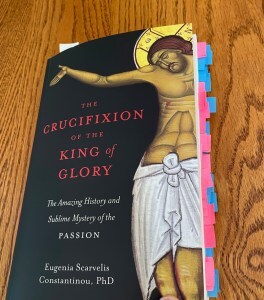 Where even to begin? SO much to share!Palm Sunday is the only day Jesus was publicly acknowledged as the Messiah.One of the (many) reasons the Pharisees dismissed Jesus as a rabbi is because he never attended a rabbinical school or studied under a well-known rabbi. Instead, he lived in an obscure village building things.Jerusalem’s temple was the largest temple complex in the entire world.Parallels between Abraham and the potential sacrifice of Isaac on Mount Moriah with Jesus’ crucifixion.The corruption of the Temple Sanhedrin–in particular in their treatment of non-High priests.Why Jesus’ seamless robe was valuable.How the Romans controlled the Sanhedrin.The curious deal with the High Priest’s robes.Was the earthquake part of the reason the Temple veil tore?Special treatment for Jewish crucifixion victims.Reactions to the crucifixion after reading this book
Constantinou’s footnoted book gave me plenty to reflect upon during Holy Week 2022.
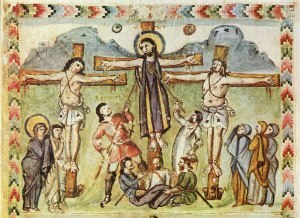 An early crucifixion painting by Meister des Rabula-Evangeliums 586 AD
 (Wikimedia Commons)
I thought about the crucifixion while I sang an Easter cantata on Palm Sunday.
Suddenly, words I’d sung many times took on a more poignant feeling than they had in the past.
When we sang about Jesus hanging from a cross, tears welled up. The whole story of Holy Week we sang looked differently and someone in the audience told me my face reflected my emotions.
Truly, Jesus is the Son of God.
A Greek Orthodox Presbytera (wife of a priest), Constantinou remarked on the crucifixion:
The cross perfectly, profoundly, and wordlessly communicates the limitless, irrational, underserved, and inexplicable love of God.
The Crucifixion of the King of Glory, p.331
Thank be to that same God.
A blessed Holy Week and Easter.
Tweetables
A tremendous, detailed examination of Jesus’ last week by a Greek Orthodox Presbytera. Click to Tweet
Surprising insights into Jesus’ Holy Week experience–even to a longtime Bible study teacher. Click to Tweet
The post The Crucifixion in all Jesus’Glory appeared first on Michelle Ule, Author.


April 5, 2022
Stations of the Cross and Protestants
What are the stations of the cross?
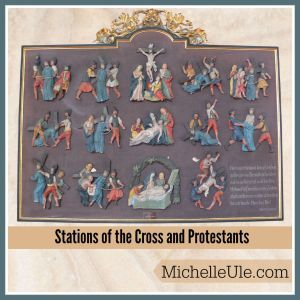
Many will say they’re a Catholic tradition during Lent.
Christians walk along a fixed path commemorating Jesus carrying the cross along the Via Dolorosa to Gethsemene.
The stations commemorate specific moments in the story. “Pilgrims” travel from station to station to pray specific prayers.
Generally associated with the Catholic church–every Catholic church I’ve visited displays them–the stations of the cross also can inform a Protestant’s reflection during Holy Week.
Should Protestants pay attention or even consider praying the stations of the cross themselves?
As always, it depends.
Where do the Stations of the Cross come from?All the traditional stops are based on scenes described in the New Testament or imagined as likely to have happened when Jesus hauled his cross up the hill to his crucifixion.
The number of stops can vary depending on which Bible passages you use.
Too often Protestants have shrugged off the Stations of the Cross because not all the traditional stations were based on Scripture.
No one can fault that argument.
That included the late Catholic Pope John Paul II.
In 1991, he requested another version called the Spiritual Way of the Cross using the Bible as the only source.
Here’s a list of the fourteen stations with linked Bible passages:
 The crown of thornsJesus prays in the Garden of Gethsemane.Jesus is betrayed by Judas and arrested.The Sanhedrin condemn Jesus.Peter denies Jesus.Pontius Pilate condemns Jesus to death.The Romans scrouge and crown Jesus with thorns.Jesus carries the cross.Simon of Cyrene helps carry the cross.Jerusalem women lament Jesus’ condemnationJesus is crucified.The thief on the cross asks and receives paradise that night.Jesus assigns his mother’s care to John.Death.Joseph of Arimathea places Jesus in his tomb.How do these stations help Believers remember Jesus?
By spending time walking from station to station describing a specific event of Good Friday, folks can recall what Jesus endured to save the world.
It doesn’t hurt to take time to remember what Jesus did on our behalf.
When Christianity becomes merely a cerebral exercise or another “club,” we can forget what the Son of God endured.
Too much of the world sees Christianity as just a simple story on a page.
 Jesus accepts the cross
But Good Friday was a hard day.
Jesus was fully man.
He knew pain, thirst, love, joy, hunger, agony–just like everyone else.
Worse, Jesus was God. He chose to live on earth and suffer.
To avoid thinking about His fully human suffering devalues His sacrifice.
We don’t have to wallow in it, but it doesn’t hurt to stop Selah and contemplate what He did.
Holy Week is the perfect time to do that.
A physical Stations of the CrossI’ve never walked the Stations of the Cross, albeit I’ve seen them countless times.
While in Tucson, Arizona recently, we encountered a version in the desert not far from our Lady of the Desert Church.
We walked among the stations, pausing to examine the sculpture at the base of each cross marking a station, and to read the explanation.
Here are photos of some of the stations.
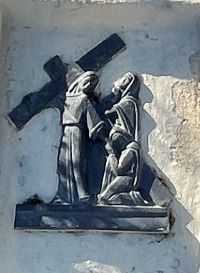 Jesus speaks to the women of Jerusalem
 Jesus is stripped of his clothes
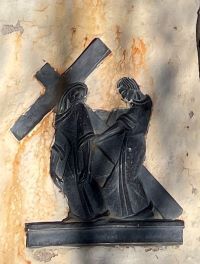 Simon of Cyrene helps carry the crossContemplating Holy Week
Some Protestant churches incorporate Stations of the Cross in their Holy Week activities.
My Lutheran church does not, but in 2021, we put together a Holy Week Walk to share with our community.
We shared six significant scenes featuring family groups of actors.
My family group involved Peter (my husband) cutting off the servant’s ear (my ear) to protect Jesus (our son), while a group of guards came to take Jesus away (another family group).
During the rehearsal, we walked through each scene together, watching what would be acted while we performed at our station.
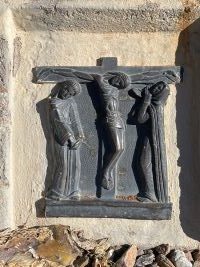 Jesus dies on the cross
The Roman guard talked about events of the day when Jesus died.
A woman gasped when he mentioned the earthquake. “There was an earthquake and the sky went dark?”
I listened with awe, marveling at what he recounted of Jesus’ last moments.
At the end of the scene, the Roman guard turned to me.
“How’d I do?”
Startled, I shook my head. “What?”
“You’re the author. Did I play the part right?”
Caught up in the moment, I’d forgotten I wrote the script.
“Perfect. Use your instincts.” What else could I say?
 Jesus laid in the tomb
But the final scene is the one that caused even me, the playwright, to gasp every time.
I watched that scene four different times, and tears filled my eyes each time.
When the angels rolled back the stone before the tomb, Jesus stepped out.
He is risen.
Hallelujah.
Death has no sting.
A blessed Holy Week, whatever year you read this.
 He’s alive!
Tweetables
Stations of the Cross and Protestants? Click to Tweet
Ways to contemplate Holy Week. Click to Tweet
The post Stations of the Cross and Protestants appeared first on Michelle Ule, Author.
March 29, 2022
End of the GVC–Great Village Campaign

How did the Oriental Missionary Society end the GVC–the Great Village Campaign?
You can read Part I here.
Begun in 1913 and planned to take five years, it almost made the deadline.
But undertaking such a vast task during the same five years of a World War, was a challenge.
Money and manpower always presented problems.
The need for both often sent the Cowmans and the GVC missionaries to prayer.
Isn’t that always what happens?
But not to despair. The Cowmans knew Oswald Chambers and certainly were familiar with his famous quote, “prayer is the greater work.”
Prayer undergirded everything planned and carried out by the Oriental Missionary Society (OMS).
Money needed for the end of the GVCWhile the Gospel-tract distribution through Japan was shockingly inexpensive, it did require financial resources.
Every issue of the OMS publication Electric Messages included appeals for money as well as providing a map of the completed work.
With World War I in Europe at its zenith, the Cowmans returned to the United States on a Deputation tour in 1916. (The United States had not yet declared war.)
The tour had two goals: find more funding for the end of the GVC and recruit volunteers to complete the task.
Charles Cowman’s first stop was to an old friend and fellow evangelist, W. E. Blackstone.
After a humorous exchange where the two evangelists stared down one another until Blackstone responded by writing a check for the 2020 equivalent of $375,000.
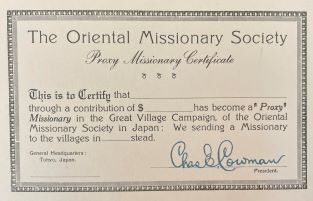 A GVC pledge card used during deputation tours. (OMS Archives)
Going one step further, Blackstone also underwrote the travel costs for ten men headed to Japan, thus enabling the Great Village Campaign to complete the project by the end of 1917.
Cowman didn’t stop just with Blackstone, but confident God would provide the rest, he continued making pitches on the deputation tour.
He carried “proxy missionary certificates” and handed them out along the way. People could sign up–sending funds instead of themselves to the grueling task.
Western missionaries needed for the end of the GVCOne of the western missionaries serving as a GVC missionary starting in 1914 was a student at God’s Bible School.
Cowman sent him back to GBS in 1916 to recruit other students from the school to take a one-year “tour,” in Japan.
Cowman knew God’s Bible School would be a good source for men willing to give up a year of their lives for the sake of the Gospel.
He estimated that with ten westerners and plenty of Japanese volunteers from the Tokyo Bible Training Institute, the end of the GVC could come by December 1917.
Encouraged by the GBS magazine The Revivalist, ten men volunteered.
(God’s Revivalist Magazine continues to this day).
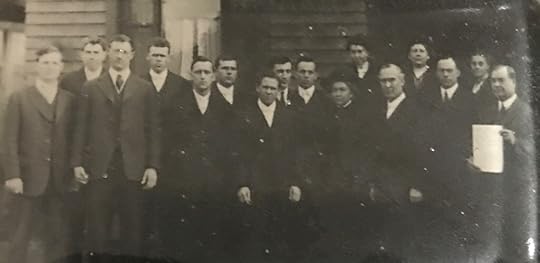 The ten American men from God’s Bible School and the Cowmans preparing to leave GBS for Japan (OMS Archives)
The ten men were:
Lewis Kyles, John Orkney. Rollie Poe, William Miller, Vernie Stanley, Everett Williamson, Paul Haines, Edward Oney, William Thiele, and Harry Woods.
The ten traveled with Charles and Lettie Cowman across the US by train to Los Angeles. After meeting with Blackstone and attending numerous prayer meetings, they continued to San Francisco from whence they sailed in early 1917.
Landing in Japan on January 20, 1917, they went right to work.
As William Miller wrote, “We landed with a zeal and determination to spread the Gospel like Samson’s foxes spread the fire.” (Young Men of the Cross, page 40).
Walking through JapanGreeted by Ernest Kilbourne upon their arrival, the men were organized into ten teams, matching each American with five to seven Japanese Bible men/interpreters.
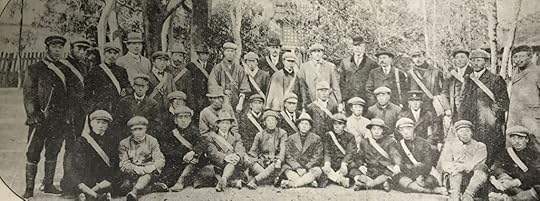 The Great Village Campaign would have been impossible without the dedicated Japanese missionaries. (OMS Archives)
The Americans ranged in age from 22 to 30 and served as the leaders—but given their lack of familiarity with the Japanese language and customs, they quickly learned to trust the men who did most of the work!
They trekked between fifteen and twenty-five miles a day. Some days they visited as many as eight villages. With five million houses visited in the previous four years, they had the same number to go.
It was hard work.
“Often after treading over mountains . . . [we have] tired, aching bodies, and blistered feet. Other times we are very wet, having worked in the rain all day.” (Young Men of the Cross p. 44).
The men often went to extremes to ensure they canvassed every house. They encountered lepers, caged men, fast-flowing creeks, frigid temperatures, and a variety of physical ailments.
What was the result by the end of the GVC campaign?
Conditions altered as the seasons and terrain changed. They trekked through the rainy season, summer heat, fall chill, winter snow, across mountains, through streams, up valleys, and along narrow paths.
One group sailed to a distant village unreachable by foot. Their shoes wore out, they lost weight, rats ran across their bodies as they slept on thin mats.
The corn-fed American men towered above the Japanese and remained continually astounded by the eastern culture.
The Visionary Behind Streams in the Desert
Was it even possible to complete the task?
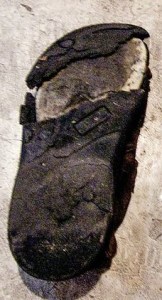 A more modern worn-out sole. (Wikimedia Commons)
Career OMS missionary Paul Haines later wrote, “a sincere effort was made as far as humanly possible, to reach every home.”
Reflecting later, missionary Woods said the rationale behind
the wholesale and indiscriminate distribution of the Bible was not so much evangelism as seed sowing.
Charles Cowman had a great faith . . . that “the gospel of Jesus Christ is the power of God unto salvation to everyone that believeth.”
(In These Mortal Hands, p. 105)
Charles Cowman himself believed any results had to be left at God’s feet. Only God could determine success.
Blackstone certainly agreed with Charles Cowman, and put his money into his belief. When funds ran low toward the end of the GVC, he wired an additional $8,000. ($119 in 2020 US).
Most of the men signed on for one year and, for the majority, the campaign finished in January 1918.
The Oriental Missionary Standard’s front page blazed the announcement: “Hallelujah! The Japan Village Campaign is finished!”
However, several men needed to remain in Japan. They closed out the final campaign distribution in June 1918.
All ten men eventually graduated from God’s Bible School. Half returned to work for the Oriental Missionary Society as missionaries.
Charles estimated the ten men (and their valuable Japanese counterparts) cumulatively walked fifty thousand miles. (Or the equivalent of twice around the world). They distributed Gospel tracts to thirty Japanese provinces in one year.
Well done, good and faithful servants!
 OMS Standard front page January 1918 (OMS Archives)
Tweetables
Lots of manpower and an amazing end of the GVC–Great Village Campaign! Click to Tweet
10 groups of men walk 50,000 miles for the sake of the Gospel in 1917. Click to Tweet
The post End of the GVC–Great Village Campaign appeared first on Michelle Ule, Author.
March 22, 2022
What was the Great Village Campaign?

Have you ever heard of the Great Village Campaign?
You’re not alone if not.
The idea astonished me when I first heard about it. I started asking people if they’d heard of it.
Only one had heard of it in my two years of querying friends.
It’s not a secret.
The whole project, undertaken between 1913 and 1918–not the Great War–was incredible!
Great Village Campaign–a startling ideaConceived, proposed, and organized by Charles Cowman, the Great Village Campaign (GVC) meant personally visiting every household in Japan.
Once there, they spoke with the resident and/or left information about becoming a Christian and what it meant.
Sponsored by the Oriental Missionary Society (OMS, now called One Mission Society), the GVC information was written in Japanese.
Two western missionaries took up the task the first year: Karl Aurell (who spoke Japanese) and Fred Briggs.
Numerous Japanese evangelists who had graduated from Tokyo’s Bible Training Institute joined them to preach and translate. The men diligently walked through the first few provinces, bags on their shoulders stuffed with tracts.
They carried two Japanese language tracts, both printed on the OMS Tokyo printing press. 32-page “The Gift of God,” written by Charles Cowman, included a selection of Scriptures telling the Gospel story using only Bible verses.
The final page explained if they wanted to find Jesus as their Savior, they should write to the Tokyo office.
Ernest Kilbourne wrote the second, shorter, tract, “The God You Should Worship.”
The Visionary Behind Streams in the Desert (unpublished)
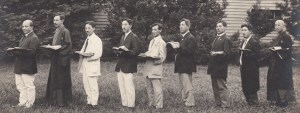 Juji Nakada also participated with Japanese Great Village Campaign missionaries (OMS Archives)But where did the idea come from?
Well, God, of course.
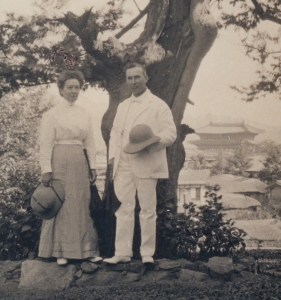 Lettie and Charles Cowman, OMS missionaries in Tokyo 1910 (OMS Archives)
But it worked its way through Lettie and Charles Cowman’s minds and souls probably starting from a deputation tour to England about 1907.
While Lettie Cowman gave a talk about the need for evangelism, a British woman asked how much it would cost OMS to evangelize an entire village.
Former businessman Charles Cowman went right to work and ciphered out an answer before Lettie finished her talk.
“About $5.”
His brain wouldn’t let the idea rest.
Several years later, Cowman stayed up all night calculating.
Or, did the Great Village Campaign grow in Cowman’s heart?In 1910, Japan had an approximate population of 58 million people living in 10,320,000 homes. Charles proposed sending trained evangelists to visit every household and leave information about Christianity.
He knew the OMS printing press in Tokyo could produce a Scripture portion and a Gospel tract for about a penny each (29¢ in 2022). Charles estimated $5 ($148 in 2022) would cover the Gospel needs of an entire village.
Charles forecast the total cost at about $100,000 ($2.9 million in 2022) for materials and personnel living costs.
It would take about five years to blanket the entire mountainous country of forty-seven provinces (also called prefectures, basically a county) spread over 430 inhabited islands.
The Visionary Behind Streams in the Desert (unpublished)
Another story comes from a colleague, Mr. Wu. (Story adapted slightly)
One evening Mr. Cowman and his wife climbed up a mountain near a large Japanese city.
They sat on a bench and sat quietly.
In every direction, they could see villages and towns. In their hearts, they knew that in none of these was a Christian witness.
Then suddenly it seemed to Charles Cowman that Christ himself was standing beside him. He heard him say, “I gave my life for these villages, too. Won’t you go and tell them for me that I want to be their Savior?”
Cowman immediately answered, “Yes, Lord. I will go.”
OMS Archives Great Village Campaign informatoin
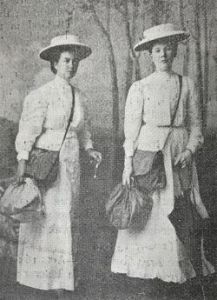 Lettie Cowman and Lizzie Pearce circa 1905. See why they would draw attention? (OMS Archives)How?
A westerner and several Japanese men set out, walking from village to village. They scaled mountains, forded rivers, traveled on ferries, and handed out tracts everywhere.
The westerner assured curious villagers would gather and take a tract. In the early decades of the 20th century, tall, well-fed, men and women dressed in western clothes always attracted attention.
95% of the Japanese could read in 1914, according to records. Charles Cowman knew God’s Word would not return void, especially since it was written in Japanese.
The assignment was grueling. Charles and Lettie went out, as well. As Cowman wrote to a friend:
“Wife and I were out with an itinerating party to some villages and did not arrive home until after midnight. The rain came down in torrents and we had five miles to walk to the nearest railway station, so you can imagine what a sight we were on our arrival home.”
Missionary Warrior by Lettie Cowman, page 209
Of course, after three months and several million tracts handed out, they ran out of money.
The full story is told in Young Men of the Cross.
How did it end?
Part 2, The Great Village Campaign–GVC–Ending, will post next week.
Tweetables
What was the Great Village Campaign in Japan? Click to Tweet
HOW could missionaries visit every Japanese home 1913-1918? Click to Tweet
The post What was the Great Village Campaign? appeared first on Michelle Ule, Author.
March 15, 2022
The Fun of an American Potluck in Romania
 Goulash is always good–potluck or not!
I attended a potluck dinner many years ago in Romania.
As a matter of fact, we stayed in Transylvania to celebrate my godson’s wedding.
The couple, working in Romania at the time, provided us with detailed instructions of what we would do during the week-long festivities.
Included in that list were several dining opportunities.
One of the nights, they asked guests to put together a potluck meal.
They asked several Americans to bring food peculiar to our country to surprise the Moldovan and Romanian guests.
The groom’s mother misunderstood the directions and brought a case of Peeps in the shape of Christmas trees, along with several packages of the classic bird.
Some of the Romanian guests loved Peeps.
I carried a pound of peanut butter M&Ms in my luggage for part of my potluck contribution.
Dinner needs and a Potluck cooking challenge These American Peeps were instantly devoured!
Our party–16 Americans and three Moldovans– spent five nights at a hotel in the medieval walled city of Brasov.
Romanian friends also joined us during the festivities.
This particular hotel featured small suites with a bedroom, kitchenette, and bathroom. We rented almost all the rooms in the hotel.
On party day, many of us wandered down the street to the open-air market attached to a local grocery store.
I needed several eggs for my potluck contribution.
Because I love prowling stores overseas, I jumped at an opportunity to shop in Brasov’s market.
It’s always fun to see familiar items and not-so-familiar items for sale, not to mention the different ways/forms you purchase food.
Packaging often looks different, and I see food I don’t even recognize.
 A Polish market–what are the vegetables in front?
It’s an adventure.
Several people made fruit salads from fresh fruit purchased in the open-air market.
Someone made a potato salad and another a green salad.
Vegetables were a must, too, along with the local sausages.
We returned to our hotel ready to cook.
I brought a brownie mix for my traditional American potluck contribution.
Unfortunately, I’d forgotten the challenge of baking in Europe. None of our kitchenettes had an oven–but they all came with stoves and a microwave.
The Internet saved the day.
By setting a drinking glass upside down in a glass pie pan, I baked brownies in the microwave in under ten minutes.
What did we eat?By the time we were done preparing the potluck, the table groaned and eventually, so did we.
You always get sausage in central Europe, and it’s usually delicious.
Someone found corn chips, but I don’t remember if they made salsa or not.
You certainly couldn’t get Mexican chiles in Romania, but substitutions can go a long way.
Nothing tasted the way I expected it to–particularly the brownies–but the fun was sampling so many different foods.
The Moldovans had never been outside of their neighboring country before. They’d never heard of a brownie.
So, they had no idea they weren’t supposed to look like a flat thick cookie with a hole in the middle (similar to a flat angel food cake).
They loved them.
The Americans all laughed.
Between us, we ate the entire case of Peeps by the end of the night!


 I’m not really sure what we ate–but I know sausage was somewhere in this potluck mix!
Tweetables
Well, what American food would you take to a potluck in Transylvania? Click to Tweet
The post The Fun of an American Potluck in Romania appeared first on Michelle Ule, Author.
March 8, 2022
Jesus-Life Under Communism

How do you live a Jesus-life under Communism?
I’ve read two books about believers living under challenging circumstances in China and in Romania.
(This idea is the subject of countless books–including Solzhenitsyn’s. I’m limiting myself to two I’ve read in the last few years.)
From both, I took away profound truths that should affect my everyday life in the United States.
Perhaps you, too, can see how to live a Jesus-life wherever you live.
Jesus-life in RomaniaSabina Wurmbrand’s book, The Pastor’s Wife, details her experiences coming to faith in Romania prior to World War II.
The pastor’s wife refers to her role in marriage to Pastor Richard Wurmbrand, who wrote many books himself.
Sabina’s book interested me because she had to help keep her husband’s church running during his years in a Communist prison.
It was a formidable task with many complications.
Like many written by others over the years, the book highlights what it was like to live under a despotic Communist regime.
(See my visit to Budapest’s House of Terror).
Sabina spent several years in the countryside near the Black Sea trying to build a canal with her bare hands. (There were many, many others doing this same work, of course).
Separated from her child, her husband in prison, she fought to retain her faith despite persecution and horrific living conditions.
Once released and sent home where she found her now-teenage son being looked after by friends, she set to work helping the underground church.
Ministering to suspected quislings
While it was bad enough to have to live with unscrupulous women of many different “professions,” returning to the local church raised the ante even higher.
Asked to step into her husband’s role and lead a small group of house church members, Sabina undertook a difficult task.
She and others had to find ways to feed themselves, but also those whom they sheltered from the local police authorities.
Meeting to worship in small groups of perhaps, eight, they had to hide their activities from neighbors only too happy to turn them in as Christians to local authorities.
And then there were the quislings–people who pretended to be Christians or their friends, and who reported on the small house church members as well.
How do you look at people through the eyes of Christ when they are either torturing you or destroying your life and that of your neighbors?
What does Jesus-life bid us do?
Sabina was prepared to die for the sake of the Gospel.
I felt sobered reading her descriptions of life in 1940s Romania.
In addition to all that, the authorities also pressured her to divorce her husband.
Richard ended up spending 14 years in prison.
Sabina recognized the authorities–who withheld food, school placements for her son, and threatened her with other reprisals–would use such a divorce to undermine her husband’s faith.
Even though she didn’t know for sure he lived, she determined she could not divorce him. She loved him, yes, but she knew she needed to remain strong for him.
Sabina reunited with her husband in 1956 and waited through yet another prison term before his final release to the west in 1964. They remained married until their deaths.
Jesus-life in the land of God is RedWhat on earth does it mean: God is Red?
The full title explains: God Is Red: The Secret Story of How Christianity Survived and Flourished in Communist China.
It’s the title of a 200 book written by Chinese journalist Liao Yiwu
Not a Christian himself–or at least not at the time he wrote the book– he asked an interesting question.

“Given the persecution of Christians [in China], why do people remain Christians?”
An excellent question.
Like a good journalist, he went in search of people committed to Jesus-life to find out.
First published in 2011, God is Red recounts edited versions of interviews Liao conducted in more rural parts of China around 2004.
Liao’s interviews often took place in hidden or in secret meetings. Several times local authorities broke up interviews, exposing Liao to surprise and unease.
Many of his stories involved Christians–both Catholic and Protestant–who spent years in miserable conditions.
Relatives recounted horrific beatings, withheld medical care, abominable living conditions, and starvation.
And yet, they did not recant their belief in Jesus.
Why?
Two reasons seemed to come up time and again with Biblical echoes or actual voices.
Where else would they go for eternal life? (John 6:68)The confidence Jesus would not leave them. (See below)Many also mentioned physical healings they received from God–signs and wonders of His power over the grim circumstances following God brought into their lives.
The Gospel itself often came through missionaries in China during the early 20th century, most notably through the China Inland Mission.
Scripture encouragement–time and againFor both Sabina and Richard Wurmbrand, and all the believers interviewed in God is Red, remembered Bible passages made all the difference.
Alone in your thoughts, sitting chained in a rank dark solitary prison cell, all you have left is your mind and memories.
Almost every story in these two books involved people in dire situations reflecting on the truth of Scripture.
One verse, in particular, meant the most to them, and often to me, Jesus’ reminder “I will be with you until the end of the age,” in Matthew 28:20.
Here’s a list of 30 different verses saying basically the same thing throughout the Bible as Jesus-life encouragement. (King James version).
How do you live a Jesus-life if you know this?The very same way.
Know God, Jesus, and the Holy Spirit intimately as a daily experience in your life.Memorize Scripture.Make sure you know what you believe and why.Remain faithful to the tenants of your faith.No matter what you’re told, refuse to become like the persecutors.Tweetables
What was Jesus-life like under Communism? Click to Tweet
How do you survive political horrors with your faith intact? Click to Tweet
The post Jesus-Life Under Communism appeared first on Michelle Ule, Author.
March 1, 2022
Who was the New Testament’s Tychicus?

Are you familiar with the name Tychicus?
Can you even pronounce it?
TICK-e-cuss. 
I’m curious today because (after a two-year COVID delay) my Bible study picks up the Book of Ephesians.
Brought to the world by Tychicus.
Thanks, Paul, for sending him along.
Basic facts about TychicusHis name means “Fortune,” and the Apostle Paul certainly felt fortunate to know Tychicus.
He is a beloved brother and faithful minister and fellow servant in the Lord.”
Colossians 4:7 ESV
Tychicus is listed as being from “Asia” the area now known as Turkey (or, in the past, “Asia Minor.”)
Church tradition suggests he came from Ephesus, which may have been why Paul sent him to the city with his letter to the Ephesians.
As such, Tychicus may have been one of Paul’s students during the more than two years the apostle spent preaching and teaching in Ephesus.
It’s where they probably met. Paul later refers to him as a “beloved brother.”
Some have compared Tychicus to Barnabas, another encourager for the very busy apostle.
All five references made to Tychicus in the New Testament involve him traveling either with Paul, to Paul, or from Paul.
You had to be brave to face the Mediterranean Sea in a first-century sailing ship.
By providing service to the Apostle Paul and accompanying him to Jerusalem–or at least that was the plan–he would have been a man of high integrity.
He carried messages, encouraged Paul, and served his friend well.
Paul’s Four T-friends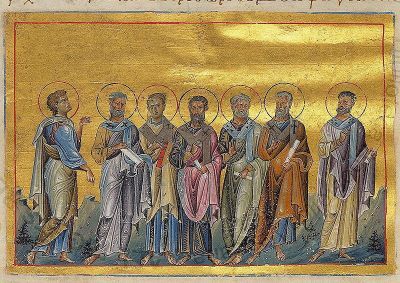 Sosthenes, Apollo, Cephas, Tychicus, Epaphroditus, Cæsar, and Onesiphorus (Wikimedia Commons)
The Apostle Paul had four close associates whose names began with T.
Timothy, Titus, Trophimus, and Tychicus.
The four men traveled with Paul through his missionary trips, and at least two accompanied him to Rome.
Who knew the Mediterranean was such a busy place for travel in the first century–particularly between Asia and Rome?
Tychicus actually may have traveled twice between Rome and Ephesus.
Specific TravelsFirst appearing in Acts 20:4, Tychicus joined several others (see the painting above) to meet Paul in Troas.
They journeyed together to Jerusalem bringing a financial gift to the needy church.
About the time of Paul’s first imprisonment in Rome, the apostle befriended a runaway slave named Onesimus, whose story is told in the book of Philemon.
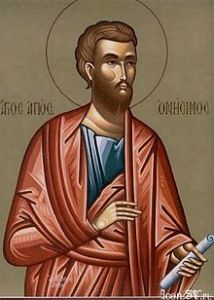 Onesimus, Philemon’s slave. (Wikimedia Commons)
Paul’s letter to Philemon explained the slave needed to be returned but encouraged his owner to treat Onesimus as a brother in Christ.
Paul sent him from Rome via Colosse with Tychicus.
In his letter to the Colossians, Paul explained to his friend there,
Tychicus will tell you all about my activities. He is a beloved brother and faithful minister and fellow servant in the Lord.
I have sent him to you for this very purpose, that you may know how we are and that he may encourage your hearts, and with him Onesimus, our faithful and beloved brother, who is one of you.
They will tell you of everything that has taken place here.”
Colossians 4: 7-9 ESV
Paul expected Onesimus to remain with his master. Tychicus, however, planned to report back to Paul in Rome.
It’s probable this trip included both the letters to the Colossians and to the Ephesians.
(Church history suggests Onesimus later became the bishop of Ephesus)
Tychicus–the Later YearsTitus 3 includes the final Biblical reference to Titus: “When I send Artemas or Tychicus to you, do your best to come to me at Nicopolis, for I have decided to spend the winter there.”
 Wikimedia Commons
Nicopolis is on Greece’s western shore.
It’s not clear what became of Tychicus after that–or if he even spent the winter in Nicopolis. Some scholars believe Paul sent him with the letter, and Tychicus returned to Ephesus to serve the church.
Legend has it he ultimately became a Bishop in one of several places: Paphos, Chalcedon, or Colophon.
Church tradition believes he was martyred for the faith in Colophon–24 miles from Ephesus.
The Catholic Church calls him St. Tychicus. His feast day on the Catholic Calendar is April 29.
Well done, good and faithful man of God.
Tweetables
Who was Tychicus? And how do you say that? Click to Tweet
The post Who was the New Testament’s Tychicus? appeared first on Michelle Ule, Author.
February 22, 2022
What is a Deputation Tour?

Have you heard of the term deputation?
A person or group appointed to represent another or others; a delegation.The act of deputing.The state of being deputed.The concept comes from the 14th century and refers to sending a delegation in place of the actual ruler.
Some used it during the American Civil War when men paid others to go in their place.
You may have heard it in Westerns–“I’m going to deputize you to join us in hunting the scoundrels.”
It’s also a term once used by religious organizations to fund missionaries.
(Other terms include “to raise support, itinerating, home ministry, or home service.”)
Charles and Lettie Cowman’s form of Deputation TourDuring the first two decades of the 20th century, Lettie and Charles Cowman spent many months on deputation tours.
They traveled all over the United States raising money for the Oriental Missionary Society’s (OMS) work in Japan.
Seeking both financial and prayer support, the Cowmans spoke to Christian organizations, churches, and often week-long camp meetings. Travels to England took them to halls run by Pentecostal and prayer ministries.
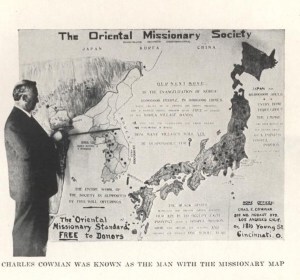 (OMS archive photo)
As the OMS ministry expanded to include Bible schools in Korea and China and to fund the Great Village Campaign, the tours grew in number and length.
Deputation tours took place while home on furlough–time away from the mission field. (The idea was to rest and touch base with family and friends for at least a few months).
But the need to share the Gospel constantly drove Charles Cowman.
While in the United States, he and Lettie may have rested a few weeks, but they soon began traveling by train across the country, west to east, and south to north.
The trips were arduous.
As Bud Kilbourne wrote years later:
Deputation work is not an easy task and we generally finish such a campaign physically undone, but oh, what a joyful work it is as we meet those who clasp our hands and tell us how they have long prayed for and helped the work.”
The Orieintal Missionary Standard October 1929
The deputation tours provided opportunities for missionaries to meet those who supported them and sent them to foreign lands to minister. By supporting missionaries, the “folks back home” did not have to go themselves.
Some people are called to be evangelists, some are not. But just because people may not have those skills, doesn’t mean they couldn’t support those who do.
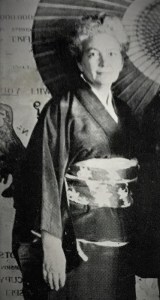
What was it like for the Cowmans on their deputation tour?In the early 1900s, the Far East was a mysterious place. The Cowmans liked to wear Japanese clothing to give folks a sense of their lives overseas.
 (OMS Archives)
In painting word pictures of their ministry needs and successes, they emphasized the cultural and spiritual differences between Tokyo, Korea, or China compared to the US or England.
As a businessman, Charles Cowman liked numbers. He always carried a map and enjoyed showing his listeners where the ministry was expanding, and how many people attended their Bible Training Institute or teaching ministry.
(They liked to describe the number of consecutive nights they’d held services at a Tokyo hall they rented upon arrival in 1901. The final number: 3000 nights in a row, usually with Juji Nakada preaching).
At camp meetings, Charles usually spoke first, providing details.
Lettie, however, was the star.
Missionaries Edward and Rachel Erny described Lettie on the podium as:
direct, winningly gracious, and charmingly animated. She could take her audience with a word, a gesture.
Quietly, without resorting to histrionics, she could communicate the white-hot fervor of her soul and share the excitement and nobility of their calling. She employed her gifts without apology in the interests of a needy world.”
No Guarantee But God, p. 73
Dressed in her kimono, she sang in a trained soprano voice, “His Love Can Never Fail,” as well as hymns in Japanese.
Along with other missionaries, the Cowman’s deputation tours kept the Bible Training Institutes in Japan, Korea, and China, funded for many years.
Charles Cowman himself, retired from missionary life while on a deputation tour. Sent home exhausted by a physician, he lived as an invalid for seven years. During that time, Lettie wrote Streams in the Desert.
The End Result?Farmers, housewives, students, businesspeople, church-goers, and folks from all walks of life donated funds in support of sharing the Gospel.
The amount of the donation was not as important as the prayer support.
(Indeed, the way funds arrived right on time was miraculous!)
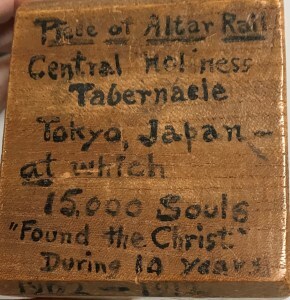 “Piece of the altar rail of Central Holiness Tabernacle in Tokyo, Japan at which 15,000 souls ‘Found the Christ,’ 1902-1912” (OMS Archives)
In 1907, a British woman asked Lettie at a meeting how much it would cost to put the Word of God into a neglected Japanese Village.
Charles Cowman did a rough calculation. He estimated that day an entire Japanese village could be evangelized for about $5. ($140 in 2020).
Groups began to commit just that sum.
And thus began what turned into the Great Village Campaign.
Deputation Tours todayThe missionaries I know today spend time contacting people over the Internet, yes, but also in public.
For the three I know well, their first request is for prayer.
They all know, as Oswald Chambers liked to say, “Prayer does not prepare us for the greater work; it is the greater work.”
I appreciate my friends. They’re scattered around the planet presenting the Gospel.
Praying for them, and sending funds from time to time, is the least I can do.
And certainly, God is pleased that His teachings go out to all with ears to hear. Thanks be to God.
Tweetables
What is a deputation tour? Click to Tweet
How did Charles and Lettie Cowman fund their missionary work in 1910? Click to Tweet
The post What is a Deputation Tour? appeared first on Michelle Ule, Author.
February 15, 2022
Making a Home for His Bride

A friend is making a home for his bride, I realized today.
That’s what’s taking him so long.
It’s not a new bride, it’s the woman he married more than 40 years ago.
But their house burned down in 2017.
He’s been rebuilding a new home for his (still wonderful) bride ever since.
Where does the idea come from?I don’t think either one sees it this way.
They’re both frustrated more than 4 years after the Tubbs fire destroyed their home. (And nearly 6000 others in my county on one ghastly night).
Her frustration is because it’s taking so long for him to rebuild the house himself.
He’s an excellent craftsman. He wants it to be perfect.
She just wants to use her own shower and cook in the gorgeous kitchen.
I’ve been sympathetic. But today I realized what he is, probably unintentionally, doing.
He’s making a home of splendid beauty for the woman he married and has loved well every since.
Such a sentiment puts a different spin on the situation, doesn’t it?
The Biblical idea–a bridegroom making a home for his bride.Many are familiar with the Gospel account of Jesus’ parents’ betrothal.
The Jewish custom was for a couple to become betrothed, which set the bridegroom’s actions in motion.
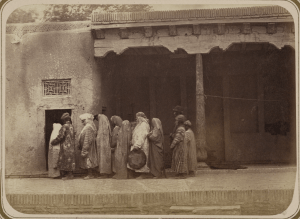 Turkestan 1860–collecting the bride.
 (Wikimedia Commons)
He had to create a home for his prospective wife and eventual family. The betrothed bridegroom often spent a year preparing for his bride.
He didn’t tell the woman when he would finish–though I’m sure she paid attention to what was happening in her new home!
One night, the groom and his friends arrived to claim the bride and take her home.
The shout went up, “the Bridegroom cometh!”
Let the party begin!
Who is the Bride of Christ?Meanwhile, the Bible tells Believers that we are the bride of Christ.
Jesus loves His Church.
In John 14:3, Jesus told His disciples the time had come for Him to depart.
“I go and prepare a place for you, I will come again and will take you to myself, that where I am you may be also.”
After Jesus died on the cross, He rose–thus demonstrating His power of sin and death.
Jesus spent 40 days showing himself to many people in the Jerusalem area.
When the time came, He returned to heaven.
But, He sent the Holy Spirit–to live with us forever, and to remind us that Jesus is making a home for us.
It’s eternal, and He’s coming back.
WaitingWhen will the bridegroom come? When will the house be finished?
 Welcome Home, right?
 Photo by Marcos Paulo Prado (Unsplash)
Soon.
The Book of Revelation warns we need to be ready, anticipating the bridegroom’s return.
My friend is helping her husband, and they both keep a list.
But anything could happen, at any time.
One day, the trumpet will sound, “for the marriage [feast] of the Lamb has come.”
Celebrations will break forth for some of us, and we’ll marvel at the beauty awaiting us.
The Beautiful End of Making a HomeWe all know our friend made a beautiful home for his bride–we can see the lines in place, the gorgeous stonework, the cabinetry.
We also know the Lord makes a beautiful place for us in heaven–if it were not true, He would not have told us He went ahead to prepare a place.
All we can do in the waiting is keep our hearts pure before God, be patient, and look forward.
 Finished!
The day is coming.
Soon we all will be home.
Meanwhile, Greg loves you, Connie.
Welcome home!
Tweetable
Jesus is busy making a home for you. But He’s coming back soon. Click to Tweet
The post Making a Home for His Bride appeared first on Michelle Ule, Author.
February 8, 2022
For Want of a Nail?

A nail lay in the road.
I paused in the crosswalk, looked up and down the street– thankful it wasn’t busy– and reached for the nail.
Later in the day, squatting down like that would be dangerous, but not this morning.
Aluminum gray and lightweight, the nail looked innocuous enough.
While it may have been this morning, that does not mean it wouldn’t have been a problem later on.
Saving Humanity–or perhaps just the neighbors?I started picking up random nails found in the street long ago when we lived in Navy housing.
The neighborhoods saw moving trucks delivering or picking up household goods weekly.
As a woman with few mechanical abilities, the thought of getting a nail in my car’s tire troubled me.
I’ve never had to change a tire before.
Some kind man always stopped to help!
I never suspected all those years ago that always would be my (happy) fate, and so I always pick up nails or screws in the street.
Both for me, and for other–potentially hapless–drivers.
But why pick up a nail in the street? The cover of Martin Luther’s book; he was handy with a nail, too. (Wikimedia Commons)
This week my Bible study reviewed the seventh commandment in Luther’s Small Catechism.
You shall not steal.
What does this mean? We should fear and love God so that we do not take our neighbor’s money or possessions, or get them in any dishonest way, but help him to improve and protect his possessions and income.
Luther’s Small Catechism (My choice to bold face)
We talked for a while about what it means to your neighbor if you help him/her protect or improve possessions or income.
Wouldn’t picking up a nail so they wouldn’t run over it be just that?
The PoemYou’re probably familiar with the poem, which basically works out to this:
For want of a
nail, a horseshoe was lost,horseshoe, a horse went lame.For want of a
horse, a rider never got through,a rider, a message never arrived.For want of a
message, an army was never sent,an army, a battle was lost.For want of
a battle, a war was lost,a war, a kingdom fell,and all for want of a nail.
Perhaps you haven’t heard how Benjamin Franklin ended it in 1758’s Poor Richard’s Almanack: “A little neglect may breed great mischief.”
Some interesting history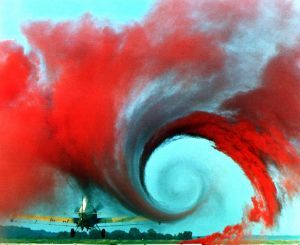 NASA photo–demonstrating a form of chaos theory. All for want of a nail.
 (Wikimedia Commons)
History records the concept as being first recorded in the 13th century, perhaps as early in Germany as 1230.
In English it appeared in John Gower’s 1390 Confessio Amantis:
“For sparinge of a litel cost, Fulofte time a man hath lost, The large cote for the hod.” (“For sparing a little cost often a man has lost the large coat for the hood).”
And, of course, Shakespeare’s King Richard III famously lamented, “A horse, a horse, my kingdom for a horse,” after he lost his horse. (But was it for want of a nail? Maybe just the horse?)
During WWII, the Anglo-American Supply Headquarters in London framed the verse and hung it on the wall.
Wikipedia posted a long list of popular instances where books, movies, musicals, television, and even a YA novel (A Wind in the Door) by Madeleine L’Engle used the concept.
Lack of a nail, or is this really chaos?Benjamin Franklin’s mischief concept provoked much interest through the years.
Modern thinkers–or perhaps just the military–call the idea, “Root-Cause Thinking Reveals That We Are Only as Strong as Our Weakest Link.”
Or, as “Clarence” noted (on a site that is blocked, sorry):
An important caveat is that these chains of causality are only ever seen in hindsight. Nobody ever lamented, upon seeing his unshod horse, that the kingdom would eventually fall because of it.
Equally important, yet tending to be overlooked, is that when we trace these events backward, starting from the fall of Rome and finally ascribing it to a blacksmith oversleeping one morning . . . We are following branches of a tree structure, and we don’t notice that at any point, we could have chosen a different path and ended up at a totally different conclusion.
It is also an illustration of the idea underpinning chaos theory, known as sensitive dependence on initial conditions; the initial condition being the presence or absence of the horseshoe nail.
 The actual nail
The engineer in my house read this post and commented, “perhaps the ‘butterfly effect’ is a better analogy?
His point?
There’s always the chance that for want of a nail good things happen.
No nail, no chance of a flat tire–car or bike. No one would slip if the nail rolled under their shoe.
The college guy who stopped to help my friend change her tire might have married her.
You never know.
What was I thinking?I took the nail home. I may use it to hang a picture.
Perhaps I’ll poke a hole in something or use it to pound our fence rail back into place.
I could hang up the tomato cage using that nail, or even the shovel–by getting it off the garage floor it might not trip me.
Anything could happen.
Flat tire potential, being a good neighbor, and pure curiosity, “I wonder where this nail came from?” is why I picked up the nail today.
But, at the same time, it’s nice to think I saved the world a little bit of chaos, isn’t it?
Tweetables
The science and neighborliness behind picking up a nail. Click to Tweet
What might you have lost for want of a nail? Click to Tweet
The post For Want of a Nail? appeared first on Michelle Ule, Author.