Michelle Ule's Blog, page 21
February 1, 2022
Samson’s Parents and Faith–or Not?

I’ve never given much thought to Samson’s parents from the Old Testament book of Judges.
Indeed, Samson is such a stranger character, I’ve read his story and moved on.
My friend Chase Replogle has a book coming out soon which examines the man more closely.
I’m looking forward to reading The Five Masculine Instincts: A Guide for Becoming a Better Man for more insight.
He discussed Samson on his January 31, 2022, podcast. You can listen here.
But in the meantime, I’ve just read Judges 13 and saw several concepts about faith and childrearing.
Samson’s parents had the same questions many of us have when a baby is coming.
Except, this child’s arrival was announced by the Angel of the Lord.
What did it mean?
Miracle and RestrictionsParenting always involves faith–for health, safety, happiness, and the future.
What would you do if Jesus–in the guise of “the Angel of the Lord”–dropped in on you?
Now there was a certain man from Zorah, of the family of the Danites, whose name was Manoah; and his wife was barren and had no children. And the Angel of the LORD appeared to the woman and said to her, “Indeed now, you are barren and have borne no children, but you shall conceive and bear a son.”
Judges 13:2-3 ESV
Interesting, isn’t it, how often Bible stories involve a barren woman?
In this case, Mrs. Manoah knew that emotional burden and embarrassment.
Then this angel appeared–“fear not”–with exciting and surprising news.
A miracle, really.
The Angel provided her with specific instructions about her pregnancy with this child, which she relayed to her husband.
Then the woman came and told her husband, “A man of God came to me, and his appearance was like the appearance of the angel of God, very awesome. I did not ask him where he was from, and he did not tell me his name, but he said to me, ‘Behold, you shall conceive and bear a son. So then drink no wine or strong drink, and eat nothing unclean, for the child shall be a Nazirite to God from the womb to the day of his death.’”
Judges 13:6-7 ESV
These directions told Mrs. Manoah that she, basically, would live with the Nazirite vow through the pregnancy.
Samson’s Parents Grapple with Faith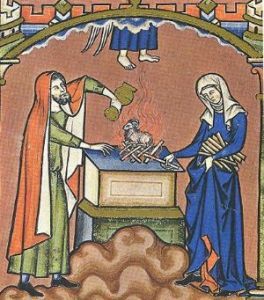 Image from the Maciejowski Bible, Note the Angel’s feet. (Wikimedia Commons)
Of course, Manoah wanted to believe this astounding news.
His wife believed it.
But, still, he asked God to confirm. (Joseph got confirmation, too.)
Don’t you love how patient God is with our flimsy faith–particularly when entering a miraculous gift?
So, the Angel of the Lord returned.
To Mrs. Manoah working in the fields. She ran to retrieve her husband this time!
Manoah arose and went after his wife and came to the man and said to him, “Are you the man who spoke to this woman?” And he said, “I am.”
And Manoah said, “Now when your words come true, what is to be the child’s manner of life, and what is his mission?”
Judges 13:11-12
Note that reply: “I am.”
That should explain who that angel was!
Manoah, though, brushed right past that amazing answer and asked instead about the child. What sort of future would he have? What mission did God plan?
Isn’t that what we all want to know about our children?
But why?
Trusting God for the futureI thought about Manoah’s question and what faith means for us. What are we really asking with the words, “will this all work out?”
Here’s the definition of superstition:
a belief or practice resulting from ignorance, fear of the unknown, trust in magic or chance, or a false conception of causation. an irrational abject attitude of mind toward God. a notion maintained despite evidence to the contraryThe news was too good to be true. If God was going to such an extreme to produce this child, would his future be safe?
The Angel of the Lord basically said, “I’ve told you all you need to know.”
Hasn’t God already told parents what they need to know?
I will never leave you nor forsake you. (1 Kings 8:57 and elsewhere)I am with you and will watch over you wherever you go. (Genesis 28:15)The Lord is my helper; I will not be afraid. What can mere mortals do to me? (Hebrews 13:6) Do not fear, for I am with you; do not be dismayed. I am your God. I will strengthen you and help you. (Isaiah 41:10)God already gave us the assurances we need. No matter what happens to ourselves or our children, He’ll be there.
He loves us. We can trust Him.
Why Samson’s parents probably were happy they didn’t know the futureGiven what that kid dragged them through, don’t you think they deserved some peace of mind?
A friend commented once that worry doesn’t do us any good. (More Bible verses!)
She quoted someone, “If you worry, you suffer twice. First, when you worry. Second when you go through it.
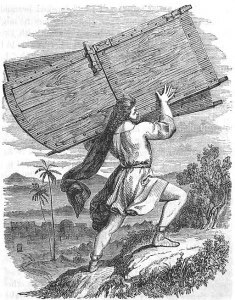 Still not sure he looks hairy enough! (Wikimedia Commons)
“But if you don’t worry, you only have to endure the experience once.”
Samson’s parents had quite a road ahead of them as they tried to guide and love their strong-headed child.
(Don’t ask me how they managed his never-cut hair!)
More than anyone, they must have watched wide-eyed as the child God called into being lived an overwhelming life.
The lies, humiliation, rash decisions, hot temper, and waywardness with women must have left them perplexed.
In the end, however, Samson served God’s purpose.
But the cost was heavy.
We raise our children with hopes and dreams, just like Samson’s parents.
Some children live honorable and wonderful lives.
Some do not.
As parents, all we can do is trust them into God’s hands. (They were His idea anyway).
Pray, believe, love, and guide.
Again and again!
They belong to God– not us.
Tweetables
Imagine being Samson’s parents! And what about his future? Click to Tweet
How to raise children without fear–or answers. Click to Tweet
The post Samson’s Parents and Faith–or Not? appeared first on Michelle Ule, Author.


January 25, 2022
To All the Ordinary Churchwomen: A Salute

Do you belong to the “ordinary churchwomen” guild?
Do you know one?
Of course, you know one. They’re everywhere.
Who do you think is organizing and keeping the churches functioning?
Yes, men are vitally important in the church.
But, the majority of churchmen I know are not cooking, tending, cleaning, or teaching women’s Bible study.
Most of the Sunday school teachers for children I’ve known were women. (My husband excepted).
The church doesn’t function without having the often overlooked churchwomen.
Today, I salute you!
Why ordinary churchwomen?I love listening every Tuesday to the Women Worth Knowing podcast.
My friends Jasmine Alnutt and Cheryl Brodersen provide stories of Christian women who accomplished great things for God.
They mine history, find obscure important women, and introduce them to their listeners.
My favorite stories are of less-famous women and their dedication to the Gospel.
They recently did a study on the Reformer wives–Katie Luther, Idelette Calvin, Katherine Zell, and Anna Bullenger.
What struck me was how these brilliant women supported their husbands and sacrificed a great deal for the sake of the gospel.
How?
By caring for their husbands and children, of course, but in the 16th century of challenging homemaking, they also took in strangers.
In other words, they practiced hospitality.
That may be a key.
Christian hospitalityHospitality is the hallmark of ordinary churchwomen.
 Who else will make the potluck?
 (Nehrams2020, CC BY-SA; Wikimedia Commons)
No church body could function without Christian hospitality–done by men or women.
The Bible is replete with verses on this subject. Here are a few:
Christians need to be “rejoicing in hope, patient in affliction, steadfastly continuing in prayer, 13 distributing to the needs of the saints, pursuing hospitality.” Romans 12:13 (MKJV)“Be hospitable to one another without complaint.” 1 Peter 4:9 (NASB)“Do not neglect to show hospitality to strangers, for by this some have entertained angels without knowing it.” Hebrews 13:2 (NASB)I recently shared one of the eulogies when my mentor died. When I strode to the front of the church I called out, “Show of hands. How many of you have spent the night at Liz’s house?”
Two-thirds of the people raised their hands.
We’ve stayed there often, but even so, the sheer number surprised me.
“Okay, how many have eaten a meal she prepared?”
Everyone had.
Well done, good and faithful servant. She loved her God with all her heart and served him in practical ways.
She also taught Sunday school, Bible studies, mentored women, and always prayed with and for us.
You may not recognize her name, but a whole lot of other people do.
Ordinary women and teachingOf course, they teach Sunday school, Vacation Bible School, and Bible studies.
 Always willing to pray (Rosie Sun on Unsplash)
But they also teach with practical skills.
I needed my friend Jan to show me how to care for a baby.
LouAnn has promised to teach me how to make soup.
I owe so many hours of work in the nursery to repay all those volunteers who sat with my kids.
Without them, I never would have gone to church for . . . many years! (Too many kids!)
One female children’s choir leader taught my daughter how to sing. Her love of music grew under Rachel’s diligent and patient eye.
They’ve used their skills to make costumes and then fit us for our recent Living Nativity and the Holy Week Walk.
Some teach knitting–using that time to pray.
I’ve never had a male choir director. The same Rachel taught me all I know about singing.
And don’t get me started on the altar guild’s skill with flowers and decorating.
Enhancing, beautifying, and loving–for God’s sake.They poured the wine in the serving trays and arranged the communion wafers (when we could do that).
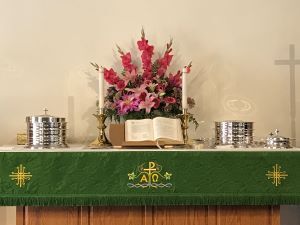 Beautifying the altar for Communion
 (author photo)
The church decorations change seasonally in our liturgical church. Ordinary women keep track of the calendar–I’m always surprised.
So many of them send notes to shut-ins, cards to service members, and messages of encouragement to the lonely.
They drive people to appointments.
Many pray for me when I teach.
Stuffing envelopes, planting flowers, dusting, cleaning, stowing, calling.
I’m having trouble listing them!
But the congregations I’ve been part of have benefited so much. We’re all thankful.
Blessings upon blessings from ordinary churchwomen.The list is long of women whom most of you won’t have known but who blessed me.
Mrs. Hahn welcomed a gawky long-haired, horn-rimmed girl into her Bible study one Wednesday night. When she directed her high school girls to the book of Romans, that girl had to look in the table of contents first.
But she saw something in me, befriended me, and prayed for me all the way to my wedding day.
Genece saw an older version of the gawky girl and taught me to pray. Dori saw a bewildered new mother and taught me how to care for my baby.
Gina showed me how to be practical with a toddler’s knees.
Liz refused to give me her ham bone but poured hours of time into my prayers, my children, and my lonely heart.
Joanne gave me books. Debbie suggested I attend Mt. Hermon Christian Writers Conference. Rachel heard my prayers, corrected my errors, and loved me through 20 years of walks.
But there were so many more.
So many self-sacrificing Bible study leaders gave me hope and encouragement.
I did my fair share, too. In the eyes of Jesus, we’re all viewed with love–no more how ordinary, or not, we may be.
Thank you. For all of your witnesses to the goodness and the love found in the body of Christ throughout the world.
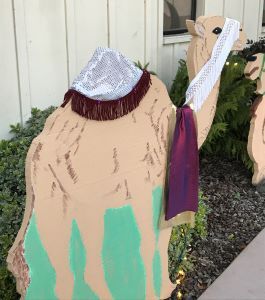
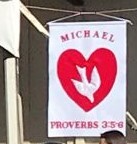
 So many women are so creative in helping the church body! They paint, they sew, they costume!
Tweetables
Praising God for the work of ordinary churchwomen. Click to Tweet
Do you know an ordinary churchwoman? Why not thank her for her ministry? Click to Tweet
The post To All the Ordinary Churchwomen: A Salute appeared first on Michelle Ule, Author.
January 18, 2022
Book Coincidences and Jerusalem

I started reading Our Jerusalem this week and discovered I’m in the middle of three book coincidences.
They all link to Eric Metaxas.
I’ve had book coincidences before–I think they’re charming and surprising.
What it means is three books in a row that I “happened” to pick up–or received as a gift–are somehow connected.
Frankly, it’s useful to read these books in a row. I’ve learned a lot about Jerusalem–past and present–as a result.
Is Atheism Dead?It started with Metaxas’ latest book, Is Atheism Dead?, which I referenced here.
My scientist husband read it first and really enjoyed it.
I followed and loved it!
I’m amazed at the stories Metaxas recounted and agree, the case for Atheism is weak. Or even non-existent
I’ve long been familiar with the “fine-tuned universe,” so well described by Dr. Hugh Ross of Reasons to Believe.
I’m quite familiar with Dr. Steven Collins and Dr. Latayne C. Scott’s Discovering the City of Sodom.
Here’s a list off the top of my head of the surprising information Metaxas discusses:
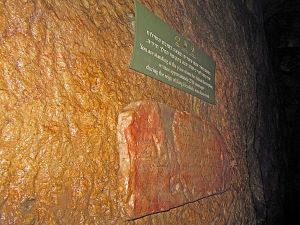 The inscription found in Hezekiah’s Tunnel (Wikimedia Commons)Three teenage boys made astounding archaeological discoveries in Israel by accident.One of them played hooky from school and discovered Hezekiah’s Tunnel in Jerusalem.Black holes influence gravity. (Finally, an explanation of black holes that make sense!)Archaeologists discovered Peter’s home in Caesarea.They found where Jesus grew up. (Thanks to some nuns in Nazareth)The Catholic Church didn’t hate Galileo.Some of the noisiest 20th-century Atheists became Believers at the end of their lives (Sarte, Flew, Camus).Science and the Scientific Method came out of people’s belief in God.
I already knew about the great Christian scientists. Copernicus, Galileo, Newton, and Maxwell basically invented science.
Wonderful!
And then I turned to a book James Clerk Maxwell’s namesake gave me for Christmas!
Book Coincidences and Jerusalem RisingI first encountered Israel Rising while listening to the Eric Metaxas show.
I was reading Ezekiel 36 at the time. The description of Israel sounded like modern-day Israel.
It only could have happened in the last 70 years.
Had anyone compared the two?
Three days later, Doug Hershey appeared on Metaxas’ podcast discussing his new book Israel Rising.
I wrote about that experience here.
Hershey found photos of Jerusalem taken in the past, and then replicated them in the modern.
With the two photos side by side, you can’t help but be impressed by the changes.
Many came from the fantastic American Colony photo collection at the Library of Congress.
Fascinating.
They pretty much prove Ezekiel 36.
Jerusalem Rising provides a wonderful photo comparison. The book includes photos of places referenced in Is Atheism Dead?
Book Coincides #3: Our JerusalemOne of my most read blog posts is “Was it Really Well with the Spafford’s Soul?
The post details what happened to the writer of “It Is Well With My Soul.”
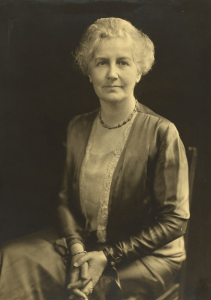 Bertha Spafford Vester, 1930
 (Library of Congress)
After the Spaffords lost four daughters when their ocean liner sank, Horatio wrote the hymn.
They had several more children and moved to Israel in 1881.
The family lived the rest of their lives in Jerusalem’s American Colony (which they established).
The oldest daughter of the second batch of children, Bertha Spafford Vester wrote Our Jerusalem.
It describes her family’s life in Jerusalem from their arrival to 1950. (That’s the year she published her book. Vester died in 1968).
As Lowell Thomas wrote in the introduction:
Of all the remarkable personalities I have known, Bertha Vester is one of the few that I have envied.
To me, Jerusalem is the most dramatic of the cities of this earth, more so even than Athens, Rome, or Paris.
Bertha Vester is the only outstanding person who has lived there, both as an observer and a participant in events.
[She lived there] under the Turkish sultans, through World War I, the period of the Mandate, a second world war, and finally the period of the return of the Children of Israel.
What a panorama!”
Our Jerusalem Introduction
Vester told an absorbing story. She seemingly met every interesting person who traveled through Jerusalem during her lifetime! (I’ve just shared the book with a WWI historian).
I opened Jerusalem Rising to find places mentioned in Our Jerusalem.
And laughed when Vester recounted the story Metaxas used in Is Atheism Dead?
Who was the boy who found Hezekiah’s Tunnel?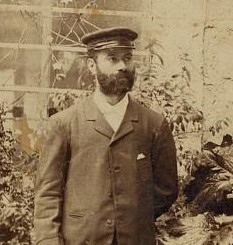 Jacob Spafford
 (Library of Congress)
His name was Jacob Elihu Spafford, the adopted son of Horatio and Anna Spafford.
Bertha grew up with him.
She described him as “above average in intellect.” Jacob spoke five languages.
After his discovery of Hezekiah’s Tunnel, Jacob eventually taught school (Bertha was one of his students).
As Bertha wrote, “There was not much either traditional or authentic about the Holy City my foster brother did not know.”
Always interested in archaeology, Jacob toured visitors around the city. He gave slide shows on archaeological findings and the Bible in Jerusalem.
As one of the leaders, he traveled for years on behalf of American Colony business.
Jacob Spafford died in an auto accident outside Jerusalem in 1932–while helping someone locate a dig.
The joy of book coincidences He had no flashlight 140 years ago. What was Jacob Spafford thinking? (Wikimedia Commons)
Reading three books on the same topic sweetened January 2022.
The Metaxas and Vester books provided more modern history than the Bible does (of course).
Jerusalem Rising allowed me to compare.
Hopefully, “this year in Jerusalem,” will happen for me.
Maybe I’ll even get to visit Hezekiah’s Tunnel and reflect on all three books.
Thank you, Eric Metaxas, Doug Hershey, and the American Colony in Jerusalem.
Tweetables
3 books about Jerusalem in 2 weeks =book coincidences & insights! Click to Tweet
Jerusalem Rising, Our Jerusalem, & Is Atheism Dead? glorious insights into a beautiful city. Click to Tweet
The post Book Coincidences and Jerusalem appeared first on Michelle Ule, Author.
January 11, 2022
2021 Reflections on the Arts with Thanks

My 2021 reflections are an odd batch this year.
(And look, they’re coming several weeks late! Had to get past Advent.)
In thinking about the year, my favorite parts involve books (surprise!), travel, and touching base with friends.
Excitement tracked me down in several places.
But in all things, just like the Bible promises, events worked out for the good.
I end 2021 thankful for many things, people, and memories.
2021 Reflections on BooksI easily met my Goodreads goal of reading 120 books in 2021.
Sleepless nights often meant I read far more than 10 books a month.
In October alone, I read 16.
These were my favorites.
NonfictionThe World Aflame by Marina Amaral. I love seeing historic photos converted into color.
You’ll Never Believe What Happened to Lacey: Crazy Stories about Racism by Amber Ruffin and Lacey Lamar. –I laughed 1/3 of the time, muttered, “I’m so sorry this happened to you,” 2/3 of the book, and am thankful I read it. Sometimes we need humor to best take in the hard topics we need to explore.
 WWII Fiction
The Rose Code by Kate Quinn –I’m totally done with WWII novels, but this one was so entertaining, I have to toff my hat.
I also enjoyed Sarah Sundin’s novel, When Twilight Breaks. (I served as a consultant on this one!) Sarah usually writes from the military/romance point of view, but this time moved into reporting.
Non-WWII NovelsBrood by Jackie Polzin –A quirky novel that has a lot more going on than you expect–in dealing with grief, it helped the heroine to brood about chickens and life.
Fresh Water for Flowers by Valérie Perrin–a haunting and beautifully lyrical French novel about a woman who runs a cemetery, sort-of.
Authors whose books I always readI enjoyed all the Biblical novels written by Connilyn Cossette.
India and Middle East stories by Alka Joshi.
Surprising, poignant, sobering, non-fiction for 2021 ReflectionsJust a list (The links are to my Goodreads page. My comments are under “My Activity” there):
Bring Back Our Girls: The Search for Nigeria’s Missing Schoolgirls and Their Astonishing Survival by Drew Hinshaw.
Wide Awake and Dreaming by Julie Flygare.
Dear Life: A Doctor’s Story of Love and Loss by Dr. Rachel Clarke.
The Pastor’s Wife by Sabina Wurmbrand.
MoviesThe only movie we saw in the theater was a National Geographic documentary: The Rescue.
It’s the story of the Thai boys’ soccer team trapped in a cave. I’d read the book, watched another documentary, and felt familiar with the story. This film, however, included the video shot by the Thai SEALS as the rescue was in progress.
Fascinating.
We also enjoyed the Fellowship for Performing Art’s The Reluctant Convert--C.S. Lewis’ story.
2021 Reflections on Art–live, in galleries!I didn’t realize how much I missed visiting art galleries and museums until this fall.

On a free afternoon in Los Angeles, we saw the Hans Holbein exhibit at the Getty Museum.
One of my favorite painters from the 16th century (what? you don’t have one, too?), Holbein’s work has intrigued me since childhood.
I relished walking through the galley, admiring the paintings close, reading everything, and feeling so thankful.
We got a bonus glorious day in LA as well.
Not a month later, we saw a presentation of the Sistine Chapel paintings–also at a closer range. I wrote about that visit here.
(We also saw, like many, the immersive VanGogh exhibit–fascinating!
Music?For many Christians, including me, music plays a key part in our worship.
During COVID shelter-in-place, I missed singing with my church body almost as much as not having my whole family around.
When a small group of us gathered outside (it was in the low 40s), to sing Christmas carols last year in four-part harmony, I danced and flung up my hands, “Whee!” after the first song.
Throughout the year+ our church met outside (in northern California) to sing through rain, sleet, freezing temperatures, I stood in the back in pure joy. The singing with the body meant so much!
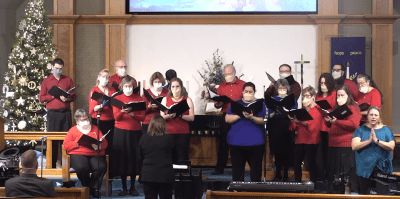
This Advent, finally back in church and singing in choir masks, we reprised a Christmas Cantata: Night of the Father’s Love by Pepper Choplin. It’s about half an hour and starts at the 15:30 mark here if you would like to watch and hear.
For most of us, singing together of Jesus’ birth was pure love.
More joy came from listening to David Voss’ 2020 Christmas Album. (You can read about our friend David here).
2021 Reflections on the ArtsThe last two years gave me a greater appreciation for family and friends, of course, along with church and teachings.
But, the arts helped, as they always do in times of trauma or crisis.
Reading, watching movies, and listening to music can provide a different perspective on our circumstances.
The Bible, of course, is even better at doing that.
I like to look back over the year and remember things that helped me process life, enjoy it, and share.
Happy 2022.
Tweetables
Another list of 2021 favorite books, music, and art. Click to Tweet
The post 2021 Reflections on the Arts with Thanks appeared first on Michelle Ule, Author.
January 4, 2022
What is Epiphany Worship? 12 Days?
How do Epiphany and worship go together?
Let’s start with Epiphany’s definition:
The word epiphany comes from a Greek word that means “to manifest” or “to show,” and on this date the church has traditionally commemorated the visit of the magi and the “epiphany.” What epiphany?
God’s manifestation to the Gentiles. God showed himself in the person of Christ to the Gentiles. That’s what that holiday is all about.
Crossway.org
And worship?
The Magi and Epiphany Worship“The Greek verb is proskenein, and that word is never used of anything but worship of the gods; it always describes a man’s feeling and action in presence of the divine.”
William Barclay, as quoted by David Guzik’s Enduring Word Commentary–Matthew 8
In the western Christian church, we celebrate Epiphany on January 6, or twelve days after Christmas.
In some places, folks refer to Epiphany as “Three Kings Day.”
Obviously, it commemorates the magi visiting baby Jesus–probably when he was about two years old.
Were there really three kings? Did they really traverse from afar? Why?
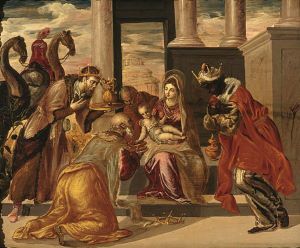 Adoration of the Three Kings by El Greco
(Wikimedia Commons)
I wrote about the reasons here.
Obviously, God captured their intellect, their imagination, and their knowledge to send them on a mission.
They didn’t rest, they dodged complications, and kept going.
The Messiah beckoned to them. They wanted to know. They wanted to worship Him–whether they knew why or not.
Honest intellectuals and brilliantly curious–they found their Messiah.
(And cherished Him enough to defy the ruling authorities not to betray Him before returning home).
The 12 Days of Christmas Song= Epiphany Worship?Yes. What a surprise–but, again, the work of people determined to worship Jesus.
According to Steve Patterson in CourageousChristianFather.com:
From 1558 until 1829 Roman Catholics in England were not allowed to practice their faith openly. During that era, someone wrote ‘The Twelve Days of Christmas‘ as a kind of secret catechism that could be sung in public without risk of persecution.
The song has two levels of interpretation: the surface meaning plus a hidden meaning known only to members of the church. Each element in the carol is a code word for a religious reality.
The 12 Days of Christmas
Here’s the why–(see the website for far more details and a printable calendar.)
A Partridge in a Pear Tree means The one true God revealed in the person of Jesus.Two Turtledoves: The Old and New TestamentsThree French hens: Faith, hope, and love.Four Calling Birds: The Four Gospels.Five Golden Rings: the Pentateuch, or the first five books of the Old Testament.Six geese a-Laying: a laying, creation, or the Six Days of Creation.Seven Swans a Swimming: The Seven Gifts of the Holy Spirit.Eight Maids a-Milking: the Eight Beatitudes.Nine Ladies Dancing: the Nine Fruits of the Spirit.Ten Lords a-Leaping: Ten CommandmentsEleven Pipers Piping: The Eleven Disciples who did not betray Jesus.Twelve Drummers Drumming: The Twelve belief statements in the Apostle’s Creed.Epiphany–such an interesting wordI always think of Epiphany as a light suddenly shining on a truth.
As the Merriam-Webster dictionary explains, the second meaning is, “a moment in which you suddenly see or understand something in a new or very clear way.”
That happened to me a half-century ago when I first had an epiphany worship: understanding that Jesus’s death on the cross was for me, personally.
(Oh, and for you, too, of course).
 Photo by Priscilla Du Preez (Unsplash)
I hadn’t seen that before and with the light of understanding shined on the Word of God for the first time, I felt awakened.
Suddenly, a book I’d never understood before (and thus never tried to read again past that initial list of genealogies in Matthew), made incredible sense.
I’ve never been the same. And seldom has a day gone by when I didn’t read it or think about its words.
The Word became flesh and dwelt in me.
All I can do, my only response, is to worship the God who created me, sent His son to die for me, and provided the Holy Spirit to guide me–every single day.
Thanks be to God.
Epiphany worship is my life.
Tweetables
What is Epiphany and why? Click to Tweet
The real meaning of those 12 Days of Christmas (song and truth). Click to Tweet
The post What is Epiphany Worship? 12 Days? appeared first on Michelle Ule, Author.
December 28, 2021
Simeon’s Worship of God at Advent
We often forget Simeon’s worship during the busy Advent season.
But he’s just as significant to the Gospel story as Zechariah’s praise when naming John.
Joseph and Mary brought Jesus to the Jerusalem temple for the Jewish rite of redemption when he was 40 days old.
What was Simeon’s worship about?When the time came for their purification according to the Law of Moses, they brought him up to Jerusalem to present him to the Lord (as it is written in the Law of the Lord, “Every male who first opens the womb shall be called holy to the Lord”) and to offer a sacrifice according to what is said in the Law of the Lord, “a pair of turtledoves, or two young pigeons.”
Luke 2: 22-24 (ESV)
Righteous and devout, Simeon regularly visited the temple “waiting for the consolation of Israel.” (Luke 2: 25).
(The name Simeon, by the way, means “listening.”)
The Holy Spirit “was upon him,” and at some point, the Holy Spirit revealed, Simeon “would not see death before he had seen the Lord’s Christ.”
Ponder that.
What would it have been like to have the Holy Spirit tell you the long-awaited Messiah was coming?
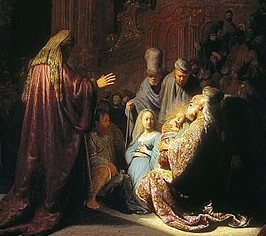 Simeon’s praise in the temple by Rembrandt (Wikimedia Commons)
He didn’t say when, but you knew in your lifetime you would see him. What did that actually mean to him–the Holy Spirit? Would he have known anything about the Holy Spirit?
Luke, writing years later, whose “informant” was probably Mary, knew about the Holy Spirit.
(See this post about the Holy Spirit in the Old Testament).
Who is the Holy Spirit (note present tense)?
The third person of the Trinity.
So, we have the second person of the Trinity, Jesus, being presented to the first person of the Trinity, God.
And the Holy Spirit was directly involved.
Simeon’s worship, undoubtedly, focused on all three.
Who? What is the “Consolation of Israel?”Consolation means “comfort, being consoled.” It can refer to a person who offers solace, comfort, or love during a difficult time.
The Bible is full of consolation, as found in Isaiah 40:1-2:
Comfort, comfort my people, says your God.
Speak tenderly to Jerusalem,
and cry to her
that her warfare is ended,
that her iniquity is pardoned,
that she has received from the Lord’s hand
double for all her sins.
Isaiah 40:1b-2 ESV
This passage refers to the Messiah–whom God promised to send in redemption for Israel’s sins.
When we read the Advent story in context for the larger story of God’s love for mankind, it looks different.
Our pastor noted recently that the whole nativity story takes place in 20 verses.
Simeon’s response to seeing baby Jesus takes 15 verses.
When you add in the prophetess Anna’s response, you’re at 18 verses.
What event–what part of the Messiah’s birth–should be most important to us? (Other than the fact He came!)
Why He came and what He did.
What did Simeon’s worship actually say?What Simeon praised God for is key.
And he [Simeon] came in the Spirit into the temple, and when the parents brought in the child Jesus, to do for him according to the custom of the Law, he took him up in his arms and blessed God and said,
29 “Lord, now you are letting your servant depart in peace,
according to your word;
30 for my eyes have seen your salvation
31 that you have prepared in the presence of all peoples,
32 a light for revelation to the Gentiles,
and for glory to your people Israel.”
Luke 2: 28-32 ESV
We don’t know Simeon’s age, but we can see the joy in his response.
Simeon knew what this baby meant.
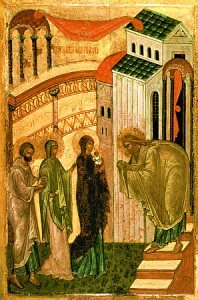 Simeon meets Jesus (Russian Icon; Wikimedia Commons)
Jesus came to provide salvation for all those who call upon the name of the Lord.
He was the promised Messiah. Jesus fulfilled the promise first given in the Garden of Eden.
As Got Questions explained:
The comforter of Israel would fulfill all the promises of the Abrahamic and Davidic covenants.
{He was] the One who would bring both personal and national salvation.
After all those years of waiting and praying for the consolation of Israel, God allowed Simeon to hold the Messiah in his arms.
In this child, Simeon saw the fulfillment of all the hopes and dreams of the Jewish people down through the centuries, and he was overjoyed.
Got Questions? The Consolation of Israel
We all praise God for Jesus’ birth and join Simeon’s worship of joy over His salvation.
Praise, Consolation, and ProphecySimeon spoke other words that day in Jerusalem. (Prophecy is worship)
He turned to the baby’s parents:
His father and his mother marveled at what was said about him. And Simeon blessed them and spoke to Mary his mother.
“Behold, this child is appointed for the fall and rising of many in Israel, and for a sign that is opposed (and a sword will pierce through your own soul also), so that thoughts from many hearts may be revealed.”
Luke 2:33-35 ESV
You decide as a mother– would you want to know this?
But then, didn’t God imply He chose Mary to be the mother of that Consolation of Israel?
As well as the Consolation of our–yours and mine–souls?
Simeon’s praise was just another confirmation of what Joseph and Mary knew about this baby.
And he’s ours, too.
Thanks be to God.
Tweetables
Simeon’s worship points to the Consolation of Israel. Click to Tweet
Worshipping God extends beyond Advent to today. Whatever day it is! Click to Tweet
The post Simeon’s Worship of God at Advent appeared first on Michelle Ule, Author.
December 21, 2021
A Living Nativity for Advent & Christmas

A Living Nativity dominated my Advent and Christmas in both 2020 and 2021.
We first put it together during that curious COVID 2020 when we needed to social distance, or, better yet, stay outside.
Our church’s Board of Education wanted to provide a healthy outing to honor the season.
For the first time since we began attending our Lutheran Church, we had no Advent services in 2020. We may have sat outside in the Christmas Eve cold, but we did sing Christmas carols.
Fortunately, we had a Living Nativity!I don’t recall who thought of the idea, but in October, when indoor gatherings looked unlikely, we began to plan something different.
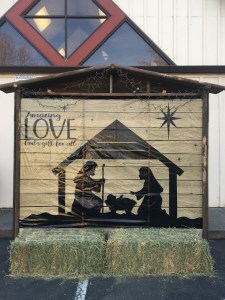
“Why not put together a living Nativity, outside, in family ‘pods.’ They could move together from station to station, seeing the Christmas story?”
This also meant each station of the Christmas story had to be composed of family pods–or actors standing at least six feet away from each other.
Would it work?
It did.
Wonderfully.
In fact, our friends and church family enjoyed the Living Nativity so much, we reprised it in 2021.
Merry Christmas!
Mary meets the Angel GabrielNow in the sixth month, the angel Gabriel was sent by God to a city of Galilee named Nazareth, to a virgin betrothed to a man whose name was Joseph, of the house of David. The virgin’s name was Mary.
The angel said to her, “Rejoice, highly favored one, the Lord is with you; blessed are you among women!”
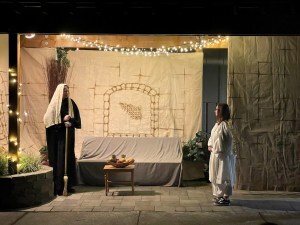 Luke 1:26-38
Seeing and hearing the angel troubled Mary.
The angel said, “Don’t be afraid, Mary, for you have found favor with God.
“Behold, you will conceive and bring forth a Son. You’ll call him Jesus.
He will be great, and will be called the Son of the Highest; the Lord God will give Him the throne of His father David.
He will reign over the house of Jacob forever, and of His kingdom there will be no end.”
Mary said to the angel, “How can this be, since I do not know a man?”
The angel said to her, “The Holy Spirit will come upon you, and the power of the Highest will overshadow you; therefore, also, that Holy One who is to be born will be called the Son of God.
“Elizabeth your relative has also conceived a son in her old age . . For with God nothing will be impossible.”
Mary said, “Behold the maidservant of the Lord! Let it be to me according to your word.”
And the angel departed from her.
Alas, no room at the inn! Luke 2:1-7 (NKJV)
In those days a decree went out from Caesar Augustus that all the world should be registered. All went to be registered, everyone to his own city.
Joseph went up from Galilee, out of the city of Nazareth, into Judea, to the city of David, which is called Bethlehem. He was of the house and lineage of David. Mary, his betrothed wife, who was with child, went with him.
While they were there, the days were completed for her to be delivered. And she brought forth her firstborn Son, and wrapped Him in swaddling cloths, and laid Him in a manger, because there was no room for them in the inn.
The Shepherds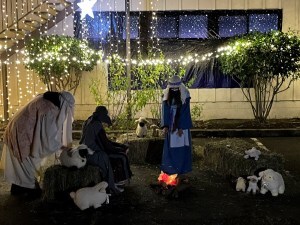 L
uke 2:8-12
L
uke 2:8-12
Now there were in the same country shepherds living out in the fields, keeping watch over their flock by night.
And behold, an angel of the Lord stood before them, and the glory of the Lord shone around them.
They were greatly afraid.
Then the angel said to them, “Don’t be afraid, for behold, I bring you good tidings of great joy for all people.
Today in the city of David a Savior is born. This is the sign: you’ll find a baby lying in a manger.”
Angels!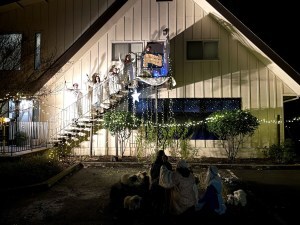 Luke 2:13-15
Suddenly a multitude of the heavenly angels filled the sky praising God and saying:
“Glory to God in the highest,
And on earth peace, goodwill toward men!”
When the angels returned to heaven, the shepherds said to one another, “Let’s go to Bethlehem and see what’s happened that the Lord sent angels to announce.”
Living Nativity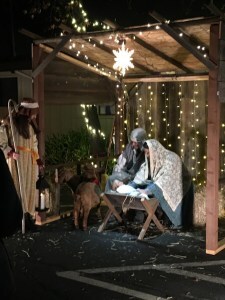 Luke 2:16-20
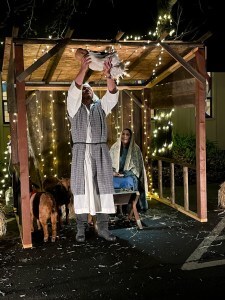
The shepherds came with haste and found Mary and Joseph, and the Babe lying in a manger.
Now when they had seen Him, the shepherd told Mary and Joseph what the angels said!
They marveled at the shepherd’s words.
Mary kept all these things and pondered them in her heart.
The shepherds returned, glorifying and praising God for all the things they saw.
Camels and Herod
After Jesus’s birth in Bethlehem of Judea in the days of Herod the king, wise men from the East traveled to Jerusalem, saying, “Where is He who has been born King of the Jews?
We saw His star in the East and have come to worship Him.”
This troubled Herod and the rest of Jerusalem.
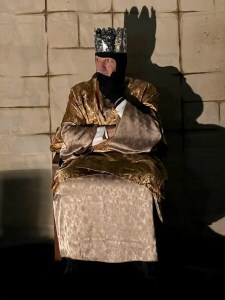
Herod gathered all the chief priests and scribes together and asked where they expected the Messiah’s birth to take place.
“In Bethlehem of Judea, as written by the prophet,” they explained.
‘But you, Bethlehem, in the land of Judah, Are not the least among the rulers of Judah;
For out of you shall come a Ruler Who will shepherd My people Israel.’ ”
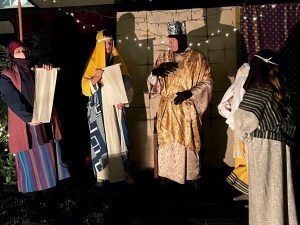 Matthew 2: 1-9
Herod secretly called the wise men and learned at what time the star appeared.
He sent them to Bethlehem and said, “Go and search carefully for the young child. When you find him, bring back word to me, so I can worship Him also.”
When they heard the king, they departed.
Toddler Jesus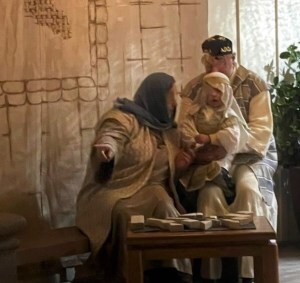 Matthew 2:11-12
(We didn’t have a baby so we used a toddler.)
When the wise men saw the young Child with Mary His mother, they fell down and worshiped Him. And when they opened their treasures, they presented gifts to Him: gold, frankincense, and myrrh.
Then, being divinely warned in a dream not to return to Herod, they departed for their own country another way.
On those chilly December nights in 2020 and 2021, visitors received a gift bag, an individual snack, and greetings for a happy Christmas.
The actors?We shared our acting to a recorded narrative about 15 times.
Even though we couldn’t mingle ourselves, we enjoyed a different way of celebrating the nativity story.
In 2021, we get to sing in the 11 o’clock Christmas Eve service–wearing masks.
Maybe next year we can be mask-free.
Regardless, Jesus is here.
Thanks be to God.
Tweetables
How one church presented a Living Nativity to celebrate Christmas. Click to Tweet
Happy Advent and Merry Christmas–one church acts out the Savior’s birth story. Click to Tweet
The post A Living Nativity for Advent & Christmas appeared first on Michelle Ule, Author.
December 14, 2021
How did Joseph Worship God at Advent?
We know how Mary worshipped God at Advent, but how did Joseph worship God?
The Scriptures tell us he volunteered to quietly “put away” Mary rather than stone her.
That shows us something of his character.
But, would God choose anyone but a good man to foster His son?
Joseph Worship=ResponsibilityMatthew’s Gospel begins with Joseph’s genealogy. It demonstrated Joseph came from a long line of men, some good men, some not so good men.
He was a descendent of King David–which was crucial in God’s decision.
A carpenter, Joseph entered a traditional betrothal with Mary.
He undoubtedly swallowed when she came to him with the news she was with child from the Holy Spirit.
 The man had a job!
The Mérode Altarpiece (Robert Campin, Wikimedia Commons)
But as a “just man,” he resolved to divorce her quietly. He didn’t want to shame her. He didn’t want her stoned to death for adultery.
God, however, sent him a special message in a dream:
Joseph, son of David, do not fear to take Mary as your wife, for that which is conceived in her is from the Holy Spirit. She will bear a son, and you shall call his name Jesus, for he will save his people from their sins.”
Matthew 1:20 (ESV)
He must have known and recognized the Scriptures concerning the Messiah.
Most scholars believe Joseph was dead by the time Jesus grew to adulthood. While Luke’s information about Jesus’ childhood undoubtedly came from Mary, Joseph never provided his point of view.
His actions spoke loudly. He assumed responsibility for Mary and her child–no matter the way Mary became pregnant.
The Bible reports no protest when Mary left Nazareth and headed to Judea to visit her cousin Elizabeth.
Worship = FaithThe Lifelight Foundations Bible study Worship noted, “the chief act of worship is really no act at all; it is a gift of God. It is faith.”
How did Joseph worship God? By acting, time and again, in faith.
By faith, he saddled up his pregnant wife and took her 75-miles from Nazareth to Bethlehem for the census.
What newlywed with a young bride would take her far from her family so close to confinement?
He obeyed the law of the land and traveled with faith God would take care of the situation.
You can almost hear his reasoning–“Well, God is behind this, so we should be okay.”
Responding to God–even at great inconvenience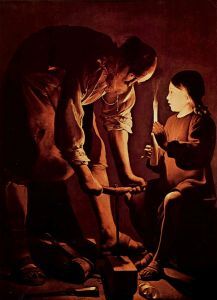 Joseph the Carpenter
 by George LaTour
(Wikimedia Commons)
In the same way, traveling to Bethlehem was a great inconvenience.
While in appearance, that journey had nothing to do with worshipping God, in reality, it had everything to do with Jesus!
Mary could not have taken the trip alone–why would she?
But, how else could the Messiah be born in Bethlehem?
They surely knew the prophecies.
Perhaps Mary and Joseph both were enthusiastic about the trip, knowing what it meant?
Joseph worship meant acting in faith and great personal inconvenience according to God’s plans.
Did Joseph worship God in the manger?Years ago, while acting as a birth coach, I ran around the house trying to find my car keys (in my pocket), my packed lunch (in my purse), and, most importantly, my glasses.
They were on my face.
Even though it wasn’t my baby or even the baby of a family member, having to get a laboring woman to the hospital distracted me.
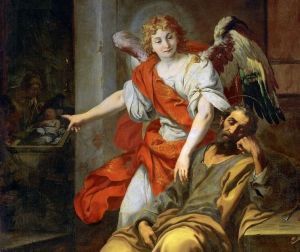 Dream of Flight by Daniele Crespi
 (Wikimedia Commons)
How would Joseph have managed alone, not in a hotel room, no relatives around, and his bride in labor?
Don’t you think he felt stress that night in the manger?
He was the bridegroom and the midwife (mid groom?) that night.
And then in waltzed a group of shepherds claiming to have seen a sky filled with angels.
When they dropped to their knees in front of the baby Jesus, Joseph may very well have joined them.
Joseph worship: loving, protecting, and overseeing–the Son of GodAs a good Jewish father, Joseph escorted his wife and newborn son to the temple for circumcision and presented an offering. This was an act of worship.
There, he encountered Simeon and Anna.
An elderly man and an elderly woman approached with tears in their eyes to rejoice over God’s son.
Surely Joseph was pondering things in his heart, just like Mary!
Such bewilderment–to worship a newborn king?
And yet, Simeon declared Jesus “the Lord’s Christ.”
The prophetess Anna took one look and, “she gave thanks to the Lord and spoke of Him to all those who looked for redemption in Jerusalem.”
Joseph worship = actionJoseph didn’t sit around admiring his newborn king/son.
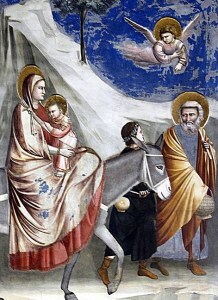 Flight into Egypt by Jose Ribeiro (Wikimedia Commons)
The family may have settled in Bethlehem for a time. They were there when the wise men arrived— more people proving God’s prophesy.
The gifts they gave Jesus probably caused Joseph’s eyes to widen. So much!
And yet, that night in a dream, another angel arrived to direct them on.
Joseph packed up Mary and Jesus the following day and headed west to Egypt. The gifts probably paid for the trip and may have lasted the family for several years.
(A large Jewish community lived in Alexandria, and Egyptian legend has it the family fled to Heliopolis seven miles north of Cairo).
So much happened with this child! Jesus needed a father who acted and did not question supernatural events.
Joseph worship–honoring GodAs shown above, Joseph did not hesitate to follow his religion. He married Mary, and he took their child to the temple. He protected his family without question and responded to dreams from God.
We last see Joseph when Jesus was twelve (after his bar mitzvah), and the family traveled to celebrate Passover in Jerusalem.
By that time, the family undoubtedly had other children. Joseph and Mary probably depended on Jesus to do and be everything they needed him to be as the oldest son. Since they traveled with family, they didn’t notice Jesus missing for several days.
But, once they couldn’t find him, Joseph and Mary retraced their route. They found Jesus in the temple, confounding the scholars.
What did Jesus’ parents know?
His mother said to him, “Son, why have you treated us so? Behold, your father and I have been searching for you in great distress.”
And he said to them, “Why were you looking for me? Did you not know that I must be in my Father’s house?”
And they did not understand the saying that he spoke to them. He went down with them and came to Nazareth and was submissive to them
Luke 2:48-50
So, maybe Mary and Joseph didn’t understand, completely, who their son was.
Surely that was for the best?
Rather than worship God by worshipping his son, Joseph chose to love Jesus as his son.
Worship to Joseph at Advent and beyond meant using his faith to care for the charge God specifically gave him to do.
Good advice for all of us.
Tweetables
Did Joseph worship God in the Advent stories of Jesus’ birth? Click to Tweet
How Joseph put action into his worship of God during the Nativity. Click to Tweet
The post How did Joseph Worship God at Advent? appeared first on Michelle Ule, Author.
December 7, 2021
Mary’s Worship of God at Advent
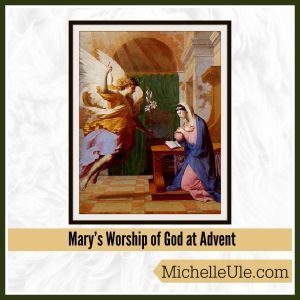
Mary’s worship of God began long before that fateful Advent when the Angel Gabriel appeared to her.
The eternal question is why did God choose that particular woman to be the mother of His son?
He obviously knew her well.
How do we know that?
Because of Mary’s worshipful response to the angel’s preposterous news.
Mary’s characterThe Gospel of Luke provides us with the largest understanding of Mary.
(Some Biblical scholars believe Mary served as Luke’s main source for his Gospel.)
Like most Hebrew women of the time, Mary was betrothed. She lived in a small village, Nazareth, about 19 miles west of the Sea of Galilee.
Jews and Romans, along with a motley mix of other Gentile cultures lived in the Galilee region.
When the angel Gabriel stood before Mary, he had words of praise:
“Greetings, O favored one, the Lord is with you!”
But she was greatly troubled at the saying, and tried to discern what sort of greeting this might be.
And the angel said to her, “Do not be afraid, Mary, for you have found favor with God. And behold, you will conceive in your womb and bear a son, and you shall call his name Jesus.
(Luke 1:28-31 ESV)
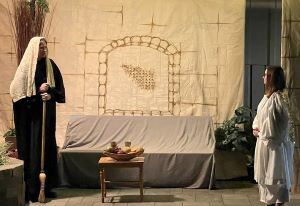
She couldn’t imagine why an angel would appear to her, much less what it meant “the Lord was with her.”
Wasn’t He always with her?
But then the angel delivered the surprising news she would conceive by the Holy Spirit and bear a child named Yeshua!
What does Yeshua mean? Salvation.
Mary’s worshipGabriel filled in a few details–Jesus/Yeshua is the Son of God– and Mary responded with a basic question.
How?
The Holy Spirit will come on you, and the power of the Most High will overshadow you. So the holy one to be born will be called the Son of God. Even Elizabeth your relative is going to have a child in her old age, and she who was said to be unable to conceive is in her sixth month. For no word from God will ever fail.”
Luke 1:35-37 NKJV
Notice that while Gabriel answered her question, he also provided her with corroborating evidence that God could do miraculous things. Her elderly cousin Elizabeth was pregnant.
And note his last sentence, which may have been a gentle chiding: “No word from God will ever fail.” This will happen.
What would you do with such a message?
Mary acknowledged and “agreed,” with humility: “Behold, I am the servant of the Lord; let it be to me according to your word.” (Luke 1:38)
God knew Mary’s heart.
Mary’s worship: the Magnificat Visitation, St Vaast Altarpiece by Jacques Daret (Wikimedia Commons)
The young woman traveled to visit Elizabeth and her husband Zechariah in the southern hill country of Judah (not far from Jerusalem).
Elizabeth called out her greeting, “Blessed are you among women, and blessed is the fruit of your womb!”
Did the teenager simper?
No.
Instead, she used the greeting to worship the God who had put her into such an interesting . . . state.
What can we learn from how Mary worshipped God?
My soul magnifies the Lord,
47 and my spirit rejoices in God my Savior,
48 for he has looked on the humble estate of his servant.
For behold, from now on all generations will call me blessed;
49 for he who is mighty has done great things for me,
and holy is his name.
50 And his mercy is for those who fear him
from generation to generation.
51 He has shown strength with his arm;
he has scattered the proud in the thoughts of their hearts;
52 he has brought down the mighty from their thrones
and exalted those of humble estate;
53 he has filled the hungry with good things,
and the rich he has sent away empty.
54 He has helped his servant Israel,
in remembrance of his mercy,
55 as he spoke to our fathers,
to Abraham and to his offspring forever.”
Luke 1: 47-55
Several things stand out:
Focus: God (v. 46-47).Humility (v. 48).Awe (v. 48-49).Recognition of God’s character (v. 49).Acknowledgment of His mercy toward her and others (v. 50).Awe at God’s power and ability (v. 51).Marveling at God’s work in the past (v. 52).Recognition of God’s grace to the poor. (v. 53).Remembrance of God’s work in the lives of His people (v. 54-55).To whom did Mary direct her words?
God.
Do you see the words “I, me, feel, just, mine,” or other personal references?
No. Mary’s worship focused on the God who created her.
Her understanding of who God is, how He acted in history, and what He promised to do, motivated her praise and worship.
Mary’s worship at Advent focused on God alone.
Let’s do the same this Advent.
Tweetables
How did Jesus’ mother Mary worship during her Advent season? Click to Tweet
What can we learn about worship during Advent from the virgin Mary? Click to Tweet
The post Mary’s Worship of God at Advent appeared first on Michelle Ule, Author.
November 30, 2021
How Can We Best Worship God at Advent?

How can we best worship God at Advent?
By focusing on God.
Or Jesus.
Or even the Holy Spirit.
That may be why Advent –as opposed to the Christmas season–can be a simpler and joyful time.
Our focus–in music, readings, candles, services–is on God, rather than . . . things.
Who was God at Advent?Liturgical churches, Christian churches that follow a set pattern of worship rituals in the services, are the ones most likely to refer to the Christian season as Advent.
The word comes from the Latin adventus, “coming or arrival,” which naturally would refer to Jesus’ birth.
 Click to read the full post
Advent anticipates three events:
The celebration of Christ’s birth this year.His resurrection celebration in Easter next year.His promise to return–anytime.In my Lutheran church, Advent means singing Christian hymns focused on the story of Jesus’ birth–anticipation, arrival, praise, and then the wise men arrive bearing gifts at Epiphany.
We celebrate them all.
God sent His son to be born into the world.
We choose to celebrate the event on December 25, but of course, no one knows the real date of Jesus’ birth.
The Holy Spirit at AdventHow do we worship God at Advent in the form of the Holy Spirit?
The Holy Spirit is part of the trinity and He played an integral role in the nativity.
When Mary, an unmarried woman, asked the Angel Gabriel how she could become the mother of God, he had an answer:
The Holy Spirit will come on you, and the power of the Most High will overshadow you. So the holy one to be born will be called the Son of God.
Luke 1: 35-36 NKJV
Mary accepted that answer, submitting her life to God through the Holy Spirit’s work.
(What would she have known about the Holy Spirit? She would have known references to God’s spirit from Numbers and King David himself among other places.
(Numbers 11:29–Moses says “Oh, that all the Lord’s people were prophets and that the Lord would put His Spirit upon them!
(David in Psalm 51:11 begs God, “Do not cast me away from Your presence. And do not take Your Holy Spirit from me.”)
Jesus at AdventWell, obviously, Advent’s awaiting is for Jesus.
Our church celebrates the Sundays of Advent by lighting candles: those focused on the coming hope, peace, joy, and love
He’s the reason for the season and we celebrate his arrival with music–like Handel’s Messiah.
Including the classic announcing Jesus’ birth:
Here’s a page full of Jesus-related Advent hymns.
Many of the best-loved Christmas carols soar on this theme: O Holy Night; Away in a Manger, Oh Little Town of Bethlehem.
Focusing on God at AdventFor many of us, focusing on God at Advent is a challenge. The busy Christmas season beckons us away from spiritual reflection on the marvel who is coming.
That can rob us of what’s truly important about this annual remembrance.
God living with us is coming.
We’re not alone to walk in darkness any longer. The Messiah, the Savior of the world came.
We’re just remembering.
Fortunately, we have examples all through the Bible–particularly in the Advent stories–about how other people celebrated whatever year Jesus was born.
From them, we can learn what it means to worship God at Advent by our actions, words, gifts, and even our dreams.
Christ the newborn King is coming soon.
Thanks be to God.
Tweetables
How can we worship God at Advent? Click to Tweet
How is Advent different from the Christmas season? Click to Tweet
The post How Can We Best Worship God at Advent? appeared first on Michelle Ule, Author.