Lee Martin's Blog, page 7
September 9, 2024
No Explanations

At the end of Katherine Mansfield’s story, “The Garden Party,” a young girl, Laura, tries to explain to her brother, Laurie, what she’s just experienced. After an extravagant garden party at Laura’s home, her mother sends her down the hill with a basket of leftover food for the family of a young workingman who that very day died in a tragic accident. Laura, who’d been sympathetic when news of the death arrived just before the party—so much so, she told her mother they shouldn’t have the party at all—now has room for only fond feelings about the party: “And it seemed to her that kisses, voices, tinkling spoons, laughter, the smell of crushed grass were somehow inside her. She had no room for anything else.”
At the home of the dead man, she’s invited and gently coerced into viewing his body. She takes note of how peacefully he seems to be sleeping, but she’s also aware of the reality of his life having ended: “Never wake him up again. . . .What did garden parties and baskets and lace frocks matter to him? He was far from all those things. He was wonderful, beautiful.”
Walking back to her house, she meets Laurie who’s come to check on her. He asks her, “Was it awful?” She tells him, “It was simply marvelous.” Then she tries to express her feelings: “Isn’t life,” she stammered, “isn’t life—” But what life was she couldn’t explain.
Exactly. What she’s just experienced—the contrast between the gaiety of the party and the somber grief in the young man’s house, as well as the beauty of his corpse amidst the sadness—has led to this undefinable juxtaposition of life and death. How do we explain all that? How do we say what life is?
We don’t, and Mansfield doesn’t. She lets the contrasts in the story settle in Laura as she must make room for them before she can find words for what she may or may not be able to articulate one day beyond the final page of the story—those eternal mysteries of our living.
Often, at the ends of our first drafts, we try to do too much. We try to make sure our readers get the point of the story. This approach almost always goes awry. As Mansfield illustrates, it’s better to embrace the unknowable, to let it arise organically from the details of the story. If we can simplify the plot, we can intensify the emotional impact of small but significant moments. When Laura looks upon the body of the young man, something changes for her, something for which she has no words. Sometimes that’s what stories do. They dramatize rather than explain, If we could explain a story, we wouldn’t need it. We’d simply need the explanatory statement, but some things are so complicated there is no explanation. That’s when we need the dramatization of characters in circumstances that end up affecting them deeply, so deeply all we need do is let them and the readers feel.
The post No Explanations appeared first on Lee Martin.


September 2, 2024
It Could Have Been: The What-Ifs of Narrative

Cathy and I have been watching reruns of the old sitcom, My Three Sons, which first aired in 1960. At that time, I would have been around the same age as the youngest son, Chip, so watching the show has been a bit nostalgic for me. I remember the toys and board games I see on the show. I remember the haircuts and the clothing styles. I remember the customs. The show’s suburban setting reminds me of 1963, the year my mother took a teaching position in Oak Forest, Illinois, on the southern edge of Chicagoland, and for six years we came as close as we ever would to living the sort of life the Douglas family did on My Three Sons. We left our farm in southern Illinois and rented an apartment in Oak Forest. It was such a different world. When I walked to school with friends, we sometimes stopped at a local bakery for whatever treats caught our eyes. When we headed down 159th Street, we signaled for semi drivers to sound their horns, and often they obliged. Starting in the fourth grade, I played biddy basketball which eventually led to a place for me on my middle school team. My parents came to all my games. Even though we spent our summers back on our farm, I was already starting to identify with the lifestyle we had in Oak Forest.
The spring I was graduating from the eighth grade, my parents felt they had to make a decision. Should they stay in Oak Forest for my high school years, or would it be better for my mother to retire from teaching and to move back downstate? I remember going with my parents to look at a few houses that were for sale. They were in the newer subdivisions; some of them weren’t even fully constructed. The lots had no sod, the roofs needed to be finished, the concrete driveways were yet to be poured. Our farmhouse had no running water. It had a large country kitchen with a pump by the sink, a living room with a fuel oil heating stove, a front bedroom, another bedroom that had been added at some point, a pantry, and a wash porch. When we came to Oak Forest, it was the first time I’d had a bathroom inside the house. The apartment we rented was a one-bedroom with a kitchen, living room, and bath. Even from my vantage point on a sleeper sofa, it seemed luxurious, but these newly built homes? They were beyond anything I could ever have imagined my parents and I owning. They must have had trouble imagining it, too, because they decided to go back downstate where I began my freshman year at a school with an enrollment of around 140 students.
From time to time, I wonder what my life might have been like had we stayed in Oak Forest. I think about what academic and athletic and artistic opportunities I might have had. Maybe if I’d been challenged more, I might have risen faster. Who’s to say? All I know is I felt at home there, and I remember the sadness of leaving. On one of the final days of school, I remember an assembly where the graduating eighth graders could speak to representatives from the high school about various extracurricular activities. I remember sitting on the floor of the gym, my back against the wall, while my basketball teammates lined up to speak to the high school coach.
“I figured you’d be with them,” one of my non-basketball-playing friends said to me.
“It’s no use,” I said. “We’re moving.”
When you’re young, you have little to say about the direction your life takes. Other people make those decisions for you. So the day came when my parents and I drove away from Oak Forest forever. I left my friends and my girlfriend behind, and I left whatever life I might have had. This isn’t to say I object to the life I had in a small downstate town. After all, those years have informed so much of my writing. Still, I wonder, as I imagine many of you do either with your own lives or the lives of your characters, what would have happened if my parents hadn’t made the decision to leave. It’s funny I should be thinking of such things here a month before my sixty-ninth birthday, but maybe it’s exactly the right time to look back and to wonder about the path not taken.
All it takes is for me to see one of the boys on My Three Sons wearing a shirt with a button on the back of the collar, or a pair of chinos, or penny loafers, or high-top Chuck Taylors, to take me back to that time of my life when I stood between one world and another with no agency to determine which I might prefer. That wasn’t my job. I was just a kid. I’d have to make do with whatever my parents decided, not knowing their choice would produce a longing that still exists just beneath the surface. What longings do you or your characters have? How can you use unfulfilled desire in a narrative? What if you began with this: I always wonder what might have happened if. . . .” Or, to make this more pointed toward a piece of fiction, Loretta always wondered what might have happened if. . . .
Let that awareness of a life offered but not realized propel your narrative.
The post It Could Have Been: The What-Ifs of Narrative appeared first on Lee Martin.
August 26, 2024
Yard Sale: Let’s Start a Story

Cathy and I got some great bargains at Kroger today. Oak milk, two cartons for four dollars; quarts of vegan ice cream, buy one, get one free. Sometimes it takes so little to delight us. Thank goodness for the upright freezer in our basement.
So that’s it. That’s the end of the story. It isn’t even a story, really. It’s more of an anecdote: We went to Kroger. We bought oat milk and vegan ice cream. Then we went home. Nothing out of the ordinary happened. It isn’t even worth my time telling or your time reading. It’s a collection of statements that disappear as soon as they’re uttered.
Stories, as we know, are worth telling because they’re about days (or moments) unlike the regular come-and-go. They merit telling and reading because they’re heading somewhere valuable. Without them some truth of human behavior would be lost to us forever. We have to ask, “Where’s the rub, the friction, that makes a story worth telling? We might even add Faulkner’s comment about stories being about the human heart in conflict with itself.
I’m teaching Raymond Carver’s story, “A Small, Good Thing,” this week. The story opens, as you may recall, with a mother going to a bakery and ordering a cake for her son’s birthday. If we stop there, we don’t have a story. It takes what happens next to propel the narrative toward what Faulkner called “the old verities and truths of the heart.” The birthday boy gets hit by a car on his way to school. At first, he seems to be okay, merely dazed. He’s able to walk back to his house where, as he’s telling his mother what happened, he loses consciousness. What follows is a stretch of days unlike any others. The birthday cake that the mother ordered becomes so much more than a mere object. I won’t ruin the story by telling you the role the baker plays, but trust me, it’s significant.
So an object might bring one who possesses it delight, but that won’t make a story. We need the friction of a complication.
Imagine, then, that one of your characters has gone to a yard sale where they’ve purchased a particular object. What might that object be? Don’t settle for the predictable items one might find at such a sale; be sure to include the extraordinary. In mapping out a story, what will happen next because of your character’s purchase? What wrinkle will appear? I’m being deliberately vague with possible examples because I want your imagination to run wild. The key is to quickly introduce some sort of complication that changes the way the main character looks at the object they’ve just acquired with the hope that this will begin a chain of narrative events that will take us to the truths of the heart that Faulkner mentioned.
The post Yard Sale: Let’s Start a Story appeared first on Lee Martin.
August 19, 2024
At the Start of a New School Year

Here we are again at the start of a new school year. Autumn, customarily notable for its decay—leaves falling and winter coming—has always signaled the start for me. I’ve spent forty-two years of my life teaching people how to be better writers, so fall has always meant renewal. It’s always been the chance to start again.
This has me thinking about how we often hit walls in our writing careers. We get frustrated with a particular project or with the trajectory of our journeys in general. Sometimes we think about giving up. Sometimes we do throw in the towel. I’ve got more than one novel “in the drawer,” as the saying goes. These early attempts will never see the light of day. In fact, they’re probably buried now on some ancient floppy disk, and who will ever take the time to recover them? This is probably for the best. I’ve also reached points where I’ve seriously considered giving up writing altogether, but I’ve never been able to do that. I’ve kept writing through sadness and illness and self-doubt. The one constant in my life has been that work.
It’s been a fabulous way to spend my days. As challenging as it sometimes is, it also enriches me. It allows me to bear witness to this crazy thing we call living. It increases my ability to empathize. It makes me aware of the contradictions we all carry in our hearts. It helps me understand the sources of people’s behaviors. In short, it makes me more human, and that’s the grandest educational experience one can have.
The point is no matter how tempted we are to give up, each day asks us to make a choice to keep doing what we love, no matter how maddening it can be on occasion. We often pretend that others can dictate that choice for us—the editors who say no, the critics with their barbs, the indifference of a universe that often appears to not care about the value of the written word—but the truth is we’re the only ones in control of how we choose to live our days, and we can make that choice day by day, month by month, year by year.
So, here’s to all of us who choose to keep going. No matter what your passion might be, keep doing what you love. Let the work itself be the reward.
The post At the Start of a New School Year appeared first on Lee Martin.
August 12, 2024
Characters on Road Trips

At 12:30 a.m. the night before Cathy and I were to board a plane to Kennedy airport and then on to Burlington, Vermont, I happened to check my phone where I learned the flight from Kennedy to Burlington had been cancelled, and, when Cathy called Delta, she learned that there were no other flights the rest of the day. I needed to be in Burlington that evening for the start of the Vermont College of Fine Arts Postgraduate Writers Conference where I’ve taught the past fifteen summers. What were we to do? The only thing we could do. Come 6 a.m., we were in the car, Vermont-bound, a twelve-hour road trip ahead of us.
Would you believe we didn’t turn on the radio a single time? When it came to long road trips, this wasn’t our first rodeo. Ten years ago, we made the drive from our native southeastern Illinois to Lubbock, Texas, for the wedding of a former student. We were in Cathy’s Mustang GT that time (she even let me drive!), and again, we never turned on the radio. As we did on our Vermont trip, we talked. We used the pairings of two cities on road signs to create characters, and we told stories about them. The time and the miles passed. We rarely squabbled even on the fourteen-hour return trip thanks to the heavy rains of tropical storm Debby. Cathy and I travel well together, which should never be the case for our characters.
Professor Brooke, in Tobias Wolff’s story, “An Episode in the Life of Professor Brooke,” is looking forward to driving alone to a regional MLA conference. We know from the opening paragraph that he “had no real quarrel with anyone in his department.” He did, however, dislike a Yeats scholar named Riley. The night before Brooke’s drive, he gets a call from Riley, whose car is in the shop, and wouldn’t you know it, he wonders if he could catch a ride to the conference with Brooke. As the story goes on to illustrate, this is a perfect pairing of characters. We get excellent mileage out of such a pairing especially if the characters can’t escape from each other. In this case, Brooke’s car encloses them, and it’s even impossible for them to lose each other at the conference which provides another claustrophobic setting. Tensions simmer until they finally have their release. We put our characters on a collision course that eventually must have its climax.
To put this into practice with a piece of fiction, ask yourself which two characters have tensions between them but due to politeness they keep them submerged. Give them a setting that makes it difficult for them to ignore each other. Daydream a plot that brings them closer and closer to letting those tensions come to light. Find a climactic moment in which each character knows exactly what the other thinks of them. The same prompts apply for a piece of creative nonfiction.
Writers must be matchmakers. The proper match increases the tension and articulates the stakes of the narrative. We can’t always be blessed with the perfect travel partners. If we were, what stories would we tell?
The post Characters on Road Trips appeared first on Lee Martin.
July 29, 2024
Keep Working

Here we are at the end of July, the time when we begin to make the turn to the start of a new school year. For me, it’s a few weeks off, but those weeks will go fast, and before I know it, the endless days of summer will come to an end. It’s a time when I take stock of what I’ve been able to accomplish during the summer months, and, as usual, I think I could have done more. It seems I always think that. I’m rarely satisfied with my productivity, and maybe that’s a good thing; it’s a sign that I’m still driven to get results.
This summer, I wrote two new essays, revised a novel and a memoir, contributed an excerpt from the novel to an upcoming anthology and went through the editing process, and went through the copy edits for my new novel that’ll be out in March.
So why can’t I be satisfied with all that? I think it’s because I don’t know what my next big project will be, and that’s unsettling. I’m happiest when I’m writing something new and working with it day by day. Long ago, I had a writing teacher who talked about earning one’s job. A good first draft, he said, showed you what needed to be done; it laid out your work. That feeling of getting up each day, knowing the work ahead of me, is one I cherish. Without it, I feel a bit lost.
I’m starting to see, though, that teaching can give me a similar feeling. I’ve done a good bit of that this summer. I’ve taught in the low-residency MFA program at the Naslund-Mann Graduate School of Writing at Spalding University, I’ve presented craft lectures at the West Virginia Writers’ Conference, and I’m getting ready to teach a week-long novel workshop at the Vermont College of Fine Arts Postgraduate Writers’ Conference. (By the way, due to the conference, I probably won’t be making a new blog post next week.) I’ll have a week off once I’m done at VCFA before classes begin at Ohio State University where I’ve taught since 2001. I’ll be teaching an advanced undergraduate fiction workshop and a graduate-level seminar in the forms of the short story. I’ll also be directing four MFA theses. I’ve always loved teaching. Helping students develop their craft can be just as satisfying as practicing the craft myself.
To be honest, though, I sometimes complain about the time teaching takes from my own writing. Then, amid my whining, I think of writers who work outside academia, who raise families, take care of loved ones, and pay attention to the countless things our adult lives ask of us. A long time ago, before I determined what my path in life would be, I worked in factories with people who would always work there. I watched how the work broke down their bodies. I listened to the stories of their lives—their divorces, the deaths of their loved ones, their financial struggles, and sometimes their criminal troubles. Day after day, year after year, they did their work because they had no other choice. Their lives passed like that, one sunrise after another, one more pajama yoke sewed, one more tray of tire patches pressed, one more shoe lining cut until the time came when, either due to retirement, or illness, or death, there was no more work. I watched my father’s life pass like this and my mother’s. My father’s heart disease made it impossible for him to keep farming. My mother retired from teaching and went to work as a housekeeper and a laundress at a nursing home until she couldn’t physically do her job.
Maybe this is why I get antsy when I don’t have a clearly defined project in front of me. Maybe I’m afraid, if I stop working, my own end will come sooner rather than later. Maybe I have to keep writing and teaching to avoid thinking about the inevitable—the final end that comes for all of us. As long as I can keep going, I can pretend this day will never come.
The post Keep Working appeared first on Lee Martin.
July 22, 2024
The Importance of Silence in Narratives

My wife Cathy is in Chicago this week, visiting her sister, so, the house, without her to talk to, is filled with much more silence than usual. This has me thinking about how fiction writers sometimes rush to get the plot onto the page, neglecting the benefits of putting space around significant events through the use of silence. I suspect this might be particularly true when it comes to the writing of first novels, although I’ve also seen the same with short stories.
I understand the inclination to rush through a plot. After all, we’re always thinking about what’s going to happen next in our narratives. If we proceed at a breakneck speed, eager to get to the next big thing that’s going to happen, we often neglect the more vertical part of writing that takes us into the characters’ thoughts and emotions. We risk ending up with a plot that may indeed be a consequential one but doesn’t have any lasting impact on our readers. We must remember that stories are about human beings who should be able to move us as we watch them deal with the events of the plot. “What is character,” Henry James said, “but the determination of incident. And what is incident but the illumination of character.” Our characters should create the plot by virtue of their own choices. The plot, then, should reveal more of the characters than we’d have without the narrative. That’s what makes a piece of fiction memorable.
So, space and silence. Space comes from staying in the moment longer so that moment resonates. If we write more, we create a visual clue that something important has happened. Silence comes because we’ve stopped trying to push the plot ahead. Instead, we’re pausing before moving on toward the next significant event.
Here, then, are a few ways writers create space and silence in a narrative:
By using interiority. We access the thoughts and emotional responses of a character. Think of Nick Carraway in The Great Gatsby or Gabriel in James Joyce’s “The Dead,” or a number of other characters from literature who feel and feel deeply the events of their lives.
By using the landscape. We could look once more at Gabriel in “The Dead” with his description of the snow falling over Ireland at the end of that story. Our descriptions can empathize the significant turns in a plot.
By using reflection. This is especially useful in first-person narratives when the narrator, speaking from a position beyond the time of the narrative, can look back upon it with a clarity and wisdom that they didn’t have then. This can also happen with the third-person point of view
By flashing forward. Moving the readers into the future so they see where a character ends up can also slow the narrative and put space around an important plot point.
Charles Baxter, in his book, Burning Down the House, says, “. . .silence is an intensifier—that it strengthens whatever stands on either side of it.” A pause in the action, then, calls our attention to plot events and how they matter. By making space and reaching a point of stillness, we enhance the plot. We make it more than merely entertainment. We make it unforgettable because we let the readers feel why the narrative matters.
The post The Importance of Silence in Narratives appeared first on Lee Martin.
July 15, 2024
The Emotions Behind the Facades

As many of you probably know, I had a stroke nearly twelve years ago. A blood clot traveled to my brain. Fortunately, I left the hospital, after two days, with no physical impairments. Since then, my doctor has had me taking an adult-strength aspirin every day. It’s kept my blood from clotting, but it’s also left me prone to bleeding and bruising under the skin if I bump into something or scrape against something. Contributing to the situation is the fact that our skin thins as we age. As my doctor recently said to me, “You’re not an old man, but you’re not a young man either.” Gee, thanks. At age 68, I don’t consider myself old, but from time to time these discolorations on my hands or arms tell me differently.
Which has me thinking of how thin-skinned—metaphorically that is—we all can be no matter our age. We all have those sore spots, the old memories or insecurities or sensitivities that can bring out an emotional response. It’s often our inclination to avoid those responses in our writing, but really we should be pushing toward them. We all have facades that we construct to protect ourselves from revealing too much, but those revelations are what writing is all about. Whether we’re writing fiction or creative nonfiction, we find those pressures that cause the facades to crumble, and to show, if only temporarily, a truer version of our characters or ourselves.
Let’s begin, then, with an inventory. Make a list of memories that make you uncomfortable, memories that evoke an emotional response. Add your shortcomings to the list, flaws that you don’t want anyone else to notice. Finally, add everything that you fear. If you’re writing fiction, choose something from your list and give it to your main character. Then construct a narrative that makes it impossible for that character to keep a painful memory, or a flaw, or a fear hidden. If you’re writing creative nonfiction, see if you can remember a time in your life when it was impossible for you to do the same. You might also write honestly about why you have a certain fear, or why a specific memory causes you to feel emotional, or what you think a flaw says about you.
No matter which route you take, the important thing is to let your emotions rise organically from the specific details of what you try to ignore or hide from the world.
The post The Emotions Behind the Facades appeared first on Lee Martin.
July 8, 2024
Sensory Trails and the Writing of Memoir
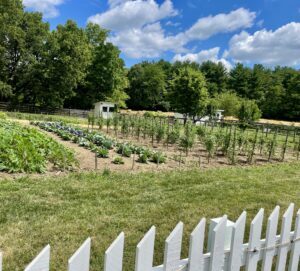
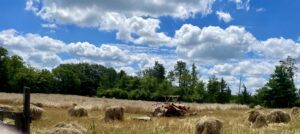 On Saturday, Cathy and I drove out to a living historical farm. The weather was pleasant—temps in the low-80’s with little humidity—and it was a pleasure to get out into the country. We walked up a lane along a field where a man was using a reaper-binder to assemble wheat shocks. We passed the chicken pen where a very vocal rooster was crowing. We looked at the large vegetable garden just outside the farmhouse. Everything took me back to my youth when I lived with my parents on our farm in southeastern Illinois.
Watching the man at his labor in the wheat field took me back in time to the days I’d helped my father with the harvest. Only now, I could see what I’d been too self-absorbed to understand then—how hard my father had worked and how, despite the toll on his body, he’d loved it all. My mother had worked hard, too. As a small boy, I’d gone with her to gather eggs from the henhouse. I’d played with my toy trucks at the edge of our garden while she ran a tiller up and down the rows or built teepees with four stakes made from tree branches for our Kentucky Wonder pole beans to wind around or bent her back to pick whatever vegetables were ready. Later, I watched the sweat pool in the hollow (the suprasternal notch) of her throat as she canned tomato juice and green beans. I remember the heat of the kitchen, the whirr of an oscillating fan, and the pops of the lids as the jars sealed.
 At the living historical farm’s corn crib, had I wanted, I could have shelled an ear or two. The smell of the kernels and the discarded red cobs didn’t just remind me of the crib at one end of our barn, it gave me the feeling of being there on a raw October day when I was five years old, and I stood in my father’s wagon and threw ears through the crib’s high windows so we could have corn through the winter for our hogs. I remembered my mother’s headscarf and her Dickies work jacket and how they carried the faint scent of the kerosene she toted in five-gallon DX cans to use in our heating stoves—all that and my own corduroy coat and the way it felt when I ran my fingers over the wales.
I could go on and on, one sensory detail leading to another. And not only details, but the memories attached to them, not to mention the people. Writing memoir is always an act of resurrection. We revisit the past to make it vivid on the page. We relive what we’ve already lived because the writing allows us to dramatize, spectate, participate, reflect, interpret, interrogate, speculate, and imagine. This work is done in the service of making meaning as we look back on where we’ve been. As we move from reliving significant moments to thinking about those moments, we come to know what we couldn’t understand then. What better way to start that journey into the past than by way of sensory details? What are yours? What takes you back into the past? Perhaps, certain sounds, tastes, scents, or the way something felt when you touched it? Follow your own sensory trail to a time in your life that invites your further examination. Maybe you’ll even get lucky, like I did, and you’ll find a place near you that has exactly what you need to see, hear, smell, and feel.
The post Sensory Trails and the Writing of Memoir appeared first on Lee Martin.
July 1, 2024
Quick Starts

It’s a pleasant Sunday. Cathy and I have been out for breakfast and then to our favorite produce market where we got some Georgia peaches and locally grown tomatoes, zucchini, summer squash, cucumbers, and small, red-skinned potatoes. In the meantime, a granddaughter is about to give birth to her first child in North Carolina.
It’s this birth that leads me to think of beginnings and how the arrival of a baby brings with it a great hope. We hope for the good health of the child and the mother. We hope for the life to be lived. May it be filled with happiness and love. Unlike the characters we create, we want to protect the newly born and the life span in front of them. We want to keep them from harm. If we approached our writing from a parental perspective, nothing would ever get written because nothing would ever go wrong. Our characters would live ideal lives during which they would never suffer, and because of that they would never have stories to tell.
Of course, we know it’s unrealistic to expect a sheltered life. Injury and loss will come along with sadness and joy. If we’re lucky, we’ll understand it’s all right to feel our sorrows along with our moments of happiness. That’s what living is all about. The capability to feel deeply makes us more human.
That’s what we’re looking for when we create our characters and put them into narratives. We want fully rounded characters who are capable of many different emotions. It’s the pressures of the plots that bring those emotions to the surface. We’re money ahead, then, if we throw our characters into some sort of trouble or instability right away. Quick starts create immediate pressures.
Raymond Carver’s story, “I Could See the Smallest Things,” opens with this sentence: “I was in bed when I heard the gate.” Already, the story is leaning forward. We wonder who’s coming or going through the gate and what their arrival or departure will mean to the narrator. Tobias Wolff’s story, “Next Door,” depends on a similar quick start: “I wake up afraid.” We’re right in the midst of the trouble. Something has startled the narrator, and we wonder what it was to cause such fear.
Even slower starts can bring with them a certain measure of curiosity. Take this example from Ellen Gilchrist’s story, “The Young Man”: “This is a story about an old lady who ordered a young man from an L. L. Bean catalog.” Here we are, in the midst of a fable, and of course we wonder about what the arrival of the young man will mean to our protagonist. Or the opening of Joan Wickersham’s “Commuter Marriage”: “On the platform at Penn Station, at 6:30 on a Saturday morning, a young woman in a red sweater stood waiting for the Boston train to pull in.” We’re immediately curious about why this woman is waiting for the Boston train and how her life is about to change forever.
John Updike described his first steps onto the page this way: “I try instantly to set in motion a certain forward tilt of suspense or curiosity, and at the end of the story or novel to rectify the tilt, to complete the motion.” That forward tilt happens most easily if we refuse to protect our characters. Like parents who know they can’t always be there to save their children, we have to allow our characters’ missteps in order for our narratives to have the sort of momentum that will lead to the emotions we want our characters to give to the readers. Why not move them along in the very beginning? Think about opening lines that can get the narratives off to a quick start while also making the readers wonder what’s going to happen.
The post Quick Starts appeared first on Lee Martin.