Lee Martin's Blog, page 6
November 25, 2024
Bookstores, a New Novel, and the Heartland
 My first experience as a book buyer came in grade school when I eagerly attended my school’s Scholastic Book Fair where I spent my allowance on paperbacks. In those days, I was interested in sports novels, especially ones that featured underdogs overcoming great odds. Looking back now, I imagine my connection to those underdog stories came from the fact that I grew up in a rural part of southeastern Illinois that was often overlooked as part of the flyover zone.
The only bookstore nearby was part of a hatchery that sold baby chicks. The front part of the hatchery housed used books. I discovered as much when I was in college, and I went to this “bookstore” often to see what new books I could add to my collection. The main business of Double R Hatchery may have been the selling of chicks, but something else had been born inside me—an eternal appreciation of booksellers. One of my greatest pleasures has always been browsing the shelves of any bookstore just to see what might catch my eye.
I know bookstores can’t stock every book that’s published, so I’ve always been thankful for any shelf space they’ve given me over the years. I’ve also valued the many stores that have invited me to do author events, but maybe none so much as an independent bookseller in southern Illinois.
One year, I was signing ARCs of one of my novels at the Winter Institute of the American Booksellers Association, and I was chatting with the people who came to my table. I asked two women where they were from, and they told me they owned a bookstore in Mt. Vernon, Illinois. “I doubt you know where that is,” one of the women said. “You’d be surprised,” I said, and then I told her I grew up only eighty miles north of there. What a delightful meeting of small-town folks! I often think of the way bookstores connect people to one another through the events they host and the books they recommend.
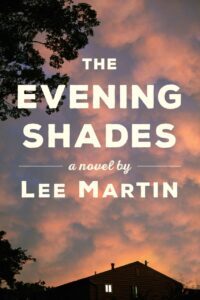
My new novel, The Evening Shades, a companion to my Pulitzer Prize Finalist, The Bright Forever, is part crime novel and part love story set in a small Midwestern town. At the end of The Bright Forever, one of its main characters, Henry Dees, leaves Tower Hill, Indiana, taking with him his secret involvement in a crime. I always wondered where he went and what his life was like. The Evening Shades provides the answer as he rents a room in a stranger’s house in another small Midwestern town. Can love find him in middle age, or will his secret past prevent it? That’s the question at the heart of The Evening Shades, a story of accommodation, resilience, forgiveness, and love in the face of all that threatens the splendor of our ordinary lives.
I tell the stories of the farming communities and small towns of the Midwest because they’re so often overlooked. I tell them because I come from those places, and though it’s been years since I lived there, they’re ingrained in me. I know them better than any place I’ve lived or visited, and I have a special empathy for the people whose voices are often silenced or ignored. I tell these stories because I want to look closely at the complicated lives lived in the Heartland with the hope that readers might know them, too.
The post Bookstores, a New Novel, and the Heartland appeared first on Lee Martin.


November 18, 2024
The Last Time
Cathy and I took advantage of the good weather today to do our outdoor winterization chores. We carried patio chairs to the basement, brought in the umbrella, covered the patio table, and cleaned out flowerpots. It always makes Cathy sad to see an empty patio, knowing as she does, it signals winter is almost here, but it’s a chore that must be done. It always makes me think about the last time we do something, perhaps not even knowing it’s the last time. I didn’t know, for instance, I was seeing my father for the final time one hot July afternoon when I told him not to work too hard just before he got in his car and drove away from me. “I won’t,” he said, and a couple of weeks later he was dead from a heart attack.
How can we use such final times in our work? Of course, if we’re writing creative nonfiction, we can write directly about the last time we saw someone, or the last time we saw a place, or the last time we did something. If we’re writing fiction, we can use the same strategy for the purpose of character development or to push the plot along. We can also use last times as part of a character’s backstory. If a last time haunts them, it becomes part of what they carry with them as they interact with other characters, and it influences the actions they take or don’t take. Last times can help create a causal chain of events in the dramatic present of a narrative.
You might catalog your own last times, or you might catalog last times for your main character, inventing whatever you can to help you better understand that character and the way they move through the narrative you’re writing.
This is the writing prompt for this week. Use a last time to put a character into motion. Maybe it was the last time they saw someone. Maybe it was the time they had to leave a place forever. Maybe it was the last time they spoke to someone. What happened to create tension or regret? What might the character be willing to do about that? Of course, you can apply these questions to your own experience in creative nonfiction. Last times. Go ahead. Write.
The post The Last Time appeared first on Lee Martin.
November 4, 2024
Election Day

I’m five years old, and I’m sitting in the back seat of my father’s Ford sedan, which is a dull brown and dust-covered from driving up and down our township’s gravel roads. We’re parked alongside one of those roads near a country church, its clapboards painted white. Next to the churchyard, there’s a wire fence that separates it from a cornfield, the dry stalks still waiting to be cut. The sun is shining, and there’s an uncommon warmth for early November. It’s Election Day, and the church is a polling place. My mother is inside casting her vote while my father stays with me in the car. Either he’s already gone in and voted, or he’s waiting for my mother to come back so he can take his turn.
An elderly gentleman walks across the churchyard and leans down to talk with my father. What do they talk about? The weather most likely, the crops, the grain prices. It’s 1960, and America is about to elect its first Roman Catholic President, John F. Kennedy. We live in a predominantly Republican county; it remains red to this day. For years, my father will joke that my mother’s Republican vote always canceled out his Democratic one. My mother never said a word. She never revealed her vote.
The elderly gentleman has a gunny sack full of apples, and he asks my father if I can have one. My father says I can, and the man reaches into the sack and pulls out the biggest Golden Delicious apple I’ve ever seen. I hold it with two hands. I wait until the elderly gentleman has gone to take my first bite.
I’ve never forgotten that apple, and the man’s kind voice, and the sweet taste when I bit into the flesh. Each year at election time, I think of it, that apple. I’m afraid there’s not much of a story here—a man talking to my father and offering me an apple—but there’s something pure and innocent about this memory, something lovely. It’s lived with me now for sixty-four years. The white church, the cornfield, the man, and his generous gift of that Golden Delicious apple. Two farmers talking on an Indian Summer day in 1960. Who knows if their politics matched. They were neighbors. They were like all the working people in Lukin Township, just trying to get from one day to the next.
Do with this what you will. As for me, I’ll hold onto the memory of that apple this election season. It was the most marvelous thing, coming as it did from what’s known as a chance seedling, a plant that was the product of unintentional breeding, possibly a hybrid of Grimes Golden and Golden Reinette—two varieties becoming one.
The post Election Day appeared first on Lee Martin.
October 28, 2024
Trick or Treat: Hokey Smoke!

When I was eight years old, my parents and I lived on the second floor of a duplex just off Cicero Avenue in Oak Forest, Illinois. We’d moved there at the end of August in 1963 because my mother had accepted a teaching position in Arbor Part District 145. She taught third grade at the Kimberly Heights Elementary School, and I was in another third-grade classroom directly across the hall. Suburbia was a culture shock for me, coming as I had from a farm downstate and a two-room schoolhouse.
As fortune would have it, the family who lived on the ground floor of the duplex was from a small southeastern Illinois town not far from our farm. The father owned a drug store on Cicero. They had a son in the seventh grade. His name was Bob.
In the country on Halloween, it was the custom to get in a car and drive to the farms of people we knew to trick or treat. I wondered how I’d trick or treat in our new town. The answer came when Bob’s mother said I could go with Bob and a classmate of his. I liked Bob. I was an only child, and he treated me the way I imagined an older brother might, with equal measures of affection and frustration.
My mother agreed that I could go trick or treating with Bob and his friend, and so we went shopping for a costume.
I was a huge fan of The Adventures of Rocky and Bullwinkle, that animated series that kids liked for the antics of Rocket J. Squirrel and Bullwinkle J. I was thrilled when we found a Bullwinkle costume. You remember the kind—hard plastic mask with the string that cut into the sides of your face, and a rayon gown of sorts with arm holes and ties in the back. The mask had antlers. I was set.
On Halloween night, I walked with Bob and his friend to the drugstore where Bob asked his father for some money. On the way out of the store, Bob stole a candy bar. His friend stole one, too. “Go ahead and take one,” Bob said to me, but I couldn’t bring myself to do it. “Suit yourself,” he said with a shrug, and then we were out the door—out into the dark and the chill of late October, out with dozens of other kids hiding behind masks.
I remember nothing else from that night. I don’t remember the houses whose doorbells we surely rang. I don’t remember the candy we got. I just remember a feeling of wanting to go home, to be with the people I loved and who loved me instead of these two boys who were so nonchalant about the candy bars they stole from Bob’s father. At the time, it shocked me, not so much because of the act itself, but more from the way it made me feel—small and alone and sad because I’d always looked up to Bob, and now he’d made it more difficult to do that. I was in a land of strangers where good people could do not-so-good things, and I wasn’t sure what to do with knowing that.
From time to time in The Adventures of Rocky and Bullwinkle, Rocky would say, “Bullwinkle, let’s get out of here,” and Bullwinkle would reply, “Right behind you, Rock.” I’ve never been able to get out of that moment when Bob and his friend stole those candy bars. It haunts me still. I’m guessing you have similar moments from your pasts, moments when innocence ran up against reality. This week of Halloween, I invite you to write about them.
The post Trick or Treat: Hokey Smoke! appeared first on Lee Martin.
October 21, 2024
Everything Felt Different

Here we are in the fall of the year, a time that always takes me back to Sunday afternoons when my father, at ease on his day of rest, suggested we go for a ride in the country. My mother in the front seat and I in the back, he pointed his Delmont 88 down the gravel roads of Lukin Township. Sometimes we went to our farm, the house unoccupied now that we’d moved into town. We might walk out to the woods where hickory trees were dropping their nuts. We’d gather what we wanted in a gunny sack, so we could take them home to crack and shell.
I remember glorious sunny days, the leaves changing color, and the warmth of that in-between time just before the killing frost came. My father, who could be a man of temper, was relaxed on these days, and I, a teenager, was content to ride and listen to him talk about who used to live where on those gravel roads and to tell stories I’d heard before, but I didn’t mind hearing them again because I knew there was goodness in my father at a time when I was discovering the less flattering aspects of my own character.
On one Sunday, I was nursing my first hangover. On a campout the night before, my friends and I had drunk way too much beer, so much that I got sick and then passed out. When I woke the next morning, I was so ashamed of what I’d done, I went straight home and confessed everything. I could see how much I’d hurt my parents—my kind mother who wanted to believe in the best parts of me and my worldly father who knew a thing or two about a thing or two and was always on guard for evidence that I’d taken a wrong turn and was on my way to ruin.
He surprised me with his reaction to the news of my bad behavior. He didn’t shout, as I expected he might. He didn’t take off his belt and whip me, which he’d done before. His voice when he spoke was weary and hollow. “We didn’t raise you to be like that,” he said, and I knew I’d disappointed him, and, of course, that was my punishment, my knowing that.
The Sunday my parents had been expecting was now a different kind of Sunday, but when the afternoon came, and my father said we should go for a ride, I understood that part of what we learn as we age is how to keep putting one foot in front of the other, how to move on beyond disappointment and sadness.
It was another beautiful Sunday, and we were driving through the country, but everything felt different. We were trying to pretend it didn’t, but I knew it in my heart, and I could tell my parents felt it too. We all occupied a different space, one tainted by my actions, but we were trying our best to hold on to what we thought we knew—those gravel roads, those beautiful trees, the sunshine, the grace before the turn toward winter.
When I look back on that time, I feel a great affection for the people we were on that day. We were doing our best to hold onto what I’d come close to ruining—the feeling of being a family. No matter how sullied, we wanted to believe in the best parts of ourselves.
I tell this story to lead us to this writing prompt. It takes so little to upset what we want to believe. In my case, my bad judgment left my parents and me feeling ashamed. If you’re writing fiction, what does a character do to upset the regular come and go of things? How do people go on pretending nothing has changed when, at least for a time, everything has? If you’re writing creative nonfiction, perhaps you have a story of your own that will lead you to an investigation of a relationship that’s been affected by someone’s bad decision. Telling the story, whether factual or invented, always lets us think more deeply about the events and their significance.
The post Everything Felt Different appeared first on Lee Martin.
October 14, 2024
What’s in a Name?: Plenty

Holly Golightly, Holden Caulfield, Jay Gatsby. These are just a few memorable names from American novels. I don’t mean to say the names alone make the novels remarkable, but I would like to suggest names matter when it comes to our characters. A name immediately hints at a particular kind of person. Holden Caulfield? A pretentious name that stands in ironic contrast to the character who is always bemoaning ingenuous people, those phonies that he detests. Jay Gatsby? Perhaps an equally pretentious name that covers over the harsher actual name, Gatz. Holly Golightly? She tries to breeze through Breakfast at Tiffany’s, desperately trying to ignore the truth of her past. Names matter because names start to build characters.
Often, when my wife Cathy and I are on road trips, we take note of those green highway signs that signal the exits that will point you toward a pair of towns, one to the left and one to the right. Sometimes those two towns form a name. Cathy and I take it and run with it, creating a narrative for Oliver Marshall or Maxwell Greenfield. A name suggests a life. Sometimes we writers start to construct the action of that life based on a set of possibilities made possible by the name alone.
Names also carry with them certain sounds. The long “o” sound of Joan, for instance, and the hard “n” at the end. Quite a different sound from, say, Lucy. Imagine a sentence ending with each of those names, and you’ll hear the difference. Syllable count, along with vowel sounds and consonant sounds contribute greatly not only to the rhythm of a sentence but also to the atmosphere it evokes. “I needed to see Lucy.” “I needed to see Joan.” Hear the difference?
So, this is just a quick post to call attention to the fact that naming a character can be as important as any other tool at our disposal when we begin to imagine a world and the people who reside there. Countless times, I’ve had to change a character’s name because the writing has shown me something about that character that I didn’t know when I began. The original name doesn’t work anymore. Or maybe I’ve found myself drafting sentences that just don’t have the sound or the rhythm I want when using the original name. In writing, everything is fluid. Everything, even names, can be changed.
You might want to try the highway sign game sometime. Spot a pair of cites that make up a name. What does the name suggest? What plot do you begin to envision?
The post appeared first on Lee Martin.
October 7, 2024
Adding Texture to Our Narratives: A Writing Prompt

Let’s say you, or one of your characters, is supposed go somewhere, but it turns out, for whatever reason, you or they can’t make the trip. Maybe the travel was only a distance of a few doors down to a neighbor’s house, or maybe it was a short drive to the mall or the grocery store, or maybe it was a long drive or a flight to a distant place. No matter the distance, the truth is the same: you or your character must cancel your trip. Instead, you or your character decide to go somewhere else. What happens in this other place? What significant event occurs, and what does it mean to you or your character? How does it vibrate against the storyline of the canceled trip?
I offer this writing prompt as a way of thinking about how we can add texture to our narratives. Something rubs up against something else—the canceled trip and the one taken instead. The latter affects the former if we pay attention to what it causes our protagonists, whether they happen to be ourselves or characters of our invention, to carry with them as the story of the canceled trip finds its completion.
The famous Robert Frost poem, “The Road Not Taken,” tells the story of a speaker who comes to where “Two roads diverged in a yellow wood.” Unable to take both, the speaker must choose:
Two roads diverged in a wood, and I—
I took the one less traveled by,
And that has made all the difference.
A choice can make all the difference when it comes to a narrative. In our example, a canceled trip leads to a choice made—a road less traveled, perhaps—and the consequences of that choice. If you’re writing creative nonfiction, perhaps you’re recalling a decision you made instead of following another path. If you’re writing fiction, maybe your main character is choosing a path with no way of knowing what lies ahead. Life sneaks up on us sometimes—news comes, or we take hasty actions, and just like that, our lives change forever. I hope this writing prompt takes you deeper into your material by giving it added texture and depth. All writing is thinking on the page, whether its source is factual or invented.
The post Adding Texture to Our Narratives: A Writing Prompt appeared first on Lee Martin.
September 30, 2024
Five Ways We Keep Ourselves from Writing

The time in the semester has come when I’m overwhelmed with reading student work. That’s what I’ve been doing on this rainy day, and now I’m worn out, so I’m going to repost this section from my craft book, Telling Stories:
I was thinking recently of all the ways that we sometimes keep ourselves from writing. Here are but a few:
We wait for inspiration to strike: Sometimes, particularly in the early years of a writing career, we get the idea that our writing is the result of being inspired, and if we just don’t feel inspired, well, then, we just don’t, period, and we wait for that inspiration to come, and we wait, and we wait, and we wait. . . . We need to recognize that when we write, we practice a craft, and the more we practice it, the better we become. It’s not inspiration that we need; it’s time, a quiet place, and effort.
We think we need to do more research: Research is seductive. We fall under its wiles and the next thing we know we aren’t writing. We’re reading. When I’m writing historical fiction or memoir, I tend to gather information and artifacts to the point that I see my characters moving through a very specific world and starting to talk to one another. Then it’s time to write. I know that I’ll go back later and fill in the gaps with more research, but once a storyline launches itself in my mind, it’s time to follow it. We can research the life out of something. We can know so much, there’s nothing left to discover in the writing.
We think we have to be perfect. When you’re writing a first draft, do you spend too much time writing and then rewriting a single sentence, a paragraph? If so, you’re a sentence or a paragraph torturer. I’ve been one in my life. I know that desire to make everything perfect before moving on, but we have to move on. Too much rewriting in a draft closes off spontaneous discovery. Produce pages; torture later.
We give into despair. We listen to the little voices in our heads, and those little voices tell us we’ll never be good enough and that no one cares if we keep writing. That’s true. No matter how much we succeed, we’ll always think we can do better. If we stop writing, the world won’t even notice. The world doesn’t owe us that caring; we owe it to ourselves. So accept the fact that our craft is one in which more often than not we feel as if we’ve fallen short. Don’t give into despair. Use that feeling of wanting to be better to make yourself write more (see #1).
We’re afraid to fail. Those little voices in our heads (damn, those little voices in our heads) tell us we’re bound to fail. Tell those little voices to take note of what Samuel Beckett said: “Ever tried. Ever failed. No matter. Try again. Fail again. Fail better.”
Here’s what I know: We don’t get anywhere by stopping. Whenever I used to tell my father I couldn’t do something, he’d say, “Can’t never did nothing.” True enough. Writers have to write. We have to care enough to keep going. The little voices in our heads have a number of reasons why we shouldn’t. Kill the little voices. Remember what former U.S. Senator and professional basketball player, Bill Bradley, said: “When you are not practicing, remember, someone somewhere is practicing, and when you meet him he will win.”
The post Five Ways We Keep Ourselves from Writing appeared first on Lee Martin.
September 23, 2024
Lost Objects: A Writing Prompt

When I was in the fourth grade, my parents gave me a first baseman glove for my birthday. We lived in Oak Forest, Illinois, a southern suburb of Chicago. One of Chicagoland’s forest preserves, Yankee Woods, stretched out along the edge of the village, and that’s where my parents threw a party for me. My friends and I played baseball. When it came time for us to go home, we couldn’t find my new glove anywhere. I never saw it again. I still wonder what happened to it.
Objects that exist only in our memories can provide subject matter for our writing whether in prose or poetry. So, asking for your forgiveness for the brevity of this post, I invite you to recall an object you treasured that vanished. What was it about that object that you loved? What did your love for it say about your identity, or your life during a certain period? I was fairly new to Oak Forest, having moved there from our farm in southeastern Illinois. What a culture shock. I was eager to gather whatever I could about this new place that would make me fit in. What better metaphor than the large pocket of that glove, made for scooping up the bad hops of errant throws, making it easier for nothing to get by me. It represented, in a sense, a place of safety and confidence at a time when I needed to feel connected to my new home.
The details of our lives, if we look at them closely enough, often tell the stories of our lives. A baseball glove can be much more than that. Use your own lost object to start an essay, a story, or a poem. Think about what the object represented to you. Think about why you can’t forget it even years after it disappeared.
The post Lost Objects: A Writing Prompt appeared first on Lee Martin.
September 16, 2024
Some Thoughts on Beginning a Story
Ernest Hemingway’s story, “A Clean, Well-Lighted Place,” opens like this:
It was very late and everyone had left the café except an old man who sat in the shadow the leaves of the tree made against the electric light. In the daytime
the street was dusty, but at night the dew settled the dust and the old man liked to sit late because he was deaf and now at night it was quiet and he felt the
difference. The two waiters inside the café knew that the old man was a little drunk, and while he was a good client they knew that if he became too drunk he
would leave without paying, so they kept watch on him.
“Last week he tried to commit suicide,” one waiter said.
Notice how gracefully Hemingway drops us into the middle of the action through the use of description: the shadow of the leaves, the electric light, the dew and the dust, the quiet. With relatively few strokes, he paints a vivid picture of this old man while also propelling the narrative forward. The two waiters know the man is a bit drunk, and they keep watch on him, so he won’t leave without paying. Within a few sentences, Hemingway has created a dramatic situation—the overseeing of the old man who just might skip out on his bill. The premise is effective enough, but perhaps not enough to make a story. To do that, we have to know what’s happened just prior to the story’s opening. One of the waiters provides that with his line of dialogue referencing the old man’s suicide attempt. At that point, the stakes rise significantly. We know the despair the old man feels, and suddenly we have a story that’s not so much about whether he’ll pay his bill but more a story about the desire for connection in a seemingly indifferent world. We move from a clear description of the people and the events to a consideration of the heart.
We can accomplish so much if we let our readers know what our main characters are carrying around inside them. The past influences the present and actually becomes a part of what the writer has come to the page to dramatize. In the case of “A Clean, Well-Lighted Place,” the concrete details of the opening sentences begin to work in concert with what we know about the old man.
You might try writing the opening for a story by calling up a few details—maybe a particular time of day, a quality of light, a snowfall, a lighted window, or whatever details appeal to you—and then putting a character in the midst of those details and giving an indication of what’s happened in this character’s life prior to their appearance in the story. See what this approach does to your, and our, understanding of the center of the story you’re going to write as well as the stakes for the characters.
The post Some Thoughts on Beginning a Story appeared first on Lee Martin.