Lee Martin's Blog, page 3
June 30, 2025
Lessons from My Seasoned Friends

This weekend, some former neighbors came to visit. We rounded up the old gang—a group who used to gather on patios and in restaurants just to enjoy one another’s company, which is exactly what we did last night. It was good to be back together with this crowd, to break bread together, to laugh, and, with that laughter, to express our affection for one another. Some friends are in their eighties now, some are in their sixties, and I’m a few months away from entering my seventies. I consider those who are older my guides into my later years.
Here’s what they’re teaching me:
Wit doesn’t have to fade with the advance of time. I’ve rarely laughed harder than I have with this group.
A sense of adventure can persist as well. We can seek out new experiences.
What we live through—the joys and the tragedies—shape us but need not define us.
It’s healthy to look back at the stumbles and miscues of our younger selves with a degree of ironic detachment. We can chuckle at the chucklehead moves we made so long ago.
If we fall on our faces, we can shrug our shoulders and go on. Who cares what others think of us and our stupidity? We are who we are.
Stop worrying about making a good impression. Be who you are without apology.
Remember what it’s like to be afraid, lonely, defeated. Use that knowledge to show compassion to others.
Don’t deny the end is coming. Move toward that end with dignity and grace and acceptance.
Look at each day—each minute shared—as a blessing.
Never lose sight of the people you love. Never forget one of those people is you.
It strikes me that these lessons can apply to the writing we do and the characters and narratives we create. I hope some of the items on my list resonate with you as you consider how to approach not only the way you live your lives, but also the work you do on the page. Here’s the most important lesson I’ve learned from my older friends: Experience doesn’t necessarily make us wise, but it sure doesn’t hurt. We know what we know.
The post Lessons from My Seasoned Friends appeared first on Lee Martin.


June 23, 2025
Ten Thoughts for Writers and Teachers

As I approach my 70th birthday (fewer than four months to go!), I find myself looking back at all the years of teaching and writing with an eye toward what I think I’ve learned. Here’s my list. I pass it along in case some of you might find it useful as you consider your own paths as writers and/or teachers.
Give more than you take.
Never trust your highs and lows. Each will pass in time.
So much of your success, or lack thereof, is out of your hands. All you can control is the work you do.
One person’s opinion doesn’t make a truth.
Say yes more often than you say no.
Protect your time the best you can.
The descent of your career will eventually come. Try to make the fall last as long as it can.
Don’t keep what you’ve learned to yourself. Share it with those who come after you. It might just save them some time.
Never be cruel. What goes around comes around.
Tame the green monster of envy as much as possible. Direct your energy to your work.
The post Ten Thoughts for Writers and Teachers appeared first on Lee Martin.
June 16, 2025
Q and A: Details as Doorways
Cathy and I are back from a book festival in Louisville, Kentucky. We were delighted to catch up with an old friend and to make a new one. During dinner after the festival closed, our new friend asked a question: “What was an odd dessert you made for yourself when you were a kid?” My answer was graham crackers with cake frosting. Just now, I remembered making toast, cheese, and jelly sandwiches. Kids are innovative, you know. Anyway, our new friend’s question soon gave rise to other questions. “What were your least favorite meals in your high school cafeteria?” “Which of your mother’s meals disappointed you?” “What was your favorite breakfast cereal when you were a kid?” “Do you remember the moment you knew what your favorite color was and why?” I love questions like these because often someone’s answer comes with a story. The details take us back into memory and can become a way of accessing material that may be embarrassing or uncomfortable. Our minds trick us into thinking we’re only talking about Sugar Snaps, for instance, when really we’re talking about a year when we missed too much school because we had some sort of separation anxiety, and what the heck was that all about? We must write about the experience to figure out possible answers. Small details like Sugar Snaps can become doorways into the mysteries we long to understand.
So I offer up our questions to those of you who are writing memoir, or even to those of you who write fiction or poetry, in hopes you can use your answers to explore whatever questions they suggest. One question from the seemingly mundane (a favorite breakfast cereal) can suggest another question that lies beneath the surface (my separation anxiety). It’s that second question that demands our attention.
The post Q and A: Details as Doorways appeared first on Lee Martin.
June 9, 2025
Using Questions to Write a Novel
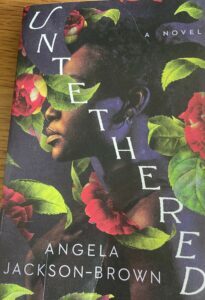 My apologies for being late with this week’s post. I spent the weekend at a writer’s conference with my wife Cathy. I’d taught at this conference the past two years, but this time Cathy was a participant, and I was just along for the ride. I thought I’d take some notes about a new novel I want to write and maybe even flesh out a scene or two, but what I ended up doing was reading a good deal of Angela Jackson-Brown’s novel, Untethered. As I read, I was reminded of an important lesson about novel writing. Sometimes writing a novel is a matter of posing a series of significant questions.
Untethered opens during a problematic situation. Our narrator, Katia, the executive director of the Pike County Group Home for Negro Boys, is concerned about one of her residents, Chad. It appears that the court will return him to his mother even though she’s an addict and has a boyfriend who’s abused Chad in the past. Question number one: What’s going to happen to Chad?
The next troubling situation involves Katia’s twin brothers, Marcus and Aaron, who are missing in action in Vietnam. Question number two: What’s going to happen to the brothers?
Jackson-Brown keeps adding complications. Katia is in a relationship with a man, Leon, whom she considers more of a brother than she does a lover. To complicate that even further, a former high school peer, Seth, appears and becomes a steadying presence in Katia’s life. She feels attracted to him but does her best to keep him at arm’s length since she can’t have a baby, and she feels sure that’s what Seth will want if they ever manage to marry. Question number 3: What’s going to happen with Katia and Leon and Seth?
Untethered opens with these unanswered questions, thereby offering up a structure that depends on the dramatization of each narrative strand. Jackson-Brown does a spectacular job of setting everything in motion by utilizing the strategy of placing characters in unstable situations. We read with interest because we want to know what the resolution will be for each narrative thread the novel includes. Following these threads gives the novel its excellent narrative momentum.
I wanted to share this description of Untethered with you to invite you to think about how to open a novel in an effective way. Give the characters significant situations that demand their attention, complicate each strand (doing so will also complicate your characters in interesting ways), dramatize each strand and delay its resolution until the last third of your book. Let each strand vibrate against the others, so each becomes necessary to the novel’s landing place.
The post Using Questions to Write a Novel appeared first on Lee Martin.
June 2, 2025
The Last Time

‘Tis the season of transition. High school students are graduating and moving on to the next phases of their lives. My MFA students are doing the same. Friends are moving, some of them to distant places. Yesterday, Cathy and I hosted a “See You Later” party for one such friend. It’s a sad occasion for those of us who love him, but it’s a happy one as well because now he and his partner will be in the same place instead of continuing a long-distance relationship.
This all has me thinking of the “see you laters” we say and how sometimes those “laters” never come. I said, “I’ll see you later,” to my father one hot July day in 1982, but I never again saw him alive. I told hm not to work too hard, and then two weeks later his heart gave out while mowing the yard. I’ve said, “I’ll see you later to friends over the years, and for one reason or another, our paths never again crossed. Some of the last times I saw someone still haunt me.
So, let’s make this week’s post short and, I hope, productive. We’ll call this prompt, “The Last Time.” See if you can think of someone and the last time you saw them. Why does that last time stand out in your memory? Was there something about your relationship that was unresolved? Was there something you wish you’d done or said? If you had the chance to see this person again, what would you say? You might even begin a direct address to this person with the words, “I wish. . . .” You can fill in the blank however you like. We often enter our material from a position of regret. This strategy often becomes a useful one in creative nonfiction. For an example, please see Brenda Miller’s flash piece, “Swerve.”
https://brevitymag.com/nonfiction/swerve/
What someone is sorry for or what they regret can also invite us to deepen character and to move plot along in a piece of fiction. What a character regrets can also be a way of fictionalizing our own personal remorse as we pretend it belongs to someone else.
I hope you’ll give this writing strategy a try. Sometimes writers have a tendency to run away from regret. I hope, though, if you face it, either in creative nonfiction or fiction, you’ll be able to fully explore the complicated and contradictory feelings that often accompany our guilt or shame.
The post The Last Time appeared first on Lee Martin.
May 26, 2025
First Notice Everything
 Each year when I see peonies in bloom, I think of what we used to call Decoration Day. Each Memorial Day, my parents and I drove from one country cemetery to another. We brought coffee cans full of peonies and irises. We filled the coffee cans with gravel. We wrapped them with foil paper. I remember the sweet smells and the rush of air through the open car windows, the spray of gravel from the road under our tires, the freshly mowed cemeteries, some of them on hillsides overlooking fields of timothy grass, others alongside country churches. I recall the way my mother stooped to place the coffee cans along the base of the headstones, the way my father read the names and the dates of birth and death the way he did each year when we came, telling again the stories of grandparents and great-grandparents as far back as John A. Martin, my great-great-grandfather, whose monument was in remarkable condition in the Ridgley Cemetery in Lukin Township. I remember paying respect to our dead with these lovely flowers of spring.
I posted a slightly different version of this paragraph on this blog fourteen years ago. Today, I want to use it to think about one of the basic elements of fiction—concrete details. Any fictional world is made of such things as the scent of peonies, the sound of gravel hitting the undercarriage of a car, the way wind makes waves in a field of timothy grass. Miller Williams, in his poem, “Let Me Tell You,” says this:
how to do it from the beginning.
First notice everything:
The stain on the wallpaper
of the vacant house,
the mothball smell of a
Greyhound toilet.
Miss nothing. Memorize it.
You cannot twist the fact you do not know.
So it is when it comes to convincing a reader of a piece of fiction that the world inside it actually exists. You’ll never be able to persuade that reader of any nuances of character, any actions of plot, any truths included in the narrative if you don’t first construct a believable world made up of concrete details.
Flannery O’Connor, in Mystery and Manners, stresses the importance of utilizing sensory details:
The beginning of human knowledge is through the senses, and the fiction writer begins where human perception begins. He appeals through the senses, and you cannot appeal to the senses with abstractions.
She goes on to talk about how writers sometimes are more interested in ideas and abstract thought. They should, instead, she says, direct their attention to “all those concrete details of life that make actual the mystery of our position on earth.” I agree with O’Connor. The writer’s first obligation is to bear witness to the concrete world even if working with science fiction or fantasy. “No ideas but in things,” William Carlos Williams famously wrote. If we can’t tell a reader what people see, hear, smell, taste, feel, we’ll never be able to tell them what goes on inside that character and what it means to our living.
Some beginning writers set their sights on the abstract without letting it come organically from the concrete. O’Connor has this to say about such writers:
The fact is that the materials of the fiction writer are the humblest. Fiction is about everything human and we are made out of dust, and if you scorn getting yourself dusty, then you shouldn’t try to write fiction. It’s not a grand enough job for you.
We shouldn’t hesitate to get down among the particulars of peonies and hot air through a car window on a gravel road. Such concrete details give rise to everything we have to say about the mysteries of human behavior.
The post First Notice Everything appeared first on Lee Martin.
May 19, 2025
Reading Backwards: A Revision Strategy

I have the manuscript of a novel that I’ve been sitting with for a couple of years. I’ve gone through it a couple of times and done small revisions. This year, my teaching consumed me. I didn’t have the time and energy to look at the novel one more time. Now, the school year behind me, I’ve picked it up again, and I’ve started to read it back to front. Which is to say, I’ve broken the book down into its major parts, and I’ve been reading it in reverse sequence. I’ve started at the end to see where the book landed, paying close attention to the main character arcs, and then I’ve asked myself how each preceding section is crucial to the novel’s end. I’ve gone through the entire manuscript this way, and I want to share with you some of my reasons for doing so and some of the discoveries I’ve made in hopes my revision strategy might prove fruitful for you.
I like this strategy because it lets me read the book with fresh eyes. Reading front to back seems too familiar, and I find myself reading with a less than critical perspective. Reading in reverse chronological order makes the book just strange enough so I can really think about how all its parts work, or don’t work, to create a unified whole.
I find myself reading more slowly because it’s impossible to think about what lies ahead when everything lies behind. When I read more slowly, I catch things I’d otherwise miss because, again, reading front to back makes the narrative too familiar to me. I find myself speeding ahead without thinking, sometimes even skimming passages because I’ve read them this way so many times.
When I read back to front, I’m also more aware of the timeline, and, in this case, I’ve already found a few problems with that. I’ve also found parts of the narrative that need to be dramatized earlier in the book. I’ve even found new scenes that need to be written. Finally, I’ve caught some repetitions and redundancies that need to be excised.
The bottom line is this revision strategy allows me to be more open to changes because I’m no longer reading in a first-this-happened-then-this-happened sort of way. Instead, I’m reading with a this-happened-because-this-happened sort of way. The causality of the narrative stands out in bolder relief. If character motivation is thin, I notice it. If the timeline is funky, I catch that, too. If there are gaps to be filled, I’m more aware of what’s missing.
“Nothing is ever so good that it can’t stand a little revision,” says Rebecca Solnit, “and nothing is ever so impossible and broken down that a try at fixing it is out of the question.” We all have our unique revision methods. The best one is the one that works for you. However you decide to approach the work, it’s important to be looking at the manuscript with fresh eyes as if you didn’t write it but are now a reader who must be satisfied. If you feel yourself cringing or mumbling or shaking your head no, ask yourself why. Then set about the work of smoothing out the rough spots to create as perfect of a read as you possibly can.
The post Reading Backwards: A Revision Strategy appeared first on Lee Martin.
May 12, 2025
The Other Mothers
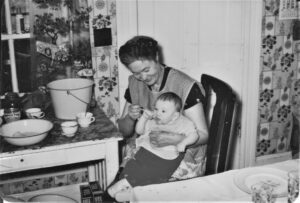 When I was a little boy, I was greedy for my mother’s attention. An only child, I lived with my parents on an eighty-acre farm. When the children at the farm across the fields were otherwise engaged, my mother was my potential playmate. She was a kind and patient woman, but she was burdened by all she had to take on: her teaching, helping my father on our farm, and raising a son when she was forty-five. Needless to say, she didn’t have as much time to give me as she may have wished, but somehow she carved out enough to play catch with me, to hit fly balls, to toss a football. As many of you know, my father couldn’t do these things because of the farming accident that cost him both of his hands.
My mother was everything to me. She loved me, she encouraged me, she consoled me. Although my birth was accidental, I feel confident she was glad I came along. My father was, too, but our relationship was fraught, and this piece isn’t about him. It’s about my mother and all the other mothers I had when I was growing up. Almost everything I am today, I owe to my mother, but there were other women who were there to help me along my way. We never get where we are by ourselves. All sorts of people influence our lives.
So on this Mother’s Day, here’s to my grandmother—my mother’s mother—who cared for me before I was old enough to start school. I spent every Monday through Friday, when my mother was teaching, in my grandmother’s home. She introduced me to buckwheat pancakes, bologna sandwiches with mayonnaise and crumbled up potato chips between two slices of Wonder Bread, and fried hot dogs with cheese melted on them. When I was bad, as I sometimes was (My apologies for pulling up all the lettuce from your garden, Grandma, and for punching a hole through your door screen while pretending to be Mighty Mouse, and for venturing into the closed-off part of the house in winter; in my defense, I couldn’t resist the books in the front bedroom), she introduced me to the business end of her flyswatter. She was sweet and fun, and I loved her.
And here’s to my aunts whose company I loved almost as much as my mother’s. My lovely aunts who must have marveled at my arrival and who tended to me with such affection. In my rebellious teenage years, I hurt them by resisting their company. Still, they were always there to remind me I wasn’t as much of a lost cause as I surely appeared. They, like my mother, refused to abandon me, and gradually I began to believe their faith was just.
A special thanks to my friends’ mothers who welcomed me into their homes, fed me, gave me a place to sleep, celebrated me, and made me feel, if only for a time, that I was a part of their families.
My teachers as well. The women who lauded me, corrected me when I was wrong, and made me feel I could succeed. Those who, during my lost teenage years, took an interest in me, reached out, and did what they could to get me back on the right path. The college professor who took the time to teach me how to write a competent college-level essay, a skill I should have already had, out of the goodness of her heart. She went the extra mile, as did so many others. They all made a difference. I’ve never forgotten them.
And I’ve never forgotten my dear mother. Any shred of compassion I may have—any bit of empathy, any capacity for love—I owe to her. She died when I was thirty-two, so she had little chance to know the man I eventually became. If I could, I’d tell her now, everything good in me came from her. The other mothers were only there to tend what she sowed. If, as Shakespeare said, “all the world’s a stage,” the others were bit players, necessary attendants but never substitutes. My mother—my dear, dear mother—she was the leading lady all along.
The post The Other Mothers appeared first on Lee Martin.
May 5, 2025
National Teacher Appreciation Week: A Message Comes

How appropriate it is that here on the cusp of National Teacher Appreciation Week, I receive a message from one of my mother’s third-grade students from 1967. He writes to say she was his favorite teacher from his elementary school years. He includes a class photo which shows him standing close to her. He’s wearing a scout uniform, and he gives the camera a confident look. She’s the mother I remember with her kind eyes and a slight closed-lip grin. She’s fifty-seven years old in this photo, only two years from her retirement. I remember her remarking how much she missed teaching in the fall when she saw schoolgirls walking past her house, books cradled in their arms. I always imagined she was a very good teacher because she was kind and patient, but it’s good to have my suspicion confirmed by her former student.
My mother started teaching when she was eighteen. At the time, she didn’t need a degree; she only needed to pass a licensing exam. By the time she retired she’d taught forty-one years. I remember the gifts her students gave her at Christmas time: the earrings, the necklaces, the handkerchiefs. I remember her sitting at our kitchen table at night, marking students’ assignments and exams. Often, I’d sit with her, working on my own lessons. I loved the blush of her red marking pencil and the answer key she used to grade multiple-choice exams. Just prior to the start of a new school year—that time of preparation—I’d be with her in her classroom where she’d be working on bulletin board displays and making sure she had textbooks ready for her students.
A quiet school on a warm, late summer day always seemed almost holy to me. The smell of fresh floor wax, a door closing quietly at the end of a long hallway, the desks in their neat rows. It was suitable for my mother, and it would become suitable for me as well. Here I am, having taught for over forty years, all because I inherited my mother’s love of books, and I wanted to share what I knew with other people.
My mother loved children. I took whatever skills I have as a teacher to the university level. When I step into a classroom, I think of my mother who taught me to care about people, to respect them, to show interest in them, and to treat them as individuals. At her funeral in 1988, several of her former students appeared, and they all told me how much they loved her. These days, whenever I’m back in southeastern Illinois to do an event for a new book, one or two of her former students are there to tell me the same.
And now this message from her student from 1967, telling me my mother had an impact on him. I love knowing that whatever she did in her time with him in the classroom mattered. What more could any teacher want to hear? So often, teachers labor in obscurity. I’m sure my mother wasn’t a dynamic teacher. She wasn’t particularly flashy or memorable with her methods of instruction. Her gift was her compassion, her gentle nature, her kindness, and I’m so glad to know that this one student, among others, remembers that.
The post National Teacher Appreciation Week: A Message Comes appeared first on Lee Martin.
April 21, 2025
Wild Mushrooms, Wild Minds

On this Easter Sunday, the day Christ is supposed to have risen from the dead, I receive a text from my cousin who says one of her best childhood Easter memories is hunting for morel mushrooms in my uncle’s woods. Her mother (my aunt) was particularly good at finding the highly valued fungi, so today when my cousin walked the woods behind her house, she found three morels. She says this must surely be a sign from whatever world waits beyond this one, a greeting and an expression of love from my aunt who died about eight or nine years ago. Just now, in what could seem a coincidence, I check the sports news, and the first headline I see is, “Christopher Morel’s Running Grab.” Could it be that a baseball player’s outstanding catch is yet another sign from my aunt’s spirit?
This all makes me think about magic. No matter whether we believe in the resurrection or in communication between the living and the dead, we can’t deny that sometimes the randomness of the world finds a pattern—the miracle of the risen Christ, the symbolism found in a morel mushroom, a name on a screen. Things connect.
What would happen if we took a piece of fiction or nonfiction (or a poem even) that was giving us trouble and decided to add a touch of magic—something out of the ordinary, something just a bit eerie? What would that do to push the piece to a higher level, arousing our curiosity so we can’t help but finish the draft or revise an already completed draft so it resonates? Maybe it’s something found, or something extraordinary, or something so coincidental we must find a way to make it believable. “Magic lies in challenging what seems impossible,” said former United States Senator, Carol Moseley Braun. Isn’t that what we do each time we sit down to write—try to shape the world of our making into something convincing and irrefutable? When the work is going poorly, maybe all we need is a bit of magic to revive what might for a time seem lost to us. We shouldn’t let the limits of our imaginations prohibit us. As Dorothy Parker once said, “Creativity is a wild mind and a disciplined eye.” Sometimes we need to let our wild minds get even wilder. What’s the craziest thing that could happen in the worlds we’re creating on the page? Let it happen. Follow it. No matter how skeptical we might be, don’t we all, somewhere deep down, want to believe that anything is possible, especially the eternal connection to those we’ve loved?
The post Wild Mushrooms, Wild Minds appeared first on Lee Martin.