Lee Martin's Blog, page 5
February 3, 2025
Using Photographs in Memoir: An Illustration
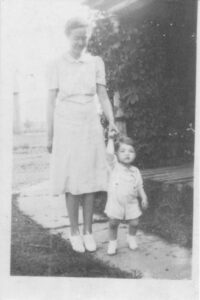 In the photograph, my mother isn’t looking at the camera. Instead, she’s looking down on her nephew, who must be about two at the time. He holds onto her hand. He’s dapper in his playsuit, his chubby legs bare from knees to ankles where his short white socks and his baby shoes anchor him. Still, he clings to my mother’s hand, and he looks directly into the camera, as if to say, “We’re coming.”
Now, both my mother and my cousin have come and gone. This photograph, though, remains, proof that on some long-ago summer day this aunt and nephew occupied a space on this earth. Did he reach for her hand, or did she take his in her own? No matter what the answer might be, here they are, and what I see in this photo is love. My mother might look prim in her white lace-up shoes, her dress with an A-line skirt, a rounded collar, and what appears to be a pin at her throat. Although I can’t see her eyes, I can feel the tender adoration from her as she keeps watch over her nephew.
She’s a single woman at the time, a schoolteacher who helps her parents in their general store in the evenings. I estimate it’s around 1940, and if I’m right, she’s about thirty. She doesn’t know about my father, and how one day, he’ll linger at the store, helping her close up after everyone is gone. She doesn’t know she’ll marry him in 1951, and four years later—surprise!—I’ll come along. I’ve written about the circumstances of my birth elsewhere, so now I want to concentrate on my mother on this day when someone took her photograph while she was with my cousin. I see in her shy smile how much she must have wanted love and how embarrassed she must have been to long for a husband and a child of her own, she who had spent so many years teaching and caring for other women’s children.
How sweet it must feel for my cousin to hold to my mother’s fingers, to trust her to keep him steady, to sense the love from his tenderhearted aunt. I know I’ll look at this photo time and time again just to feel the love emanating from it.
My cousin was a kind man. As a child, I gravitated toward him. I wanted to sit by him at the table when we had family dinners. Once, I left my cap pistol at my aunt and uncle’s house, and when my father drove us back to retrieve it, I found my adult cousin holding it while he watched a western on television. I like to think he was keeping it close because he knew I’d be coming back, or maybe it gave him a chance to remember his own childhood. At the very least, I choose to imagine that toy gun connected us in some way. Now, after his death, I think of the precious, tenuous bonds between family members and how they can persist in the memory of those who survive.
It was a beautiful summer day. The ivy was in full leaf. My mother and my cousin were wearing their Sunday best. They stood still for the photographer, held in time forever, just about to take a step into the rest of their lives.
The post Using Photographs in Memoir: An Illustration appeared first on Lee Martin.


January 27, 2025
Using the Figurative to Deepen the Prose

I love Jill Christman’s essay, “The Sloth,” so much, I’m going to quote it here, as published in Brevity, in its entirety:
There is a nothingness of temperature, a point on the body’s mercury where our blood feels neither hot nor cold. I remember a morning swim on the black sand eastern coast of Costa Rica four months after my twenty-two-year-old fiancé was killed in a car accident. Walking into the water, disembodied by grief, I felt no barriers between my skin, the air, and the water.
Later, standing under a trickle of water in the wooden outdoor shower, I heard a rustle, almost soundless, and looking up, expecting something small, I saw my first three-toed sloth. Mottled and filthy, he hung by his meat-hook claws not five feet above my head in the cecropia tree. He peered down at me, his flattened head turned backwards on his neck. Here is a fact: a sloth cannot regulate the temperature of his blood. He must live near the equator.
I thought I knew slow, but this guy, this guy was slow. The sound I heard was his wiry-haired blond elbow, brushed green with living algae, stirring a leaf as he reached for the next branch. Pressing my wet palms onto the rough wooden walls, I watched the sloth move in the shadows of the canopy. Still reaching. And then still reaching.
What else is this slow? Those famous creatures of slow—the snail, the tortoise—they move faster. Much. This slow seemed impossible, not real, like a trick of my sad head. Dripping and naked in the jungle, I thought, That sloth is as slow as grief. We were numb to the speed of the world. We were one temperature.
I love this essay not only for the gorgeous writing and for what it expresses so gracefully and beautifully, but also for what it teaches us about how easy it is to use the figurative to think more fully about what we’ve come to the page to explore.
The figurative begins with a detail—in this case, the sloth—and then it expands to hold something more abstract within its concreteness. “What else is this slow?” Christman asks, and the answer, of course, is her grief. The figurative—image, simile, metaphor—becomes a way of connecting what’s hard to articulate to something that’s very tangible. It would be difficult for one to describe one’s grief over the loss of a loved one, but it’s easier to see it in something particular.
We should be on the lookout for details in our prose that want to serve our thinking. We might ask ourselves how a detail expresses what we can’t say directly. Given the right context, a sloth is something more than a sloth. It’s a doorway into another level of understanding. It takes the piece and the writer to a more fully realized place.
The post Using the Figurative to Deepen the Prose appeared first on Lee Martin.
January 20, 2025
Believe
 Last night, Cathy and I braved the cold and snow and ice to hear the music of Phil Dirt and the Dozers, a band who plays, as one member says, “songs from the nineteen-hundreds.” In other words, an oldies band that first formed in 1981and has kept going ever since. One member is approaching eighty; another is nearly seventy. You get the idea—a group of professional musicians who love what they do and who intend to do it as long as they can.
The evening was, in a word, sublime. From the first falsetto notes of a Frankie Valli and the Four Seasons medley to the high-octane encore rendition of Mitch Ryder’s covers of Shorty Long’s “Devil with the Blue Dress On” and Little Richard’s “Good Golly, Miss Molly,” the joint, as they say, was jumpin’. Audience members danced the twist between their tables and tossed their hands in the air, as instructed, to the chorus of the Beach Boys standard, “Help Me Rhonda.” This was far from a night of nostalgia, though there was plenty of that. It was above all a celebration of the creative spirit, the force that’s sustained many of us for years. We choose to create something, whether it be music, art, pastries, or poetry or prose. We engage with the world by making things be they furniture pieces, houses, sculptures, inventions, plays, or whatever our talents produce. We sustain ourselves, and we try to sustain the world by what we give those around us. A full, vibrant life demands creation rather than destruction.
I write this on the birthday of Martin Luther King, a man who gave all he had to creating equality and peace. Even though an assassin’s bullet took his life, King’s influence lives on. When it comes to civil rights, there’s so much more work to be done, but what he created carries forth to this day. In his 1963 “Letter from Birmingham Jail,” King says, “We must use time creatively, in the knowledge that the time is always ripe to do right.” The creative spirit, as five men of well-seasoned years proved last night, persists. To make something is to love something, maybe even the world, imperfect as it is. To make something is to insist on the power of creation to take us to a more human place, a place of joy, perhaps, or nostalgia, or understanding, or celebration.
Time runs short the older we get, but last night Cathy and I celebrated the nearly two hours of continuous music Phil Dirt and the Dozers provided. The final song before the encore was Jackie Wilson’s “(Your Love Keeps Lifting Me) Higher and Higher.” This song of thanksgiving, faith, hope, and love was a stirring reminder to keep creating, and as these five men, glorious in all they’d given, soaked up their well-earned applause, I believed, and even today when that other event is taking place in Washington D. C., I still believe.
The post Believe appeared first on Lee Martin.
January 13, 2025
Small Moments of Joy

Here in central Ohio, we’re in the heart of winter. Snow on the ground. Cold temperatures. Fierce winds. Dark longer in the mornings. Gray days. Early nightfalls. It’s enough, at least for me, to invite despair. Especially at night, just before I close my eyes for sleep, I’m prone to wander into what I call the dark corners. I keep telling myself not to go there.
Despite this tendency to vanish into darkness, I’m aware that joy is all around me. The love of a good woman. Our entertaining and loving cats. Close friends. My students who inspire me. Good, long runs. Fabulous meals. Memories. The opportunity to do what I’ve always loved, to teach and write. Plus, sunset is coming a tad later each day. Soon, I tell my night class students, we’ll be leaving our workshop room in daylight, and the temperatures will be warm, and the birds will be singing, and flowers and trees will be in bloom.
As writers, we can sometimes be too unkind to our characters. We bring them nothing but misery and woe. We should also think about what brings them joy. Amy Bloom’s story, “Silver Water,” for instance, features a young woman who is schizophrenic, but she also has the most amazing singing voice. The result is a character who lives on the thin line between torment and beauty, as do her family members as they try their best to help her have a happy life. Without the glorious singing voice, we would have a one-note story (pun intended), a story only about despair. Bloom also gives this character a wickedly funny direct way of speaking that makes her even more irresistible and memorable.
I encourage us all to give our troubled characters the grace of something that makes them beautiful. Let them hold onto the darkness and the light. Make them something other than victims. Make them human. Maybe they’re like me, trying their best to avoid the dark corners by embracing small moments of joy.
The post Small Moments of Joy appeared first on Lee Martin.
January 6, 2025
In Memoriam
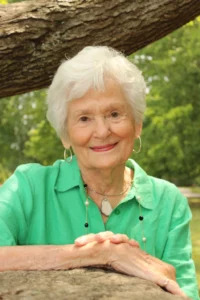 When I met Carter Taylor Seaton, we were in her hometown of Huntington, West Virginia. I’d driven down from Ohio with my wife Cathy because Eliot Parker had invited me to do a reading and an interview with a show on local cable television. He introduced me to Carter, a wiry, white-haired woman who reminded me just a tad of the actress Barbara Billingsley (the mother on the old sitcom, Leave It to Beaver) in her later years. My point is if you sent a request for a grandmother to central casting, Carter would be the one you’d get.
At dinner after the reading, I learned that Carter, who must have been nearing eighty at the time, was a writer, a sculptor, an activist. She’d been an event organizer, a concert promotor, a marathon runner. She’d had, in short, a remarkable life. Over the short time, I knew her, I’d find out exactly how remarkable. If you’d like to find out, too, you can read her recently published memoir, Wednesday’s Child. It would turn out to be her final book. Here’s what I said about it when she asked me to provide a promotional quote:
Carter Taylor Seaton’s memoir, Wednesday’s Child, is a story of the human spirit. Written with a clear eye on the flaws and contradictions of the heart, this book traces a journey from the turmoil of a teenage pregnancy and an early marriage to an embrace of an artistic life. This is much more than a story of survival. It’s a story of making peace with where we are and how to thrive with what we’re given. What a triumph!
When I think of her now, saddened as I am by her death, it’s as if a single star has gone out and left the world just a bit darker. As the pastor at her memorial service yesterday reminded us, Carter’s life was a life shaped by love—a life of triumph indeed. There’s no telling how many lives she touched through her art and her community work.
One of those lives was mine. She promoted my books whenever I published a new one. Having taken over for Eliot Parker, she interviewed me more than once, and she was instrumental in getting me invited to teach at the West Virginia Writers Conference. In return, I offered editorial advice on her memoir when it was in manuscript form, and I wrote promotional quotes for more than one of her books.
The last time I saw her was last summer at the conference at Cedar Lakes in Ripley, West Virginia. She’d been ill with leukemia the previous summer, and it was so good to see her out and about. Her life was one of making connections, of being involved, of doing what she could to help others, of offering love.
So yesterday at the end of her memorial service, as first her family and then her friends exited, they did so to the pianist’s playing of “Take Me Home, Country Roads.” As bits of the lyrics came to me, this is the one that got me: “I hear her voice in the morning hour, she calls me.” The voices of the dead gradually fade from our memories, but the way they made us feel never leaves us. Carter Taylor Seaton loved her life, and in her leaving she reminds us to love ours as well.
The post In Memoriam appeared first on Lee Martin.
December 30, 2024
Using Liminal Spaces to Create Narratives

Here we are at the end of another year, and soon we’ll be beginning a new one. These liminal spaces, where we stand at a threshold, one foot in the present and one in the future, can be fruitful for character exploration in our writing.
Consider a character who buys something new. Maybe it’s a new dress, a new car, a new house, a new whatever. Pair this character with another character with whom some tension is just barely submerged. What characters try to keep hidden often creates the inciting incident for a story.
So, let’s say we open the story with something like this: “On Monday, Jill decided to buy the cocktail dress she’d been admiring for weeks at Saks Off 5th.” Here, we might want to add a description of the dress and the reason Jill thought she deserved it as well as the reason she hesitated to buy it.
Then we write something like this: “The first time she wore it, her mother said, ‘Oh, Jill. That dress is so you.’” Here we have a choice to make involving the subtext of the mother’s dialogue. Is she being genuine, offering Jill a compliment, or is she being snarky, pointing out something about the dress that matches one of Jill’s unflattering personality quirks? Whichever way we decide to go, the important thing is to let what the mother says unsettle Jill. What might Jill do or say in response that would ignite a sequence of narrative events? How will the story affect the mother-daughter relationship forever?
The space between something old and something new can leave our characters with uncertainties. If we let the response to the new establish a degree of tension, we can use it to create a storyline that involves the new object. In Jill’s case, I’m already imagining her wearing the new dress to an event where the mother will be present. If we put them in a place where they have to be together, we can find the narrative that will take us more fully into their relationship.
The post Using Liminal Spaces to Create Narratives appeared first on Lee Martin.
December 23, 2024
Whatever Happened to Fast Starts?

I read a lot of student-written short stories, and these days I’m left to wonder whether opening amid significant action, and with just a touch of mystery, has fallen out of favor. “I was in bed when I heard the gate.” So begins Raymond Carver’s story, “I Could See the Smallest Things.” Tobias Wolff’s “Next Door” begins with, “I wake up afraid.” Ellen Gilchrist’s “The Young Man” opens with, “This is a story about an old lady who ordered a young man from an L. L. Bean catalog.” With openings like these, how can a reader refuse to read on. Who’s coming through the gate? Why is the narrator afraid? Will a young man actually appear from L.L. Bean?
Such openings are leaning forward as a narrative begins, and they’re bringing the readers along for the ride. Openings like these are confident starts. They announce the writer is in control of a narrative that will be significant. They establish trust.
This isn’t to say more leisurely openings won’t work, but from what I’ve been seeing lately they can often be a sign that writers are hemming and hawing as they struggle to find traction for their stories. Slow openings can diminish reader trust. They can also leave the reader on the outside of the story too long. A quick opening makes it impossible for a reader to stay on the sideline.
Short stories rely on compression. They require writers to enter quickly, move steadily, and exit gracefully. Don’t be afraid of action. Embrace mystery. Make yourself curious. Put your main characters into action. Write your way to a climactic moment. Dramatize the consequences.
So, here’s a writing prompt. Put your main character in a public place—a park, a grocery store, a bank—and have them attend to something. Maybe another person catches their eye. Maybe that other person is doing something curious. Or maybe your main character is merely waiting for someone or something. Write an opening sentence that enters the narrative quickly and with some degree of mystery and/or urgency. Here’s the opening of Joan Wickersham’s “Commuter Marriage”: “On the platform at Penn Station, at 6:30 on a Saturday morning, a young woman in a red sweater stood waiting for the Boston train to pull in.” Who’s the woman? Why is she waiting for the train? Will she be getting on it, or will someone be getting off? The important thing is to write a sentence that makes a reader—and maybe even you—want to know more.
The post Whatever Happened to Fast Starts? appeared first on Lee Martin.
December 16, 2024
What to Write When You’re Not Writing

Intrigued by the title of this post? So am I because I have no idea what it means. It came to me as I was thinking about what to write for my weekly blog. This post comes as a very busy semester is winding down for me, and still I have tasks to complete such as writing letters of recommendation or blurbs for other writers’ books or interviews in support of my new novel that’s coming out at the end of March. Add to that a bevy of committee meetings at school. As Calvin and Hobbes would have it—the days are just packed! I don’t mean to whine—after all this is the life I always wanted to have—but it is meant to say we all have times when we’re not able to devote much time to our own writing.
What can we do to keep our momentum flowing? Writing is a generative activity. The more we do it, the more we write, and the more we write, the better we write. This is particularly true for book-length projects such as novels or memoirs. It’s hard for that sort of writing to succeed in bits and pieces. It takes more of a steady pace, producing pages each day.
So, what to do when other things interrupt the writing process? Here are a few thoughts.
Take Notes: Surely, we can find a few minutes each day to jot down a few things in a journal. Maybe notes about interesting people or things we’ve seen. Maybe a mood or a frame of mind that’s with us at a particular time. Maybe a line or two that pops into our heads. Maybe a description or an image. Anything to keep us engaged with the world around us.
Read: Especially poetry. Read a poem each day just to remind us of the music language can make on the page. Or read a section from a favorite novel or memoir, one that touches us in some way and makes us want to respond with writing of our own.
Watch: Revisit the movies that have moved us, anything that keeps our emotional responses alive.
Listen: The same thing that happens when we re-watch movies that have moved us can happen when we listen to music that has a similar effect. For a while now, I’ve liked watching people’s reactions to hearing particular songs for the first time on YouTube. I like the feeling I get when I watch someone deeply immersed, as I’ve been, in a specific song. It reminds me of what art can do for people, and it makes me want to get back to my writing so I can, I hope, do the same for my readers.
The important thing is to stay alive, not only physically, of course, but emotionally as well. Writing must take place on the page, yes, but during those times when you can’t make it to the page, there are these other things you can do to keep your desire for expression alive. One day, you’ll get back to the page, and you’ll want to be ready when you do.
The post What to Write When You’re Not Writing appeared first on Lee Martin.
December 9, 2024
A Beautiful Day

Cathy and I had a wonderful day—a little exercise, a good breakfast, a short road trip, a little shopping. Not a thing went haywire. A little laughter, a little conversation, a little flirting, a little of this, and a little of that. Nothing memorable outside the blessing of our time together. I mention this because I’m the sort who always expects trouble to find him. A perfect day, then, becomes truly remarkable.
We all know that narratives are interesting when they include complications. Trouble comes and people try to get out of it. Sometimes they create the trouble themselves. We writers can become a dour bunch since we’re always looking for that trouble to spur our narratives. We can forget to give our characters grace.
So here’s your prompt. Choose something you’re writing and give the people involved a perfect day amid whatever trouble they’re dealing with. One perfect day, or even a single perfect moment in that day. Let grace fill them. Your readers will relate to your characters even more because we know nothing is ever completely dark or light. Not only that, but you’ll also find yourself more engaged with your characters, perhaps even moved to tears, because you’ll recognize how temporary our beautiful moments can be and how precious they are because they can escape us. As writers and as people, we sometimes miss the glorious moments because we’re too caught up in what troubles us. Blessings are all around us. Let it be so for your characters as well.
The post A Beautiful Day appeared first on Lee Martin.
December 2, 2024
Mirror Characters

In 1964, when I was eight, a high school basketball team from Southern Illinois made it to the championship game of the state tournament. This happened at a time when all the schools in the state, no matter their size, competed for the crown. For tiny Cobden, population 918, to make it all the way to the championship game, the feat was amazing. The school only had 147 students.
My parents and I had moved from a similar tiny place in southeastern Illinois, a little over two hours north of Cobden, to Oak Forest, a southern suburb of Chicago, only a year before. I was still trying to assimilate, still trying to figure out how to transform myself from a country boy to a city boy. I knew the players on that Cobden team, and I knew the town itself, though I’d never been there, because I’d spent my time in similar places across the downstate part of Illinois. I’d gone to basketball games in cracker box gyms. I’d seen the players eating hamburgers and drinking milkshakes. I knew some of them lived on farms, and some of them lived in wood frame houses in these itty-bitty towns that had no stoplights. I knew the smell of their houses on cold winter nights—bacon grease, boiled vegetables, cigarette smoke, and kerosene fumes. I knew the Butch Hair Wax they used on their crew cuts and flattops. I knew the barbershops and cafés and grocery stores and gas stations and pool halls where people talked about the high school teams. I knew because I was a member of that tribe.
In Oak Forest, though, I was an outsider, which explains how I came to be caught up in Cobden’s David and Goliath story. When I saw that team, I saw myself and the place from where I’d come. I saw my story in their story.
I have a vivid memory of that championship game because I wasn’t supposed to watch it on television. I was sick with the three-day measles and the chickenpox, and my doctor told me I couldn’t watch television because, if I did, I might harm my vision. I lay on our couch, and from time to time, I glanced at the television set, hoping Cobden would win. At halftime, I went to sleep. My parents woke me after the game was over, and they told me Cobden had lost to Pekin by five points. I marched off to bed, disappointed.
The story of that Cobden team surfaces from time to time over fifty years later, and each time it does, I recall that night in 1964 when that game was more than a game to the eight-year-old I was—this shy kid who often felt far away from his rightful home and who wanted more than anything to fit into his new city way of life.
We want to see ourselves represented in the world at large. For writers of fiction, this can mean providing our characters with an opportunity to see themselves in other characters. How can we bring a story to a moment when the main character sees something of the self in another character they always assumed was radically different from them? When writing creative nonfiction, the same strategy can apply. Can you recall moments from your life when you were surprised to notice something you shared with a character you always felt distant from?
I wasn’t supposed to watch the television that night in 1964, but I couldn’t resist. Each time I looked, I saw myself, and I saw my family, and I saw the place from where we came, a place to which we’d one day return, and I’d play high school basketball in those small-town gyms, and as the days and years went on, there’d be a feeling of coming home. It’s a feeling that remains to this day. Although I’m a very different person than I was during my high school days, each time I’m back in that part of the world, I’m reminded of who I was, this small-town boy who never leaves me.
The post Mirror Characters appeared first on Lee Martin.