Lee Martin's Blog, page 11
November 6, 2023
The Writer’s Garden

Today, Cathy and I put our garden down for the winter. We harvested our turnips, picked the last of the lettuce, and told our plot we hoped to see it in the spring. It was a good year for the garden. From spring lettuce and radishes, to bush beans and tomatoes and peppers and cucumbers, and on to the cool weather crops, our raised bed certainly has produced well.
Now, it’s time to let it rest. I’ve turned the soil, and it won’t be long before the winter cold will freeze the ground. Snow will come, and the winds will blow, and our thoughts won’t be of the garden at all, at least not until we make the turn to spring, and one fine day we’ll smell the earth thawing, and we’ll know it won’t be long before we’re planting once again. We know that what we hope may not come to be, but that doesn’t stop us because we know with diligence and the right conditions, we might just hit it big.
Such is the case with our writing. Instead of freshly worked soil, we face the blank page, and we begin to make our marks. So much can go wrong, but we should remember that so much can go right. We give our best efforts, and then whatever will be will be. Sometimes we must put a manuscript away, or at worst, let it go altogether. Take heart. There’s always the next thing we want to write, and we turn to it with hope. We must never lose hope.
It’s so easy to surrender to despair. Rejections from editors and agents are the cut worms and bean beetles in the writer’s garden. Those who tell us no are the rain that won’t come and the floods that do. They’re the unrelenting sun and the killing freeze.
Take heart. So much of the publishing process is out of our control. The sad truth is good works go unpublished all the time because of factors that have nothing to do with the writing itself. Just like we can’t change the weather, we have no choice but to accept the vagaries of the publishing industry. All we can do is stick to our work. We can be steady in our habits, forgiving of our shortcomings, grateful for our strengths, clear sighted about our next steps, modest about our successes, and merciful when disappointment comes. The world beats us up enough. There’s no reason for us to join in the pummeling. Nothing to be done but to come back to the page, to do the thing we love, and to do our best to maintain our optimism, knowing someday there may be a bright day. Someday, everything may be in our favor, and we’ll enjoy the fruits (and, yes, the vegetables, too!) of our labor. And if that bright day never comes? We’ll still have the writing process itself, that creative process we’ve always loved. Never let anyone take that love. Hold it, practice it, nurture it, protect it. Never let anyone destroy the pleasure you take from the act of writing. Some may try to destroy that joy, but you’re the only one who can let that happen. You’re the one who gets to say, “No, you can’t have it.”
The post The Writer’s Garden appeared first on Lee Martin.


October 30, 2023
The Body Writes a Narrative
 My wife Cathy has a sore throat. She’s tested negative for COVID, so more than likely she’s just got a little bug that will run its course. Of course, I’m worried that little bug will hop on over to me. The possibility of this happening has me thinking about my own history of maladies.
When I was in the eighth grade, I came down with scarlatina, a more poetic name for scarlet fever. I remember the fevered dreams, the sore throat, the red rash on my body. I must have missed a week or two of school, and, of course, I couldn’t go to basketball practice or play in games. I remember watching one game from the bleachers when I was finally well enough to come back to school but not well enough to play. This all happened toward the end of the season, and, when I was finally allowed to dress for the conference tournament, I was so weak I only got to play a few minutes. My team went on to win that tournament, but I felt like I wasn’t a part of it.
Timing in narrative is everything. Someone arrives at the wrong time. Someone says something at the wrong time. Someone takes a chance at the wrong time. Nothing works out the way we thought it would. The world has other plans.
Illness or injury often creates a good plot premise. The body can create narrative if the writer knows what to ask of a character. The eighth-grade basketball player falls ill just before the big tournament. What happens if he insists on playing before he’s at full strength and ends up costing his team the title? What happens if Cathy’s sore throat comes just as she’s about to make an important speech, or perform in a play, or have the most important conversation of her life? What if laryngitis sets in, rendering her mute and reliant on writing messages? What happens to that important conversation? In her haste to write messages, does she “say” something she never meant to say? Or does she make an error in the writing that leads to a complication?
You get the idea. Whether you’re writing fiction or nonfiction, you can use the body to move a narrative along. The timing is the key. Poor luck, yes, but how your character responds—what action they take—can complicate the narrative while also intensifying the stakes of the story. What will that character’s action cost them? What might it gain? How does a life change because someone either insisted on forging ahead despite illness or injury? Or maybe someone decides to use a malady for insidious purposes or to gain an advantage. The key is to let what’s happening with the body require a choice. That choice creates the plot and sweeps us along the narrative.
The post The Body Writes a Narrative appeared first on Lee Martin.
October 23, 2023
Small Facts

On Friday, my wife Cathy retired after forty-seven years as a healthcare professional, and on Saturday we celebrated with a gathering of friends. It’s a bittersweet time for Cathy. As ready as she is to move on to a new chapter of her life, she’ll admit to a touch of sadness over leaving her work family. It’s also a time of uncertainty as Cathy and I move into this new reality, and that’s what brings me to some observations about storytelling.
Good narratives begin amid instability. We meet our characters at times of their lives when something is uncertain. Maybe there’s a problem to be solved, or maybe someone new has appeared, or maybe an opportunity presents itself. In short, something in our characters’ lives has shifted, and they’re uncertain about what it may mean for their futures.
Think of the times in your life when the reality you’d been living in changed and sent you out into a new world: your first day of school, a move you made, the loss of a loved one, your marriage, the birth of a child, the reappearance of a lost friend, or a number of other possible triggers for stories you want to tell.
Take one of those major shifts and break it down into smaller occurrences. Maybe your first day of school, for instance, takes you to a memory of a haircut, or shopping with your mother for new clothes. Maybe you remember stiff blue jeans, or Buster Brown shoes, or patent leather Mary Janes. Maybe you recall your new school supplies: blunt-tipped scissors, paste jars, a box of Crayola crayons, or a number 2 pencil and the way it smelled after you sharpened it and then used it to stab a girl in the palm of her hand because you were just a kid and you loved her, but you didn’t know how to say that. Okay, that last part is my story. The point is you can access the large shifts in a life by using smaller moments attached to them. Start small and the complicated things will rise organically from the worlds you’re creating with the precise details.
So, there you have it, plain and simple. Tell the stories you have to tell with a small step onto the page: a shopping trip, a haircut, a pencil sharpener. Then shade in the context that makes those details matter: a divorce, a controlling father, an abused child eager for someone to love him. Let the details take you through worlds that are changing for your main characters. Write about the small things, and the big things will follow.
The post Small Facts appeared first on Lee Martin.
October 16, 2023
Begin with the Details: Writing Memoir
 Down a lane off County Line Road in Lukin Township, Lawrence County, Illinois, a pile of rubble, which used to be the farmhouse where I lived with my parents, lies surrounded by briars and weeds. Some years back, one of the giant maple trees I remember from my childhood fell on the house, and it collapsed. Another family owns the eighty acres upon which our house once stood. The place, as it was, now only exists in my memory.
This time of year, autumn, I find myself recalling gathering hickory nuts in our woods where the trees were ablaze with color. I remember the sound of the wind rattling dry leaves on cornstalks, and the way my father worked to pick the corn. We always kept enough ears in our corncrib to feed our hogs. I remember standing in the wagon, pitching ears through the open windows of the crib. I remember a corduroy jacket, and my mother’s headscarf tied beneath her chin. My father wore overalls, faded and patched, the cuffs rolled. When our leaves came down, we raked them onto our barren garden and set them on fire. The piles smoldered past dusk, the embers refusing to go out. We lay down to sleep in our beds in our house on our farm, and just like that the hours rolled on and became days and weeks and months and years, and the tree fell on the house, and the house came down, and the rubble lay there on what had become another family’s land.
In my mind, though, I still hear the squeal of the handpump at our sink as my mother draws water to prepare our breakfast. I hear the scratch of a kitchen match on the stovepipe as she lights the gas burners on the cookstove. I hear the weight of a cast iron skillet. I smell the sizzle of the lard. I smell the bacon frying. My father comes in from his morning chores, and he carries the scent of the cold air on his clothes. Later, my mother will do a load of laundry on our wash porch. The motor on the wringer washer will chug along. By then, the day will have warmed, and my mother will put the clothes to dry on the clothesline. Late in the afternoon, she’ll set up her ironing board and go to work, a bowl of water handy to dampen the shirts and dresses and handkerchiefs and pillowcases. She’ll dip her hand into the bowl and with a dainty turn of her wrist she’ll sprinkle the clothes, and her hot iron will steam when it touches them. The dark comes on early these days, and we eat our supper under the fluorescent light ring above our table. The oil cloth that covers it shines. And then it’s time for bed again, and we sleep in the heart of the country and rise again to live another day.
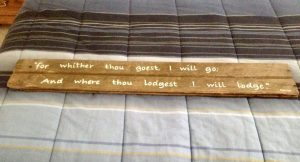
A few years ago, my wife Cathy and I got permission from the new owners to pay the homeplace a visit. We walked the perimeter of what had once been my house, and we just happened to come away with a piece of a door jamb that Cathy turned into a shelf that now hangs in our house and holds old family photos and mementoes. We also took a section of hardwood flooring, upon which Cathy painted an excerpt from one of my favorite Bible verses: “. . .for whither thou goest, I will go; and where thou lodgest, I will lodge. . . .” This is, of course, Ruth, the Moabite, pledging her loyalty to her Israelite mother-in-law, Naomi. This piece of flooring now hangs in the bedroom at Cathy’s and my house. It serves as a reminder of all we promise each other, but it also speaks of the life that went on in a farmhouse that no longer exists in the physical world. Despite that fact, I still carry it with me. What places do you carry with you? What concrete details bring them back to you? What stories can you tell to resurrect them? Who were you when you lived in those places? Who were the people you loved? What troubles did you have? What joys? How glorious and how complicated were your lives? I hope questions like these might lead you to a piece of memoir. Often, when we revisit the past, we come upon what we’ve never been able to let go—the things that haunt us, the things that cause us to question, the speculations we have. Isabel Allende once said, “A memoir forces me to stop and remember carefully. It is an exercise in truth.” Exactly. Begin with the facts—the sound of the handpump, the scratch of a kitchen match, the sizzle of an iron—and let the details take you where you might not even know you need to go.
The post Begin with the Details: Writing Memoir appeared first on Lee Martin.
October 9, 2023
Get Yourself Unstuck

Has this ever happened to you? You’re in the midst of a piece of writing, and you’re trying to maintain your momentum by working on it each day. Then the day comes when you realize you’re stuck. You can’t go on. You sit and stare out the window. You check your email. You get up for that second or third cup of coffee. You play with the cat. You do everything but write. Maybe it’s because you don’t know where to go next with your manuscript, or maybe you just don’t feel like working. Don’t despair. There are things you can do to get yourself and your manuscript back in stride.
You can rewrite a sentence. Often tinkering with a sentence can lead you to tinker with another and another until you find yourself writing new sentences.
You can rewrite dialogue. Take a scene that has dialogue and see if you can use subtext to open up things that you may have not considered. What do your characters talk about to avoid confronting their real issues? How can what they say contain what they really want to say?
You can pressure a character. Our characters always have things they’re trying to keep themselves from doing, or maybe they aren’t even aware of the actions they want to take. Put more pressure on them until they find themselves doing the things they never imagined doing.
You can add description. Find a passage that seems a bit flat or general. What sensory details can you add to more fully immerse you and your readers in that passage? Sometimes our writing grinds to a halt because we’re not fully engaged with its world. Use your senses to make it come alive.
You can read a poem. For prose writers, poetry can often unlock a manuscript. A poem’s language, imagery, or atmosphere can provide a spark of inspiration. Maybe it’s like a call and response. We “hear” the poem, and we want to answer it.
You can work on something else. There’s nothing wrong with laying a piece of writing aside and looking at something else. Maybe you start something new. Maybe you return to another piece that’s been waiting for you. Whatever it takes to keep you in the game.
You can stop. There’s no law that says you have to write. You can take a break from writing altogether. Maybe you need time away to recharge. Remember you’re a person and not a machine. Cast all guilt aside. Pay attention to your life and odds are you’ll eventually return to the writing.
I hope these tips help you with manuscripts that seem to be floundering. Sometimes paying attention to something small like a sentence or a scene can re-engage you and propel your work to its end. Sometimes rest can do the same thing. Whatever your approach, I hope you’ll keep doing the good work.
The post Get Yourself Unstuck appeared first on Lee Martin.
October 2, 2023
Story Starters

Stories begin amid instability. The main character’s world is rocked by something that changes the regular order of things. Sometimes, it’s a character’s own actions that cause the instability; other times, it’s the actions of others that require an action on the part of the main character. Here, then, are some situations that should help you get a story into motion.
A telephone call comes in the middle of the night.
Someone confesses.
Someone arrives.
Someone sets out on a journey.
Someone finds something.
Someone hides something.
Someone tells the truth.
Someone asks a favor.
Someone hurts a loved one.
Someone misinterprets the facts.
Someone buys a gift.
Someone gets a gift.
Someone loses something.
Someone steals something.
Someone suspects someone else.
I could go on and on, but this is enough for now. The key to starting a story is to find the inciting event—the thing that happens that requires your main character to make an active response. Complications ensue, tension rises, characters surprise themselves and others, something submerged in character emerges at the end in a way that’s unexpected but also inevitable.
The post Story Starters appeared first on Lee Martin.
September 25, 2023
Setting and Atmosphere
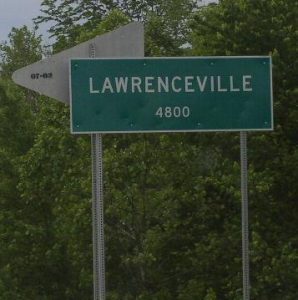 Out here in the small towns of southeastern Illinois—these Podunk farming towns where we’re eager to burst out of our teenage years and into our adult lives—the nights belong to the young. It’s 1974, and I’m eighteen. We’re on the cusp of spring—that awkward time in early March in the Midwest when it can be shirt-sleeve weather one day and cold and snowy the next. Highway 250 runs from my hometown east to Bridgeport and then on to the county seat, Lawrenceville, where my friends and I have come to watch the semi-final games in the regional state high school basketball tournament.
The earth has thawed, and the highway is littered with mud from the tires of farm trucks and oil field trucks that have come from the wet fields and the gravel roads. Soon tractors will sink plows into that ground, and farmers will sow soybeans and corn. The fields of winter wheat are already green. Nights, the lanterns on fishermen’s john boats dot the lake at Red Hills State Park. The flares at oil pumps flicker on the prairies and in the woodlands. The lights on the towers at the Texaco Refinery continue to burn on the southern edge of Lawrenceville. Here in the heartland, as spring nears, we feel a stirring. We’re restless, we’re eager. After winter’s seclusion, we’re ready for something to happen.
I wrote these lines to remember what it felt like to be that age in that place where I was eager for someone to love me. That was the night Cathy and I first began to pay attention to each other. I wrote about the place, and the early spring weather, and the this and the that to immerse myself in memory but also to use setting to link to action. We’re usually very good with the clarity of what happened, but sometimes we neglect the atmosphere or mood that provides a backdrop for the events of our narratives. In other words, we can use the feeling of a particular setting and time period to underscore or create the actions our characters take. It’s really a cause-and-effect relationship. Because we lived in this place at this time, certain events became possible.
So, what are your places? Where have you set your narratives? Choose the details that will create the atmosphere you need to convince your readers that what you claimed happened, really did.
The post Setting and Atmosphere appeared first on Lee Martin.
September 18, 2023
It Is What It Is: Writing Memoir from the Voices of Our Pasts
 My father had a penchant for colorful sayings. “Can’t never did nothing,” he often told me when I complained I couldn’t perform a task. “You’re breeding a scab on your ass,” he said when I misbehaved. “You’re just talking to hear yourself roar,” he said when I got too chatty. And, of course, when I whined because I wanted something, he said, “People in hell wanting ice water, too.” Or, “If ‘if’s’ and ‘but’s’ were candies and nuts, we’d all have a merry Christmas.”
My parents have been gone for several years, and though I’ve tried to retain the sounds of their voices, I’m not quite sure I ever manage to hear them. Each time I get close, their voices fade away. What remains, though, are the things they said. My mother’s exclamation of, “My word!” Or the way she answered the telephone—“Yell-o.” Or drew out the word, well,” at the beginning of a sentence. Because I can remember what my parents said, I can come closer to retaining how they sounded.
Our voices from the past—from parents, grandparents, aunts, uncles, friends, etc.—try desperately to converse with us when we write memoir. When we create them as characters on the page, they begin to talk to us. They are in motion. They move through scenes, ironing pillowcases, singing hymns, driving tractors, reading newspapers. We smell their Secret deodorant, their Butch hair crème, their scent of wheat chaff or sweat or fuel oil. We hear the sounds they make—the creaking of bedsprings, the banging of a spatula on the rim of a frying pan, the heavy footsteps on porch floors, the loose dentures clacking in their mouths. We hear the things they say. When we begin a memoir, we enter the dream world of our memories. We have to use our senses to pay attention. People come alive though the sights, sounds, scents, tastes, etc. Their voices tell us much of what we have to remember—the way my mother used my full name when she wanted me to know how much I’d disappointed her; the way my father could sometimes surprise me with a soft-toned word of encouragement. Through the details, we resurrect the people from our past, including our former selves.
A few years ago, a former schoolmate, upon our reunion, asked me to say to him the thing I always used to say.
“What thing is that?” I asked.
“You know. Every day you’d walk into our geometry class and say, ‘It is what it is, man.’”
I have no memory of ever saying that to him or to anyone else for that matter, but who am I to dispute his memory? If I said it, or if I didn’t, it invites me to see myself for what I may have been at that age—a little cocky, a little bit in love with what I mistakenly considered my worldly cool.
Whose voices do you remember? Spend some time daydreaming. What do you hear people from your past say? Use those voices to lead you to actions, reflections, questions, speculations as you begin the process of dramatizing and interpreting your experiences.
The post It Is What It Is: Writing Memoir from the Voices of Our Pasts appeared first on Lee Martin.
September 11, 2023
Dark Corners: A Writing Prompt
 My wife Cathy and I went to the apple orchard yesterday. The Honeycrisp is my favorite apple, and I welcome its return each autumn. It tells me we’ve made it through another year, but it also tells me time is swiftly passing. The seasons of a single life eventually run out, and those who love us are left to mourn our leaving.
We shouldn’t think we’re anyone special because of this. Eventually, we all leave; eventually, we all mourn. This is one of the dark corners I try to keep myself out of as the days go on. I assume we all have them—the places that trap us with our shame, guilt, and regret. As I age, I have to be more practiced at avoiding them.
My mother was the single most compassionate person I ever knew. This isn’t to say she was a saint. Like all of us, she had her flaws. Despite that fact, she always had an extraordinary optimism. She saw the good in people. She understood how to live kindly. She knew how to love. When I was a teenager, tormented by the sorts of worries I imagine most of us had when we were young—the insecurities, the fears, the doubts—I had trouble sleeping. My mother would sit at the edge of my bed and tell me, with her soft voice, to count my blessings, and she would sit there until I fell asleep. I never thanked her for her consolation and the hope she tried to give me. I never thanked her for always believing in me even during my darkest days.
I wish she could know I remember those nights when she did everything she could to ease my misery. I wish I could tell her about the Honeycrisp apples, and the sounds of insects chirring in the early-autumn dusk, and the way the cool morning air feels when I step outside, and the way the light leaves us earlier and earlier at the end of a day. I would tell her about the dark corners where I come close to losing myself—they usually come at night—but then I hear her voice. “Count your blessings,” she tells me, and I do. My lovely wife Cathy, our orange tabby cat Stella, our friends and family, the blessing of being able to do what I love, the countless students I’ve been fortunate to teach, a life of riches. As I count the blessings one by one, I recall my mother’s weight on the edge of my teenage bed and how with her assurance I let go of my worries and my regrets, and I drifted off to sleep.
Do you have a person you miss? Maybe it’s someone who believed in you, someone who loved you unconditionally. Maybe this person is now gone, or maybe it’s a person who was important to you even though you never met them. What do you wish you’d told them? Write it now. I’d tell my mother thank you. I’d tell her despite my missteps along the way and everything that haunts me, I’m all right. Because of her faith, I’m able to love my life.
The post Dark Corners: A Writing Prompt appeared first on Lee Martin.
September 4, 2023
Until It’s Done: Writers and Work
 (I’m recycling this Labor Day post from two years ago)
On this Labor Day weekend, I’m thinking a good deal about work and what it takes to keep doing it. My father farmed all his life until his heart disease forced him to stop. His second heart attack, the one that killed him, happened when he was mowing the yard on one of the hottest days of the year. My mother taught grade school for thirty-eight years. Many of those years she was also working other jobs. She helped my grandparents by working evenings and weekends in the general store they ran; she worked summers in the local shoe factory; and once she was married to my father, she worked on the farm. She drove grain trucks, greased machinery, milked cows, gathered eggs, fed the hogs. She tended a large vegetable garden. She canned green beans and tomato juice. She put up freezer corn. And there was the house to clean and the countless meals to cook and the clothes to wash and iron and put away.
After she retired from teaching, she worked as a laundress and a housekeeper at a local nursing home. I could go on and tell you about the time she walked a mile through a heavy snow because my father couldn’t get our car out of our driveway, and she had to be at work at five a.m. She didn’t once think about calling to say she was snowbound and wouldn’t be able to be there. She worked in that laundry even though the detergent left her hands raw and rash-eaten. I was a teenager at the time. I had no idea whether we needed the money her job provided or whether she kept working because that’s what she did all her life.
My parents weren’t exceptional. All sorts of fathers and mothers were working hard in our small Midwestern town. Like most teenagers, I whined when I had to work on the farm or in our garden, but somehow I got the message. Work was necessary. Work was my inheritance. Work was my duty. So it came to pass that I did a number of manual labor jobs before I became a teacher. I worked in that same shoe factory where my mother had spent her summers. I worked in a garment factory and a tire repairs manufacturing plant. I worked on a Christmas tree farm. I worked in the hayfields. I detasseled corn. I walked the beans, hoe in hand, cutting weeds. I plowed and disked and harrowed. I gradually learned that the paycheck I received wasn’t nearly as important as what I was learning about the nature of work itself. It asked of me a dedication that would eventually serve me well as a writer. I learned that the job didn’t get done unless I did it. I learned to concentrate on the task at hand, knowing that each thing done brought me closer to completing the work before me. I learned perseverance. I learned how to meet and overcome challenges. I learned the feeling of accomplishment that came to me when I knew I’d taken on and met all that the job required of me.
“It always seems impossible until it’s done,” Nelson Mandela once said. So, I encourage all you writers to keep doing what you’ve been called to do. Be steady and earnest with your habits. Be diligent. Dedicate yourselves to the tasks before you. Everything is possible if you put forth the effort. Keep doing the good work!
The post Until It’s Done: Writers and Work appeared first on Lee Martin.